용액공정을 이용한 다중벽 탄소 나노튜브/폴리스티렌(MWCNT/PS) 복합체 합성 및 열적 거동
텡 다용⋅신영환⋅권영환
†
대구대학교 공과대학 화학공학과
(2008년 5월 25일 접수, 2008년 7월 1일 채택)
-
Synthesis of Multi-Walled Carbon Nanotube/Polystyrene (MWCNT/PS) Composites by Solution Process and Their Thermal Behavior
Dayong Teng, Young Hwan Shin, and Younghwan Kwon
†
Department of Chemical Engineering, Daegu University, Gyeongsan, Gyeongbuk 712-714, Korea
(Received May 25, 2008; accepted July 1, 2008)
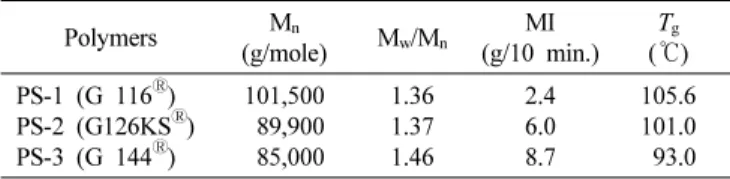
본 연구에서는 다양한 조성의 다중벽 탄소 나노튜브/폴리스티렌 복합체들을 유화제를 이용한 용액공정을 이용하여 제조하 였다. 이때, 분자량이 다른 3종의 폴리스티렌(PS-1 : = 101500 g/mole, PS-2 : = 89900 g/mole, PS-3 : = 85000 g/mole) 을 사용하였다. 복합체에서 매트릭스로 사용된 폴리스티렌의 임계흐름온도(T cf ∼195 ℃) 이상과 이하인 210 ℃ 및
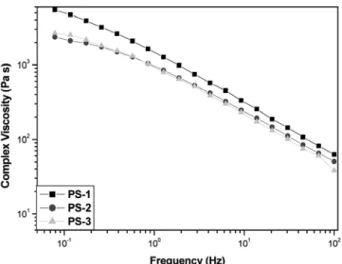
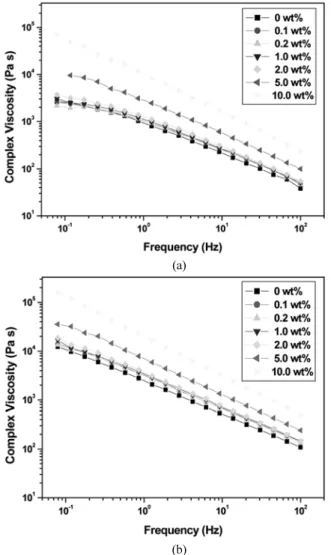
180 ℃에서의 열적 거동을 동적 유변측정기를 이용하여 측정하였다. 복합체의 저장 탄성율, 손실탄성율 및 용융점도는 복합
체내에서 다중벽 탄소 나노튜브 함량이 증가함에 따라 증가하였으며, 용융점도의 경우에는 다중벽 탄소 나노튜브 함량이
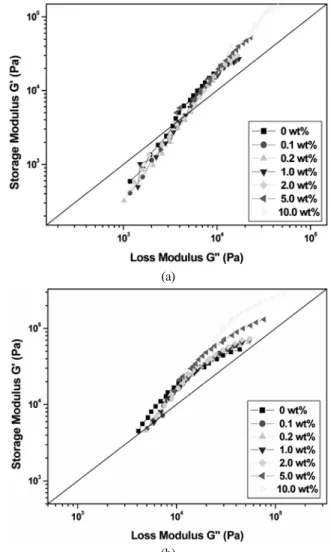
2 wt% 에서 5 wt% 사이에서 가장 큰 증가가 관찰되었다. 210 ℃의 유변특성 거동에 의하면, 특정 다중벽 탄소 나노튜브
함량에서 복합체의 점성 특성이 탄성특성으로 전이되는 현상이 관찰되었으며, 이때 다중벽 탄소 나노튜브 함량은 MWCNT/
PS-1, MWCNT/PS-2 및 MWCNT/PS-3 조성에 대해 각각 3.5 wt%, 3.2 wt 및 3.0 wt%를 나타내었다.
Multi-walled carbon nanotube/polystyrene (MWCNT/PS) composites with various MWCNT contents were prepared by using a solution process with an aid of surfactant. Particularly, PS’s with 3 different molecular weights ( = 101500 g/mole for PS-1, = 89900 g/mole for PS-2, and = 85000 g/mole for PS-3) were used in this study. Thermal behavior of these composites was examined by using an oscillator rheometer at 210 ℃ and 180 ℃, of above and below the critical flow temper- ature ( T cf ∼195 ℃) of PS matrix, respectively. The storage and loss modulus, and the complex viscosity of these composites increased with increasing MWCNT content at both temperatures. Largest increases in the frequency-dependent moduli and complex viscosity were observed between 2 wt% and 5 wt% of MWCNTs at 210 ℃ and 180 ℃. Only the composite at 210 ℃ showed the rheological phase transition from a viscous-dominant to an elastic-dominant behavior of the composites at a certain MWCNT content. The MWCNT content at the rheological phase transition of MWCNT/PS composites generally increased with decreasing molecular weight of PS, and was measured to be 3.5 wt% for MWCNT/PS-1, 3.2 wt% for MWCNT/PS-2, and 3.0 wt% for MWCNT/PS-3 composites.
Keywords: multi-walled carbon nanotube, composite, critical flow temperature, thermal behavior
1. Introduction
1)
Polymer/carbon nanotube (CNT) composites have attracted consid- erable attention due to their unique mechanical, electrical, and thermal properties. CNTs usually have specific interactions with polymer ma- trices resulting from the nano-scale structure and extremely large inter- facial area of CNTs[1-4]. It is well known, however, that CNTs are easy to agglomerate or entangle, limiting the effective utilization of CNTs in polymeric matrices[5]. Salvetat et al.[6] studied the effect of
dispersion of CNTs on mechanical properties of polymer/CNT compo- sites, and found that poor dispersion and rope-like entanglement of CNTs led to drastic deterioration of the composites. Thus, dispersion of CNTs in polymer matrices has been considered to have a predom- inant role on mechanical and other functional properties of poly- mer/CNT composites[7,8].
In order to disperse CNTs into the polymer homogeneously, the en-
tanglement of CNTs inherited from their synthetic process and Van der
Waals force between CNTs should be minimized. Three common
methods to incorporate CNTs into polymeric matrices are solution
process of mixing polymers and CNTs in solvents, in-situ polymer-