• 검색 결과가 없습니다.

Prevalence of mental disorders in Family practice centers in Korea and the utility of diagnostic tool

N/A
N/A
Protected

Academic year: 2021

Share "Prevalence of mental disorders in Family practice centers in Korea and the utility of diagnostic tool"

Copied!
7
0
0

로드 중.... (전체 텍스트 보기)

전체 글

(1)

INTRODUCTION

Mental distress is a common phenomenon among many patients who visit their primary care physicians. However, it

is not well recognized or treated appropriately.

1-3)

Some patients who seem to be in need of mental help do not ask for treat- ment, whereas others who describe psychosocial problems to their primary care physicians are not considered to be in need.

Therefore, many patients in primary care setting continue to suffer from undiagnosed mental disorders.

Over the past 10 years, clinical investigators have focused on enhancing the detection of mental disorders in primary care.

Several diagnostic tools have been developed for use by cli- nicians who are not psychiatrists. However, the time constraints

◇ Original Article ◇

Prevalence of Mental Disorders in Family Practice Centers in Korea and the Utility of a Diagnostic Tool

Department of Family Medicine, University of Ulsan College of Medicine, *Inje University College of Medicine, **Bundang Jesaeng General Hospital, ***Keimyung University College of Medicine, ****Kyung Hee University College of Medicine, *****Pusan National University College of Medicine, ******The Catholic University College of Medicine, *******Sungkyunkwan University School of Medicine, Korea

Young Sik Kim, M.D., Yeong Sook Yoon, M.D.*, Jeong Yeol Oh, M.D.**, Hee Tak Ryu, M.D.**, Dae Hyun Kim, M.D.***, Young Sung Suh, M.D.***, Byung Sung Kim, M.D.****, Yun Jin Kim, M.D.*****, Sang Wook Song, M.D.******, Jungkwon Lee, M.D.*******

ꠏꠏꠏꠏꠏꠏꠏꠏꠏꠏꠏꠏꠏꠏꠏꠏꠏꠏꠏꠏꠏꠏꠏꠏꠏꠏꠏꠏꠏꠏꠏꠏꠏꠏꠏꠏꠏꠏꠏꠏꠏꠏꠏꠏꠏꠏꠏꠏꠏꠏꠏꠏꠏꠏꠏꠏꠏꠏꠏꠏꠏꠏꠏꠏꠏꠏꠏꠏꠏꠏꠏꠏꠏꠏꠏꠏꠏꠏꠏꠏꠏꠏꠏꠏꠏꠏꠏꠏꠏꠏꠏꠏꠏꠏꠏꠏꠏꠏꠏꠏꠏꠏꠏꠏꠏꠏꠏꠏꠏꠏꠏꠏꠏꠏꠏ Background: A considerable portion of patients in primary care are thought to have mental disorders in Korea. But they are not easily noticed and are thus underdiagnosed and approached improperly. This study was done to assess the prevalence of common mental disorders in a hospital-based family practice and to evaluate the utility of a diagnostic tool, the Patient Health Questionnaire (PHQ).

Methods: Ten or more patients each day were systematically selected in family practice clinics for two weeks in a university and a community hospital-based family practice clinics in Seoul, Korea. Routine care was delivered as a control during the first week and the PHQ was administered to patients during the second week and the physicians were allowed to review the PHQ just before making clinical decisions.

Physicians were asked to answer whether they recognized patients' with mental disorders before reviewing the PHQ.

Results: The prevalence of mental disorders was higher in the test group than the control except for eating disorders and other anxiety disorders (P<0.05)(test vs. control group): major depressive disorders 1.75%

vs. 3.8%, other depressive disorders 6.8% vs. 11.4%, panic disorders 0.6% vs. 2.3, somatoform disorders 3% vs. 5%, alcohol abuse 2.2% vs. 8.7%, and any mental disorders 20.9% vs. 29.4%. In the test group, the percentage (95% confidence interval in parenthesis) of newly diagnosed mental disorders after physicians' review of the PHQ were 66% (49∼82) in major depressive disorders, 70% (50∼90) in panic disorders, 70% (56∼83) in somatoform disorders, 84% (75∼92) in alcohol abuse, and 68% (62∼74) in any mental disorders. Patients' response to the PHQ was overall very receptive.

Conclusion: One-week prevalence of common mental disorders in the hospital-based family practice was 29.4% and the PHQ tool was efficient to help the family physicians recognize hidden mental disorders.

ꠏꠏꠏꠏꠏꠏꠏꠏꠏ

Key words: mental disorders, family practice, medical history taking, questionnaires, diagnosis

ꠚꠚꠚꠚꠚꠚꠚꠚꠚꠚꠚꠚꠚꠚꠚꠚꠚꠚꠚꠚꠚꠚꠚꠚꠚꠚꠚꠚꠚꠚꠚꠚꠚꠚꠚꠚꠚꠚꠚꠚꠚꠚꠚꠚꠚꠚꠚꠚꠚꠚꠚꠚꠚꠚꠚꠚꠚꠚꠚꠚꠚꠚꠚꠚꠚꠚꠚꠚꠚꠚꠚꠚꠚꠚꠚꠚꠚꠚꠚꠚꠚꠚꠚꠚꠚꠚꠚꠚꠚꠚꠚꠚꠚꠚꠚꠚꠚꠚꠚꠚꠚꠚꠚꠚꠚꠚꠚꠚꠚꠚꠚꠚꠚꠚꠚꠚꠚꠚꠚꠚꠚꠚ

Received August 9, 2004, Accepted October 31, 2005

Corresponding author: Jungkwon Lee

Tel: 02-3410-2441, Fax: 02-34100388 E-mail: [email protected]

,

,

(2)

of real-world office practice and the often-cumbersome psychia- tric nomenclature have limited their use.

4)

Several self-report questionnaires have been developed that can be used as screen- ing instruments to identify psychopathology in primary care settings and in the community. They detected previously unre- cognized cases and may prove to be valuable tools for psy- chiatric diagnosis in primary care.

5,6)

Our aim was to investigate the prevalence of common mental disorders in the primary care setting in Korea, an area that has not previously very well studied, and also evaluate the utility of a diagnostic tool, the Patient Health Questionnaires (PHQ).

MATERIALS AND METHODS 1. Study subjects

Eighteen family physicians, 13 from 8 university-based hos- pitals and 5 from 3 community-based hospitals, participated in this study. From January to March 2001, ten or more patients each day were selected in 11 family practice clinics during the first week of the study (run-in period) as a control group.

During the run-in period every Nth patient in the clinic’s roll over 18 years of age was included. N was dependent on the volume of patients in each clinic so that the selection process was equally distributed throughout the whole day. These con- trol patients were consulted as usual without administration of PHQ. During the next week (test period), the test group was selected in the same method as the control group each day.

These 10 or more patients in each clinic were asked to fill out PHQ by themselves in a waiting room before consultation. The next patient was approached when the selected patient was illiterate, or had difficulties in communication, or declined to fill out PHQ. The patients already enrolled during the run-in period as a control were excluded from the test group.

2. Screening tool and clinical diagnosis

PHQ is a single, shortened, 3-page, self-administered ques- tionnaire version of Primary Care Evaluation of Mental Dis- orders (PRIME-MD) and is designed to facilitate the recogni- tion and diagnosis of 5 common mental disorders in primary care patients: somatoform, depressive, anxiety, eating and alco- hol disorders. The original version of PRIME-MD is a 2-stage system in which the patient first completes a 26-item self- administered questionnaire that screens for the 5 common dis- orders in primary care.

7)

This has been widely used in clinical

research, but the considerable amount of time was a limiting factor for clinical use in the primary care setting. PHQ was therefore developed to overcome this time barrier and well validated in primary care setting.

8)

We used the translated form of an original English version.

During the test period, physicians were allowed to review PHQ at the final session of consultation just before making clinical decisions. Medical records of both groups were retrieved with a structured form that was filled out by the physicians.

Physicians were asked to answer in this form whether they had diagnosed the patient’s mental disorders before reviewing PHQ or recognized after reviewing it. All the physicians involved in this study were trained for an hour to interpret PHQ as an aid to diagnosing mental disorders. Diagnoses made only by calculated PHQ scores were not allowed and a detailed descrip- tion about definitive diagnosis was explained using the manual developed by the author of PHQ. Since the questionnaire relies on patients’ self-report, the clinician must verify definitive dia- gnoses, taking into account how well the patient understood the questions in the questionnaire, as well as other relevant information from the patient, patient’s family or other sources.

In addition, the diagnoses of major depressive disorder (rather than syndrome) and other depressive disorders require ruling out normal bereavement (mild symptoms, duration less than 2 months), a history of a manic episode (bipolar disorder) and physical disorder, medication or other drugs as the biological cause of the depressive symptoms. Similarly, the diagnoses of panic disorder and other anxiety disorders require ruling out a physical disorder, medication or other drugs as the biological causes of the anxiety symptoms.

3. Statistical analysis

The prevalence of mental disorders was calculated with 95%

confidence interval. Demographic variables were compared with Chi-square test and t-test.

RESULTS

1. Characteristics of study subjects

Initially 1,709 subjects were enrolled in this study, 839 from the control phase and 870 from the test phase. Final analyses were done on 1,683 subjects (829 in the control group and 854 in the test group) because of missing values of initial data.

The average age was higher in the control group (mean age±

SD: 51±13) than in the test group (mean age±SD: 47±13)

(3)

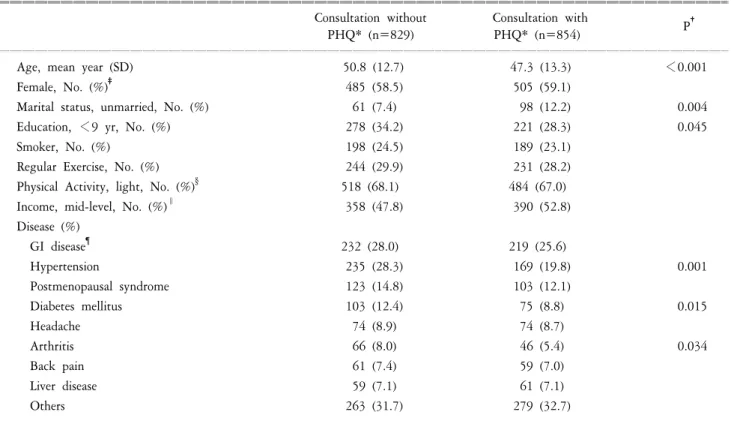
(P<0.001). The male/female ration was the same in both groups, but more unmarried (P=0.004) and higher educated (P=0.05) patients were in the test group. The prevalence of chronic dis- eases such as hypertension (28% vs. 20%, P=0.001), diabetes (12% vs. 9%, P=0.02), and arthritis (8% vs. 5%, P=0.03) was higher in the control group than in the test group (Table 1).

2. One-week prevalence of mental disorders

The one-week prevalence of any mental disorders in family practice was higher in the test group at 29.4% than in the control group at 20.9% (P<0.001). Twenty one percent of the patients with any mental disorders in the control group and 32.3% of those in the test group had more than one mental disorder (Table 2). Except eating disorders and other anxiety disorders, the prevalence of all mental disorders was higher in the test group than in the control group (P<0.05). Compared with the control phase, particularly more depressive disorders

and alcohol abuses were diagnosed during the test phase as follows (control vs. test group): major depressive disorders, 1.7% vs. 3.8%; other depressive disorders, 6.8% vs. 11.4%;

and alcohol abuse, 2.2% vs. 8.7%. Panic disorders were 0.6%

and 2.3%, and somatoform disorders 3% and 5%, in the control and test group, respectively. As noted above, only other anxiety disorders at 9.8% and 8.1%, and eating disorders at 1.7% and 1.8%, respectively, were not significantly higher in the test group.

3. Detection of hidden mental disorders

Besides the increased detection of mental disorders with PHQ, the proportion of newly diagnosed mental disorders re- ported by the physicians who recognized them after reviewing the PHQ information was used as an indicator of usefulness of the PHQ tool. In the test group, the percentage (95%

confidence interval in parentheses) of newly diagnosed mental

Table 1. Demographic characteristics of subject patients.

ꠧꠧꠧꠧꠧꠧꠧꠧꠧꠧꠧꠧꠧꠧꠧꠧꠧꠧꠧꠧꠧꠧꠧꠧꠧꠧꠧꠧꠧꠧꠧꠧꠧꠧꠧꠧꠧꠧꠧꠧꠧꠧꠧꠧꠧꠧꠧꠧꠧꠧꠧꠧꠧꠧꠧꠧꠧꠧꠧꠧꠧꠧꠧꠧꠧꠧꠧꠧꠧꠧꠧꠧꠧꠧꠧꠧꠧꠧꠧꠧꠧꠧꠧꠧꠧꠧꠧꠧꠧꠧꠧꠧꠧꠧꠧꠧꠧꠧꠧꠧꠧꠧꠧꠧꠧꠧꠧꠧꠧꠧꠧꠧꠧꠧꠧ

Consultation without Consultation with

P

PHQ* (n=829) PHQ* (n=854)

ꠏꠏꠏꠏꠏꠏꠏꠏꠏꠏꠏꠏꠏꠏꠏꠏꠏꠏꠏꠏꠏꠏꠏꠏꠏꠏꠏꠏꠏꠏꠏꠏꠏꠏꠏꠏꠏꠏꠏꠏꠏꠏꠏꠏꠏꠏꠏꠏꠏꠏꠏꠏꠏꠏꠏꠏꠏꠏꠏꠏꠏꠏꠏꠏꠏꠏꠏꠏꠏꠏꠏꠏꠏꠏꠏꠏꠏꠏꠏꠏꠏꠏꠏꠏꠏꠏꠏꠏꠏꠏꠏꠏꠏꠏꠏꠏꠏꠏꠏꠏꠏꠏꠏꠏꠏꠏꠏꠏꠏꠏꠏꠏꠏꠏꠏ

Age, mean year (SD) 50.8 (12.7) 47.3 (13.3) <0.001

Female, No. (%)

485 (58.5) 505 (59.1)

Marital status, unmarried, No. (%) 61 (7.4) 98 (12.2) 0.004

Education, <9 yr, No. (%) 278 (34.2) 221 (28.3) 0.045

Smoker, No. (%) 198 (24.5) 189 (23.1)

Regular Exercise, No. (%) 244 (29.9) 231 (28.2)

Physical Activity, light, No. (%)

§

518 (68.1) 484 (67.0)

Income, mid-level, No. (%)

358 (47.8) 390 (52.8)

Disease (%)

GI disease

232 (28.0) 219 (25.6)

Hypertension 235 (28.3) 169 (19.8) 0.001

Postmenopausal syndrome 123 (14.8) 103 (12.1)

Diabetes mellitus 103 (12.4) 75 (8.8) 0.015

Headache 74 (8.9) 74 (8.7)

Arthritis 66 (8.0) 46 (5.4) 0.034

Back pain 61 (7.4) 59 (7.0)

Liver disease 59 (7.1) 61 (7.1)

Others 263 (31.7) 279 (32.7)

ꠏꠏꠏꠏꠏꠏꠏꠏꠏꠏꠏꠏꠏꠏꠏꠏꠏꠏꠏꠏꠏꠏꠏꠏꠏꠏꠏꠏꠏꠏꠏꠏꠏꠏꠏꠏꠏꠏꠏꠏꠏꠏꠏꠏꠏꠏꠏꠏꠏꠏꠏꠏꠏꠏꠏꠏꠏꠏꠏꠏꠏꠏꠏꠏꠏꠏꠏꠏꠏꠏꠏꠏꠏꠏꠏꠏꠏꠏꠏꠏꠏꠏꠏꠏꠏꠏꠏꠏꠏꠏꠏꠏꠏꠏꠏꠏꠏꠏꠏꠏꠏꠏꠏꠏꠏꠏꠏꠏꠏꠏꠏꠏꠏꠏꠏ

*PHQ indicates Patients Health Questionnaire, short and self-administered version of PRIME-MD (Primary Care Evaluation of Mental Disorders).

P values not showed in this column are statistically not significant.

All percent values in this table are calculated subtracting missing data from denominator.

§

Physical activity shown here is only one category among four grades(light, middle, heavy, very heavy).

Income level shown here is only mid-level among three levels.

GI diseases include gastritis, functional GI disease, peptic ulcer disease,

esophagitis, and irritable bowel disease.

(4)

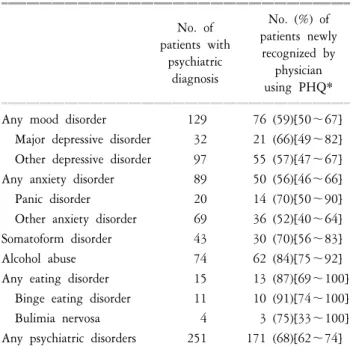
disorders was as follows: major depressive disorders, 66% (49∼

82); other depressive disorders, 57% (47∼67); panic disorders, 70% (50∼90); other anxiety disorders, 52% (40∼64); soma- toform disorders, 70% (56∼83); alcohol abuse 84% (75∼92);

and eating disorders 87% (69∼100). Overall, among 251 pa- tients with any mental disorders 68% (n=171) had not been recognized as having any diagnosis before physician review of PHQ (Table 3).

4. Co-morbidity of mental disorders

We compared co-morbid mental disorders with common physical health problems in the patients enrolled in this study (Table 4). Headache patients had more mood disorders (29.1%

vs. 10.2%), more anxiety disorders (25.7% vs. 8.6%), and more somatoform disorders (12.8% vs. 3.2%) than patients without headache (P=0.001). Patients with functional GI disorders had more mood disorders (15.7% vs. 11.1%), more anxiety disor- ders (19.2% vs. 8.2%), more somatoform disorders (8.7% vs.

3.1%), and more alcohol abuse (9.4% vs. 4.7%) than patients without functional GI disorders (P=0.001). Patients with irritable bowel syndrome had more mood disorders (21.7% vs.

11.5%) and more anxiety disorders (18.3% vs. 9.8%) than patients without irritable bowel syndrome (P=0.03). Back pain patients had more somatoform disorders (8.3% vs. 3.7%) than patients without back pain (P=0.01). Patients with liver diseases had more alcohol abuse (15% vs. 4.7%) than patients without liver diseases (P=0.001).

5. Patients' response to PHQ

Patients’ evaluation of answering PHQ was excellent overall.

Eighty six percent of patients rated the questionnaire positively more than average (5-point Likert scale) in ease of answering, 99.7% in expecting the physician’s greater understanding of themselves with the information in PHQ, and 99.9% in helpfulness for their own problem management. Seventy three percent of patients rated the time taken in filling out PHQ reasonable.

Table 2. Prevalence of psychiatric disorders in family practice.

ꠧꠧꠧꠧꠧꠧꠧꠧꠧꠧꠧꠧꠧꠧꠧꠧꠧꠧꠧꠧꠧꠧꠧꠧꠧꠧꠧꠧꠧꠧꠧꠧꠧꠧꠧꠧꠧꠧꠧꠧꠧꠧꠧꠧꠧꠧꠧꠧꠧꠧꠧꠧꠧꠧꠧ

Consultation Consultation

without with

PHQ* PHQ* P

(N=829) (N=854)

No. (%) No. (%)

ꠏꠏꠏꠏꠏꠏꠏꠏꠏꠏꠏꠏꠏꠏꠏꠏꠏꠏꠏꠏꠏꠏꠏꠏꠏꠏꠏꠏꠏꠏꠏꠏꠏꠏꠏꠏꠏꠏꠏꠏꠏꠏꠏꠏꠏꠏꠏꠏꠏꠏꠏꠏꠏꠏꠏ Any psychiatric disorders 173 (20.9) 251 (29.4) <0.001 No. of diagnoses

1 136 (16.4) 170 (19.9)

2 33 (4.0) 65 (7.6)

3 4 (0.5) 16 (1.9)

Any mood disorder 71 (8.6) 129 (15.1) Major depressive disorder 14 (1.7) 32 (3.8) 0.01 Other depressive disorder 57 (6.8) 97 (11.4) 0.001 Any anxiety disorder 86 (10.4) 89 (10.4)

Panic disorder 5 (0.6) 20 (2.3) 0.003 Other anxiety disorder 81 (9.8) 69 (8.1)

Somatoform disorder 25 (3.0) 43 (5.0) 0.04 Alcohol abuse 18 (2.2) 74 (8.7) 0.001 Any eating disorder 14 (1.7) 15 (1.8)

Binge eating disorder 4 (0.5) 11 (1.3) Bulimia nervosa 10 (1.2) 4 (0.5)

ꠏꠏꠏꠏꠏꠏꠏꠏꠏꠏꠏꠏꠏꠏꠏꠏꠏꠏꠏꠏꠏꠏꠏꠏꠏꠏꠏꠏꠏꠏꠏꠏꠏꠏꠏꠏꠏꠏꠏꠏꠏꠏꠏꠏꠏꠏꠏꠏꠏꠏꠏꠏꠏꠏꠏ

*PHQ indicates Patients Health Questionnaire, short and self-administered version of PRIME-MD (Primary Care Evaluation of Mental Disorders).

P values not shown in this column are statistically not significant.

Table 3. Frequency of psychiatric diagnoses newly recognized by physician using PHQ.

ꠧꠧꠧꠧꠧꠧꠧꠧꠧꠧꠧꠧꠧꠧꠧꠧꠧꠧꠧꠧꠧꠧꠧꠧꠧꠧꠧꠧꠧꠧꠧꠧꠧꠧꠧꠧꠧꠧꠧꠧꠧꠧꠧꠧꠧꠧꠧꠧꠧꠧꠧꠧꠧꠧꠧ

No. (%) of No. of

patients newly patients with

recognized by psychiatric

physician diagnosis

using PHQ*

ꠏꠏꠏꠏꠏꠏꠏꠏꠏꠏꠏꠏꠏꠏꠏꠏꠏꠏꠏꠏꠏꠏꠏꠏꠏꠏꠏꠏꠏꠏꠏꠏꠏꠏꠏꠏꠏꠏꠏꠏꠏꠏꠏꠏꠏꠏꠏꠏꠏꠏꠏꠏꠏꠏꠏ

Any mood disorder 129 76 (59)[50∼67]

Major depressive disorder 32 21 (66)[49∼82]

Other depressive disorder 97 55 (57)[47∼67]

Any anxiety disorder 89 50 (56)[46∼66]

Panic disorder 20 14 (70)[50∼90]

Other anxiety disorder 69 36 (52)[40∼64]

Somatoform disorder 43 30 (70)[56∼83]

Alcohol abuse 74 62 (84)[75∼92]

Any eating disorder 15 13 (87)[69∼100]

Binge eating disorder 11 10 (91)[74∼100]

Bulimia nervosa 4 3 (75)[33∼100]

Any psychiatric disorders 251 171 (68)[62∼74]

ꠏꠏꠏꠏꠏꠏꠏꠏꠏꠏꠏꠏꠏꠏꠏꠏꠏꠏꠏꠏꠏꠏꠏꠏꠏꠏꠏꠏꠏꠏꠏꠏꠏꠏꠏꠏꠏꠏꠏꠏꠏꠏꠏꠏꠏꠏꠏꠏꠏꠏꠏꠏꠏꠏꠏ

*PHQ indicates patients health questionnaire, short and self-

administered version of PRIME-MD (Primary Care Evaluation of

Mental Disorders). Numbers in brackets are 95% confidence

intervals.

(5)

DISCUSSION

This study shows that the one-week prevalence of mental disorders in family practice is much higher than the nationwide lifetime prevalence in Korea.

9)

Lifetime prevalence of depressive disorders and anxiety disorders in 2001 was 4.8% and 9.1%, respectively. However, 15.1% of patients were recognized as having depressive disorders and 10.4% any anxiety disorders in the family practice setting. These findings were very com- patible with those of another study using PRIME-MD that found the prevalence of mood disorders and anxiety disorders 10% to 20% and 9% to 12%, respectively, depending on the patient’s utilization pattern of medical care in a general internal medicine outpatient clinic at an urban, academic medi- cal center.

10)

Another prevalence study using a different tool also showed a similar prevalence rate of mental disorders in the primary care setting.

11)

The prevalence of any mental disorders, 29.4% in our study, is similar with that reported in different parts of the world.

12,13)

This study showed that screening with PHQ had an impact on the increased detection for mood disorders, panic disorder, somatoform disorder and alcohol abuse, but not for other anxi- ety disorders and eating disorders. The increased prevalence of mental disorders after implementation of PHQ screening reflec- ted the increased recognition rate of hidden mental disorders.

Our study clearly highlighted how many mental disorders

could be missed in a busy clinical setting if primary care phy- sicians are not careful in paying attention to patients’ emo- tional symptoms.

The high prevalence of mental disorders should also be assessed from a consideration of whether screening tools cause false positive results. Board-certified family physicians that carefully examined their patients and did not rely solely on PHQ results made final diagnoses, but the accuracy of these diagnoses could not be assessed because our study lacked any gold standard such as a double-check by mental health profes- sionals. The overall sensitivity and specificity of PHQ in any mental disorders are reported to be 75% and 90%, respec- tively.

8)

The predictive value of a positive PHQ for any mental disorders derived from Bayes theorem was calculated to range from 66.6% to 75.4% in our setting, where the prevalence of any mental disorders is between 21% to 29%, depending on the use of PHQ. This figure is acceptable in the primary care setting. One study showed false positive results from screens for mental disorders are not uncommon in primary care pa- tients, but a substantial proportion of these patients with false positive screen results had significantly greater functional im- pairment and higher rates of recent use of mental health ser- vices than the subjects with true negative screen results.

14)

Although we cannot exclude the possibility of incorrect diag- noses in our study, these findings and the acceptable predictive value justify the role of primary care physician who should pay careful clinical attention to those patients who present with Table 4. Comorbidity of common physical health problems and psychiatric disorders.

ꠧꠧꠧꠧꠧꠧꠧꠧꠧꠧꠧꠧꠧꠧꠧꠧꠧꠧꠧꠧꠧꠧꠧꠧꠧꠧꠧꠧꠧꠧꠧꠧꠧꠧꠧꠧꠧꠧꠧꠧꠧꠧꠧꠧꠧꠧꠧꠧꠧꠧꠧꠧꠧꠧꠧꠧꠧꠧꠧꠧꠧꠧꠧꠧꠧꠧꠧꠧꠧꠧꠧꠧꠧꠧꠧꠧꠧꠧꠧꠧꠧꠧꠧꠧꠧꠧꠧꠧꠧꠧꠧꠧꠧꠧꠧꠧꠧꠧꠧꠧꠧꠧꠧꠧꠧꠧꠧꠧꠧꠧꠧꠧꠧꠧꠧ

Physical health problems Prevalence in the patients with or without physical health problem*

ꠏꠏꠏꠏꠏꠏꠏꠏꠏꠏꠏꠏꠏꠏꠏꠏꠏꠏꠏꠏꠏꠏꠏꠏꠏꠏꠏꠏꠏꠏꠏꠏꠏꠏꠏꠏꠏꠏꠏꠏꠏꠏꠏꠏꠏꠏꠏꠏꠏꠏꠏꠏꠏꠏꠏꠏꠏꠏꠏꠏꠏꠏꠏꠏꠏꠏꠏꠏꠏꠏꠏꠏꠏꠏꠏꠏꠏꠏꠏꠏꠏꠏꠏꠏꠏꠏꠏꠏꠏꠏꠏꠏꠏꠏꠏꠏꠏꠏꠏꠏꠏꠏꠏꠏꠏꠏꠏꠏꠏꠏꠏꠏꠏꠏꠏ

With (%) Without (%)

Headache (n=148) Any mood disorder 29.1 10.2

Any anxiety disorder 25.7 8.6

Somatoform disorder 12.8 3.2

Functional GI disorder (n=286) Any mood disorder 15.7 11.1

Any anxiety disorder 19.2 8.2

Somatoform disorder 8.7 3.1

Alcohol abuse 9.4 4.7

Irritable bowel disease (n=60) Any mood disorder 21.7 11.5

Any anxiety disorder 18.3 9.8

Back pain (n=120) Somatoform disorder 8.3 3.7

Liver disease (n=120) Alcohol abuse 15 4.7

ꠏꠏꠏꠏꠏꠏꠏꠏꠏꠏꠏꠏꠏꠏꠏꠏꠏꠏꠏꠏꠏꠏꠏꠏꠏꠏꠏꠏꠏꠏꠏꠏꠏꠏꠏꠏꠏꠏꠏꠏꠏꠏꠏꠏꠏꠏꠏꠏꠏꠏꠏꠏꠏꠏꠏꠏꠏꠏꠏꠏꠏꠏꠏꠏꠏꠏꠏꠏꠏꠏꠏꠏꠏꠏꠏꠏꠏꠏꠏꠏꠏꠏꠏꠏꠏꠏꠏꠏꠏꠏꠏꠏꠏꠏꠏꠏꠏꠏꠏꠏꠏꠏꠏꠏꠏꠏꠏꠏꠏꠏꠏꠏꠏꠏꠏ

*Difference of prevalence between the patients with or without the respective physical health problems is of statistical significance (P<0.05).

(6)

emotional symptoms even though they have false positive results.

Differences in age and other aspects of social background between the test and control groups might have influenced the physicians’ rate of diagnosis of mental disorders. Detection and management of mental morbidity were lower for older indivi- duals

15,16)

and the physicians’ rate of diagnosis of mental disor- ders was lower for men, students, and patients with a at least partial college education than for subjects who had a low income, less than 7 years of school, or were widowed.

17)

But this influence is unlikely to have happened in our study because of the small mean age difference (3.5 years) and the lower educa- tional level in the control group than in the test group. The other bias for the different prevalence rate between the test and control groups may have arisen from the study design. We administered PHQ only to the test group, which may have caused the patients to report their symptoms in a non- comparable manner with the control group (recall bias). Admini- stering PHQ to the control group without giving the informa- tion to the physicians could have prevented this bias. Even if this potential bias had some influence on the physicians’

diagnosis and eventual prevalence rate, mental health screening using a simple tool in the primary care setting should be more emphasized.

The patients’ good response to PHQ encourages the appli- cation of PHQ to all new patients in a busy primary care office, as suggested by original author of PRIME-MD. Participant physicians in this study rated PHQ as a good aid to recognize hidden mental disorders, but were a little reluctant to admini- ster it to all new patients partly due to the review time (average: 2 minutes, range: 30 seconds to 5 minutes) and par- tly due to the belief that patients do not want their primary care physician to assess their mental health. One study showed that more than 60% of patients desired periodic mental health screening, and one third wanted psychiatric assessment only when a problem was suspected.

18)

From the patient’s perspec- tive, it is feasible and acceptable to use self-administered ques- tionnaires for routine screening of psychiatric problems in pri- mary care settings.

19)

The study by Leon AC et al

11)

showed that the prevalence of mental disorders was higher in patients returning for follow-up visits (27.9%) than in those either pre- senting with a new illness (21.7%) or seeking a routine physical examination (11.8%). Thus primary care physicians should be taught to use this kind of screening tool for the early detection of hidden, unrecognized mental disorders whether the patients are new or established.

Our study also showed a high co-morbidity of mental disor- ders in primary care patients with physical symptoms or vice versa. This is a consistent finding with previous studies in Korea, which showed that various common physical illnesses and sym- ptoms are usually accompanied by depression and anxiety.

20-23)

Understanding the role of primary care physicians in the reco- gnition and management of mental disorders among their pa- tients is important in the health care system because of the high prevalence combined with low recognition of mental mor- bidity in primary care settings.

Our study confirmed again that a substantial proportion of patients with mental disorders are seeking medical care in non-psychiatric settings. Further educational programs com- bined with training in psychiatry and efficient screening tools should be implemented for the primary care physicians working in a busy office setting.

REFERENCES

1. Depression Guideline panel. Depression in primary care:

volume 1, Detection and diagnosis. Rockville, Md: US Dept of Health and Human Services, Public Health Service, Agency for Health Care Policy and Research; 1933. Clinical Practice Guideline, No 5. AHCPR publication No. 93-0550.

2. Ormel J, Vonkorff M, Ustun TB, Pini S, Korten A, Oldehinkel T. Common mental disorders and disability across cultures.

Results from the WHO collaborative study on psychological problems in general health care. JAMA 1994;272:1741-8.

3. Coyne JC, Fechner-Bates S, Schwenk TL. Prevalence, nature, and comorbidity of depressive disorders in primary care. Gen Hosp Psychiatry 1994;16:267-76.

4. Schmitz N, Kruse J, Tress W. Improving screening for mental disorders in the primary care setting by combining the GHQ- 12 and SCL-90-R subscales. Compr Psychiatry 2001;42:

166-73.

5. Leon AC, Olfson M, Weissman MM, Portera L, Fireman BH, Blacklow RS, et al. Brief screens for mental disorders in pri- mary care. J Gen Intern Med 1996;11:426-30.

6. Olfson M, Leon AC, Broadhead WE, Weissman MM, Barrett JE, Blacklow RS, et al. The SDDS-PC: a diagnostic aid for multiple mental disorders in primary care. Psychopharmacol Bull 1995;31:415-20.

7. Spitzer RL, Williams JB, Kroenke K, Linzer M, deGuy FV 3rd, Hahn SR, et al. Utility of a new procedure for diagnosing mental disorders in primary care: the PRIME-MD 1000 study.

JAMA 1994;272:1749-56.

8. Spitzer RL, Kroenke K, Williams JB. Validation and utility

of a self-report version of PRIME-MD: the PHQ primary care

(7)

study. Primary care evaluation of mental disorders. Patient Health Questionnaire. JAMA 1999;282:1737-44.

9. Ministry of Health and Welfare. The epidemiological survey of psychiatric illnesses in Korea. 2001 (monograph).

10. Lefevre F, Reifler D, Lee P, Nwadiaro N, Verma S, Yarnold PR. Screening for undetected mental disorders in high utilizers of primary care services. J Gen Intern Med 1999;14:425-31.

11. Leon AC, Olfson M, Broadhead WE, Barrett JE, Blacklow RS, Keller MB, et al. Prevalence of mental disorders in primary care. Implications for screening. Arch Fam Med 1995;4:857- 61.

12. Fink P, Jensen J, Borgquist L, Brevik JI, Dalgard OS, Sanda- ger I, et al. Psychiatric morbidity in primary public health care: a Nordic multicentre investigation. Part I: method and prevalence of psychiatric morbidity. Acta Psychiat Scand 1995;

92:409-18.

13. Hansson L, Nettelbladt P, Borgquist L, Nordstrom G. Screen- ing for psychiatric illness in primary care. A cross-sectional study in a Swedish health district. Soc Psychiatry Psychiatr Epidemiol 1994;29:83-7.

14. Leon AC, Portera L, Olfson M, Weissman MM, Kathol RG, Farber L, et al. False positive results: a challenge for psychi- atric screening in primary care. Am J Psychiatry 1997;154:

1462-4.

15. German PS, Shapiro S, Skinner EA, Von Korff M, Klein LE, Turner RW, et al. Detection and management of mental health problems of older patients by primary care providers.

JAMA 1987;257:489-93.

16. Shapiro S, German PS, Skinner EA, VonKorff M, Turner RW, Klein LE, et al. An experiment to change detection and management of mental morbidity in primary care. Med Care 1987;25:327-39.

17. Hoeper EW, Nycz GR, Kessler LG, Burke JD Jr, Pierce WE.

The usefulness of screening for mental illness. Lancet 1984;

1(8367):33-5.

18. Lish JD, Kuzma MA, Lush DT, Plescia G, Farber NJ, Zimmerman M. Psychiatric screening in primary care: what do patients really want? J Psychosom Res 1997;42:167-75.

19. Zimmerman M, Lush DT, Farber NJ, Hartung J, Plescia G, Kuzma MA, et al. Primary care patients’ reactions to mental health screening. Int J Psychiatry Med 1996;26:431-41.

20. Doh BW, Joh SJ, Choi SY, Oh SW, Kim CH, Yoo TW.

Correlation of depressive trait with symptoms and diseases in primary care. J Kor Acad Fam Med 1996;17:775-83.

21. Chung TH, Suh YS, Lim SY, Kang HC, Bae CY, Shin DH.

Relation of headache with depression and anxiety. J Kor Acad Fam Med 1992;13:436-41.

22. Kim IY, Lim CG, Kim YH, Kim KS, Shin HC, Park ES.

Anxiety and depressive trait in patients with gastrointestinal diseases. J Kor Acad Fam Med 1992;13:916-26.

23. Jeo BS, Lee JY, Choi BH, Lee KY, Park TJ. Comparison of depression, anxiety and stress level between non-ulcer dys- pepsia and control group. J Kor Acad Fam Med 1997;18:

411-23.

수치

Table  1.  Demographic  characteristics  of  subject  patients.
Table  2.  Prevalence  of  psychiatric  disorders  in  family  practice.

참조

관련 문서