Characterization of Physicochemical Properties of Starch in Barley Irradiated with Proton Beam
Sang Kuk Kim*, Shin Young Park**, and Hak Yoon Kim***†
*Division of Crop Breeding, Gyeongsangbuk-do Provincial Agricultural Research and Extension Services, Daegu 702-708, Republic of Korea
**Department of Clinical Pathology, Jeju Halla University, Jeju 690-708, Republic of Korea
***Department of Global Environment, Keimyung University, Daegu 704-701, Republic of Korea
260
†Corresponding author: (Phone) +82-53-580-5918 (E-mail) [email protected]
<Received 25 March, 2013; Accepted 22 July, 2013>
ABSTRACT The study was carried out to determine the gel pasting properties of barley (Hordeum vulgare L. cv.
Geoncheonheugbori) as affected by different proton beam irradiation. The λmax, blue value, and amylose content were significantly associated with increasing proton beam irradiation. The pasting time in barley flour irradiated with proton beam ranged 0.09 to 0.16 min shorter than non- irradiated barley flour. Gel pasting temperature ranged 57.4 to 60.5℃. Gel pasting temperature in barley flour decreased with increasing proton beam irradiation. Proton beam irradiation caused a significant decrease in the onset temperature (To), peak temperature (Tp), conclusion temperature (Tc) and enthalpy change (ΔH). Gelatinization range (R) in barley starch was more broaden than that of non-irradiated barley starch. Barley starches gave the strong diffraction peak at around 2θ values15°, 18°, 20°, and 23° 2θ. Peak intensity tended to increase with increased proton beam irradiation. The granule crystallinity is closely associated with decreased amylose and increased amylopectin component. The crystallinity degree of barley starch irradiated with proton beam was significantly increased and it ranged from 24.9 to 32.9% compared to the non-irradiated barley starches. It might be deduced that proton beam irradiation causes significant changes of properties of starch viscosity in rice, especially at high irradiation of proton beam.
Keywords : barley, Hordeum vulgare, proton beam irradiation, starch properties
Barley
is the world’s fourth most important cereal after wheat, rice, and corn. It is the most widely cultivated but for the most part, it is used for feed and brewing material rather than as foodstuff for human consumption (Bhatty,1993; Mitsunaga et al., 1994).
Irradiation is known to degrade the starch. Numerous studies have been carried out on gamma-irradiated starch.
As a useful method for the production of modified starch, gamma irradiation produces free radicals on starch molecules that can alter their size and structure (Sabularse et al., 1991). Several studies on the effects of ionizing radiation on wheat starch (Lai et al., 1959; Milner, 1961) and barley endosperm (Faust and Massey, 1966) have been conducted.
Gamma irradiation is capable of hydrolyzing chemical bonds, thereby cleaving large molecules of starch into smaller fragments of dextrin that may be either electrically charged or uncharged as free radicals. These changes may affect the physical and rheological properties of irradiated foods, resulting in increased solubility of starch (Deschreider, 1959) and decreased swelling power (Tollier and Guilbot, 1970) and decreased relative viscosity (Vakil et al., 1973) of starch paste. Very often the viscosity of cooked native starch is too high to use in certain applications. Therefore, it should be modified to meet such application.
Modified starch can provide a wide range of functions, from binding to disintegrating, imbibing or inhibiting moisture.
Types of modification that are most often made, sometimes singly, but often in combinations, are crosslinking of polymer chains, non-crosslinking derivatization, pregelatinization and depolymerization (Shelton and Lee, 2000).
This study aimed at elucidating the effect of proton beam irradiation on the physicochemical characteristics of black pigmented barley starch with higher doses in order to find its potential in wide application.
Table 1. Wavelength at maximum absorption (λmax), absorbance at 680 nm (blue value, BV) and amylose content of proton beam irradiated black pigmented barley starches.
Proton beam dose (Gy)
λmax (nm)
Blue value (at 680 nm)
Amylose content (%) 0
50 100 150 200 250 300
599a 598a 573b 564c 555d 546e 539f
0.29a 0.28a 0.23b 0.20c 0.16d 0.13e 0.09f
13.5a 13.4a 12.5b 12.1b 11.5c 11.0c 10.4d Different letters within each column indicate significant differences (P < 0.01). Amylose content was calculated by dry weight basis.
MATERIALS & METHODS
Black pigmented barley (Hordeum vulgare L. cv.
Geoncheonheugbori) seeds were exposed to proton beams accelerated to 45 MeV (LET 1.57 keV/μm) with a dose of 0, 50, 100, 150, 200, 250 and 300 Gy. The LET values of the beam were calculated at the surface of the seeds. After treatment, 20 g of black pigmented barley seeds were ground to pass through a 100-mesh sieve on Ball miller (Model MM-400 Retsch, Verder Co., Germany), and these powders were used for starch isolation.
Barley powder was dispersed in 200 ml 0.05% aqueous NaOH at room temperature for 24 h. After draining off the supernatant and washing with distilled water several times, the grains were wet milled and filtered through a nylon screen (53 µm). The slurry was centrifuged and the top yellow layer was removed. The solid obtained by centrifugation were sequentially purified five times by the toluene-salt solution shaking procedure (McDonald and Stark, 1988).
The clean white layer of isolated rice starch was washed with distilled water and ethanol before drying in a convection oven at 32℃ for 48 h.
The absorption curves of starch and iodine complexes were measured by a UV/VIS spectrophotometer (Model Evolution 300, Thermo Electron Corporation, USA) at 700 to 500 nm. A solution containing 2 mg iodine and 20 mg potassium iodate was added to 1 mg NaOH-gelatinized and HCl-neutralized starch, and made up to 25 ml. The wavelength at maximum absorption (λmax) and blue value (BV), absorbance at 680 nm, were determined (Fujimoto et al., 1972). According to the method of Kainuma (1977), amperometric iodine titration of defatted starch was carried out at 1A and 50 mV.
Barley flours were determined by using a Rapid Visco Analyzer (RVA, Model 4, Newport Scientific, Sydney, Australia). Each sample (flour 3 g, 12% moisture basis) was mixed with 25 ml of deionized water in an RVA sample canister. The idle temperature was set at 50℃, and the following 12.5 min test profile was run: 50℃ held for 1.0 min, the temperature was linearly ramped up to 95℃ until 7.3 min, the temperature was linearly ramped down to 50℃ at 11.1 min and held at 50℃ until 12.5 min.
Thermal properties of barley starch were determined by
using a differential scanning calorimeter (DSC-7, Perkin-Elmer, Norwalk, CT, USA) equipped with an intracooling II system. Starch (3 mg) was accurately weighed to 0.01 mg in a hermetic aluminium DSC pan, mixed with 9 mg of deionized water and sealed and equilibrated at room temperature for at least one hour. The sample was allowed to equilibrate for 1 h and scanned at a rate of 10℃/min over a temperature range of 30-110℃. An empty aluminium pan was used as the reference to balance the heat capacity of the sample pan.
Gelatinization onset (To), peak (Tp) temperature, conclusion (Tc) and enthalpy change (ΔH) were determined. X-ray diffraction patterns of the barley starch were obtained with copper Kα radiation in a diffractometer (D-500, Siemens, Madison, WI). The analysis was conducted by following the procedure of Yoo and Jane (2002).
The collected data were analyzed by using SAS package (version 8.0, SAS Institute Inc., Cary, NC) for Dunkan’s multiple range tests.
RESULTS & DISCUSSION
Gel pasting properties of barley starch was evaluated from barley seeds irradiated with proton beam (Table 1).
The three parameters, λmax, blue value, and amylose content were significantly associated with increasing proton beam irradiation. In particular, amylose content was significantly decreased by higher irradiation. Like a tendency of gamma irradiation (Wu et al., 2002), the decreasing effect of high proton beam irradiation on apparent amylose
Table 2. Pasting properties of black pigmented barley flours.
Proton beam dose (Gy)
Pasting time (min.)
Pasting temp.
(℃)
Viscosity (RVU)
PKV HPV CPV Breakdown Setback
0 50 100 150 200 250 300
4.46 4.37 4.35 4.36 4.35 4.32 4.30
60.6 60.5 61.4 60.5 58.7 57.2 57.4
2,595a 2,443b 2,372c 2,290d 2,204d 2,176e 2,018e
1,977a 1,754b 1,673c 1,584c 1,495d 1,466d 1,301e
1,974 1,884 1,873 1,786 1,735 1,721 1,683
618d 689c 699b 706b 709ab
710a 717a
-621a -559b -499c -504c -469d -455d -335e Different letters within each column indicate significant differences (P < 0.01).
Table 3. Thermal properties of black pigmented barley starches irradiated with different proton beam doses.
Proton beam dose (Gy)
Gelatinization parameters
To (℃) Tp (℃) Tc (℃) ΔH gel (J/g) PHI R
0 50 100 150 200 250 300
54.2a 53.7a 53.1ab
52.5b 50.1b 48.7b 48.5b
58.6a 58.9a 59.4ab
59.9b 61.6c 62.9cd
63.5d
64.3a 64.5a 64.4a 64.7a 65.2ab
64.9a 65.9b
8.3a 8.1a 7.7b 7.4b 7.0c 6.8c 6.9c
1.89a 1.56b 1.22c 1.00c 0.61d 0.48e 0.46f
10.1f 10.8e 11.3e 12.2d 15.1c 16.2b 17.4a Different letters within each column indicate significant differences (P < 0.01).To, onset temperature; Tp, peak temperature; Tc, conclusion temperature; R, gelatinization range (Tc-To); ΔH, enthalpy of gelatinization (based on starch dry weight); PHI, peak height index ΔH gel/(Tp-To).
content was associated with the structure of starch. The results were also in agreements with those reported by Jane et al. (1992) and MacGregor and Fincher (1993).
As we know, starch can be chemically fractionated into two types of distinct glucopyranosyl polymers: amylose, which is the smaller one essentially linear in structure, and amylopectin, which is a very large polymer with extensive branching resulting from (1–6) linkages. In an amylopectin molecule, short glucan chains (chains) are unbranched, but linked to multiple branched B chains, and there is a single reduction end to the C chain glucan (Ball et al., 1996).
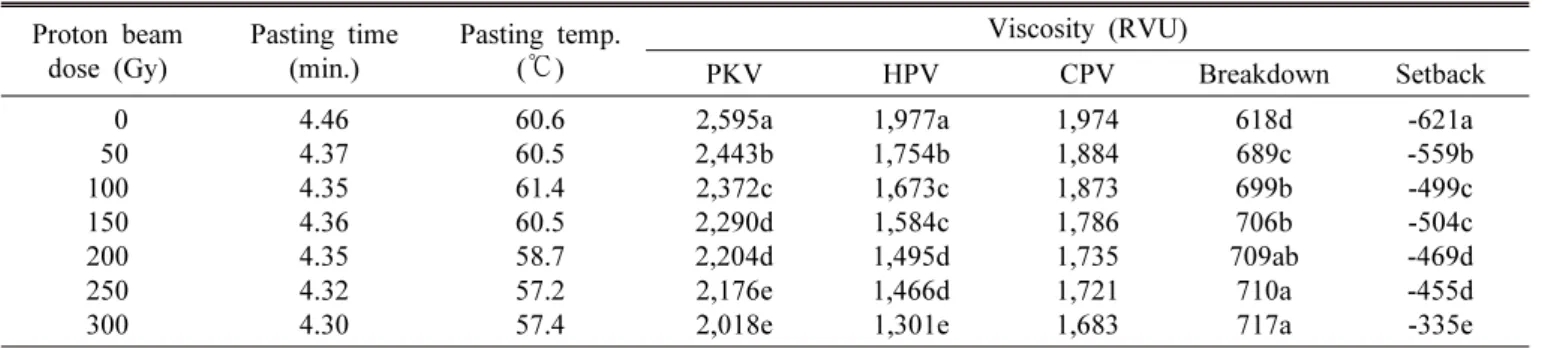
With the analysis of RVA, seven major parameters of barley flour pasting properties, peak viscosity (PKV), hot pasting viscosity (HPV), cool pasting viscosity (CPV), setback (CPV minus PKV), breakdown (PKV minus HPV), pasting time and temperature were significantly decreased with the increasing proton beam irradiation (Table 2).
The pasting time in barley flour irradiated with proton beam ranged 0.09 to 0.16 min shorter than non-irradiated
barley flour. Gel pasting temperature ranged 57.4 to 60.
5℃. Gel pasting temperature in barley flour decreased with increasing proton beam irradiation. These changes in pasting properties were referred to the breakage of starch granules caused by proton beam irradiation (Yu and Yang, 2007).
The peak viscosity, hot peak viscosity, cool peak viscosity and setback were considerably decreased with increasing proton beam irradiation dose. The setback is mainly due to a re-ordering or polymerization of leached amylose and long linear amylopectin (Wu et al., 2002).
It is therefore likely that degradation or shortening of amylose and longer amylopectin branch chains by proton beam irradiation was responsible for the decrease in setback.
The parameter setback viscosity that is often used as an indicator of the firmness of cooked rice, with higher values indicating firmer texture (Bason et al., 1994; Juliano et al., 1990; Shu et al., 1998), was reduced with dose increases.
In our previous studies, change of properties of starch viscosity in rice (Kim et al., 2012) and Chinese yam (Kim
Table 4. X-ray diffraction data of black pigmented barley starches irradiated with proton beam.
Proton beam dose (Gy) Diffraction peaks at 2θ values
15° 17° 18° 20° 23°
0 50 100 150 200 250 300
15.2 14.9 14.9 15.0 15.2 15.1 15.1
17.2 17.1 16.9 17.0 17.1 17.3 17.2
18.1 18.0 18.2 18.1 18.2 17.9 18.2
20.0 20.1 20.2 20.1 20.0 20.0 20.1
23.1 23.1 22.8 23.0 23.1 23.2 23.1 Table 5. Crystal pattern and relative crystallinity at different dose of black pigmented barley.
Proton beam dose (Gy) Relative crystallinity (%) Crystal patterns
0 50 100 150 200 250 300
24.5g 24.9f 26.7e 28.3d 29.3c 32.2b 32.9a
A A A A A A A
Different letters within each column indicate significant differences (P < 0.01). Crystallinity was determined following equation as Xc=Ac/(Ac+Aa); Ac: the crystallized area; Aa: the amorphous area on the X-ray diffractogram.
et al., 2011), it concluded that proton beam treatment like a gamma irradiation caused a significant decrease in starch viscosity. The present study was considerably in agreement with previous results (Kim et al., 2011; Kim et al., 2012).
It was generally accepted that the increase in viscosity that occurs during heating of starch suspension is mainly due to the swelling of the starch granules and breakdown of viscosity was caused by rupture of the swollen granules (Sandhya Rani and Bhattacharya 1995; Vandeputte et al., 2004).
It is also accepted that the swelling degree of starch granules was directly proportion to the average size of starch granules in rice (Vandeputte et al., 2004). It was therefore likely that the observed decrease in peak viscosity, hot pasting viscosity was due to the decreased of size of starch granules caused by proton beam irradiation. The parameters of cool pasting viscosity, setback and peak time must be correlated with the degree of polymerization after RVA processing (Sandhya Rani and Bhattacharya, 1995).
Table 3 shows thermal properties of barley starches as affected by proton beam irradiation. Proton beam irradiation caused a significant decrease in the onset temperature (To),
peak temperature (Tp), conclusion temperature (Tc) and enthalpy change (ΔH). Gelatinization range (R) in barley starch was more broaden than that of non-irradiated barley starch.
The onset temperature (To) of wheat and rice decreased after gamma irradiation (Bao et al., 2005; Ciesla and Eliasson, 2002). Rombo et al. (2004) reported that the onset temperature (To) decreases in maize flour after gamma irradiation. The ΔH was reported to decrease in potato and wheat starches (Ciesla and Eliasson 2002, 2003) and bean flour (Rombo et al., 2004) after gamma irradiation. As DSC thermal properties reflect gelatinization of the crystalline of starch, our results indicate a significant decrease in the crystalline ordering in barley starch after proton beam irradiation.
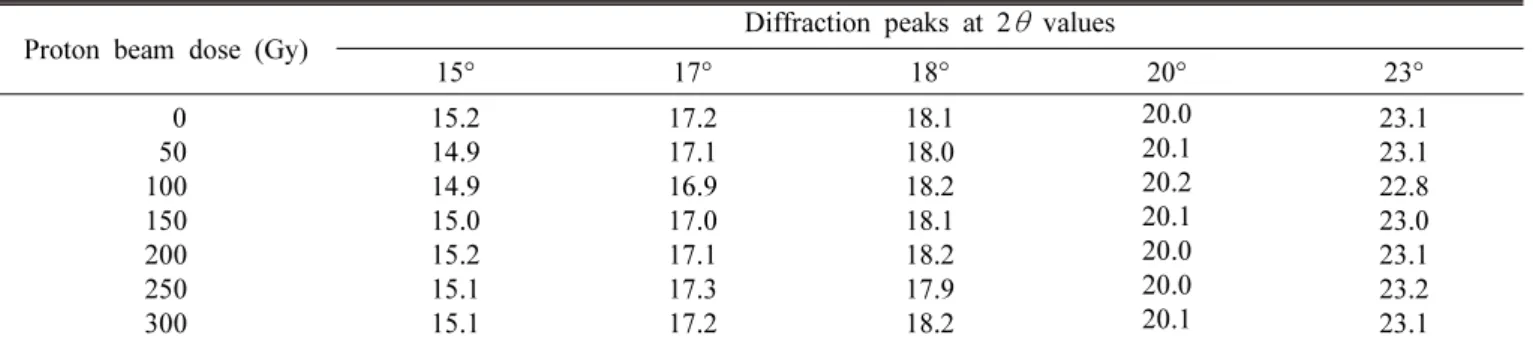
The X-ray diffraction data and degree of crystallinity in barley as affected by proton beam irradiation was shown in Table 4 and Table 5. Barley starches gave the strong diffraction peak at around 2θ values 15°, 18°, 20°, 23° and a small peak at 17° 2θ.
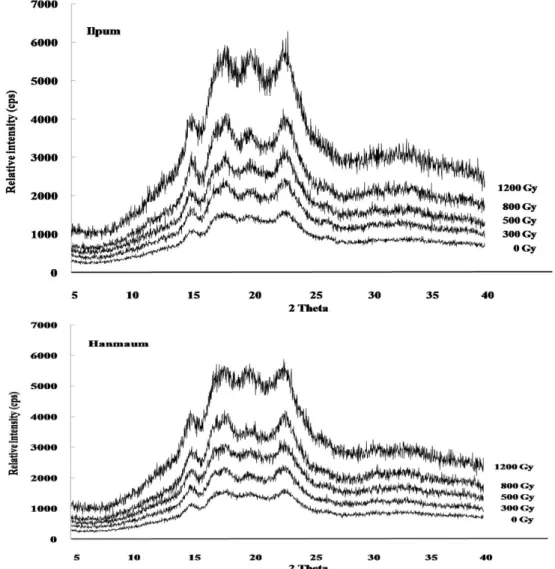
The X-ray diffraction patterns of proton beam irradiated barley starches are shown in Fig. 2. In all of the starches,
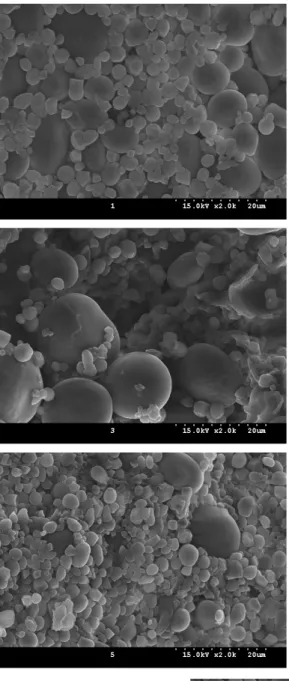
Fig. 1. Scanning electron micrograph of black pigmented barley starch granules irradiated with proton beam (2.0kX). 1:
non-irradiated; 2: 50Gy; 3: 100Gy; 4: 150Gy; 5: 200Gy; 6: 250Gy, 7: 300Gy. The endosperm of barley shows starch granules of various sizes embedded in a protein matrix containing numerous protein bodies.
Fig. 2. X-ray diffraction patterns of two rice varieties as affected by different proton beam irradiation.
major peaks were observed at d-spacing of 5.8, 5.2, 4.8, 4.4 and 3.8 Å are characteristic of an A-type starch crystal that is common to most cereal starches. The d-spacing of 4.4 Å is characteristic of amylose-lipid complex. Furthermore, large starch granules in each fraction had a peak at 4.4 Å.
Peak intensity tended to increase with increased proton beam irradiation. The granule crystallinity is closely associated with decreased amylose and increased amylopectin component.
The crystallinity degree of barley starch irradiated with proton beam was significantly increased and it ranged from 24.9 to 32.9% compared to the non-irradiated barley starches.
It is can be explained possibly that decreased amylose content is attributed to increase their crystallinity under proton beam irradiation.
The changes in size of starch granules represented effect of irradiation on microstructure of barley starch as affected by different proton beam irradiation (Fig. 1). The size of starch granules of non-irradiated barley starch was partially large, and small size granules could be found. With increasing proton beam irradiation, the amount of small size granules was to some extent increased. These changes were due to the free radicals generated by high proton beam irradiation, cleaving large starch molecules like some results (Grant and G’Appolonia, 1991; Sabularse et al., 1991). In conclusion, it might be deduced that proton beam irradiation causes significant changes of properties of starch viscosity in rice, especially at high irradiation of proton beam.
REFERENCES
Ball, S., H. P. M. James, A. Myers, P. Keeling, G. Mouile, A. Buleon, P. Colona, and J. Preiss. 1996. From glycogen to amylopectin: a model for biogenesis of the plant starch granule. Cell 86 : 349-352.
Bhatty, R. S. 1993. Nonmalting uses of barley. Pages 355-417 in: Barley Chemistry and Technology. A. W. MacGregor and R. S. Bhatty, eds. Am. Assoc. Cereal Chem.: St. Paul, MN.
Bason, M. L., A. B. Blakeney, and R.I. Booth. 1994. Assessing rice quality using the RVA-results of an international collaborative trial. RVA World 6 : 2-4.
Cieśla, K. and A. C. Eliasson. 2002. Influence of gamma irradiation on potato starch gelatinization studied by differential scanning calorimetry. Radiat. Phys. Chem. 64 : 137-148.
Cieśla, K. and A. C. Eliasson. 2003. DSC studies of gamma irradiation influence on gelatinization and amylose-lipid complex transition occurring in wheat starch. Radiat. Phys.
Chem. 68 : 933-940.
Deschreider, A. R. 1959. Systematic study of flour treated with gamma rays, 1. Action on polysaccharides. Fermentation 1 : 31.
Faust, M. and L. M. Jr. Massey. 1966. The effect of ionizing radiation on starch breakdown in barley endosperm. Rad.
Research 29 : 33-36.
Fujimoto, S., T. Nagahama, and M. Kanie. 1972. Changes in contents and chain length of amylose of sweet potato starch with development of the granules. Nippon Nogeikagaku Kaishi. 46 : 577-583.
Grant, L. A. and B. L. G’Appolonia. 1991. Effect of low-level gamma irradiation on water-soluable non-starchy polysaccharides isolated from hard red spring wheat flour and bran. Cereal Chem. 68 : 651-660.
Jane, J. and J. F. Chen. 1992. Effect of amylose molecular size and amylopectin branch chain length on paste properties of starch. Cereal Chem. 69 : 60-65.
Juliano, B. O., C. M. Perez, R. Kaushik, and G. S. Khush.
1990. Grain properties of IR36-based starch mutants.
Starch 33 : 157-162.
Kainuma, K. 1977. Handbook of Starch Science, J Nikuni, et al., eds, Asakara, Tokyo, 174-179.
Kim, S. K., H. J. Choi, K. R. Kim, and H. K. Kim. 2011.
Properties of starches in chinese yam, Dioscorea oppsita Thunb. irradiated with proton beam. Korean J. Plant Res.
24(3) : 304-308.
Kim, S. K., S. Y. Park, K. R. Kim, J. H. Shin, S. Y. Kim, H.
K. Kim, and I. J. Lee. 2012. Effect of proton beam irradiation on germination, seedling growth, and pasting properties of starch in rice. J. Crop Sci. Biotech. 15(4) : 305-310.
Lai, S. P., K. F. Finney, M. Milner, and M. 1959. Treatment
of wheat with ionizing radiations, 4. Oxidative, physical and biochemical changes. Cereal Chem. 36 : 401-404.
McDonald, A. M. L. and J. R. Stark. 1988. A critical examination of procedures for the isolation of barley starch. J. Inst.
Brew. 94 : 125–132.
MacGregor, A. W. and G. B. Finche. 1993. Carbohydrate of the barley grain. In AW MacGregor, RS Bhatty (Eds.), Barley chemistry and technology, (pp. 73-130). St. Paul:
American Association of Cereal Chemists.
Milner, M. 1961. Technological effects of gamma irradiation of wheat. In: Proceedings of the Fifth International Congress of Biochemistry, 8, Moscow 1961. Pergamon Press Ltd., p. 108.
Mitsunaga, T., M. Shimizu, K. Inaba, T. Yoshida, and S.
Hayashi. 1994. Polishing and milling of barley grain for wider use in foodstuffs. Bull. Inst. Compr. Agric. Sci.
Kinki Univ. 27 : 55-62.
Rombo, G. O., J. R. N. Taylor, and A. Minnaar. 2004. Irradiation of maize and bean flours: effects on starch physicochemical properties. J. Sci. Food Agric. 84 : 350-356.
Sabularse, V. C., J. A. Liuzzo, R. M. Rao, and R. M. Grodner.
1991. Cooking quality of brown rice as influenced by gamma-irradiation, variety and storage. J. Food Sci. 56 : 96.
Sandhya Rani, M. R. and K. R. Bhattacharya. 1995. Rheology of rice flour pastes : relationship of paste breakdown to rice quality, and a simplified brabender viscograph test. J.
Texture Studies, 26 : 587-598.
Shelton, D. R. and W. J. Lee. 2000. Cereal Carbohydrate. In:
Handbook of Cereal Science and technology. 2nd edition, revised and expanded. Edited by Kulp, K. and Ponte, J.G.
Mercel Dekker, Inc. USA : pp. 385-415.
Shu, Q. Y., D. X. Wu, Y. W. Xia, M. W. Gao, and A.
McClung. 1998. Relationship of rice starch RVA profiles with eating quality. China Agric. Sinica 31 : 25-29.
Tollier, M. T. and A. Guilbot. 1970. Development of certain physicochemical properties of the starch granule as a function of irradiation conditions. Starch/Staerke 22, 296.
Vakil, U. K., M. Aravindakshan, H. Srinivas, P. S. Chauhan, and A. Sreenivasan A. 1973. Nutritional and wholesomeness studies with irradiated foods: India’s program, IAEA, SM-166/12. Vienna, p. 673.
Vandeputte, G. E., J. Derycke, J. Geeroms, and J. A. Delcour.
2003. Rice starches. II. Structural aspects provide insight into swelling and pasting properties. J. Cereal Sci. 38 : 53-59.
References and further reading may be available for this article. To view references and further reading you must purchase this article.
Wu, D., Q. Shu, Z. Wang, Y. Xia. 2002. Effect of gamma irradiation on starch viscosity and physicochemical properties of different rice. Radiat. Physics and Chem. 65 : 79-86.
Yoo, S. H. and J. Jane. 2002. Structural and physical characteristics of waxy and other wheat starches. Carbohydr. Polym. 49 : 297-305.