ORIGINAL ARTICLE
Design and Field Test of Automatic Data Logger System for Portable Magnetometer using Raspberry Pi
Eun-Kyeong Choi, Sung-Wook Kim, Jinwoo Cho
1), Khil-Ha Lee
2)*GI Co. Ltd., Geo-Information Institute, Busan 47598, Korea
1)
Geotechnical Engineering Research Institute, Korea Institute of Civil Engineering and Building Technology, Goyang 10223, Korea
2)
Department of Civil Engineering, Daegu University, Gyeongsan 38453, Korea
Abstract
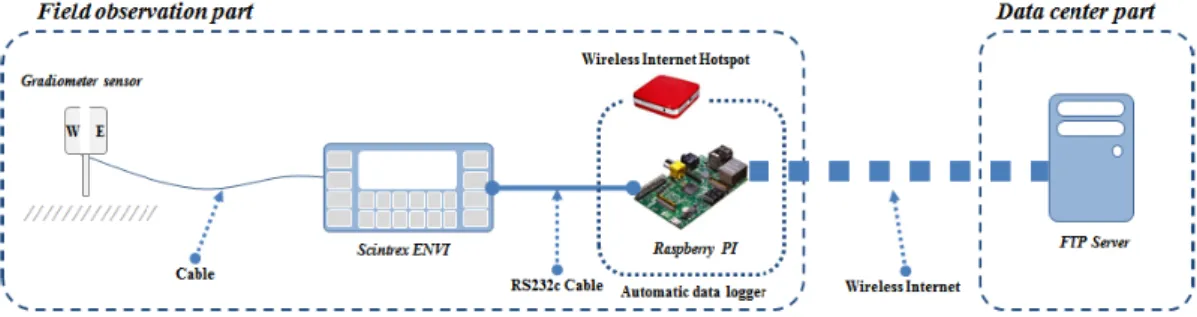
A monitoring system for a field magnetometer was configured with assistance of a Raspberry Pi as a data logger. The suggested geomagnetic system uses a semi-real-time data transmission module. The system consists of two parts: a field-observation part and a data-center part. The field-observation part comprises a Raspberry Pi, magnetometer, LTE router, and power source, while the data center part takes samples at the site. The collected magnetometer data are then sent to the data center through the LTE router. The newly designed monitoring system was deployed and checked in Jeju-do island, and found to operate stably. The suggested system is promising in that it is simple and cost saving, providing at least physical insight and knowledge on the complex natural phenomena.
Key words : Raspberry Pi, Magnetometer, Data logger
1. Introduction 1)
The Earth's geomagnetic field is an ever-changing phenomenon that influences human activity and the natural world in a myriad of ways. The geomagnetic field changes from place to place, and on time scales ranging from seconds to decades to eons. These changes can affect health and safety, and economic well-being. The geomagnetic field can disrupt electric power utilities and pipeline operations, and it can influence modern communications systems, spacecraft, and more (http://www.geomag.nrcan.gc.ca; https://www.
ngdc.noaa.gov/geomag). Hence the geomagnetic monitoring is used for detecting changes of the earth's
environment, i.e. ionosphere (Campbell, 2001, 2015;
Thomson, 2014; Lastovicka, 2002), inside the Earth (Merrill et al., 1998; Merrill, 2010; Moroz et al., 2011), and observation of magnetic disturbances related to earthquakes (Fraser -Smith et al., 1990;
Moskovskaya, 2012; Hayakawa et al., 2007).
Several equipments were developed for geomagnetic observation at the site, and tested at the fixed positions. There is no exception in Korea. The geomagnetic monitoring stations in South Korea include those operated by the Korea metrological administration (KMA), Korean space weather center (KSWC) of the National Radio Research Agency, and Korean institute of geoscience and mineral resources
Received 3 September, 2016; Revised 29 September, 2016;
Accepted 30 September, 2016
*