I. 서 론
다환방향족탄화수소(Polycyclic Aromatic Hydrocarbons, PAHs)는 두 개 이상의 방향족 탄화수소 고리가 결합된 물질
로 발암성을 가지는 유해대기오염물질이다. PAHs는 주로 유기 화합물의 불완전한 연소에 의해 생성되며, 다양한 경로를 통하 여 환경으로 배출된다. 주요 배출원은 화석연료를 사용하는 산 업시설과 화력발전소, 디젤 및 가솔린 자동차의 배기가스, 폐
석유화학단지 주변 주거지역 다환방향족탄화수소(PAHs)의 농도와 Monte-Carlo 모의실험을 통한 위해성평가
박동윤1 , 최영태2 , 양원호2 , 최길용3 , 이채관1,4*
1
인제대학교 환경ㆍ산업의학연구소,
2대구가톨릭대학교 산업보건학과,
3안양대학교 환경에너지공학과,
4인제대학교 부산백병원 직업환경의학과
Seasonal Concentration of Polycyclic Aromatic Hydrocarbons (PAHs) in Residential Areas Around Petrochemical Complexes and Risk Assessment Using
Monte-Carlo Simulation
Dong-Yun Park1, Young-Tae Choe2, Wonho Yang2, Kil-Yong Choi3, and Chae-Kwan Lee1,4*
1
Institute of Environmental and Occupational Medicine, Medical School, Inje University,
2Department of Occupational Health, Daegu Catholic University,
3
Department of Environmental Energy, Anyang University,
4Department of Occupation and Environmental Medicine, Busan Paik Hospital, Inje University
ABSTRACT ABSTRACT
Background: Polycyclic aromatic hydrocarbons (PAHs) are generated in petrochemical complexes, can spread to residential areas and affect the health of residents. Although harmful PAHs are mainly present in particle phase, gas phase PAHs can generate stronger toxic substances through photochemical reaction. Therefore, the risk assessment for PAHs around the petrochemical complex should consider both particle and gas phase concentrations.
Objectives: This study aimed to investigate the concentration characteristics of particle and gas phase PAHs by season in residential areas around petrochemical complexes, and to assess the risk of PAHs.
Methods: Samples were collected for 7 days by seasons in 2014~2015 using a high volume air sampler. Particle and gas phase PAHs were sampled using quartz filter and polyurethane foam, respectively, analyzed by GC- MS. Chronic toxicity and probabilistic risk assessment were performed on 14 PAHs. For chronic toxicity risk assessment, inhalation unit risk was used. Monte-Carlo simulation was performed for probabilistic risk assessment using the mean and standard deviation of measured PAHs.
Results: The concentration of particle total PAHs was highest in autumn. The gas phase concentration was highest in autumn. The average gas phase distribution ratio of low molecular weight PAHs composed of 2~3 benzene rings was 85%. The average of the medium molecular weight composed of 4 benzene rings was 53%, and the average of the high molecular weight composed of 5 or more benzene rings was 9%. In the chronic toxicity risk assessment, 7 of the 14 PAHs exceeded the excess carcinogenic risk of 1.00×10
–6. In the Monte- Carlo simulation, Benzo[a]pyrene had the highest probability of exceeding 1.00×10
–6, which was 100%.
Conclusions: The concentration of PAHs in the residential area around the petrochemical complex exceeded the standard, and the excess carcinogenic risk was evaluated to be high. Therefore, it is necessary to manage the air environment around the petrochemical complex.
Key words: Monte-carlo, PAHs, particle and gas phase, risk assessment
Received August 11, 2021 Revised August 20, 2021 Accepted August 20, 2021
Highlights:
ㆍ The phases of PAHs depend on mole- cular weight around the petrochemical complex.
ㆍ Season’s peaks of total PAHs were found in the fall.
ㆍ The excess cancer risks of seven PAHs (e.g. B[a]P) exceeded “1.00×10
–6”.
*Corresponding author:
Institute of Environmental and Oc- cupational Medicine, Department of Occupation and Environmental Medicine, Busan Paik Hospital, Inje University, 75 Bokji-ro, Busnajin-gu, Busan 47392, Republic of Korea Tel: +82-51-890-5931 Fax: +82-51-895-7040 E-mail: [email protected]
Original Article
Copyright
ⒸKorean Society of Environmental Health.
This is an open-access article distributed under the terms of the Creative Commons Attribution Non-Commercial License (http://creativecommons.org/licenses/by-nc/4.0/), which
permits unrestricted non-commercial use, distribution, and reproduction in any medium, provided the original work is properly cited.
기물 소각, 주거지역의 난방 등이 있다.1-9) 석유화학단지의 경우 산업단지와 마찬가지로 주거지역보다 PAHs의 농도가 높으며,10) 특히 benzo[a]pyrene과 dibenz[a,h]anthracene의 배출량은 소각 시설보다 높다.11)
우리나라에서 대기 중 PAHs에 관한 국내 연구는 주로 입 자상 PAHs를 대상으로 수행하였다. 계절별 PAHs 농도는 겨 울철에 높고, 여름철에 낮으며,12-15) 주거지역보다 공업지역의 PAHs 농도가 더 높은 수준을 나타내었다.9,16) 그리고 Lee et al.
(2018)10) 의 연구에 의하면 석유화학단지도 주거지역보다 입자 상 PAHs 농도가 높았으며, 위해성평가 결과 그 위해도도 높은 것으로 보고하였다.
우리나라 환경부에서는 전국에 분포한 38개의 유해대기물 질 측정소를 통하여 16종의 가스상 PAHs를 모니터링하고 있 으며, 울산시에는 3개의 유해대기물질 측정소를 운영하고 있 다. 울산시의 가스상 PAHs 농도는 전국 15개 행정구역 중 10번 째로 높았으며, 대기 중의 주요한 PAHs 성분은 Phenanthrene, Fluoranthene, Pyrene의 순이었다.17)
IARC (International Agency for Research on Cancer)는 PAHs를 인간에게 암을 유발하는 발암성 물질로 지정하였으 며, 각 성분이 인체에 미치는 영향에 따라서 등급을 분류하고 있다. 그 중 benzo[a]pyrene은 발암성이 확인된 1등급 물질이 며, Benz[a]anthracene, Benzo[b]fluoranthene, Benzo[k]fluor- anthene, Chrysene, Indeno[1,2,3,-cd]pyrene, Naphthalene은 2B 등급으로 발암 가능성이 있는 물질로 지정하고 있다.18) U.S.
Environmental Protection Agency (2017)19)는 benzo[a]pyrene에 의한 인체 노출이 생식과 면역기능에 영향을 줄 수 있으며, 산 모의 경우 benzo[a]pyrene의 대사물질이 태반을 통해 태아에게 전달되어 체중, 혈압, 생식, 신경 등 성장에 부정적인 영향을 주 는 것으로 보고하였다. 그리고 인체 노출 경로에 따라 소화 및 호흡기관, 간, 신장, 피부 등에서 발암을 일으키는 물질로 지정 하였다.19)
PAHs는 반휘발성 유기화합물(Semi Volatile Organic Compunds, SVOCs)로 대기 중에 입자상과 가스상의 형태로 존재한다. 유해성과 관련된 PAHs는 주로 입자상으로 존재하지 만, 가스상 PAHs는 광화학 반응 등을 통해 기존 PAHs보다 강 한 독성물질들을 생성한다.20,21) 따라서, PAHs에 대한 위해성 평가는 입자상 농도와 함께 가스상 농도도 같이 고려하여야 한 다.
이 연구는 석유화학단지 주변 주거지역에서 계절별로 입자상 과 가스상 PAHs 농도를 측정하여 농도 특성을 조사하고, 이를 기반으로 PAHs의 위해도를 평가하고자 하였다.
Ⅱ. 연구 방법
1. 시료 채취
주거지역인 울산광역시 울주군 청량중학교(35°29′17″, 129°18′16″) 옥상에서 시료를 채취하였다. 시료 채취지점은 울산 석유화학공업단지 경계지점에서 직선거리로 약 1 km 떨 어진 주거지역에 위치하였으며, 주변에 주거지역과 상업지역, 그리고 녹지지역이 혼재되어 있었다. 울산 석유화학공업단지에 는 2014년 기준으로 석유화학업종을 중심으로 기계, 자동차, 전기 등 약 850여 개의 업체가 입주하고 있다.22) 2014년 기준 으로 울산시의 인구는 1,166,377명이고 석유화학단지와 인접 한 울산시 남구와 울주군 청량읍, 온산읍에는 387,144명이 거 주하였다.23)
시료 채취 기간은 여름(2014년 8월 28일~2014년 09월 03 일), 가을(2014년 11월 03일~2014년 11월 09일), 겨울(2015 년 01월 27일~2015년 02월 02일), 봄(2015년 03월 24일
~2015년 03월 03일)으로 계절을 구분하였으며, 24시간을 기 준으로 7일 동안 총 28개의 시료를 채취하였다. 시료채취는 고용량시료채취장치(High Volume Air Sampler, HV-1000F, SIBATA, Japan)를 사용하여, 200 L/min의 유량으로 수행하 였다. 입자상 PAHs 시료채취는 석영필터(QMA filter, 8″×10″, Whatman Inc., USA)를 사용하였다. 석영필터는 시료채취 전 HPLC 등급의 메탄올(HPLC grade Methanol, MERCK, USA) 에 담근 후 초음파 세척기를 이용하여 PAHs를 포함한 유기 성 불순물을 제거하였다. 가스상 PAHs 시료채취는 필터 후 단에 Polyurethane foam (PUF)를 장착하여 채취하였다. PUF 는 시료채취 전 HPLC 등급의 메탄올(HPLC grade Methanol, MERCK, USA)과 아세톤(HPLC grade, Sigma, USA) 혼합용액 (9:1)에 담가 24시간 방치 후 건조하여 사용하였다.
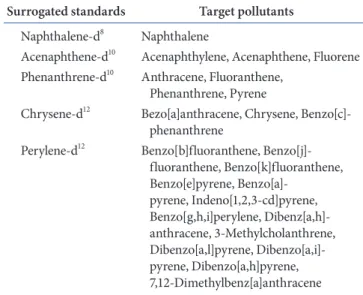
Table 1. Target PAHs for surrogated standards Surrogated standards Target pollutants
Naphthalene-d
8Naphthalene
Acenaphthene-d
10Acenaphthylene, Acenaphthene, Fluorene Phenanthrene-d
10Anthracene, Fluoranthene,
Phenanthrene, Pyrene
Chrysene-d
12Bezo[a]anthracene, Chrysene, Benzo[c]- phenanthrene
Perylene-d
12Benzo[b]fluoranthene, Benzo[j]- fluoranthene, Benzo[k]fluoranthene, Benzo[e]pyrene, Benzo[a]-
pyrene, Indeno[1,2,3-cd]pyrene,
Benzo[g,h,i]perylene, Dibenz[a,h]-
anthracene, 3-Methylcholanthrene,
Dibenzo[a,l]pyrene, Dibenzo[a,i]-
pyrene, Dibenzo[a,h]pyrene,
7,12-Dimethylbenz[a]anthracene
2. 시료 추출 및 분석
2.1. 시료추출
석영필터와 PUF로 채취한 PAHs는 속슬렛(Soxhlet) 추출 장치를 이용하여 추출하였다. 헥산과 아세톤(9:1, v/v) 혼합 용매로 시간 당 6회의 순환율로 12~16시간 동안 추출하였 다. 추출과정에서 회수율 보정을 위해 11 μg/mL의 대리표준 물질(Z-014J, Accustandard Inc., USA)을 100 μL 주입하였 다. 대리표준물질에는 Naphthalene-d8, Acenaphthene-d10, Phenanthrene-d10, Chrysene-d12, Perylene-d12이 혼합되어 있 으며, 각 대리표준물질에 대한 대상 PAHs 성분은 Table 1에 나 타내었다.
시료 추출 후 자동질소농축장치(Chongmin Tech. korea)를 사용하여 시료를 농축하였다. 시료를 3~4 mL로 농축한 후 무 수황산나트륨 컬럼을 사용하여 수분을 제거하였으며, 수분이 제거된 시료는 고순도 질소를 이용하여 1 mL까지 농축하였다.
최종 농축된 시료에 10 μg/mL 수준의 PAHs 2종(Pyrene-d10, Benzo[a]pyrene-d12)이 함유되어있는 내부표준물질(Cambridge Isotope Laboratories, Inc., USA)을 100 μL 주입하였다.
2.2. 시료분석
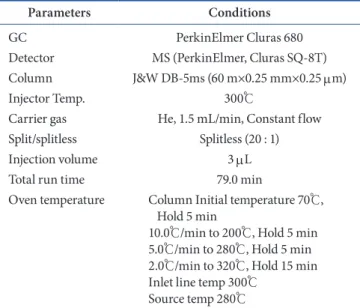
PAHs의 정성 및 정량 분석에는 PerKinElmer사의 Gas Chromatography/Mass Spectrometry (Clarus 680/Clarus SQ- 8T)를 사용하였다. 분석방법은 EPA TO-13A Method와 국내 대기오염공정시험기준(ES 01552.1)을 적용하였다. 컬럼은 DB- 5MS (60 m long, 0.25 mm ID, 0.25 μm film thickness)를 사 용하였다. GC oven의 온도 조건은 초기온도를 70℃로 5분간 유지한 후 320℃까지 승온시키고, 최종온도에서 15분간 유지
하였다. 운반기체는 헬륨(99.999%)을 사용하였다. 시료 주입 구 온도는 300℃ 였으며, splitless 모드로 3 μL를 주입하였다 (Table 2).
3. 정도관리(QA/QC)
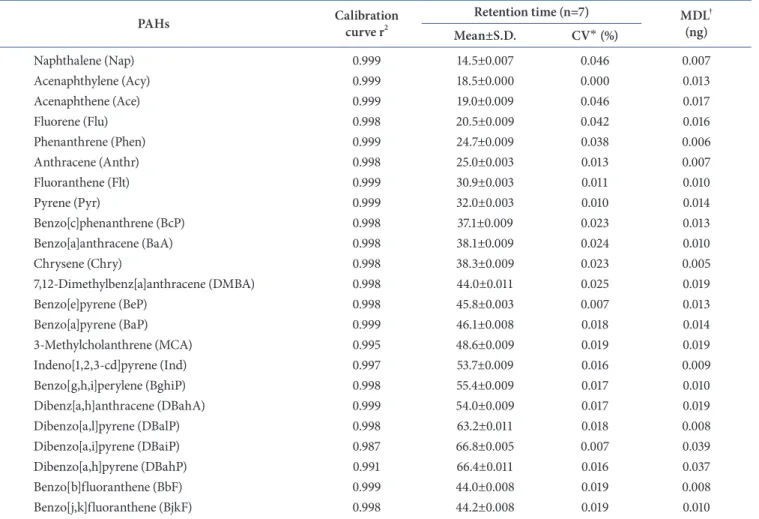
결과의 신뢰성을 높이기 위해 PAHs 표준물질과(PAHs 24 Mix, Accustandard Inc., USA)와 대리표준물질(Z-014J, Accustandard Inc., USA), 그리고 내부표준물질(internal stan- dard, Cambridge Isotope Laboratories Inc., USA)을 이용하여 정도관리(QC/QA)를 수행하였다. 정도관리에는 검량선의 선형 성 및 체류시간의 재현성, 방법검출한계(MDL), 시료 전처리 회 수율(Recovery factor)을 평가하였다. 방법검출한계(MDL)는 표 준시료(0.2 ng/μL)를 7회 분석하였으며, 검출된 농도의 표준편 차에 3.14를 곱하여 계산하였다(Tables 3, 4).
4. 위해성평가
4.1 만성독성 위해성평가
US EPA에서 관리하는 16종의 PAHs24) 중 이 연구와 측정항 목이 동일한 14종의 PAHs에 대해서 위해성평가를 실시하였다.
흡입 단위 위해도(inhalation unit risk, IUR)를 특징으로 하는 발암 위해성평가에는 노출농도(exposure concentration, EC)를 추정하는 노출시간(exposure time, ET), 노출빈도(exposure fre- quency, EF), 노출기간(exposure duration, ED)과 같은 시나리오 별 매개변수뿐만 아니라 현장의 노출 지점에서 측정된 공기 중 오염농도(contaminant concentration in air, CA)를 포함한다.25) 주거지역에서 상시 노출되는 것을 고려하여 U.S. EPA (1998)26) 의 노출 매개변수에 따라 EF는 365일, ED는 70년, ET는 24시 간으로 가정하여 평가하였다. EC는 일반적으로 CA의 형태로 나타내며 EC를 추정하는 방정식은 아래와 같다.
× × ×
EC: exposure concentration (μg/m3)
CA: contaminant concentration in air (μg/m3) ET: exposure time (hr/day)
EF: exposure frequency (days/year) ED: exposure duration (years)
AT: averaging time (lifetime in years×365 days/year×24 hours/day)
14종의 PAHs 항목 모두 발암성이 있다고 가정하여 흡입 경 로를 통해 노출된 수용체에 대한 초과 암 위험은 다음 방정식 으로 추정하였다.
Table 2. GC/MS conditions for PAHs analysis
Parameters Conditions
GC PerkinElmer Cluras 680
Detector MS (PerkinElmer, Cluras SQ-8T) Column J&W DB-5ms (60 m×0.25 mm×0.25 μm)
Injector Temp. 300℃
Carrier gas He, 1.5 mL/min, Constant flow Split/splitless Splitless (20 : 1)
Injection volume 3 μL
Total run time 79.0 min
Oven temperature Column Initial temperature 70℃, Hold 5 min
10.0 ℃/min to 200℃, Hold 5 min 5.0 ℃/min to 280℃, Hold 5 min 2.0℃/min to 320℃, Hold 15 min Inlet line temp 300℃
Source temp 280℃
×
IUR: Inhalation Unit Risk (μg/m3)-1 EC: exposure concentration (μg/m3)
또한, 초과발암위해도가 1.00×10⁻⁶을 초과하지 않고, IARC 에서 비발암성물질로 확인된 항목들은 다음 방정식으로 위해 지수(hazard index, HI)를 산출하였다.
4.2 확률론적 위해성평가
위해성평가에 적용된 측정값의 평균값뿐만 아니라 측정값의 표준편차를 이용하여 Monte-Carlo 모의실험을 통한 확률론적 위해성평가를 실시하였다. Monte-Carlo 모의실험은 여러 노출 인자에 대해 정의된 확률분포에서 임의의 수를 반복대입을 통 하여 결과를 도출하는 계산 알고리즘으로,27) 유용한 접근 방식
중 하나로 효율적인 계산을 할 수 있다. 위해성평가의 EC값은 대수정규분포를 적용하였으며 IUR값은 각 물질에 대해 제시된 단일값을 적용하여 각 1,000,000번의 모의실험을 통해 분석 하였다. 공기 오염물질의 농도는 대수정규분포를 적용하였으며 각 1,000,000번의 모의실험을 통해 분석하였다. 확률론적 분 석을 통하여 초과발암 위해도가 1.00×10⁻⁶을 초과하는 비율 을 제시하였다.
Table 3. QA/QC data for PAHs
PAHs Calibration
curve r
2Retention time (n=7) MDL
†Mean±S.D. CV* (%) (ng)
Naphthalene (Nap) 0.999 14.5±0.007 0.046 0.007
Acenaphthylene (Acy) 0.999 18.5±0.000 0.000 0.013
Acenaphthene (Ace) 0.999 19.0±0.009 0.046 0.017
Fluorene (Flu) 0.998 20.5±0.009 0.042 0.016
Phenanthrene (Phen) 0.999 24.7±0.009 0.038 0.006
Anthracene (Anthr) 0.998 25.0±0.003 0.013 0.007
Fluoranthene (Flt) 0.999 30.9±0.003 0.011 0.010
Pyrene (Pyr) 0.999 32.0±0.003 0.010 0.014
Benzo[c]phenanthrene (BcP) 0.998 37.1±0.009 0.023 0.013
Benzo[a]anthracene (BaA) 0.998 38.1±0.009 0.024 0.010
Chrysene (Chry) 0.998 38.3±0.009 0.023 0.005
7,12-Dimethylbenz[a]anthracene (DMBA) 0.998 44.0±0.011 0.025 0.019
Benzo[e]pyrene (BeP) 0.998 45.8±0.003 0.007 0.013
Benzo[a]pyrene (BaP) 0.999 46.1±0.008 0.018 0.014
3-Methylcholanthrene (MCA) 0.995 48.6±0.009 0.019 0.019
Indeno[1,2,3-cd]pyrene (Ind) 0.997 53.7±0.009 0.016 0.009
Benzo[g,h,i]perylene (BghiP) 0.998 55.4±0.009 0.017 0.010
Dibenz[a,h]anthracene (DBahA) 0.999 54.0±0.009 0.017 0.019
Dibenzo[a,l]pyrene (DBalP) 0.998 63.2±0.011 0.018 0.008
Dibenzo[a,i]pyrene (DBaiP) 0.987 66.8±0.005 0.007 0.039
Dibenzo[a,h]pyrene (DBahP) 0.991 66.4±0.011 0.016 0.037
Benzo[b]fluoranthene (BbF) 0.999 44.0±0.008 0.019 0.008
Benzo[j,k]fluoranthene (BjkF) 0.998 44.2±0.008 0.019 0.010
* Coefficient of variation.
†
Method detection limit.
Table 4. Sample extraction recovery rate using the surrogated standards Surrogated
standards
Mean±S.D.
Filter (n=28, %) PUF* (n=28, %)
Naphthalene-d
874.7±23.3 75.8±19.9
Acenaphthene-d
1074.9±12.5 90.2±13.2
Phenanthrene-d
1093.7±21.8 96.7±21.5
Chrysene-d
12114.1±36.2 129.5±27.3
Perylene-d
12142.1±53.9 151.2±39.0
*Polyurethane foam.
Ta ble 5 . C on ce nt ra tio n o f p ar tic le a nd g as p ha se P A H s ( ng /m
3) PA H s To ta l Spr in g Su m me r Au tu m n W in ter Pa rt ic le Ga s Pa rt ic le Ga s Pa rt ic le Ga s Pa rt ic le Ga s Pa rt ic le Ga s Na ph th al en e ( Na p) 0.1 44 ±0 .13 8 0. 53 8± 0. 63 7 0. 24 9± 0.1 65 0. 40 1± 0. 38 6 0. 08 2± 0. 07 9 0. 27 8± 0. 37 6 0.1 48 ±0. 08 3 1.3 05 ±0 .6 45 0. 09 8± 0.1 58 0.1 69 ±0. 41 8 Ac en ap ht hy len e ( Ac y) 0. 01 0± 0. 00 6 0. 64 6± 0.9 79 0. 00 4± 0. 00 2 0. 08 6± 0.1 03 0. 00 8± 0. 00 3 0. 02 4± 0. 02 2 0. 01 7± 0. 00 5 1.8 24± 0.9 34 0. 01 0± 0. 00 5 0. 65 0± 0.9 98 Ac en ap ht he ne (Ac e) 0. 02 4± 0. 02 0 0. 23 3± 0.1 97 0. 01 0± 0. 01 8 0.1 24 ±0 .10 8 0. 02 5± 0. 01 3 0.1 50 ±0 .13 1 0. 04 2± 0. 01 9 0. 42 6± 0.1 81 0. 01 7± 0. 01 4 N .D. * Flu or en e ( Flu ) 0. 321 ±1 .2 98 1.3 47 ±1. 77 0 0. 01 1± 0. 01 6 0. 20 2± 0.1 54 0. 00 2± 0. 00 1 0. 27 5± 0. 30 5 0. 02 1± 0. 007 4.1 05 ±1 .17 0 1.2 48 ±2 .2 23 0. 80 7± 0.7 25 Ph en an th re ne ( Phe n) 0.1 18 ±0 .10 8 10. 95 7±5 .12 5 0. 09 4± 0. 06 6 1.9 00 ±1. 97 4 0. 01 4± 0. 01 0 3. 891 ±2 .92 1 0. 20 5± 0. 09 7 35 .77 4± 7.3 78 0.1 59 ±0 .12 4 2. 261 ±1 .3 54 A nt hr ac en e ( A nt hr ) 0. 01 1± 0. 00 9 1.1 70 ±1. 89 7 0. 00 2± 0. 00 1 0.1 14 ±0 .13 7 N .D. * 0.1 78 ±0 .13 4 0. 01 9± 0. 00 5 4.1 32 ±1 .5 69 0. 01 3± 0. 00 8 0. 25 5± 0.1 98 Fl uo ra nt he ne ( Fl t) 0. 31 7± 0. 25 1 4.11 6± 5. 50 1 0. 22 7± 0.1 24 0.7 16 ±0 .74 5 0. 01 8± 0. 01 9 2.1 60 ±2 .21 4 0. 57 6± 0. 20 2 12 .91 5± 2. 91 7 0. 44 6± 0.1 61 0. 67 3± 0. 31 2 Py re ne (Py r) 0. 28 1± 0. 24 1 3. 391 ±4 .72 1 0.1 80 ±0 .10 7 0. 49 1± 0. 54 7 0. 017 ±0 .018 1.7 88 ±1. 80 2 0. 55 0± 0. 20 5 10 .8 28 ±3 .0 52 0. 37 8± 0.1 56 0. 45 6± 0. 23 6 Ben zo [c] ph en an th ren e (B cP) 0. 06 3± 0. 05 8 0.1 82 ±0. 28 5 0. 01 0± 0. 00 6 0. 01 8± 0. 02 5 N .D. * 0. 07 3± 0. 08 2 0.1 04 ±0. 03 9 0. 62 6± 0. 22 1 0. 07 4± 0. 06 5 0. 01 2± 0. 00 8 Be nz o[ a]a nt hr ac en e (B aA) 0. 20 1± 0. 24 2 0.1 87 ±0. 33 8 0. 04 2± 0. 03 5 0. 01 2± 0. 02 4 0. 01 2± 0. 01 4 0. 05 8± 0. 06 0 0. 48 5± 0.1 97 0. 67 1± 0. 38 1 0. 26 4± 0. 23 6 0. 00 8± 0. 00 8 Ch ry se ne (Ch ry ) 0. 29 1± 0. 32 7 0. 33 6± 0. 54 0 0. 08 4± 0. 05 7 0. 03 8± 0. 057 0. 02 2± 0. 02 6 0.1 78 ±0. 29 7 0.7 43 ±0. 24 9 1.11 3± 0. 51 0 0. 314 ±0 .2 27 0. 01 3± 0. 01 0 7,1 2-D im et hy lb en z[ a] an th ra ce ne (D M BA) 0. 07 2± 0. 07 5 0. 00 7± 0. 00 4 0. 030 ±0 .030 N .D. * N .D. * N .D. * 0.1 63 ±0. 05 2 0. 00 7± 0. 00 4 0. 02 2± 0. 01 8 N .D. * Be nzo [b ,j,k ]- fluo ra nt he ne ( Bb jk F) 0. 41 0± 0. 46 4 0. 03 1± 0. 02 4 0.1 10 ±0. 08 6 N .D. * 0. 01 6± 0. 01 1 0. 01 0± 0. 01 1 1.10 6± 0. 26 3 0. 05 2± 0. 01 7 0. 40 8± 0.1 62 N .D. * Be nz o[e ]p yr en e ( Be P) 0. 25 9± 0. 29 2 0. 01 2± 0. 00 9 0. 06 8± 0. 05 3 N .D. * 0. 04 1± 0. 05 8 0. 00 7± 0. 00 6 0.7 15 ±0. 18 8 0. 01 6± 0. 01 2 0. 210 ±0 .0 81 N .D. * Ben zo [a ]p yr en e ( Ba P) 0. 60 5± 0.7 59 0. 00 8± 0. 00 6 0. 05 3± 0. 04 3 N .D. * 0. 00 5± 0. 00 3 0. 00 8± 0. 00 5 0. 823 ±0. 35 0 0. 00 9± 0. 00 9 1.53 9± 0.7 85 0. 00 6± 0. 00 3 3- M et hy lch ol an th re ne (M CA) 0. 02 6± 0. 03 7 0. 04 1± 0. 02 6 0. 00 6± 0. 00 6 N .D. * 0. 06 4± 0. 05 7 0. 04 3± 0. 03 0 0. 03 0± 0. 01 5 0. 039 ±0 .012 0. 00 2± 0. 00 1 N .D. * In de no [1 ,2, 3- cd ]- py re ne (I nd ) 0. 29 3± 0. 36 3 0. 01 1± 0. 00 7 0. 06 0± 0. 06 8 N .D. * 0. 03 5± 0. 08 0 N .D. * 0. 86 7± 0. 25 1 0. 01 1± 0. 01 0 0. 21 1± 0. 07 3 N .D. * Ben zo [g ,h ,i] per yl en e (B gh iP) 0. 28 5± 0. 35 1 0. 01 2± 0. 00 7 0. 06 1± 0. 06 0 N .D. * 0. 04 3± 0. 08 2 N .D. * 0. 83 8± 0. 257 0. 01 2± 0. 00 8 0.1 98 ±0. 06 6 N .D. * D ib enz [a,h ]a nt hr ac en e (D Ba hA) 0. 05 1± 0. 06 3 0. 00 4± 0. 00 2 0. 00 8± 0. 00 8 N .D. * N .D. * N .D. * 0.1 34 ±0. 03 3 0. 00 4± 0. 00 2 0. 01 1± 0. 00 5 N .D. * D ib en zo [a ,l] py ren e (D Ba lP) 0. 09 7± 0.1 07 0. 02 4± 0. 02 8 0. 00 7± 0. 00 9 N .D. * 0. 02 8± 0. 01 4 N .D. * 0. 24 7± 0. 06 8 0. 00 9± 0. 00 2 0.1 04 ±0. 06 8 0. 03 8± 0. 05 0 D ib en zo [a ,i] py ren e (D Ba iP) 0. 01 2± 0. 01 3 0. 00 3± 0. 00 2 0. 001 ±0 .0 01 N .D. * N .D. * N .D. * 0. 02 2± 0. 01 5 0. 00 4± 0. 00 2 N .D. * 0. 002 ±0 .0 02 D ib en zo [a ,h ]p yr en e (D Ba hP) 0. 03 8± 0. 03 7 0. 00 3± 0. 00 2 0. 00 5± 0. 00 3 N .D. * N .D. * N .D. * 0. 07 1± 0. 02 8 0. 00 3± 0. 00 2 N .D. * N .D. * To ta l P A H s 107 .84 2± 0.4 02 64 7.2 06 ±4 .4 29 9.2 54 ±0 .0 92 28 .71 4± 0.6 07 3.0 24 ±0 .0 48 63 .84 7± 1.3 97 55 .4 82 ±0 .3 76 51 7.1 95±8 .0 44 40. 08 2± 0. 61 3 37 .450 ±0 .6 34 *N ot de te cte d.
Ⅲ. 결 과
1. 계절별 PAHs 농도 분포
Table 5는 측정한 PAHs 성분들에 대한 입자상과 가스상 농 도를 계절별로 나타낸 것이다. 입자상 총 PAHs의 농도는 가 을(55.482 ng/m3)에 가장 높았으며, 겨울(40.082 ng/m3), 봄 (9.254 ng/m3), 여름(3.024 ng/m3) 순으로 조사되었다. 그리고 가스상 농도는 가을(517.195 ng/m3), 여름(63.847 ng/m3), 겨 울(37.450 ng/m3), 봄(28.714 ng/m3) 순으로 조사되어, 여름이 가장 낮은 입자상 PAHs 결과와 다른 경향을 나타내었다.
Fig. 1은 입자상 및 가스상 PAHs 농도를 계절별로 나타 낸 것이다. 봄의 입자상 PAHs 농도 순은 Naphthalene (Nap), Fluoranthene (Flt), Pyrene (Pyr)이었으며, 여름은 Naphthalene (Nap), 3-Methylcholanthrene (MCA), Benzo[g,h,i]per- ylene (BghiP), 가을은 Benzo[b,j,k]fluoranthene (BbjkF), Indeno[1,2,3-cd]pyrene (Ind), Benzo[g,h,i]perylene (BghiP), 겨 울은 Benzo[a]pyrene (BaP), Fluorene (Flu), Fluoranthene (Flt) 의 농도 순으로 나타났다. 봄과 여름은 Naphthalene의 농도가 각각 0.249 ng/m3, 0.082 ng/m3으로 가장 높았으며, 가을에 는 Benzo[b,j,k]fluoranthene (1.106 ng/m3), 겨울에는 Benzo[a]
Fig. 1. Particle and gas phase PAHs concentration by season
Nap: Naphthalene, Acy: Acenaphthylene, Ace: Acenaphthene, Flu: Fluorene, Phen: Phenanthrene, Anthr: Anthracene, Flt: Fluoranthene, Pyr:
Pyrene, BcP: Benzo[c]phenanthrene, BaA: Benzo[a]anthracene, Chry: Chrysene, DMBA: 7,12-Dimethylbenz[a]anthracene, BbjkF: Benzo[b,j,k]
fluoranthene, BeP: Benzo[e]pyrene, BaP: Benzo[a]pyrene, MCA: 3-Methylcholanthrene, Ind: Indeno[1,2,3-cd]pyrene, BghiP: Benzo[g,h,i]
perylene, DBahA: Dibenz[a,h]anthracene, DBalP: Dibenzo[a,l]pyrene, DBaiP: Dibenzo[a,i]pyrene, DBahP: Dibenzo[a,h]pyrene.
Fig. 2. Ratio of particle and gas phase PAHs concentration by season
Nap: Naphthalene, Acy: Acenaphthylene, Ace: Acenaphthene, Flu: Fluorene, Phen: Phenanthrene, Anthr: Anthracene, Flt: Fluoranthene, Pyr:
Pyrene, BcP: Benzo[c]phenanthrene, BaA: Benzo[a]anthracene, Chry: Chrysene, DMBA: 7,12-Dimethylbenz[a]anthracene, BbjkF: Benzo[b,j,k]
fluoranthene, BeP: Benzo[e]pyrene, BaP: Benzo[a]pyrene, MCA: 3-Methylcholanthrene, Ind: Indeno[1,2,3-cd]pyrene, BghiP: Benzo[g,h,i]
perylene, DBahA: Dibenz[a,h]anthracene, DBalP: Dibenzo[a,l]pyrene, DBaiP: Dibenzo[a,i]pyrene, DBahP: Dibenzo[a,h]pyrene.
pyrene (1.539 ng/m3)이 가장 높은 것으로 조사되었다. 가스상 PAHs의 경우 봄, 여름, 가을의 농도 순은 Phenanthrene (Phen), Fluoranthene (Flt), Pyrene (Pyr)이었으며, 겨울은 Phenanthrene (Phen), Fluorene (Flu), Fluoranthene (Flt)의 농도 순으로 나 타났다. 봄과 여름, 가을의 가스상 농도 순위는 비슷한 경향 을 가지는 것으로 조사되었으며, 가스상 농도는 4계절 모두 Phenanthrene (Phen)이 가장 높은 것으로 나타났다.
2. PAHs의 입자상과 가스상 농도 분포
Fig. 2는 입자상과 가스상 PAHs 분포 비율을 계절별로 나 타낸 것이다. 봄에는 벤젠고리가 2~3개로 구성된 저분자량 의 PAHs 성분(Naphthalene (Nap), Acenaphthylene (Acy), Acenaphthene (Ace), Fluorene (Flu), Phenanthrene (Phen), Anthracene (Anthr)) 중 Naphthalene (Nap)을 제외한 나머 지 성분들은 가스상 분포 비율이 90% 이상으로 나타났으 며, Naphthalene (Nap)는 62%의 가스상 분포 비율을 나 타내었다. 벤젠고리가 4개로 구성된 중간분자량의 PAHs 성분(Fluoranthene (Flt), Pyrene (Pyr), Chrysene (Chry), Benzo[c]phenanthrene (BcP), Benz[a]anthracene (BaA), 7,12-Dimethylbenz[a]anthracene (DMBA)) 중 Fluoranthene (Flt)와 Pyrene (Pyr), Benzo[c]phenanthrene (BcP)은 각각 76%, 73%, 64%이었으며, Chrysene (Chry)와 Benz[a]anthracene (BaA)가 각각 31%, 22%이었다. 그러나 7,12-Dimethylbenz[a]
anthracene (DMBA)와 벤젠고리가 5~6개로 구성된 고분자
량의 PAHs 성분(Benzo[b,j,k]fluoranthene (BbjkF), Benzo[a]- pyrene (BaP), Benzo[e]pyrene (BeP), 3-Methylcholanthrene (MCA), Dibenz[a,h]anthracene (DBahA), Indeno[1,2,3-cd]- pyrene (Ind), Benzo[g,h,i]perylene (BghiP), Dibenzo[a,l]py- rene (DBalP), Dibenzo[a,h]pyrene (DBahP), Dibenzo[a,i]pyrene (DBaiP))은 모두 입자상으로 나타났다.
여름에는 벤젠고리가 2~4개로 구성된 PAHs 성분 중 7,12-Dimethylbenz[a]anthracene (DMBA)을 제외한 나머지 성 분들이 75~100%의 가스상 분포 비율을 나타내었으며, 벤젠 고리가 5개 이상으로 구성된 PAHs 성분 중 Benzo[b,j,k]fluor- anthene (BbjkF), Benzo[a]pyrene (BaP), Benzo[e]pyrene (BeP), 3-Methylcholanthrene (MCA)을 제외한 나머지 성분들은 모두 입자상으로 나타났다.
가 을에는 벤젠고리가 2~4개로 구성된 PAHs 성분 중 7,12-Dimethylbenz[a]anthracene (DMBA)을 제외한 나머 지 성분들이 58~100%의 가스상 분포 비율을 나타내었으 며, 7,12-Dimethylbenz[a]anthracene (DMBA)은 4%로 나타 났다. 그리고 벤젠고리가 5개 이상으로 구성된 PAHs 성분 중 3-Methylcholanthrene (MCA)와 Dibenzo[a,i]pyrene (DBaiP)를 제외한 나머지 성분들은 5% 이하의 가스상 분포 비율을 나타 내었다.
겨울에는 벤젠고리가 2~3개로 구성된 PAHs 성분 중 Acenaphthene (Ace)을 제외한 나머지 성분들은 39~99%
의 가스상 분포를 보였으며, Acenaphthene (Ace)은 모두 입
Table 6. Inhalation unit risk values and human health risk calculation for selected substances
PAHs IUR* ((μg/m
3)
−1) Classification
Risk Probability
§(%) EPA IRIS
†IARC
‡Naphthalene 3.4×10
–5C 2B 4.90×10
–694.1
Acenaphthylene 1.1×10
–6D - 0.01×10
–60.0
Acenaphthene 1.1×10
–6D 3 0.03×10
–60.0
Fluorene 1.1×10
–6D 3 0.35×10
–67.2
Phenanthrene 1.1×10
–6D 3 0.13×10
–60.1
Anthracene 1.1×10
–5D 3 0.12×10
–60.0
Fluoranthene 1.1×10
–6D 3 0.35×10
–63.2
Pyrene 1.1×10
–6D 3 0.31×10
–62.5
Benzo[a]anthracene 1.1×10
–4B2 2B 2.21×10
–599.7
Chrysene 1.1×10
–5B2 2B 3.20×10
–679.8
Benzo[a]pyrene 1.1×10
–3B2 1 2.85×10
–4100.0
Indeno[1,2,3-cd]pyrene 1.1×10
–4B2 2B 2.86×10
–668.2
Benzo[g,h,i]perylene 1.1×10
–5D 3 3.22×10
–676.8
Dibenzo[a,h]pyrene 1.2×10
–3B2 2B 1.44×10
–599.5
*Inhalation unit risk.
†
Integrated Risk Information System.
‡
International Agency for Research on Cancer.
§
Probability of exceeding excess carcinogenic risk (1.00×10
–6).
자상으 로 나타났다. 벤젠고리가 4개로 구성된 PAHs 성 분 은 7,12-Dimethylbenz[a]anthracene (DMBA)를 제외 한 나머지 성분들은 3~60%의 가스상 분포를 보였으며, 7,12-Dimethylbenz[a]anthracene (DMBA)은 모두 입자상 으로 나타났다. 벤젠고리가 5개 이상으로 구성된 PAHs 성 분 중 Benzo[a]pyrene (BaP), Dibenzo[a,l]pyrene (DBalP), Dibenzo[a,i] pyrene (DBaiP)은 각각 0.4%, 27%, 100%의 가스 상 분포를 보였으며, 나머지 물질은 모두 입자상으로 나타났다.
3. 위해성평가
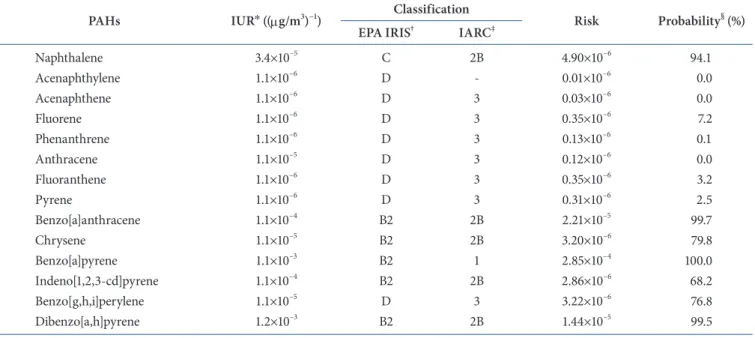
각 물질에 대한 IUR값과 발암성 영향에 따른 IARC, EPA IRIS 분류등급, 초과발암위해도, 초과발암위해도 1.00×10⁻⁶ 을 초과할 확률을 Table 6에 나타내었다. 위해성평가에 적용 된 14종의 PAHs에 대한 IUR값은 US EPA에서 제공된 값을 적용하였다. 위해성평가 결과 14종의 PAHs 중 7종의 항목들 이 초과발암위해도 1.00×10⁻⁶을 초과한 것으로 나타났고, 7 종의 항목이 초과발암위해도 1.00×10⁻⁶ 미만으로 나타났다.
1.00×10⁻⁶을 초과한 항목은 Naphthalene (Nap) 4.90×10⁻⁶, Benzo[a] anthracene (BaA) 2.21×10⁻⁵, Chrysene (Chry) 3.20
×10–6, Benzo[a]pyrene (BaP) 2.85×10⁻⁴, Indeno[1,2,3-cd]- pyrene (Ind) 2.86×10⁻⁶, Benzo[g,h,i]perylene (BghiP) 3.22
×10–6, Dibenzo[a,h]pyrene (DBahP) 1.44×10⁻⁵으로 나타났 다. 초과발암위해도가 가장 높은 항목은 Benzo[a]pyrene으 로 1.00×10⁻⁴를 초과하여 위해도가 가장 높은 것으로 나타났 다. Benzo[a]pyrene이 가장 높은 것으로 나타났다. 초과발암위 해도가 1.00×10⁻⁶미만으로 나타난 항목들은 Acenaphthylene (Acy) 0.01×10⁻⁶, Acenaphthene (Ace) 0.03×10⁻⁶, Fluorene (Flu) 0.35×10⁻⁶, Phenanthrene (Phen) 0.13×10⁻⁶, Anthracene (Anthr) 0.12×10⁻⁶, Fluoranthene (Flt) 0.35×10⁻⁶, Pyrene (Pyr) 0.31×10⁻⁶으로 Acenaphthylene이 가장 낮은 것으로 나 타났다. US EPA에서는 각 발암물질에 대해 전 생애 발암위 해도의 역치값은 1.00×10⁻⁶, 발암물질들에 대한 총 위해도 의 역치값은 1.00×10⁻⁴를 권장하고 있다.28) 초과발암위해도 가 1.00×10⁻⁶을 초과하지 않고 IARC 분류 발암성이 없는 항 목인 Acenaphthene, Fluorene, Phenanthrene, Anthracene, Fluoranthene, Pyrene의 HI값은 1.29×10⁻⁶으로 나타나 총 위 해도 기준 역치보다 낮았다.
Monte-Carlo 모의실험 결과 Naphthalene은 초과발암위해 도가 1.00×10⁻⁶이 초과할 확률이 94.1%, Benzo[a]anthra- cene은 99.7%, Chrysene은 79.8%, Benzo[a]pyrene은 100%, Indeno[1,2,3-cd]pyrene은 68.2%, Benzo[g,h,i]perylene 은 76.8%, Dibenzo[a,h]pyrene은 99.5%, Acenaphthylene과 Acenaphthene은 0%, Fluorene은 7.2%, Phenanthrene은 0.1%, Anthracene은 0%, Fluoranthene은 3.2%, Pyrene은 2.5%이었 다.
Ⅳ. 고 찰
이 연구는 석유화학단지 주변 주거지역에서 계절별로 입자 상과 가스상 PAHs 농도를 측정하여 농도 특성을 조사하고, 이 를 기반으로 PAHs의 위해도를 평가하고자 하였다. PAHs 측정 결과 입자상 총 PAHs의 농도는 가을에 가장 높았으며, 겨울, 봄, 여름 순으로 조사되었다. 그리고 가스상 농도는 가을, 여름, 겨울, 봄 순으로 조사되었다. 계절별 입자상 및 가스상 PAHs 의 각 성분을 농도 순으로 분석한 결과 입자상 PAHs 성분에 서 봄은 Naphthalene (Nap), Fluoranthene (Flt), Pyrene (Pyr) 이었으며, 여름은 Naphthalene (Nap), 3-Methylcholanthrene (MCA), Benzo[g,h,i]perylene (BghiP), 가을은 Benzo[b,j,k]flu- oranthene (BbjkF), Indeno[1,2,3-cd]pyrene (Ind), Benzo[g,h,i]- perylene (BghiP), 겨울은 Benzo[a]pyrene (BaP), Fluorene (Flu), Fluoranthene (Flt)의 농도 순으로 나타났다. 그리고 가스 상 PAHs 성분에서 봄, 여름, 가을의 농도 순은 Phenanthrene (Phen), Fluoranthene (Flt), Pyrene (Pyr)이었으며, 겨울은 Phenanthrene (Phen), Fluorene (Flu), Fluoranthene (Flt)의 농도 순으로 나타났다. 14종의 PAHs에 대해서 위해성평가를 실시 한 결과 만성독성 위해성평가 결과 14종의 PAHs 중 7종의 항 목들이 초과발암위해도 1.00×10⁻⁶을 초과한 것으로 나타났 다. Monte-Carlo 모의실험을 통한 확률론적 위해성평가 결과 Benzo[a]pyrene은 초과발암위해도 1.00×10⁻⁶을 초과할 확률 이 100%로 가장 높았으며, Benzo[a]anthracene, Dibenzo[a,h]- pyrene, Naphthalene은 90% 이상으로 나타났다.
Lim et al. (2016)14)은 서울 도심지역에서 입자상 및 가스상 PAHs 성분(18종)을 여름과 겨울로 구분하여 측정하였으며, 이 연구의 결과와 비교하면 서울 도심지역의 농도가 석유화학단지 주변 주거지역을 대상으로 조사한 이 연구의 결과보다 더 높았 다. 검출된 PAHs 성분을 비교해 보면, 벤젠고리가 3개로 구성 된 저분자량의 입자상 PAHs (Acenaphthene, Fluorene)와 벤젠 고리가 5~6개로 구성된 고분자량의 가스상 PAHs (Benzo[a]py- rene, Benzo[e]pyrene, Dibenzo[a,l]pyrene, Dibenzo[a,i]pyrene) 는 이 연구에서 검출되었으나 Lim et al. (2016)14)의 연구에서 는 검출되지 않았다. 이를 통해 석유화학단지에서 PAHs 농도 는 도심지역보다 농도 수준이 낮으나, 검출되는 PAHs 성분의 종류는 더 많은 것으로 평가된다. 이전 연구에서 공업지역에 인 접한 주거지역이 공업지역보다 PAHs 농도가 더 높거나 유사한 수준으로 보고된 바 있다. 이는 시료채취지점의 지형적 특성과 기상조건에 영향을 받을 수 있으며,5) 주거 및 도심지역의 경우 자동차 배기가스와 난방시설에 의한 영향이 PAHs 농도 수준을 증가시킬 수 있음을 의미한다.29,30)
Jung et al. (2011)9)은 철강산업단지와 주변 주거지역에서 입자상 및 가스상 PAHs 성분(16종)을 측정하였다. 철강산업 단지 주변 주거지역에서 PAHs 농도는 이 연구결과보다 낮은
수준이었다. 철강산업단지에서는 입자상 PAHs 중 Benzo(a)- pyrene, Pyrene, Chrysene, Fluoranthene, Benzo(g,h,i)per- ylene, Indeno(1,2,3)pyrene의 농도가 높은 수준으로 나타 났으며, Fluoranthene을 제외한 나머지는 이 연구와 비슷한 수준이었다. 그리고 검출된 가스상 PAHs는 Phenanthrene, Fluoranthene, Pyrene, Anthracene, Fluorene이었으며, 이 중 Phenanthrene은 다른 PAHs 물질보다 2배 이상의 높은 농도를 나타내어 이 연구와 유사하였다.
Lee et al. (2018)10)은 석유화학단지와 주변 주거지역에서 PM2.5에 함유된 입자상 PAHs를 측정하였으며, PAHs 농도에 대한 위해성평가를 하였다. 측정된 입자상 PAHs 성분은 11종 이었으며, 그중 5종 성분을 발암성에 대한 위해성평가를 수행 하였다. 입자상 PAHs 측정결과는 석유화학단지가 주거지역보 다 높은 것으로 조사되었고, 위해성평가 결과도 석유화학단지 가 주거지역에 비하여 높았으며, Benzo[a]pyrene이 다른 물질과 비교해서 가장 높게 나왔다. 그러나 기준 허용 위해도(1.00×
10–6)보다 낮은 수치 결과를 나타내어, 기준 허용 위해도를 초 과한 이 연구의 결과와는 차이가 있었다.
이 연구에서는 입자상 및 가스상 PAHs 농도를 계절별로 조 사하였다. 입자상 PAHs 농도는 가을과 겨울에 높았으며, 봄과 여름에 낮은 것으로 나타났다. 동절기에는 농도가 높고 하절 기에 낮게 나타나는 전형적인 농도 분포 유형이었으며, 국내에 서 보고된 이전의 연구들과도 유사하였다. 가스상 PAHs의 계 절별 농도 분포는 가을, 여름, 겨울, 봄 순으로 나타났다. 가을 에 가장 높은 농도를 나타내는 것은 입자상 PAHs와 같았으나, 여름이 겨울보다 더 높은 농도 수준을 나타내었다. Lim et al.
(2016)14) 연구에서는 입자상 및 가스상 PAHs 농도 여름보다 겨 울에 더 높은 것으로 조사되어 이 연구결과와 차이를 보였다.
Baek and Choi (1998)31) 는 벤젠고리가 2개로 구성된 저분자 PAHs 경우 계절에 따른 온도 변화에 영향을 받지 않으며, 4계 절 동안 가스상 분포가 높은 것으로 보고하였다. 그러나 벤젠 고리가 4~5개로 구성된 PAHs 성분은 여름이 겨울보다 가스상 분포가 높은 것으로 나타나 계절에 따른 온도 변화에 영향을 받는 것으로 보고하였다.31) 이 연구결과에서 가스상 PAHs 농 도 분포는 여름이 겨울보다 높았으나, 입자상 및 가스상을 합한 PAHs 농도는 겨울이 여름보다 농도가 높은 것으로 나타났다.
이는 PAHs가 주변 온도에 따라 상 분포에 영향을 받는 것으로 생각된다.31)
이 연구에서는 PAHs 성분들의 입자 및 가스상 분포 비율을 계절별로 구분하여 살펴보았다. 벤젠고리가 2~3개로 구성된 저분자량 PAHs는 Naphthalene (Nap), Acenaphthylene (Acy), Acenaphthene (Ace), Fluorene (Flu), Phenanthrene (Phen), Anthracene (Anthr)이었으며, 4계절 동안 가스상 분포 비율의 평균은 85%로 대부분이 가스상 형태로 존재하였다. 벤젠고리 가 4개로 구성된 중간분자량 PAHs (Fluoranthene (Flt), Pyrene
(Pyr), Chrysene (Chry), Benzo[c]phenanthrene (BcP), Benz[a]- anthracene (BaA), 7,12-Dimethylbenz[a]anthracene (DMBA)) 의 평균은 53%이었으며, 벤젠고리가 5개 이상으로 구성된 고 분자량 PAHs (Benzo[b,j,k]fluoranthene (BbjkF), Benzo[a]- pyrene (BaP), Benzo[e]pyrene (BeP), 3-Methylcholanthrene (MCA), Dibenz[a,h]anthracene (DBahA), Indeno[1,2,3-cd]- pyrene (Ind), Benzo[g,h,i]perylene (BghiP), Dibenzo[a,l]py- rene (DBalP), Dibenzo[a,h]pyrene (DBahP), Dibenzo[a,i]pyrene (DBaiP))의 평균은 9%이었다. 이를 통해 저분자량의 PAHs는 가스상 형태로 존재하려는 성향이 강하고, 분자량이 증가할수 록 입자상 형태로 존재하는 성향이 강하다는 사실을 확인할 수 있었다.20,21)
14종의 PAHs 항목의 위해성평가 결과 7종의 항목이 초과 발암위해도 1.00×10⁻⁶을 초과함을 보였다. 그 중 발암물질로 보기 어려운 항목인 Benzo[g,h,i]perylene을 제외하더라도 6가 지 항목이 사람에게 위해를 가하는 것으로 평가되었다. 또한, Monte-Carlo 모의실험을 통해 확률론적 위해성평가를 실시한 결과 초과발암위해도가 1.00×10⁻⁶을 초과할 가능성이 7종의 항목 모두 88%이상의 확률을 나타내었다. 반면 초과발암위해 도가 1.00×10⁻⁶ 미만으로 평가된 항목들은 Monte-Carlo 모의 실험에서도 초과발암위해도가 1.00×10⁻⁶을 초과할 가능성이 10% 미만의 확률을 보였다. 이와 같은 항목들은 세르비아의 폐기물 매립지의 대기 중 PAHs의 위해성평가 결과와 같이 초 과발암위해도가 1.00×10⁻⁶보다 낮은 결과를 보였다.32)
이 연구는 다음과 같은 제한점이 있다. 우선 석유화학단지 주변 주거지역 한 지점의 측정결과로 위해성평가를 수행하였기 때문에 실제 개인의 노출을 반영하기는 어렵다. 그리고 해당 지 역 전체에 대한 대표성에도 제한점이 있다. PAHs 농도를 계절 별로 각각 7일 동안 반복 측정한 결과를 기반으로 성인에 대해 위해성평가를 수행하였으나, 계절별 7일간 농도의 일간 변이가 다소 있는 것으로 생각되어 계절별 7일간의 측정이 해당 계절 을 대표하기에도 제한점이 있다. 아울러 위해성평가 시 조사지 역의 인구특성을 고려하지 않아 노출농도(exposure concentra- tion, EC)를 산출할 때 몸무게(BW)와 호흡량(IR)의 변수를 포 함하지 못하였다. 그리고 오염물질의 발생원에서 거리에 따른 인구 규모와 연령, 성별, 직업, 시간 활동 양상 등의 영향 요인을 고려하지 못한 점도 있다.
Ⅴ. 결 론
이 연구는 석유화학단지 주변 주거지역에서 계절별로 입자상 과 가스상 PAHs 농도를 측정하여 농도 특성을 조사하고 이를 기반으로 위해도평가를 수행하였다.
석유화학단지 주변 주거지역 PAHs 농도 측정결과 입자상의 농도는 가을에 가장 높았으며, 겨울, 봄, 여름 순으로 조사되
었다. 그리고 가스상의 농도는 가을, 여름, 겨울, 봄 순이었다.
PAHs 성분들의 입자과 가스상 분포 비율을 계절별로 구분하 면, 벤젠고리가 2~3개로 구성된 저분자량 PAHs는 4계절 동안 가스상 분포 비율이 85%로 대부분이 가스상 형태로 존재하였 다. 벤젠고리가 4개로 구성된 중간분자량 PAHs은 53%이었으 며, 벤젠고리가 5개 이상으로 구성된 고분자량 PAHs은 9%이 었다. 이를 통해 저분자량의 PAHs는 가스상 형태로 존재하는 성향이 강하고, 분자량이 증가할수록 입자상 형태로 존재하는 성향이 강하다는 사실을 확인할 수 있었다.
석유화학단지 주변에서 검출된 PAHs 중 14종의 PAHs에 대 하여 만성독성과 Monte-Carlo 모의실험을 통한 확률론적 위 해성평가를 실시하였다. 만성독성 위해성평가에서는 14종 의 PAHs 중 7종(Naphthalene, Benzo[a]anthracene, Chrysene, Benzo[a]pyrene, Indeno[1,2,3-cd]pyrene, Benzo[g,h,i]perylene, Dibenzo[a,h]pyrene)의 항목들이 초과발암위해도 1.00×10⁻⁶ 을 초과하였으며, 위 7종에 대한 확률론적 위해성평가 결과 모 두 초과발암위해도 1.00×10⁻⁶을 초과할 확률이 88% 이상이 었다.
References
1. Ravindra K, Sokhi R, Van Grieken R. Atmospheric polycyclic aro- matic hydrocarbons: source attribution, emission factors and regu- lation. Atmos Environ. 2008; 42(13): 2895-2921.
2. Baek S. Atmospheric polycyclic aromatic hydrocarbons- environ- mental implications. J Korean Soc Atmos Environ. 1999; 15(5): 525- 544.
3. Baek K, Seo Y, Cho B, Baek S. Characteristics of hazardous air pol- lutants in the steel industrial city, Pohang (I)- polycyclic aromatic hydrocarbons. J Korean Soc Atmos Environ. 2018; 34(2): 233-243.
4. Baek K, Seo Y, Baek S. Occurrence of particulate polycyclic aromatic hydrocarbons and phthalates in the ambient air of Yeosu·Gwangyang area. J Korean Soc Atmos Environ. 2019; 35(6):
767-785.
5. Kim T, Shin S. Analytical methods and release of polycyclic aro- matic hydrocarbons in environments. Anal Sci Technol. 2001;
14(4): 47A-74A.
6. Zielinska B, Sagebiel J, McDonald JD, Whitney K, Lawson DR.
Emission rates and comparative chemical composition from select- ed in-use diesel and gasoline-fueled vehicles. J Air Waste Manag Assoc. 2004; 54(9): 1138-1150.
7. Simoneit BR, Medeiros PM, Didyk BM. Combustion products of plastics as indicators for refuse burning in the atmosphere. Environ Sci Technol. 2005; 39(18): 6961-6970.
8. Bi X, Simoneit BRT, Sheng G, Fu J. Characterization of molecular markers in smoke from residential coal combustion in China. Fuel.
2008; 87(1): 112-119.
9. Jung J, Phee Y, Cho S, Ok G, Shon B, Lee K, et al. Concentration levels and distribution characteristics of polycyclic aromatic hydro-
carbons (PAHs) at ambient air in industrial complex area. Clean Technol. 2011; 17(4): 379-388.
10. Lee S, Kim S, Park M, Cho I, Lee H, Choi S. Contamination charac- teristics of hazardous air pollutants in particulate matter in the at- mosphere of Ulsan, Korea. J Korean Soc Environ Anal. 2018; 21(4):
281-291.
11. National Institute of Environmental Research. Study on the Ex- posure Assessment of Residents Near Petrochemical Industrial Comple. Available: https://library.me.go.kr/#/search/detail/5709825 [accessed 21 July 2021].
12. Baek S, Choi J. Occurrence and behaviour of polycyclic aromatic hydrocarbons in the ambient air (I) - locational and seasonal con- centrations. J Korean Soc Environ Eng. 1996; 18(4): 465-480.
13. Baek S, Choi J. Occurrence and behaviour of polycyclic aromatic hydrocarbons in the ambient air (II) - affecting factors on the con- centration variations. J Korean Soc Environ Eng. 1996; 18(5): 573- 586.
14. Lim H, Kim Y, Lee J. Day and night distribution of gas and particle phases polycyclic aromatic hydrocarbons (PAHs) concentrations in the atmosphere of Seoul. J Korean Soc Atmos Environ. 2016; 32(4):
408-421.
15. Kim H, Jung K, Kim T. Characteristics of seasonal distributions of fine particles (PM2.5) and particle-associated polycyclic aromatic hydrocarbons in urban, metropolitan and industrial complex sites. J Environ Toxicol. 2006; 21(1): 45-56.
16. Baek K, Seo Y, Chung D, Baek S. Atmospheric occurrence and concentrations of PAHs and heavy metals in Pohang. J Korean Soc Atmos Environ. 2019; 35(5): 533-554.
17. AirKorea. Annual Report of Ambinet Air Quality in Korea, 2019. Avail- able: https://www.airkorea.or.kr/web/detailViewDown?pMENU_
NO=125 [accessed 21 July 2021].
18. International Agency for Research on Center. Agents Classified by the IARC Monographs. Available: https://monographs.iarc.who.int/
list-of-classifications/ [accessed 21 July 2021].
19. U.S. Environmental Protection Agency. Toxicological Review of Benzo[a]pyrene. Available: https://cfpub.epa.gov/ncea/iris/iris_
documents/documents/toxreviews/0136tr.pdf [accessed 19 August 2021].
20. Lee J, Lane D. Unique products from the reaction of naphthalene with the hydroxyl radical. Atmos Environ. 2009; 43(32): 4886-4893.
21. Lee J, Lane D. Formation of oxidized products from the reaction of gaseous phenanthrene with the OH radical in a reaction cham- ber. Atmos Environ. 2010; 44(20): 2469-2477.
22. Korea Industrial Complex Corporation. Korean Industrial Complex Corporation Industry Trend. Available: https://www.kicox.or.kr/
user/bbs/BD_selectBbs.do?q_bbsCode=1036&q_bbscttSn=242&q_
order=&q_clCode=1 [accessed 19 August 2021].
23. Korean Statistical Information Service. Average Number by Ad- ministrative District. Available: https://kosis.kr/statHtml/statHtml.
do?orgId=101&tblId=DT_1B040A3&checkFlag=N [accessed 19 August 2021].
24. U.S. EPA. Integrated Risk Information System. 2003. Available:
https://www.epa.gov/iris [accessed 4 October 2018].
25. U.S. EPA. Risk Assessment Guidance for Superfund Volume I: Hu-
man Health Evaluation Manual (Part F, Supplemental Guidance for Inhalation Risk Assessment). Washington, D.C.: Environmental Protection Agency; 2009.
26. U.S. EPA. Human Health Risk Assessment Protocol for Hazardous Waste Combustion Facilities. Washington, D.C.: United States En- vironmental Protection Agency; 1998.
27. Hubbard DW. How to Measure Anything: Finding the Value of In- tangibles in Business. Hoboken: John Wiley & Sons; 2007. p.46.
28. U.S. EPA. Regional Screening Levels (RSLs) - User's Guide. Avail- able: https://www.epa.gov/risk/regional-screening-levels-rsls-users- guide [accessed April 3 2020].
29. Park C, Yun J, Kim M, Sohn J, Mo S. PAHs source fingerprints for municipal incinerator, motor vehicle fuels and industrial boilers emission. J Korean Soc Atmos Environ. 2004; 20(3): 331-343.
30. Choi J, Baek S. Characteristics of and affecting factors on the con- centrations of polycyclic aromatic hydrocarbons associated with
PM10 in the urban atmosphere. J Korean Soc Atmos Environ. 2003;
19(1): 33-44.
31. Baek J, Choi J. Effect of ambient temperature on the distribution of atmospheric concentrations of polycyclic aromatic hydrocarbons in the vapor and particulate phases. J Korean Soc Atmos Environ.
1998; 14(2): 117-131.
32. Petrovic M, Sremacki M, Radonic J, Mihajlovic I, Obrovski B, Vo- jinovic Miloradov M. Health risk assessment of PAHs, PCBs and OCPs in atmospheric air of municipal solid waste landfill in Novi Sad, Serbia. Sci Total Environ. 2018; 644: 1201-1206.
<저자정보>
박동윤(연구원), 최영태(연구원), 양원호(교수), 최길용(교수), 이채관(교수)