Estimating Effects of Climate Change on Ski Industry
- The Case of Ski Resorts in South Korea -
Song-Yi Kim*·Chan Park**·Jin-Han Park***·Dong-Kun Lee****
Tourism Industry Research Division, Korea Culture & Tourism Institute, Korea*
Urban research division, Korea Research Institute for Human Settlements, Korea**
Interdisciplinary Program in Landscape Architecture, Seoul National University, Korea***
Department of Landscape Architecture and Rural Systems Engineering, Seoul National University, Korea****
스키산업에 기후변화가 미치는 영향 분석
- 한국의 스키장을 사례로 -
김송이*·박 찬**·박진한***·이동근****
한국문화관광연구원 관광산업연구실*, 국토연구원 도시연구본부**, 서울대학교 협동과정 조경학***, 서울대학교 조경지역시스템공학부****
요 약 : 스키산업은 기후변화에 매우 민감한 산업이다. 이에 따라 세계 각국의 많은 연구자들이 기후화로 인한 스키산업의 영향을 연구해왔다. 그러나 이런 대부분의 연구들은 대부분 세계적 규모의 대형 스키장 을 대상으로 진행해왔기 때문에 우리나라와 같은 소규모 스키장에 연구 결과를 적용하기는 어려웠다. 이 에 국내 스키장 17곳을 대상으로 한국적 여건을 고려한 스키산업의 기후 변화 영향을 분석하고자 하였다.
그 결과, 저감 노력 하에 기후변화 추세가 완화한다면(RCP 4.5) 스키산업은 현재와 같은 수준으로 유지될 수 있을 것으로 전망되었다. 그러나 현재의 기후변화 추세가 계속 지속된다면(RCP 8.5) 스키산업의 운영 어려움이 발생될 것으로 전망되었는데, 스키장 운영 최소 영업일 100일을 기준으로 했을 때, 17개 스키장 중 2030년대에 3개, 2060년대에는 12개, 2090년대에는 나머지 2개 스키장의 운영이 불가해 질 것으로 전망되었다. 이는 우리나라의 소규모 스키장 또한 해외의 대형 스키장과 마찬가지로 기후변화로 인한 운 영 어려움에 노출될 것임을 뜻하며, 스키장의 운영 지속성을 확보하기 위한기술적, 운영적 차원의 적응 노 력이 필요함을 시사한다.
주요어 : 기후변화, 취약성, 적응, 관광 산업, 스키 산업, RCP시나리오
Abstract : Ski industry is sensitive to climate change. Many studies were carried out to learn the impact on climate change to large scale ski resorts around the world and the results are difficult to be applied to small scale ski resorts in general. So, this study targeted small ski resorts composing the ski industry of Korea and forecasted the impact of climate change. As a result, based on the mitigation
Corresponding Author: Dong-Kun Lee, Department of Landscape Architecture and Rural Systems Engineering,+ Seoul National University Tel: +82-2-880-4875 E-mail: [email protected]
Received: 30 July, 2015. Revised: 30 September, 2015. Accepted: 30 September, 2015.
Research Paper
I. Introduction
The surface temperature of the Earth has increased 0.85 (0.65 to 1.06) ˚C over the period from 1880 to 2012, and the speed of warming is gradually quickening. It is expected that the trend of warming will continue in the future. If we do not work hard to mitigate climate change, the (average) surface temperature of Earth from 2080 to 2100 will be 4.8 ˚C higher than that of the 1986-2005(IPCC, 2013). The global warming has negative effect on ecology, industry and our everyday lives. Among all, it is the tourism industry that is hit most hard by the climate change.
The tourism industry is vulnerable to climate change since climate is an important factor (Becken & Wilson, 2013), especially when nature- oriented or season-oriented tourism is heavily effected to climate. The ski industry is a good index for tourism. It is highly susceptible to cli- mate change as skiing is only available at specific conditions such as cold temperature for snow or snow making.
Since 1990s, there were many studies on the effects of climate change to ski industry. The early studies focused on estimating the decreased amount of snowfall and described the increased hardship in ski industry (Whetton et al., 1996;
Koeing & Abegg, 1997; Elasasser & Burki, 2002;
Fukusima et al., 2002). Since 2000s, using artificial snow was more universal and emphasized in ski industry. Researchers focused on studying the condition for artificial snow making since the operation of ski resort depends on the ability to make snow (Scott et al., 2003; Hennessy et al., 2008; Steiger, 2010; Steiger & Stotter, 2013).
Furthermore, couple of studies were conducted on learning the economic loss caused by reduced operation days (Moen & Fredman, 2007; Scott et
al., 2007; Dawson et al., 2009), and accessibilitychange to ski resort caused by ski resorts busi- ness closure (Dawson et al., 2009; Dawson &
Scott, 2013). Recently, many researchers per- formed studies to figure out the perception, reac- tion and adaptive action of the ski industry (Bicknell & Mcmanus, 2006; Scott & McBoyle, 2007; Bank & Wiesner, 2011; Trawoger, 2014).
The significance of these studies is the estab- lishment of standard on the impact of climate change to tourism industry as well as the estima- tion of future changes and possible risk.
However, most of these studies were performed at large scale ski resorts in Austria and Canada and other famous locations around the world.
Therefore, the results of the studies are somewhat difficult to be applied at small scale ski resorts.
efforts to minimize climate changes of the future (RCP 4.5), ski industry could be maintained at the same level of today. However, if climate change continues at the current trend (RCP 8.5), ski resorts will face loss of business days. If 100 days are considered as the minimum days to maintain the ski business, among 17 ski resorts in Korea, 3 ski resorts will be driven out of business by 2030s, 12 more ski resorts by 2060s and remaining 2 ski resort by 2090s will end the business. It means that smaller ski resorts has higher chance of facing difficulties in running business just as large scale ski resorts.
Therefore, to sustain the ski business, technical and managerial efforts to adapt to the changing environment is needed.
Keywords : Climate Change, Tourism Vulnerability, Ski Industry, Adaptation, South Korea, RCP Scenario
The ski resorts with smaller sizes have very dif- ferent environmental conditions compared to larger ones. For example, they locate at lower alti- tudes, have smaller and narrower ski slope while the dependency on artificial snow is high due to lack of precipitation. This may cause different kind of vulnerability from the effects of climate changes.
So, this study focused on the impact of climate change on ski resorts in Korea where the indus- try is maintained by small size resorts. Several studies were conducted also in Korea(Heo & Lee, 2008; Heo & Lee, 2010; Heo & Lee, 2012). But these studies was not including all of ski resorts in Korea and not conducted in accurate scale.
In this study, all of ski resorts was included and basic analysis unit was set at 1km×1km to increase the accuracy of analysis. When consider- ing the uncertainty of the future climate change, 2 RCP(Reresentative Concentration Pathway) sce-
narios were adapted: The RCP scenarios are greenhouse gas concentration trajectories adopted by the IPCC(Intergovernmental Panel on Climate Change) for its fifth Assessment Report in 2014.
RCP 4.5 describes the success of climate change mitigation efforts and the trend will be moderat- ed. While RCP 8.5 scenario is simulated based on the hypothesis that climate change trend will con- tinue as it is today.
Ⅱ. Study Areas
This study investigated all 17 ski resorts in Korea. The location of resorts is divided by administrative district as referred below (‘do’; the unit equivalent to ‘state’ of USA). The Mountain Chains are also mentioned in order to reflect geo- logical differences within the same province. The Taebaek Mountain Chain, called the backbone of Korea, stretches out 60km long and elevates from
Figure 1. Study areas; location of Korean ski resort
800m to 1000m in altitude, is located in Gangwondo. Gwangju Mountain Chain, sub- backbone of Korea, also stems from Taebaek Mountain Chain, and such particular geographi- cal characteristic leads to high concentration of ski resorts, 9 of 17 resorts are located in Gangwondo. For research purposes, Gangwondo is divided into three regions: Mid Gangwondo adjacent to Daegawallyeong ridge, South Gangwondo adjacent to Mount Taebaek and West Gangwondo adjacent to Gwangju mountain chain. One ski resort in Gyeonggiddo located near to Gwangju mountain chain was included to West Gangwondo region to accurately reflect its physical location. Ski resorts in Gyeonggido are located at the tail end of Charyung Mountain Chain which is below 300m elevation. The ski resort in ChungCheongbukdo is adjacent to mid- dle of Sobaek Mountain chain, approximately 800m in elevation. The ski resort in Jeollabukdo is adjacent to the end of the Sobaek Mountain Chain and ski resorts in Gyeongsangnamdo is located at end of Nakdongjungmaek, approxi- mately 600m in elevation. All of these ski resorts are located at the hillside of the mountains so altitudes are less than 1000m and the size of ski resorts are around 1km×1km.
Ⅲ. Method
1. Data
This study used the existing climate data and projected the minimum temperature from November to March in the future. According to data analysis, the minimum temperature from April to October until 2100 does not drop below zero degree in Korea so the data was excluded in this study.
The observed data was gathered from regional meteorological station near each ski resort. The data of Mid Gangwondo region was collected from Daegwallyeong station, the South Gangwondo from Taebaek meteorological station, the West Gangwondo from Hongcheon meteoro- logical station, the data of Gyeonggi from Yangpyeong station, the Chungcheonbukdo from Jecheon station, the data of Jeollabukdo from Muju station, the Gyeongsangnamdo region from Milyang station, respectively.
The projected data was extracted from RCP 4.5 scenario and RCP 8.5 scenario. The scenarios including HadGEM2-AO climate change projec- tion model was provided by Korea Metrological Administration and Climate Change Information Center. The data resolution has been set at 1km×1km.
2. Ski season simulation
The Korean Ski Season Simulation Model was developed to run a scenario of ski season for this study. The model was developed using the inter- view of 7 ski resort operators at each divided region. The interviewer asked what conditions forced the operators to start making artificial snow as well as factors that determine opening and closing of the resort. The interview was given on one-on-one base over the phone for half an hour during March 23 to 27, 2013.
First, according to the interviews the snow
making threshold, regions such as West
Gangwondo, Gyeonggido, Chungcheongbukdo
and Gyeongsangnamdo start artificial snow-mak-
ing at daily minimum temperature of -2˚C. Other
regions such as Mid Gangwondo, South
Gangwondo and Jeollabukdo start snow making
at -3˚C without a reference to humidity. Some
interviewees commented that they make artificial snow with covering marquee in order to mini- mize the damage from warm and dry air condi- tion and advance the resort open season.
Therefore, we set the snow-making threshold at -2˚C without humidity reference.
Second, concerning the threshold for season opening of each resort, operators claimed that the opening date is decided by the accumulated amount of snow at the resorts which should go over 30 cm. However, they also mentioned that it is difficult to measure exactly how much snow is needed to pass this 30cm threshold because there are many factors that make the exact measure- ment challenging. Some of these factors include the condition of the snow-making machine, out- door temperature and condition of snow piling machines, etc. So the operators emphasized that it is usually better to use “time frame” than amount of snow as a standard gauge to determine open- ing. At the end of the interview, operators said it usually takes a week from the initial snow-mak-
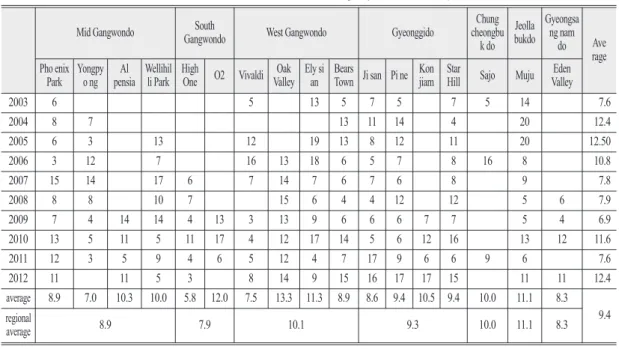
ing day until the snow is properly ready for offi- cial opening. Thus, we counted the number of days to the season opening from the very first day the temperature goes below -2˚C during 2003/2004-2012/2013. It is found that it generally took average 9.4 days for snow-making and we selected the ski season open condition as 9 days after the date temperature goes below -2˚C (Table 1).
Third, about deciding when to close ski season, operators answered that they close the season in March, even if temperature stays below -2˚C.
According to the interview, the most important factor deciding the time of closure is demand sat- isfaction. The number of visitors reduces once school starts with snow deterioration. Thus, this study initially intended to set the condition of
“resort closing” at the point when snow deterio- rates easily and change of environment is closely related to the degree of attractiveness of visiting ski resorts by customers, namely, when tempera- ture is over zero degree.
Table 1. Number of artificial snow making days until season open
Mid Gangwondo South
Gangwondo West Gangwondo Gyeonggido Chung cheongbu
k do Jeolla bukdo
Gyeongsa ng nam
do Ave Pho enix rage
Park Yongpy o ng Al
pensia Wellihil li Park High
One O2 Vivaldi Oak Valley Ely si
an Bears
Town Ji san Pi ne Kon jiam Star
Hill Sajo Muju Eden Valley
2003 6 5 13 5 7 5 7 5 14 7.6
2004 8 7 13 11 14 4 20 12.4
2005 6 3 13 12 19 13 8 12 11 20 12.50
2006 3 12 7 16 13 18 6 5 7 8 16 8 10.8
2007 15 14 17 6 7 14 7 6 7 6 8 9 7.8
2008 8 8 10 7 15 6 4 4 12 12 5 6 7.9
2009 7 4 14 14 4 13 3 13 9 6 6 6 7 7 5 4 6.9
2010 13 5 11 5 11 17 4 12 17 14 5 6 12 16 13 12 11.6
2011 12 3 5 9 4 6 5 12 4 7 17 9 6 6 9 6 7.6
2012 11 11 5 3 8 14 9 15 16 17 17 15 11 11 12.4
average 8.9 7.0 10.3 10.0 5.8 12.0 7.5 13.3 11.3 8.9 8.6 9.4 10.5 9.4 10.0 11.1 8.3 regional 9.4
average 8.9 7.9 10.1 9.3 10.0 11.1 8.3
Last, ski resorts are operated based on a season unit counting the consecutive days between the opening and closing date when snow plowing is completed rather than adding up the days opened during the season.
Then, the value of current temperature was set as baseline using the average value estimated from the daily minimum temperature records from 2003/2004 to 2012/2013. In addition, the daily minimum temperature of 2031/2032 to 2040/2041, 2061/2062 to 2070/2071, 2091/2092 to 2099/2100 was extracted using RCP 8.5 and RCP 4.5 scenarios. The 10 years of average minimum temperature were used as a reference to decide the future temperatures of 2030s, 2060s and 2090s.
Finally, the predicted temperature was inserted at the ski season simulation model to forecast the changes on 2030s, 2060s and 2090s. The potential for the future operation was carefully projected base on the 100 days rule. The 100 days rule is widely applied as minimum business days required to maintain the ski resorts(Scott et al., 2007; Steiger et al., 2013; Koeing & Abegg, 1997).
Ⅳ. Results
1. Temperature Change
If, fortunately, the mitigation efforts of climate change ends up as a success (RCP 4.5), the aver- age minimum temperature for ski season in Korea will only rise from -5.58 to -3.98 (+1.60).
The ski resorts in Mid Gangwondo will face increase from -8.14 to -5.71 (+2.43), the ski resorts in South Gangwondo from -5.68 up to -4.23 (+1.45), the ski resorts in West Gangwondo from -5.77 up to -4.80 (+0.97), the ski resort in Gyeonggido from -4.11 to -2.56 (+1.55), the ski resort in Chungcheongbukdo from -6.44 up to -2.68 (+3.76), the ski resort in Jeollabukdo from -4.42 up to -3.46 (+0.96), and, lastly, the ski resorts in Gyeongsangnamdo from -2.18 up to -0.78 (+1.4).
On the other hand, if current trend of climate change continues (RCP 8.5), the daily average minimum temperature of the ski season from November to March will increase from -5.58 to -0.42 (+5.16) by 2090s. Especially the ski resorts in Mid Gangwondo and Chungcheongbukdo, the
Table 2. Prediction of average daily minimum temperature (˚C) of ski resortMid Gangwondo South Gangwondo West Gangwondo Gyeonggido Chungc heong buk do
Jeol la buk do
Gyeong nam do Avesang Pho enix rage
Park Yongp yo ng Al
pensia Wellihilli Park Avera
ge High
One O2 Avera ge Vivald
i Oak Valley Ely si
an Bears Town Avera
ge Ji san Pi ne Kon
jiam Star Hill Aver
age Sajo Muju Eden Valley RCP 4.5
Base line -8.14 -8.14 -8.14 -8.14 -8.14 -5.68 -5.68 -5.68 -5.77 -5.77 -5.77 -5.77 -5.77 -4.11 -4.11 -4.11 -4.11 -4.11 -6.44 -4.42 -2.18 -5.58 30s -7.66 -5.92 -7.60 -7.01 -7.05 -5.54 -5.77 -5.65 -5.20 -4.99 -5.48 -6.05 -5.43 -3.97 -3.65 -3.14 -3.64 -3.60 -3.71 -4.54 -1.59 -5.03 60s -6.83 -5.05 -6.54 -6.24 -6.17 -4.64 -4.68 -4.66 -4.26 -4.16 -4.49 -5.25 -4.54 -3.15 -2.85 -2.35 -2.84 -2.79 -3.00 -3.94 -0.95 -4.19 90s -6.28 -4.72 -6.09 -5.74 -5.71 -4.10 -4.35 -4.23 -4.01 -6.01 -4.24 -4.95 -4.80 -2.96 -2.62 -2.10 -2.56 -2.56 -2.68 -3.46 -0.78 -3.98 RCP 8.5
Base line -8.14 -8.14 -8.14 -8.14 -8.14 -5.68 -5.68 -5.68 -5.77 -5.77 -5.77 -5.77 -5.77 -4.11 -4.11 -4.11 -4.11 -4.11 -6.44 -4.42 -2.18 -5.58 30s -5.93 -5.43 -6.99 -7.44 -6.45 -5.93 -5.11 -5.52 -5.19 -5.00 -5.61 -6.09 -5.47 -4.34 -4.00 -2.89 -3.30 -3.63 -3.99 -4.95 -0.48 -4.86 60s -3.09 -2.69 -4.09 -4.57 -3.61 -3.09 -2.36 -2.73 -0.13 -2.30 -2.87 -3.40 -2.18 -1.72 -1.36 -0.23 -0.66 -0.99 -1.28 -2.15 1.77 -2.01 90s -1.22 -0.95 -2.16 -2.77 -1.77 -1.22 -0.49 -0.85 -0.79 -0.66 -1.24 -1.76 -1.11 0.00 0.36 1.52 0.94 0.71 0.35 -0.51 3.46 -0.42
temperature will increase from -8.14 to -1.77 (+6.37) and from -6.44 to 0.35 (+6.79), respectively.
Ski resorts in South Gangwondo will experience temperature rise from -5.68 up to -0.85 (+4.83), the ski resorts in West Gangwondo from -5.77 to -1.11 (+4.66), the ski resorts in Gyeonggido from -4.11 up to 0.71 (+4.82), the ski resort in Jeollabukdo from -4.42 up to -0.51 (+3.91), and the ski resort in Gyeongsangnamdo from -2.18 up to 3.46 (+5.64). The ski resorts in Gyeonggido and Gyeongsangnamdo, the lowest daily temper- ature will be up to zero degree during the winter
in 2090s(Table 2).
2. Ski Season Change
If the efforts to mitigate climate change results as a success (RCP4.5), the ski resorts at Mid Gangwondo, South Gangwondo and Jeollabukdo will be relieved from facing difficult situation as they will continue to guarantee 130 days of operation. In addition, the resorts in West Gangwondo, Gyeonggido and Chungcheonbukdo will also continue status quo 110 days operation.
The Gyeongsangnamdo region, ski resorts could
Table 3. Outlook of ski season length changeDays(reduction ratio) Days(reduction ratio) Days(reduction ratio) Days(reduction ratio) RCP 4.5 RCP 8.5 RCP 4.5 RCP 8.5 RCP 4.5 RCP 8.5 RCP 4.5 RCP 8.5 GangwondoMid
Phoenix Park Yong Pyong Alpensia Wellihilli Park
Baseline 133 133 133 133 133 133 133 133
30s 135(-2) 131( 2) 134(-1) 120(10) 135(-2) 133( 0) 135(-2) 133( 0)
60s 136(-2) 97(27) 127( 5) 93(30) 135(-2) 121( 9) 136(-2) 114(14)
90s 134(-1) 93(30) 133( 0) 85(36) 133(0) 95(29) 134(-1) 96(28)
South Gangwondo
High One O2
Baseline 129 129 129 129
30s 135(-5) 131( -2) 136(-5) 126( 2)
60s 126(-2) 97(25) 126( 2) 96(26)
90s 133(-3) 93(28) 133( -3) 93(28)
GangwondoWest
Vivaldi Oak Valley Elysian Bears Town
Baseline 127 127 127 127 127 127 127 127
30s 121( 5) 120( 6) 121( 5) 119( 6) 122( 4) 120( 6) 135(-6) 131( -3)
60s 114(10) 91(28) 114(10) 93(27) 114(10) 93(27) 134(-6) 97(24)
90s 115( 9) 73(43) 132(-4) 73(43) 120( 6) 73(43) 134(-6) 74(42)
Gyeonggido
Jisan Pine Konjiam Star Hill
Baseline 113 113 113 113 113 113 113 113
30s 118(-4) 110( 3) 116(-3) 108( 4) 109( 4) 92(19) 115(-2) 93(18)
60s 113( 0) 72(36) 113(0) 70(38) 112( 1) 60(47) 112( 1) 69(39)
90s 114(-1) 73(35) 117(-4) 43(58) 110( 3) 45( 6) 117(-4) 46(59)
etc.
Chungcheongbukdo
Sajo Jeollabukdo
Muju Gyeongsangnamdo
Eden Valley
Baseline 129 129 127 127 94 94
30s 117( 9) 116(10) 126( 1) 131( -3) 91( 3) 84(11)
60s 112(13) 92(29) 126( 1) 95(25) 94( 0) 52(45)
90s 118( 9) 55(57) 133(-5) 56(56) 90( 4) 11(88)
* some negative(-) reduction ratio means increase ratio
maintain season with 90 days of possible opera- tion date in 2090s. In other words, according to the results, none of the ski resorts will run out of business.
However, if the climate change continues at current rate (RCP 8.5), the ski resorts in Mid Gangwondo and South Gangwondo will main- tain the number of opening days at today’s level until 2030s. Yet, the season will be shortened by 9-30% during 2060s, 28-36% during 2090s. This means that the ski season will last about 130 days in 2030s, approximately for 100 days in 2060s, and about 90 days in 2090s. The ski resorts in West Gangwondo, Chungcheonbukdo and Jeollabukdo will maintain their season at current level until 2030s. Moreover, they will not avoid the shortening of the season down to 24-29% of the current level in 2060s, and 42-57% in 2090s.
Regarding the number of opening days, they would maintain the season for about 120 days in 2030s, 90 days in 2060s, and about 60 days in 2090s. The number of operating days of resorts in Gyeonggido will start to decrease in 2030s, by 36- 47% in 2060s, and by 35-59% in 2090s. This means that ski resorts in Gyeonggido would
maintain their season for about 95 days in 2030s, 70 days in 2060s, and 60 days in 2090s. The resorts in Gyeongsangnamdo will find itself in the most difficult situation. They already have less than 100 days for business operation. To make matters worse, the resort will only be able to maintain their season for 84 days in 2030s, 52 days in 2060s, and only 11 days in 2090s.
3. Ski resorts operation possibility
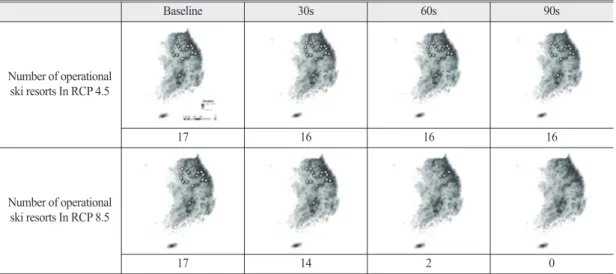
According to the 100 days rule, if the climate change is controlled (RCP 4.5), 16 of 17 ski resorts are able to operate for 100 days until 2090s. The 1 resort which failed to operate more than 100 days still has high chance to maintain its business until 2090s since it will have more than 90 days of operation date. If ski resorts could continue their business under as little as 90 days operation, all ski resorts in Korea would be able to keep its business until 2090s.
On the other hand, if the climate change rate maintain as today (RCP 8.5), 3 of 17 ski resorts will be driven out of business in 2030s, 12 more ski resorts will run out of business during 2060s
Baseline 30s 60s 90s
Number of operational ski resorts In RCP 4.5
17 16 16 16
Number of operational ski resorts In RCP 8.5
17 14 2 0
Figure 2. Forecast on future operation possibilit under the 100days operation system
and the remaining 2 ski resorts will face to termi- nate its business by 2090s. When looked into regions, ski resorts in Gyeongsangnamdo and part of Gyeonggido will disappear by 2030s.
After 2060s, Jeollabukdo, Chungcheongbukdo, Gyeonggido, West Gangwondo and South Gangwondo will lose all of its ski resorts and by 2090s. Mid Gangwondo will be forced to termi- nate its business, and then no more ski business will be operated in Korea (Figure 2).
Ⅴ. Discussion
1. Ski season simulation method
Many studies have tried to develop sophisticat- ed ski season simulation model. The representa- tive models are SkiSim1.0 (Scott et al., 2003) and SkiSim2.0 (Steiger, 2010). There are a couple of differences between the one constructed in this study and the model of recent studies depicted in the Table 4.
The first major difference of this study is that the temperature for artificial snow threshold was set higher than that of the existing scenarios.
Unlike large scale ski resort in the world, Korean ski resorts have less natural snow and therefore, worked hard to improve snow making technolo- gy to overcome such challenges. As a result, Korean ski resorts are able to produce artificial snow at higher temperature. Second, unlike other studies where depth of snow was used as basic measurement to count the number of days that
require snow making to keep the resort opened, this study shifted the focus from quantity frame to time frame since it is extremely difficult to cal- culate the total amount of snow to accumulate 30 cm from snow precipitation. Third, this study set the closing condition of the resorts based on the quality of snow. Since the resort managements would consider demand satisfaction more vital to the length of skiing season even though the cli- mate conditions are good enough to continue the operation. Forth, this study calculated the dura- tion of each ski season from the date of the phys- ical openings of the resorts to the date the resorts actually close. The ski resorts are not operating on a day unit; rather, considers the entire season as one unit. Last, precipitation has not been con- sidered because the historical data indicates that consecutive days of liquid precipitation more than 20mm, which is suggested as a closing con- dition from existing studies, have not happened in Korea during winters (Heo & Lee, 2012). Also temperature lapse for elevation was not consid- ered as the size of Korean ski resorts is not larger than the data resolution (1km×1km), and it does not carry any significance to divide them into smaller scales.
2. Ski season shortening and Alternatives Base on the premise that the effort to reduce the trend of climate change will continue, RCP 4.5 forecasted that there will be not much of a change in the ski resorts in Korea. However,
Table 4. Comparison among ski season simulation modelsThis Study SkiSims(scott et al., 2003; Steiger, 2010)
Snowmaking threshold < -2˚C < -5˚C
Open Condition 9days after <-2˚C snow depth > 30cm
Close Condition > 0˚C snow depth<30cm; maximum temperature 10˚C for 2 consecutive days accompanied by liquid precipitation; or 2d of liquid precipitation totaling>20mm
Ski Season from open to close Number of open days
according to the RCP 8.5 scenario based on the hypothesis that climate change rate will be main- tained at today’s level, as other prestigious resorts around the world, Korea’s small scale resort will face grave difficulties. The result of this study shows that the ski season would be shortened to 118 days in 2030s, 88 days in 2060s and 70 days by 2090s. This results aligns with other case stud- ies on ski resort in Ontario, Canada which is expected to face reduction of operation days from 123 days to 73 days. The Tyrol is also projected to loss its operation days from 136 days to 12 days, 136 days to 2 days and 166 days to 130 days. This could be translated that the hardship of ski business caused by climate change will not be restricted to one area but it will become a worldwide problem (Table 5).
Korean ski industry is already sensing the impact of climate change and reacting to make an adaptation to its influence. The response divides into 2 parts: technical aspect and management part.
First, on a technical aspect, ski resorts are improving artificial snow making and managing skills. As mentioned earlier, the threshold of arti- ficial snow in Korea is 3 degree (˚C) higher than that of other countries. The operators put a lot of efforts in upgrading snow making machines and to produce snow at higher temperature. Such
efforts is expected to enhance the snow making ability at more demanding environmental condi- tions in the future.
Second, when looking at the management aspect, ski resorts are expanding their business to a complex resort to reduce the dependency on ski business. Korean ski resorts first started as a win- ter sports oriented business, but today they are adding other attractions such as golf, water parks and shopping mall. Especially, water parks or shopping mall could run business all-around-a- year which compensates the loss of business from shortening of ski seasons. During the interview, one operator mentioned that “ski resort will transforme into a service-oriented facility for cus- tomers rather than a revenue source”.
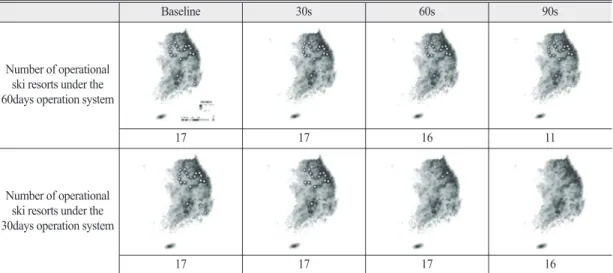
Base on the comment from operators, this study set a hypothesis that even the ski resorts lose its revenue source, it might be able to run as a service-oriented facility and maintain its busi- ness. This study worked on the hypothesis and outlook how long ski resorts might be able to maintain its operation. Despite the climate change speed, if business could continue to open 60 days, all 17 resorts shall keep its business by 2030s, 16 resorts by 2060s and 11 resorts by 2090s. In addition, if the resorts can maintain 30 operation days as a minimum level, all 17 resorts could maintain its operation by 2060s and 16 will
Table 5. Comparison of season length change with world famous large scale ski resortScott(2003) Steiger(2010) This Study
Ontario, Canada(regional level) Tyrol, Austria Korea(average
of 17resorts) A resort B resort C resort
Climate Change Scenario HadC
M3 -B2 CGCM 2 -B2 CSIRO
-A2 CCSR - IS92a HadCM
3 -IS92a CGCM1
-IS92a B1 A1B B1 A1B B1 A1B RCP
4.5 RCP
8.5
Baseline 123 123 123 123 123 123 136 136 136 136 166 166 124 124
Short term 123 118 114 112 114 107 136 125 131 134 164 161 124 118
Medium term 116 114 104 102 104 91 124 103 122 97 158 161 120 88
Long term 112 104 73 78 86 75 92 12 54 2 153 130 124 70
survive until 2090s (Figure 3). However, consider- ing the expenses to operate a ski resort, it is des- tined to face loss of business operation and it is unclear that they could maintain its business by 2090s. It is also uncertain that the future demands of ski will maintain at the same level of today.
Ⅵ. Conclusion
This study focused on the impact of climate change on small scale ski resorts in Korea.
If the efforts to mitigate climate change main- tains, it is expected that the ski industry in Korea will not face any changes compared to today.
However, if the climate change rate continues as it is today, the ski resorts in Korea, as other world class large scale ski resorts, will experience reduced number of ski season days and many of them will be impossible to run a business.
Ski resort operators will continuously improve snow management skills and transfer into com- plex resort business to lower the dependency on ski business. If such efforts are sustained, there is a high chance that ski resorts can be operated till the 2090s. However, considering the human
resource and physical resource investment, the reality is quite doubtful.
Climate change is continuing even at this moment. Therefore, the ski industry which is highly dependent to climate change cannot avoid changes. To sustain ski industry, the effort to mit- igate climate change and steady research is need- ed. Moreover, to adapt to trend of climate change, technical and managerial study and effort must be continuously performed.
References
Bank M, Wiesner R. 2011. Determinants of weather derivatives usage in the Austrian winter tourism industry, Tourism Management, 32(1), 62 -68.
Becken S, Wilson J. 2013. The impacts of weather on tourist travel, Tourism Geographies, 15(4), 620 -639.
Bicknell S, Mcmanus P. 2006. The canary in the coalmine: Australian ski resorts and their response to climate change, Geographical Research, 44(4), 386 -400.
Dawson J, Scott D. 2013. Managing for climate
Baseline 30s 60s 90s
Number of operational ski resorts under the 60days operation system
17 17 16 11
Number of operational ski resorts under the 30days operation system
17 17 17 16
Figure 3. Forecast on future operation possibilit under the 60, 30days operation system in RCP 8.5