순환식 수경재배시 배양액조성에 따른 배양액 양분농도 변화 및 오이 생육
노미영1·최경이1·이한철1·서태철1·김완순2*·이용범2
1국립원예특작과학원시설원예시험장
,
2서울시립대학교환경원예학과Changes in Nutrient Element Concentrations and Growth of Cucumber Plants ( Cucumis sativus L. cv. Joeun Baegdadagi)
as Affected by Nutrient Solution Composition in Recirculating Hydroponic Systems
Mi Young Roh
1, Gyeong Lee Choi
1, Han Cheol Rhee
1, Tae Cheol Seo
1, Wan Soon Kim
2*, and Yong Beom Lee
21
Protected Horticulture Research Station, NIHHS, RDA, Busan 618-800, Korea
2
Dept. of Environmental Horticulture, Univ. of Seoul, Seoul 130-743, Korea
Abstract.
This experiment was conducted to find out the effect of nutrient solution composition on the growth of cucumber plants and the changes in macro-elements in nutrient solutions in recirculating hydro- ponic systems. Cucumber plants ( Cucumis sativus L. cv. Joeun Baegdadagi) were grown in closed perlite cultivation systems supplied with different nutrient solutions developed by NHRS (National Horticultural Research Station in Japan), Yamasaki, PBG (Proefstation voor Bloemisterij en Glasgroente), and NIHHS (National Institute of Horticultural and Herbal Science in Korea). The concentrations of NO
3-N, Ca
2+, Mg
2+, and SO
4-S in the recycled nutrient solutions increased but that of NH
4-N decreased gradually in all the treat- ments. The PO
4-P and K
+concentrations were continuously reduced from the beginning of the harvest to the harvest peak period. There were no significant differences in the concentrations of NO
3-N, NH
4-N, and Ca
2+in the recirculated nutrient solutions among four treatments, while the concentrations of PO
4-P and K
+were lowest and those of Mg
2+and SO
4-S were highest in the treatment of Yamasaki's nutrient solution. All growth-related parameters of cucumber plants except for leaf number were not significantly affected by the nutrient solution compositions. Due to its low concentrations of PO
4-P and K
+in the recycled nutrient solu- tion, however, the number and yield of cucumber fruits were lowest in the treatment of Yamasaki’s nutrient solution.
Key words :
drainage, hydroponics, nutrient ratio, nutrient solution recycling
서 론
수경재배방식은 작물을 재배하면서 배출되는 배액
(
排液)
의폐기또는회수여부에따라비순환식수경재배와 순환식수경재배로 구분된다
.
근년들어 농업을비롯한 모든 산업에서 환경을 보전하기 위한 친환경 기술개발이활발히진행되고있고수경재배에서도작
물 재배에 사용하고 남은 배액의배출을 최소화하기 위한친환경순환식수경재배기술개발에대한연구 가이루어지고있다
.
순환식수경재배에서배양액을교체하지않고계속 사용하면순환되는배양액과초기에시용한배양액간 의 무기양분 비율 및 농도가 달라지므로
(Bando
등, 1988; Sasaki
와Toshitaka, 1978; Yamashita
와Hayashi,
1997),
이러한변화를줄이기 위해서는 배양액조성에대한검토가필요하다
(Bando
와Machida, 1992).
순환 식수경재배시스템을이용하여배양액을재순환할경*Corresponding author: [email protected]
*Received September 17, 2008; Revised October 4, 2009;
*Accepted December 5, 2009
우
, Zekki
등(1996)
은무기양분비율간의불균형이신 속하게 일어난다고 하였고, Sonneveld(1981, 2002)
는Ca
2+, Mg
2+ 및SO
42−와 같은2
가이온들의 축적이발 생하여배양액내무기양분조성이변화된다고보고하 였다.
현재오이 수경재배용으로여러종류의배양액조성
(Roh
등, 1997; Sonneveld
와Straver, 1992; Yamasaki, 1984)
이개발되어 있고, Roh
등(1997)
은순환식수경 재배시 배양액조성에 따른 오이 작물의 생육 특성에 대하여보고한바있다.
그러나,
배양액조성을달리하여지속적으로배양액을재순환하였을때배양액내무 기양분농도의변화에 대한연구는미흡한실정이다
.
따라서
,
본연구는주지착과성이높은반백계오이품종을이용하여순환식수경재배시배양액조성에따른배 양액내 무기양분 농도의 변화를구명하고 그에 따른 오이의생육반응을조사하고자수행되었다
.
재료 및 방법
‘
조은백다다기’
오이품종을시험재료로하여국립원 예특작과학원 시설원예시험장내에 있는 유리온실(
폭6.5m ×
길이25m ×
동고3m)
에서시험을수행하였다.
최아시킨 종자를
2004
년4
월21
일에 육묘용 상토가 들어있는50
공플러그트레이에파종하고, 5
월18
일에 펄라이트가 들어있는 베드(
폭38cm ×
길이200cm ×
깊이
15cm)
위에각각10
주씩정식하였다.
배지는정 식전에EC 1.2dS
·m
−1의배양액으로포수시켰다.
베드는
1/200
의 경사를주고 바닥 부분에배수구를 뚫어공급된배양액이흘러나오도록하였으며
,
배수구를통해흘러나온배양액을순환하여재사용할수있도록 정식베드 아랫부분에
140L
용량의 급배액 용기와290W
모터펌프를설치하였다.
또한,
배지내수분이대기중으로증발되는것을막기 위하여흑백플라스틱 필름으로베드위를멀칭하였다
.
시험에사용된배양액조성은일본원시 배양액
,
야마자키오이 배양액
(
이후 야마자키 배양액), PBG
오이순환식배양액
(
이후PBG
배양액)
및원예원오이순환식배양액
(
이후원예원배양액)
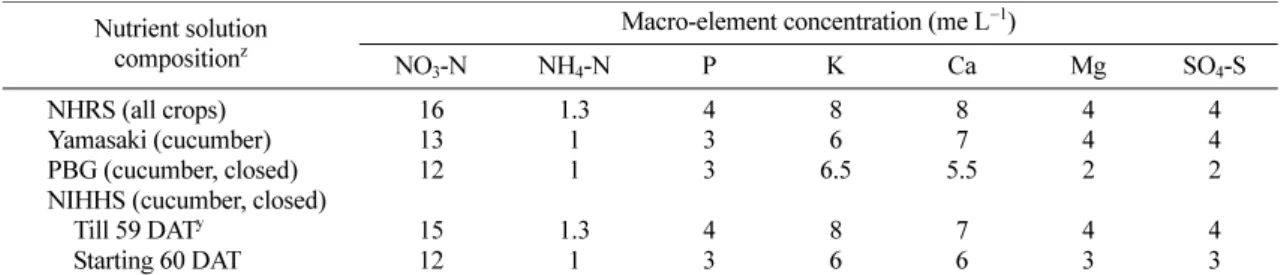
이었다(Table 1).
원예원배양액은다른배양액조성과는달리과실수확최 성기에 접어들면서 배양액내
NO
3-N, Mg
2+, SO
4-S
등의농도가증가되는것을억제하기위하여이들성 분의농도를다소낮추도록조성한배양액이다
.
초기에시용한배양액의
EC
는정식직후부터정식후7
일까지 는1.2dS
·m
−1,
정식후8
일부터21
일까지는1.6dS
·m
−1,
정식후
22
일부터34
일까지는2.0dS
·m
−1,
정식후35
일 부터59
일까지는2.4dS
·m
−1,
정식후60
일이후에는2.0dS
·m
−1이되도록관리하였다.
초기에공급한배양액량
(120L)
의20%
정도가 감소될 때마다 배양액을보충하였으며
,
정식후35
일과60
일째에는배양액을전 량교체하였다.
급배액용기내순환배양액의
EC
와pH
는EC
미터(DCM-10, DIK Co. Ltd., Korea)
와pH
미터((DPM-10, DIK Co. Ltd., Korea)
를 이용하여배양액 보충 전후 에측정하였다.
순환배양액의무기양분농도변화를측정하기위하여배양액시료를채취하여분석하였는데
,
배양액내의질소는켈달증류법
(Kjeltec 2300 Analyzer Unit, FOSS),
칼륨과칼륨은ICP
분광법(Integra XL, GBC Scientific Equipment Pty. Ltd.),
그리고 인산Table 1.
Composition of nutrient solutions used this experiment.
Nutrient solution
composition
zMacro-element concentration (me L
−1)
NO
3-N NH
4-N P K Ca Mg SO
4-S
NHRS (all crops) Yamasaki (cucumber) PBG (cucumber, closed) NIHHS (cucumber, closed)
Till 59 DAT
yStarting 60 DAT
16 13 12 12 15
1.3 1 1 1.3 1
4 3 3 4 3
8 6 6.5
8 6
8 7 5.5
7 6
4 4 2 4 3
4 4 2 4 3
z
NHRS; National Horticultural Research Station in Japan, PBG; Proefstation voor Bloemisterij en Glasgroente in the Nether- lands (Research Station for Floriculture and Glass Vegetables), NIHHS; National Institute of Horticultural and Herbal Science in Korea.
y
DAT; days after transplanting.
은 바나도몰리브덴산법
(Genesys 2, Thermo Fisher Scientific Inc.)
을이용하여정량분석하였다.
각 처리구별로 시험이 종료된 시점에 초장
,
엽수,
엽면적을측정한다음
, 70
oC
의온도로유지되는건조 기에 넣어 무게 변화가없을 때까지 건조시킨후 건 물중을 측정하였다.
수량 조사는7
월1
일부터8
월7
일까지실시하였으며
,
오이과실은길이가25cm
정도 되었을때수확하여과장,
과경및과중을측정하였다.
결과 및 고찰
네 가지 배양액조성
,
즉 일본원시 배양액,
야마자키배양액
, PBG
배양액및원예원배양액을사용하여오이를재배하였을때순환배양액의
EC
와pH
변화를Fig. 1
에나타내었다.
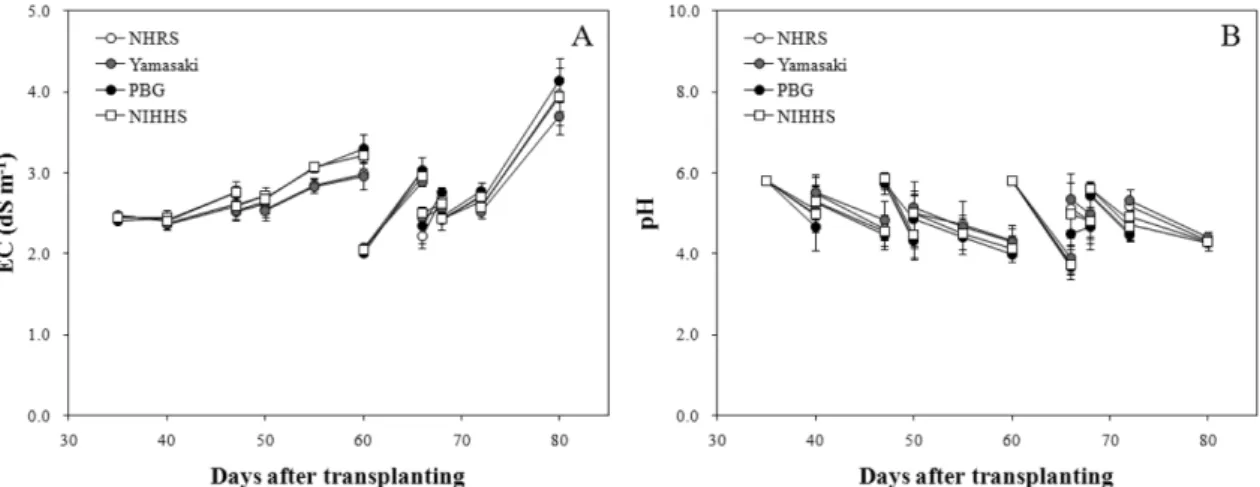
모든처리에서순환배양액의EC
는배양액을보충하거나전량교체하였을때일시적으 로낮아지기는 하였으나정식후일수가경과됨에따라 증가되는 경향을 나타내었는데
(Fig. 1A),
그 원인은 계속적으로 배양액을 재순환하였기 때문이다(Savvas, 2002; Savvas
와Manos, 1999; Stanghellini
등, 1998).
Choi
등(2001)
은 순환식 고형배지재배에서 배양액이순환되는동안작물의생육단계에따라근권내무기양 분중의일부 이온들은빠르게소모되고일부이온들 은 배지 내에 집적되기 때문에 순환배양액의
EC
와pH
가 심하게 변한다고 하였으며, Benoit(1992)
와Böhme(1995)
은 축적되기 쉬운 이온인SO
4-S, Na
+, Cl
−등은순환배양액의EC
를높이는주요인이된다고보고하였다
.
EC
변화와는 달리 순환배양액의pH
는 계속적으로 감소되는경향을나타내었으며,
특히과실수확개시후2~4
주에해당되는정식후55~66
일경에는더욱급격히저하되었다
(Fig. 1B). Roh
등(2008)
이 오이 순환식 수경재배시 배양액농도에따른pH
변화에대해 보고 한바와같이,
이러한pH
저하는생육단계에따른오이의양분흡수특성에기인한것으로서왕성한생식생 장으로인한
K
+의흡수증가와그에따른근권으로의H
+의배출증가에의한것이다.
Ishihara
등(2006)
은 근권내배양액의NO
3-N, Ca
2+및
Mg
2+ 농도는근권내배양액의EC
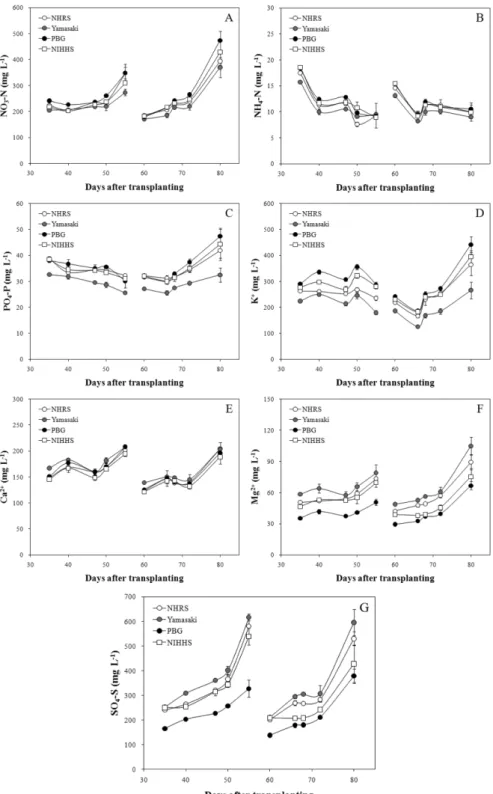
와유사한변화 추이를나타낸다고보고하였는데본시험에서도동일 한 경향을나타내었다(Fig. 2).
순환배양액내NO
3-N, Ca
2+, Mg
2+ 및SO
4-S
의 농도는배양액조성에 관계없이정식후일수가진전됨에따라계속적으로증가되는 경향을 보였다
(Fig. 2A, 2E, 2F
및2G).
한편, NH
4-
N
의 농도는배양액을전량교체한시점인정식후35
일과
60
일에 가장 높고 그 후에는 점차로 감소되어(Fig. 2B), NO
3-N, Ca
2+, Mg
2+ 및SO
4-S
의 농도 변 화와는상반되는 양상을보였다. PO
4-P
와K
+의농도 는과실수확이시작된정식후43
일부터과실수확최성 기에해당되는정식후66
일까지는계속적으로감소하Fig. 1.
Changes in the EC (A) and pH (B) of the recycled nutrient solution at different nutrient solution compositions in a
closed perlite culture of cucumber. Vertical bars represent the standard deviation of a sample (n = 3). NHRS (National Hor-
ticultural Research Station in Japan), PBG (Proefstation voor Bloemisterij en Glasgroente in the Netherlands), and NIHHS
(National Institute of Horticultural and Herbal Science in Korea).
Fig. 2.
Changes in the concentrations of NO
3-N (A), NH
4-N (B), PO
4-P (C), K
+(D), Ca
2+(E), Mg
2+(F), and SO
4-S (G) in the
recycled nutrient solution at different nutrient solution compositions in a closed perlite culture of cucumber. Vertical bars
represent the standard deviation of a sample (n = 3). NHRS (National Horticultural Research Station in Japan), PBG
(Proefstation voor Bloemisterij en Glasgroente in the Netherlands), and NIHHS (National Institute of Horticultural and
Herbal Science in Korea).
다가
,
그후에는점진적으로증가하고시험종료시점인 정식후80
일에가까워지면서급격히증가되는경향을나타내었다
(Fig. 2C
와2D).
Bando(1991a, b)
는야마자키배양액을이용한장기수경재배시에과채류에서는점차적으로특정성분농 도의증가나저하가일어날수있으며
,
토마토의경우에는
NO
3-N, K
+ 및PO
4-P
의 농도는 저하되고Ca
2+와
Mg
2+의 농도는 상승한다고 하였다. Masuda
등(1989)
은 일본 원시 배양액을 이용한 토마토 순환식암면재배 시에
PO
4-P
와K
+의 농도는 저하되고Ca
2+와
Mg
2+의 농도는 상승한다고 보고하였다.
또한, Isozaki
등(2004)
은PO
4-P
와K
+의농도가극단적으로 저하되면줄기가가늘어지고과실수확기가지연될수 있다고 하였으며, Bando
와Machida(1992)
는 토마토 순환식 수경재배에서는 생육중기의 배지내PO
4-P
와K
+의농도저하를방지하기위하여급액하는배양액의PO
4-P
와K
+의농도를높인개량배양액조성을공급하여야한다고제시하였다
.
따라서
,
본 연구의시험결과와위에서언급한연구 자들의 연구결과를 토대로,
순환배양액내다량원소의 농도변화 양상은배양액조성에관계없이세가지유 형,
즉 지속적 증가형(NO
3-N, Ca
2+, Mg
2+ 및SO
4- S),
지속적감소형(NH
4-N)
및생식생장기감소형(PO
4- P
와K
+)
으로 분류할수있을것으로판단되었으며오 이,
토마토등을포함한과채류순환식수경재배시에이러한농도변화유형을고려하여공급배양액내무기 양분농도를조절해주는것이근권내적정 무기양분 농도 유지 및 작물 생육 증대에바람직할것으로 생 각되었다
.
순환배양액내무기양분농도를배양액조성별로비교 해 보면
(Fig. 2), NO
3-N, NH
4-N
및Ca
2+의 농도는배양액조성간에큰차이를나타내지않았다
.
그러나,
야마자키배양액을이용한오이순환식수경재배시에 다른세가지 배양액조성에비하여
PO
4-P
와K
+의농 도는 가장 낮아지고Mg
2+와SO
42−의 농도는가장 높 아지는결과를나타내었다. PO
4-P
의농도는과실수확기로접어들면서부터
Sonneveld
와Straver(1992)
가제시한근권내적정농도인
28mg
·L
−1보다도낮게유지 되었으며K
+의농도는재배기간내내근권내적정농도 인313mg
·L
−1보다훨씬낮은수치를나타내었다.
한편
,
순환식수경재배시 특히배양액내 축적이문제시되는
SO
4-S
의농도는PBG
배양액조성처리에서전재 배기간동안가장낮았고원예원배양액조성처리에서는 정식후
60
일부터 농도를 낮춘 조성(Table 1)
으로관리함으로써
PBG
배양액조성에근접하는결과를보 였다.
배양액조성을달리하여오이를순환식으로수경재배 하였을때
,
엽수를제외한작물생육은배양액조성간에 유의한 차이를 보이지않았는데
(Table 2),
이러한결과는정식후
35
일,
즉영양생장이어느정도진전된 상태에서처리가개시되었기때문이라생각된다.
오이 의주당과수와과실수량은야마자키배양액조성처리 에서가장적었으며나머지세가지배양액조성간에는큰차이를나타내지않았다
(Table 3).
야마자키배양액을이용한오이 순환식수경재배에서과실수량이 가장감소된것은다른처리에비하여과실수확기동 안
PO
4-P
와K
+의 농도가근권내 적정농도보다 훨씬 낮은농도로유지됨으로써(Fig. 2),
이들무기성분들이 과실생육에필요한만큼공급되지않았기때문이라생 각된다.
이상의결과를토대로
,
오이 순환식수경재배시순 환배양액내다량원소의농도는배양액조성에관계없이 Table 2.Growth responses of cucumber plants grown at different nutrient solution compositions in a closed perlite culture 82
days after transplanting.
Nutrient solution composition
zPlant height (cm) Leaf number (no./plant) Top dry wt. (g/plant) Leaf area (cm
2/plant) NHRS Yamasaki
PBG NIHHS
y
696 a
y696 a 692 a 703 a
58 a 55 ab 54 b 58 a
119.7 a 114.8 a 119.5 a 120.6 a
26,607 a 27,078 a 27,245 a 27,263 a
z
NHRS; National Horticultural Research Station in Japan, PBG; Proefstation voor Bloemisterij en Glasgroente in the Nether- lands (Research Station for Floriculture and Glass Vegetables), NIHHS; National Institute of Horticultural and Herbal Science in Korea.
y
Mean separation within columns by Duncan’s multiple range test at P < 0.05.
주로영양생장이나생식생장등의작물생육특성에기 인하여변화된다는것을알수있었다
.
또한,
야마자키 배양액을이용하여순환식수경재배방식으로오이를재 배할경우,
과실수확기동안순환배양액내또는근권내PO
4-P
와K
+의 농도를 적정범위 수준으로 유지할 수 있도록이들무기양분의공급량을증가시켜야할것으 로판단되었다.
적 요
본시험은순환식수경재배시배양액조성이배양액 내 다량원소 농도의변화 및오이 생육에미치는 영 향을구명하고자 수행되었다
.
네가지배양액조성,
즉일본 원시 배양액
,
야마자키 오이 배양액, PBG
오이순환식배양액및원예원오이순환식배양액이급액 되는순환식펄라이트수경재배시스템에서오이
(‘
조은 백다다기’
품종)
를재배하였다.
네가지배양액조성처 리구 모두에서 순환배양액내NO
3-N, Ca
2+, Mg
2+ 및SO
4-S
의농도는정식후일수가진전됨에따라증가되었고
NH
4-N
의농도는점차적으로감소되었다.
순환배양 액내PO
4-P
와K
+의농도는과실수확개시기부터과실 수확최성기까지계속적으로감소되었다.
순환배양액내NO
3-N, NH
4-N
및Ca
2+의 농도는 배양액조성 간에큰차이를나타내지않았다
.
그러나,
야마자키배양액 을 이용한오이 순환식수경재배 시에 다른 세가지 배양액조성에비하여PO
4-P
와K
+의농도는가장낮아 지고Mg
2+와SO
42−의 농도는 가장 높아지는 결과를 나타내었다.
엽수를제외한작물생육은배양액조성간 에유의한차이를보이지않았다.
그러나,
오이의과수 와과실수량은야마자키배양액조성처리에서가장적 었는데,
그것은 순환배양액내PO
4-P
와K
+의 농도가낮게유지되었기때문이다
.
주제어 : 무기양분비율
,
배액,
배양액재순환,
수경재배인 용 문 헌
1. Bando, K. 1991a. Recirculating rockwool culture of tomato [1]. Agr. Hort. 66:61-66 (in Japanese).
2. Bando, K. 1991b. Recirculating rockwool culture of tomato [2]. Agr. Hort. 66:68-72 (in Japanese).
3. Bando, K. and H. Machida. 1992. Establishment of the productive techniques of rock wool culuture on toma- toes IV. Effect of nutrient solution compositions on the quality and yield in circular solution system. Bull.
Tokushima Agric. Exp. Stn. 28:35-42 (in Japanese).
4. Bando, K., H. Machida, and H. Kodo. 1988. Establish- ment of the productive techniques of rock wool cul- ture on tomatoes . Effect of nutrient concentration on the quality and yield of tomato in circular solution cul- ture. Bull. Tokushima Agric. Exp. Stn. 25:27-35 (in Japanese).
5. Benoit, F. 1992. Practical guide for simple soilless cul- ture techniques. European Vegetable R & D Center, Belgium, pp. 28-37.
6. Böhme, M. 1995. Effects of closed system in sub- strate culture for vegetable production in greenhouses.
Acta Hort. 396:45-54.
7. Choi, E.Y., H.J. Lee, and Y.B. Lee. 2001. Mineral ele- ments control of the nutrient solution in perlite culture of cucumber. J. Kor. Soc. Hort. Sci. 42:497-500 (in Korean).
8. Ishihara, Y., H. Hitomi, and Y. Yamaki. 2006. Effect of nutrient composition used in the closed hydroponics system with capillary uptake method on nutrient ele- ment concentrations in the organic substrates and yield of tomato. Hort. Res. (Japan) 5:265-270 (in Japanese).
9. Isozaki, M., N. Konishi, M. Kuroki, Y. Nomura, and K. Tanaka. 2004. Growth of tomato plants and changes in nutrient element concentrations in the rockwool sys-
Table 3.
Yield responses of cucumber plants grown at different nutrient solution compositions in a closed perlite culture har- vested from 43 to 82 days after transplanting.
Nutrient solution composition
zFruit number (no./plant) Fruit length (cm) Fruit diameter (mm) Fruit yield (g/plant) NHRS Yamasaki
PBG NIHHS
8.6 ab
y8.3 b 9.3 ab 9.6 a
25.6 a 25.2 a 25.3 a 25.9 a
31.9 a 33.0 a 31.7 a 33.8 a
b1,801 ab 1,662 b b1,946 ab
2,026 a
z
NHRS; National Horticultural Research Station in Japan, PBG; Proefstation voor Bloemisterij en Glasgroente in the Nether- lands (Research Station for Floriculture and Glass Vegetables), NIHHS; National Institute of Horticultural and Herbal Science in Korea.
y