• 검색 결과가 없습니다.

Design and Implementation of the Basic Technology for Solitary Senior Citizen's Lonely Death Monitor ing System using PLC

N/A
N/A
Protected

Academic year: 2021

Share "Design and Implementation of the Basic Technology for Solitary Senior Citizen's Lonely Death Monitor ing System using PLC"

Copied!
11
0
0

로드 중.... (전체 텍스트 보기)

전체 글

(1)

1. INTRODUCTION

The communications through the power lines are called as the PLC (Power Line Communica- tions) and this is a common name for the commu- nication modes for the information delivery. This technology transmits the data through the power lines on which the information is stored with the form of high frequency signal. The frequency sig- nal can be separated from the power line through exclusive power line modem and transmitted to the terminal devices. Owing to the economic and social developments, the PLC has a vast market potential

and wherever the electric power is available, it has an advantage of making a high-speed communica- tion possible without installing exclusive lines.

However, the disadvantage is that the lines are used to send electric power so that they are not the suitable communication media.

On the contrary, due to recent improvements in the stability and transmission speed with the digi- tal power line communication method, the PLC is being used for the home-network construction or for the factory automation, gradually widening it's application fields[1] and getting the limelight as the base technology of the 'Smart Grid'. For that rea-

Design and Implementation of the Basic Technology for Solitary Senior Citizen's Lonely Death

Monitoring System using PLC

Jun-Ho Huh

, Kyungryong Seo

††

ABSTRACT

The communications through the power lines are called as the PLC and this is a common name for the communication modes for the information delivery. This technology transmits the data through the power lines on which the information is stored with the form of high frequency signal. The characteristic of the frequency signal is that the signal can be separated from the power line through exclusive power line modem and transmitted to the terminal devices. In this paper, 'In-home Headcount' checking algorithm using Wi-Fi and taking above mentioned advantages is proposed, and the basic Technology for such Solitary Senior Citizen's Lonely Death monitoring system has been designed and implemented.

The comparative analysis has been conducted in this paper with the test-operated and test bed-completed 'Hyosimi 119 Safety-Welfare System' which is still being tested since 2008. With the 'In-home Headcount Checking Algorithm', Wi-Fi connection/disconnection status and SSIDs of relevant Wi-Fis will be checked. We expect that our proposed method will become as the basic Technology which can prevent lonely deaths of elderly people living alone. Since the PLC technology can be normally implement all the functions used on internet anticipate that the technology could be applied to many areas to construct a new form of communication network.

Key words: PLC, Power Line Communications, In-home Headcount, Monitoring System, IoT, Solitary Senior Citizen's Lonely Death Monitoring System

※ Corresponding Author : Kyungryong Seo, Address:

DSLab, Pukyong National University at Daeyeon, 45, Yongso-ro, Nam-gu, Busan, Republic of Korea, TEL : +82-17-545-6885, E-mail : [email protected]

Receipt date : Dec. 26, 2014, Revision date : Apr. 10, 2015 Approval date : May 2, 2015

††

Department of Computer Engineering, Pukyong National University (E-mail : [email protected])

††
Department of Computer Engineering, Pukyong National University (E-mail : [email protected])

※ This work was supported by a Research Grant of

Pukyong National University. (2014Year).

(2)

son, PLC has been widely studied recently in re- spect that it's a low-cost communication solution for the power grid and more recently, for the 'Smart Metering'.

The population aging is a global phenomenon.

These days, a variety of Smart environmental con- trol systems have been developed to help elderly and disabled people because the population aging is also a continuous phenomenon[2-6].

Nowadays, in Republic of Korea, unattended deaths of single-living elderly people have become a social issue. Thus, in this paper, we attempt to introduce the Smarthome-based technology which enables device-to-device communications without special equipments using PLC for the purpose of solving the problems through Solitary Senior Citizen's Lonely Death Monitoring System with the PLC and PLC-based Wi-Fi. That is, this tech- nology can be considered as an important element technology among the Internet of Things(IoT)- based technologies which enable at-home devices' internet connections without additional communi- cation lines.

In this study, the proposed technology has been implemented using the C and C++ languages be- cause of the fact that the Rasberry Pi is based on the C language and it's more convenient for the recognition purpose.

2. RELATED STUDIES

2.1. Research Trends 2.1.1 Domestic Case

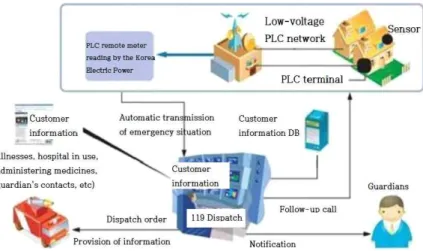
The 'Hyosimi 119 Safety-Welfare System' has started as a trial service in 2007 and is continuing up to this date. This system is a electrical power usage pattern analysis program to automatically detect unattended deaths, fire incidents and gas leakages and provide 119 service by installing the PLC terminals(watt-hour meter) in the households of elderly people.

The 'Hyosimi 119 Safety-Welfare System' pro-

vide the service in the level of informing whether emergency situation has occurred to the single- living elderly person. The Korea Electric Power Corp. collects power usage information through in- stalled PLC terminal at the PLC center and once they find that the usage pattern is abnormal, an emergency situation notifications will be sent to the district fire department or the designated helpers. For example, if a household that uses an average of 2Kw each morning to prepare breakfast and to watch TV does not appear to use any power at all, the PLC center will grasp the situation that the persons in home is not awake and active.

Therefore, the system is to automatically send out the warning signals to command the helpers or the emergency crews to call or visit the household when there is no detected power usage at the time of the normal situation where the power should be used.

2.1.2 Foreign Casees

Most of foreign countries' environmental control systems use RFID technology and as the control signals, they employ external sensors and voice recognition. Carol Rus et al.[6] proposed the voice control Smart house to control devices with the voice recognitions. Corcoran et al.[7] proposed the Universal Plug-n-Play (UPnP) to provide services to the wireless home network users with their PDAs and mobile phones or wearable devices. The user can send out the requests with his voice or user interface to the home server and in this case, the inconveniences caused by the pre-set areas and pre-recorded voice commands can be overcome.

Hwang et al.[4] introduced RFID-based multi-user access control algorithm for the UPnP Smart home.

The users are required to carry RFID tags to mon-

itor their access situations automatically so that

many additional RFID detectors have to be in-

stalled in each different place. Helal et al.[2] and

Liau et al.[3] suggested wireless Smart floor tech-

nology in which pressure sensors had been mount-

(3)

ed to detect the location of the residents. Nowa- days, the Brain Computer Interface-based smart environmental control system is an issue[8].

2.2 PLC Module

To use a PLC module, a single Data Concentra- tion Unit(DCU) is composed by binding with MCU, which is to control the PLC module. This DCU plays the rolls of storing the amount of usage measured with the electronic ammeter and of de- livering it to the main server periodically. Connect- ed to the PLC module, the usage amount is re- corded in the main server and output to the smart phones or external displays depending upon the needs of the user. The DCU composition is shown in (Fig. 1). RS-232 communication is carried out between the PLC module, MCU and main server.

This is an serial type interface and commonly called as a serial port. For this, RS-232 communi- cation must be established between MCU and main server. Our target system, Rasberry Pi and Odriod both support RS-232 communication so that we do not expect much trouble, and since Atmega and Arduino also have the pins for the RS-232 commu- nication, they are considered to be adequate for the device-to-device communications.

3. The Basic Technology for Solitary Senior Citizen's Lonely Death Monitoring System using PLC

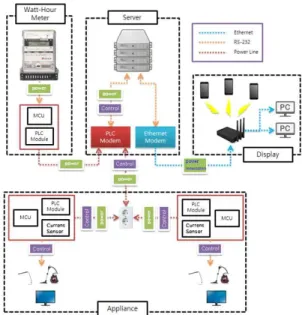
The entire functional diagram is shown in (Fig.

2). The structure is to establish communications between the watt-hour meter, main server and each electronic device by using the PLC modem.

Thus, the communication is possible without

other communication lines. For an external con- nection, internet is used to communicate between Smart phone and the main server. in the case of the connection with Smartphone with Wi-Fi, in- house headcount can be checked with the number of people connected to the Wi-Fi in use. The watt-hour meter communicates with the main server through the connection established with the PLC modem and the server stores the information received from the meter and transmits it to Smart phone when necessary. Each electronic devices communicate with the main server through the PLC modem and will be controlled by external con- nections or the other designated programs.

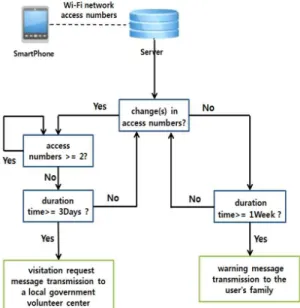
(Fig. 3) shows the Solitary Senior Citizen's Lonely Death Monitoring mechanism. The user ac- cesses to the network through the PLC and Wi-Fi and the server checks the number of people ac- cessing internet in realtime basis. Depending upon the changes in the number of access, the system functions are divided into 2 categories. First, in the event that there are no changes in the number. If the number does not change over a period of 1 week or more, the warning messages are trans- mitted to the user's family members or local gov- Fig. 1. DCU composition.

Fig. 2. Entire functional diagram.

(4)

ernment agencies determining the situation as 'continuously unattended condition'. Should there be any changes, the judgements are made if such changes have been caused by the simple accesses of the user or by the others' visits. The system transmits visit requests to the volunteer center and the local government agencies once the judgement is made as 'other people's visits' and its period exceeds 3 to 4 days, describing the condition as 'requiring observation for the visits' and such ac- tions can be monitored with Smart phones.

In-home headcount checking algorithm is in- dicated in (Fig. 4). Designate owner's IP address to H_ip. When the user makes a connection with Wi-Fi, the IP address of the router currently con- nected is stored at N_ip by searching SSID. Then, by comparing H_ip with N_ip, increase the count by 1 if they are identical or go back to the initial Wi-Fi connection process if they are different.

Meanwhile, we could assume the event that the Wi-Fi link has been disconnected and in that case, decrease the count by 1 if the comparison result is identical. Here, H_ip is a variable in which home Fig. 3. Solitary senior citizen's lonely death monitoring

mechanism.

Fig. 4. In-home headcount checking algorithm.

Fig. 5. In-home headcount system core.

(5)

owner's router IP address has been stored while N_ip is a variable where the IP address of the rout- er currently in access is stored. Lastly, 'Count' in- dicates the number of people connected to Wi-Fi.

The In-home headcount system is shown in (Fig. 5). System core is composed of 4 elements;

① Server, ② Device Manager, ③ Log Manager, and ④ Webpage Manager.

As for the direct communication with the Client, the Server first receives a signal which the Client side sends after checking the current in-home headcount and control the devices through DM. If the Client side sends In signal, the variable value called Home People becomes as ++, and if the sig- nal is Out, it becomes --.

The Device Manager receives an information about the in-home headcount and issue commands for the power supply control. Switch ON command will be given to the power supply when Home People≧1, determining that there a person or per- sons are inside. And OFF, for the condition of Home People == 0, considering that there are no

people inside of home. The Log Manager has no actual influences to the system but it generates Log data after checking the recording time and successes or failures every 4 seconds to conduct performance evaluations. The Webpage Manager outputs the power use amount on Webpage in or- der to make easier for the client to get an access and takes the roll of updating the amount.

(Fig. 6) Functional diagram shows the functional relationships between respective Classes. Main functions are largely comprised of Device Manager, WebpageManger, counting Server and Log Mana- ger.

First, the Device Manager communicates with each device's controller through PLC and assumes the role of delivering the orders to respective de- vices by user's request. Device represents each device carrying out the RS232 communications through PLC physically. Here, [(int)Sender Device]

[(int)Receiver Device] [(int)Unused] [(string)

Command Line] [End Of Command]-type protocol

is used. Mail Box is a central part of the Device

Fig. 6. Functional diagram shows the functional relationships respective classes.

(6)

Manager to process commands and a sort of non-circular queue of which is to deliver the re- quirements from a user to each device in the form of Mails. The Device Manager checks the MailBox, and if there are new any requests, delivers them to the relevant device(s), and stores the replies back to the Mail Box.

In our proposed system, the Device Manager gets the readings from the digital watt hour meter and sends the power usage volume to the webpage.

Device Manager manages not only currently linked devices but also continuously added devices through PLC.

Next is the Counting Server, the Class which is to communicate with an End user directly through Ethernet. The main function is getting the In-home headcount. This is the most fundamental part of the 'Solitary Death Monitoring System of Elderly Persons Living Alone' in which the In-home headcount is checked and updated when there's a change. If the headcount does not change over a certain period of time, the system transmits the messages to the local authority and families.

Webpage Manager takes charge of the function that updates the power usage status to enable measurement of the current usage on the web through Apache2. Through this operation, the power usage pattern can be learnt and if the usage does not increase any longer or shows a different pattern, it checks and sends out the visit request mails to the local authority or the families.

Log Manager documents the problems or in- formation generated from all the Classes and as- sists the administrator by generating text-type log files according to date in order for him to check

server's condition. According to the need of the administrator, much more information can be col- lected by adjusting the Logging level.

In the watt hour meter, using Interrupt Service Routine(ISR), the pulse generated by incoming signals is checked(UARTO_RX_vect) to process the commands coming in through PLC(UART1_

RX_vect). The content of UART1_RX_vect could be changed depending on the device. The form of the commands incoming from PLC is byte-type characters and the communication is carried out according to the protocol. When a message arrives at the relevant device, the command is checked and carried out and the commands written for the task are as below (Table 1).

(Fig. 7) shows User interface of Android-based applications. We explain four domains of the user interface of Android-based applications depending on their functions. Domain ① has the function of

Table 1. Commands written for the Task

Command Performance detail Target device

Begin End Req On Off

Notification of communication initiation Notification of communication termination Request for current power usage Power supply

Power disconnection

All devices(equipments) All devices(equipments) System control device(unit) Control device(unit) Control device(unit)

Fig. 7. User interface of Android-Based Applications.

(7)

updating previously stored Mac address(s) by the user. The function of Domain ② is to output and update the Mac address currently accessing. In Domain ③, access to the server URL, which is to check power consumption, is made and one's own power consumption information can be checked.

Finally, Domain ④'s function is to output Mac ad- dress currently stored. Should the Mac address stored in Domain ④ matches to the Mac address being accessed in Domain ②, then it is determined that someone has entered the room. This is to eliminate the possibility of an error of determining that someone has entered the room when nearby residents access their Wi-Fi networks, despite of the fact that there's no one resides there.

4. DEVELOPED PRODUCTS

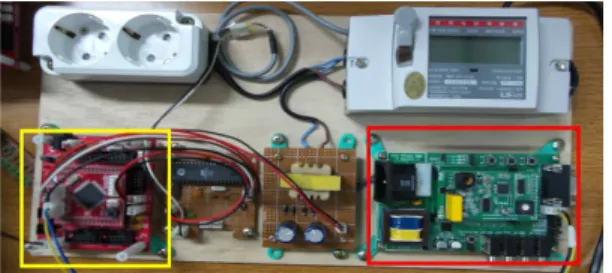
The implementation diagram of the usage in- formation transmission part is shown in (Fig. 8).

The power usage information on the watt-hour meter is recorded through MCU (yellow quad- rangle). Transmits information through the PLC module(red quadrangle).

① and ② of (Fig. 9) are the parts that are used for the control communication of each device. ③ is used for the communication support between the Server and the watt-hour meter.

In the (Fig. 10), the information on the watt-hour meter is transmitted to the Server through the PLC module and the Server outputs this information on the webpage. The characteristic of the Client is that it is possible to monitor the power usage in realtime by accessing the webpage and, the Server controls the power supply of electronic devices through Device Manager receiving commands from the Client.

5. PERFORMANCE EVALUATION

The performance evaluation was carried out un- der the condition where the devices or equipments were connected to the PLC system and power con- sumption was consistent. A comparison has been made between PLC-utilized and RS232-utilized (direct connections) communications under the identical condition. As seen in the (Fig 11), the PLC method showed about 20~35% failure rates where- as the RS232 device-connection method showed Fig. 8. Implementation diagram.

Fig. 9. Server implementation diagram.

Fig. 10. Whole system implementation diagram.

(8)

almost 0%.

Thus, the PLC system has a problem of low reli- ability when compared with RS232 connection method. This low reliability will cause more re- transmission requests resulting in lower efficiency of the whole system. However, since it’s not easy to increase the reception success rate unless the module is changed due to the technological charac- teristics of the PLC, the shortest possible and brief communications are required. Additionally, a mech- anism that processes repeated requests/responses when the message hasn’t been delivered is required. The future task involves development of a much more improved protocol (i.e., more than standardized TCP/IP) which has stronger security level, at the same time.

6. COMPARISON WITH OTHER SYSTEM

In the US recently, the micro-sensor(s) em- bedded in the wearable device senses bio-signals and the signals are processed with the algorithm loaded on the mounted processor. The output data from the device will be delivered to a mobile termi- nal and the relevant information can be monitored on the display(s). The sensors which utilize the network elements such as USB, Bluetooth, Wi-Fi and NFC are being constantly developed including the sensors that acquire patient’s bio-information or individual activity or body features. The in- formation is then delivered in real-time or after it’s been stored, depending on the purpose of application. In case of Japan, some senior citizens who live alone are being monitored with the RFID [10], water-, gas-, and tap water-sensors. In UK, the solitary deaths of these elders are monitored with the Tele-care service.

6.1 Comparison with other system of Republic of Korea

The comparison has been made with the 'Hyo- simi 119 Safety-Welfare System'. While this sys- tem is to provide the 119 service by automatically detecting the events of unattended deaths, fires and gas leakages with the power use pattern analysis

Fig. 12. Hyosimi 119 Safety-Welfare system.

Fig. 11. Test in an environment where interferences

exist.

(9)

program mounted on the PLC terminals(i.e., watt- hour meter) installed at the households of elderly people living alone[9], our proposed system in this paper transmits the warning messages to the users' families or the local government agencies with the in-home headcount algorithm which fo- cuses on the PLC and PLC-based Wi-Fi.

It is possible to provide the server to those who want it breaking the bounds of national-level management. When there are changes in the num- ber of headcount at home, our system makes the judgements about the possibilities that whether such changes have been caused by the simple ac- cesses of the user or by the others' visits. The sys- tem transmits visit requests to the volunteer center and the local government agencies once the judge- ment is made as 'other people's visits' and its pe- riod exceeds 3 to 4 days, describing the condition as 'requiring observation for the visits'.

6.2 Comparison with other system of Japan A senior citizen B (Male, 73-years old), also liv- ing alone, collapsed due to a stroke but he was im- mediately carried to the hospital owing to the sys- tem which had used the tap water-sensor. A liv- ing-aid staff member visited his home because the alarm was automatically triggered at the regional General Consultation Organization when the tap water had not been used for a period of 12 hours.

This region reduced the number of solitary deaths of elderly people living alone from 47 to 41 cases during past 5 years (i.e., 2003~2007) by establish- ing the Safety Checking System using the gas me- ters combined with a communication function, tel- ephone lines and heat-detecting sensor together with the tap water-sensor. In the same period, the ageing rate has increased 5% points (example of Kobe-city, Japan).

In June, 2013, the Japanese company, Solxyz, announced that they started a care support service called ‘Imairumo’ which remotely monitors and protects elderly people living alone using smart- phones and sensors. Since the information sensed

by the sensors is automatically recorded on the Cloud 24 hours via internet, the officers in charge of managing the live-alone senior citizens or the guardians can go through collected data all the time with Smart phones or tablets.

If it’s the case that an elderly person is away from the sensors for a certain period of time, the current situation is deduced by tracing back past sensed data and there is a function of sending the E-mails to designated addresses once the attached button is pressed. Our system proposed in this pa- per is different from the ones mentioned above for it involves the PLC technology and Smart phones.

6.3 Comparison with other system of United Kingdom

While the Tele-care service is a system that en- ables more independent and safer living conditions, the Tele-health service is a system that monitors patients remotely incorporating the Tele-care service.

Meanwhile, the Tele-health’s concept is to let people to manage their own health and to improve their quality of life by themselves. It’s not alter- native to the practice of visiting doctors in a hospi- tal for face-to-face consultations.

In UK, 31% of the entire population suffers from chronic illnesses and 5% of them accounts for 49%

of inpatients so that 69% of Department of Health’s

initial and emergency care budget has been allo-

cated for these people. Also, in UK, about 17 million

households use the Tele-care service presently es-

tablishing the system relatively early by investing

80 million pounds for 2 years since 2006. These

households account for about 29% of the house-

holds of senior citizens. In March, 2012, the

Minister of Health Paul Burstow suggested that if

only 1% point of hospital visits can be reduced,

there will be a cost saving effect of roughly 200

million pounds and at the same time, he announced

that the National Health System (NHS) will be able

to save 1.2 billion pounds for the next 5 year-period

through the Tele-health trial program.

(10)

A senior citizen A (female, 75-years old), who lives alone with a mild dementia, needed hospital admission or care by the relevant facility because she often fall off a bed at night. However, after the government had installed the Tele-care system in- cluding the fall-detector, bed sensor and door- passing detection sensor, home-care became possible. For this service, the community was to prepare the emergency code of response for each sensor alert to swiftly deal with contingencies (example of Havering borough, London, UK).

7. CONCLUSION AND EXPECTED EFFECTS

In this paper, a part which is considered to be the important element technology among the IoT (Internet of things)-based communication tech- nologies that utilize devices such as PLC modems between the electric watt-hour meters, main serv- ers and each electronics devices has been in- troduced. As an external connection, the link is es- tablished with internet between Smart phone and the main server, and in-home headcount is moni- tored with the 'In-home headcount Checking Algorithm' we've proposed. In the future, by ex- panding the system, we attempt to graphically construct the system in which the watt-hour meter is connected to the PLC modem and communicates with the main server, the server is then stores the informations received from the meter, and lets the users to monitor them with their Smart phones.

In this paper, Wi-Fi connection/disconnection status and SSIDs are checked with the application embedded in the user's Smart phone. An then, if the found SSID is the one that's been registered, it re-checks MAC address once again and once the MAC address has been verified, own MAC address and encrypted code will be transmitted to the server. The server confirms the user by checking the code and MAC address and determines wheth- er the user has returned or gone out from home.

In-home headcount is adjusted using this process.

However, there could be some problems with this checking method. Firstly, the Wi-Fi connection is not the one that can be established immediately af- ter coming back to home. The connection between Wi-Fi and mobile phone could take from minimum of a few seconds and maximum of several tens of seconds so that it may be determined that there is no in-home person(s) during this time period.

Secondly, when the Smart phone is not available.

There could be a case that a person is too old or too young to carry Smart phone and therefore lim- iting the head count check. Such limits of the study could be the future tasks that need to be com- plemented.

REFERENCE

[ 1 ] S. Panchadcharam, G.A. Taylor, I. Pisica, and M. R. Irving, “Modeling and Analysis of Noise in Power Line Communication for Smart Metering,” Proceeding of Power and Energy Society General Meeting, pp. 1-8, 2012.

[ 2 ] S. Helal, W. Mann, H.E. Zabadani, J. King, Y.

Kaddoura, and E. Jansen, “The Gator Tech Smart House: A Programmable Pervasive Space,” IEEE Computer Society, Vol. 38, No.

3, pp. 50-59, 2005.

[ 3 ] W.H. Liau, C.L. Wu, and L.C. Fu, “Inhabitants Tracking System in a Cluttered Home Environment Via Floor Load Sensors,” IEEE Transactions on Automation Science and Engineering, Vol. 5, No. 1, pp. 10-20, 2008.

[ 4 ] T.I. Hwang, H.J. Park, E.H. Paik, “Location- aware UPnP AV Session Manager for Smart Home,” IEEE First International Conference on Networked Digital Technologies, pp.

106-109, 2009.

[ 5 ] C.S. Li, Y.M. Huang, and H.C. Chao, “UPnP

IPv4/IPv6 Bridge for Home Networking

Environment,” IEEE Transactions on Consu-

mer Electronics, Vol. 54, No. 4, pp. 1651-1655,

2008.

(11)

[ 6 ] C. Rus, K. Kontola, I.D.D. Curcio, and I. Defee,

“Mobile TV Content to Home WLAN,” IEEE Transactions on Consumer Electronics, Vol.

54, No. 3, pp. 1038-1041, 2008.

[ 7 ] P.M. Corcoran, J. Desbonnet, P. Bigioi, and L.

Lupu, “Home Network Infrastructure for Handheld/Wearable Appliances,” IEEE Transactions on Consumer Electronics, Vol.

48, No. 3, pp. 490-495, 2002.

[ 8 ] C.Z. Ou, B.S. Lin, C.J. Chang, and C.T. Lin,

"Brain Computer Interface-based Smart Environmental Control System," Proceeding of International Conference on Intelligent Information Hiding and Multimedia Signal Processing IEEE Computer Society, pp.

281-284, 2012.

[ 9 ] H.R. Kwon and D.S. Park. “Development of Care Skills And the Roles of Emergency Medical Technicians,” Korean J ournal of Research in Gerontology, Vol. 21, pp. 27-45, 2012.

[10] Ryo ONISHI, Shigeyuki HIRAI, "Improve- ment of Measurement System of Human Activities in A Bathroom Using RFID,“

Information Processing Society of Japan (IPSJ), pp. 17-22, 2007. (In Japanese) [11] J. H. Huh, M. H. Hong, J. Lee, K. Seo,

Implementation of DDoS Botnet Detection System On Local Area Network, Journal of Korea Multimedia Society, Vol. 16, No. 6, pp.

678-688, 2013. (In Korean)

Jun-Ho Huh completed the Cooperative Marine Science and Engineering Program, Texas A&M Univer- sity at Galverston, United States of America in Aug. 2006.

Received Bachelor of Science Degree from Department of Major of Applied Marine Sciences (Marine Aquaculture, Oceanography, Marine Life Sciences), Bachelor of Engineering Degree (Double Major) from Department of Major of Computer Engineering from Jeju National University at Ara, Jeju, Republic of Korea in Aug. 2007.

Master of Education Degree from Department of Major of Computer Science Education, Graduate School of Education, Pukyoug National University at Daeyeon, Busan, Republic of Korea in Aug. 2012.

Student in the Doctor Course Major of Computer Engineering, Graduate School, Pukyoug National University at Daeyeon, Busan, Republic of Korea.

He received the best paper award from Korea Multimedia Society 2times(Nov. 2014, May. 2015).

His research directions are Green IT, Smart Grid, Curriculum of Computer, High Availability Computing.

Kyungryong Seo

received Bachelor of Engineer- ing Degree from Department of Major of Electrical Machinery Engineering from Pusan Natio- nal University, Busan, Republic of Korea in Feb. 1983.

Master of Engineering Degree in Electrical Engineering from Korea Advanced Insti- tute of Science and Technology (KAIST), Daejeon, Republic of Korea in Feb. 1990.

Received the Ph.D. Degree in Electrical Engineering from Korea Advanced Institute of Science and Tech- nology (KAIST), Daejeon, Republic of Korea in Aug. 1995.

Currently he is a professor (Tenure) of Computer Engineering Departments, Pukyong National University at Daeyeon, Busan, Republic of Korea.

His research directions are High Speed Computer

Network, Network Security, High Availability Com-

puting.

수치

Fig.  2.  Entire  functional  diagram.
Fig.  5.  In-home  headcount  system  core.
Fig.  7.  User  interface  of  Android-Based  Applications.
Fig.  9.  Server  implementation  diagram.
+2

참조

관련 문서