적응적 중첩 블록 움직임 보상을 이용한 프레임 율 향상 알고리즘
이 강 준
a) ‡
Frame Rate up-conversion Algorithm using Adaptive Overlapped Block Motion Compensation
Kangjun Lee
a) ‡
요 약
본 논문에서는 적응적 중첩 블록 움직임 보상 방법을 이용한 새로운 양방향 프레임 율 향상 방법을 제안한다. 제안한 방법에서는 참조 영역의 움직임 복잡도에 기반한 적응적 중첩 블록 음직임 보상 방법이 사용된다. 움직임 복잡도는 이전에 부호화된 움직임 추정 과정에서 판단되므로 중첩 블록 움직임 보상 방법에 적응적 기법을 추가적인 계산 복잡도 없이 적용 가능하다. 실험결과는 제한한 방 법이 기존 방법에 비해 객곽적, 주관적 화질에서 우수함을 보여준다.
Abstract
In this paper, a new bilateral frame rate up-conversion algorithm using adaptive overlapped block motion compensation is proposed. In this algorithm, the adaptive overlapped block motion compensation is based on the motion complexity of the reference region. As the motion complexity is determined by the size of the previously coded motion estimation prediction, the overlapped block motion compensation method is selected without any additional computational complexity. Experimental results show that the proposed algorithm provides better image quality than conventional methods both objectively and subjectively.
Keyword : Frame Rate Up-conversion, Motion Compensated Interpolation, Overlapped Block Motion Compensation
Copyright Ⓒ 2016 Korean Institute of Broadcast and Media Engineers. All rights reserved.
“This is an Open-Access article distributed under the terms of the Creative Commons BY-NC-ND (http://creativecommons.org/licenses/by-nc-nd/3.0) which permits unrestricted non-commercial use, distribution, and reproduction in any medium, provided the original work is properly cited and not altered.”
a)국민대학교 자동차공학전문대학원(Graduate School of Automotive Engineering, Kookmin University)
‡Corresponding Author : 이강준(Kangjun Lee)
E-mail: [email protected] Tel: +82-2-910-5542
ORCID: https://orcid.org/0000-0002-7542-0531
․Manuscript received April 24, 2019; Revised August 12, 2019; Accepted August 13, 2019.
일반논문 (Regular Paper)
방송공학회논문지 제24권 제5호, 2019년 9월 (JBE Vol. 24, No. 5, September 2019) https://doi.org/10.5909/JBE.2019.24.5.785
ISSN 2287-9137 (Online) ISSN 1226-7953 (Print)
Ⅰ. Introduction
Frame rate up-conversion (FRUC) increases the frame rate of videos by inserting new intermediate frames be- tween the original frames. Recently, FRUC methods have become an important technology for alleviating the motion blur problem in liquid crystal displays and increasing the im- age information in input camera modules [1], [2]. Motion- compensated frame rate up-conversion (MC-FRUC) con- sists of three steps: (1) motion estimation (ME), (2) motion vector refinement (MVR) and (3) motion compensated in- terpolation (MCI). The structure of the overall FRUC method is determined by ME approaches because the accu- racy of motion information dramatically influences the vis- ual quality of the images. A ME process is separated in two ways. In uni-directional ME method, Motion vectors (MVs) are estimated from a unilateral ME pass in one direction. Although this mv is more precise than the MV from bi-directional ME process, additional complexity is required by in the process of removing hole and overlapped region. Although many algorithms are proposed to solve these problems, complexity is also burden to im- plementation [3-7]. In bi-directional methods, using sym- metric mv search process, hole and overlapped area are not generated. However, ME and MCI based on block-wise cause the blocking artifact. To prevent this side effect, overlapped block motion compensation (OBMC) is widely used to reduce blocking artifacts in block-wise FRUC algo- rithms [8]. Among the many OBMC methods, OBMC that uses simple average (OBMCSA) has been widely used [9].
However, this method causes edge over-smoothing. To overcome this weakness, OBMC using a weighting win- dow (OBMCWW) is popular for reducing the number of blocking artifacts [10]. Although OBMCWW reduces the blocking artifacts in the complex motion regions, it causes another block artifact in the homogeneous regions and re- peated patterns. Moreover, it increases computational complexity. To prevent this, we propose a motion compen-
sation method by the adaptive OBMC algorithm based on the motion complexity of the reference region. In our pro- posed method, after determining the motion complexity of the reference region by the prediction size of the motion estimation in the previously coded bit-stream, the OBMC algorithm is adaptively selected. This improves the sub- jective and objective image quality in the interpolated frame. Furthermore, the computational complexity is re- duced, making it comparable to that of OBMCWW algorithms.
Ⅱ. Proposed algorithm
The OBMC shows good performance when used with bilateral motion estimation (BME) [4]. In BME, to find the best motion vector (MV), the sum of the bilateral absolute differences (SBAD) is used:
{ }
1 1
( , )
( , )
( , )
( , ) ( , )
arg min ( , , )
,
n n
x y
dx dy SR i
i
b
i i
SBAD b dx dy
f x dx y dy f x dx y dy
V SBAD b dx dy
- +
Î
Î
=
+ + - - -
=
å (1)
where fn-1(x,y) and fn+1(x,y) are the pixel values in the previous and following frames, respectively. bi represents the ith block index and Vi is the MV that minimizes the SBAD in ith block. SR is the predefined search range.
After completing the motion estimation process, the inter- polated frame is generated as follows:
[ ] [ ]
{ }
3
1 1
0 ( /4 )
( ) 1 ( ) ( )
n 2 n i p n i p
p
i
jp i i
f b C f
-b v
+f
+b v
+=
=
å
+ - (2)where fn(bi) is the pixel value in the interpolated block
in the bi position. It is then divided into tetramerous blocks
and indexed by j/4. Cp is the normalized filter coefficient
in the weighting window. bi(v) is the block pixel value in
the bi positon with the MV v. In OBMCWW, Cp is de- termined by the relative position within bi and the reli- ability of the neighboring MV. If Cp is the same in all bi(v), this process is performed in OBMCSA. Although OBMCWW reduces the blocking artifacts in adjacent blocks with different MV activities, it causes another blocking artifact by its different filter coefficient for homo- geneous background regions and repeated patterns.
To solve this problem, we propose the adaptive OBMC algorithm. As shown in Fig. 1, ME processes of various sizes are used in the current video coding standard. This ME prediction size is correlated with the object character- istics [11]. Therefore, by using the predicted size of the ME reference region, we can estimate the motion characteristics of the related block.
그림 1. 비디오 부호화에서 사용되는 다양한 크기의 움직임 추정 블록들 Fig. 1. Various ME prediction sizes in video coding
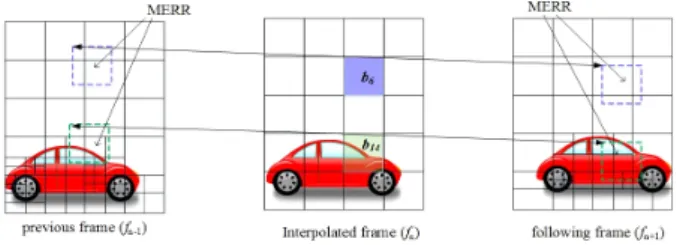
For example, in Fig. 2, the bi-directional motion estima- tion reference region (MERR) for b6 comprises the basic prediction size. In this case, since there is a high proba- bility that the block is a simple background without motion movement, the OBMCSA method is reliable. On the other
그림 2. MERR에 따라 다르게 나타나는 블록의 특성
Fig. 2. Different block characteristics according to the MERR
hand, the ME prediction size of the reference region of b14 is smaller than the basic prediction size, which means that this region contains a moving object with a complex texture. In this situation, OBMCWW shows better perform- ance than OBMCSA. Using this characteristic, we propose an adaptive OBMC method based on the block prediction size in the reference region of the ME.
To determine the block complexity (BCi) in each block, we check the prediction size in the MERR. As shown in Fig 3, {PB1, PB2, PB3, PB4, NB1, NB2, NB3, NB4} are included in the MERR of bi. As such, we check the pre- diction size of the eight blocks in (3), as shown below.
그림 3. MERR을 사용한 블록 복작도 판단 Fig. 3. Block complexity determination in MERR
1
i
0all blocks in MERR are basic size BC
otherwise
=
ì
í î
(3)If all blocks in the MERR are coded as the basic block size, such as b6 in Fig. 2, we set BCi to 1. In other cases, BCi is set to 0. After determining the BCi, we execute the OBMC process of bi in (4), as shown below:
i 1
OBMCSA if BC OBMCWW otherwise ì
=í î
(4)If BCi is 1, OBMCSA is processed. Otherwise, OBMCWW is executed.
III. Experimental results
In this section, we compare the proposed OBMC algo-
rithm with the OBMCWW algorithm. Additionally, to compare with uni-directional method. Yu’s method is used [7]. In the experiments, we used the Akiyo, Bus, Coa- stguard, Container, Flower, Foreman, and Stefan image se- quence with a standard CIF (352 × 288) format. In a HD format, Johnny, Kristen & Sara, Four-People are used. We remove and interpolate the 50 odd frames of each test se- quence using each algorithm. As the BME block size is 16 × 16, the overlapping width is 8. In OBMCWW and proposed algorithm, we set the ME search range to 10 pix- els for both the horizontal and vertical directions. In im- plementing Yu’s method, all parameters are setting as de- scribing in his paper. To make an objective image quality comparison, we calculated the peak signal-to-noise ratio (PSNR) for the interpolated and original frames. Table 1 presents the results of the average PSNR comparison.
In a comparison of OBMCWW and proposed algorithm,
the performance of the proposed OBMC algorithm is better than that of the OBMCWW algorithm. The improvement of the average PSNR with the proposed algorithm is about 0.11 dB. In the Container sequence, in which a moving ob- ject with a complex texture is present simultaneously with a background with a homogeneous texture, the quality of the interpolated image is substantially improved by the pro- posed algorithm. Comparing the Yu’s algorithm, in Coast- guard, Flower and Foreman sequence, the performance of the proposed algorithm is better than that of Yu’s algorithm.
As shown in Fig. 4, the structure in upper right corner of the image is closely interpolated by the proposed algorithm, as compared to the unnatural interpolation of this area by the OBMCWW algorithm. These OBMCWW results are caused by the miscalculated weighting coefficient in the repeated pattern of the building part. In our proposedalgorithm, this problem is alleviated by the simple average method.
Sequence Yu’s method OBMCWW Proposed
CIF (352X288)
Akiyo 44.1 40.71 40.81
Coastguard 30.67 31.26 31.33
Container 43.68 39.7 39.87
Flower 27.26 29.06 29.06
Foreman 32.22 32.55 32.65
Stefan 25.65 26.84 26.99
HD (1280X720)
Johnny 39.89 37.53 37.79
Kristen & Sara 41.11 38.65 38.8
FourPeople 40.38 38.26 38.28
표 1. 제안한 방법과 기존 방법의 성능 비교 (dB)
Table 1. The performance for proposed algorithm and conventional algorithms (dB)
(a) Yu’s method (b) OBMCWW (c) proposed algorithm
그림 4. Foreman 시퀀스에서 주관적 화질 비교
Fig. 4. Subjective image quality comparison in the Foreman sequence
As shown in Fig. 5, the blurring of the player part is alle- viated in OBMCWW and proposed algorithm. These re- sults are caused by a weighting coefficient in overlapped block motion compensation.
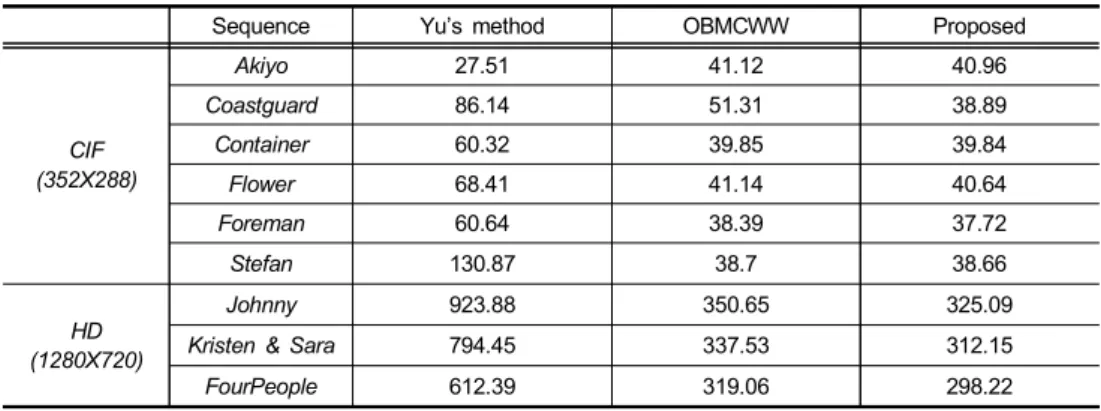
Table 2 shows the processing time for each FRUC algorithm. The average processing time of the proposed al- gorithm was 40% less than that of Yu’s method. Compared to OBMCWW, in the Coastguard sequence, the processing time of the proposed method is about 24% less than that of the OBMCWW algorithm. This result is achieved by the reduction in unnecessary calculations of the filter co- efficient in the homogeneous region.
IV. Conclusion
To reduce the blocking artifacts in block-wise FRUC algorithms, the OBMCWW is widely used. However, the weighting window concept is inappropriate for homoge- neous texture regions and repeated patterns. In this study, we propose a new OBMC algorithm that selects the filter coefficient calculation method based on the region texture complexity. Using this algorithm, the objective and sub- jective image quality of the interpolated frames is im- proved. We anticipate that this algorithm will motivate the development of numerous other OBMC algorithms based on previously coded information.
Sequence Yu’s method OBMCWW Proposed
CIF (352X288)
Akiyo 27.51 41.12 40.96
Coastguard 86.14 51.31 38.89
Container 60.32 39.85 39.84
Flower 68.41 41.14 40.64
Foreman 60.64 38.39 37.72
Stefan 130.87 38.7 38.66
HD (1280X720)
Johnny 923.88 350.65 325.09
Kristen & Sara 794.45 337.53 312.15
FourPeople 612.39 319.06 298.22
표 2. 계산 복잡도 측정 (초)
Table 2. Computational complexity evaluation (seconds) (a) Yu’s method
(b) OBMCWW
(c) proposed algorithm 그림 5. Stefan 시퀀스에서 주관적 화질 비교
Fig. 5. Subjective image quality comparison in the Stefan sequence
참 고 문 헌 (References)
[1] J. Someya, N. Okuda and H. Sugiura, "The Suppression of Noise on A Dithering Image in LCD Overdrive," IEEE Transactions on Consumer
Electronics, Vol. 52, No. 4, pp. 1325-1332, 2006.
[2] Y.F Ou, Y. Xue, Z. Ma and Y. Wang, "Q-STAR: A Perceptual Video Quality Model Considering Impact of Spatial, Temporal, and Amplitude Resolutions," IEEE Transactions on Image Processing, Vol. 23, No. 6, pp. 2473-2486, 2014.
[3] D. wang, A. Vincent, P. Blanchfield, and R. Klepko, “Motion-compen- dated Frame Rate Up Conversion−part II: New Algorithms for Frame Interpolation,” IEEE Transactions on Broadcasting, Vol. 56, No. 2, pp.
142-149, 2010.
[4] U. S. Kim and M. H. Sunwoo, “New Frame Rate Up-Conversion Algorithms with Low Computational Complexity,” IEEE Transactions
on Circuits and Systems for Video Technology, Vol. 24, No. 3, pp.
384-293, 2014.
[5] H. Kwon and C. Lee "Efficient Motion Compensated Interpolation Technique using Image Resizing," Journal of Broadcast Engineering, Vol. 18, No. 4, pp. 599-609, 2013.
[6] C. Wang, L. Zhang, Y. He, and Y. P. Tan, “Frame Rate Up-Conversion
using Trilateral Filtering,” IEEE Transactions on Circuits and Systems
for Video Technology, Vol. 20, No. 6, pp. 886-893, 2010.
[7] S. H. Yu, J. C. Jeong "Motion Estimation Algorithm using Variance and Adaptive Search Range for Frame Rate Up-Conversion," Journal
of Broadcast Engineering, Vol. 23, No. 21, pp. 138-145, 2018.
[8] C.L. Huang and T.T. Chai, "Motion-Compensated Interpolation for Scan Rate Up-Conversion," Optical Engineering, Vol. 35, No. 1, pp.
166-176, 1996.
[9] B.T. Choi, S.H. Lee, and S.J. Ko , "New Frame Rate Up-Conversion using Bidirectional Motion Estimation," IEEE Transactions on
Consumer Electronics, Vol. 46, No. 3, pp. 603-609, 2000.
[10] B.D. Choi, J.W. Han, C.S. Kim and S.J. Ko, "Motion-Compensated Frame Interpolation using Bilateral Motion Estimation and Adaptive Overlapped Block Motion Compensation," IEEE Transactions on
Circuits and Systems for Video Technology, Vol. 17, No. 4, pp.
407-416, 2007.
[11] B.G. Kim, "Novel Inter-Mode Decision Algorithm based on Macroblock(MB) Tracking for The P-slice in H.264/AVC Video Coding," IEEE Transactions on Circuits and Systems for Video