한중 자동 문서분류를 위한 최적 자질어 비교
Comparison Between Optimal Features of Korean and Chinese for Text Classification
임미영* ․ 강신재**
†Mei-Ying Ren and Sinjae Kang
†*대구대학교 컴퓨터정보공학과, **대구대학교 컴퓨터․IT공학부
*Dept. of Computer & Information Engineering, Daegu University
**School of Computer & Information Technology, Daegu University
본 논문은 2013학년도 대구대학교 학술연 구비에서 지원하여 연구하였음.
This is an Open-Access article distributed un- der the terms of the Creative Commons Attribution Non-Commercial License ( ht t p: / / c r ea t i v ec ommon s . or g / l i- censes/by-nc/3.0) which permits unrestricted non-commercial use, distribution, and re- production in any medium, provided the orig- inal work is properly cited.
요 약
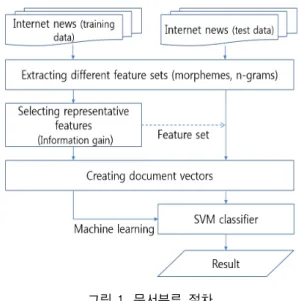
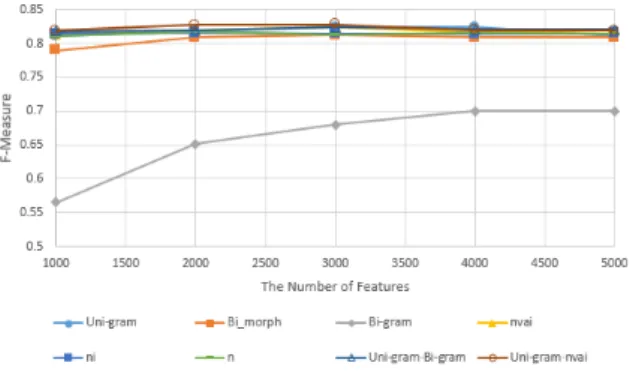
본 논문에서는 한국어와 중국어의 언어학적인 특징을 고려하여 문서 자동분류 시스템의 성능을 높일 수 있는 최 적의 자질어 단위를 제안한다. 언어 종속적 단위인 형태소 자질어와 언어 독립적 단위인 n-gram 자질어 그리고 이들을 조합한 복합 자질어 집합을 대상으로 각 언어의 인터넷 신문기사를 SVM으로 분류하는 실험을 수행하였 다. 실험 결과, 한국어 문서분류에서는 bi-gram이 F1-measure 87.07%로 가장 좋은 분류 성능을 보였고, 중국어 문서분류에서는 ‘uni-gram․명사․동사․형용사․사자성어’의 복합 자질어 집합이 F1-measure 82.79%로 가장 좋은 성 능을 보였다.
키워드 : 중국어 문서분류, 한국어 문서분류, 정보획득량, SVM 분류기, 자질어 선택 Abstract
This paper proposed the optimal attributes for text classification based on Korean and Chinese linguistic features. The experiments committed to discover which is the best feature among n-grams which is known as language independent, morphemes that have language dependency and some other feature sets consisted with n-grams and morphemes showed best results. This paper used SVM classifier and Internet news for text classification. As a result, bi-gram was the best feature in Korean text categorization with the highest F1-Measure of 87.07%, and for Chinese document classification, ‘uni-gram+noun+verb+adjective+idiom’, which is the combined feature set, showed the best performance with the highest F1-Measure of 82.79%.
Key Words : Chinese Text Classification, Korean Text Classification, Information Gain, SVM Classifier, Feature Selection
Received: Mar. 3, 2015 Revised : Jun. 11, 2015 Accepted: Jun. 11, 2015
†Corresponding author [email protected]