무선 중계 시스템에서의 적응 간섭 제거 방식
한용식*
Adaptive Interference Cancellation Method in Wireless Repeater System
Yong-Sik Han*
요 약
이동통신서비스가 넓게 확대되고, 서비스영역의 확대로 인해 중계기가 급속히 증가하고 있다. 이동통신 서 비스의 큰 서비스 구역으로 간섭제거시스템을 위한 새로운 Signed CMA알고리즘을 제안한다. 제안된 Signed CMA알고리즘은 조정된 스텝사이즈 값에 의해 성능이 개선된다. 우리는 Signed CMA의 평균자승에러를 개선 한다. 매트랩은 실험결과에 맞춰 제안된 알고리즘과 비교 분석하여 사용한다. 수렴횟수 1000번일 때 스텝사이 즈 0.0065를 가진 제안된 Signed CMA알고리즘의 최소자승에러 성능이 기존 CMA 알고리즘보다 약 5 dB 더 낫다.
ABSTRACT
The mobile communication service is widely used and the repeaters is rapidly increasing because of the extending service areas.
we propose a new Signed CMA(: Constant Modulus Algorithm) algorithm for ICS(: Interference Cancellation System) as a larger service area of mobile communication service. The proposed Signed CMA algorithm improved performances by adjusting step size values. We showed that the proposed algorithm could improve the Mean Square Error(: MSE) performance of Signed CMA.
MATLAB(: Matrix Laboratory) is employed to analyze the proposed algorithm and to compare it with the experimental results .At the convergence of 1000 iteration state, the MSE(: Mean Square Error) performance of the proposed Signed CMA algorithm with step size of 0.0065 is about 5 dB better than the conventional CMA algorithm.
키워드
Interference Cancellation System(: ICS), Signed CMA, Constant Modulus Algorithm, Repeater 간섭 제거 시스템, 부호화된 상수 계수 알고리즘, 상수 계수 알고리즘, 중계기
*교신저자 : 구마대학교 전자통신과 ㆍ접 수 일 : 2016. 04. 20 ㆍ수정완료일 : 2016. 05. 13 ㆍ게재확정일 : 2016. 05. 24
ㆍReceived : Apr. 20, 2016, Revised : May. 13, 2016, Accepted : May. 24, 2016 ㆍCorresponding author : Yong Sik Han
Dept. of Electronic Communications. Gumi University Email : [email protected]
Ⅰ. Introduction
In this paper, The mobile communication service is widely used and the repeaters is rapidly increasing because of the extending service areas.
But a wireless repeater has a problem that the output of the transmit antenna is fed back to the
receive antenna. we propose a new sign-CMA algorithm for Interference Cancellation System(:
ICS) as a larger service area of mobile communication service[1-2]. This algorithm has to adjust the step size for fast convergence rate and low Mean Square Error. The step size The http://dx.doi.org/10.13067/JKIECS.2016.11.5.459
sign-CMA algorithm has to minimize the mean error, it is a non-convex cost function of the weight vector. Therefore, is proposed which can repeater by canceling interference noises in mobile communication systems for Wideband Code Division Multiple Access[3-5].
These works have proposed and investigated several modified CMA algorithms successfully while imposing various constraints to avoid unstability and local minima problems but little effort has been contributed to the problems of phase rotation or spinning and the ways to switch between the mode and decision-directed operations.
In this paper a minimum-disturbance technique is proposed, which not only leads to simultaneous algorithm and phase recovery, but takes the advantage of the principle of minimum disturbance to achieve better stability and improved robustness with respect to various noise characteristics and time-varying channels. Also, higher convergence speed and lower steady-state error can be obtained by means of very simple algorithm without increasing the computation complexity[6-11].
We have the conventional CMA algorithm and proposed sign-CMA algorithm in chapter 2, 3. In chapter 4, we show the results of the simulation that compares the proposed algorithm with other algorithms from the viewpoint of the Mean Square Error(: MSE) and iteration number, the Bit Error Rate(: BER).
Finally, our conclusions are given in chapter 5.
Ⅱ. Conventional CMA
The CMA adjusts the equalizer weights by minimizing the non-convex cost function.
(1)
Where ∙ is the expectation operator,
is the output error given by Eq.(2).
(2)
Where filter output
∙ (3)
A cost function is needed by the algorithm for the recovery of the phase, because of constant function to the phase of filter output .
Where is the weight vector, is the step size, is the input signal.
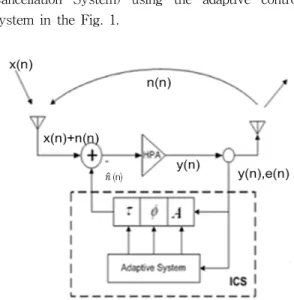
We show the structure of ICS(Interference Cancellation System) using the adaptive control system in the Fig. 1.
Fig. 1 The structure of ICS(Interference Cancellation System) using the adaptive control system.
Ⅲ. Proposed Sign Constant Modulus algorithm
is the adaptive weight vector.
Here, an FIR adaptive filter with N taps channel impulse response. We use the Widrow-Hoff algorithm to minimize . The gradient vector is defined as follows.
∇ (4)
We propose a Signed Constant Modulus Algorithm.
In the proposed performance criteria, it is necessary to include the transmitted signal with constant modulus . The sign-CMA has the cost function shown in Eq.(5). The least squares value of the cost function is used to update the weight vector, and is given by Eq.(6).
Where is the cost function, is the weight vector, is the step size, is the error signal, and is the input signal.
(5)
For practical reasons, and are positive integers and limited to 1 and 2. Then the corresponding algorithm has yielded useful adaptive form and they are referred to as algorithm. To minimize the cost function over the
space of weight vectors, a stochastic approximation to the steepest descent algorithm is used Weight vectors are updated as Eq.(6).
(6) Where is a small real scalar named step size and ∇
is an unbiased estimate of the gradient of the cost function with respect to .
Using a stochastic gradient algorithm to define the update to the rule, the coefficient vector is adapted by
(7)
and
i f
i f
i f
(8)
What this means is that given the new input data (at time n) represented by the input vector , the proposed technique in the mode updates the tap-weight vector in such a way that the value
computed at time n+1 exhibits a minimum change with respect to the known value at time n.
Usually, due to stability considerations, the step-size parameter which can be used in the CMA algorithms are much smaller than the corresponding values used in the LMS algorithms.
Since the step-size parameter determines the convergence speed, this leads to the fact that CMA in general exhibit very slow convergence speed.
From another viewpoint, for the same steady-state mean squared error, the chosen values of the step-size parameters for CMA are usually considerably smaller than the permissible values for the LMS algorithms.
This is one of the few major reasons for the slow convergence of CMA algorithms. To speed up the convergence process it has been proposed that the CMA algorithm can be switched to a decision directed algorithm scheme once the error level is reasonably low to form a 'dual-mode' operation.
The step size is given optimum conditions for fast convergence and low MSE of the adaptive algorithm.
Ⅳ. Simulation Results We show the simulation conditions in table 1.
Table 1. Simulation conditions Multiple access WCDMA, LTE System bandwidth 10 MHz Sampling frequency 10 MHz
Fast fading Jake‘s 1 path fading
Feedback signal 5 dB
System time delay 8 μS 이하 Signal to noise ratio 10~15 dB
0 50 100 150 200 250 300 350 400 450 500 -10
-8 -6 -4 -2 0 2 4 6 8 10
time(sec)
x(t)
Fig. 2 Input signal of adaptive filter in the repeater.
Figure 2 show that the input signal with noise of the adaptive filter in the repeater.
Figure 3 show that the output signal with cancel to the noise of the adaptive filter.
0 50 100 150 200 250 300 350 400 450 500
-5 -4 -3 -2 -1 0 1 2 3 4 5
time(sec)
x(t)
Fig. 3 Output signal of adaptive filter in the repeater.
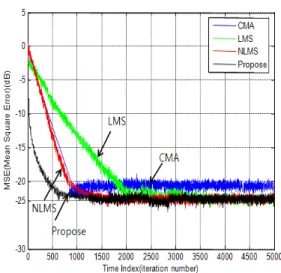
Figure 4 show that the MSE of the proposed algorithm with a step size value of 0.0015 have about 3500 less iterations than LMS and NLMS and gives 15 dB better MSE than CMA.
Figure 5 show that the MSE of the proposed algorithm with a step size value of 0.0035 have about 1000 ~ 1200 less iterations than LMS and NLMS and gives 2.5 dB better MSE than CMA.
Fig. 4 Comparison of the MSE for various adaptive algorithms( × ).
Fig. 5 Comparison of the MSE for various adaptive algorithms( × ).
Figure 6 show that the MSE of the adaptive algorithm is about 5 dB better than that of the conventional CMA algorithm, and requires about 500 ~ 1000 iterations less than the LMS and NLMS algorithms.
Fig. 6 Comparison of the MSE for various adaptive algorithms( × ).
In the result, the proposed algorithm with a step size value of 0.0065( × ) has better about 500 less iterations than proposed algorithm with a step size value of 0.0015 ( × ).
Ⅴ. Conclusion
In this paper, we proposed a sign-CMA algorithm improved performances by adjusting step size values for mobile communication systems. The simulation results show that when a value of 0.0065( × ) were chosen for the step size, the proposed algorithm has the best performance when the number of iterations has to 1200 from 500, as compared to the LMS and NLMS algorithms. At the convergence of 1000 iteration state, the MSE(Mean Square Error) performance of the proposed Signed CMA algorithm with step size of 0.0065 is about 5 dB better than the conventional CMA algorithm.
감사의 글
본 논문은 한국전자통신학회 2015년 봄철국제 학술대회 우수논문으로 선정되었습니다.
References
[1] S. Rappaport, Wireless Communications, Prentice Hall, Englewood Cliffs, New Jersey, 2002.
[2] W. Moon and S. Im, "Adaptive feedback interference cancellation using correlation for WCDMA wireless repeaters,” The Institute of Electronics Engineers of Korea, Journal, vol. 44, issue 7, July, 2007.
[3] Lattice Semiconductor Corporation, “LMS Adaptive Filter,” Reference Design RD 1031, Feb, 2012.
[4] Godard, D.N. "Self-recovering equalization and carrier tracking in two-dimensional data communication systems,” IEEE Trans.
Commun., vol. 28, no. 11, nov. 1980, pp.
1867-1875.
[5] Sato, Y. "A method of self-recovering equalization for multi-level amplitude -modulation systems,” IEEE Trans. Commun., vol. 23, issue 6, Jun. 1975.
[6] J. Treichler and B. ACEE, "A new approach to multipath correction of constant modulus signals,” IEEE Trans. Acoust. Speech Signd Process, vol. 31, issue 2, Apr. 1983, pp.
459-472.
[7] P. Haghighat and A. Ghrayeb, “Trickle-Based Interference Cancellation Schemes for CDMA Systems,” IEEE Trans. on wireless communication, vol. 8, no. 1, Jan. 2009, pp.
13-17.
[8] S. Kim, J. Lee, J. Lee, J. Kim, B. Lee, and N.
Kim, “Adaptive feedback interference cancellation system(AF-ICS),” Proc. IEEE MTTS Int. Microwave Symposium Digest, vol. 1, Seoul, South of Korea, June 2003, pp.
627~630.
[9] S. Kim, "Limit Analysis of the Distance between DU and RU in 4G FDD Mobile Communication Systems,” J. of the Korea
Institute of Electronic Communication Sciences, vol. 7, no. 1, 2012, pp. 135-139.
[10] S. Kim, "A New RF-path Calibration Method for BSs with Repeaters,” J. of The Korea Institute of Electronic Communication Sciences, vol. 6, no. 2, 2011, pp. 274-279.
[11] S. Hwang, “Channel Estimation Based on LMS Algorithm for MIMO-OFDM System,” J.
of The Korea Institute of Electronic Communication Sciences, vol. 7, no. 6, 2012, pp.
1455-1461.
저자 소개
한용식(Yong-Sik Han) 1994년 경일대학교 전자공학과 졸업(공학사)
2003년 영남대학교 대학원 정보 통신공학과 졸업(공학석사) 2011년 인천대학교 대학원 전자공학과 졸업(공학 박사)
2012년 1월 ∼ 현재 정보통신기술 진흥 센터 평가 위원
2016년 5월 ∼ 현재 재난안전기술개발사업단 평가 위원
2012년 ∼ 현재 구미대학교 전자통신과 조교수
※ 관심분야 : 이동통신시스템, 중계시스템