한국컴퓨터정보학회 동계학술대회 논문집 제20권 제1호 (2012. 1)
101
WMN의 멀티캐스트 라우팅 메트릭에 대한 연구
고 휘○, 이형옥*, 남지승*
○*전남대학교 전자컴퓨터공학과
e-mail: [email protected], [email protected], [email protected]
A Study on Multicast Routing Metric for Wireless Mesh Network
Hui Gao○, Hyung-ok Lee*, Ji-seung Nam*
○*Dept. of Electronics and Computer Engineering, Chonnam National University
●
요 약●
This paper gives an introduction to multicast in wireless mesh networks. The factors to be addressed when designing a multicast protocol for wireless mesh network are presented. Emphases are paid on selection of multicast routing metrics in wireless mesh networks. Also details of adapting these metrics to gain high-throughput multicast in wireless mesh network are described in the paper.
키워드: wireless mesh network(WMN), multicast, routing metrics
I. Introduction to Multicast in WMN
Wireless Mesh Network (WMN) is a radical network form of the ever-evolving wireless networks that marks the divergence from the traditional centralized wireless system such as cellular networks and wireless local area networks (WLANs). Wireless Mesh Network comprised of two types of nodes: mesh routers and mesh clients. The primary advantages of a WMN lie in its inherent fault tolerance against network failures, simplicity of setting up a network and broadband capability [1].
Multicasting is a bandwidth-conserving technology that reduces traffic by simultaneously delivering a single stream of packets to a group of recipients. Many multicast routing protocols have been proposed for single-radio multi-hop wireless networks. A typical approach to supporting multicast in such an environment is to construct a multicast tree and let each parent node be responsible for multicasting data to its child nodes. This approach works under the assumption that a parent node and its child nodes share a common channel.
However, in multichannel WMNs this assumption may not hold. In addition, if the channel assignment is dynamic, extra overhead due to frequent tree reconstruction or retransmissions of multicast packets must be addressed [2].
II. Factors of Multicast Protocol in WMN
Applying the aforementioned method of multicasting in WMN is difficult, since in a WMN a multicast protocol must consider several factors such as [5]:
● The effect of multiple channels and channel assignment
● Availability of static mesh router infrastructure backbone
● Load balancing
● Selection of multicast routing metrics
● Effect of guaranteed quality of service(QoS)
● Cross layer optimization
All these factors should be considered when designing multicast protocols for WMN. This paper focuses on selection of multicast routing metrics among all the factors for WMN.
III. Routing Metrics for Multicast Protocols
The routing metric is a criterion to judge the goodness of a path in routing algorithms. Due to differences between unicast and multicast, directly taking the link-quality based routing metrics proposed for unicasting is not appropriate for multicasting in WMN.
The main design goal for routing protocols is shifted from maintaining connectivity between source and destination nodes to finding high-throughput paths between the nodes.
한국컴퓨터정보학회 동계학술대회 논문집 제20권 제1호 (2012. 1)
102
Towards this goal, more sophisticated routing metrics than the hop-count metric need to be used to find paths that achieve high throughput, as protocols based on the hop-count metric often choose long links which tend to be lossy and give low throughput [4].
Important routing metrics used in WMN are Expected Transmission Count (ETX), Expected Transmission Time (ETT), Weighted Cumulative Expected Transmission Time (WCETT), Packet Pair (PP), Success Probability Product (SPP), and Multicast ETX (METX). ETX measures the expected number of MAC transmissions and retransmissions needed to successfully deliver a packet from a sender to receiver. ETT explains the expected MAC transmission time of a packet over certain link. It improves on ETX by making use of data rate in each link. WCETT is based on ETT and aware of loss rate due to ETX and bandwidth of the link [3].
Modifications done in ETX, ETT, PP, METX and SPP to adapt multicasting in WMN will be addressed [4]. Section IV will describe the details of modifications comparatively.
IV. Details of Adapting Metrics for Multicast in WMN
Two major factors in adapting link-quality metrics for multicast in WMN are important. Firstly link quality in the reverse direction should not be considered in the link-quality metric. Secondly product of the metric values of the individual links better reflects the quality of the path [4].
1. PP(packet pair)
1.1 PP (packet pair) - for unicast
The packet pair (PP) metric was to measure the delay between a pair of back-to-back probes to a neighboring node.
Each neighbor computes the delay between arrival of the two probes and sends this delay back to the sender. An exponentially weighted moving average (EWMA) of the delays is maintained at each node for each of its neighbors.
The path with the least sum of delays is selected by the routing algorithm.
1.2 PP (packet pair) - adapted for multicast
A weight of 90% to the accumulated average and 10% to the current one is assigned. In case either the large or the small packet is lost, a 20% penalty is imposed. The value of the metric for a path is the sum of the PP values of the individual links.
2. ETX (expected transmission count)
2.1 ETX - for unicastThe expected transmission count (ETX) metric is based on the expected number of transmissions required to send a unicast packet over a link, including retransmissions. The ETX value of the link is given by
×
(1)where df is the probability that a packet successfully reaches the receiver and dr is the probability that an ACK is successfully received by the sender.
2.2 ETX - adapted for multicast
Without consideration of reverse path link quality, it is defined as
(2)The probe packets no longer contain any information and each node simply counts the number of the probe packets it received in the past 10 probing intervals.
3. WCETT- for unicast and ETT – adapted for multicast
3.1 WCETT- for unicast
Weighted cumulative expected transmission time (WCETT) metric is an enhancement to ETX by considering both the loss rate and the bandwidth of links. WCETT along a path with n hops and k different channels is given by
×
×
≤ ≤
(3) 3.2 ETT – adapted for multicastSince multiple channels are not assumed, ETT adapted for multicast instead of WCETT is given by
×
(4)where S is the packet size and B the bandwidth of the link.
The receiver uses the small packets received to calculate ETX. The bandwidth of each link is estimated by dividing the size of the big packet by the inter-arrival time between the small and the large packets.
4. METX(Multicast ETX)- adapted for multicast
METX can be expressed as한국컴퓨터정보학회 동계학술대회 논문집 제20권 제1호 (2012. 1)
103
∏
(5) Where i denotes the ith link along a path from a source to a destination comprising n links.
5. SPP (Success Probability Product)-adapted for multicast
SPP for a path consisting of n links is given by
∏
(6)
(7) SPP gives the probability for the destination node to receive a packet properly over a path with link-layer broadcast. 1/SPP reflects the expected number of transmissions at the source itself.
The routing algorithm selects the path with the maximum SPP or minimum 1/SPP. As a product, SPP is more effective in avoiding paths containing bad links than ETX. [4] gave an example to demonstrate that SPP performed better than ETX.
6. Summary of metrics for multicast
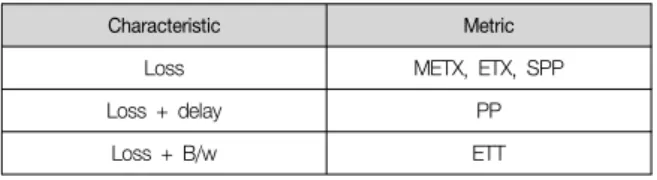
Table 1 classifies the link-quality metrics into three categories based on the link characteristics that they measure.
The first category includes ETX, METX and SPP; these are purely loss-based metrics. The second category includes PP which takes into account both loss and delay. Finally, the third category includes ETT which takes into account both loss and bandwidth.
Table 1. Routing metrics for multicast protocols and the corresponding link characteristics
Characteristic Metric
Loss METX, ETX, SPP
Loss + delay PP
Loss + B/w ETT
V. Conclusions
In this paper, the factors to be addressed when designing a multicast protocol for WMN are presented. Emphases are paid on selection of multicast routing metrics in WMN. Also details of adapting these metrics to gain high-throughput multicast in wireless mesh network are described. Multicast routing metric must be carefully chosen to suit WMN. Recent works on multicasting in WMN has taken into account some of these issues but to the best of our knowledge there does not exists a generalized multicast algorithm that addresses all the factors.
Acknowledgement
This research was supported by the MKE (The Ministry of Knowledge Economy), Korea, under the ITRC (Information Technology Research Center) support program supervised by the NIPA (National IT Industry Promotion Agency) (NIPA-2011-(C1090-1111-0001)).
References
[1] Ian F. Akyildiz, Xudong Wang, and Weilin Wang b, “Wireless mesh networks: a survey”, Computer Networks, 2005.
[2] Tehuang Liu Wanjiun Liao, “On Routing in Multichannel Wireless Mesh Networks: Challenges and Solutions, in Network”, IEEE, Jan 2008.
[3] M. Cagalj, J. P. Hubaux, and C. Enz, “Minimum-energy broadcast in all-wireless networks: NP-Completeness and distribution”, Proc. of ACM MobiCom, September 2002.
[4] S. Roy, D. Koutsonikolas, S. Das, Y.C. Hu, “High-throughput multicast routing metrics in wireless mesh networks”, 26th International Conference on Distributed Computing Systems, July 2006.
[5] Ajish Kumar K.S, Saumya Hegde, “Multicasting in Wireless Mesh Networks: Challenges and Opportunities”, Proc. of ICIME, 2009.