Efficacy, Safety, and Pharmacokinetics of Beroctocog Alfa in Patients Previously Treated for Hemophilia A
Shin Young Hyun,1 Seon Yang Park,2 Soon Yong Lee,3 Hoon Kook,4 Sang Hoon Paik,5 In-Jin Jang,6 and Kun Soo Lee7
1Department of Internal Medicine, Yonsei University Wonju College of Medicine, Wonju;
2Department of Hematology and Oncology, Seoul National University College of Medicine, Seoul;
3Department of Pediatrics, Inje University College of Medicine, Busan Paik Hospital, Busan;
4Department of Pediatrics, Chonnam National University Hwasun Hospital, Hwasun;
5Green Cross Research Center, Green Cross Corporation, Yongin;
6Department of Clinical Pharmacology & Therapeutics, Seoul National University College of Medicine and Hospital, Seoul;
7Department of Pediatrics, Kyungpook National University School of Medicine, Daegu, Korea.
Received: August 11, 2014 Revised: October 27, 2014 Accepted: December 4, 2014 Corresponding author: Dr. Kun Soo Lee, Department of Pediatrics,
Kyungpook National University School of Medicine,
680 Gukchaebosang-ro, Jung-gu, Daegu 700-842, Korea.
Tel: 82-53-420-5713, Fax: 82-53-425-6683 E-mail: [email protected]
∙ The authors have no financial conflicts of interest.
© Copyright:
Yonsei University College of Medicine 2015 This is an Open Access article distributed under the terms of the Creative Commons Attribution Non- Commercial License (http://creativecommons.org/
licenses/by-nc/3.0) which permits unrestricted non- commercial use, distribution, and reproduction in any medium, provided the original work is properly cited.
Purpose: Beroctocog alfa is a second generation recombinant factor VIII manufac- tured by removing the B-domain from factor VIII. This prospective clinical trial was conducted to evaluate the efficacy, safety, and pharmacokinetics of beroctocog alfa in patients of ages ≥12 years previously treated for severe hemophilia A. Mate- rials and Methods: Seventy subjects received beroctocog alfa as an on-demand treatment for acute hemorrhage. Results: The final hemostatic effect was excellent in 35 subjects (50%) and good in 26 subjects (37.1%). The drug showed an overall ef- ficacy rate of 87.1%. The majority of acute hemorrhages was treated by administer- ing the study drug once (86.2%) or twice (10.0%), and the mean dose administered per single infusion was 28.55±6.53 IU/kg. Ten subjects underwent 12 surgical pro- cedures, and hemostatic efficacy was excellent in seven cases (58.3%) and good in five cases (41.7%), showing a 100% efficacy rate. A total of 52 of 88 subjects (59.0%) experienced 168 adverse events. There were 18 serious adverse events (10.7%) in 11 subjects, and two (mild dyspnea and facial edema) in one subject were related to the study drug. Only one subject formed a de novo factor VIII inhibitor, for an occur- rence rate of 1.4% (one-sided 95% upper confidence limit: 3.85%). The final elimi- nation half-life was 13.3 h and 12.6 h at baseline and 6 months after administration, respectively. Conclusion: Our results suggest that beroctocog alfa is safe and effi- cacious as either an on-demand treatment for acute hemorrhage or a surgical pro- phylaxis in patients with hemophilia A.
Key Words: Hemophilia A, factor VIII, B-domain-deleted factor VIII
INTRODUCTION
Hemophilia A is caused by a lack of factor VIII (FVIII) in males due to X-linked re- cessive genes, and comprises 80‒85% of all hemophiliacs.1 FVIII concentrates are
This trial was approved by the Korea Food and Drug Ad- ministration and the Institutional Review Boards of the par- ticipating institutions. Written informed consent was obtained prior to the study from the patients or an acceptable legally representative. This trial was conducted in accordance with the Declaration of Helsinki8 and was registered at www.clini- caltrials.gov (NCT01568580).
Study drug
Beroctocog alfa, developed by the Green Cross Corporation (Yongin, Korea), is manufactured by removing the B-do- main from FVIII and introducing the genetic sequence of this FVIII to CHO cells to establish a recombinant cell line whose cells are massively cultured through the suspension method using serum free medium without human or animal proteins to produce massive amounts of FVIII.9 FVIII gen- erated in this way is separated for purification and finished as a product in a lyophilized formulation. Beroctocog alfa is unique from other second generation rFVIII products in that human albumin is in the final formulation but the cell cul- ture process is free of albumin or other human or animal source proteins. The purification process is comprised of vi- ral removal processes with an affinity column and three con- secutive ion exchange columns. In the final lyophilization manufacturing process, a human serum albumin excipient, which is validated for absence of pathogens and virals, is included in the lyophilized formulation. The molecular weight of beroctocog alfa is approximately 170 kDa and in- cludes FVIII consisting of 1425 amino acids. The study drug was provided as a sterile, freeze-dried powder of 500 IU per vial.
Study design
This prospective, open-label, non-comparative, multicenter trial was conducted to evaluate the efficacy and safety of rFVIII, beroctocog alfa, in previously treated patients with hemophilia A. This trial enrolled 71 patients at four sites in Korea and was completed in 21 months between December 2004 and September 2006.
This trial consisted of three parts: an acute hemorrhage treatment study (study 1), prophylaxis for surgery study (study 2), and a PK study (study 3). All subjects eligible for study 1 were administered 10‒50 IU/kg of beroctocog alfa intravenously whenever bleeding occurred at home. The ad- ministered dose was determined by consulting past doses in each subject and the guidelines on FVIII doses set by the World Federation of Hemophilia.10 The study drug was ad- essential for treating patients with hemophilia A and have
evolved from plasma-derived FVIII concentrates to recom- binant FVIII (rFVIII) concentrates in the last two decades.
The production of FVIII using recombinant DNA technolo- gy has emerged as an alternative to plasma-derived FVIII concentrates, which introduce problems of limited yield and the possibility of propagating various viral diseases. The rF- VIII concentrates first used clinically included Kogenate® (Bayer Healthcare, Berlin, Germany), Kogenate-FS® (Bayer Healthcare, Berlin, Germany), and Recombinate® (Baxter Healthcare Corporation, Westlake Village, CA, USA).2-4 Oc- tocog alfa, moroctocog alfa, and turoctocog alfa, which are rFVIII concentrates developed using plasma/albumin-free method, were introduced consecutively as third generation treatments.5-7 Despite the recent development of several rF- VIII concentrates, their use is still limited in some countries, where clinicians face difficulties in treating patients with he- mophilia A.
Beroctocog alfa is a second generation rFVIII manufac- tured by removing the B-domain from FVIII and is the sec- ond commercially available B-domain-deleted (BDD) rF- VIII concentrate after ReFacto® (Wyeth Pharmaceuticals, Collegeville, PA, USA). This prospective clinical trial was conducted to evaluate the efficacy of beroctocog alfa in treating acute hemorrhage and for prophylaxis during surgi- cal procedures in patients previously treated for hemophilia A. This trial also evaluated the pharmacokinetic (PK) char- acteristics and safety aspects thereof in relation to FVIII in- hibitor production, immunological reactions, viral dissemi- nation, and the occurrence of adverse events (AE).
MATERIALS AND METHODS
Subjects
The eligibility criteria comprised an age of ≥12 years, diag- nosis of severe hemophilia A with a baseline FVIII level
≤2% of normal (≤1% for the PK test), and prior treatment with FVIII concentrates for 150 exposure days or greater.
Exclusion criteria included the presence of an FVIII inhibi- tor of 0.6 Bethesda units (BU) or higher; presence of anti- bodies to rFVIII, mouse IgG, or Chinese hamster ovary (CHO) cells; a history of hematological disorders or blood coagulation diseases other than hemophilia A; presence of human immunodeficiency virus (HIV) antibody; CD4 lym- phocyte cell count <400/µL; or a history of hypersensitivity to FVIII concentrates.
ough but hemostatic effect recognizable), and none (hemo- static effect not recognizable) when administering the study drug at home, 24 hours after the administration, or right be- fore additional administration in a diary. The subjects visited investigators every month to evaluate hemostatic effects of the home on-demand treatment. Then, the investigators pre- pared a monthly review of the subject’s daily record and ev- aluated the hemostatic effects on a 4-point scale based on a physical examination and other tests. At the end of the study, a final evaluation of the hemostatic effects was prepared based on the monthly evaluations by the investigators. Effi- cacy rate was defined as [(number of subjects who respond- ed “excellent” or “good”)/(total number of subjects)]×100.
The secondary endpoints of study 1 were the dose frequ- ency, the dose of the study drug used monthly and the dose used to treat a single hemorrhage, the subjects’ evaluation of hemostatic effects and its recovery rate, the formation of FVIII inhibitor, immunological reactions (anti-rFVIII anti- body, anti-mouse IgG antibody, anti-CHO antibody, CD4, CD8, and CD4/CD8), viral infection positivity [HIV-anti- body, anti-HAV (IgG, IgM), HBsAg/anti-HBs, and HCV-an- tibody], and AEs. Blood samples were drawn every 3 months, including at baseline, to assess development of an FVIII in- hibitor, recovery rate, complete blood count, clinical chemis- try tests, immunological reactions, and viral infections, and were analyzed at a central laboratory (Green Cross Medical Foundation, Yongin, Korea). The activity of plasma FVIII was assessed by a one-stage clotting assay at a central labo- ratory. FVIII inhibitor level was initially measured using the Bethesda method. If the FVIII inhibitor level was >0.6 BU according to the results of Bethesda assay, it was retested us- ing the Nijmegen assay.11 If the retest results showed >0.6 BU of the FVIII inhibitor, the FVIII inhibitor was considered to have formed.
Statistical analysis
The recruiting goal of this trial was to include more than 50 previously treated patients as recommended in the Europe- an Medicines Agency’s guideline. The subjects were classi- fied into four populations: the intention-to-treat (ITT) popu- lation, all subjects who were treated according to the study protocols; a per-protocol 1 (PP1) population, who satisfied 100 days of exposure to the study drug or were administered the study drug for an entire year; the per-protocol 2 (PP2) population, who did not commit any serious protocol viola- tion and completed the clinical trial according to the proto- col; and the safety population, who had at least one admin- ministered by patients as soon as possible when there was a
hemorrhagic symptom, and an additional dose was taken if hemostatic effects were insufficient. If the additional dose still had insufficient hemostatic effects, the subject visited the institution to assess FVIII inhibitor formation. The last visit was planned when 100 exposure days to the study drug were achieved or when the study drug administration peri- od reached one year. When a subject participating in study 1 was hospitalized for treatment of major bleeding during the study period, the dose and administration period were de- termined based on the investigator’s judgment.
For study 2, subjects who were enrolled in study 1 and needed to receive a surgical procedure during the study pe- riod were administered the study drug prior to the surgical procedure to prevent hemorrhage. The dose and administra- tion period were determined at the level capable of prevent- ing hemorrhage according to the type of procedure and condition of the subject based on the judgment of the inves- tigator. A surgical procedure was defined as any treatment involving not only major surgery but also relatively simple minor surgery, such as tooth extraction, in the oral surgery department, the orthopedics department, or the general sur- gery department. The investigator evaluated hemostatic ef- fects, as well as the amount of hemorrhage during and after the procedure, the volume of transfusion, and any AEs. When the subject recovered after the procedure, study 1 was con- tinued until the end of the scheduled study period.
Study 3 proceeded with subjects who were enrolled in study 1 and agreed to participate in the PK study. After at least a 72-h washout period, 50 IU/kg of the study drug was administered over 15 minutes by intravenous infusion at the study institution at baseline and 6 months after administra- tion. Blood samples were collected 15 times before starting drug administration until 48 hours thereafter (at a regular time interval) to measure FVIII: C levels. Adverse event evalu- ation and clinical tests were performed until 48 hours after administration. Subjects who entered the PK study at base- line and participated in study 1, continued with home treat- ment and re-performed the PK study after 6 months.
Clinical assessments
The primary endpoint of studies 1 and 2 was the investiga- tor’s final evaluation of hemostatic effects. In study 1, the subjects recorded the time and date of hemorrhage, the site of hemorrhage, the time and date of administration and dose, and hemostatic effects on a 4-point scale of excellent (totally hemostatic), good (almost hemostatic), moderate (not en-
in study 1, 10 entered the prophylaxis for surgery study (stu- dy 2), and 12 entered the PK study (study 3).
The ITT population included 70 subjects who had evalu- able hemostatic efficacy data. All 70 subjects were Asian males. Their mean age was 31.9±9.6 years, and three of the 70 patients (4.2%) were adolescents (12‒18 years of age).
The median duration of previous exposure to FVIII was 18.9±
5.9 years. A total of 52/70 subjects (74.2%) were positive for hepatitis C.
Hemostatic efficacy of acute hemorrhage treatment During study 1, a total of 5142 acute hemorrhages occurred in all subjects. Bleeding episodes were most frequent in joints (78.1%), followed by muscles (11.5%), multiple sites (3.7%), oral (3.6%), soft tissue (1.6%), and others (1.3%).
The majority of acute hemorrhages were mild or moderate, and there were 2 episodes of major bleeding (traumatic in- tracerebral hemorrhage, upper gastrointestinal bleeding).
The investigators’ final evaluations of hemostatic effect for acute hemorrhage were excellent in 35 subjects (50%), good in 26 subjects (37.1%), moderate in 9 subjects (12.9%), istration of the study drug. The analyses of hemostatic ef-
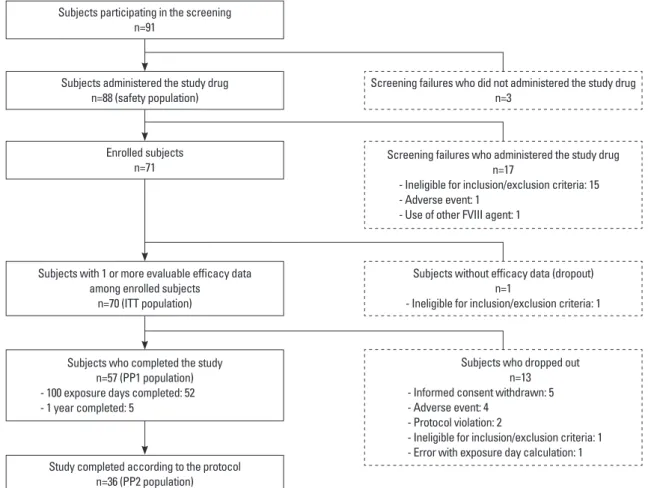
ficacy were conducted for the ITT population in principle, and additional analyses were performed on the PP1 and PP2 populations. The analyses of baseline characteristics of the subjects and laboratory tests targeted the ITT population, while analyses of AEs targeted the safety population (Fig. 1).
Baseline characteristics, hemostatic efficacy, and safety variables are presented using descriptive statistics. The PK parameters between each visit were compared using the Wil- coxon-signed rank test to confirm statistical differences. All p-values<0.05 were considered significant.
RESULTS
Subjects
A total of 91 subjects with severe hemophilia A were scre- ened for participation in this study, and 20 were excluded;
thus, 71 patients were enrolled (Fig. 1). Of these, 14 subjects dropped out, and 57 subjects completed the acute hemor- rhage treatment study (study 1). Of the 71 subjects enrolled
Fig. 1. Status of subjects who participated in the acute hemorrhage treatmnt study (study 1). ITT, intention-to-treat; PP1, per-protocol 1; PP2, per-protocol 2;
FVIII, factor VIII.
Subjects participating in the screening n=91
Subjects administered the study drug n=88 (safety population)
Subjects with 1 or more evaluable efficacy data among enrolled subjects
n=70 (ITT population)
Subjects who completed the study n=57 (PP1 population) - 100 exposure days completed: 52 - 1 year completed: 5
Enrolled subjects n=71
Study completed according to the protocol n=36 (PP2 population)
Screening failures who administered the study drug n=17
- Ineligible for inclusion/exclusion criteria: 15 - Adverse event: 1
- Use of other FVIII agent: 1
Screening failures who did not administered the study drug n=3
Subjects without efficacy data (dropout) n=1
- Ineligible for inclusion/exclusion criteria: 1
Subjects who dropped out n=13 - Informed consent withdrawn: 5 - Adverse event: 4
- Protocol violation: 2
- Ineligible for inclusion/exclusion criteria: 1 - Error with exposure day calculation: 1
0.77%/(IU/kg), which when compared to the recovery at the baseline, showed statistically significant decrease (p=
0.0015). However, considering the fact that the normal range of FVIII: C is 60‒150%, the difference of FVIII: C being 60‒150% before and after administering 50 IU/kg of FVIII concentrate, as in this clinical trial, makes the recovery of 1.2‒3%/(IU/kg) which could lead to the interpretation that the recovery change of the study drug represents a change within a normal range.
Hemostatic efficacy of prophylaxis for surgery
Ten subjects received 12 surgical procedures in this trial.
The surgical procedures included arthroplasty (two cases), arthrolysis (one case), hemorrhoid operation (two cases), tooth extraction (three cases), tooth extraction site suture (one case), subgingival curettage (one case), epidermal cyst incision and drainage (one case), and hordeolum incision and drainage (one case). The median dose administered per surgical procedure was 8750 (2000‒189000) IU, and hemo- static efficacy by the investigators for the surgical proce- dures was excellent in seven cases (58.3%) and good in five cases (41.7%), showing a 100% efficacy rate.
Safety
A total of 88 subjects who were administered the study drug more than once were included in the safety analysis. Three and none in 0 subjects (0.0%). The overall efficacy rate was
87.1% [95% confidence interval (CI) 79.3‒95.0%]. The in- vestigators’ evaluations of hemostatic effect for major bleed- ing were excellent in 1 case and good in 1 case, showing 100% efficacy rate (Table 1). There were a total of 6179 cas- es in which hemostatic effects were evaluated: the efficacy rate was 72.3% (95% CI 71.2‒73.5%), with excellent efficacy in 1425 cases (23.1%), good efficacy in 3045 cases (49.3%), moderate efficacy in 1583 cases (25.6%), and no efficacy in 126 cases (2.0%).
The majority of acute hemorrhages were treated with one (86.2%) or two (10.0%) administrations of the study drug. In terms of site of hemorrhage, bleeding was stopped by ad- ministering the study drug once in 87.1% of cases involving joints, 84.8% involving muscles, 82.3% involving multiple sites, 82.8% involving oral sites, 78.3% involving soft tis- sues, and 70.6% involving other sites (Table 2). The subjects were administered the study drug 88.30±31.92 times on av- erage, and the mean dose administered per single dose was 28.55±6.53 IU/kg. An average of 1.20 times of 34.31 IU/kg was administered to treat a single hemorrhage. The subjects were administered the study drug 9.18±3.67 times (17710±
9325 IU) every month.
The baseline recovery was 2.16±0.85%/(IU/kg), ranging from the minimum of 0.58%/(IU/kg) to the maximum of 3.98%/(IU/kg). The recovery at the close-out visit was 1.70±
Table 1. Evaluation of Hemostatic Efficacy Against Acute Hemorrhage Population No. of
patients
Final hemostatic effect,* no. of subjects (%) Efficacy rate† (%), (95% CI)
Excellent Good Moderate None
ITT 70 35 (50.0) 26 (37.1) 9 (12.9) 0 (0.0) 87.1 (79.3‒95.0)
PP1 57 33 (57.9) 20 (35.1) 4 (7.0) 0 (0.0) 93.0 (86.4‒99.6)
PP2 36 20 (55.6) 14 (38.9) 2 (5.6) 0 (0.0) 94.4 (87.0‒101.9)
CI, confidence interval; ITT, intention-to-treat; PP1, per-protocol 1; PP2, per-protocol 2.
*Classification of hemostatic effects: excellent=totally hemostatic, good=almost hemostatic, moderate=not enough but hemostatic effect recognizable, and none=hemostatic effect not recognizable.
†Efficacy rate defined as [(number of subjects who responded “excellent” or “good”)/(total number of subjects)]×100.
Table 2. Dose and the Number of Infusions to Treat Acute Hemorrhage According to Hemorrhage Site Site of
hemorrhage No. of cases No. of infusions to treat bleeding* No. of
infusions†
Overall dose to treat bleeding†
1 2 3 ≥4
Joint 4021 (78.2) 3503 (87.1) 391 (9.7) 98 (2.4) 29 (0.7) 1.18±0.56 33.25±18.28
Muscle 592 (11.5) 502 (84.8) 57 (9.6) 25 (4.2) 8 (1.4) 1.24±0.75 36.42±23.97
Multiple Sites 192 (3.7) 158 (82.3) 25 (13.0) 5 (2.6) 4 (2.1) 1.26±0.66 36.22±21.56
Oral 186 (3.6) 154 (82.8) 22 (11.8) 7 (3.8) 3 (1.6) 1.25±0.65 37.51±26.01
Soft tissue 83 (1.6) 65 (78.3) 9 (10.8) 6 (7.2) 3 (3.6) 1.7±2.74 47.54±88.12
Others 68 (1.3) 48 (70.6) 12 (17.7) 5 (7.4) 3 (4.4) 1.5±0.98 48.05±28.64
Total 5142 (100.0) 4430 (86.2) 516 (10.0) 146 (2.8) 50 (1.0) 1.20±0.69 34.31±22.60
*Values are number of cases (%).
†Values are mean±standard deviation.
statistical significance before or after administration of the study drug. After study drug administration, we performed enzyme linked immunosorbent assay (ELISA) assay, in which anti-rFVIII Ab in four (5.7%) of 70 subjects and an- ti-mouse IgG in one 1 (1.4%) of 70 subjects turned from negative to positive.
Anti-HAV IgG turned from negative to positive in four of 10 subjects (40%), although anti-HAV IgM was negative in these four subjects. Anti-HBs turned from negative to posi- tive in two of 17 subjects (11.8%). A positive conversion rate for HIV Ab, anti-HAV IgM, HBs Ag, and HCV Ab was not observed in any subject.
Pharmacokinetics
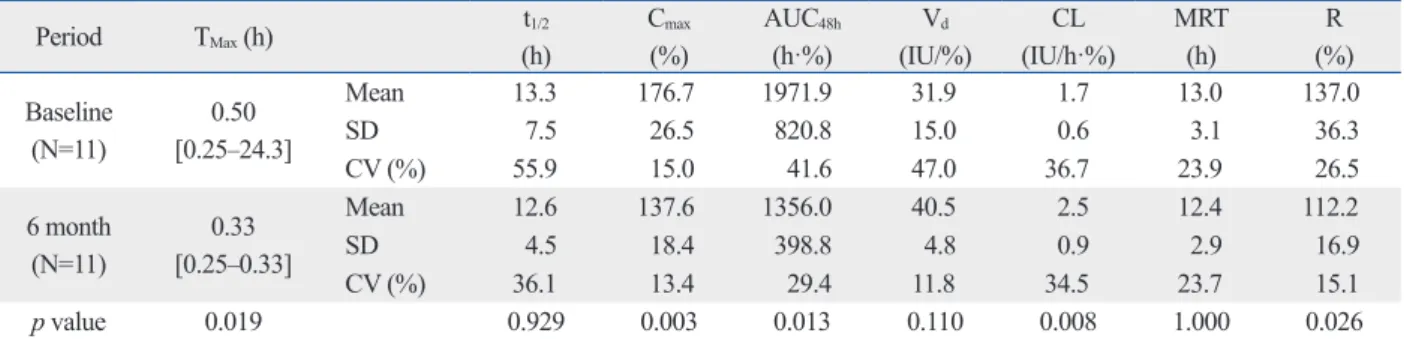
The results of the PK parameters are presented in Table 3.
No differences were observed between visits as the final elim- ination half-life was 13.3 h and 12.6 h at baseline and 6 months, respectively. The maximum activity in blood (Cmax) showed a mean of 176.7% at baseline but a mean of 137.6%
at 6 months, and the blood activity-time area under curve (AUC48h) showed a mean of 1971.9 h·% at baseline but de- creased to 1356.0 h·% at 6 months (p=0.003 and p=0.013, respectively). Recovery decreased from a mean of 137.0% at baseline to a mean of 112.2% at 6 months (p=0.026).
DISCUSSION
Beroctocog alfa (GreenGene®, Green Cross Corporation, Yongin, Korea) is a newly developed second generation rF- VIII manufactured by removing the B-domain from FVIII, and is the second commercially available BDD rFVIII con- centrate after ReFacto®. In this clinical trial, beroctocog alfa showed excellent efficacy in the treatment of acute hemor- rhage and as prophylaxis for surgical procedures in patients subjects who had a surgical procedure after the clinical trial
close-out and received new subject numbers through re-sc- reening were analyzed as new subjects. The subjects acquired 6397 rFVIII exposure days during studies 1 and 2, and 82.5%
of the subjects had more than 50 rFVIII exposure days.
In this trial, 52 of 88 subjects (59.0%) experienced 168 AEs. Eighteen serious AEs (10.7% of AEs) occurred in 11 subjects who all recovered. Five subjects dropped out be- cause of AEs. Among the 18 serious AEs, two (mild dys- pnea and facial edema) in one subject were related to the study drug. There were 43 AEs (25.6%) that were related to the study drug and were evaluated as definite/possible/prob- able. Of the 127 AEs that occurred while treating acute he- morrhage, 26 (20.5%) in 16 subjects were related to the study drug: anti FVIII antibody positivity (six events), urticaria (three events), palpitations (two events), nausea (two events), and facial edema (two events), anemia (two events), and oth- ers (one event each). Of 24 AEs that occurred during pro- phylaxis for surgery, seven (29.2%) in two subjects were related to the study drug: infection site swelling (three ev- ents), phlebitis (two events), and others (one event each).
Ten of 17 AEs (58.8%) in six subjects during the PK study were related to the study drug, such as headache, nasal con- gestion, sputum retention, and throat irritation (two events for each), as well as nausea, axillary pain, blood IgG increase, abnormal liver function test, dizziness, somnolence, pyuria, cough, and sneezing (one event for each). The FVIII inhibi- tor was negative before study drug administration (<0.6 BU) in the entire ITT population, and only one subject form- ed de novo FVIII inhibitor for an occurrence rate of 1.4%; the one-sided 95% upper confidence limit was 3.85%.
Among immunological reactions, 11 (18.6%) of 59 sub- jects turned from normal to abnormal for CD4; this transi- tion also took place for CD8 in three (4.9%) of 61 and for CD4/CD8 in five (9.1%) of 55. These reactions did not show
Table 3. Pharmacokinetic Parameters after Single Intravenous Administration of B-Domain-Deleted Recombinant Factor VIII, Beroctocog Alfa, in 11 Subjects Who Completed the Pharmacokinetic Study
Period TMax (h) t1/2
(h)
Cmax (%)
AUC48h
(h·%)
Vd (IU/%)
CL (IU/h·%)
MRT (h)
R (%) Baseline
(N=11)
0.50 [0.25‒24.3]
Mean 13.3 176.7 1971.9 31.9 1.7 13.0 137.0
SD 7.5 26.5 820.8 15.0 0.6 3.1 36.3
CV (%) 55.9 15.0 41.6 47.0 36.7 23.9 26.5
6 month (N=11)
0.33 [0.25‒0.33]
Mean 12.6 137.6 1356.0 40.5 2.5 12.4 112.2
SD 4.5 18.4 398.8 4.8 0.9 2.9 16.9
CV (%) 36.1 13.4 29.4 11.8 34.5 23.7 15.1
p value 0.019 0.929 0.003 0.013 0.110 0.008 1.000 0.026
N, number of patients; TMax, time to the maximum activity in blood; t1/2, elimination half-life; Cmax, maximum activity in blood; AUC, activity in blood-time area under curve; Vd, volume of distribution; CL, clearance; MRT, mean residence time; R, recovery; SD, standard deviation; CV, coefficient of variation.
homogeneity of the study drug may contribute to lessening concerns for safety and quality control of rFVIII products.16 Accordingly, it is not because beroctocog alfa does not uti- lize albumin during the cell culture process, making this product different from ReFacto®, that it becomes highly at- tractive; instead, its homogeneity sets it apart from other rF- VIII products.
The hemostatic efficacy rate of beroctocog alfa was 87.1%
in the present study, and that of Kogenate FS® was reported to be 82.9%.17 The efficacy rates of ReFacto® and octocog alfa were 86%5 and 86%,6 respectively. In addition, the rate of achieving hemostasis for a single hemorrhage with two or fewer administrations of the study drug was relatively higher than that of other rFVIII concentrates. Instances of administering rFVIII concentrate only once or twice to treat a single hemorrhage was 96.2% for the study drug, 88.7%
for Kogenate FS®, 91.2% for Recombinate®,18 86.7% for ReFacto®,5 92.5% for Xyntha® (Pfizar Inc., New York, NY, USA),5 and 93.0% for octocog alfa.6 Although a direct com- parison of the efficacy rate between the study drug and other rFVIII concentrates could not be performed, the study drug had comparable hemostatic efficacy with previous rFVIII concentrates. Additionally, the hemostatic effects were ex- cellent in 12 surgical procedure cases, verifying the efficacy of the study drug for inhibiting and preventing hemorrhage symptoms.
Of the 127 AEs that occurred during acute hemorrhage treatment, 26 were related to the study drug, and out of the 24 AEs that occurred during surgical procedures, seven were related to the study drug. The common AEs were anti FVIII antibody positivity (6 events), urticaria (3 events), and infec- tious site swelling (3 events). The clinical trial results of Re- Facto® showed that 70 AEs related to the study drug occurr- ed in 31 of 113 subjects (27.4%), and they mostly consisted of nausea (11 events), dyspnea (7 events), headache (5 events), vasodilation (5 events), asthma (3 events), angina pectoris (2 events), and anorexia (2 events).19 Although beroctocog alfa showed a higher incidence of AEs than ReFacto®, only two serious AEs (mild dyspnea and facial edema) in 1 subject were related to the study drug, and most of AEs were not se- rious and manageable. No significant changes in immuno- logical reactions or viral propagation were observed. There- fore, beroctocog alfa appeared to be as safe as other rFVIII products for use.
The major PK parameters of administration of the study drug after 6 months and the results of previous research are similar. The parameters for the first administration period previously treated for severe hemophilia A. Beroctocog alfa
also revealed an acceptable safety, based on its AE profile.
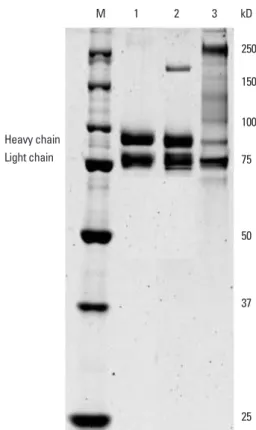
Previous results of phase I and II studies to evaluate the PK parameters and safety profiles of 25 and 50 IU/kg of be- roctocog alfa through single and repetitive administrations in 12 hemophilia A patients demonstrated comparable safe- ty and PK profiles in comparison to those of commercial plasma derived FVIII (active control).12 No serious AEs were observed, and the PK parameters showed dose-inde- pendent effects in the 25 and 50 IU/kg dose ranges. Inter- estingly, beroctocog alfa is a highly homogenous rFVIII product with a heavy chain (A1 and A2 domain) and a light chain (A3, C1, and C2 domain) at 90 and 80 kDa.13 Paik, et al. previously reported beroctocog alfa to be homogenously secreted and highly purified FVIII. Sodium dodecyl sul- phate-polyacrylamide gel electrophoresis (SDS-PAGE) re- sults demonstrated beroctocog alfa has no heterogeneous B domain, such as full length FVIII, nor a single-chain protein, as in other commercial rFVIII concentrates (Fig. 2). By sepa- rating itself from other FVIIII products that are observed in the SDS-PAGE to be heterogeneous in many form of FVIIII, it acquires a distinctive homogenous characteristic.14-16 The
Fig. 2. SDS-PAGE to evaluate the homogeneity of beroctocog alfa and oth- er recombinant factor VIII (rFVIII) products. Lane #M: molecular weight standard (Biorad), lane #1: berotocog alfa, lane #2: commercial B domain deleted rFVIII, lane #3: commercial full length rFVIII. SDS-PAGE, sodium do- decyl sulphate-polyacrylamide gel electrophoresis.
Heavy chain Light chain
250 150
100 75
50
37
25 M 1 2 3 kD
for beroctocog alfa), and these incidence rates of inhibition by BDD-rFVIII concentrates are comparable with full length FVIII concentrates.
There are some limitations to this study. We reported the efficacy and the safety of beroctocog alfa of on-demand treatment instead of prophylactic treatment because only the former was permitted as a clinical trial under Korean regu- lations in 2004. Also, the high rate of drop out subjects made this study less of a well-controlled trial. Only 36 of the 71 (50.7%) enrolled subjects completed the study according to the protocol, although hemostatic efficacy was consistently high in the ITT, PP1, and PP2 populations. Additionally, this study was conducted several years ago and the publication was delayed due to several reasons; however, little has ch- anged in the management of hemophilia A.
In conclusion, this clinical trial demonstrated that beroc- tocog alfa is safe and effective in treatment of acute hemor- rhage and as a surgical prophylaxis in patients with hemo- philia A. Beroctocog alfa provides another option for tr- eating adolescents and adult patients with hemophilia A.
ACKNOWLEDGEMENTS
This trial was sponsored by the Green Cross Corporation (Yongin, Korea).
Sang Hoon Paik has been employed by the Green Cross Corporation and contributed to the development of the study product, as well as the preparation of the manuscript.
REFERENCES
1. Kulkarni R, Soucie JM. Pediatric hemophilia: a review. Semin Thromb Hemost 2011;37:737-44.
2. Bray GL, Gomperts ED, Courter S, Gruppo R, Gordon EM, Man- co-Johnson M, et al. A multicenter study of recombinant factor VIII (recombinate): safety, efficacy, and inhibitor risk in previous- ly untreated patients with hemophilia A. The Recombinate Study Group. Blood 1994;83:2428-35.
3. Lusher JM, Arkin S, Abildgaard CF, Schwartz RS. Recombinant factor VIII for the treatment of previously untreated patients with hemophilia A. Safety, efficacy, and development of inhibitors. Ko- genate Previously Untreated Patient Study Group. N Engl J Med 1993;328:453-9.
4. Abshire TC, Brackmann HH, Scharrer I, Hoots K, Gazengel C, Powell JS, et al. Sucrose formulated recombinant human antihe- mophilic factor VIII is safe and efficacious for treatment of hemo- philia A in home therapy--International Kogenate-FS Study Group.
Thromb Haemost 2000;83:811-6.
5. Recht M, Nemes L, Matysiak M, Manco-Johnson M, Lusher J,
showed differences from those at 6 months and the results of previous research.12 AUC48h and recovery between the first administration period and administration after 6 months was 0.78, 0.70, and 0.85, in terms of the ratio of the value at 6 months to baseline for Cmax, AUC48h, and recovery. The ex- act cause of the change in the PK parameters between base- line and 6 months was unclear. Antibody formation, weight change, change in the test instrument or test method, or change in the manufactured lot of the study drug could be suspected reasons for the differences. Almost no change in weight and age was observed. There was also no change in test method and the manufacturing process. The decrease in recovery with time when administering the same rFVIII concentrate to the same patient is caused by antibody for- mation.2 However, the results of conducting previously iden- tified antibody tests showed no antibody formation in the subjects that participated in this clinical trial.20 Considering that the degree of recovery of various recombinant concen- trates in published reports varied from 73.5% to 135.0%17,20 and that the recovery of the same concentrates in existing studies (mean of 113.0%)12 was similar to the recovery at 6 months, we suggest that the possibility of over-estimating recovery at baseline may account for the discrepancy. When administering blood-derived FVIII concentrates or rFVIII concentrates, the dose is determined to achieve FVIII activ- ity in blood of 100% of the normal value. As this is calcu- lated by assuming 100% recovery, the clinical significance can be considered the same if recovery is 100% or more.21 When beroctocog alfa was administered at baseline and 6 months, the mean recovery was 100% and the administra- tion of 50 IU/kg beroctocog alfa for 6 months reached a re- covery rate of 100% or more.
Previous studies have demonstrated that the B-domain of FVIII is dispensable for in vitro procoagulant activity.22 However, there are several concerns about BDD-rFVIII con- centrates. A meta-analysis reported a shorter half-life of BDD-rFVIII compared with full length rFVIII concen- trates.23 This meta-analysis had some limitations in that the analysis included non-randomized observational studies in a single cohort. In contrast, two randomized controlled PK studies failed to confirm a difference in PK parameters be- tween the BDD-rFVIII concentrate ReFacto® and full-length FVIII and showed a bioequivalence of BDD-rFVIII con- centrates and full-length FVIII.24,25 Furthermore, the inci- dences of de novo FVIII inhibitor for Xyntha®, ReFacto®, and beroctocog alfa are only 1.5% (three of 187 subjects for both Xyntha® and ReFacto®)5 and 1.4% (one of 70 subjects
16. Paik SH, Kim YJ, Han SK, Kim JY, Park H, Park YI. Comparabili- ty studies of new 3rd generation recombinant human factor VIII GreenGene F after improvement of formulation and viral inactiva- tion/removal process. Biologicals 2012;40:405-14.
17. Yoshioka A, Shima M, Fukutake K, Takamatsu J, Shirahata A; Co- ganate FS Study Group. Safety and efficacy of a new recombinant FVIII formulated with sucrose (rFVIII-FS) in patients with haemo- philia A: a long-term, multicentre clinical study in Japan. Haemo- philia 2001;7:242-9.
18. White GC 2nd, Courter S, Bray GL, Lee M, Gomperts ED. A mul- ticenter study of recombinant factor VIII (Recombinate) in previ- ously treated patients with hemophilia A. The Recombinate Previ- ously Treated Patient Study Group. Thromb Haemost 1997;77:
660-7.
19. Courter SG, Bedrosian CL. Clinical evaluation of B-domain de- leted recombinant factor VIII in previously untreated patients. Se- min Hematol 2001;38(2 Suppl 4):52-9.
20. Lee C. The use of recombinant factor VIII products in previously treated patients with hemophilia A: pharmacokinetics, efficacy, safety, and inhibitor development. Semin Thromb Hemost 2002;
28:241-6.
21. Viuff D, Barrowcliffe T, Saugstrup T, Ezban M, Lillicrap D. Inter- national comparative field study of N8 evaluating factor VIII as- say performance. Haemophilia 2011;17:695-702.
22. Toole JJ, Pittman DD, Orr EC, Murtha P, Wasley LC, Kaufman RJ.
A large region (approximately equal to 95 kDa) of human factor VIII is dispensable for in vitro procoagulant activity. Proc Natl Acad Sci U S A 1986;83:5939-42.
23. Gruppo RA, Brown D, Wilkes MM, Navickis RJ. Comparative ef- fectiveness of full-length and B-domain deleted factor VIII for prophylaxis--a meta-analysis. Haemophilia 2003;9:251-60.
24. Di Paola J, Smith MP, Klamroth R, Mannucci PM, Kollmer C, Fe- ingold J, et al. ReFacto and Advate: a single-dose, randomized, two- period crossover pharmacokinetics study in subjects with haemo- philia A. Haemophilia 2007;13:124-30.
25. Kessler CM, Gill JC, White GC 2nd, Shapiro A, Arkin S, Roth DA, et al. B-domain deleted recombinant factor VIII preparations are bioequivalent to a monoclonal antibody purified plasma-de- rived factor VIII concentrate: a randomized, three-way crossover study. Haemophilia 2005;11:84-91.
Smith M, et al. Clinical evaluation of moroctocog alfa (AF-CC), a new generation of B-domain deleted recombinant factor VIII (BDDrFVIII) for treatment of haemophilia A: demonstration of safety, efficacy, and pharmacokinetic equivalence to full-length recombinant factor VIII. Haemophilia 2009;15:869-80.
6. Shapiro AD. Anti-hemophilic factor (recombinant), plasma/albu- min-free method (octocog-alpha; ADVATE) in the management of hemophilia A. Vasc Health Risk Manag 2007;3:555-65.
7. Lentz SR, Misgav M, Ozelo M, Salek SZ, Veljkovic D, Recht M, et al. Results from a large multinational clinical trial (guardian™1) using prophylactic treatment with turoctocog alfa in adolescent and adult patients with severe haemophilia A: safety and efficacy. Hae- mophilia 2013;19:691-7.
8. World Medical Association. World Medical Association Declara- tion of Helsinki: ethical principles for medical research involving human subjects. JAMA 2013;310:2191-4.
9. Chun BH, Park SY, Chung N, Bang WG. Enhanced production of recombinant B-domain deleted factor VIII from Chinese hamster ovary cells by propionic and butyric acids. Biotechnol Lett 2003;
25:315-9.
10. Srivastava A, Brewer AK, Mauser-Bunschoten EP, Key NS, Kitch- en S, Llinas A, et al. Guidelines for the management of hemophilia.
Haemophilia 2013;19:e1-47.
11. Verbruggen B, Novakova I, Wessels H, Boezeman J, van den Berg M, Mauser-Bunschoten E. The Nijmegen modification of the Bethesda assay for factor VIII:C inhibitors: improved specificity and reliability. Thromb Haemost 1995;73:247-51.
12. Han H, Shin KH, Paik SH, Chung JY, Lim KS, Cho JY, et al. Phar- macokinetics and Tolerability Evaluation of Human Coagulation Recombinant Factor VIII (GreenGene(TM)) in Hemophilia A Pa- tients. J Korean Soc Clin Pharmacol Ther 2011;19:144-51.
13. Paik SH, Kim YJ, Han SK, Kim JM, Huh JW, Park YI. Mixture of three amino acids as stabilizers replacing albumin in lyophiliza- tion of new third generation recombinant factor VIII GreenGene F.
Biotechnol Prog 2012;28:1517-25.
14. D’Amici GM, Timperio AM, Gevi F, Grazzini G, Zolla L. Re- combinant clotting factor VIII concentrates: heterogeneity and high-purity evaluation. Electrophoresis 2010;31:2730-9.
15. Jankowski MA, Patel H, Rouse JC, Marzilli LA, Weston SB, Sharpe PJ. Defining ‘full-length’ recombinant factor VIII: a com- parative structural analysis. Haemophilia 2007;13:30-7.