INTRODUCTION
It is critical that patients undergoing chronic hemodialysis
maintain vascular access without failure. Autologous arterio- venous fistula (AVF) is the preferred hemodialysis access due to its many advantages, including greater duration in function and lower infection rate compared with arteriovenous grafts (AVG) and central venous hemodialysis catheters.1,2 However, mature AVFs are still at risk of malfunction, as they require re- peated intervention to maintain patency and commonly ne- cessitate subsequent vascular access.3 Late AVF failure is gen- erally defined as failure occurring after three months of use.4 Neointimal hyperplasia is thought to be the most important factor causing late loss of AVF patency after a period of suc- cessful use.3,5 The mechanism by which neointimal hyperpla- sia progresses and stenosis and/or thrombosis develop during chronic hemodialysis treatment is unclear, but is presumably due to a combination of shear stresses, repeated needle inju- ry, and uremic milieu.3,5,6
Erythropoietin stimulating agents (ESA) are used in the treat-
Administration of a High-Dose Erythropoietin- Stimulating Agent in Hemodialysis Patients is
Associated with Late Arteriovenous Fistula Failure
Hye Yun Jeong1, Eun-Jung Ko1, Sang Hoon Kim2, Mi Jung Lee1, Hye Jeong Cho1, Dong Ho Yang1, and So-Young Lee1
Divisions of 1Nephrology and 2Cardiology, Department of Internal Medicine, CHA Bundang Medical Center, CHA University School of Medicine, Seongnam, Korea.
Purpose: Investigating the risk of vascular access failure is critical for maintenance hemodialysis (MHD) patients. Erythropoietin stimulating agents (ESA) typically used for anemia of chronic kidney disease (CKD) may also stimulate neointimal hyperplasia, which is the most important factor in late arteriovenous fistula (AVF) failure. The aim of this study was to investigate whether ESA treatment is associated with late AVF failure.
Materials and Methods: The late AVF failure group comprised 51 patients who underwent percutaneous intervention or surgery for fistula revision after successful use for at least three months. There were 51 controls whose AVF had been patent for at least 24 months.
Results: The mean time from the first cannulation to late loss of AVF patency was 8.4±4.2 months. The average weekly dose of ESA was significantly higher in patients with AVF failure (4782.2±2360.5 IU/mL/wk vs. 7161.8±2775.2 IU/mL/wk, p<0.001). The only in- dependent predictor of late AVF failure in multivariate analysis was high average ESA dose (odds ratio=1.015, 95% confidence in- terval=1.002–1.028, p=0.022).
Conclusion: Patients with late AVF patency loss exhibit an association with a higher dose of ESA, although causality is unproven.
Further study to elucidate potential mechanisms is warranted.
Key Words: Arteriovenous fistula, chronic kidney disease, erythropoietin stimulating agents, maintenance hemodialysis, neointimal hyperplasia
pISSN: 0513-5796 · eISSN: 1976-2437
Received: October 7, 2016 Revised: January 30, 2017 Accepted: February 15, 2017
Co-corresponding authors: Dr. So-Young Lee, Division of Nephrology, Department of Internal Medicine, CHA Bundang Medical Center, CHA University School of Medi- cine, 59 Yatap-ro, Bundang-gu, Seongnam 13496, Korea.
Tel: 82-31-780-5025, Fax: 82-31-780-5219, E-mail: [email protected] and Dr. Dong Ho Yang, Division of Nephrology, Department of Internal Medicine, CHA Bun- dang Medical Center, CHA University School of Medicine, 59 Yatap-ro, Bundang-gu, Seongnam 13496, Korea.
Tel: 82-31-780-5896, Fax: 82-31-780-5219, E-mail: [email protected]
•The authors have no financial conflicts of interest.
© Copyright: Yonsei University College of Medicine 2017
This is an Open Access article distributed under the terms of the Creative Com- mons Attribution Non-Commercial License (http://creativecommons.org/licenses/
by-nc/4.0) which permits unrestricted non-commercial use, distribution, and repro- duction in any medium, provided the original work is properly cited.
Yonsei Med J 2017 Jul;58(4):793-799 https://doi.org/10.3349/ymj.2017.58.4.793
ment of anemia in patients with chronic kidney disease (CKD), but it has some adverse effects, such as hypertension and car- diovascular and cerebrovascular events.7 Interestingly, several experimental studies have shown that ESA could stimulate vascular smooth muscle cells8 and induce neointimal hyper- plasia.9 However, the role of ESA in the process of late AVF loss in patients on chronic hemodialysis is still inconclusive.10 The aim of the present study was to determine whether ESA treat- ment is associated with late loss of AVF function after success- ful maturation in patients receiving chronic hemodialysis.
MATERIALS AND METHODS
Patients
This was a retrospective case-control study of patients who re- ceived maintenance hemodialysis (MHD) and underwent AVF creation. All patients had end stage renal disease (ESRD) and were treated with MHD at the CHA Bundang Medical Cen- ter hemodialysis center between 2006 and 2015. We selected patients who received percutaneous intervention or surgery to revise their fistula after successful use of AVF for at least three months to be enrolled in the late AVF failure group. In the percutaneous intervention, vessels were dilated using a balloon catheter [ArmadaTM 35 (Abbott Vascular, Santa Clara, CA, USA), MUSTANGTM (Boston Scientific Co., Marlborough, MA, USA)] with a diameter varying from 4–8 mm. The balloon was inflated for 30–60 seconds and repeated as necessary. Bal- loon inflation pressure was 14–24 atm as recommended by the
manufacturer.
Vascular access failure events occurred in 195 patients dur- ing that time period. Among those patients, 68 had an AVG.
Only 51 patients were ultimately included in the late AVF fail- ure group (Fig. 1). Fifty-one controls were selected from our centers whose AVF had been patent without an episode of ac- cess failure for at least 24 months. Neither cases nor controls had a history of cancer, coagulation disorder, active infection, or AVG with synthetic material. AVF operations were per- formed within one month after the first MHD in both groups.
All patients initiated AVF cannulation within 3 months after AVF formation. All patients were undergoing chronic bicarbon- ate hemodialysis for a mean time of 4.0 hours, three times a week. The blood flow rate ranged between 250 and 300 mL/
min, whereas a dialysate flow rate of 500 mL/min was rou- tinely used. Kt/V was evaluated monthly as a marker of dialy- sis efficiency. The study was approved by the Institutional Re- view Board of the CHA Bundang Medical Center, CHA Uni- versity. Because the study involved the analysis of data already collected and the data had individual identifying information removed, the ethics board waived the need for individual pa- tient consent.
Clinical variables
Patient demographic, clinical, and vascular access data, includ- ing age, gender, and etiology of ESRD (e.g., diabetes, hyper- tension, glomerulonephritis, polycystic kidney disease, or un- known), AVF site (forearm or upper arm), medications (antihy- pertensive drugs, antiplatelet agents, calcium containing ag-
Fig. 1. Flow chart illustrating study population enrollment. A total of 1625 patients received MHD at the hemodialysis center of CHA Bundang Medical Center between 2006 and 2015. Vascular access failure events occurred in 245 patients. After applying exclusion criteria, only 51 patients were eligible for the late AVF failure group. AVG, arteriovenous graft; AVF, arteriovenous fistula; MHD, maintenance hemodialysis.
MHD in CHA Bundang Medical Center (2006–2015) (n=698)
Vascular access failure (n=195) Non vascular access failure (n=503)
Eligible patients (n=57) Eligible patients (n=72)
Late failure (n=51) Control group (n=51)
Exclusion criteria (n=138) - AVG (n=68)
- Cancer (n=9)
- Coagulation disorder (n=0) - Active infection (n=9)
- Insufficient medical record (n=39) - AVF formation before MHD start (n=8)
- AVF formation later than 1 month since MHD start (n=5)
Exclusion criteria (n=431) - AVG (n=238) - Cancer (n=29)
- Coagulation disorder (n=2) - Active infection (n=25) - Insufficient medical record (n=89) - AVF formation before MHD start (n=30)
- AVF formation later than 1 month since MHD start (n=18)
Excluded - Early failure (n=6)
Excluded
- AVF patency history less than 24 months (n=21)
ents, or vitamin D analogues), heparin dose, and other comor- bidities (ischemic heart disease, cerebrovascular disease, or peripheral vascular disease), were obtained by medical record review. Cardiovascular diseases were defined when patients had any medical history of angina pectoris, positive treadmill test, myocardial infarction, percutaneous transluminal coro- nary angioplasty, coronary artery bypass surgery, or congestive heart failure. Cerebrovascular diseases were defined when pa- tients had any medical history of stroke, transient ischemic at- tack, or intracranial hemorrhage. The combined cardiovascular disease group included patients who had cardiovascular and cerebrovascular disease. Laboratory findings were collected, including serum hemoglobin, serum calcium, blood urea ni- trogen, phosphate, intact parathyroid hormone (iPTH), uric acid, total cholesterol, low density lipid cholesterol, c-reactive protein (CRP), 25-hydroxyvitamin D, and albumin, at the time of the first access cannulation. The mean weekly erythropoie-
tin doses and the mean hemoglobin level were calculated us- ing medical records through the period from the first AVF use to an event or at least two years after the first AVF cannulation for the control group. For dose conversion, 1 mcg of darbepo- etin alpha was converted to 200 IU epoetin alpha.11 Blood flow rate data were collected for the three most recent hemodialy- sis treatments for controls or for the last three hemodialysis treatments before late AVF failure for cases. Loss of AVF paten- cy due to thrombosis was defined as the need for percutane- ous intervention, thrombectomy, or reconstruction surgery to revise the fistula.
Statistical analysis
Categorical variables were recorded as numbers and percent- ages. Continuous variables were presented as the mean±stan- dard deviation. Student’s t-test and the Mann-Whitney U test were used to compare continuous variables. Categorical vari-
Table 1. Baseline Characteristics of the Study Population
Characteristics Overall (n=102) No AVF failure (n=51) AVF failure (n=51) p value
Male, n (%) 63 (61.7) 31 (60.7) 32 (62.7) 0.839
Age (yr) 54.2±13.5 50.6±13.4 57.9±12.7 0.006
BMI (kg/m2) 22.7±3.03 23.0±3.35 22.3±2.6 0.275
MBP (mm Hg) 97.7±13.7 98.1±14.8 97.4±12.7 0.803
First needling time (month) 2.34±0.48 2.27±0.45 2.41±0.50 0.147
HTN, n (%) 84 (82.3) 38 (74.5) 46 (90.1) 0.038
Diabetes, n (%) 64 (62.7) 23 (45.0) 41 (80.3) <0.001
Cardiovascular disease, n (%) 15 (14.7) 2 (3.9) 13 (25.4) 0.002
Cerebrovascular, n (%) 9 (8.8) 2 (3.9) 7 (13.7) 0.160
Combined CVD group, n (%) 21 (20.5) 4 (7.8) 17 (33.3) 0.001
Heparin, loading (IU/mL) 1039.2±376.8 1039.2±372.0 1039.2±385.2 1.000
Heparin, continuous (IU/mL) 300.9±179.6 270.5±172.0 331.3±183.5 0.088
Blood flow rate (mL/min) 264.8±34.6 271.5±27.5 258.0±39.5 0.048
Forearm fistula, n (%) 90 (88.2) 46 (90.1) 44 (86.2) 0.539
Hemoglobin (g/dL) 9.3±1.5 9.4±1.5 9.3±1.5 0.842
Albumin (mg/dL) 3.4±0.6 3.6±0.5 3.2±0.6 0.001
Uric acid 7.8±1.9 7.8±2.0 7.8±1.8 0.959
BUN (mg/dL) 22.7±3.03 66.2±33.2 67.5±22.5 0.811
Creatinine (mg/dL) 7.9±3.5 8.5±4.0 7.4±2.8 0.093
Calcium (mg/dL) 8.1±0.9 8.2±0.9 8.0±1.0 0.309
Phosphate (mg/dL) 5.0±1.6 5.1±1.6 4.9±1.6 0.456
iPTH, mg/dL (IQR) 142.9 (69.4–221.9) 157.7 (83.0–363.3) 119.7 (55.4–180.8) 0.017
T. cholesterol (ug/dL) 155.5±44.9 157.4±35.0 153.6±53.2 0.676
LDL cholesterol (mg/dL) 86.0±39.1 87.1±37.7 85.0±40.8 0.786
CRP, mg/dL (IQR) 0.2 (0.1–0.7) 0.2 (0.1–0.5) 0.3 (0.1–1.6) 0.059
25-OH Vitamin D3 (ug/mL) 14.4±8.7 15.5±8.3 12.7±9.2 0.340
spKT/V 1.4±0.2 1.4±0.1 1.3±0.3 0.254
ESA (IU/mL/wk) 5972.0±2828.6 4782.2±2360.5 7161.8±2775.2 <0.001
ESA (IU/mL/wk/kg) 99.4±50.0 79.2±42.4 119.6±49.2 <0.001
AVF, arteriovenous fistula; BMI, body mass index; BUN, blood urea nitrogen; CRP, C-reactive protein; Combined CVD group, combined cardiovascular or cerebrovascu- lar disease group; ESA, erythropoietin stimulating agent; First needling time, first needling time since AVF formation; HTN, hypertension; LDL, low density lipid;
MBP, mean blood pressure; iPTH, intact parathyroid hormone; T. cholesterol, total cholesterol; 25-OH Vitamin D3, 25 hydroxy vitamin D.
Data are expressed as the mean±standard deviation, median (IQR) or the count (percentage).
ables were compared using the χ2 test or Fisher’s exact test. Bi- nary logistic regression analysis was performed to investigate the effects of covariates on AVF patency. All p-values<0.050 were considered significant. Statistical analyses were performed us- ing SPSS for Windows (version 21; SPSS Inc., Chicago, IL, USA).
RESULTS
Study population
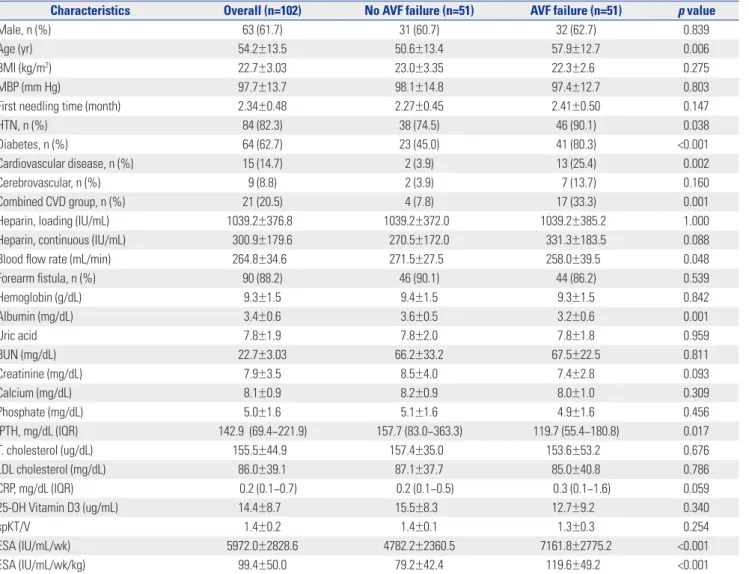
Clinical and biochemical characteristics are shown in Table 1.
The mean age of the study population was 54.2±13.5 years, and men comprised 61.7% of the population. The etiologies of ESRD were diabetic nephropathy (62.7%), hypertension (21.5%), glomerulonephritis (5.8%), autosomal dominant polycystic kidney disease (1.9%), and unknown (7.8%). Most patients had radiocephalic fistulas in the forearm (88.2%). The mean initial dose of heparin was 1039.2±376.8 IU/mL, and the maintenance dose was 300.9±179.6 IU/mL/hr. The mean ESA dose was 5972.0±2828.6 IU/mL/wk and 99.4±50.0 IU/mL/wk/kg (Table 1).
Clinical characteristics of patients with late AVF failure The mean duration of MHD was 59.7±32.2 months in the con- trol group and 11.8±4.2 months in the late AVF failure group.
The mean time from the first cannulation to late loss of AVF patency was 8.4±4.2 months.
Among the 51 eligible late AVF failure patients, most AVF ste- noses were located in the proximal draining vein. The stenotic sites in 23 patients were in the proximal draining veins, and the sites in 20 patients were near both anastomosis sites and the proximal draining veins. Of these patients, one opted to aban- don the original access site and underwent double lumen cath- eter insertion, and two underwent a thrombectomy. The re- maining 48 patients underwent percutaneous angioplasty, of which all were successful.
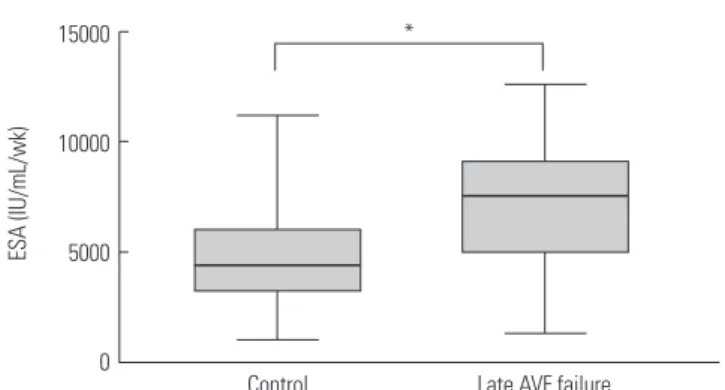
Baseline demographics and comorbidities of patients who developed late loss of functional AVF patency were compared with patients without AVF failure in Table 1. Patients with late AVF failure were significantly older and more likely to have co- morbid conditions, such as hypertension, diabetes mellitus, and cardiovascular disease. Additionally, patients with late AVF failure had significantly lower serum albumin and iPTH lev- els, compared to patients without late AVF failure. Blood flow rates during MHD treatment were significantly lower in the group with late AVF failure. Most importantly, the average week- ly dose of ESA was significantly higher in the patients with late loss of functional AVF patency (4782.2±2360.5 IU/mL/wk vs.
7161.8±2775.2 IU/mL/wk, p<0.001 and 79.2±42.4 IU/mL/wk/
kg vs. 119.6±49.2 IU/mL/wk/kg, p<0.001) (Table 1, Fig. 2). Se- rum hemoglobin levels, however, were not different between groups. We also compared mean hemoglobin levels between groups during the period from the first AVF use to an event or at least two years since the first AVF cannulation for the con-
trol group. The mean hemoglobin level was slightly higher in the AVF failure group, although the difference was not statistically significant (9.6±0.5 g/dL vs. 9.5±1.5 g/dL, p=0.728) (Fig. 3).
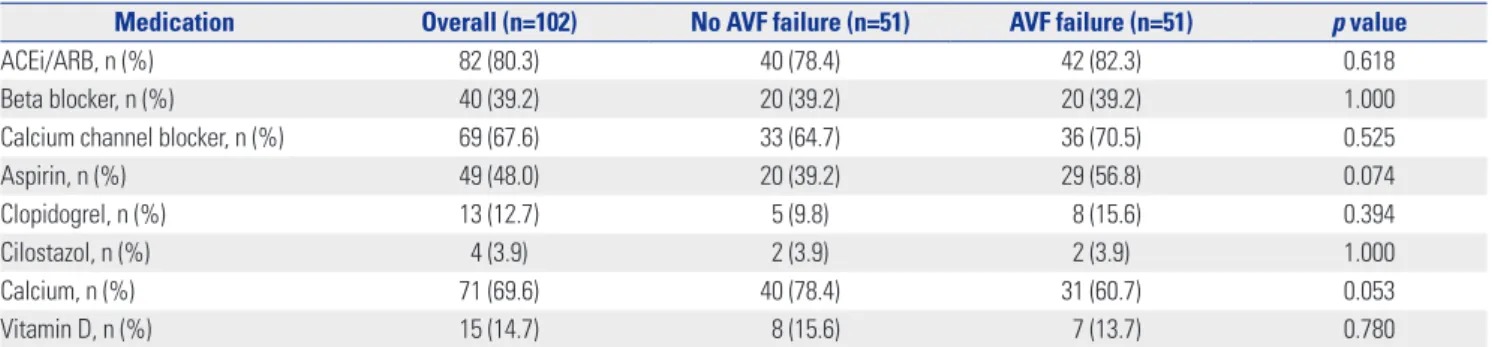
No differences in sex, access location, or medications were observed between those with and without late failure (Table 1 and 2).
Multivariate analysis
Binary logistic regression analysis was performed to assess the effects of covariates on AVF patency (Table 3). We used the con- tinuous value of ESA in IU/mL/wk/kg to evaluate the effect of ESA dose. The variables chosen for inclusion in the multivari- able logistic regression analysis were those found to be signifi- cantly correlated with late loss of functional patency on uni- variate analysis. Variables that met this criterion were age;
presence of diabetes, hypertension, or ischemic heart disease;
blood flow rate; serum albumin; iPTH; and dose of ESA. The only independent predictor of late loss of AVF patency in mul- tivariate analysis was a high average ESA dose (odds ratio=
1.015, 95% confidence interval=1.002–1.028, p=0.022) (Table 3).
Fig. 2. Mean ESA dose according to AVF patency loss. The mean ESA dose was 7161.8±2775.2 IU/mL/wk for the AVF failure group and 4782.2±2360.5 IU/mL/wk for the control group. The difference in mean ESA dose between the two groups was statistically significant (*p<0.001).
AVF, arteriovenous fistula; ESA, erythropoietin stimulating agent.
15000
10000
5000
0 Late AVF failure
*
Control
ESA (IU/mL/wk)
Fig. 3. Mean hemoglobin level according to AVF patency loss. The mean hemoglobin level was 9.6±0.5 g/dL in the AVF failure group and 9.5±1.5 g/dL in the control group. The mean hemoglobin level was slightly higher in the AVF failure group, but the difference was not statistically significant (p=0.728). AVF, arteriovenous fistula.
14 12 10 8
6 Control Late AVF failure
Hemoglobin (g/dL)
DISCUSSION
In this study, we retrospectively compared 51 cases and con- trols. All of them had successfully matured AVF and had used it for vascular access for more than three months. We com- pared the mean weekly ESA dose between the AVF patency loss group and controls, and we also compared the mean he- moglobin levels during the study period. This study showed that high-dose ESA could be a risk factor for late AVF patency loss. Notably, there was a significant relationship between ESA dosage and late AVF patency failure on multivariate analysis.
Traditionally, it is well known that ESA resistance is associ- ated with nutritional or inflammation status, which can be as- sociated with low albumin or high CRP levels. Such patients would continuously need a higher ESA dose in order to main- tain an appropriate hemoglobin level.12,13 In our study, the al- bumin level was significantly lower and CRP was not signifi- cantly higher in the AVF failure group. Furthermore, patients in the AVF failure group were older and had more co-morbid- ities. However, these factors were not statistically significant in multivariate analysis, which could suggest that the high ESA dose in the AVF fistula group was not influenced by ESA resis- tance as a confounding factor. Although age and diabetes are known to be significant factors for various disease states,14 the effects of age or diabetes on AVF patency are still controver- sial.15-17 In our study, patients with late AVF failure were signif- icantly older and more likely have diabetes than the patients with patent AVF in univariate analysis. However these differ-
ences were no longer significant in multivariate analysis.
Studies exploring the relationship between ESA treatment and AVF failure are scarce. Grandaliano, et al.18 reported that the weekly ESA dose was higher in a group of patients with AVF failure than patients without in their five-year case-control study. However, they did not mention the exact duration be- tween AVF formation and event and did not consider the ef- fects of medications, such as antiplatelet agents or antihyper- tensive drugs. Another study conducted by Roozbeh, et al.19 suggested that ESA administration influenced fistula patency (RR=10.92, p=0.021), but did not compare to controls or cal- culate the exact ESA dose. A three-year prospective study with 16 ESA-treated and 14 placebo-treated patients undergoing chronic hemodialysis showed that ESA therapy had no effect on the risk of progressive stenosis of native AVF.10
There are several possible mechanisms underlying the use of ESA leading to late failure of native AVF. First, the growth index of vascular smooth muscle cells from spontaneously hy- pertensive rats is reportedly enhanced by ESA treatments.20 Ac- celerated smooth muscle cell-rich neointimal hyperplasia in- duced by ESA has been observed in mice.9
Second, increased hemoglobin concentration can mediate increased plasma viscosity and elevated red blood cell aggre- gation can limit microcirculatory flow.21,22 The rapidity of the increase in hemoglobin concentration could exacerbate the cardiovascular risk through a hemodynamic or rheologic mech- anism. The Normal Hematocrit Study and the CHOIR trial23 reported the relationship between excessive rates of hemoglo- Table 2. Medications Taken by the Study Population
Medication Overall (n=102) No AVF failure (n=51) AVF failure (n=51) p value
ACEi/ARB, n (%) 82 (80.3) 40 (78.4) 42 (82.3) 0.618
Beta blocker, n (%) 40 (39.2) 20 (39.2) 20 (39.2) 1.000
Calcium channel blocker, n (%) 69 (67.6) 33 (64.7) 36 (70.5) 0.525
Aspirin, n (%) 49 (48.0) 20 (39.2) 29 (56.8) 0.074
Clopidogrel, n (%) 13 (12.7) 5 (9.8) 8 (15.6) 0.394
Cilostazol, n (%) 4 (3.9) 2 (3.9) 2 (3.9) 1.000
Calcium, n (%) 71 (69.6) 40 (78.4) 31 (60.7) 0.053
Vitamin D, n (%) 15 (14.7) 8 (15.6) 7 (13.7) 0.780
ACEi/ARB, angiotensin converting enzyme inhibitor/angiotensin receptor blocker; AVF, arteriovenous fistula.
Table 3. Binary Logistic Regression Analysis for AVF Failure
Univariate model Multivariate model
Odds ratio (95% CI) p value Odds ratio (95% CI) p value
ESA dose (IU/mL/kg) 1.020 (1.010–1.031) <0.001 1.015 (1.002–1.028) 0.022
Age 1.044 (1.011–1.078) 0.008 1.028 (0.982–1.076) 0.233
HTN 0.318 (0.104–0.971) 0.044 0.830 (1.195–3.531) 0.800
Diabetes 0.200 (0.083–0.485) <0.001 0.423 (0.144–1.244) 0.118
Cardiovascular disease 0.119 (0.025–0.561) 0.007 0.297 (0.055–1.597) 0.157
Blood flow rate 0.988 (0.975–1.000) 0.050 0.989 (0.974–1.003) 0.128
Albumin 0.310 (0.149–0.646) 0.002 0.685 (0.283–1.658) 0.410
iPTH 0.996 (0.993–0.999) 0.020 0.997 (0.993–1.001) 0.123
AVF, arteriovenous fistula; CI, confidence interval; ESA, erythropoietin stimulating agent; HTN, hypertension; iPTH, intact parathyroid hormone.
bin increase and the risk of adverse cardiovascular outcomes.24 The third possibility is an increased platelet count or reactivi- ty. Several previous studies have reported that ESA therapy could decrease bleeding time in CKD patients on dialysis.25,26 One study in dogs suggested that ESA promotes the produc- tion of reticulated platelets and that these newly synthesized platelets are more reactive, compared with controls.27 In a ran- domized controlled trial, Stohlawetz, et al.28 enrolled healthy human volunteers and found that ESA markedly enhanced platelet reactivity. In uremic patients, ESA therapy increased circulating hematopoietic progenitor cells29 and increased platelet aggregation.30
Other possible mechanisms are ESA-induced hypertension or impaired vasodilation.31-33 Increased viscosity and enhanced vascular reactivity by the correction of hypoxia due to ESA ther- apy have been reported to induce hypertension.31 Furthermore, the hypertensive effects of ESA could be augmented in uremic and hypertension-predisposed animals.32 ESA also affects contraction of the vascular endothelium. Noguchi, et al.33 re- ported that endothelial NO synthesis was suppressed and va- sodilating responses were decreased in rabbits treated with ESA for one week.
Investigating the risk of vascular access failure is valuable as it is the cause of inconvenience, discomfort, and morbidity.5 Vascular access failure has been reported as the leading cause for hospitalization and morbidity in patients with ESRD.3,34,35 Furthermore, it is associated with high costs.23 The ESRD preva- lence is increasing,36 and the costs of caring of this population have also increased. The reported cost of access failure in the United States in 1996 was approximately one billion dollars.37 The United States Renal Data System reported HD access fail- ure as the most frequent cause of hospitalization for CKD pa- tients.38
Furthermore, increased use of ESA for the treatment of ane- mia in CKD patients and the possibility of it being an impor- tant risk factor for AVF failure are reasons it is important to elucidate the relationship between ESA and AVF failure, in- cluding dose-effect outcomes. Our study differs from previous clinical studies in that we selected patients who had matured AVF access and calculated mean ESA doses and hemoglobin levels during the whole study period. Based on our results it is reasonable to assume that ESA dose may be a significant risk factor, irrespective of hemoglobin level, because the mean he- moglobin levels were comparable between the two groups.
This study has several limitations. It was a small, cross-sec- tional study. We only included laboratory data collected at the time of AVF formation. Because we depended on data from medical records only, the other possible effects of smoking history and intra-access blood flow could not be included.
Even though all patients had initiated AVF cannulation suc- cessfully within 3 months since AVF formation, we could not evaluate AVF maturation by objective methods, such as ac- cess flow, depth from skin surface, or fistula diameter. Further-
more, we only proposed that ESA might indirectly promote neo-intimal hyperplasia, and no pathophysiological mecha- nisms were explored in our study. Because we did not per- form imaging or intervention on all AVFs in the control group, we could not elucidate whether focal hyperplasia might be present in control patients during the study period.
In conclusion, we have demonstrated an association be- tween ESA dose and late AVF failure, which suggests that ESA may contribute to late AVF failure, although causality was not shown. Further evaluation of ESA effects on late AVF patency failure with a larger patient population and longer follow-up period, as well as a direct investigation on whether ESA pro- motes neo-intimal hyperplasia in late AVF failure, are neces- sary to confirm our results.
ACKNOWLEDGEMENTS
This research was supported by a grant of the Research Driven Hospital R&D project, funded by the CHA Bundang Medical Center (grant number: BDCHA R&D 2015-35).
REFERENCES
1. Leermakers JJ, Bode AS, Vaidya A, van der Sande FM, Evers SM, Tordoir JH. Cost-effectiveness of vascular access for haemodialy- sis: arteriovenous fistulas versus arteriovenous grafts. Eur J Vasc Endovasc Surg 2013;45:84-92.
2. Rosas SE, Feldman HI. Synthetic vascular hemodialysis access versus native arteriovenous fistula: a cost-utility analysis. Ann Surg 2012;255:181-6.
3. Roy-Chaudhury P, Sukhatme VP, Cheung AK. Hemodialysis vas- cular access dysfunction: a cellular and molecular viewpoint. J Am Soc Nephrol 2006;17:1112-27.
4. Beathard GA. Failure of the mature hemodialysis arteriovenous fistula [accessed on 2017 February 3]. Available at: http://www.
uptodate.com/contents/failure-of-the-mature-hemodialysis-ar- teriovenous-fistula.
5. Lu FP, Liu LP, Lu ZX. One-year patency rate of native arteriove- nous fistulas reconstructed by vascular stripping in hemodialysis patients with venous neointimal hyperplasia. J Vasc Surg 2015;61:
192-6.
6. Liang A, Wang Y, Han G, Truong L, Cheng J. Chronic kidney disease accelerates endothelial barrier dysfunction in a mouse model of an arteriovenous fistula. Am J Physiol Renal Physiol 2013;304:
F1413-20.
7. Babitt JL, Lin HY. Mechanisms of anemia in CKD. J Am Soc Nephrol 2012;23:1631-4.
8. Akimoto T, Kusano E, Fujita N, Okada K, Saito O, Ono S, et al.
Erythropoietin modulates angiotensin II- or noradrenaline-in- duced Ca(2+) mobilization in cultured rat vascular smooth-mus- cle cells. Nephrol Dial Transplant 2001;16:491-9.
9. Janmaat ML, Heerkens JL, de Bruin AM, Klous A, de Waard V, de Vries CJ. Erythropoietin accelerates smooth muscle cell-rich vas- cular lesion formation in mice through endothelial cell activation involving enhanced PDGF-BB release. Blood 2010;115:1453-60.
10. De Marchi S, Cecchin E, Falleti E, Giacomello R, Stel G, Sepiacci G, et al. Long-term effects of erythropoietin therapy on fistula ste- nosis and plasma concentrations of PDGF and MCP-1 in hemodi-
alysis patients. J Am Soc Nephrol 1997;8:1147-56.
11. Aljama P, Bommer J, Canaud B, Carrera F, Eckardt KU, Hörl WH, et al. Practical guidelines for the use of NESP in treating renal anae- mia. Nephrol Dial Transplant. 2001;16 Suppl 3:22-8.
12. Locatelli F, Andrulli S, Memoli B, Maffei C, Del Vecchio L, Aterini S, et al. Nutritional-inflammation status and resistance to erythro- poietin therapy in haemodialysis patients. Nephrol Dial Transplant 2006;21:991-8.
13. Agarwal R, Davis JL, Smith L. Serum albumin is strongly associated with erythropoietin sensitivity in hemodialysis patients. Clin J Am Soc Nephrol 2008;3:98-104.
14. Salmela B, Hartman J, Peltonen S, Albäck A, Lassila R. Thrombo- philia and arteriovenous fistula survival in ESRD. Clin J Am Soc Nephrol 2013;8:962-8.
15. Sedlacek M, Teodorescu V, Falk A, Vassalotti JA, Uribarri J. Hemo- dialysis access placement with preoperative noninvasive vascular mapping: comparison between patients with and without diabetes.
Am J Kidney Dis 2001;38:560-4.
16. Allon M, Litovsky S, Young CJ, Deierhoi MH, Goodman J, Hanaway M, et al. Medial fibrosis, vascular calcification, intimal hyperpla- sia, and arteriovenous fistula maturation. Am J Kidney Dis 2011;58:
437-43.
17. Bashar K, Conlon PJ, Kheirelseid EA, Aherne T, Walsh SR, Leahy A. Arteriovenous fistula in dialysis patients: factors implicated in early and late AVF maturation failure. Surgeon 2016;14:294-300.
18. Grandaliano G, Teutonico A, Allegretti A, Losappio R, Mancini A, Gesualdo L, et al. The role of hyperparathyroidism, erythropoietin therapy, and CMV infection in the failure of arteriovenous fistula in hemodialysis. Kidney Int 2003;64:715-9.
19. Roozbeh J, Serati AR, Malekhoseini SA. Arteriovenous fistula throm- bosis in patients on regular hemodialysis: a report of 171 patients.
Arch Iran Med 2006;9:26-32.
20. Ammarguellat F, Gogusev J, Drüeke TB. Direct effect of erythro- poietin on rat vascular smooth-muscle cell via a putative erythro- poietin receptor. Nephrol Dial Transplant 1996;11:687-92.
21. Skali H, Parving HH, Parfrey PS, Burdmann EA, Lewis EF, Ivanov- ich P, et al. Stroke in patients with type 2 diabetes mellitus, chron- ic kidney disease, and anemia treated with Darbepoetin Alfa: the trial to reduce cardiovascular events with Aranesp therapy (TREAT) experience. Circulation 2011;124:2903-8.
22. Jelkmann W, Gross AJ. Erythropoietin. New York: Springer-Verlag Berlin Heidelberg; 1989. p.139-45.
23. Irish A, Dogra G, Mori T, Beller E, Heritier S, Hawley C, et al. Pre- venting AVF thrombosis: the rationale and design of the Omega-3 fatty acids (Fish Oils) and Aspirin in Vascular access OUtcomes in REnal Disease (FAVOURED) study. BMC Nephrol 2009;10:1.
24. Unger EF, Thompson AM, Blank MJ, Temple R. Erythropoiesis-
stimulating agents--time for a reevaluation. N Engl J Med 2010;
362:189-92.
25. Malyszko J, Malyszko JS, Borawski J, Rydzewski A, Kalinowski M, Azzadin A, et al. A study of platelet functions, some hemostatic and fibrinolytic parameters in relation to serotonin in hemodia- lyzed patients under erythropoietin therapy. Thromb Res 1995;
77:133-43.
26. Kooistra MP, van Es A, Marx JJ, Hertsig ML, Struyvenberg A. Low- dose aspirin does not prevent thrombovascular accidents in low- risk haemodialysis patients during treatment with recombinant human erythropoietin. Nephrol Dial Transplant 1994;9:1115-20.
27. Wolf RF, Peng J, Friese P, Gilmore LS, Burstein SA, Dale GL. Eryth- ropoietin administration increases production and reactivity of platelets in dogs. Thromb Haemost 1997;78:1505-9.
28. Stohlawetz PJ, Dzirlo L, Hergovich N, Lackner E, Mensik C, Eichler HG, et al. Effects of erythropoietin on platelet reactivity and throm- bopoiesis in humans. Blood 2000;95:2983-9.
29. Dessypris E, Graber SE, Krantz SB, Stone WJ. Effects of recombi- nant erythropoietin on the concentration and cycling status of hu- man marrow hematopoietic progenitor cells in vivo. Blood 1988;
72:2060-2.
30. Cases A, Escolar G, Reverter JC, Ordinas A, Lopez-Pedret J, Revert L, et al. Recombinant human erythropoietin treatment improves platelet function in uremic patients. Kidney Int 1992;42:668-72.
31. Smith KJ, Bleyer AJ, Little WC, Sane DC. The cardiovascular ef- fects of erythropoietin. Cardiovasc Res 2003;59:538-48.
32. Roger SD, Fluck RJ, McMahon AC, Raine AE. Recombinant eryth- ropoietin increases blood pressure in experimental hypertension and uraemia without change in vascular cytosolic calcium. Neph- ron 1996;73:212-8.
33. Noguchi K, Yamashiro S, Matsuzaki T, Sakanashi M, Nakasone J, Miyagi K, et al. Effect of 1-week treatment with erythropoietin on the vascular endothelial function in anaesthetized rabbits. Br J Pharmacol 2001;133:395-405.
34. Salmela B, Hartman J, Peltonen S, Albäck A, Lassila R. Thrombo- philia and arteriovenous fistula survival in ESRD. Clin J Am Soc Nephrol 2013;8:962-8.
35. Xue H, Lacson E Jr, Wang W, Curhan GC, Brunelli SM. Choice of vascular access among incident hemodialysis patients: a decision and cost-utility analysis. Clin J Am Soc Nephrol 2010;5:2289-96.
36. Ryu JH, Kim H, Kim KH, Hann HJ, Ahn HS, Lee S, et al. Improving survival rate of Korean patients initiating dialysis. Yonsei Med J 2015;56:666-75.
37. Feldman HI, Kobrin S, Wasserstein A. Hemodialysis vascular ac- cess morbidity. J Am Soc Nephrol 1996;7:523-35.
38. Vascular Access Work Group. Clinical practice guidelines for vas- cular access. Am J Kidney Dis 2006;48 Suppl 1:S248-73.