* Corresponding author : Ki-Yong Kim, National Institute of Animal Science, RDA, Cheonan, (31000) Korea. Tel: +82-41-580-6751, E-mail: [email protected]
Research Article
Dry Matter Yield of Early Maturing Italian Ryegrass (Lolium multiflorum Lam) Cultivars at Different Harvesting Times
Ki-Yong Kim*, Gi Jun Choi, Sang-Hoon Lee, Tae-Young Hwang, Ki-Won Lee, Hee Chung Ji and Sung Min Park National Institute of Animal Science, RDA, Cheonan, (31000) Korea
ABSTRACT
This experiment was carried out to investigate the effect of harvesting time of Italian ryegrass (Lolium multiflorum Lam; IRG) in spring on dry matter (DM) yield. IRG cultivars ‘Kowinearly’ and ‘Greenfarm’ were seeded at 50 kg/ha and grown on rice paddy fields. There was no difference in growth characteristics between both varieties before winter. However, cold tolerance of Kowinearly was higher than that of Greenfarm, as demonstrated by post-wintering growth characteristics. The heading date of both varieties was affected by the spring weather. The IRG was harvested three times at 5-day intervals beginning from 9 May. The DM yield of Greenfarm was 6,306; 7,335; and 8,109 kg/ha, and that of Kowinearly was 7,498; 9,196; and 10,449 kg/ha at the three consecutive harvests. The delay of the harvesting time for 5 and 10 days increased the DM yield of Greenfarm by 16%
and 29% and that of Kowinearly by 23% and 39%, respectively, compared to the yield at first harvest (p < 0.05). Therefore, IRG harvest later than early to mid-May is expected to increase productivity. The feed values of Greenfarm were: 12.2% of crude protein (CP), 34.5% of acid detergent fiber (ADF), 57.7% of neutral detergent fiber (NDF), 61.6% of total digestible nutrients (TDN), and 72.3% of in vitro DM digestibility (IVDMD). For Kowinearly, these values were 16.4% of CP, 30.4% of ADF, 52.7% of NDF, 64.9% of TDN and 79.0% of IVDMD.
(Key words : Italian ryegrass, Early maturing cultivar, Growth characteristics, Dry matter yield, Harvesting time)
Ⅰ. INTRODUCTION
Cold tolerant and early maturing Italian ryegrass (Lolium
multiflorum Lam; IRG) cultivars were developed in Koreain recent years, while the cultivation method by seeding on rice paddy fields was developed and advertised in the farmhouse. Owing to these efforts, the cultivation acreage of IRG has recently been greatly increased, accounting for 70% or more of winter forage crop acreage in Korea in 2015. IRG in Korea is mostly grown in paddy fields, but since rice is mostly transplanted in mid-May, the IRG cultivated in paddy fields should be harvested until mid-May. Thus, the early maturing IRG cultivars such as Kowinearly, because of their harvest in early May and high tolerance to cold, are suitable for cultivation in rice paddy fields in the central region of Korea (Kim et al., 2015).
Of 12 IRG cultivars developed in Korea, only the early maturing cultivars can be grown in paddy fields of the central region of Korea: Kowinearly (Choi et al., 2011a), Kospeed (Choi et al., 2007), Kogreen (Choi et al., 2006),
Green farm (Ji et al., 2011), Green farm 2ho (Ji et al., 2013) and Green farm 3ho (Ji et al., 2015); heading in these varieties occurs from late April to early May.
IRG can be harvested starting from the heading stage (Choi et al., 2011b). However, the dry matter (DM) of Hwasan 101ho (Choi et al., 2000) is highest in late heading (Choi et al., 2011b). IRG acreage has increased but many farmers do not know when to harvest the forage. The aim of this study was to determine the optimal harvest time by harvesting IRG at intervals of 5 days.
Ⅱ. MATERIALS AND METHODS 1. Test site and cultivars
This experiment was carried out in Cheonan, Korea, from
2013 to 2015. We used two cultivars early maturing cultivars
of IRG, Kowinearly (Choi et al., 2011a) and Greenfarm (Ji
et al., 2011), both developed in Korea. The main growth
characteristics of these cultivars are listed in Table 1.
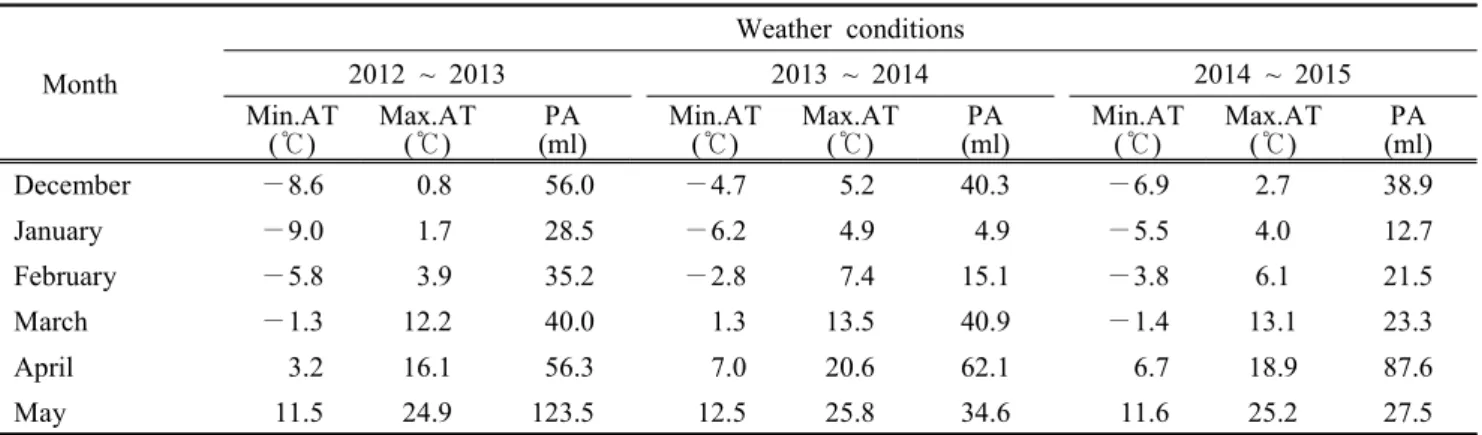
Table 2. The average minimum (Min.AT) and maximum (Max.AT) air temperature and precipitation amount (PA) of four years (December 2012 ~ May 2015, NWS) in Cheonan region
Month
Weather conditions
2012 ~ 2013 2013 ~ 2014 2014 ~ 2015
Min.AT
( ℃) Max.AT
( ℃) PA
(ml)
Min.AT
( ℃) Max.AT
( ℃) PA
(ml)
Min.AT
( ℃) Max.AT
( ℃) PA
(ml)
December -8.6 0.8 56.0 -4.7 5.2 40.3 -6.9 2.7 38.9
January -9.0 1.7 28.5 -6.2 4.9 4.9 -5.5 4.0 12.7
February -5.8 3.9 35.2 -2.8 7.4 15.1 -3.8 6.1 21.5
March -1.3 12.2 40.0 1.3 13.5 40.9 -1.4 13.1 23.3
April 3.2 16.1 56.3 7.0 20.6 62.1 6.7 18.9 87.6
May 11.5 24.9 123.5 12.5 25.8 34.6 11.6 25.2 27.5
Table 3. Chemical characteristics of experimental fields in Cheonan region pH
(1:5)
TN*
(%)
OM*
(g/kg)
P
2O
5(mg/kg)
Exchangeable cation (cmol
+/kg)
K Ca Mg
6.2 0.24 23.1 42 0.7 5.2 1.5
* TN : total nitrogen; * OM : organic matter.
Table 1. Agronomic growth characteristics of early maturing Italian ryegrass cultivars used in this study
Cultivar Heading
date
Harvesting time
Cold tolerance
Lodging tolerance
Leaf color
Plant length (cm)
Greenfarm April 25 Early in May High Medium Green 93
Kowinearly May 6 The first 10 days
of May Very high Medium Green 89
2. Cultivation method and climatic conditions
The experiments were conducted on a total field size of 1 ha per each cultivar. Each field was divided into three equal portions, each harvested at a different time equaling to three treatments (harvest dates: 9 May, 14 May, and 19 May). Each cultivar was broadcasted at 50 kg/ha on experimental paddy fields in late October (Oct. 24 2012, Oct. 25 2013 and Oct. 25 2014), after the rice was harvested and the rice straw collected in mid-October.
Fertilizer was sprayed immediately after the rice harvest and drainage was installed. Paddy fields used to grow IRG were pressed using a roller in late November and early March. The application rates of chemical fertilizer were calculated for total nitrogen (140 kg/ha), phosphorous (150 kg/ha), and potassium (150 kg/ha). Nitrogen fertilizer was applied at a rate of 40 kg/ha as basic fertilization and at a rate of 100 kg/ha as additional fertilization. Phosphorous and
potassium fertilizers were applied at a rate of 75 kg/ha as basic fertilization and at a rate of 75 kg/ha as additional fertilization.
Growth difference in IRG depends on climate conditions during winter and spring. The weather conditions of the Cheonan region (National Weather Service (NWS), Korea) during the study period are given in Table 2. The temperatures in the winter of 2012 were unusually low and those in the spring of 2013 were lower than in other years.
The chemical characteristics of the experimental fields are presented in Table 3. The soil tests results indicate low phosphoric acid content and high potassium content.
3. Investigation of growth characteristics and DM yield
Seedling stand, number of tillers, plant length, winter
survival ratio, and heading date were investigated for both
cultivars. The seedling stand, number of tillers, and plant
Table 4. Growth characteristics of the early maturing Italian ryegrass cultivars ‘Greenfarm’ (G) and ‘Kowinearly’
(K) before and after winter
Year
Before winter (first week of Dec.) After winter (first week of Mar.) Seedling stand
(%)
No. of tillers (ea)
Seedling stand (%)
No. of tillers (ea)
Winter survival (%)
G K G K G K G K G K
2013 90 90 3.5 4.0 85
NS85
NS3.7
b4.5
a76
b79
a2014 90 90 4.0 4.0 85
b90
a4.1
b4.5
a90
b96
a2015 90 90 4.1 4.0 80
b90
a3.5
b4.0
a85
b91
aMean 90 90 3.9 4.0 83
b88
a3.8
b4.3
a84
b89
aa,bMeans in the same row with different letters are significantly different (p < 0.05).
length were assessed before (early December) and after (early March) winter, and winter survival ratio was assessed in early March.
IRG was harvested at 5-day intervals, on 9 May, 14 May, and 19 May. Fresh yield was calculated at harvest per 1 m
2at three locations in each treatment group. To calculate DM content, the samples collected at each harvest were dried at 65 ℃ for 72 hours or more in a hot air circulation dryer. DM yield was calculated by multiplying the ratio of DM with fresh yield, and the value was converted as DM per hectare. Mean values and standard deviations of the experimental results were obtained using SAS (Statistics Analytical System, SAS Institute Inc., Cary, NC, USA, 2008). Duncan’s multiple comparison test was used to identify differences among the treatments, which were considered significant at p < 0.05.
4. Nutritive value analysis
The IRG samples examined for DM content were used for chemical composition analysis after crushing and filtering through a 20-mesh sieve. The crude protein (CP) was analyzed according to AOAC (1990) using a Kjeltec 2400 Auto Sampler System (FOSS, Hillerod, Denmark).
Neutral detergent fibers (NDF) and acid detergent fibers (ADF) were analyzed according to the method described by Goering and Van Soest (1970) in an Ankom Fiber Analyzer (ANKOM Technology, 2005a & 2005b, Macedon, NY, USA).
Ⅲ. RESULTS AND DISCUSSION
The early maturing IRG cultivars Kowinearly and Green
farm were grown in paddy fields cultivated with rice. The growth characteristics of the two cultivars before and after the winter are shown in Table 4. The seedling stand and the number of tillers of Greenfarm decreased from 90% and 3.9 before winter (early December) to 83% and 3.8 after winter (early March), winter survival was at 84% in early March. Similarly the seedling stand of Kowinearly decreased from 90% before winter to 88% after winter, while the number of tillers increased from 4.0 to 4.3;
winter survival was at 89% in early March.
There was no difference in growth characteristics between both varieties before winter, but the winter survival ratio of Kowinearly (89%) was higher than that of Green farm (84%) in the post-winter period (p < 0.05). This difference in winter survival ratio between the two varieties can be explained by the higher cold tolerance of Kowinearly.
Similar results were reported by Kim et al. (2015).
The heading date and DM yields of Green farm harvested at 5-day intervals starting from 9 May are given in Table 5. The heading date of Green farm varied depending on the weather in the spring. Thus in 2013, the heading date of Green farm was delayed by more than 15 days from the regular heading date. This delay of the heading was probably due to severe winter in 2012 and low temperatures in the spring of 2013. The DM yield of Greenfarm, as a result of the delay in harvest in 5-day increments, increased by 16% and 29% over that at first harvest(p < 0.05).
The heading date and DM yields of Kowinearly
harvested at 5-day intervals are given in Table 6. Similar
to Greenfarm, the heading date of Kowinearly delayed by
13 days from the normal heading date due to the weather
Table 5. Growth characteristics and dry matter (DM) yield of Greenfarm
Year Heading
date
Plant length (cm)
DM yield (kg/ha)
9 May 14 May 19 May
2013 15 May 90 4,970
c7,007
b8,148
a2014 29 April 95 7,082
c7,733
b8,285
a2015 8 May 84 6,865
c7,265
b7,895
aMean
(Index) 90 6,306
c(100)
7,335
b(116)
8,109
a(129)
a-cMeans in the same row with different letters are significantly different (p < 0.05).
Table 6. Growth characteristics and dry matter (DM) yield of Kowinearly
Year Heading
date
Plant length (cm)
DM yield (kg/ha)
9 May 14 May 19 May
2013 19 May 92 4,998
c7,832
b8,193
a2014 5 May 99 8,752
c10,076
b11,807
a2015 15 May 95 8,728
c9,680
b11,346
aMean
(Index) 95 7,493
c(100)
9,196
b(123)
10,449
a(139)
a-cMeans in the same row with different letters are significantly different (p < 0.05).
Table 7. Crude protein (CP), acid detergent fiber (ADF), neutral detergent fiber (NDF), total digestible nutrient (TDN), and in vitro dry matter digestibility (IVDMD) of early maturing Italian ryegrass cultivars
Cultivar CP (%) ADF (%) NDF (%) TDN (%) IVDMD (%)
Greenfarm 12.2 34.5 57.7 61.6 72.3
Kowinearly 16.4 30.4 52.7 64.9 79.0
in the spring season. The DM yield of Kowinearly increased, as a result of the delay in harvest 5 and 10 days, 23% and 39%, respectively, over that first harvest (p
< 0.05). The DM yield of Kowinearly increased more than that of Greenfarm; this increase explained by the late vegetative growth and thereby later heading date of Kowinearly than of Green farm. These results corroborate those reported by Kim et al. (1995), Lee and Lee (1997), and Choi et al. (2011b). The results presented herein indicate that the productivity of the early maturing IRG cultivars Kowinearly and Green farm can be increased by postponing their harvest to the second half of May.
The general components and feed values of both cultivars harvested on May 14 for each are presented in Table 7.
The higher nutritive value of Kowinearly than that of Greenfarm is due to their being harvested at the same time (14 May).
Ⅳ. ACKNOWLEDGEMENT
This work was carried out with the support of
“Cooperative Research Program for Agriculture Science &
Technology Development (Project title: Analysis of productivity and feed value of forage crops cultivated utilizing a animal manure; Project No. PJ010516012016)” Rural Development Administration, Republic of Korea.
Ⅴ. REFERENCES
Ankom Technology. 2005a. Method for determining neutral detergent fiber. ANKOM Technology, Fairport, NY. http://www.ankom.
com/09_procedures /procedures2.shtml. Accessed May 8, 2005.
Ankom Technology. 2005b. Method for determining acid detergent fiber. ANKOM Technology, Fairport, NY. http://www.ankom.
com/09_procedures /proceduresl.shtml. Accessed May 8, 2005.
AOAC. 1990. Official Methods of Analysis, 15th ed. Association of
Official Analytical Chemists, Washington, DC.
Choi, G.J., Ji, H.C., Kim, K.Y., Park, H.S., Seo, S., Lee, K.W. and Lee, S.H. 2011a. Growth characteristics and productivity of cold-tolerant ‘Kowinearly’ Italian ryegrass (Lolium multiflorum L.) in the northern part of South Korea. African Journal of the Biotechnology. 10:2676-2682.
Choi, G.J., Lim, Y.C., Ji, H.C., Lee, S.-H., Lee, K.-W., Kim, D.K., Seo, S. and Kim, K.-Y. 2011b. Change in dry matter yields and feed values of Italian ryegrass, Hwasan 101, at different growth stages. Journal of the Korean Society of Grassland and Forage Science. 31(2):107-112.
Choi, G.J., Lim, Y.C., Rim, Y.W., Sung, B.R., Kim, M.J., Kim, K.Y.
and Seo, S. 2006. A cold-tolerant and early-heading Italian ryegrass (Lolium multiflorum L.) new variety ‘Kogreen’. Journal of the Korean Society of Grassland and Forage Science. 26:9-16.
Choi, G.J., Lim, Y.C., Sung, B.R., Kim, K.Y., Lee, J.K., Lim, K.B., Park, H.S., Seo, S. and Ji, H.C. 2007. A cold-tolerant and early-maturing Italian ryegrass (Lolium multiflorum L.) new variety ‘Kospeed’. Journal of the Korean Society of Grassland and Forage Science. 27:145-150.
Choi, G.J., Rim, Y.W., Kim, K.Y., Choi, S.H., Sung, B.R., Kim, W.H., Shin, D.E. and Lim, Y.C. 2000. A cold-tolerant and high-yielding Italian ryegrass (Lolium multiflorum L.) new variety
‘Hwasan 101’. Journal of the Korean Society of Grassland and Forage Science. 20:1-6.
Goering, H.K. and Van Soest, P.J. 1970. Forage fiber analysis. Ag.
Handbook. No. 379. ARS. USDA: Washington DC.
Ji, H.C., Choi, G.J., Lee, S.H., Kim, K.-Y., Lee, K.W., Park, N.G.
and Lee, E.S. 2013. A very early-maturing Italian ryegrass (Lolium multiflorum Lam.) new variety, ‘Green farm II’. Journal of the Korean Society of Grassland and Forage Science.
33(1):10-14.
Ji, H.C., Hwang, T.Y, Kim, K.-Y., Choe, H., Hong, K.H., Choe, K.W., Lee, K.-Y. and Lee, S.-H. 2015. A very early-maturing Italian ryegrass (Lolium multiflorum Lam.) new variety,
‘Greenfarm3ho’. Journal of the Korean Society of Grassland and Forage Science. 31(1):31-35.
Ji, H.C., Lee, S.H., Yoon, S.H., Kim, K.-Y., Choi, G.J., Park, H.S., Park, N.G., Lim, Y.C. and Lee, E.S. 2011. A very early- maturing Italian ryegrass (Lolium multiflorum Lam.) new variety,
‘Green Farm’ for double cropping system. Journal of the Korean Society of Grassland and Forage Science. 31(1):9-14.
Kim, J.G., Han, M.S., Kim, G.Y., Han, J.D., Kang, W.S. and Shin, J.N. 1995. Study on baled silage making of selected forage crops and pasture grasses. Ⅱ. Yield performance and nutritive evaluation of bale silages as affected by stage of growth. Journal of the Korean Society of Grassland and Forage Science. 15(3):
198-206.
Kim, K.-Y., Lee, S.-H., Ji, H.C., Hwang, T.-Y., Lee, K.-Y. and Park, S.M. 2015. Growth characteristics and yield comparisons of domestic and foreign Italian ryegrass (Lolium multiflorum Lam) varieties in Yecheon area of Korea. Journal of the Korean Society of Grassland and Forage Science. 35(1):43-49.
Lee, I.D. and Lee, H.S. 1997. A study on the dry matter yield and quality of Festulolium braunii at growing stages. Journal of the Korean Society of Grassland and Forage Science. 17(2):117-122.
NWS (National Weather Service climate data of Republic of Korea).
http://www.kma.go.kr.
SAS. 2010. SAS/STAT software for PC. Release 9.3, SAS Institute INC., Cary, NC, USA.
(Received August 17, 2016 / Revised September 6, 2016 / Accepted November 1, 2016)