Research Article
Effect of Waterlogging Duration on Growth Characteristics and Productivity of Forage Corn at Different Growth Stages Under Paddy Field Conditions
Jeong Sung Jung*, Gi-Jun Choi and Bo-Ram Choi
Grassland & Forage Division, National Institute of Animal Science, Rural Development Administration, Cheonan 31000, Republic of Korea
ABSTRACT
The purpose of this study was to determine the effect of waterlogging duration on the growth characteristics and productivity of forage corn at different growth stages under paddy field conditions. Treatments consisted of waterlogging at two growth stages (V7 or V14) for four waterlogging durations (no waterlogging, 48 hours, 72 hours, and 96 hours, respectively). The V14 growth stage was more vulnerable to waterlogging than the V7 stage. Among the waterlogging durations, the lodging score increased at 48 hours. The stem height of forage corn decreased with the increase in waterlogging duration at the different growth stages (V7 and V14). Increase in waterlogging duration reduced the stem dry matter yield, ear dry matter yield, and total dry matter yield at both growing stages (V7 and V14). The waterlogging treatments at the V14 stage affected ear dry matter yield more than those at the V7 growing stage.
Thus, the management of forage corn under paddy field conditions must be strengthened during early (V7) and grain fill stages (V14).
When waterlogging occurs, surface and subsurface drainage should be implemented within 48 hours to control (no waterlogging) the groundwater level and, thus, minimize economic losses due to forage corn damage.
(Key words: Forage Corn, Paddy field, Productivity, Waterlogging)
Ⅰ. INTRODUCTION
Forage corn is cultivated worldwide as an important summer crop. It is considered as a promising source of silage and green chop. Forage corn and sorghum-sudangrass hybrids are the main summer forage crops in South Korea (Seo et al., 2000). Demand for forage corn is steadily increasing because of the growing perceived importance for livestock farmers of producing high feed value forage crops rather than high productivity forage crops (Choi et al., 2019; Shin et al., 2017). However, forage corn is grown on more than 13,000 hectares of land and had a productivity of 238 thousand ton in 2018, which only constitutes about 5.6% of the total yield and area of forage crops grown in South Korea (MAFRA, 2019). The Korean government is trying to improve the food self-sufficiency rate and control the supply and demand of rice by increasing the forage cultivation area in paddy fields. The cultivation area for winter forage crops, including Italian ryegrass, is gradually increasing, but difficulties are being faced in increasing the cultivation area for summer forage crops, including forage corn, under paddy field conditions due to the intolerance of
these crops to water stress (Ji et al., 2010; Shin et al., 2016).
Under field conditions, waterlogging delays the growth of corn and reduces dry matter accumulation. Moreover, waterlogging influences grain filling, resulting in decreased grain weight and, eventually, in the reduction of the total dry matter yield of forage corn (Ren et al., 2019). Although there are regional differences, the rainy season in Korea usually occurs from June to August. During the rainy season, Korea receives 20~30% of the annual precipitation (KMA 2019). Heavy rains occur from late June to early August, which overlaps with the grain filling stage of maize, considerably affecting grain development due to waterlogging. Waterlogging lowers activities of enzymes related to photosynthesis and nitrogen metabolism (Yang et al., 2019).
Therefore, waterlogging during grain filling not only affects the grain productivity, but also grain quality (Jiang et al., 2009).
Waterlogging is one of the critical abiotic stresses affecting crop growth and productivity. In particular, corn is more vulnerable to waterlogging stress during the rainy season due to poor drainage or long periods of rainfall (Yu et al., 2019). Water stress significantly affects root growth in the early growing season and disturbs grain filling (Ren et al., 2019). Moreover,
*Corresponding author: Jeong Sung Jung, Grassland & Forage Division, national Institute of Animal Science, Rural Development Administration, Cheonan, 31000, Republic of Korea. Tel: +82-41-580-6748, Fax: +82-41-580-6779, E-mail: [email protected]
waterlogging enhances the activity of alcohol dehydrogenase and decreases the nitrogen, starch, and chlorophyll contents in leaf, inducing lipid peroxidation and membrane injury (Yang et al., 2019; Musgrave and Ding, 1998). Waterlogging and crop submergence lead to a decrease of gas exchange between the root tissue and the atmosphere, which creates anoxic conditions around the roots. Oxygen is very important for the energy- supplying pathway of the cell, and the cellular oxygen content determines cellular metabolic activity and energy production (Dennis et al., 2000).
Many studies have been performed to screen waterlogging tolerant maize lines by determining growth characteristics under waterlogging conditions simulated in greenhouses and the effect of waterlogging on early growth (Shin et al., 2017; Yang et al., 2019; Ren et al., 2019). However, there have been no studies to conclusively identify a correlation between the waterlogging period and productivity of forage corn under paddy field conditions. Therefore, this study was conducted to investigate this correlation.
Ⅱ. MATERIALS AND METHODS
1. Experiment site
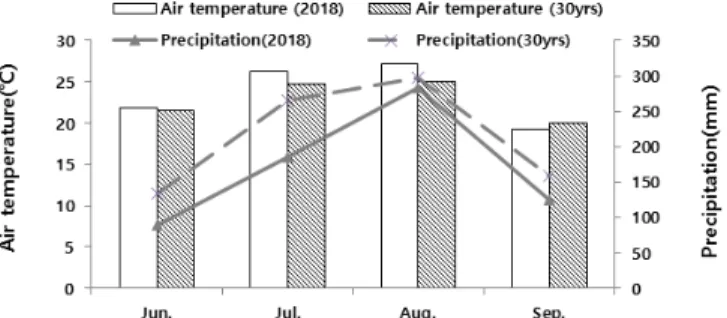
The field study was conducted between June and September 2018 at a paddy field in Cheonan (latitude 36°49ʹ0ʹʹN, longitude 127°10ʹ0ʹʹE), which is located in the central reign of South Korea. The paddy soil was immature and slightly alkaline (pH 6.97) and contained to low total nitrogen, organic matter, and available phosphate (Table 1). The seasonal rainfall was 641.2 mm in 2018, which is lower than the 30-years average precipitation (Fig. 1). The average air temperature from June to September was slightly higher than the 30-years mean air temperature (Fig.
1). During the experimental period (June-September 2018), the total amount of precipitation was much lower than the 30-year average (Fig. 1).
Fig. 1. Mean values and the 30-years average of the air temperature and precipitation during the growing season in Cheonan, Korea, 2018.
The soil moisture content was monitored using WatchDog 1000 series Micro Stations and SM100 WaterScout soil moisture sensors (Spectrum Technologies, Inc.). One soil moisture sensor was used per treatment. The probes were installed at a 30 cm elevation from the surface soil.
2. Plant materials and experimental design
The experiment was performed using a split-plot design including two factors: waterlogging duration and growth stage.
The growth period was divided into the V7 (7-leaves) and V14 (14-leaves) stages. Each stage was subjected to waterlogging for four durations: control (no waterlogging), 48, 72, and 96 hours. Waterlogging treatment began on August 1 for the V7 growth stage and August 20 for the V14 growth stage. Each plot was 2.25 × 15 m and plots were separated by barriers (of approximately 30 cm height). The plots were separated by a distance of 3 m to prevent interference among them. The timing of each treatment is shown in Table 2.
The forage corn(Zea mays L.) cultivar used was the “Kwangpyeongok”
cultivar and it was sown on 1 June 2018. Forage corn seeds were sown at a rate of 89,000 seeds ha
-1(75 cm row spacing
× 16 cm planting distance). Plants were harvested on 13 September, when the forage corn was at the yellow ripe stage. The application rates of the basic fertilizers were as follows: 200 kg ha
-1for nitrogen, 150 kg ha
-1for phosphorus, and 150 kg ha
-1for potassium.
pH (1:5 H
2O)
T-N
†(%)
OM
‡(g kg
-1)
Average P
2O
5(mg kg
-1)
CEC
§(cmol+kg
-1)
6.97 0.07 11.25 22.89 13
†T-N: total nitrogen; ‡OM: organic matter; §CEC: cation exchange capacity Table 1. Chemical properties of the soil before the experiment
Nitrogen fertilizer was applied at 50% as a basal fertilizer and again at 30% at the growing stage (7~8 leaves).
For agronomic trait measurements, ten plants were randomly collected from each plot before harvest. Stem height, ear height, and stem diameter were measured according to the investigation and analysis of research and technology in agriculture specifications (RDA, 2012). Seven different treatment combinations were performed and three sites (1.5 × 2 m) were randomly selected and sampled to evaluate the yield and feed value per treatment by hand cutting of crops. Sub-samples were collected randomly from the harvested crops to calculate dry matter yield by oven-drying at 70°C for 72 hours.
3. Statistical analysis
Statistical analyses were conducted using SAS (release 9.4;
SAS Institute, Cary, NC, USA). Data were analyzed using the PROC GLM (general linear model) procedure and means were separated on the basis of Duncan’s multiple range test (SAS Institute, 2007). Significances were declared at p ≤ 0.05 level.
Ⅲ. RESULT AND DISCUSSION
1. Soil moisture content changes
During the V7 waterlogging period, the soil water content of no waterlogging was constant because there was no precipitation from 1 August to 14 August. The treatment of 48 hours (V7) waterlogging duration was flooded from 1 to 3 August, and the soil moisture content decreased rapidly after 7 August. The treatment of 72 hours (V7) waterlogging duration was flooded from 1 to 7 August, and the soil moisture content decreased rapidly after 9 August. The treatment of 96 hours (V7) waterlogging duration was flooded from 1 to 5 August, and the soil moisture
content decreased rapidly after 10 August. As a result, the soil moisture content rose immediately after flooding and it took 4 to 5 days for changes to occur in the soil moisture content under the paddy field conditions. This result supported those of a previous study (Mo`allim et al., 2018), which showed that the soil moisture began to decrease after 4-5 days of cultivation under paddy field conditions.
During the V14 waterlogging period, the soil moisture content of no waterlogging was constant, but it increased due to rainfall after August 24. The treatment of 48 hours (V14) waterlogging duration was flooded from 20 to 22 August, and the soil water content decreased after 25 August. The treatment of 72 hours (V14) waterlogging duration was flooded from 20 to 23 August, and the soil water content decreased after 26 August. The treatment of 96 hours (V14) waterlogging duration was flooded from 20 to 24 August, and the soil water content decreased slightly after 27 August due to rain fall. Unlike V7, the soil moisture content in V14 did not significantly reduce due to rainfall.
2. Agronomic characteristics of plants
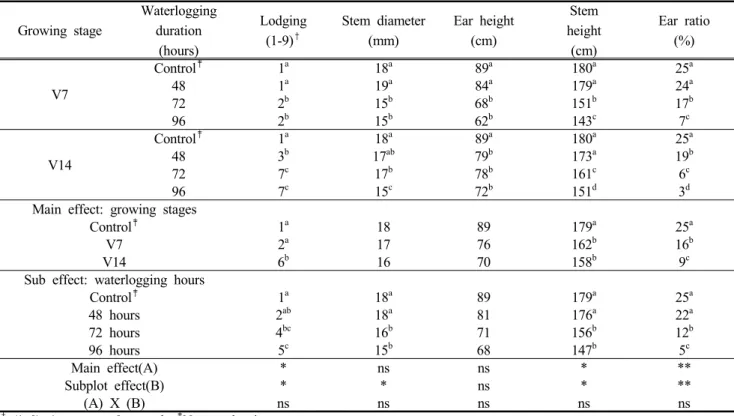
Table 3 shows the agronomical traits at harvest. The lodging scores at 72 and 96 hours of waterlogging at the V7 growing stage were significantly higher than those at the control (no waterlogging) and 48 hours (P ≤ 0.05). During the V14 growing stage, the lodging scores at 72 and 96 hours were significantly greater than those at the control (no waterlogging) and 48 hours (P ≤ 0.05). The V14 growing stage was more vulnerable to waterlogging than V7 growing stage. During waterlogging, the lodging score increased by for 48 hours. Stem diameter is a good indicator of productivity-related growth in forage corn (Choi et al., 2019). The average stem diameter of forage corn significantly decreased at both growing stages. However, this indicator was not significantly affected by the growing stage.
Growth stage Waterlogging duration (hours)
Control
†48 72 96
V7 (7-leaves) - 1 Aug. 17:00 –
3 Aug. 17:00
1 Aug. 17:00 – 4 Aug. 17:00
1 Aug. 17:00 – 5 Aug. 17:00
V14 (14-leaves) - 20 Aug. 14:00 –
22 Aug. 14:00
20 Aug. 14:00 – 23 Aug. 14:00
20 Aug. 14:00 – 24 Aug. 14:00
†No waterlogging treatment
Table 2. Timing of Waterlogging treatments at the different growth stages
The average stem diameters were lowered by increasing the waterlogging duration. The ear height of forage corn significantly decreased at the V7 growing stage. However, no significant difference was seen among waterlogging treatments by increasing the waterlogging duration. Ear height did not change significantly by altering waterlogging duration and stage. The waterlogging treatments at the V14 growing stage reduced the stem height more significantly than those at the V7 growing stage (P ≤ 0.05). Stem height decreased with an increase in the waterlogging duration at both growing stages (P ≤ 0.05). With an increase in the waterlogging duration at both V7 and V14 growing stages, stem height gradually decreased. As a result, stem height decreased with an increase of waterlogging duration at the different growth stages. These results are in accordance with the findings of Shin et al. (2017) who reported that stem height decreased with increasing waterlogging duration. However, Son et al.
(2010) reported that there was no significant difference in stem height between paddy fields and upland fields. Ear ratio plays a very important role in the productivity and feed value of forage corn (Choi et al., 2019; Son et al., 2010). The ear ratio
Growing stage
Waterlogging duration
(hours)
Lodging (1-9)
†Stem diameter (mm)
Ear height (cm)
Stem height
(cm)
Ear ratio (%)
V7
Control
‡1
a18
a89
a180
a25
a48 1
a19
a84
a179
a24
a72 2
b15
b68
b151
b17
b96 2
b15
b62
b143
c7
cV14
Control
‡1
a18
a89
a180
a25
a48 3
b17
ab79
b173
a19
b72 7
c17
b78
b161
c6
c96 7
c15
c72
b151
d3
dMain effect: growing stages
Control
‡1
a18 89 179
a25
aV7 2
a17 76 162
b16
bV14 6
b16 70 158
b9
cSub effect: waterlogging hours
Control
‡1
a18
a89 179
a25
a48 hours 2
ab18
a81 176
a22
a72 hours 4
bc16
b71 156
b12
b96 hours 5
c15
b68 147
b5
cMain effect(A) * ns ns * **
Subplot effect(B) * * ns * **
(A) X (B) ns ns ns ns ns
† (1~9): 1 = strong, 9 = weak, ‡No waterlogging treatment.
a,b,c Means with the same letter in a column for each planting date are not significantly different at the 5% level, as determined by Duncan`s multiple test. *P ≤ 0.05; **P ≤ 0.01; ***P ≤ 0.001; ns: not significant. ns: not significant.
Table 3. Effect of waterlogging duration on the growth characteristics of forage corn at different growing stages, 2018 (A)
(B)
Fig. 2. Changing soil moisture contents during waterlogging at the V-7 (A) and V14 (B) growing stages, 2018.
differed significantly with the waterlogging duration and time (P ≤ 0.05). The waterlogging treatments affected the V14 growing stage more than V7 growing stage in terms of ear ratio.
The ear ratio decreased after 72 hours of waterlogging (P ≤ 0.05).
3. Productivity of forage corn
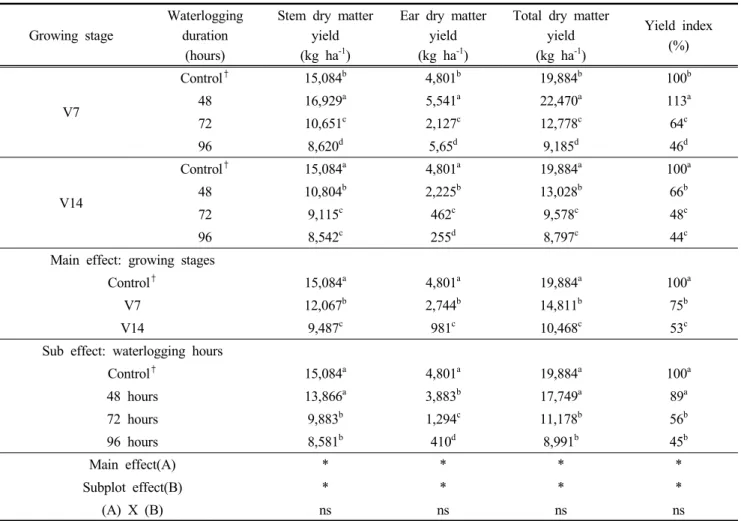
Water stress has a great effect on the productivity of forage corn and there have been many studies related to this (Shin et al., 2017; Liu et al., 2010; Ren et al., 2019). In this study, the productivity of plants was significantly affected by the waterlogging duration and time. As shown in Table 4, an increase in waterlogging duration reduced the stem dry matter yield, ear dry matter yield, and total dry matter yield at both growing stages (V7 and V14). The waterlogging treatments had a greater effect on the V14 growing stage than the V7 growing stage in terms of ear dry matter yield. This result supported findings of a
previous study (Son et al., 2010) showing that the ear ratio of forage corn cultivated in paddy fields was lower than that of corn grown in upland fields. The ear weight was one of the most important factors affecting productivity. During grain filling, the soil moisture status is one of the important factors affecting grain yield and feed quality (Ahmadi and Baker, 2001; Jiang et al., 2019). Ren et al. (2019) reported that waterlogging affected endosperm weight and grain volume of corn, indicating that waterlogging damages the endosperm cell growth of summer maize grains. Other studies showed that the endogenous ABA (abscisic acid) level in grains increases dramatically during the grain-filling stage, but the extremely high ABA levels under waterlogging may have inhibitory effects on grain-filling (Ahmadi and Baker, 2001; Ren et al., 2019). In this study, dry matter yield was more affected by waterlogging treatments than stem dry matter yield. At the V7 and V14 growing stages,
Growing stage
Waterlogging duration
(hours)
Stem dry matter yield (kg ha
-1)
Ear dry matter yield (kg ha
-1)
Total dry matter yield (kg ha
-1)
Yield index (%)
V7
Control
†15,084
b4,801
b19,884
b100
b48 16,929
a5,541
a22,470
a113
a72 10,651
c2,127
c12,778
c64
c96 8,620
d5,65
d9,185
d46
dV14
Control
†15,084
a4,801
a19,884
a100
a48 10,804
b2,225
b13,028
b66
b72 9,115
c462
c9,578
c48
c96 8,542
c255
d8,797
c44
cMain effect: growing stages
Control
†15,084
a4,801
a19,884
a100
aV7 12,067
b2,744
b14,811
b75
bV14 9,487
c981
c10,468
c53
cSub effect: waterlogging hours
Control
†15,084
a4,801
a19,884
a100
a48 hours 13,866
a3,883
b17,749
a89
a72 hours 9,883
b1,294
c11,178
b56
b96 hours 8,581
b410
d8,991
b45
bMain effect(A) * * * *
Subplot effect(B) * * * *
(A) X (B) ns ns ns ns
a,b,c Means with the same letter in a column for each planting date are not significantly different at the 5% level, as determined by Duncan`s multiple test. *P ≤ 0.05; **P ≤ 0.01; ***P ≤ 0.001; ns: not significant, †No waterlogging treatment.
Table 4. Effect of waterlogging duration on the productivity of forage corn at different growing stages, 2018
96 hours of waterlogging lead to 54% and 56% decreases in total dry matter productivity, respectively, compared to the control (no waterlogging treatment) (P ≤ 0.05). The total dry matter yields for the waterlogging treatments at the V14 growing stage were 47% and 25 % lower than those at the control and V7 grow[ing stages, respectively (P ≤ 0.05). The total dry matter yields after 96 hours of waterlogging were 55%, 44%, and 11%
lower than those for the control, 72 hours waterlogging, and 48 hours waterlogging, respectively (P ≤ 0.05). Shin et al.
(2017) reported that waterlogging treatments at V3 significantly reduced the ear length and thickness, grain filling length, and productivity of maize. Waterlogging could damage the growth of forage corn at early growing stages and at the grain fill stage (Shin et al., 2017; Yang et al., 2019; Ren et al., 2019).
Ⅳ. CONCLUSION
This study was conducted to determine the effect of the waterlogging period on the growth characteristics and productivity of forage corn at different growth stages under paddy field conditions. Lodging scores after 72 and 96 hours of waterlogging at the V7 growing stage were significantly higher than those for the control and 48 hours of waterlogging (P ≤ 0.05). The V14 growing stage was more vulnerable to waterlogging than the other growing stages. The lodging score increased over 48 hours of waterlogging. There were no significant differences in ear height in terms of waterlogging duration and stage. The stem height of forage corn decreased with an increase in waterlogging duration at the different growing stages (V7, V14). The total dry matter yield of forage corn was significantly affected by the waterlogging duration and time. As a result, increase in waterlogging duration reduced the stem dry matter yield, ear dry matter yield, and total dry matter yield at both growing stages (V7 and V14). The waterlogging treatments affected the V14 growing stage more than the V7 growing stage in terms of ear dry matter yield. Therefore, the management of forage corn in paddy fields must be strengthened during the early (V7) and grain fill (V14) stages. When waterlogging occurs, surface and subsurface drainage should be implemented within 48 hours to control the groundwater level and minimize the economic losses due to damage of forage corn.
Ⅴ. ACKNOWLEDGEMENTS
This work was carried out with the support of "Cooperative Research Program for Agriculture Science & Technology Development (Project title: A survey on suitable agro-climatic zones and productivity change of forage under climate change, and assessing impact and vulnerability of forage to climate change, Project No. PJ01284601)" Rural Development Administration, Republic of Korea.
Ⅵ. REFERENCES
Ahmadi, A. and Baker, D.J. 2001. The effect of water stress on the activities of key regulatory enzymes of the sucrose to starch pathway in wheat. Plant Growth Regulation. 35:81-91.
Choi, G.J., Jung, J.S., Choi, K.C., Hwang, T.Y., Kim, J.H., Kim, W.H., Lee, E.J., Sung, K.I. and Lee, K.-W. 2019. Growth characteristic and productivity of forage corn varieties sown at the last ten days of may in central region of Korea. The Korean Society of Grassland and Forage Science. 39:17-23.
Dennis, E.S., Dolferus, R., Ellis, M., Rahman, M., Wu, Y., Hoeren, F., Grover, A., Ismond, K., Good, A. and Peacock, W.J. 2000. Molecular strategies for improving waterlogging tolerance in plants. Journal of Experimental Botany. 51:89-97.
Ji, H.-C., Lee, S.-H., Yoon, S.-H., Kwon, O.-D., Choi, G.-J., Kim, W.-H., Kim, K.-Y. and Lim, Y.-C. 2010. Growth, forage production and quality of sorghum, sorghum× sudangrass and sudangrass hybrids at paddy field in southern region of Korea. Journal of The Korean Society of Grassland and Forage Science. 30:109-114.
Jiang, D., Yue, H., Wollenweber, B., Tan, W., Mu, H., Bo, Y., Dai, T., Jing, Q., and Cao, W. 2009. Effects of post‐anthesis drought and waterlogging on accumulation of high‐molecular‐weight glutenin subunits and glutenin macropolymers content in wheat grain. Journal of Agronomy and Crop Science. 195:89-97.
Korea Meteorological Administration. Climate of Korea. Available from:
http://www.kma.go.kr/eng/biz/climate_01.jsp. Accessed Sep. 6, 2019.
Liu, Y.-Z., Bin, T., Zheng, Y.-L., XU, S.Z. and QIU, F. 2010. Screening methods for waterlogging tolerance at maize (Zea mays L.) seedling stage. Agricultural Science in China. 9:362-369.
Ministry of Agriculture. 2019. Main statistics in agriculture, livestock, and food.
Mo’allim, A., Kamal, M., Muhammed, H., Yahaya, N., Zawawe, M., Man, H. and Wayayok, A. 2018. An assessment of the vertical movement of water in a flooded paddy rice field experiment using hydrus-1d. Agricultural Green Infrastructure for Nutrient Reduction
in Watercheds. 10:783.
Musgrave, M. and Ding, N. 1998. Evaluating wheat cultivars for waterlogging tolerance. Crop Science. 38:90-97.
RDA. 2012. Investigation and analysis of research and technology in agriculture.
Ren, B., Hu, J., Zhang, J., Dong, S., Liu, P. and Zhao, B. 2019. Spraying exogenous synthetic cytokinin 6‐benzyladenine following the waterlogging improves grain growth of waterlogged maize in the field. Journal of Agronomy and Crop Science. 2019:1-9
Seo, S., Kim, J.G., Chung, E.S., Kim, W.H. and Kang, W.S. 2000.
Effect of methods and rates of seeding on the forage production and nutritive value of sorghum× sudangrass hybrid grown under application of animal manure. Journal of the Korean Society of Grassland Science. 20:49-54.
Shin, S., Jung, G.-H., Kim, S.-G., Son, B.-Y., Kim, S.G., Lee, J.S., Kim, J.T., Bae, H.-H., Kwon, Y., Shim, K.-B., Lee, J.-E., Baek, S.B. and Jeon, W.-T. 2017. Effect of prolonged waterlogging on growth and
yield of characteristics of maize (Zea mays L.) at early vegetative stage. Journal of The Korean Society of Grassland and Forage Science. 37:271-276.
Son, B.-Y., Kim, J.-T., Lee, J.-S., Baek, S.-B., Kim, W.-H. and Kim, J.-D. 2010. Comparison of growth characteristics and yield of silage corn hybrids by different planting dates at paddy and upland field.
Journal of the Korean Society of Grassland Science. 30:237-246.
Yang, H., Wen, Z., Huang, T., Lu, W. and Lu, D. 2019. Effects of waterlogging at grain formation stage on starch structure and functionality of waxy maize. Food Chemistry. 294:187-193.
Yu, F., Liang, K., Fang, T., Zhao, H., Han, X., Cai, M. and Qiu, F. 2019.
A group VII ethylene response factor gene, ZmEREB180, coordinates waterlogging tolerance in maize seedlings. Plant Biotechnology Journal.
2019:1-13.
(Received : August 17, 2019 | Revised : September 6, 2019 | Accepted : September 6, 2019)