위식도역류질환과 관련 없는 비심인성 흉통 환자의 우울 및 불안
인천기독병원 정신과,1 해수 소아청소년 정신과,2 성균관대학교 의과대학 삼성서울병원 내과학교실,3 정신과학교실4
박주언1·류한욱2·이풍렬3·유범희4
GERD-unrelated Non-cardiac Chest Pain may be Associated with Depression and Anxiety
Joo-Eon Park, MD
1, Han-Wook Ryu, MD
2, Poong-Lyul Rhee, MD
3and Bum-Hee Yu, MD
4Department of Psychiatry1, Incheon Christian Hospital, Incheon, Hae-Su Child & Adolescent Psychiatric Clinic2, Seoul,
Department of Medicine3 and Psychiatry4, Samsung Medical Center, Sungkyunkwan University School of Medicine, Seoul, Korea
ABSTRACT
Objectives
:Non-cardiac chest pain (NCCP) can be divided into gastroesophageal reflux disease (GERD) related NCCP and non-GERD related NCCP. Our study was designed to examine the differences in clinical characteristics and psychological mood states between the two clinical syndromes.
Methods
:After some cardiologic evaluations such as treadmill exercise, coronary angiography, and echo- cardiography, 27 patients with NCCP were enrolled in this study. They were divided into patients with GERD related NCCP (12 patients) and those with non-GERD related NCCP (15 patients) using the upper gastro- intestinal endoscopy and the ambulatory 24 hour esophageal pH monitoring. Clinical characteristics such as typical reflux symptoms and psychological mood states were measured. Patients who showed scores more than 10 on the Beck Depression Inventory (BDI) or Beck Anxiety Inventory (BAI) were defined as depressed or anxious group. Anxiety sensitivity Index (ASI) was also measured in all patients. All parameters were compared between patients with GERD related NCCP and those with non-GERD related NCCP.
Results
:The two groups showed a difference in typical reflux symptoms. Patients with non-GERD related NCCP had higher scores on the BDI, BAI and ASI than those with GERD related NCCP. Among all NCCP patients, 14 patients (51.9%) were suggested to have possible depression or anxiety disorders.
Conclusion
:The non-GERD related NCCP was shown to be associated with psychological mood states such as anxiety and depression. Thus, we suggest that routine measurement of psychological mood states should be necessary in the evaluation and treatment of NCCP. (Anxiety and Mood 2006;2(1):28-32)
KEY WORDS:Noncardiac chest pain·Depression·Anxiety·Gastroesophageal reflux disease.서 론
흉통 환자의 경우 임상적 응급성 때문에 관상동맥질환과 같은 심인성 흉통을 먼저 감별하는 것이 중요하다.1 평가를 통해 심인성 흉통(cardiac chest pain)을 배제한 후 남겨 진 증후군을 비심인성 흉통(noncardiac chest pain;이하
NCCP)이라고 칭한다.2,3
흉통을 호소하는 환자 중 많게는 89%까지 심장질환의 기 질적 원인을 찾지 못하였고,4 이러한 NCCP 환자의 경우 일 반 인구 조사에서 유병율이 14~33%로 나타날 만큼 흔하 다.3,5 이렇게 흔한 유병율에도 불구하고, 심인성 흉통과 달 리 NCCP의 10년 사망률이 1%가 되지 않는다는 점6 때문 에 지금까지 임상적 관심을 덜 받은 것도 사실이다. 하지만, 수명이 길어지고 삶의 질에 대한 관심이 높아진 현재 NCCP 환자들에서 보이는 몇 가지 특징들은 임상적으로 중요해졌 고 사회적 부담을 가중시키고 있다.7 즉, 이러한 증후군을 가 진 환자들은 다른 질환의 유병율이 높고, 의료기관을 자주 이용한다고 알려져 있다.8,9 과도한 의료기관 방문으로 인한
접수일자:2006년 4월 28일 / 심사완료:2006년 5월 11일 Address for correspondence
Bum-Hee Yu, M.D., Department of Psychiatry, Samsung Medical Center, Sungkyun- kwan University School of Medicine, 50 Ilwonbon-dong, Gangnam-gu, Seoul 135-710, Korea
Tel:+82.2-3410-3583, Fax:+82.2-3410-0050 E-mail:[email protected]
경제적 손실과 반복적인 진단 검사에 의한 인위적 합병증 (iatrogenic complications)의 잠재적 위험에 노출되는 것 이다. 또한, NCCP 환자의 50~80%에서 사회적 장애나 직 업 능력의 감소를 호소하고,10,11 이와 더불어 삶의 질과 만 족감도 떨어지게 된다.9
이러한 관점에서 NCCP의 정확한 진단과 적절한 치료를 위해서 그 원인을 찾는 노력이 필요하다. 하지만, NCCP의 병 태생리학은 과거에 생각되었던 것보다 훨씬 더 복잡하다고 여 겨진다.3 한 보고에 따르면, NCCP의 흔한 원인 3가지는 근골 격계질환(36%), 위장관질환(19%), 정신과 질환(7.5%)으 로 알려져 있다.1 Botoman12이 제시한 진단 알고리듬에 따 르면, NCCP 환자에서 가장 흔한 원인으로 알려진 위식도역 류질환(gastroesophageal reflux disease;이하GERD)2,3,13 과 더불어 정신과 질환에 대한 진단적 고려를 요구하고 있 다. 더구나, 상부위장관내시경(UGI endoscopy), 보행성 24 시간 식도 산도 검사(ambulatory 24-h esophageal pH monitoring), 식도내압검사(esophageal manometry), 바 륨 식도조영술(barium esophagography) 등으로 평가를 하여도 원인을 밝히지 못한 환자군이 존재한다.14 또한, 심 리적 장애나 정신과 질환에서 흉통이나 다른 신체적 증상을 보일 수 있다는 것은 잘 알려진 사실이다. NCCP 환자에 서 공황장애를 비롯한 다른 정신과 질환과의 관련성이 높
고,15,16 스스로 보고한 불안과 우울 정도도 높게 보고되었다.5
하지만, 이러한 보고들은 NCCP 전체 환자들을 대상으로 하 였고, 기질적 원인 여부와 상관없이 정신과적 질환이나 증 상을 고려한 측면이 있다. 또한, NCCP 환자를 흔히 보는 일차의나 내과의사들의 관심이 주로 위장관질환과 근골격 계질환에 국한되어온 것이 사실이다. 더구나 심리적 어려움 이나 문제를 신체증상으로 호소하는 환자의 경우 정신장애 에 대해 거부감을 가지고 있어 진단적 접근이 쉽지 않다.17 이런 측면에서 진단 초기부터 우울증과 불안장애에 대한 고 려가 필요하고, 자가보고 형식의 설문지는 여러모로 유용 할 수 있다. 그래서, 본 연구에서는 NCCP 증상을 보이는 환 자들을 gastroesophageal reflux disease(GERD)로 진단된 환자군(이하 GERD군)과 GERD로 진단되지 않은 환자군(이 하 Non-GERD군)으로 나누어 우울 및 불안 등 정신과적 증 상을 비교하고자 하였다. 또한, GERD 진단에 도움이 되는 임 상 증상과 진단 도구들에 대한 평가도 함께 시도하였다.
연 구 방 법
대상군
본 연구에 포함된 NCCP군은 삼성서울병원에 흉통을 주
소로 내원하여 운동 부하 심전도 검사(treadmill exercise), 관상동맥조영술(coronary angiography), 심초음파 검사 (echocardiography) 등의 심질환 검사상 특별한 이상이 없 는 환자군을 대상으로 하였다. 또한, 심각한 간, 폐. 신장, 또 는 혈액학적 장애가 있거나 위궤양, 결합조직질환(connec- tive tissue disorder), 그리고 근골격계질환이 명백한 경우 는 본 연구에서 제외되었다. 이들 모두에게 연구에 대해 설 명한 후 서면으로 동의를 받았다.
연구에 포함된 환자들의 인구학적 특성이 확인되었고, 증 상의 정의에 따라 전형적 역류 증상(reflux symptoms)이 2명의 면담자에 의해 조사되었다. 가슴쓰림(heartburn)은 가슴 아래쪽에서 목으로 향하는 타는 듯한 느낌(burning sensation)으로, 위산역류(acid regurgitation)는 가슴 아래 쪽에서 목구멍으로 위산이 역류하는 것으로 정의되었다.18,19 또한, 이러한 면담 과정에서 체질량 지수, 흡연력, 과도한 음 주 상태(>20 g ethanol/day)가 조사되었다.
위장관 평가
연구에 참여한 모든 환자들에게 보행성 24시간 식도 산 도 검사, 상부위장관내시경, 바륨 식도조영술, 식도내압검사 를 시행하였다. 이런 검사 당시 소화기내과 전문의 2명과 영상의학과 전문의 1명이 환자의 임상 상태에 대해 알지 못 한 상태에서 그 결과를 해석하게 하였다. 이렇게 얻은 결과 로 상부위장관내시경에서의 역류식도염(reflux esophagi- tis)으로 확진되거나13 24시간 식도 산도 측정에서 측정 시 간의 4% 이상 식도 내부 pH가 4 이하인 경우20 GERD군 으로 진단하였다. 또한, 식도내압검사를 통해 식도운동장애 (esophageal motility abnormality)를 이미 발표된 방법21 에 따라 진단하였다.
정신과적 평가
환자들의 정신과적 평가를 위해 우울 및 불안 상태를 설 문지를 통해 자가 보고하도록 하였다. Beck Depression Inventory(BDI)22,23와 Beck Anxiety Inventory(BAI)24 를 측정하였고, 기존에 제안된 절단점에 따라 각각 척도에 서 10점 이상의 점수를 보인 경우 우울군과 불안군으로 정 하였다. 또한, 불안의 신체 증상에 대한 두려움을 측정하 기 위해 Anxiety Sensitivity Index(ASI)25를 시행하였 다. 이러한 불안 민감도는 증상을 얼마나 파국적으로 생각 하는가를 보여주고 향후 불안 증상과 특히 공황장애로 진 행할 지 여부에 대한 인지적 취약성을 나타낸다고 알려져 있다.
통계 분석
GERD군과 Non-GERD군 간의 인구학적 자료를 chi- square test(성별, 흡연, 음주)와 independent t-test(연 령, BMI)를 통해 비교하였다. GERD 진단과 관련하여 전형 적 역류 증상, 식도조영술 소견, 식도내압검사 소견 등의 유 무를 비교하기 위해 chi-square test를 시행하였다. 또한, 두 군의 우울 및 불안 증상의 차이를 확인하기 위해 inde- pendent t-test를 사용하였고, BDI와 BAI의 절단점을 이 용한 우울 집단 및 불안 집단의 비율을 비교하기 위해 Fi- sher’s exact test를 이용하였다. 모든 통계적 계산은 SPSS/
PC 13.0 version을 이용하였고, 유의수준은 양쪽 방향으로 α 수치 0.05로 하였다.
결 과
대상군의 특징
본 연구에 포함된 NCCP 환자는 총 27명으로 모두 연구 과정을 완수하였다. 이들 중 역류식도염으로 확인된 경우가 3명(11%), 위산에 병적 노출(pathologic acid exposure) 된 환자가 11명이었고, 두 가지 상태를 모두 가진 환자는 2 명으로 GERD로 확진된 환자는 총 12명(44.4%)이었다.
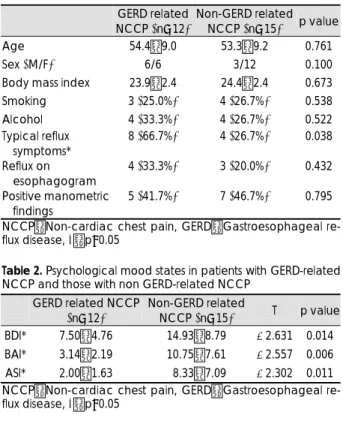
GERD와 Non-GERD군의 임상적 특성을 비교 분석한 것 을 Table 1로 정리하였다. 두 군을 비교했을 때, 나이(54.4±
9.0 vs 53.3±9.2), 성별(남/녀=6/6 vs 3/12), 체질량지 수(23.9±2.4 vs 24.4±2.4), 흡연(25% vs 26.7%), 음주 (33.3% vs 26.7%)에서 유의한 차이가 없었다.
위장관 평가
전형적인 위식도 역류 증상은 GERD군에서 8명(66.7%), Non-GERD군에서 4명(26.7%)으로 두 군간에 통계적으 로 유의한 차이를 보였다(p=0.038). 식도내압검사 상 식 도운동장애가 확인된 환자 총 12명 중, 비효율성 식도운동 장애(ineffective esophageal motility disorder)를 보인 환자는 10명이었고, 비특이적 식도운동장애(nonspecific eso- phageal motility disorder)와 고압성 하부식도괄약근(hyper- tensive lower esophageal sphincter) 소견을 각각 1명이 보였다. 또한, 식도조영술에서 병적 역류(pathologic reflux) 소견은 총 7명이 관찰되었다. GERD군과 Non-GERD군 간 에 식도운동장애 및 병적 역류 소견은 통계적으로 유의한 차 이를 보이지 않았다(Table 1).
정신과적 평가
NCCP 환자들을 GERD군과 Non-GERD군으로 나누어
우울 및 불안 증상을 평가한 결과는 Table 2에 요약하였다.
주관적인 우울 증상을 나타내는 BDI의 경우 GERD군에 비 해 Non-GERD군에서 높은 점수를 보였고(7.50±4.76 vs 14.93±8.79, p=0.014), 불안 증상을 측정한 BAI와 ASI 의 경우에도 Non-GERD군이 GERD군에 비해 유의하게 높 은 점수를 보였다(BAI:3.14±2.19 vs 10.75±7.61, p=
0.006, ASI:2.00±1.63 vs 8.33±7.09, p=0.011).
미리 내려진 정의에 따른 우울군 또는 불안군에 속하는 환 자는 총 14명으로 NCCP 전체 환자의 51.9%를 차지하였다.
그 중 BDI 10점 이상의 환자군은 GERD군에 비해 Non- GERD군에서 유의하게 높게 나타났고(16.7% vs 80.0%, p=0.002), BAI로 평가한 불안군의 경우도 GERD군에서는 한 명도 없는 반면 Non-GERD군에서 6명(40.0%)를 보 고하여 통계적으로 유의한 차이를 보였다(p=0.044).
고 찰
사망률이 높은 심인성 흉통이 배제된 후 상당수의 환자들 은 특별한 진단 없이 퇴원하게 되고, 외래 추적 관찰 없이 지내는 경우가 많다.26 이런 NCCP 환자의 경우 일반 인구 유병율이 33%까지 보고되고 있지만, 제대로 진단되지 않 은 상태에서 반복적으로 흉통을 경험하게 되고, 결국 무분 별하게 진단 행위와 치료에 매달리게 된다.5,9 또한 직업과
Table 1. Subject characteristics in patients with GERD-related NCCP and those with non GERD-related NCCP
GERD related NCCP (n=12)
Non-GERD related NCCP (n=15) p value Age 54.4±9.0 53.3±9.2 0.761
Sex (M/F) 6/6 3/12 0.100
Body mass index 23.9±2.4 24.4±2.4 0.673
Smoking 3 (25.0%) 4 (26.7%) 0.538
Alcohol 4 (33.3%) 4 (26.7%) 0.522
Typical reflux symptoms*
8 (66.7%) 4 (26.7%) 0.038
Reflux on esophagogram
4 (33.3%) 3 (20.0%) 0.432
Positive manometric findings
5 (41.7%) 7 (46.7%) 0.795
NCCP:Non-cardiac chest pain, GERD:Gastroesophageal re- flux disease, *:p<0.05
Table 2. Psychological mood states in patients with GERD-related NCCP and those with non GERD-related NCCP
GERD related NCCP (n=12)
Non-GERD related
NCCP (n=15) T p value
BDI* 7.50±4.76 14.93±8.79 -2.631 0.014
BAI* 3.14±2.19 10.75±7.61 -2.557 0.006
ASI* 2.00±1.63 08.33±7.09 -2.302 0.011
NCCP:Non-cardiac chest pain, GERD:Gastroesophageal re- flux disease, *:p<0.05
학업에서의 부적응 등과 더불어 삶의 질이나 만족도가 낮다.5,9 현재까지 알려진 바로는 GERD가 NCCP 원인의 60%까 지 보고13되는 등 가장 흔한 원인으로 받아들여지고 있다.
NCCP의 원인을 확진하는 표준적 진단 기준이 없음에도 불 구하고, 이런 관점에서 NCCP 환자에서 GERD를 진단하거 나 배제하는 작업이 우선시 되었다. 하지만, 본 연구에서 식 도 산도 검사와 달리 상부위장관내시경 검사는 GERD 진단 에서 30%(GERD 12명 중 3명)가 되지 않는 진단율을 보 였다. 이것은 내시경이 선별검사로서의 유용성을 갖지만 진 단율이 낮다는 이전 연구들과 일치한다.27 더구나, 본 연구 에서 GERD군과 Non-GERD군 간의 비교에서 식도내압 검사와 식도조영술에서는 유의한 차이를 보이지 않았다. 이 결과는 이런 검사들이 GERD 진단에서 낮은 예민도를 보 여 초기 검사로 권장되지 않는 미국소화기학회의 지침서와 같은 맥락에서 이해할 수 있다. 반면, 보행성 24시간 식도 산도 검사는 진단 도구 중에서 GERD를 가장 정확히 진단 할 수 있는 것으로 알려져 있고,28 본 연구에서도 91.7%
(GERD 12명 중 11명)의 높은 진단율을 보였다. 이렇게 높 은 GERD 진단율에도 불구하고, 과도하게 위산에 노출되었 다는 소견이 환자가 호소하는 흉통과 연관되지 않는 경우도 있어 GERD가 NCCP의 원인이라고 단정 지을 수 없는 환자 군이 존재한다.14 한편, 본 연구에서 GERD군과 Non-GERD 군 간의 임상적 차이를 보인 부분은 전형적 위산 역류 증상 이었다. 이 결과는 GERD의 주요 증상으로 받아들여지는 여 러 보고들과 일치된 소견이지만, 본 연구의 표본수가 적고 GERD와 연관된 NCCP 증상에서 서양인과 달리 동양인에 서 전형적 위산 역류 증상이 명확하지 않다는 보고27도 있 어 향후 표본 수를 증가시켜 확인해보는 것이 필요하다.
NCCP 환자에서 우울과 불안 증상이 흔하다는 것은 잘 알 려진 사실이다.5,29 또한, 공황장애를 비롯한 정신과 질환이 NCCP 증후군에서 흔한 공존질환이라는 보고도 있다.15,16 이 런 맥락에서 볼 때 NCCP 환자를 평가할 때 정신과적 문제 에 대한 고려가 필요할 수 있다. 본 연구에서 Non-GERD 군이 GERD군에 비해 더 우울하고 불안해 한다는 결과를 보 였다. 또한, 우울증과 불안장애를 의심할 수 있는 환자군도 Non-GERD군에서 휠씬 더 많았다. 더구나, 본 연구에서 Non-GERD군에서 높은 수치를 보인 불안 민감도가 건강 염려증적 사고와 관련이 있다는 보고30를 볼 때 향후 나쁜 예후를 예측하는 인자일 수도 있다. 결국, NCCP 증후군에 서 GERD를 배제하고 난 뒤 남은 환자들의 특성을 좀 더 명확하게 밝힐 수 있었는데, 특히 Non-GERD군의 특성은 임상적으로 중요한 점을 시사하고 있다. 즉, 이전 보고들과 본 연구 결과를 같이 고려하면, 이전 연구에서 보고된 NCCP
증후군의 정신과적 공존질환들은 주로 Non-GERD군에 해 당된다고 할 수 있다. 또한, 본 연구에서 우울증이나 불안장 애를 의심할 수 있는 환자군이 전체 NCCP 환자의 50%가 넘었다는 결과를 같이 고려할 때, GERD를 진단하기 위한 단계에서부터 정신과적 선별검사를 같이 시행하는 것이 타 당할 수 있다.
본 연구에서 흥미로운 사실은 자가 보고한 불안 증상보다 우울 증상이 더 높은 수치를 보인다는 점이다. 일반인구를 대상으로 NCPP 증후군에 대해 조사한 연구에서 불안 증 상이 우울 증상보다 더 많다는 보고3와는 상반된 결과이다.
하지만, 다른 임상 연구31에서 우울 증상의 빈도가 더 높은 것으로 보고된 경우도 있었다. 이런 차이는 대상군의 선정 기준 차이 등으로 인해 설명될 수 있지만, 향후 추가 연구 가 필요한 부분이라고 생각된다.
본 연구의 제한점으로는 참여한 NCCP 환자의 수가 적고 정신과적 구조 면담을 시행하지 않아 본 연구 결과를 일반 화하기 어렵다는 점이다. 또한, 삼성서울병원 내과를 방문한 환자들만을 대상으로 하였다는 점에서 특정 환자군 또는 특 정 경제사회적 지위를 가진 참여자로 구성되었을 오류가 존 재할 수 있다. 마지막으로, 이 연구에서는 두 군간의 차이 를 비교할 때 성별의 차이를 포함한 다양한 요소들의 영향 을 충분히 제거하지 않아 1종 오류(type 1 error)가 발생 할 가능성이 있다. 향후 연구에서는 표본 수를 늘이고, 다양 한 배경에서 추출한 환자 표본을 포함시키는 것이 필요할 것 이다.
하지만, 우울 및 불안 증상이 GERD 유무에 따라 다르다 는 것을 본 연구에서 처음으로 제시하였다. 이 결과는 NCCP 증후군의 병태생리학에서 정신과적 요인이 GERD와는 독립 적으로 작용할 가능성을 의미하고, NCCP 환자의 진단과 치 료에서 정신과적 접근이 필요함을 강조해준다. 또한, 본 연 구에서 사용된 자가보고 형식의 설문지의 경우 정신질환에 대한 저항을 줄일 수 있어 향후 내과진료에서 좀더 적극적 인 활용을 권장할 수 있겠다. 따라서 NCCP 환자 진료 시 에 이런 자가보고식 설문지에서 이상소견이 발견되는 환자 들은 정신과로의 협진을 적극 의뢰하는 체계를 갖추는 것이 필요하리라 생각된다.
결론적으로, NCCP 환자들은 여러 질환들의 연속선상에 있 어 다양한 임상적 특성을 갖는 경우가 흔하다. 특히, GERD와 연관된 NCCP 환자들은 전형적 역류 증상과 관련이 많지만, GERD로 진단되지 않은 환자들은 우울증이나 불안장애 같 은 정신과 질환을 가졌을 가능성이 높다. 이러한 결과들을 고려할 때, 우울 및 불안과 같은 심리적 요인이 NCCP의 병 태생리학적 요인으로써 중요한 역할을 할 가능성이 있다. 따
라서 NCPP 환자의 진료에 있어 이러한 기분상태에 대한 측 정이 NCCP의 원인론적 평가 및 치료에 있어 도움이 될 수 있으리라 생각된다.
중심 단어
:비심인성 흉통·우울·불안·위식도역류질환.REFERENCES
1. Klinkman MS, Stevens D, Gorenflo DW. Episodes of care for chest pain: a preliminary report from MIRNET. J Fam Pract 1994;38:345-352.
2. Ho KY, Ng WL, Kang JY, Yeoh KG. Gastroesophageal reflux disease is a common cause of noncardiac chest pain in a country with a low prevalence of reflux esophagitis. Dig Dis Sci 1998;43:1991-1997.
3. Eslick G, Jones M, Talley N. Non-cardiac chest pain: prevalence, risk factors, impact and consulting - a populationbased study. Aliment Phar- macol Ther 2003;17:1115-1124.
4. Kroenke K, Mangelsdorff AD. Common symptoms in ambulatory care: incidence, evaluation, therapy, and outcome. Am J Med 1989;86:
262-266.
5. Wong WM, Lam KF, Cheng C, Hui WM, Xia HH, Lai KC, et al.
Population based study of noncardiac chest pain in southern Chinese:
prevalence, psychosocial factors and health care utilization. World J Gastroenterol 2004;10:707-712.
6. Chambers J, Bass C. Chest pain with normal coronary anatomy: a re- view of natural history and possible etiologic factors. Progr Cardiov Dis 1990;33:161-184.
7. Eslick GD, Coulshed DS, Talley NJ. The burden of noncardiac chest pain. Aliment Pharmacol Ther 2002;16:1217-1223.
8. Chambers J, Bass C. Atypical chest pain: looking beyond the heart.
Quart J Med 1998;91:239-244.
9. Husser D, Bollmann A, Kuhne C, Molling J, Klein HU. Evaluation of noncardiac chest pain: diagnostic approach, coping strategies and qua- lity of life. Eur J Pain 2006;10:51-55.
10. Ockene IS, Shay MJ, Alpert JS, Weiner BH, Dalen JE. Unexplained chest pain in patients with normal coronary arteriograms: a follow-up study of functional status. N Engl J Med 1980;303:1249-1252.
11. Papanicolaou MN, Califf RM, Hlatky MA, McKinnis RA, Harrell FE, Jr, Mark DB, et al. Prognostic implications of angiographically normal and insignificantly narrowed coronary arteries. Am J Cardiol 1986;
58:1181-1187.
12. Botoman VA. Noncardiac chest pain. J Clin Gastroenterol 2002;34:6-14.
13. Richter JE. Extraesophageal presentations of gastroesophageal reflux disease: an overview. Am J Gastroenterol 2000;95:S1-3.
14. Beedassy A, Katz PO, Gruber A, Peghini PL, Castell DO. Prior sensi- tization of esophageal mucosa by acid reflux predisposes to reflux- induced chest pain. J Clin Gastroenterol 2000;31:121-124.
15. Fleet RP, Beitman BD. Unexplained chest pain: when is it panic disor- der? Clin Cardiol 1997;20:187-194.
16. Ho KY, Kang JY, Yeo B, Ng WL. Non-cardiac, non-oesophageal chest pain: the relevance of psychological factors. Gut 1998;43:105-110.
17. Katon W, Hall ML, Russo J, Cormier L, Hollifield M, Vitaliano PP, et al.
Chest pain: relationship of psychiatric illness to coronary arteriogra- phic results. Am J Med 1988;84:1-9.
18. Carlsson R, Dent J, Bolling-Sternevald E, Johnsson F, Junghard O, Lauritsen K, et al. The usefulness of a structured questionnaire in the assessment of symptomatic gastroesophageal reflux disease. Scand J Gastroenterol 1998;33:1023-1029.
19. Dent J, Brun J, Fendrick AM, Fennerty MB, Janssens J, Kahrilas PJ, et al. An evidence-based appraisal of reflux disease management--the Genval Workshop Report. Gut 1999;44 Suppl 2:S1-16.
20. Jamieson JR, Stein HJ, DeMeester TR, Bonavina L, Schwizer W, Hin- der RA, et al. Ambulatory 24-h esophageal pH monitoring: normal values, optimal thresholds, specificity, sensitivity, and reproducibility.
Am J Gastroenterol 1992;87:1102-1111.
21. Spechler SJ, Castell DO. Classification of oesophageal motility abnor- malities. Gut 2001;49:145-151.
22. Kendall PC, Hollon SD, Beck AT, Hammen CL, Ingram RE. Issues and recommendations regarding the use of the Beck Depression Inven- tory. Cognit Ther Res 1987;11:289-299.
23. Strik JJ, Honig A, Lousberg R, Denollet J. Sensitivity and specificity of observer and self-report questionnaires in major and minor depression following myocardial infarction. Psychosomatics 2001;42:423-428.
24. Beck AT, Epstein N, Brown G, Steer RA. An inventory for measuring clinical anxiety: psychometric properties. J Consult Clin Psychol 1988;
56:893-897.
25. Reiss S, Peterson RA, Gursky DM, McNally RJ. Anxiety sensitivity, anxiety frequency, and the prediction of fearfulness. Behav Res Ther 1986;24:1-8.
26. Adamek RJ, Roth B, Zymanski CH, Hagemann B. Esophageal moti- lity patterns in patients with and without coronary heart disease and healthy controls. Hepato-Gastroenterology 1999;46:1759-1764.
27. Wong WM, Lai KC, Lau CP, Hu WH, Chen WH, Wong BC, et al.
Upper gastrointestinal evaluation of Chinese patients with non-cardiac chest pain. Aliment Pharmacol Ther 2002;16:465-471.
28. Hewson EG, Sinclair JW, Dalton CB, Richter JE. Twenty-four-hour esophageal pH monitoring: the most useful test for evaluating noncar- diac chest pain. Am J Med 1991;90:576-583.
29. Serlie AW, Erdman RA, Passchier J, Trijsburg RW, ten Cate FJ. Psy- chological aspects of non-cardiac chest pain. Psychother Psychosom 1995;64:62-73.
30. Otto MW, Demopulos CM, McLean NE, Pollack MH, Fava M. Addi- tional findings on the association between anxiety sensitivity and hypo- chondriacal concerns: examination of patients with major depression.
J Anxiety Disord 1998;12:225-232.
31. Potts SG, Bass CM. Psychological morbidity in patients with chest pain and normal or near-normal coronary arteries: a long-term follow-up study. Psychol Med 1995;25:339-347.