408 Copyright © 2016 The Korean Society of Cardiology Korean Circulation Journal
Introduction
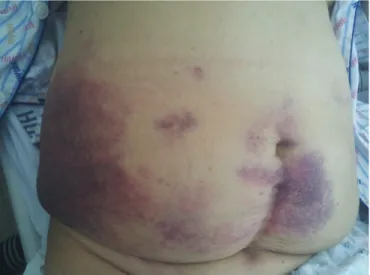
Vascular complications are the most frequent adverse outcomes associated with percutaneous coronary intervention (PCI) via the femoral artery. They contribute to in-hospital morbidity, mortality, and costs; and furthermore, are associated with increased long- term risk of myocardial infarction and death. Vascular complications include bleeding, pseudoaneurysm formation, hematoma, arterio- venous fistula, retroperitoneal bleeding, and other femoral arterial injuries requiring procedural or surgical intervention. Abdominal wall hematoma is a rare condition that can give rise to an acute abdomen.
In this report, we describe a case of a 73-year-old woman who developed an abdominal wall hematoma, which is a rare but serious
complication of a PCI via the femoral approach.
Case
A 73-year-old woman, with a past medical history of hypertension, diabetes mellitus for 40 years, and chronic kidney disease stage 5, because of diabetic nephropathy, presented to the emergency department with dyspnea (NYHA IV). The patient had the following vital signs: blood pressure: 155/63 mmHg; pulse: 93 beats per minute; respiratory rate: 28 breaths per minute; and her body temperature was 36.0℃. On physical examination, the patient had no notable findings, other than bilateral expiratory rales and neck vein distention. No heart murmurs or pericardial friction rub were heard. An electrocardiogram was within normal limits. A chest X-ray revealed marked cardiomegaly and pulmonary edema. Laboratory tests showed the following: white blood cell count: 10300/mm
3, hemoglobin: 8.3 g/dL, platelet count: 250000/mm
3, blood urea nitrogen: 63 mg/dL, creatinine: 4.4 mg/dL, brain natriuretic peptide:
483 pg/mL, creatine kinase isoenzyme MB: 2.0 ng/mL, and troponin-I:
0.10 ng/mL. The patient received emergency hemodialysis because of pulmonary edema refractory to medical therapy, including high- dose furosemide infusion. After stabilizing the patient’s volume status by regular hemodialysis, she received coronary angiography for the evaluation of ischemic heart disease on the 19th day of admission. The patient took aspirin (300 mg) and clopidogrel (300
Case Report
http://dx.doi.org/10.4070/kcj.2016.46.3.408 Print ISSN 1738-5520 • On-line ISSN 1738-5555
Abdominal Wall Hematoma as a Rare Complication following Percutaneous Coronary Intervention
In Tae Moon, MD 1 , Jeong Hun Shin, MD 1 , Young Seok Sohn, MD 1 , Ji Young Lee, MD 1 , Hwan Cheol Park, MD 1 , Sung Il Choi, MD 1 , Soon Gil Kim, MD 1 , and Ji Young Oh, MD 2
1