• 검색 결과가 없습니다.

A Rare Case of Acute Ocular Hy-pertensive Episode in a Patient with Chronic Infantile Neurological Cu-taneous Articular Syndrome

N/A
N/A
Protected

Academic year: 2022

Share "A Rare Case of Acute Ocular Hy-pertensive Episode in a Patient with Chronic Infantile Neurological Cu-taneous Articular Syndrome"

Copied!
3
0
0

로드 중.... (전체 텍스트 보기)

전체 글

(1)

237 rimal punctum protrusion have not been previously report-

ed, and only a significant negative correlation between the severity of punctal protrusion and tear clearance has been reported in the literature [5]. The patient showed a lower eyelid laxity of grade 1 during the initial examination and it was unclear whether the inability to discharge tears was caused by protrusion. Early surgical treatment was at- tempted as the patient also raised cosmetic concerns.

Epiphora improved considerably, and it was confirmed that the case was caused by decreased tear flow due to punc- tum protrusion.

In conclusion, we report a case of epiphora caused by an abnormal lacrimal punctum position due to severe protru- sion. The patient was successfully treated with a novel punctal fixation technique.

Jong Hwa Jun

Department of Ophthalmology, Dongsan Medical Center, Keimyung University School of Medicine, Daegu, Korea E-mail: [email protected]

Conflict of Interest

No potential conflict of interest relevant to this article was reported.

References

1. Blackmore KJ, Ainsworth G, Robson AK. Epiphora: an evidence based approach to the 12 minute consultation.

Clin Otolaryngol 2010;35:210-4.

2. Lee DW, Chai CH, Loon SC. Primary external dacryo- cystorhinostomy versus primary endonasal dacryocysto- rhinostomy: a review. Clin Experiment Ophthalmol 2010;

38:418-26.

3. Czyz CN, Wulc AE, Ryu CL, et al. Caruncular fixation in medial canthal tendon repair: the minimally invasive purse string suture for tendinous laxity and medial ectropion.

Ophthal Plast Reconstr Surg 2015;31:34-7.

4. Narayanan K, Barnes EA. Epiphora with eyelid laxity. Or- bit 2005;24:201-3.

5. Zheng X, Kamao T, Yamaguchi M, et al. New method for evaluation of early phase tear clearance by anterior seg- ment optical coherence tomography. Acta Ophthalmol 2014;92:e105-11.

A Rare Case of Acute Ocular Hy- pertensive Episode in a Patient with Chronic Infantile Neurological Cu- taneous Articular Syndrome

Dear Editor,

Chronic infantile neurological cutaneous articular (CIN- CA) syndrome is a rare inflammatory disease that consists of a triad of neonatal onset cutaneous symptoms, meningi- tis, and joint manifestations with recurrent fever and in- flammation [1]. We report a patient with acute-on-chronic ocular inflammation associated with intraocular pressure

surge together with imaging findings.

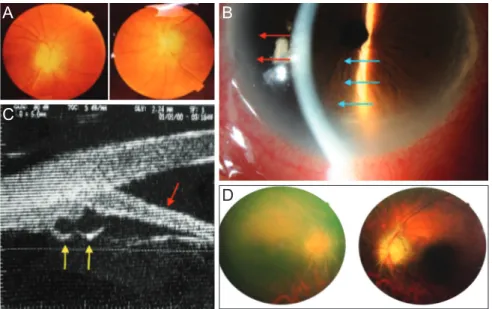
A 45-year-old Chinese man was referred to the eye clinic for dry eye evaluation, with suspicion of Sjogren’s syn- drome in 2004. Ophthalmological findings were unremark- able except for blurred optic disc margins (Fig. 1A). Fur- ther work-up was prompted by a compatible history of neonatal onset urticarial rash, periodic fever, joint defor- mities, and sensorineural hearing loss. Genetic tests showed heterozygous missense mutation in exon 3 of the CIAS1 gene, diagnostic of CINCA syndrome.

The patient presented again in February 2013 with right eye redness and decreased visual acuity (VA) for 2 days.

Intraocular pressure was 44 mmHg and VA 3 / 60. The an- terior chamber was deep and irides were flat, without obvi- ous pupil block (e.g., iris bombé or seclusio pupillae). Go- nioscopy of his right eye revealed no angle structures 360°,

Korean J Ophthalmol 2016;30(3):237-239

http://dx.doi.org/10.3341/kjo.2016.30.3.237

(2)

238

Korean J Ophthalmol Vol.30, No.3, 2016

with no peripheral anterior synechiae, neovascularisation, or double-hump sign. His left eye showed 270° Shaffer grade 0, inferior 90° grade 1, and no double hump sign.

There were bilateral cataracts, which was more severe on the right. He was treated as ‘acute angle closure attack’ of the right eye, and received intravenous acetazolamide, pi- locarpine, and steroid eye-drops, resulting in rapid intraoc- ular pressure normalization. He later underwent bilateral laser iridotomy and argon laser iridoplasty, after which post-laser gonioscopy revealed persistent angle closure with Shaffer grading 0 to 1. Further follow-ups showed pe- ripheral corneal stromal opacification, mild bilateral inter- mittent anterior chamber activity with cells and flare, and chemosis (Fig. 1B). Ultrasound biomicroscopy confirmed invisibility of the scleral spur with flat irides, no anterior rotation of the ciliary body, and incidental findings of small iridociliary cysts in the right eye 9 o’clock and the left eye 6 o’clock positions (Fig. 1C). He then received right eye phacoemulsification, intraocular lens implantation, and posterior subtenon triamcinolone injection 4 mg. Best cor- rected VA improved to 0.3, and both fundi showed pale optic discs with blurry margins surrounded by ghost ves- sels (Fig. 1D). He was maintained on daily oral predniso- lone 5 mg and loteprednol etabonate 0.5% eye-drops, and there was no recurrence of hypertensive episodes 22

months after the operation, although the postoperative go- nioscopic appearance remained the same.

A wide variety of ocular disturbances have been de- scribed in association with CINCA syndrome, with poor correlation between ocular and systemic severity. Dollfus et al. [2] conducted the largest review of cases to date, with anterior uveitis, episodic redness, and corneal involvement being the most common anterior segment abnormalities.

Among posterior segment changes, pseudopapilloedema, optic disc elevation, and optic atrophy predominate (83%).

VA was moderately to severely affected in 27% of the cas- es in that study. Other sporadic cases describe ocular changes such as keratitis and corneal infiltrates [3,4]. Our patient had features of uveitis, but his closed angle was more likely due to congenital structural malformations rather than recurrent inflammatory changes, as evidenced by flat irides without peripheral anterior synechiae or pu- pillary block. To our knowledge, this is the first document- ed case of CINCA syndrome with acute ocular hyperten- sion. Ultrasound biomicroscopy findings were atypical of primary angle closure. We postulate that the hypertensive episode was due to a compromised angle anatomy perpet- uated by inflammation. Regular surveillance of visual function is mandatory for preserving vision in such pa- tients.

Fig. 1. (A) 2004 Fundoscopy showing bilateral blurred optic disc margins, vessel sclerosis, and normal macula. (B) Follow-up after laser iridotomy and argon laser iridoplasty, demonstrating peripheral corneal stromal opacification (red arrows) and anterior chamber activity of the right eye with cells and flare (blue arrows). (C) Ultrasound biomicroscopy of right eye’s 9 o’clock position showing invisibility of scleral spur with flat iris configuration (red arrow), no anterior rotation of ciliary body, and incidental finding of small iridociliary cysts (yellow arrows). (D) 2013 Fundoscopy showing similar findings.

A

D B

C

(3)

239

Karen Kar-Wun Chan

Hospital Authority, Hong Kong

Jonathan Chun-Ho Ho, Irene Tak-Yee Yeung, Simon Tak-Chuen Ko

Department of Ophthalmology, Tung Wah Eastern Hospital, Hong Kong

E-mail (Jonathan Chun-Ho Ho): [email protected]

Conflict of Interest

No potential conflict of interest relevant to this article was reported.

References

1. Feldmann J, Prieur AM, Quartier P, et al. Chronic infantile neurological cutaneous and articular syndrome is caused

by mutations in CIAS1, a gene highly expressed in poly- morphonuclear cells and chondrocytes. Am J Hum Genet 2002;71:198-203.

2. Dollfus H, Hafner R, Hofmann HM, et al. Chronic infan- tile neurological cutaneous and articular/neonatal onset multisystem inflammatory disease syndrome: ocular mani- festations in a recently recognized chronic inflammatory disease of childhood. Arch Ophthalmol 2000;118:1386-92.

3. Terrada C, Neven B, Boddaert N, et al. Ocular modifica- tions in a young girl with cryopyrin-associated periodic syndromes responding to interleukin-1 receptor antagonist anakinra. J Ophthalmic Inflamm Infect 2011;1:133-6.

4. Espandar L, Boehlke CS, Kelly MP. First report of keratitis in familial cold autoinflammatory syndrome. Can J Oph- thalmol 2014;49:304-6.

Arteritic Anterior Ischemic Optic Neuropathy Associated with Giant Cell Arteritis in an Elderly Korean Man

Dear Editor,

Giant cell arteritis (GCA), also known as temporal arte- ritis, is a systemic autoimmune disease primarily affecting the elderly. It is characterized by granulomatous inflam- mation of large and medium-sized arteries [1]. Arteritic anterior ischemic optic neuropathy (AAION) is the most common type of ophthalmic complication of GCA, and can cause permanent visual loss [2]. Therefore, AAION represents a true ophthalmic emergency, because the pos- sibility of visual loss is very high if it is not recognized and treated promptly [3]. There have been few reports of GCA among Asians, and only one involving a patient with silent GCA-associated AAION in Korea [2]. Herein, we report a case of GCA-associated AAION with typical systemic

GCA symptoms in an elderly Korean man, as confirmed by temporal artery biopsy.

A 70-year-old man presented with sudden vision loss in his right eye (oculus dexter, OD), which had occurred the previous day. He had been suffering headaches for several months, and anorexia, general weakness and scalp tender- ness were also noted during this period. His best-corrected visual acuity (VA) was 10 / 20 in OD and 20 / 20 in the left eye (oculus sinister, OS). A relative afferent pupillary de- fect was also noted in OD and intraocular pressure was 14 mmHg in OD, 12 mmHg in OS. Both eyes were freely movable and non-tender upon eye movement. A chalky white swelling in OD was discovered upon fundus exam- ination (Fig. 1A), and visual field testing (Humphrey HFA II; Carl Zeiss Meditec, Jena, Germany) revealed a near to- tal field defect in the same eye. The Hardy-Rand-Rittler test showed total dyschromatopsia in OD and fluorescein angiography revealed delayed filling of the vertical water- shed zone at the adjacent nasal peripapillary choroid and optic disc leakage at late phase. The patient’s body tem- perature was 38.3°C and white blood cell count was 12,900/mm

3

. C-reactive protein levels, as well as the eryth- rocyte sedimentation rate, were also elevated to be 14.5

Korean J Ophthalmol 2016;30(3):239-241

http://dx.doi.org/10.3341/kjo.2016.30.3.239

수치

Fig. 1. (A) 2004 Fundoscopy showing bilateral blurred optic disc margins, vessel sclerosis, and normal macula

참조

관련 문서