• 검색 결과가 없습니다.

Transcatheter Closure of Secundum Atrial Septal Defect in Patients Over 60 Years Old

N/A
N/A
Protected

Academic year: 2022

Share "Transcatheter Closure of Secundum Atrial Septal Defect in Patients Over 60 Years Old"

Copied!
5
0
0

로드 중.... (전체 텍스트 보기)

전체 글

(1)

Korean Circulation Journal

Introduction

Atrial septal defect (ASD) is the most common congenital heart

Print ISSN 1738-5520 • On-line ISSN 1738-5555

Transcatheter Closure of Secundum Atrial Septal Defect in Patients Over 60 Years Old

Saet Byul Woo, MD 1 , So-Ick Jang, MD 2 , Seong-Ho Kim, MD 2 , Soo-Jin Kim, MD 3 , Sang-Yun Lee, MD 2 , Jae-Sook Baek, MD 2 , and Woo-Sup Shim, MD 2

1

Department of Pediatrics, Hallym University Medical Center, Seoul,

2

Department of Pediatrics, Sejong Heart Institute, Sejong General Hospital, Bucheon,

3
Department of Pediatrics, Konkuk University Hospital, Seoul, Korea

Background and Objectives: Atrial septal defect (ASD) is the one of most common congenital heart diseases detected in adults. Along with remarkable development of device technology, the first treatment strategy of secundum ASD has been transcatheter closure in fea- sible cases. However, there are only a few publications regarding the results of transcatheter closure of ASD in elderly patients, especially those over 60 years of age. We report our results of transcatheter closure of ASD in patients over 60 years old.

Subjects and Methods: Between May 2006 and December 2011, 31 patients over 60 years old (25 female and 6 male; mean 66.7±5.25 years old, range 61-78 years old) were referred to our center.

Results: A total of 23 patients underwent therapeutic catheterization to close secundum ASD, and the closure was successful in 22 pa- tients (95.7%). All patients who underwent the procedure survived except for one patient who expired because of left ventricular dys- function. A small residual shunt was observed in two (9%) of 21 patients before discharge but disappeared at follow-up. All patients eventually had complete closure. There were five patients who had coronary problems. One patient underwent percutaneous coronary in- tervention using a stent at the same time as transcatheter closure of ASD. Atrial arrhythmias were detected in 6 of 23 patients (26.1%) before the procedure. One patient was successfully treated by radiofrequency ablation before the procedure. No patients displayed new onset arrhythmia during the follow-up period. Follow-up echocardiographic evaluation showed a significantly improved right ventricular geometry.

Conclusion: We conclude that transcatheter closure of ASD is a safe and an effective treatment method for patients over 60 years old if the procedure is performed under a thorough evaluation of comorbidities and risk factors. (Korean Circ J 2013;43:110-114)

KEY WORDS: Atrial septal defect; Septal occluder device; Elderly.

Received: August 16, 2012

Revision Received: October 30, 2012 Accepted: November 1, 2012

Correspondence: So-Ick Jang, MD, Department of Pediatrics, Sejong Heart Institute, Sejong General Hospital, 28 Hohyeon-ro 489beon-gil, Sosa-gu, Bucheon 422-711, Korea

Tel: 82-32-340-1122, Fax: 82-32-340-1236 E-mail: [email protected]

• The authors have no financial conflicts of interest.

This is an Open Access article distributed under the terms of the Creative Commons Attribution Non-Commercial License (http://creativecommons.

org/licenses/by-nc/3.0) which permits unrestricted non-commercial use, distribution, and reproduction in any medium, provided the original work is properly cited.

disease detected in adults, accounting for about 10% of all conge-

nital heart anomalies. Although many patients with ASD are asym-

ptomatic for years, almost all the patients eventually develop symp-

toms, most often dyspnea on exertion, fatigue, and palpitation. Al-

ong with the remarkable developments of device technology, trans-

catheter closure has been preferred as the initial treatment strategy

of secundum ASD in feasible cases.

1-3)

Moreover, many clinicians have

performed transcatheter ASD closure as an alternative to surgery

and reported excellent results with low complication rates. How-

ever, several factors, such as morphology of ASD, comorbidity, and

age, can influence the outcome significantly. In particular, in elderly

patients, prolonged left-to-right shunting results in right ventricular

(RV) volume overload and subsequent pulmonary hypertension and

atrial arrhythmia. We report our results of transcatheter ASD closure

with the Amplatzer Septal Occluder (ASO; AGA Medical Corp., Gold-

(2)

en Valley, MN, USA) in patients over 60 years old, and discuss the risk factors of the procedure as well as the strategies to prevent com- plications in this particular subset of patients.

Subjects and Methods

Study population

Between May 2006 and December 2011, 31 patients over 60 years of age (25 female and 6 male; mean 66.7±5.25 years old, range 61- 78 years old) were referred to our center of Grown-Up Congenital Heart disease. Of these patients, 8 underwent surgery after diagno- stic catheterization and 23 underwent transcatheter closure of se- cundum ASD. The indications for ASD closure were hemodynamical- ly significant secundum ASD <40 mm in diameter with adequate rims (>5 mm in length, except for the anterior superior rim), and RV en- largement on transthoracic echocardiography (TTE) and/or clinical- ly symptomatic patients. ASD assessment was done by TTE and/or transesophageal echocardiography (TEE). Patients who had evid- ence of partial anomalous pulmonary venous return and/or ASD size

>40 mm were excluded from the study. We retrospectively review- ed the medical records of all patients, and the Institutional Review Board approved the study and waived informed consent.

Device closure procedure

The sizes of defects were measured with TEE or intracardiac echo- cardiography (ICE) in all patients in the catheterization laboratory.

One dose of cephazolin was administered 30 minutes before the procedure and 2 doses were administered 8 hours apart after the procedure. We used ASO in all patients. The procedure was per- formed under local anesthesia, ICE and fluoroscopic guidance, ex- cept for two patients who requested the procedure be done under general anesthesia. A 24 or 34 mm sizing balloon (AGA medical Corp., Golden Valley, MN, USA) was used to measure the diameter of the defect. Baseline hemodynamic assessment was performed in every patient prior to closure except in 1 patient who was evaluated for the hemodynamic state at another hospital and referred to our hospital. We used the stop-flow technique in general to avoid ov- ersizing the defect. Before deployment of the device, we performed the “Minnesota wiggle”(reference) procedure gently to confirm the stability of the device. All patients received aspirin (100 mg) for 6 months and were checked by chest X-ray, electrocardiography and TTE before discharge. We recommended prophylactic antibiotics for infective endocarditis for 6 months. We performed test occlusion of the defect in 3 patients to evaluate the left ventricular compli- ance in case of high left atrial pressure. One patient’s left atrial pres- sure was 23 mm Hg and the increase of left atrial pressure from baseline was lower than 3 mm Hg. Therefore, we occluded the de-

fect. Another case also involved test occlusion because of high left ventricular end diastolic pressure of 19 mm Hg, which increased to 21 mm Hg on test occlusion. In the 3rd case, test occlusion was per- formed for left ventricular diastolic dysfunction on TTE. The left ven- tricular end-diastolic pressure increased from 10 mm Hg to 15 mm Hg after test occlusion and we occluded the defect with heart fail- ure medications after the procedure.

Follow-up

We performed history taking, physical examination, electrocar- diography, chest X-ray and TTE at the first post-procedure day, at 1 month, 6 months, 1 year and annually thereafter to assess the symp- toms and detect any complications or residual shunt. Residual sh- unt was classified according to the color jet width described by Bou- tin et al.

4)

as trace <1 mm, small >1 mm and <2 mm, moderate >2 mm and <4 mm, large if >4 mm.

Statistics

The results are presented as mean and range. Differences between pre- and post-closure parameters were compared using Statistical Package for the Social Sciences (SPSS) 13.0 (SPSS Inc., Chicago, IL, USA). Null of no difference were rejected if p were less than 0.05. In pa- tients with multiple ASDs, the largest defect size was used for analysis.

Results

Twenty-two patients had single ASD and 1 patient had two ASDs.

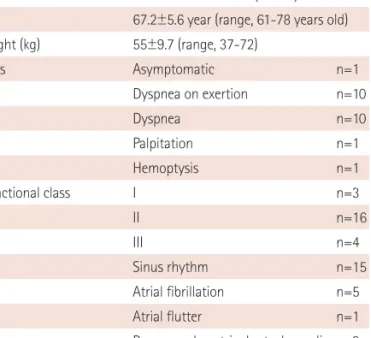
The baseline clinical data are presented in Table 1 and the hemody- namic data and related conditions are listed in Table 2.

Percutaneous transcatheter closure was tried in 23 patients and was successful in 22 patients (95.7%). The mean fluoroscopy time was 26.7±13.7 minutes (range 7.6-67 minutes). There was no fen- estration case of ASO.

The procedure was successful in all patients except in one who failed due to encroachment of the mitral valve (MV) by the ASO de- vice and was sent to surgery. All patients survived except for one patient who expired the next day of the procedure because of sus- picious left ventricular dysfunction that developed after the trans- catheter closure of ASD.

A small residual shunt was observed in 2 (9%) of 21 patients on the first follow-up TTE before discharge but disappeared later during the follow-up period. All patients eventually had complete closure.

We used a single ASO in all cases. In one patient with multiple ASD, we occluded the larger one but left the smaller one (2 mm) be- cause of high left atrial pressure (mean 11 mm Hg) and high left ven- tricular end diastolic pressure (14 mm Hg).

The mean size of ASDs measure by ICE (n=21) or TEE (n=2) was

(3)

18.0 mm (range, 11-34 mm), and the mean ASD balloon-stretched diameter (stop-flow technique) (n=18) was 17.8 mm (range, 12-28 mm). The mean of mean pulmonary artery pressure (mean PAP) was 28.3 mm Hg (range, 17-49 mm Hg). The mean pulmonary blood flow to systemic flow ratio as calculated using the Fick’s principle was 2.28 : 1 (range, 1.4-4.3 : 1). The mean device size used on all pa- tients (n=22) was 19.9 mm (range, 12-32 mm).

Pulmonary arterial hypertension (mean PAP ≥25 mm Hg) was ob- served in 15 patients (65.2%). Of these, 3 patients had significant pulmonary hypertension (mean PAP ≥40 mm Hg). All patients with pulmonary hypertension underwent transcatheter closure of ASD with successful results except for 1 patient who underwent surgical closure because the device encroached on the MV. There were no significant complications except pain, bruising or hematoma at the

site of venous puncture. However, a patient who showed successful results in immediate post-procedural assessment developed cardi- ac arrest after one day of the procedure and expired despite repeat- ed resuscitation efforts.

There were 5 patients with coronary problems, thus they were re- ferred to adult cardiologist. 4 patients underwent medical therapy and 1 patient underwent percutaneous coronary artery intervention using a stent because of 90% stenosis of the right coronary artery at the same time of transcatheter closure of ASD.

Atrial arrhythmias were detected in 6 of 23 patients (26.1%, 5 at- rial fibrillation, 1 atrial flutter) before the procedure. 1 of 6 patients was successfully treated by radiofrequency ablation before transca- theter closure of ASD and 5 patients were managed with antiarrhy- thmic medications. 2 patients were reported to have persistent at- rial fibrillation in the follow-up period. No patients had new onset ar- rhythmia during the follow-up period.

We followed-up on 21 of 23 patients. 1 patient expired the next day of the procedure and 1 patient underwent operation. The mean follow-up interval was 21.6±18.5 months (range, 2.4-59 months).

Patients were reassessed for New York Heart Association (NYHA) functional class and we discovered that 18 (85.7%) of 21 patients sh- owed improvement. 3 patients showed no change but they showed NYHA functional class I before the procedure (Table 3).

We evaluated geometric changes in the RV by measuring tricuspid valve (TV) diameter and TV/MV diameter ratio (TV/MV ratio) and we found a statistically significant improvement of RV geometry after closure of the defect. The mean TV/MV ratio was decreased from 1.31±0.2 before transcatheter closure of ASD to 1.10±0.17 after transcatheter closure. The mean TV diameter was decreased from 38.3±3.63 mm before transcatheter closure to 34.4±4.83 mm after Table 1. Baseline clinical characteristics of the patients with secundum

atrial septal defect

Characteristics Total=23

Sex Male : Female=3 : 20 (86.9%)

Age 67.2±5.6 year (range, 61-78 years old)

Body weight (kg) 55±9.7 (range, 37-72)

Symptoms Asymptomatic n=1

Dyspnea on exertion n=10

Dyspnea n=10

Palpitation n=1

Hemoptysis n=1

NYHA functional class I n=3

II n=16

III n=4

Rhythm Sinus rhythm n=15

Atrial fibrillation n=5

Atrial flutter n=1

Paroxysmal ventricular tachycardia n=2 NYHA: New York Heart Association

Table 2. Cardiac catheterization and hemodynamic data

Mean (±SD) Minimum Maximum

meanPAP (mm Hg) 28.3 (±8.50) 17 49

Qp/Qs 2.28 (±0.80) 1.4 4.3

FT (minutes) 26.7 (±13.7) 7.6 67

ASD size (TTE, mm) 16.5 (±6.30) 8 30

ASD size (TEE or ICE, mm) 18.0 (±6.50) 11 34

BSD size (mm) 17.8 (±5.20) 12 28

Device size (mm) 19.9 (±5.90) 12 32

SD: standard deviation, meanPAP: mean pulmonary artery pressure, Qp/Qs:

pulmonary blood flow/systemic flow, FT: fluoroscopy time, ASD: atrial sepal defect, TTE: transthoracic echocardiography, TEE: transesophageal echocardiog- raphy, ICE: intracardiac echocardiography, BSD: balloon stretched diameter

Table 3. Assessment of symptoms according to NYHA functional class NYHA functional

class

Preclosure (n=23), n (%)

Postclosure (n=21), n (%)

I 3 (13) 19 (90.5)

II 16 (69.6) 2 (9.5)

III 4 (17.4)

IV

Two patients were excluded: 1 patient due to death and 1 patient due to fail- ure of transcatheter closure. NYHA: New York Heart Association

Table 4. Decrease of right ventricular volume before and after transcath- eter closure of atrial septal defect

Preclosure (n=21) mean±SD

Postclosure (n=21)

mean±SD p

TV/MV ratio 1.31±0.20 1.10±0.17 0.000

TV diameter (mm) 38.3±3.63 34.4±4.83 0.001

SD: standard deviation, TV: tricuspid valve, MV: mitral valve

(4)

transcatheter closure (Table 4). These changes in the RV geometry did not include patients who underwent operation or expired.

Discussion

Percutaneous transcatheter closure of secundum ASD with the ASO in pediatric and adult patients has a high success rate and ex- cellent results which have been documented in many studies.

2)3)

Moreover, lower rates of mortality and perioprative complications are observed in patients less than 40 years of age.

5)

However, there are only a few available data on elderly patients of age older than 60 years. Surgical closure of ASD in patients over 60 years old can re- sult in significant mortality and morbidity.

6)

A study showed that patients who underwent surgical therapy had improved functional class and better survival rate than those treated with conservative therapy.

7-9)

One of the most difficult problems for treatment of ASD in elder- ly patients is co-morbid disease. More than one third of patients have systemic hypertension and other systemic diseases such as diabetes mellitus or cerebral infarction. Cardiac comorbidities such as pulmonary hypertension, ventricular dysfunction, atrial arrhyth- mia and ischemic heart disease are known to make the problem more complicated.

10-14)

This retrospective study was performed to evaluate the immedi- ate and midterm results of transcatheter closure of ASD with ASO in patients over 60 years of age and to analyze symptomatic im- provement, RV dimension, associated comorbidities and complica- tions. The procedure was successful in all patients except in one who failed due to encroachment of the MV by the ASO device. All pa- tients survived except for one patient who expired the day after the procedure due to a suspicious left ventricular dysfunction that de- veloped after the transcatheter closure of ASD. As with many au- thors, we recommend test occlusion of the defect in patients with baseline mean left atrial pressure ≥15 mm Hg or left ventricular end-diastolic pressure ≥18-20 mm Hg for 15-20 minutes, and then recheck the mean left atrial pressure or left ventricular end-diasto- lic pressure. If the pressure is increased by more than 5 mm Hg, clo- sure of ASD should be performed with ASO with a small fenestration or treatment should begin with heart failure medications. Unfor- tunately, the patient in the study that has expired had mildly high left atrial pressure (11-12 mm Hg) and left ventricular end-diastolic pressure (17 mm Hg) and thus we did not perform test occlusion.

The accurate cause of death of this patient is not known. She had mild pulmonary hypertension with a severely enlarged right ven- tricle (TV diameter=45.7 mm) but no coronary artery problem and no arrhythmia. Therefore, we cannot exclude the possibility of masked restriction of the left ventricle. In such cases, prolonged left

to right shunting may result in RV volume overload and mask the restriction of the left ventricle. Therefore, we recommend careful hemodynamic assessment in elderly patients with moderate to large ASDs for potential left ventricular dysfunction as well as tempo- rary balloon test occlusion of ASD before transcatheter closure es- pecially in cases of more than 10 mm Hg of left atrial pressure, and we also recommend the commencement of anticongestive medi- cations in high risk patients.

9-11)15-19)

In this study, we used ICE in 21 (91.3%) of 23 patients. The femo- ral vein was punctured in 2 separate sites, 1 for the device delivery system and 1 for the ICE catheter. We usually use ICE as an imaging guidance tool because there is no need for endotracheal intuba- tion and general anesthesia. There were no ICE-associated complic- ations except pain, bruising or hematoma at the site of venous pu- ncture, and we obtained images of superior quality. Therefore, if available and familiarized, ICE provides better images during trans- catheter closure of ASD.

20)21)

In this study, 6 (26%) of 23 patients had documented atrial fibril- lation or flutter prior to ASD closure. The occurrence of arrhythmia in this group may be due to prolonged right atrial dilatation caused by prolonged left-to-right shunting. Chessa et al.

22)

reported arrhy- thmic problems after transcatheter closure of ASD due to stretching of the interatrial septum by the central waist of the device. In this study, however, we had no new onset of atrial fibrillation or flutter.

Some reports have documented that substantial reverse remod- eling of the heart after closure improves the symptoms and func- tional status.

11)12)16)

From this study, we found a statistically signifi- cant decrease in TV dimension and TV/MV ratio which suggest de- crease in RV volume after transcatheter closure of ASD as well as improved functional status despite the old age of the patients.

This study has some limitations such as the retrospective nature of the study, small sample size and relatively short follow-up period.

A study with a larger sample may produce a larger number of ad- verse events.

In conclusion, even in patients over 60 years of age, transcatheter closure of ASD is a safe and an effective treatment method if the procedure is performed under a thorough evaluation including co- morbidities, risk factors and possibility of left ventricular dysfunc- tion. Thus, we recommend the temporary balloon test occlusion of ASD and careful observation in the change of left atrial pressure or left ventricular end-diastolic pressure. Also, physician must follow their patients for serious complications such as arrhythmia, pulmo- nary hypertension, and right and left ventricular failure. We can also expect right heart remodeling in patient over 60 years old.

References

1. Podnar T, Martanovic P, Gavora P, Masura J. Morphological variations

(5)

of secundum-type atrial septal defects: feasibility for percutaneous closure using Amplatzer septal occluders. Catheter Cardiovasc Interv 2001;53:386-91.

2. Du ZD, Hijazi ZM, Kleinman CS, Silverman NH, Larntz K; Amplatzer In- vestigators. Comparison between transcatheter and surgical closure of secundum atrial septal defect in children and adults: results of a mul- ticenter nonrandomized trial. J Am Coll Cardiol 2002;39:1836-44.

3. Masura J, Gavora P, Podnar T. Long-term outcome of transcatheter se- cundum-type atrial septal defect closure using Amplatzer septal oc- cluders. J Am Coll Cardiol 2005;45:505-7.

4. Boutin C, Musewe NN, Smallhorn JF, Dyck JD, Kobayashi T, Benson LN.

Echocardiographic follow-up of atrial septal defect after catheter clo- sure by double-umbrella device. Circulation 1993;88:621-7.

5. Murphy JG, Gersh BJ, McGoon MD, et al. Long-term outcome after surgical repair of isolated atrial septal defect. Follow-up at 27 to 32 years. N Engl J Med 1990;323:1645-50.

6. Harjula A, Kupari M, Kyösola K, et al. Early and late results of surgery for atrial septal defect in patients aged over 60 years. J Cardiovasc Surg (Torino) 1988;29:134-9.

7. Konstantinides S, Geibel A, Olschewski M, et al. A comparison of surgi- cal and medical therapy for atrial septal defect in adults. N Engl J Med 1995;333:469-73.

8. Miyaji K, Furuse A, Tanaka O, Kubota H, Ono M, Kawauchi M. Surgical repair for atrial septal defect in patients over 70 years of age. Jpn Heart J 1997;38:677-84.

9. Attie F, Rosas M, Granados N, Zabal C, Buendía A, Calderón J. Surgical treatment for secundum atrial septal defects in patients >40 years old.

A randomized clinical trial. J Am Coll Cardiol 2001;38:2035-42.

10. Schubert S, Peters B, Abdul-Khaliq H, Nagdyman N, Lange PE, Ewert P.

Left ventricular conditioning in the elderly patient to prevent conges- tive heart failure after transcatheter closure of atrial septal defect.

Catheter Cardiovasc Interv 2005;64:333-7.

11. Swan L, Varma C, Yip J, et al. Transcatheter device closure of atrial sep-

tal defects in the elderly: technical considerations and short-term out- comes. Int J Cardiol 2006;107:207-10.

12. Spies C, Hijazi ZM. Transcatheter closure of secundum atrial septal de- fects in the elderly. Korean Circ J 2009;39:47-51.

13. Giardini A, Donti A, Sciarra F, Bronzetti G, Mariucci E, Picchio FM. Long- term incidence of atrial fibrillation and flutter after transcatheter atrial septal defect closure in adults. Int J Cardiol 2009;134:47-51.

14. Taniguchi M, Akagi T, Ohtsuki S, et al. Transcatheter closure of atrial septal defect in elderly patients with permanent atrial fibrillation. Cath- eter Cardiovasc Interv 2009;73:682-6.

15. Ewert P, Berger F, Nagdyman N, et al. Masked left ventricular restriction in elderly patients with atrial septal defects: a contraindication for closure? Catheter Cardiovasc Interv 2001;52:177-80.

16. Elshershari H, Cao QL, Hijazi ZM. Transcatheter device closure of atrial septal defects in patients older than 60 years of age: immediate and follow-up results. J Invasive Cardiol 2008;20:173-6.

17. Kim NK, Park SJ, Choi JY. Transcatheter closure of atrial septal defect:

does age matter? Korean Circ J 2011;41:633-8.

18. Holzer R, Hijazi ZM. Interventional approach to congenital heart dis- ease. Curr Opin Cardiol 2004;19:84-90.

19. Beyer J. Atrial septal defect: acute left heart failure after surgical clo- sure. Ann Thorac Surg 1978;25:36-43.

20. Koenig P, Cao QL, Heitschmidt M, Waight DJ, Hijazi ZM. Role of intra- cardiac echocardiographic guidance in transcatheter closure of atrial septal defects and patent foramen ovale using the Amplatzer device.

J Interv Cardiol 2003;16:51-62.

21. Zanchetta M, Onorato E, Rigatelli G, et al. Intracardiac echocardiogra- phy-guided transcatheter closure of secundum atrial septal defect: a new efficient device selection method. J Am Coll Cardiol 2003;42:

1677-82.

22. Chessa M, Carminati M, Butera G, et al. Early and late complications

associated with transcatheter occlusion of secundum atrial septal de-

fect. J Am Coll Cardiol 2002;39:1061-5.

수치

Table 3. Assessment of symptoms according to NYHA functional class NYHA functional  class Preclosure (n=23), n (%) Postclosure (n=21), n (%) I 3 (13) 19 (90.5) II 16 (69.6) 2 (9.5) III 4 (17.4) IV

참조

관련 문서