서 론
경동맥 내중막 두께(intima-media thickness, IMT)는 고혈압, 당뇨 병, 이상지질혈증, 흡연 등과 같은 죽상경화증의 위험 인자로 알려져 있으며,1-4) 미국심장학회에서는 심혈관 질환의 독립 인자로서 IMT 측정을 권고하였다.5) Framingham Heart Study 역시 10년내 관상동맥
질환 위험도와 IMT의 독립적인 연관관계를 보고하여 IMT 측정의 중요성을 강조하였다.6) 최근 비침습적인 방법으로 고해상도 B-mode 초음파가 IMT의 측정에 사용되고 있으며 이를 통해 조기 죽상동맥 경화 병변의 관찰이 가능하여 죽상경화증의 추적관찰에 사용되고 있다.7,8)
복부 비만이 있는 경우 고혈압, 당뇨병, 이상지질혈증, 관상동맥 질
Original Article
50대 성인 남성에서 체성분 분석기로 측정한 체지방량과 경동맥 내중막 두께와의 관계
이민웅
1, 계소신
1,*, 차명진
2, 이주현
1, 김자영
1, 안소연
1, 신민식
1, 이나라
1경찰병원 1가정의학과, 2신경과
Relationship between Fat Mass Measured with Body Composition Analyzer and Carotid Intima-Media Thickness in Men in Their 50s
MinWoong Lee
1, SoShin Kye
1,*, MyoungJin Cha
2, JuHyun Lee
1, JaYoung Kim
1, SohYeon Ahn
1, MinShik Shin
1, NaRa Lee
1 Departments of 1Family Medicine and 2Neurology, National Police Hospital, Seoul, KoreaBackground: Increase in carotid intima-media thickness (IMT), which can be measured using ultrasound, is a risk factor for atherosclerosis. Fat mass, measured with a body composition analyzer using bioelectrical impedance analysis, is used in the assessment of abdominal obesity, which is associated with a number of diseases that can lead to atherosclerosis. This study investigated the relationship between fat mass measured with a body composition analyzer and carotid IMT in men in their 50s.
Methods: From November 2012 to May 2015, we evaluated a total of 3,351 men in their 50s. All subjects underwent measurement of fat mass and IMT.
T-test was used to account for differences in IMT according to medical history and smoking. Univariate correlation analysis was used to check the correlation between the IMT and each variable. In order to check the independent impact of fat mass on the IMT, multiple regression analysis was conducted.
Results: The IMT was greater in patients who had hypertension or diabetes. IMT had positive correlations with age, body mass index, waist circumference, systolic blood pressure, fasting blood glucose level, total cholesterol level, low-density lipoprotein level, triglyceride level and fat mass, while it had a negative correlation with high-density lipoprotein level. On multivariate analysis, fat mass remained an independent factor affecting the IMT.
Conclusion: Fat mass, measured conveniently with a body composition analyzer, may be useful in predicting the possibility of increased IMT, which, in turn, is a risk factor for atherosclerosis.
Keywords: Carotid Intima-Media Thickness; Ultrasonography; Body Fat; Electrical Impedance; Body Composition
https://doi.org/10.21215/kjfp.2016.6.6.540eISSN 2233-9116
Korean J Fam Pract. 2016;6(6):540-545
KJFP
Korean Journal of Family PracticeReceived March 12, 2016 Revised March 14, 2016 Accepted June 24, 2016 Corresponding author SoShin Kye
Tel: +82-2-3400-1395, Fax: +82-2-3400-1366 E-mail: [email protected]
Copyright © 2016 The Korean Academy of Family Medicine
This is an open-access article distributed under the terms of the Creative Commons At- tribution Non-Commercial License (http://creativecommons.org/licenses/by-nc/4.0) which permits unrestricted noncommercial use, distribution, and reproduction in any medium, provided the original work is properly cited.
이민웅 외. 체지방량과 경동맥 내중막 두께와의 관계 Korean Journal of Family Practice
KJFP
Original Article
Korean Journal of Family Practice 환 등을 동반하는 대사증후군의 유병률이 증가하는 것으로 알려져
있다.9,10) 비만 지표로는 체질량지수(body mass index, BMI)가 가장 대
중적으로 사용되고 있지만 세계보건기구 및 미국의 국립보건원에 따르면, BMI가 같아도 복부 비만의 정도에 따라 건강위험도의 차이 를 보인다.11,12) 임상에서 복부 비만을 평가하는 데 사용할 수 있는 방 법으로는 허리 둘레 측정, 생체전기 저항 분석법(bioelectric imped- ance analysis, BIA), 이중에너지 방사선 흡수계측법(dual-energy X-ray absorptiometry, DEXA), 전산화단층촬영법(computed tomography, CT), 자기공명영상(magnetic resonance image, MRI) 등이 있다.13) 이중 CT와 MRI는 내장지방 측정의 표준 측정법으로 사용되나, 비용이 비싸고 시간과 고가의 장비가 필요한 단점이 있으며, 또한 CT 촬영 시에는 방사선 노출로 인하여 사용하는 데 한계가 있다.
최근 들어 BIA를 이용한 체성분 분석기(X-scan plus II; Jawon Medi- cal, Kyungsan, Korea)가 널리 보급되면서 이를 통한 체지방량(fat mass, FM)의 측정이 용이해졌으며, 임상에서도 이를 복부 비만의 평 가에 이용하고 있다. BIA은 전기 전도성의 조직에 따른 차이를 이용 하여 신체구성을 예측하는 것으로 전기 전도성은 수분과 전해질량 이 많을수록 증가하며, 세포가 원형에 가까울수록 감소한다. 지방조 직의 경우 원형 세포로 이루어져 있고, 수분의 양이 다른 조직에 비 해 상대적으로 적어 전기 전도성은 지방량에 반비례하게 된다.14) 이 와 같은 원리를 이용한 체성분 분석기를 통해 FM을 정확히 측정할 수 있다는 다수의 보고들이 있다.15,16) Oh 등17)의 연구에 따르면 BIA 를 통해 측정한 FM이 CT 촬영을 통한 총 복부 지방 면적과 강한 상 관 관계를 나타내었다.
기존 몇몇 연구들에서 복부 비만의 지표로 BMI, 허리 둘레, 허리- 엉덩이둘레비 등을 사용하여 IMT의 증가와 독립적인 연관성이 있 음을 보고하였으나,18,19) FM과 IMT와의 연관성에 대한 연구는 당뇨 병 환자에 국한되어 미미한 실정이다.20) 이에 본 연구에서는 50대 성 인 남성을 대상으로 체성분 분석기로 측정한 FM과 IMT와의 관계를 살펴봄으로써, 복부 비만의 지표로 FM의 임상적 의미를 알아보고 자 하였다.
방 법
1. 연구 대상
2012년 11월부터 2015년 5월까지 경찰병원에 뇌혈관 특화검진을 위해 입원한 50대 성인 남성 3,369명 중 결과가 누락된 대상자를 제외 한 총 3,351명을 대상으로 하였다. 본원 특성상 대상 집단의 직업은 경찰이었으며 직업 특성상 모두 남성이었다. 모든 대상자에서 병력 청취, 신체계측, 혈액 검사, FM 측정 및 IMT 측정을 시행하였다.
2. 병력 청취, 신체계측 및 혈액 검사
문진을 통하여 과거 병력 및 흡연력에 대해 조사하였다. 과거 병력 은 고혈압, 당뇨병, 이상지질혈증의 유무에 대해 ‘있다’라고 한 경우를 해당 환자군으로 정하였고, 흡연력은 현재 흡연 중인 사람을 흡연자, 그 외에는 비흡연자로 정하였다. 신장, 체중, 수축기/이완기 혈압, 허 리 둘레를 측정하였고, 신장, 체중을 통하여 BMI를 계산하였다. 또 한 12시간 이상의 금식 후 공복혈당(fasting blood glucose, FBG), 당화 혈색소(hemoglobin A1c), 총 콜레스테롤(total cholesterol, TC), 고밀도 지단백 콜레스테롤(high-density lipoprotein-cholesterol, HDL), 저밀도 지단백 콜레스테롤(low-density lipoprotein-cholesterol, LDL), 중성지 방(triglyceride, TG)을 검사하였다.
3. 체지방량의 측정
BIA를 이용한 체성분 분석기를 통하여 FM을 측정하였다. FM의 정확한 측정을 위하여 피검자는 가벼운 복장을 하고 신체에서 금속 성분을 모두 제거한 후 맨발로 측정계에 표시된 위치에 올라간 후 똑바로 서서 팔과 다리를 약간 벌린 자세를 취하고 양 손으로 전극 손잡이를 잡고 기계의 측정 순서대로 측정을 시행하였다.
4. 경동맥 내중막 두께의 측정
IMT의 측정은 고해상도의 초음파기기(Z. One Ultra SP; Zonare Medical Systems, Mountain view, CA, USA)를 이용하여 B-mode 방식 으로 시행하였다. 5–10 MHz의 선형 탐촉자를 사용하였으며, 각각 숙련된 2인의 임상병리사에 의해 시행되었다. IMT는 Pignoli 등21)의 방법에 따라 처음 반사면의 선연으로부터 두 번째 반사면의 선연까 지를 측정하였다. 총경동맥에서 경동맥 팽대부로 이행하는 경계부 로부터 근위부 1 cm 구간의 원위벽에서 좌우 IMT를 측정하여, 양측 값의 평균치를 구하였다.
5. 통계분석
모든 통계 수치는 평균±표준편차 혹은 수(%)로 표시하였다. 고혈 압, 당뇨병, 이상지질혈증의 질환 유무, 흡연 여부에 따른 IMT의 차 이는 독립 표본 t-test를 이용하였고 IMT와 각 변수들의 상관성은 단 변량 상관분석을 이용하였다. 또한 FM이 관련 변수들을 보정한 후 에도 IMT에 미치는 독립적인 영향을 확인하기 위해 다중회귀분석 을 시행하였다. 통계처리는 통계 프로그램 R ver. 3.2.3을 이용하였고, P값이 0.05 이하일 때 유의한 것으로 간주하였다.
MinWoong Lee, et al. Relationship between Fat Mass and Carotid Intima-Media Thickness
Korean Journal of Family Practice
KJFP
결 과
1. 연구대상자들의 일반적인 특성
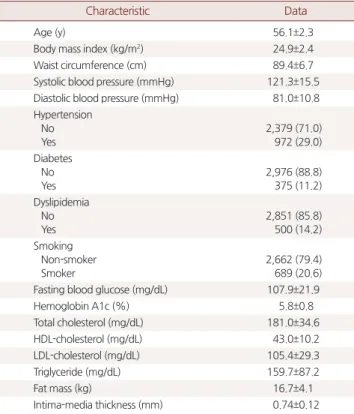
전체 대상자 3,351명의 평균 연령은 56.1±2.3세, 평균 BMI는 24.9±2.4 kg/m2, 평균 허리 둘레는 89.4±6.7 cm, 평균 수축기 혈압은 121.3±15.5 mmHg, 평균 이완기 혈압은 81.0±10.8 mmHg이었다. 전체 대상군의 과거 병력을 보면 고혈압이 972명(29.0%), 당뇨병이 375명
(11.2%), 이상지질혈증이 500명(14.2%), 흡연군이 689명(20.6%)이었다.
혈액 검사 결과 평균 FBG는 107.9±21.9 mg/dL, 평균 당화혈색소는 5.8%±0.8%, 평균 TC는 181.0±34.6 mg/dL, 평균 HDL은 43.0±10.2 mg/
dL, 평균 LDL은 105.4±29.3 mg/dL, 평균 TG는 159.7±87.2 mg/dL로 측 정되었다. 체성분 분석 결과 평균 FM은 16.7±4.1 kg이었고, 경동맥 초 음파를 통한 평균 IMT는 0.74±0.12 mm였다(Table 1).
2. 과거 병력 및 흡연에 따른 경동맥 내중막 두께의 차이
IMT는 고혈압(0.749±0.12 mm vs. 0.739±0.12 mm, P<0.05), 당뇨병 (0.754±0.12 mm vs. 0.740±0.12 mm, P<0.05)이 있는 경우 통계적으로 유의하게 더 두꺼웠다. 그러나 이상지질혈증 유무(0.744±0.11 mm vs.
0.741±0.12 mm, P=0.635), 흡연 여부(0.746±0.13 mm vs. 0.740±0.12 mm, P=0.276)에 따른 IMT의 차이는 없었다(Table 2).
3. 경동맥 내중막 두께와 각 변수들의 상관 관계
IMT는 연령(r=0.13, P<0.05), BMI (r=0.18, P<0.05), 허리 둘레(r=0.13, Table 1. Clinical characteristics of the study subjects (n=3,351)
Characteristic Data
Age (y) 56.1±2.3
Body mass index (kg/m2) 24.9±2.4
Waist circumference (cm) 89.4±6.7
Systolic blood pressure (mmHg) 121.3±15.5 Diastolic blood pressure (mmHg) 81.0±10.8 Hypertension
No Yes
2,379 (71.0) 972 (29.0) Diabetes
No Yes
2,976 (88.8) 375 (11.2) Dyslipidemia
No Yes
2,851 (85.8) 500 (14.2) Smoking
Non-smoker Smoker
2,662 (79.4) 689 (20.6) Fasting blood glucose (mg/dL) 107.9±21.9
Hemoglobin A1c (%) 5.8±0.8
Total cholesterol (mg/dL) 181.0±34.6
HDL-cholesterol (mg/dL) 43.0±10.2
LDL-cholesterol (mg/dL) 105.4±29.3
Triglyceride (mg/dL) 159.7±87.2
Fat mass (kg) 16.7±4.1
Intima-media thickness (mm) 0.74±0.12
Values are presented as mean±standard deviation or number (%).
HDL, high-density lipoprotein; LDL, low-density lipoprotein.
Table 2. Differences of IMT according to past medical history and smoking
Variable IMT (mm) P-value*
Hypertension No 0.739±0.12 <0.05
Yes 0.749±0.12
Diabetes No 0.740±0.12 <0.05
Yes 0.754±0.12
Dyslipidemia No 0.741±0.12 0.635
Yes 0.744±0.11
Smoking Non-smoker 0.740±0.12 0.276
Smoker 0.746±0.13
Values are presented as mean±standard deviation.
IMT, intima-media thickness.
*P-values were calculated by t-test.
Table 3. Matrix of univariate correlations between IMT and related factors
IMT Age BMI Waist SBP FBG TC HDL LDL TG† FM
IMT 1.0 0.13* 0.18* 0.13* 0.19* 0.08* 0.06* -0.07* 0.09* 0.06* 0.11*
Age 1.0 -0.02 0.02 0.03 0.06* -0.08* 0.01 -0.07* -0.06* -0.02
BMI 1.0 0.77* 0.27* 0.14* 0.02 -0.22* 0.03 0.28* 0.84*
Waist 1.0 0.25* 0.17* 0.005 -0.23* 0.005 0.29* 0.74*
SBP 1.0 0.11* 0.10* -0.03 0.07* 0.18* 0.24*
FBG 1.0 -0.04* -0.09* -0.07* 0.17* 0.15*
TC 1.0 0.24* 0.89* 0.33* 0.06*
HDL 1.0 0.08* -0.33* -0.23*
LDL 1.0 0.12* 0.06*
TG† 1.0 0.31*
FM 1.0
IMT, intima-media thickness; BMI, body mass index; SBP, systolic blood pressure; FBG, fasting blood glucose; TC, total cholesterol; HDL, high-density lipoprotein-cho- leterol; LDL, low-density lipoprotein-choleterol; TG, triglyceride; FM, fat mass.
*P<0.05, calculated by Pearson correlation analysis. †Log-transformed variable.
이민웅 외. 체지방량과 경동맥 내중막 두께와의 관계 Korean Journal of Family Practice
KJFP
P<0.05), 수축기 혈압(r=0.19, P<0.05), FBG (r=0.08, P<0.05), TC (r=0.06, P<0.05), LDL (r=0.09, P<0.05), TG (r=0.06, P<0.05), FM (r=0.11, P<0.05)과 통 계적으로 유의한 양의 상관 관계가 있었고, HDL (r=-0.07, P<0.05)과는 통계적으로 유의한 음의 상관 관계가 있었다. BMI (r=0.84, P<0.05)와 허 리 둘레(r=0.74, P<0.05)는 각각 FM과 높은 상관성을 보였다(Table 3).
4. 경동맥 내중막 두께 관련 인자의 다중회귀분석
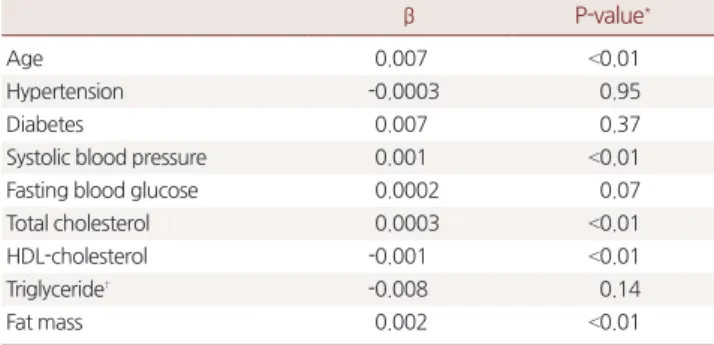
FM이 IMT에 영향을 주는 독립적인 인자인지를 알기 위해 다중 회귀분석을 시행하였다. Table 3에서 FM과 높은 상관성을 보인 BMI 와 허리 둘레를 제외하고, 연령, 고혈압, 당뇨 병력, 수축기 혈압, FBG, TC, HDL, TG을 보정한 뒤에도 FM은 IMT에 영향을 주는 독립 인자 로 나타났다(β=0.002, P<0.01)(Table 4).
고 찰
죽상경화증의 초기에는 동맥 내벽의 작은 변화만 나타나게 되며, 이런 초기 변화를 일찍 발견하여 예방함으로써 죽상경화증으로 인 한 이환율과 사망률을 감소시킬 수 있다.22,23) IMT는 고해상도 B- mode 초음파를 이용하여 측정할 수 있고, 이는 비침습적이고 정량 적인 계측법이다. 또한 반복적 측정하기 편하고 병변의 조기 관찰이 가능하기 때문에 죽상경화증의 조기진단 및 추적관찰에 유용하게
사용되고 있다.22,23)
비만은 유병률이 급격하게 증가하고 있으며 죽상경화증을 일으 킬 수 있는 여러 질환들과 관련이 있다.18) 복부 비만과 건강 위험도와 의 관련성은 수십 년 동안 연구되었고 상복부의 지방분포가 대사와 심혈관 질환에 악영향을 끼치는 원인이며, 복부 혹은 내장지방이 대 사증후군과 심혈관계 질환의 발생과 연관이 있다고 알려져 있다.24) 내장지방을 쉽고 정확하게 측정하기 위해 많은 방법들이 개발되었
으며 이 중에서 BIA는 임상에서 손쉽게 사용되고 있다.
본 연구 대상자들의 평균 IMT는 0.74±0.12 mm였으며, 이는 2003년 Cho 등25)이 연구한 IMT의 50대 평균치 0.72±0.21 mm보다 더 두꺼운 수치였다. FM 역시 2003년 Lee 등26)이 연구한 50대의 평균 FM인 15.67±4.3 kg보다 더 많은 16.7±4.1 kg이었다. 이는 다른 연구와 비교하 였을 때 본 연구에서는 경찰이라는 직업 특성 및 남성만으로 이루어 진 연구라는 차이점이 있어 다르게 나타난 것으로 생각된다.
과거 병력, 흡연에 따른 IMT 차이에 대해, 본 연구에서는 고혈압, 당뇨병 병력이 있는 군에서 없는 군에 비해 평균 IMT가 더 증가하였 고, 이상지질혈증이나 흡연 여부에 대해서는 차이가 없었으며, 이는 Kang 등20)의 연구와 같은 결과이다.
IMT는 일반적으로 연령, 고혈압, 당뇨병, 혈청 총 콜레스테롤, LDL 과 상관 관계가 있으며 HDL은 방어 인자로 알려져 있다. 국내에서는 Park 등27)의 연구에서 연령, 당뇨병, 당뇨병의 유병기간, TG과 HDL이 IMT에 영향을 준다고 보고하였으며, Ahn 등28)은 연령, 성별, 수축기 혈압, 혈청 총 콜레스테롤, HDL이 영향을 준다고 보고하였다. 본 연 구에서는 연령, BMI, 허리 둘레, 수축기 혈압, FBG, TC, LDL, TG, FM 이 IMT와 관련이 있었고, HDL은 음의 상관 관계가 있었다. 이러한 차이는 각 연구 간의 대상군들의 특성 차이와 연관이 있을 것으로 생각된다.
본 연구 결과 FM은 연령, 고혈압, 당뇨 병력, 수축기 혈압, FBG, TC, HDL, TG를 보정한 뒤에도 IMT에 영향을 끼치는 독립 인자였다. 이 는 연령만이 IMT를 결정짓는 독립 인자로 나타났던 Kang 등20)의 연 구와는 차이가 있었다.
결론적으로 본 연구는 50대 성인 남성에서 BIA를 통한 체성분 분 석기를 이용하여 측정한 FM과 IMT의 관계를 알아보고자 하였으며, FM은 다른 인자들을 보정한 후에도 IMT와 통계적으로 유의한 상 관성이 있었다. 체성분 분석기 사용의 증가와 편의성을 생각해봤을 때 이러한 결과는 FM의 임상적 유용성을 확인하였다는 의미가 있 으며, FM의 측정을 통하여 IMT의 증가 가능성을 예측하는 데 도움 이 될 수 있을 것으로 생각된다.
다만, 본 연구는 전향적 연구가 아닌 단면 연구로 관련 인자들과 IMT와의 인과관계를 명확하게 증명할 수 없는 한계가 있으며, 대상 자가 일개 병원에 내원한 50대 남성에 국한되어 관련된 인자들이 전 체 인구 집단을 대표하기엔 어려운 제한점이 있다. 향후 연령 및 성별 을 확대하여 다른 복부 비만 지표와의 우월성 비교 등의 추가적인 연구가 필요할 것으로 생각된다.
Table 4. Multiple regression analysis for intima-media thickness
β P-value*
Age 0.007 <0.01
Hypertension -0.0003 0.95
Diabetes 0.007 0.37
Systolic blood pressure 0.001 <0.01
Fasting blood glucose 0.0002 0.07
Total cholesterol 0.0003 <0.01
HDL-cholesterol -0.001 <0.01
Triglyceride† -0.008 0.14
Fat mass 0.002 <0.01
R2=0.062.
HDL, high-density lipoprotein.
*P-values were calculated by multiple regression analysis. †Log-transformed variable.
MinWoong Lee, et al. Relationship between Fat Mass and Carotid Intima-Media Thickness
Korean Journal of Family Practice
KJFP
요 약
연구배경:
경동맥 내중막 두께의 증가는 죽상경화증의 위험 인자로 초음파를 사용하여 비침습적으로 측정할 수 있다. 복부 비만은 죽 상경화증을 일으킬 수 있는 여러 질환들과 관련이 있으며 체지방량 은 복부 비만 지표로 사용되고 있다. 이에 본 연구는 50대 성인 남성 을 대상으로 체성분 분석기로 측정한 체지방량과 경동맥 내중막 두 께와의 관계를 조사하였다.방법:
2012년 11월부터 2015년 5월까지 경찰병원에 입원한 50대 성인 남성 3,351명을 대상으로 병력 청취, 신체계측, 혈액 검사, 체지방량 측정, 경동맥 내중막 두께 측정을 시행하였다. 고혈압, 당뇨병, 이상지 질혈증의 질환 유무 및 흡연에 따른 경동맥 내중막 두께의 차이는 t- test를, 경동맥 내중막 두께와 각 변수들의 상관성은 단변량 상관분 석을 이용하였다. 체지방량이 경동맥 내중막 두께에 미치는 독립적 인 영향을 확인하기 위해 다중회귀분석을 시행하였다.결과:
전체 대상자의 평균 체지방량은 16.7±4.1 kg, 평균 경동맥 내중 막 두께는 0.74±0.12 mm였다. 경동맥 내중막 두께는 고혈압, 당뇨병 이 있는 경우에 유의하게 더 두꺼웠다. 경동맥 내중막 두께는 연령, 체질량지수, 허리 둘레, 수축기 혈압, 공복혈당, 총 콜레스테롤, 저밀 도지단백 콜레스테롤, 중성지방, 체지방량과 양의 상관 관계가 있었 고, 고밀도지단백 콜레스테롤과 음의 상관 관계가 있었다. 연령, 고혈 압, 당뇨 병력, 수축기 혈압, 공복혈당, 총 콜레스테롤, 고밀도지단백 콜레스테롤, 중성지방을 보정한 뒤에도 체지방량은 경동맥 내중막 두께에 영향을 주는 독립 인자로 나타났다.결론:
체성분 분석기 사용의 증가와 편의성을 생각해봤을 때 이러 한 결과는 체지방량의 임상적 유용성을 확인하였다는 의미가 있으 며, 체지방량의 측정을 통하여 경동맥 내중막 두께의 증가 가능성 을 예측하는 데 도움이 될 수 있을 것으로 생각된다.중심단어:
경동맥 내중막 두께; 초음파; 체지방량; 생체전기 저항 분 석법; 체성분 분석기REFERENCES
1. Ferrières J, Elias A, Ruidavets JB, Cantet C, Bongard V, Fauvel J, et al. Carotid intima-media thickness and coronary heart disease risk factors in a low-risk population. J Hypertens 1999; 17: 743-8.
2. O’Leary DH, Polak JF, Kronmal RA, Savage PJ, Borhani NO, Kittner SJ, et al.
Thickening of the carotid wall. A marker for atherosclerosis in the elderly?
Cardiovascular Health Study Collaborative Research Group. Stroke 1996;
27: 224-31.
3. Park KR, Kim KY, Yoon SM, Bae JH, Seong IW. Correlation between intima-
media thickness in carotid artery and extent of coronary atherosclerosis.
Korean Circ J 2003; 33: 401-8.
4. O’Leary DH, Polak JF, Kronmal RA, Manolio TA, Burke GL, Wolfson SK Jr.
Carotid-artery intima and media thickness as a risk factor for myocardial infarction and stroke in older adults. Cardiovascular Health Study Collab- orative Research Group. N Engl J Med 1999; 340: 14-22.
5. Smith SC Jr, Greenland P, Grundy SM. AHA conference proceedings. Pre- vention conference V: beyond secondary prevention: identifying the high- risk patient for primary prevention: executive summary. American Heart Association. Circulation 2000; 101: 111-6.
6. Kieltyka L, Urbina EM, Tang R, Bond MG, Srinivasan SR, Berenson GS.
Framingham risk score is related to carotid artery intima-media thickness in both white and black young adults: the Bogalusa Heart Study. Atheroscle- rosis 2003; 170: 125-30.
7. Salonen JT, Salonen R. Ultrasound B-mode imaging in observational stud- ies of atherosclerotic progression. Circulation 1993; 87(3 Suppl): II56-65.
8. Grobbee DE, Bots ML. Carotid artery intima-media thickness as an indica- tor of generalized atherosclerosis. J Intern Med 1994; 236: 567-73.
9. St-Pierre J, Lemieux I, Vohl MC, Perron P, Tremblay G, Després JP, et al. Con- tribution of abdominal obesity and hypertriglyceridemia to impaired fast- ing glucose and coronary artery disease. Am J Cardiol 2002; 90: 15-8.
10. Després JP. Health consequences of visceral obesity. Ann Med 2001; 33: 534- 41.
11. Obesity: preventing and managing the global epidemic. Report of a WHO consultation. World Health Organ Tech Rep Ser 2000; 894: i-xii, 1-253.
12. The practical guide: identification, evaluation, and treatment of overweight and obesity in adults [Internet]. Bethesda: National Institute of Health;
c2000 [cited 2016 Feb 23]. Available from: http://www.nhlbi.nih.gov/files/
docs/guidelines/prctgd_c.pdf.
13. Kwon KY, Han JH. Clinical significance of visceral adipose tissue. J Korean Acad Fam Med 2007; 28: 739-47.
14. Kang JH, Kim KG, Kim KS, Kim DJ, Kim SM, Park YS, et al. 12 evaluation of body composition. In: Korean Society for the Study of Obesity, editor. Clini- cal obesity. 3rd ed. Seoul: Korea Medicine; 2008. p. 184-6.
15. Kim HS, Park HS. Reliability and validity of bioimpedance body composi- tion analyzer. J Korean Soc Stud Obes 2002; 11: 389-97.
16. Han SH, Lee SY, Kim KN, Yoo SM. Comparison between dual energy X-ray absorptiometry(DEXA) and bioelectrical impedance analysis(BIA) in mea- surement of lean body mass and fat mass in obese adults-based bland-alt- man plot analysis. Korean J Obes 2006; 15: 213-8.
17. Oh YA, Shim KW, Lee HS, Lee SW, Kim SA. Correlation between abdomi- nal fat measured by BIA and fat CT. Korean J Clin Geri 2006; 7: 225-37.
18. De Michele M, Panico S, Iannuzzi A, Celentano E, Ciardullo AV, Galasso R, et al. Association of obesity and central fat distribution with carotid artery wall thickening in middle-aged women. Stroke 2002; 33: 2923-8.
19. Lakka TA, Lakka HM, Salonen R, Kaplan GA, Salonen JT. Abdominal obe- sity is associated with accelerated progression of carotid atherosclerosis in men. Atherosclerosis 2001; 154: 497-504.
20. Kang SH, Kim KM, Cho DH, Kang HC, Chung DJ, Chung MY. Association of carotid atherosclerosis and obesity in type 2 diabetic patients. Korean J Med 2006; 70: 277-87.
21. Pignoli P, Tremoli E, Poli A, Oreste P, Paoletti R. Intimal plus medial thick- ness of the arterial wall: a direct measurement with ultrasound imaging.
이민웅 외. 체지방량과 경동맥 내중막 두께와의 관계 Korean Journal of Family Practice
KJFP
Circulation 1986; 74: 1399-406.
22. Wofford JL, Kahl FR, Howard GR, McKinney WM, Toole JF, Crouse JR 3rd.
Relation of extent of extracranial carotid artery atherosclerosis as measured by B-mode ultrasound to the extent of coronary atherosclerosis. Arterio- scler Thromb 1991; 11: 1786-94.
23. Salonen R, Haapanen A, Salonen JT. Measurement of intima-media thick- ness of common carotid arteries with high-resolution B-mode ultrasonog- raphy: inter- and intra-observer variability. Ultrasound Med Biol 1991; 17:
225-30.
24. Larsson B, Svärdsudd K, Welin L, Wilhelmsen L, Björntorp P, Tibblin G. Ab- dominal adipose tissue distribution, obesity, and risk of cardiovascular dis- ease and death: 13 year follow up of participants in the study of men born in 1913. Br Med J (Clin Res Ed) 1984; 288: 1401-4.
25. Cho YL, Kim DJ, Kim HD, Choi SH, Kim SK, Kim HJ, et al. Reference values
of carotid artery intima-media thickness and association with atheroscle- rotic risk factors in healthy subjects in Korea. Korean J Med 2003; 64: 275- 83.
26. Lee JH, Song CH, Yum KS, Kim KS, Nam SW, Han JY, et al. Age associated changes in body mass index and body fat distribution. J Korean Acad Fam Med 2003; 24: 1010-6.
27. Park TS, Rhee KH, Lim SH, Lee SH, Back HS, Chung GH. Relationships be- tween the intimal-medial thickness of carotid artery measured by high res- olution B-mode ultrasound imaging and the atherosclerotic risk factors in NIDDM patients. Diabetes Matab J 1996; 20: 145-52.
28. Ahn YB, Jung SL, Ko SH, Song KH, Son HS, Yoon KH, et al. Relationship be- tween intimal-medial thickness (IMT) of the carotid artery and atheroscle- rotic risk factors in patients with type 2 diabets mellitus. J Korean Diabetes Assoc 2001; 25: 142-51.