251
Keggin 형 H
3+xPW
12-xNb
xO
40(x=0, 1, 2, 3) 및 Wells-Dawson형 H
6+xP
2W
18-xNb
xO
62(x=0, 1, 2, 3) 헤테로폴리산 촉매를 이용한 n-Butanol로부터 Di-n-Butyl Ether의 제조
김정권·최정호·이종협·송인규†
서울대학교 공과대학 화학생물공학부 151-744 서울특별시 관악구 관악로 599 (2011년 9월 19일 접수, 2011년 10월 10일 채택)
Etherification of n-Butanol to Di-n-Butyl Ether over H
3+xPW
12-xNb
xO
40(x=0, 1, 2, 3) Keggin and H
6+xP
2W
18-xNb
xO
62(x=0, 1, 2, 3) Wells-Dawson Heteropolyacid Catalysts
Jeong Kwon Kim, Jung Ho Choi, Jongheop Yi and In Kyu Song†
School of Chemical and Biological Engineering, College of Engineering, Seoul National University, 599 Gwanak-ro, Gwanak-gu, Seoul 151-744, Korea
(Received 19 September 2011; accepted 10 October 2011)
요 약
Keggin형 H3+xPW12-xNbxO40(x=0, 1, 2, 3)및 Wells-Dawson형 H6+xP2W18-xNbxO62(x=0, 1, 2, 3) 헤테로폴리산 (Heteropolyacid) 촉매를 이용하여 n-Butanol의 에테르화(Etherification) 반응을 통한 Di-n-Butyl Ether의 제조를 수행하 였다. 먼저 Niobium이 서로 다른 비율로 치환된 Keggin형 및 Wells-Dawson형 헤테로폴리산 촉매를 제조하였다. FT- IR, ICP-AES 및 31P NMR 분석을 통하여 촉매가 잘 제조되었음을 확인하였다. NH3-TPD(Temperature-Programmed Desorption) 분석을 통해 헤테로폴리산 촉매의 산특성을 측정하였다. 두 계열의 촉매군에서 헤테로폴리산 촉매는 Niobium의 함량에 따라 다른 산특성을 나타내었다. 이후, 헤테로폴리산 촉매를 에테르화 반응에 적용하고 촉매의 반 응활성과 산특성 간의 상관관계를 분석하였다. Keggin형 H3+xPW12-xNbxO40 및 Wells-Dawson형 H6+xP2W18-xNbxO62 헤 테로폴리산 촉매의 Acidity는 Keggin형과 Wells-Dawson형 모두에서 Niobium의 치환량이 증가함에 따라 감소하였으 며, n-Butanol의 전환율과 Di-n-Butyl Ether로의 수율은 헤테로폴리산 촉매의 구조와 관계없이 Acidity가 증가함에 따 라 선형적으로 증가하였다. 이처럼 헤테로폴리산의 Acidity는 n-Butanol의 에테르화(Etherification) 반응을 통한 Di-n- Butyl Ether의 제조 반응에서 촉매 활성을 결정하는 중요한 요소로 작용하였다.
Abstract − Etherification of n-butanol to di-n-Butyl Ether was carried out over Keggin H3+xPW12-xNbxO40 (x=0, 1, 2, 3) and H6+xP2W18-xNbxO62 (x=0, 1, 2, 3) Wells-Dawson heteropolyacid catalysts. Niobium-substituted Keggin and Wells- Dawson heteropolyacid catalysts with different niobium content were prepared. Successful preparation of the catalysts was confirmed by FT-IR, ICP-AES, and 31P NMR analyses. Their acid properties were determined by NH3-TPD (Temperature- Programmed Desorption) measurements. Heteropolyacid catalysts showed different acid properties depending on niobium content in both series. The correlation between acid properties of heteropolyacid catalysts and catalytic activity was then established. Acidity of Keggin and Wells-Dawson heteropolyacid catalysts decreased with increasing niobium content, and conversion of n-butanol and yield for di-n-butyl ether increased with increasing acidity of the catalysts, regardless of the identity of heteropolyacid catalysts (without heteropolyacid structural sensitivity). Thus, acidity of heteropolyacid catalysts served as an important factor determining the catalytic performance in the etherification of n-butanol to di-n-Butyl Ether.
Key words: Etherification, Di-n-Butyl Ether, Heteropolyacid Catalyst, Niobium, Acidity 1. 서 론
디젤기관에서 적절한 연료첨가제의 첨가는 배출되는 NOx, CO 및 입자상 물질의 발생을 최소화하고 연료효율을 향상시키는 가장 효과
적인 방법이다[1-3]. 최근, 선형 에테르(Total Number of Atoms≥9) 가 연료첨가제로서 뛰어난 성능을 보이는 것으로 보고되었으며, 그 중에서도 바이오부탄올(Biobutanol)로부터 직접합성 가능한 Di-n- Butyl Ether는 뛰어난 옥탄가 및 세탄가 향상제로서 주목받고 있다 [4]. 하지만 대부분의 선형 에테르 제조에 대한 연구는 Dimethyl Ether와 Diethyl Ether에 집중되어 왔으며[5-7], Di-n-Butyl Ether 제 조에 대한 연구는 거의 이루어지지 않았다.
†To whom correspondence should be addressed.
E-mail: [email protected]
‡이 논문은 한국에너지기술연구원 조순행 박사님의 정년을 기념하여 투고되었습니다.
배위원소(Polyatom)의 비가 1:12인 Keggin형과 2:18인 Wells-Dawson 형의 헤테로폴리산이 촉매로서 뛰어난 활성을 보이는 것으로 알려져 있다.
본 연구에서는 헤테로폴리산 촉매의 구성원소를 조절함으로써 촉매 의 산 능력을 적절하게 변화시킬 수 있다는 점에 착안하여 Niobium이 서로 다른 비율로 치환된 Keggin형 H3+xPW12-xNbxO40(x=0, 1, 2, 3) 및 Wells-Dawson형 H6+xP2W18-xNbxO62(x=0, 1, 2, 3) 헤테로폴리산 촉매를 제조하고, n-Butanol로부터 Di-n-Butyl Ether 제조에 적용하 였다. NH3-TPD 분석을 통해 각각의 Keggin형 H3+xPW12-xNbxO40및 Wells-Dawson형 H6+xP2W18-xNbxO62헤테로폴리산 촉매의 산특성을 측정하였으며, 이로부터 촉매의 산특성과 반응활성 간의 상관관계를 살펴보았다.
2. 실 험 2-1. 헤테로폴리산 촉매제조
Niobium이 치환된 Keggin형 H3+xPW12-xNbxO40(x=0, 1, 2, 3)및 Wells-Dawson형 H6+xP2W18-xNbxO62(x=0, 1, 2, 3) 헤테로폴리산 촉 매는 기존에 있는 문헌[17-22]을 참고하여, Na2WO4·2H2O(Junsei Chem.), H3PO4(Samchun Chem.), Acetic Acid(Samchun Chem.), Hydrochloric Acid(Sigma-Aldrich), Oxalic Acid(Sigma-Aldrich), NbCl5 (Sigma-Aldrich), NaHSO4(Junsei Chem.), H2O2(Junsei Chem.), KCl (Junsei Chem.), NaOH(Samchun Chem.)을 이용하여 제조하였다.
제조된 Keggin형 H3+xPW12-xNbxO40 및 Wells-Dawson형 H6+xP2W18-x NbxO62 헤테로폴리산 촉매는 FT-IR(Nicolet, Nicolet 6700), ICP- AES(Shimadzu, ICPS-1000IV) 및 31P NMR(Bruker, AVANCE 600) 을 이용하여 분석하였으며, 기존에 보고된 결과와 비교하여 성공적 인 촉매제조를 확인하였다. 본 연구에서는 x=0, 1, 2, 3인 Keggin형 H3+xPW12-xNbxO40 헤테로폴리산 촉매는 K-Nb0, K-Nb1, K-Nb2, K- Nb3으로 표기하였으며, x=0, 1, 2, 3인 Wells-Dawson형 H6+xP2W18-x NbxO62 헤테로폴리산 촉매는 WD-Nb0, WD-Nb1, WD-Nb2, WD-Nb3 으로 표기하였다.
2-2. 헤테로폴리산 촉매의 산특성 분석
Keggin형 H3+xPW12-xNbxO40(x=0, 1, 2, 3)및 Wells-Dawson형 H6+xP2W18-xNbxO62(x=0, 1, 2, 3) 헤테로폴리산 촉매의 산특성을 측 정하고자 NH3-TPD(Temperature-Programmed Desorption) 분석을
P2W18-xNbxO62(x=0, 1, 2, 3) 헤테로폴리산 촉매를 이용하여 n- Butanol의 에테르화 반응을 수행하였다. n-Butanol의 에테르화 반응을 통한 Di-n-Butyl Ether의 제조는 Stainless Steel 재질로 제작된 Autoclave 반응기(200 ml)에서 수행하였다. n-Butanol 80 ml와 Toluene 20 ml(Solvent)을 반응기에 주입하고 헤테로폴리산 촉매 1 g을 도입하 였다. 산화반응 및 기타 부반응을 최소화하기 위해 질소가스로 몇 차 례 환기시켜 주어 반응기 내의 산소를 제거하였다. 이후 반응기의 내 부를 200oC까지 가열하고, 질소분위기(30 bar)에서 3시간 동안 반응 을 수행하였다. 반응 후 생성물은 Capillary Column(Agilent, DB- 5MS, 60 m×1.0 mm×0.320 mm)이 장착된 Gas Chromatograph (Younglin Corp., YL6100 GC-FID)을 이용하여 분석하였다. n- Butanol의 전환율과 Di-n-Butyl Ether 선택도 및 수율은 기존의 문헌 [23]을 참고하여 아래와 같이 계산하였다.
Conversion n-Butanol (%) = ×100
(1) Selectivity for Di-n-Butyl Ether (%)
= ×100 (2)
Yield for Di-n-Butyl Ether (%)
= (Conversion of n-Butanol)×(Selectivity for Di-n-Butyl Ether) (3)
3. 결과 및 고찰 3-1. Niobium이 치환된 헤테로폴리산 촉매
Keggin형 H3+xPW12-xNbxO40(x=0, 1, 2, 3) 및 Wells-Dawson형 H6+xP2W18-xNbxO62(x=0, 1, 2, 3) 헤테로폴리산 촉매들의 특징적인 헤테로폴리음이온 구조를 확인하기 위해 FT-IR 분석을 수행하였으 며 그 결과는 Fig. 1과 같다. 헤테로폴리산의 1차구조인 헤테로폴리 음이온은 중심원소(Heteroatom)과 배위원소(Polyatom) 및 격자산소 (Lattice Oxygen)로 구성되어 있으며 이들 간의 결합은 FT-IR 분석 상에 700-1200 cm−1의 영역에서4개의 주된 IR Band로 나타나는 것 으로 알려져 있다[24,25]. 예를 들면 Keggin형 K-Nb0촉매의 경우 1080 cm−1에서 Heteroatom-O 결합이, 982 cm−1에서 Polyatom=O 결 합이 나타나며, 893 cm−1에서 Polyatom-O-Polyatom(Corner-Sharing) 결합이, 812 cm−1에서 Polyatom-O-Polyatom(Edge-Sharing) 결합이 나타난다. 이 영역의 4개의 IR band는 나머지 Keggin형 K-Nb1, K-
Mole of n-Butanol Reacted Mole of n-Butanol in the Feed
2×Mole of Di-n-Butyl Ether Formed Mole of n-Butanol Reacted
3+x 12-x x 40 6+x 2 18-x x 62 253
Nb2, K-Nb3 촉매에서도 관찰되며, 이로부터 헤테로폴리음이온 구조 가 성공적으로 형성되었음을 알 수 있다. Wells-Dawson형 WD-Nb0 촉매도 마찬가지로 1090 cm−1에서 Heteroatom-O 결합이, 960 cm−1 에서 Polyatom=O 결합이 나타나며 916 cm−1에서 Polyatom-O-Polyatom (Corner-Sharing) 결합이, 781 cm−1에서 Polyatom-O-Polyatom (Edge-Sharing) 결합이 나타난다. 나머지 Wells-Dawson형 WD-Nb1, WD-Nb2, WD-Nb3 헤테로폴리산 촉매 역시 같은 영역에서 특정 피 크가 나타남을 확인하였으며, 이를 통해 헤테로폴리음이온 구조의 성공적인 형성을 확인하였다[26].
추가적으로 31P NMR 분석을 이용해 헤테로폴리산 촉매의 제조를 확인하였다[27]. Keggin형 K-Nb0, K-Nb1, K-Nb2, K-Nb3헤테로폴 리산 촉매의 경우 −14.9, −13.5, −11.9, −10.6 ppm에서 하나의 피크 만이 관찰되었으며, 이를 통해 고순도의 헤테로폴리산이 성공적으로 제조되었음을 확인하였다[20]. 피크의 위치는 Niobium의 치환량이 증가함에 따라 약 +1.4 ppm 정도의 화학적 이동(Chemical Shift)이
일어나는 것으로 관찰되었다. WD-Nb0헤테로폴리산 촉매의 경우
−12.6 ppm 위치에 하나의 주요 피크가 나타남을 확인할 수 있으며 기존의 문헌 값과 일치함을 확인할 수 있다[28]. WD-Nb1, WD-Nb2, WD-Nb3 헤테로폴리산 촉매의 경우, 각각의 촉매에서 높은 영역의 피크(−13.1, −13.6, −14.0 ppm)와 낮은 영역의 피크(−10.8, −9.2,
−7.6 ppm)가 나타남을 확인할 수 있다. 이는 Niobium의 치환으로 인 해 Wells-Dawson 헤테로폴리산 구조 내의 두 Phosphrous 원자의 대 칭성이 사라지기 때문이다. 제조된 Keggin형 H3+xPW12-xNbxO40 및 Wells-Dawson형 H6+xP2W18-x NbxO62 헤테로폴리산 촉매의 Phosphorous, Tungsten, Niobium의 화학적 조성비를 ICP-AES로 측 정하였으며 그 결과를 Table 1에 정리하였다. Phosphorous: Tungsten:
Niobium의 이론적인 조성비와 ICP-AES 분석을 통한 측정값이 잘 일치함을 통해 Niobium이 치환된 Keggin형 H3+xPW12-xNbxO40및 Wells-Dawson형 H6+xP2W18-xNbxO62헤테로폴리산 촉매가 성공적으 로 제조되었음을 확인하였다.
Fig. 1. FT-IR spectra of (a) H3+xPW12-xNbxO40 (x=0, 1, 2, 3) Keggin and (b) H6+xP2W18-xNbxO62 (x=0, 1, 2, 3) Wells-Dawson heteropolyacid cat- alysts.
Fig. 2.31P NMR spectra of (a) H3+xPW12-xNbxO40 (x=0, 1, 2, 3) Keggin and (b) H6+xP2W18-xNbxO62 (x=0, 1, 2, 3) Wells-Dawson heteropolyacid catalysts dissolved in D2O. The chemical shift was recorded using H3PO4 as an external reference.
3-2. Niobium이 치환된 헤테로폴리산 촉매의 산특성
Keggin형 H3+xPW12-xNbxO40(x=0, 1, 2, 3) 및 Wells-Dawson형 H6+xP2W18-xNbxO62(x=0, 1, 2, 3) 헤테로폴리산 촉매의 산특성은 NH3-TPD 분석을 통하여 측정하였다. 측정된 TPD Profile은 Fig. 3 에 나타나 있으며, Table 2에 Acidity 값을 요약하였다. 헤테로폴리 산 촉매의 Acidity는 Keggin형 H3+xPW12-xNbxO40 헤테로폴리산 촉 매의 경우, K-Nb3(136.1 µmol/g-cat.) < K-Nb2(163.4 µmol/g-cat.) <
K-Nb1(234.5 µmol/g-cat.) < K-Nb0(262.1 µmol/g-cat.)의 순서로 증
경향을 보인다. Keggin형 및 Wells-Dawson형 헤테로폴리산 모두에 서 Niobium의 함량이 감소함에 따라 Acidity가 증가하며, Keggin형 이 Wells-Dawson형보다 상대적으로 더 높은 Acidity를 나타내는 것 으로 관찰되었다.
3-3. n-Butanol로부터 Di-n-Butyl Ether 합성반응
n-Butanol을 통한 Di-n-Butyl Ether의 합성은 n-Butanol의 탈수화 반응에 의해 진행되며, 이를 Fig. 4에 나타내었다. n-Butanol의 탈수 화 반응은 분자간 탈수화 반응과 분자내 탈수화 반응이 평행반응으 로 일어나는 것으로 알려져 있다. Di-n-Butyl Ether의 합성은 헤테로 폴리산 촉매의 표면에 흡착된 n-Butanol 분자간 탈수반응 (Intermolecular Dehydration)에 의해 진행되며, 1-Butene으로의 전환은 합성은 촉매 내부에 흡착된 분자의 분자내 탈수 반응(Intramolecuar Dehydration)에 의해 진행되고, 이성화 반응에 의해 cis-2-Butene, trans-2-Butene 등이 생성되는 것으로 알려져 있다[29].
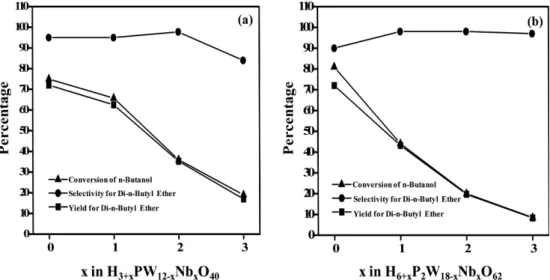
구조 및 조성이 상이한 Keggin형 H3+xPW12-xNbxO40(x=0, 1, 2, 3) 및 Wells-Dawson형 H6+xP2W18-xNbxO62(x=0, 1, 2, 3) 헤테로폴리산 촉매를 이용하여 Di-n-Butyl Ether를 합성하는 반응을 수행하였으며, 반응실험 결과를 Fig. 5에 나타내었다. n-Butanol의 전환율은 Niobium의 함량이 증가함에 따라 감소하는 경향을 보였으며, 이는 Kegging형 및 Wells-Dawson형 헤테로폴리산 촉매 모두에서 동일하 게 나타났다. Di-n-Butyl Ether로의 선택도는 모든 촉매에서 매우 높 은 것으로 나타났다.
3-4. 헤테로폴리산 촉매의 산특성과 반응활성간의 상관관계 3-2절과 3-3절의 밝힌 결과를 토대로 헤테로폴리산 촉매의 산특성과 Di-n-Butyl Ether의 수율의 관계에 대해서 살펴보았다. 헤테로폴리산 촉매의 Acidity와 반응 수율은 Niobium이 치환되지 않은 K-Nb0 헤 테로폴리산 촉매와 WD-Nb0 헤테로폴리산 촉매에서 가장 높게 나타 났으며, Niobium의 함량이 증가할수록 점차 감소하는 경향을 보였 다. Fig. 6은 헤테로폴리산 촉매의 Acidity와 Di-n-Butyl Ether의 수율 사이의 관계를 나타낸 것이다. Niobium이 치환된 Keggin형 H3+xPW12-x NbxO40(x=0, 1, 2, 3) 및 Wells-Dawson형 H6+xP2W18-xNbxO62(x=0, 1, 2, 3) 헤테로폴리산 촉매의 반응활성은 헤테로폴리산 구조에 관계없 이 Acidity가 증가할수록 증가함을 확인할 수 있다. 따라서 헤테로폴 리산 촉매의 Acidity는 Di-n-Butyl Ether의 수율을 결정하는 중요한 요소라 판단된다.
Fig. 3. NH3-TPD profiles of H3+xPW12-xNbxO40 (x=0, 1, 2, 3) Keggin and H6+xP2W18-xNbxO62 (x=0, 1, 2, 3) Wells-Dawson het- eropolyacid catalysts.
Table 2. Acidity of H3+xPW12-xNbxO40(x=0, 1, 2, 3) Keggin and H6+x P2W18-xNbxO62(x=0, 1, 2, 3) Wells-Dawson heteropolyacid catalysts
Catalyst Acidity(µmol-NH3/g-catalyst)
K-Nb0 262.1
K-Nb1 234.5
K-Nb2 163.4
K-Nb3 136.1
WD-Nb0 247.4
WD-Nb1 169.0
WD-Nb2 139.1
WD-Nb3 82.0
3+x 12-x x 40 6+x 2 18-x x 62 255
4. 결 론
본 연구에서는 Niobium이 치환된 Keggin형 H3+xPW12-xNbxO40 (x=0, 1, 2, 3) 및 Wells-Dawson형 H6+xP2W18-xNbxO62(x=0, 1, 2, 3) 헤테로폴리산 촉매를 n-Butanol로부터 Di-n-Butyl Ether의 합성반응 에 적용하여 보았다. 각각의 Keggin형 및 Wells-Dawson 헤테로폴리 산 촉매를 제조하고, FT-IR, 31P NMR 및 ICP-AES 분석을 통해 촉 매가 성공적으로 제조되었음을 확인하였다. NH3-TPD 분석을 통해 제조된 헤테로폴리산 촉매의 산특성을 측정하였으며, 촉매의 Niobium의 함량이 증가함에 따라 Acidity가 감소하는 것으로 나타났 다. 이를 에테르화 반응에 적용시킨 결과, 헤테로폴리산 촉매 구조와 관계없이 촉매의 Acidity가 증가함에 따라 Di-n-Butyl Ether의 수율 도 선형적으로 증가하는 것으로 나타났다.
감 사
본 연구는 환경부 “환경융합신기술 개발사업(202-101-009)”의 일
환으로 수행되었으며 이에 감사드립니다.
참고문헌
1. Tejero, J., Fité, C., Iborra, M., Izquierdo, J. F., Cunill, F. and Bringué, R., “Liquid-phase Dehydrocondensation of 1-Pentanol to Di-n-pentyl ether (DNPE) over Medium and Large Pore Acidic Zeolites,” Microporous Mesoporous Mater., 117(3), 650- 660(2009).
2. Patrini, R. and Marchinonna, M., US Patent 0159341 (2003).
3. Golibkov, A., WO Patent 01/018154(2001).
4. Alaoui, F. E. M., Montero, E. A., Bazile, J. -P., Aguilar, F. and Bonded, C., “Liquid Density of Biofuel Additives: 1-Butoxybu- tane at Pressures up to 140 MPa and from (293.15 to 393.15) K,” J. Chem. Eng. Data, 56(3), 595-600(2011).
5. Xu, M., Lunsford, J. H., Goodman, D. W. and Bhattacharyya, A., “Synthesis of Dimethyl Ether (DME) from Methanol over Solid-acid Catalysts,” Appl. Catal. A, 149(2), 289-301(1997).
6. Woodhouse, J. C., US Patent 2014408(1935).
7. Golay, G., Kiwi-Minsker, L., Doeppwe, A. and Renken, A.,
“Influence of the Catalyst Acid/base Properties on the Catalytic Ethanol Dehydration under Steady State and Dynamic Condi- tions. In situ Surface and Gas-phase Analysis,” Chem. Eng. Sci., 54(15-16), 3593-3598(1999).
8. Patrini, R. and Marchinonna, M., US Patent 6218583(2001).
9. Makarova, M. A., Paukshtis, E. A., Thomas, J. M., Williams, C.
and Azamaraev, K. I., “Dehydration of n-Butanol on Zeolite H- ZSM-5 and Amorphous Aluminosilicate: Detailed Mechanistic Study and the Effect of Pore Confinement,” J. Catal., 149(1), 36- 51(1994).
10. Makgoba, N. P., Sakuneka, T. M., Schalkwyk, C., Botha, M. and Nicolaides, C. P., “Silication of γ-alumina Catalyst during the Dehy- dration of Linear Primary Alcohols,” Appl. Catal. A, 297(2), 145-150 (2006).
11. Berteau, P., Checkiewicz, S. and Delmon, B., “Role of the Acid- base Properties of Aluminas, Modified γ-Alumina, and Silica- Alumina in 1-Butanol Dehydration,” Appl. Catal., 31(2), 361-383 (1987).
Fig. 5. Catalytic performance of (a) H3+xPW12-xNbxO40 (x=0, 1, 2, 3) Keggin and (b) H6+xP2W18-xNbxO62 (x=0, 1, 2, 3) Wells-Dawson heteropolyacid catalysts in the etherification of n-butanol.
Fig. 6. Correlation between acidity of H3+xPW12-xNbxO40 (x=0, 1, 2, 3) Keggin and H6+xP2W18-xNbxO62 (x=0, 1, 2, 3) Wells-Daw- son heteropolyacid catalysts and yield for di-n-butyl ether.
Heteropolyacid Supported on Silica: Isobutane Alkylation with C4 Olefins,” Appl. Catal. A, 217(1-2), 131-141(2001).
17. Pope, M. T., Heteropoly and Isopoly Oxometalates, Springer- Verlag, Berlin Heidelberg, New York, 15-32(1983).
18. Park, D. R., Song, S. H., Hong, U. G., Seo, J. G., Jung, J. C. and Song, I. K., “Redox Properties and Catalytic Oxidation Activi- ties of Polyatom-substituted HnPW11M1O40(M=V, Nb, Ta, and W) Keggin Heteropolyacid Catalysts,” Catal. Lett., 132(3-4), 363-369(2009).
19. Park, D. R., Choi, J. H., Park, S. Y. and Song, I. K., “ Reduction Potential, UV-visible Absorption Edge Energy, and Oxidation Catalysis of Niobium-contaning H3+xPW12-xNbxO40 Keggin and H6+xP2W18-xNbxO62 Wells-Dawson Heteropolyacid Catalysts,”
Appl. Catal. A, 394(1-2), 201-208(2011).
20. Okumura, K., Yamashita, K., Yamada, K. and Niwa, M., “Stud- ies on the Identification of the Heteropoly Acid Generated in the H3PO4-WO3-Nb2O5 Catalyst and its Thermal Transformation Process,” J. Catal., 245(1), 75-83(2007).
21. Massart, R., Contant, R., Fruchart, J.-M., Ciabrini, J.-P. and Fournier,
25. Comuzzi, C., Dolcetti, G., Trovarelli, A., Cavani, F., Trifirò, F., Llorca, J. and Finke, R. G., “The Solid-State Rearrangement of the Wells-Dawson K6P2W18O62·10H2O to a Stable Keggin-type Heteropolyanion Phase: A Catalyst for the Selective Oxidation of Isobutane to Isobutene,” Catal. Lett., 36(1-2), 75-79(1996).
26. Okuhara, T., Mizuno, N. and Misono, M., “Catalytic Chemistry of Heteropoly Compound,” Adv. Catal., 41, 113-252(1996).
27. Lee, K. Y., Arai, T., Nakata, S., Asaoka, S., Okuhara, T. and Mis- ono, M., “Catalysis by Heteropoly Compounds. 20. An NMR Study of Ethanol Dehydration in the Pseudoliquid Phase of 12- Tungstophosphoric Acid,” J. Am. Chem. Soc., 114(8), 2836-2842 (1992).
28. Himeno, S., Takamoto, M. and Ueda, T., “Formation of α- and β- Keggin-Type [PW12O40]3− Complexes,” Bull. Chem. Soc. Jpn., 78, 1463-1468(2005).
29. Okuhara, T., Kasai, A., Hayakawa, N., Misono, M. and Yoneda, Y., “The Important Role of The Bulk of 12-Tungustophosphoric Acid in the Catalytic Dehydration of Alcohol to Olefins,” Chem.
lett., 391-394(1981).