1. Introduction
Atmospheric corrosion which is one of the most com- mon corrosion processes has been reported to account for more failures in terms of cost and tonnage than any other type of material degradation process [1]. Vast majority of structures, machines and materials are placed at external environments, thus the adverse effect of atmosphere in terms of corrosion is inevitable.
Atmospheric corrosion constitutes a relatively compli- cated electrochemical process that consists of a metal and its corrosion products, an electrolyte and the more or less polluted atmosphere. Electrolyte’s composition mainly de- pends on the air pollutants, deposition rate together with changes in the weather as humidity, temperature, wind and rainfall [2,3].
Atmospheric exposure tests are developed to study the effect of atmospheric corrosion. Tests have been used since many decades ago with frequent developments and have been a great interest of corrosion research [1,2,4-6].
These studies normally involve metals and alloys ex- position to the action of several atmospheres in different geographical regions for a certain period of time [3].
Corrosivity readings as a result of atmospheric exposure tests have been reported for many regions of the world [1,3,6-17].
Other than measuring the corrosivity, atmospheric ex- posure tests have been conducted for more detail studies based on corrosion behaviour, modelling and prevention strategies of different metals, alloys, coatings and products under different atmospheric conditions [14-22].
Laboratory tests are usually carried out for a specific purpose. Their indications with respect to the service- ability of any material should be confirmed by field tests.
The results of atmospheric field exposure tests should al- ways be correlated with the prevailing atmospheric con- ditions at the test location. Measuring corrosivity readings of different atmospheres of a country is a paramount ne- cessity for future design and plan against corrosion.
Singapore is a small island in south East Asia with around 710 km2 area and more than 5 million population.
Being a developed and densely populated country, Singapore hosts lot of manufacturing industries. Although no doubt of Singapore also being “victimised” by corro- sion, no proper record on the severity of corrosion. With the possibility having different atmospheric conditions spread in the tiny area, no tangible evidence to justify the calamity of the effect. Therefore, to shed some lights to the problem, standardised atmospheric exposure tests
Effect of Tropical Atmosphere on Corrosion of Different Metals
Sudesh Wijesinghe†and Tan Zixi
Precision Measurements Group, Singapore Institute of Manufacturing Technology, No 71, Nanyang Drive, Singapore (Received September 13, 2017; Revised September 13, 2017; Accepted December 15, 2017)
Atmospheric corrosion is clearly the most noticeable of all corrosion processes. A tremendous amount of economic losses are caused by atmospheric corrosion. Thus, it is imperative to know the level of atmosphere’s aggressiveness or in other words “corrosivity”, before designing or planning any corrosion prevention strategy.
In Singapore, corrosivity values were not recorded earlier though the process of measurement and recording was prevalent in other countries. With an aim of filling this gap, three test sites were setup at three locations in Singapore to represent marine, industrial and urban atmospheres or their mixtures. Subsequently, corrosivity readings were measured and recorded according to ISO 9223:2012 for the first time in Singapore. Salient atmospheric constituents or parameters like time of wetness (TOW), Cl-, SO2, NO2, O3, and HNO3 were measured at all sites over a period of time to categorize corrosivity of particular atmosphere. The effect of the atmosphere on corrosion of steel, Cu, Al, and Zn has also been investigated and quantified. “Estimated”
and “determined” corrosivities were quantified and compared according to ISO 9223 standard. The study data along with final corrosivity measurements will be presented and discussed in the present work.
Keywords: atmospheric exposure, corrosivity, Singapore, atmospheric constituents
†Corresponding author: [email protected]
have been established in Singapore with mentorship of Swerea KIMAB, Sweden. Three sites have been setup un- der the first phase. The objective of this paper is to record the corrosivity measurement of Singapore for the first time and to discuss the results.
2. Experimental Procedure
Exposure racks were setup at three sites in Singapore to represent different atmospheric exposer conditions;
a. West of Singapore (Inside NTU campus, on Singapore Institute of Manufacturing Technology roof top) – NTU campus is designed with lot of trees in an eco-logically friendly atmosphere thus expected to be “urban”, however, the location is not too far from industrial zones b. Jurong Island of Singapore – Separate Island in the West side of Singapore re-served as an industrial zone with lot of chemical plants and other industries. Represent both industrial and marine atmospheres
c. St John’s Island – Separate Island around 20 to 30 minutes boat ride from the main island, located in the north of Singapore towards Indonesia. Mainly represent marine atmosphere
Racks together with standard samples were mounted in three locations according to ISO 8565. Standard metal samples; unalloyed carbon steel (Cu 0.03 to 0.1%, P <
0.07%), Zinc (≥ 98.5%), Copper (≥ 99.5%) and Aluminium (≥ 99.5%) were exposed to calculate the
“determined” corrosivity. Passive and diffusive samples were mounted to measure the pollutants including SO2, NO2, O3 and HNO3. The samples were withdrawn quarterly over a 12 months period and analysed volumetric technique (by Swedish Environmental Research Institute). Details of the technique are given else-where [23]. Airborne salinity was measured using the “wet candle” method and Cl- meas- urement was taken and recorded by selective ion electrode technique every month. Measurements for site “b” and “c”
were completed for one whole year period and site “a”
is under measurement (Cl- measurement for site “a” in
this discussion is based on the projected values upon 4 months readings).
Humidity, temperature and rain fall values were ob- tained to calculate the time of wetness (TOW). TOW which is the length of time (number of hours per year) when the relative humidity is greater than 80% at a tem- perature greater than 0 °C, was calculated for each site based on the relative humidity values and temperature records.
TOW values for each site was calculated and classified according to the ISO 9223. The SO2 and Cl- measurements were also classified accordingly. Final estimated corro- sivity values for each metal were calculated according to both versions of ISO 9223; using Dose-response functions according to ISO 9223:2012 and using the cumulative ta- ble according to ISO 9223:1992. Results were compared.
Mass loss and corrosion rates of the standard metal sam- ples were measured after one year exposure. Pickling and subsequent mass loss measurements together with corro- sion rate calculations were conducted according to the ISO 8407and ISO 9226. Final determined corrosivity catego- ries for each site were classified according to the ISO 9223 (note: method to calculate determined corrosivity and subsequent classification are same under both 1992 and 2012 versions of the ISO 9223).
3. Results and Discussion
3.1 Measured / Determined Corrosivity
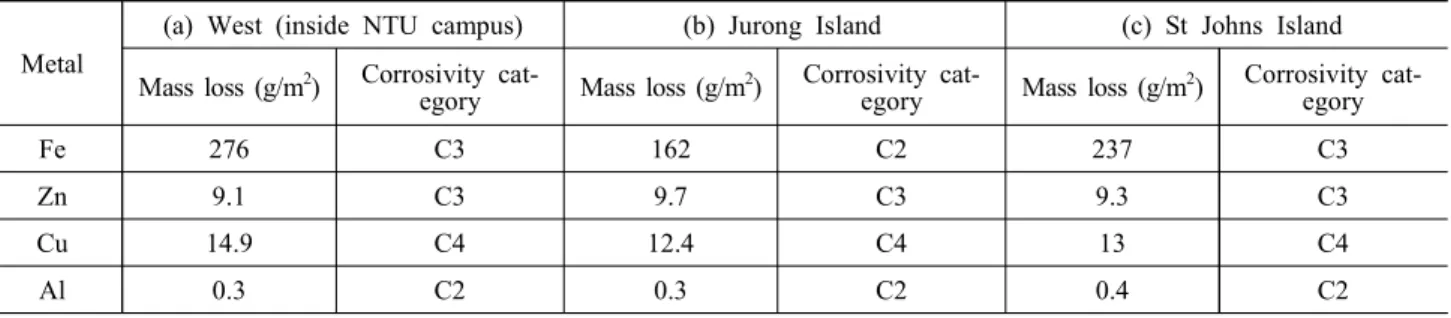
Table 1 presents the average mass loss values measured and calculated for all standard metal samples after com- pletion of one year exposure at three sites together with respective corrosivity categories according to ISO 9223.
Triplicates of each type of metal were used to conclude the values. Medium corrosivity (C3) values were recorded for Fe and Zn for all three sites with the exception of lower value than expected at site “b”. Higher time of wet- ness (TOW) values (which is given in the section 3.2) of sites “a” and “c” compared to that of site “b” could
Table 1 Average mass loss of Fe, Zn, Cu and Al after completion of one year exposure (measured and calculated from triplicate samples) and corrosivity classification (ISO 9223) for the three exposure sites
Metal
(a) West (inside NTU campus) (b) Jurong Island (c) St Johns Island Mass loss (g/m2) Corrosivity cat-
egory Mass loss (g/m2) Corrosivity cat-
egory Mass loss (g/m2) Corrosivity cat- egory
Fe 276 C3 162 C2 237 C3
Zn 9.1 C3 9.7 C3 9.3 C3
Cu 14.9 C4 12.4 C4 13 C4
Al 0.3 C2 0.3 C2 0.4 C2
be the reason for higher corrosion rates of Fe and Zn of sites “a” and “c”. Copper does not seems to be behaving well in Singapore in terms of corrosion resistance as all three sites show higher corrosivities (C4). Aluminium be- haves relatively better than others having lower corrosiv- ities for all three sites.
3.2 Estimated Corrosivity
As shown in the Table 2 all three sites have higher TOW values. Despite the similar TOW categories, site
“b” shows lower TOW value compared to other two sites.
Table 3 elaborates the Cl- deposition rate (annual aver- age) measurements calculated according to the ISO 9223 together with subsequent categories.
Surprisingly the salinity values recorded in all three sites including the site “c” (St John’s Island represents marine atmosphere) are belonged to low category accord- ing to the ISO 9223. Different wind conditions and higher rain fall could have some influence on the result. This indicates that Singapore salinity readings are not that se- vere throughout the current sites.
Classification of pollution by SO2 deposition rates and subsequent categories are given in the Table 4.
Site “b” shows higher SO2 content than other two sites though all three belongs to the same category according to ISO 9223. Jurong Island (site “b”) being an industrial zone may “inherited” for higher pollution than other two sites.
Final corrosivity values, both estimated and determined, are given in the Table 5. Estimated corrosivity is calcu- lated according to both versions of ISO 9223 (1992 and 2012 versions) for comparison.
Noting some differences of two types of estimated cor- rosivity values based on two ISO 9223 versions, there are also some differences between estimated and de- ter-mined corrosivity values though the majority remains similar.
Few of the higher estimated corrosivity values of metals compared to respective determined corrosivities may due to the higher rain fall in Singapore (rain fall for 12 months period of exposure varied between 2000 ml and 2500 ml) which could “wash off” pollutants from the metal surfaces.
This may give an indication of vulnerability of “sheltered”
structures in Singapore. Out of determined corrosivities, the most surprising remark is the comparable corrosivity Table 2 Time of wetness (TOW) values and classification according to ISO 9223. Scale of the category varies from t1 (lowest) to t5 (highest)
Site TOW (h/a) Category
(a) West (inside NTU campus) 4962 t
4
(b) Jurong Island 4090 t
4
(c) St John’s Island 4964 t
4
Table 3 Chloride deposition values (as an annual average) for three sites and subsequent categories according to the ISO 9223.
Scale of the category varies from S0 (lowest) to S3 (highest)
Site Chloride Deposition
(mg Cl-/m2.d) Category
(a) West (inside NTU campus) 19.57 S1
(b) Jurong Island 9.00 S1
(c) St John’s Island 26.78 S1
Table 4 SO2 concentration rate values (annual average) for three sites and subsequent categories according to the ISO 9223.
Scale of the category varies from P0 (lowest) to P3 (highest)
Site SO2 deposition
(µg/m3) Category
(a) West (inside NTU campus) 22.3 P1
(b) Jurong Island 33.1 P1 (closer to P2)
(c) St John’s Island 16.9 P1
readings recorded at site “a” to those of other two sites.
Site “a” at a glance having the “greenest” atmosphere, was expected to have lower corrosivity values than re- corded, specially compared to other two sites. However, other than the higher TOW value recorded, the results might have influenced by having the Jurong Island and other industrial zones located at somewhat nearby loca- tions considering the effect of the wind. (Note: the rack with the samples was located on a roof top where some factories can be seen).
To calculate the final estimated corrosivity values, Dose-responsive functions are used according to the ISO 9223:2012 version in contrast to the previous version (ISO 9223:1992) which is based on TOW, Cl- and SO2 catego- ries (e.g. Tables 2 to 4). The ISO 9223:2012 uses exact values of environmental and pollutant data without much approximation thus can expect better reliability of final results. However, there are some limitations for the Dose-responsive approach, as an example relative humid- ity (RH) interval should be between 34% and 93%, where in Singapore 8% to 10% of the time RH can be ≥ 93%
according to this study. This may imply some risk of the accuracy of the final results.
4. Conclusions
Standardised atmospheric exposure tests have been es- tablished in Singapore. Three exposure sites were setup and corrosivity values were calculated and recorded for first time. Both estimated and determined corrosivity read- ings for Fe, Zn, Al and Cu have been compared. Although majority of corrosivity readings remain similar, there are some notable differences and unexpected observations.
Results and readings will be important for Singapore’s future corrosion prevention plans and initiatives.
Acknowledgments
Our sincere gratitude to Dr Vladimir Kucera for mentor- ing us to establish atmospheric exposure tests in Singapore.
Also wish to thank Ms Lena Sjögren, Dr Johan Tidblad and the team from Swerea KIMAB. Gratitude also extends to Singapore Institute of Manufacturing Technology for approval and financial support for the project.
References
1. M. O. G. Portella, K. F. Portella, P. A. M. Pereira, P.
C. Inone, K. J. C. Brambilla, M. S. Cabussu, D. P.
Cerqueira, and R. N. Salles, Procedia Engineer., 42, 171 (2012).
2. J. Tidblad, Atmos. Environ., 55, 1 (2012).
3. J. Morales, S. Martı´n-Krijer, F. Dı´az, J. Herna´ndez-Borges, and S. Gonza´lez, Corros. Sci., 47, 2005 (2005).
4. H. S. Rawdon, J. Franklin Inst., 223, 655 (1937).
5. P. R. Roberge, R. D. Klassen, and P. W. Haberecht, Mater.
Design, 23, 321 (2002).
6. M. Morcillo, S. Flores, G. Salas, and M. Valencia, Atmos.
Environ., 27A, 1959 (1993).
7. J. Morales, F. Dı’az, J. Herna’ndez-Borges, S. Gonza’lez, and V. Cano, Corros. Sci., 49, 526 (2007).
8. J. R. Vilche, F. E. Varela, G. Acufia, E. N. Codaro, B.
M. Rosales, A. Fernandez, and G. Moriena, Corros. Sci., 37, 941 (1995).
9. F. Mansfeld and R. Vijayakumar, Corros. Sci., 28, 939 (1988).
10. J. G. Castaño, C. A. Botero, A. H. Restrepo, E. A. Agudelo, E. Correa, and F. Echeverría, Corros. Sci., 52, 216 (2010).
11. T. T. N. Lan, N. T. P. Thoa, R. Nishimura, Y. Tsujino, M. Yokoi, and Y. Maeda, Corros. Sci., 48, 179 (2006).
12. M. Morcilo, Bele’n Chico, D. de la Fuente, E. Almeida, G. Joseph, S. Rivero, and B. Rosales, Cold Reg. Sci.
Technol., 40, 165 (2004).
13. F. Corvo, C. Haces, N. Betancourt, L. Maldonadoj, L.
Velevaj, M. Echeverria, O. T. De Rincont and A. Rincons, Table 5 Estimated and determined corrosively values of three sites of Singapore according to the ISO 9223. Estimated values are calculated according to both ISO 9223 versions (ISO 9223:1992 and ISO 9223:2012)
Metal (a) West (NTU campus) (b) Jurong Island (c) St. John Island
Estimated (according to two ISO 9223 versions)
Determined
Estimated (according to two ISO
9223 versions)
Determined
Estimated (according to two ISO
9223 versions)
Determined
1992 2012 1992 2012 1992 2012
Fe C3 C3 C3 C3/C4 C3 C2 C3 C3 C3
Zn C3 C3 C3 C3/C4 C3 C3 C3 C4 C3
Cu C3 C4 C4 C3/C4 C4 C4 C3 C4 C4
Al C3 C3 C2 C3/C4 C3 C2 C3 C4 C2
Corros. Sci., 39, 823 (1997).
14. D. Persson, D. Thierry, and N. LeBozec, Corros. Sci., 53, 720 (2011).
15. A. R. Mendoza, F. Corvo, A Gómez, and J. Gómez, Corros. Sci., 46, 1189 (2004).
16. Y. Ma, Y. Li, and F. Wang, Corros. Sci., 52, 1796 (2010).
17. F. Corvo, T. Pe´rez, Y. Martin, J. Reyes, L. R. Dzib, J.
Gonza´lez-Sa´nchez, and A. Castaneda, Corros. Sci., 50, 206 (2008).
18. P. Qiu, C. Leygraf, and I. O. Wallinder, Mater. Chem.
Phys., 133, 419 (2012).
29. J. A. Gonza´lez, M. Morcillo, E. Escudero, V. Lo´pez, and E. Otero, Surf. Coat. Technol., 153, 225 (2002).
20. E. Escudero, V. López, E. Otero, M. J. Bartolomé, and J. A. González, Surf. Coat. Technol., 201, 7303 (2007).
21. Ma. J. Bartolomé, J. F. del Río, E. Escudero, S. Feliu Jr., V. López , E. Otero, and J. A. González, Surf. Coat.
Technol., 202, 2783 (2008).
22. D. Persson, D. Thierry, N. LeBozec, and T. Prosek, Corros.
Sci., 72, 54 (2013).
23. M. Ferm and P.-A. Svanberg, Atmos. Environ., 32, 1377 (1998).