Extract-Based Disinfectant
Jaehong Han*, Yong-Ung Kim, Ki-Yeon Kim and Young Tae Hahm
Metalloenzyme Research Group, BET Research Institute and Department of Biotechnology, Chung-Ang University, Anseong, 456-789, Korea
Received May 8, 2006; Accepted August 22, 2006
Bactericidal activity of grapefruit seed extract (GSE)-based disinfectant, as a safe disinfectant, was measured against five bacteria by Korean Food & Drug Administration (KFDA) dilution-neutralization method. GSE-based disinfectant showed a 99.9999% bactericidal activity against Escherichia coli ATCC 10536, Salmonella typhi ATCC 29629, Staphylococcus aureus ATCC 6538, Bacillus cereus ATCC 11778, and Listeria monocytogenes ATCC 1911 at the concentration of 2.15% GSE. It showed better bactericidal activity against Gram-negative bacteria of E. coli ATCC 10536 and S. typhi ATCC 29629 at lower concentration of GSE (0.43%). Based on the results, it was suggested that a possible bactericidal mechanism of GSE active ingredients was due to the abrupt osmotic shift during the bactericidal activity test by KFDA method.
Key words: Grapefruit seed extract, Bactericidal, Disinfectant, Osmotic shift, KFDA Disinfectants are the products used in food industry for
sanitary purpose. Due to the recent growing safety concerns, the importance of non-toxic disinfectants and their development cannot be overemphasized in food industry. Registration of disinfectants for food-contacting surfaces and food processing equipments is regulated by Korean Food & Drug Administration (KFDA) in Korea.1) It requires a food industry disinfectant to show 99.999% bactericidal activity for Escherichia coli ATCC 10536 and Staphylococcus aureus ATCC 6538 to be registered. Majority of disinfectants in market contain one of the active ingredients, such as ethanol, organochlorines, peracids, quaternary ammonium ions and hypochloric acid.
These chemicals are known to have adverse effects to human and environments.
As a non-toxic natural disinfectants, grapefruit seed extract (GSE) has been used for various applications, including retardation of Kimchi fermentation,2,3) antioxidant effect on vegetable oils,4) and antimicrobial packaging paper5). Processed GSE can also be used for medical applications without toxic effect at a low concentration while maintaining bactericidal activity.6,7) Although general bactericidal activity of GSE has been reported, extensive examination of GSE-based disinfectant’s bactericidal activity by KFDA method has never been published before. Here we report bactericidal activity of GSE- based disinfectant against five food pathogenic bacteria of E.
coli ATCC 10536, Salmonella typhi ATCC 29629, S. aureus ATCC 6538, Bacillus cereus ATCC 11778, and Listeria monocytogenes ATCC 1911 by adopting KFDA’s dilution- neutralization method. GSE is known to contain many
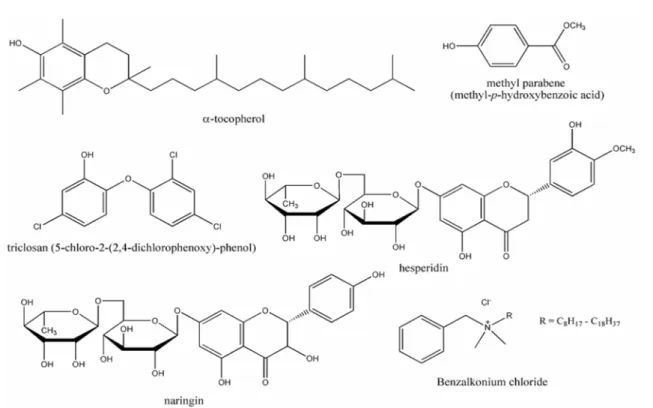
biologically active ingredients such as tocopherols, naringin and hesperidin.8) (Fig. 1) Possible mechanism of bactericidal activity by GSE-based disinfectant will also be discussed.
Materials and Methods
GSE-based disinfectant was prepared with GSE (4.3%), ethanol (25.7%), citrate (8.5%) and NaCl (1.5%) in water (60%). To test bactericidal activity of the disinfectant at different concentrations, 10%, 30% and 50% (v/v) of disinfectants were prepared by dilution with sterilized water.
Tryptone soya agar (TSA) media were prepared from the sterilized solution of tryptone, pancreatic digest of casein (15.0 g), soya peptone, papaic digest of soybean meal (5.0 g), NaCl (5.0 g) and agar (15.0 g) in 1000 ml of water after adjustment to pH 7.2 ± 0.2 at 20 ± 1oC. Water used in the experiment was obtained from sterilization of distilled water.
Heavy water solution was prepared by membrane (pore size
<0.45 µm) filtration of a mixture of solution A (6.0 ml) and solution B (8.0 ml) in 1.0l volumetric flask. Solution A is a 1.0l water solution of anhydrous MgCl2 (19.84 g) and anhydrous CaCl2 (46.24 g). Solution B is a 1.0l water solution of NaHCO3 (35.02 g). To prepare neutralizer solution, potassium phosphate dibasic (34.0 g) was dissolved in 500 ml of water and pH 7.2 ± 0.2 was obtained by 1.0 N NaOH at 20 ± 1oC. Final volume of the solution was adjusted to 1000 ml by adding water. BSA (Cohn fraction V for Dubos medium) solutions of 0.3% and 3% were used as interference substances for clean and dirty conditions, respectively.
Dilution solution (tryptone sodium chloride solution) was prepared by sterilized tryptone, pancreatic digest of casein (1.0 g) and NaCl (8.5 g) solution (1000 ml) at pH 7.2 ± 0.2.
*Corresponding author
Phone: 82-31-670-4830; Fax: 82-31-670-4830 E-mail: [email protected]
Strains and bacterial suspension.
E. coli ATCC 10536, Sal. typhi ATCC 29629, S. aureus ATCC 6538, B, cereus ATCC 11778, and L. monocytogenes ATCC 1911 were obtained from KCTC (Korean Collection for Type Cultures) and KCCM (Korea Culture Center of Microorganisms). To prepare bacterial suspension, each culture from the third generation of bacterial strains in TSA media was inoculated into 100 ml Erlenmeyer flask containing dilution solution (10 ml) and glass beads (5 g). After 3 minute-shaking, bacterial suspension (N
) was adjust to 1.5×10⁸-5×10⁸ cfu/ml in test tube and incubated for 2 hours at 20 ± 1oC. To perform a viable count of the each bacterial suspension, pour-plate method was used.9) The viable count of the bacterial cell suspensions was 6×10²-3×10³ cfu/ml after 10−6-10−7 dilution.Dilution-neutralization method
10).
The experiment was repeated thrice and applied to clean and dirty conditions for comparison. All reagents, media and strains were maintained at 20 ± 1oC before the test. To a solution of interference substance (1.0 ml), bacterial suspension (1.0 ml) was added in sterilized test tube at 20 ± 1oC. After 2 minutes, GSE solution (8.0 ml) was added and treated for 5 minute ± 10 seconds. For neutralization step, 1.0 ml of the reaction mixture was taken and added into the test tube containing the neutralizer (8.0 ml) and water (1.0 ml) for 5 minute ± 10 seconds. For pour-plate counting, two of 1.0 ml of the neutralized solutions were inoculated on each TSA medium at 45 ± 1oC and the plates were cooled down. Upon them, Additional 3-5 ml of TSA media were overlaid to prevent colony formation by diffusion.The plates were incubated for 24 hours at 36 ± 1oC. The maximum colony number (
V
c) was counted from the plates to calculated viable counts in the reaction mixture (cfu/ml,N
a).Validation of dilution-neutralization method.
Validation of the test method includes test condition validation, neutralizer toxicity test and dilution-neutralization method validation. For test condition validation, heavy water was used instead of the disinfectant and viable count (A
) was carried out without neutralization step. For neutralizer toxicity test, bacterial suspension (1.0 ml) was added to the mixture of neutralizer (8.0 ml) and water (1.0 ml). After 5 minute ± 10 seconds, viable count (B
) was carried out by taking two of 1.0 ml of the solution to perform pour-plate method. For dilution- neutralization method validation, interference substance (1.0 ml), dilution solution (1.0 ml) and the GSE-based disinfectant (8.0 ml) were incubated for 5 minute ± 10 seconds at 20 ± 1oC.After neutralization step, 1.0 ml of bacterial suspension was added and incubated for 30 minute ± 10 seconds. Viable count (C) was carried out by taking two of 1.0 ml of the solution to perform pour-plate method.
Calculations
Viable count for bacterial suspension (
N
) is obtained from the equation ofN
(cfu/ml) =c/(2.2×10−6), where c is sum of colony numbers on the plates. Viable counts for dilution- neutralization method (N
a) and its validations (N
v,A
,B
,C
) are obtained by the equation of (cfu/ml) = c (2×d).Significant data satisfy following criteria;
A
andB
(>0.05N
v),C
(>0.5B
),N
(1.5×10⁸ cfu/ml-5×108 cfu/ml),N
a andN
v (6×10² cfu/ml-3×103 cfu/ml). Reduction of viable count (R) is expressed asR
= 0.1N
/N
a and bactericidal activity (%) is expressed by the equation of 100 (N
–N
a)/N
.Fig. 1. Chemical structures of the bioactive compounds found in commercial grapefruit seed extract.
Jaeho ng H an et al.
Bacterial strains Nv A B C N 50 30 10
Na R % Na R % Na R %
Escherichia coli
ATCC 10536 2.9×10³ 1.9×10² 1.5×10² 1.3×10² 3.1×10⁸ <1.5×10² >105 >99.9999 <1.5×10² >105 >99.9999 <1.5×10² >105 >99.9999 Salmonella typhi
ATCC 29629 2.2×10³ 1.1×10² 1.1×10² 1.9×10² 2.8×10⁸ <1.5×10² >105 >99.9999 <1.5×10² >105 >99.9999 <1.5×10² >105 >99.9999 Staphylococcusaureus
ATCC 6538 3.0×10³ 1.5×10² 1.8×10² 1.6×10² 3.1×10⁸ <1.5×10² >105 >99.9999 4.5×10³ 7.6×10³ 99.9985 >3×10³ <105 NA Bacillus cereus
ATCC 11778 1.1×10³ 5.5×10 5.8×10 7.8×10 1.4×10⁸ <1.5×10² >105 >99.9999 <1.5×10² >105 >99.9999 7.4×10³ 1.9× 10³ 99.9947 Listeria monocytogenes
ATCC 1911 2.7×10³ 1.9×10² 2.1×10² 1.8×10² 3.3×10⁸ <1.5×10² >105 >99.9999 <1.5×10² >105 >99.9999 1.1×10³ 3.0 × 10⁴ 99.9997
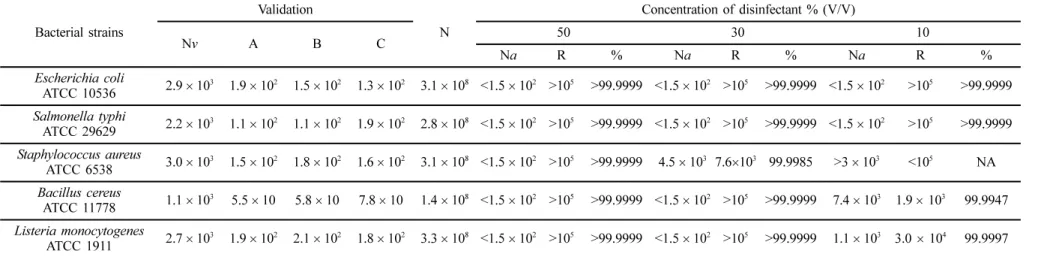
N; Number of the viable cells in bacterial suspension, Nv; Number of the viable cells in diluted bacterial suspension, A; Number of the viable cells for verification of experimental conditions, B; Number of the viable cells for verification of the toxicity of neutralizer, C; Number of the viable cells for verification of dilution-neutralization, Na; Number of the viable cells after GSE treatment, R; Reduction of viable count, %; bactericidal activity.
Table 2. Bactericidal effects of GSE-based disinfectant under dirty conditions
Bacterial strains Validation
N Concentration of disinfectant % (V/V)
Nv A B C 50 30 10
Na R % Na R % Na R %
Escherichia coli
ATCC 10536 2.9×10³ 1.8×10² 1.53×10² 1.6×10² 3.1×10⁸ <1.5×10² >105 >99.9999 <1.5×10² >105 >99.9999 <1.5×10² >105 >99.9999 Salmonella typhi
ATCC 29629 2.2×10³ 2.1×10² 1.1×10² 1.9×10² 2. 8×10⁸ <1.5×10² >105 >99.9999 <1.5×10² >105 >99.9999 <1.5×10² >105 >99.9999 Staphylococcusaureus
ATCC 6538 3.0×10³ 1.5×10² 1.8×10² 1.9×10² 3.1×10⁸ <1.5×10² >105 >99.9999 4.4×10³ 7.0×10³ 99.9986 >3×10³ <105 NA Bacillus cereus
ATCC 11778 1.1×10³ 5.9×10 5.8×10 8.6×10 1.4×10⁸ <1.5×10² >105 >99.9999 <1.5×10² >105 >99.9999 2.9×10³ 4.8×10³ 99.9979 Listeria monocytogenes
ATCC 1911 2.7×10³ 1.9×10² 2.1×10² 2.1×10² 3.3×10⁸ <1.5×10² >105 >99.9999 <1.5×10² >105 >99.9999 5.6×10² 6.0×10⁴ 99.9983
N; Number of the viable cells in bacterial suspension, Nv; Number of the viable cells in diluted bacterial suspension, A; Number of the viable cells for verification of experimental conditions, B; Number of the viable cells for verification of the toxicity of neutralizer, C; Number of the viable cells for verification of dilution-neutralization, Na; Number of the viable cells after GSE treatment, R; Reduction of viable count, %; bactericidal activity.
Results and Discussion
Bactericidal activity of GSE-based disinfectant.
Bactericidal activity of GSE-based disinfectant under clean condition and dirty condition are presented in Table 1 and Table 2, respectively.GSE-based disinfectant showed a good bactericidal activity against five bacteria under both conditions and no significant differences of bactericidal activity were measured in the presence of interference substances. On the contrary, difference in bactericidal activity between Gram-negative and Gram- positive bacteria was observed. Gram-negative bacteria of E.
coli ATCC 10536 and Sal. typhi ATCC 29629 were more sensitive, while Gram-positive bacteria of S. aureus ATCC 6538,B, cereus ATCC 11778, and L. monocytogenes ATCC 1911 were relatively less sensitive to the disinfectant. Overall GSE-based disinfectant was still effectively bactericidal up to 10% concentration and showed more than 99.9999% of bactericidal activity at 50% concentration. Therefore, GSE- based disinfectant satisfies the registration requirement by KFDA at 50% concentration.
Bactericidal mechanism by GSE.
Although GSE has been claimed to possess antibacterial, antiviral, and anti-fungal properties as an alternative medicine, there are limited literatures on its biological activity. When antimicrobial activities of 33% of GSE-ethanolic extract on 20 bacteria and 10 yeast strains were studied by agar diffusion method,8) GSE showed bactericidal activity on Gram-positive bacteria and yeasts. But it didn’t show any inhibitory effects on the Gram- negative bacteria. The authors suggested that it was because ethanolic extract of GSE had less amounts of flavonoids which were responsible for bactericidal activity. Different bactericidal activities between Gram-negative and Gram- positive bacteria were reported.6) Gram-positive bacteria were more susceptible against commercial 33% GSE glycerol extract. Naringin and hesperidin in GSE were known to be more effective against Gram-positive bacteria.11)On the contrary, others claimed that the bactericidal activity of GSE was rather due to the commercial preservative substances such as benzalkonium chloride, triclosan and methyl parabene (Fig. 1) introduced during the GSE production.12,13,14) It seems to be reasonable based on the fact that these preservative substances are very effective bactericides. Gram-positive bacteria are more susceptible to benzalkonium chloride,15) while no Gram-selectivity has been reported for triclosan and methyl parabene.16)
Regardless, based on our experimental results, Gram- negative bacteria were more susceptible to GSE-based disinfectant. Different susceptibility between Gram-negative and Gram-positive bacteria may be due to the different test conditions, because GSE-based disinfectant contained no other bioactive compounds. KFDA’s dilution-neutralization method is a solution-based assay while the other reported methods adopted agar diffusion test. During the test, 8.0 ml of disinfectant are introduced to the bacterial suspension (1.0 ml), which may result in an abrupt osmotic shift to bacteria.
Recently it was reported that a sudden osmotic shift would extent lag phase duration of Gram-negative foodborne bacteria.17) Thus, it appears that bactericidal activity of GSE- based disinfectant is at least partly influenced by test method.
Acknowledgments
This work was supported by Industry, Academy, and Research Consortium Project of Korea Small and Medium Business Administration in 2005.
References
1. Korean Food & Drug Administration Notice 2005-75.
2. Park, W.-P. and Chang, D.-K. (2003) Kimchi quality affected by the addition of grapefruit seed extract powder.
Kor. J. Food Pres.10, 288-292.
3. Kim, H.-S., Jung, S.-K., Cho, S.-H., Ku, J.-G. and Lee, S.- C. (2003) Preparation and effect of eudragit E100 micro- capsules containing grapefruit seed extract on Kimchi. J.
Kor. Soc. Food Sci. Nutr.32, 1239-1244.
4. Armando, C., Maythe, S. and Beatriz, N. P. (1998) Antioxi- dant activity of grapefruit seed extract on vegetable oils. J.
Sci. Food. Agric.77, 463-467.
5. Cho, S.-H., Kim, C.-H. and Park, W.-P. (2004) Antimicro- bial activities of botanical antimicrobial agent-grapefruit seed extract mixture for the preparation of antimicrobial packaging paper. Kor. J. Food Pres.11, 411-416.
6. Reagor, L., Gusman, J., McCoy, L., Carino, E. and Heg- gers, J. P. (2002) The effectiveness of processed grapefruit- seed extract as an antibacterial agent: I. An in vitro agar assay. J. Altern. Compl. Med.8, 325-332.
7. Heggers, J. P., Cottingham, J., Gusman, J., Reagor, L, McCoy, L., Carino, E., Cox, R. and Zhao, J.-G. (2002) The effectiveness of processed grapefruit-seed extract as an anti- bacterial agent: II. Mechanism of action and in vitro toxic- ity. J. Altern. Compl. Med.8, 333-340.
8. Cvetniæ, Z. and Vladimir-Kneževiæ, S. (2004) Antimicro- bial activity of grapefruit seed and pulp ethanolic extract.
Acta Pharm.54, 243-250.
9. Brock, T. D. and Madigan, M. T. (1988) Measurement of growth, In Biology of microorganisms (5th ed.) pp. 317- 320, Prentice Hall, New Jersey.
10. KFDA notice 2005-33. Dilution-neutralization method.
www.kfda.go.kr
11. Basile, A., Sorbo, S., Giodano, S., Ricciardi, L., Ferrara, S., Montesano, D., Castaldo Cobianchi, R., Vuotto, M. L. and Ferrara, L. (2000) Antibacterial and alleopathic activity of extract from Castanea sativa leaves. Fitoterapia 71, S110- S116.
12. Sakamoto, S., Sato, K., Maitani, T. and Yamada, T. (1996) Analysis of components in natural food additive grapefruit seed extract by HPLC and LC/MS. Eisei Shikenjo Hokoku.
114, 38-42.
13. von Woedtke T., Schluter, B., Pflegel, P., Lindequist, U. and Julich, W. D. (1999) Aspects of the antimicrobial efficacy
(2005) Identification of benzalkonium chloride in commer- cial grapefruit seed extract. J. Agric. Food Chem. 53, 7630- 7636.
15. Aarestrup, F. M. and Hasman, H. (2004) Susceptibility of different bacterial species isolated from food animals to
and its link to antibiotics. FEMS Microbiol. Lett. 202, 1-7.
17. Mellefont, L. A., McMeekin, T. A. and Ross, T. (2003) The effect of abrupt osmotic shifts on the lag phase duration of foodborne bacteria. Int. J. Food Microbiol.83, 281-293.