https://doi.org/10.7570/kjo.2016.25.4.197 pISSN 2383-899X eISSN 2234-7631
Introduction
Recently, the prevalence of obesity has been increasing because of diet westernization and sedentary lifestyles. Thus, obesity has be- come a serious social issue.1 Obesity itself can interfere with daily life, but the more serious problem is that it leads to several diseases such as fatty liver, hypertension, diabetes, and cardiovascular diseases.2,3
A recent report on national health statistics published in 2012 by the Ministry of Health & Welfare indicates that 36.3% of Korean men and 28.0% of women, aged 19 years or older, are obese.4 The prevalence rate of obesity among elementary, middle, and high- school students increased from 13.2% in 2009 to 15.3% in 2013, and the incidence rate of extreme obesity reached 1.5% in 2013. The number of obese children and teenagers has been consistently in- creasing. This increase in the size of the obese population might lead to an increased prevalence of chronic diseases. In addition, accord-
ing to the Korea Institute for Health and Social Affairs, social and economic expenses spent on obesity reached 1.8 trillion won in 2011.5 It was also found that medical expenses spent on child and ad- olescent obesity accounted for 10% of the National Health Service’s budget in 2010, and approximately 23.2 billion won had been claimed from the National Health Insurance Corporation for child and adolescent obesity as well as other obesity-related diseases for the past 5 years.6
The most effective method for obesity management involves si- multaneous diet control, exercise, and lifestyle modification. How- ever, since this method requires time and effort, it is deemed that the use of anti-obesity medications or diet products (i.e., functional foods) may be another useful way to manage obesity.7 The 13 func- tional foods for which weight loss effects have been verified are Gar- cinia cambogia extract, conjugated linoleic acid (free fatty acids and triglycerides), green Maté extract, green tea extract, soybean sprout
The Effect of Maté Extract on Body Weight and Fat Reduction in Obese Women: A Randomized Placebo-controlled Clinical Trial
Ji-Hye Jung1, Yang-Im Hur2,*
1Institute for Clinical Nutrition, Inje University Seoul Paik Hospital, Seoul; 2Obesity Research Institute, Department of Family Medicine, Seoul Paik Hospital, Inje University College of Medicine, Seoul, Korea
Background: This study was performed to investigate the effects of Maté extract on body weight and fat content in obese women [25.0 kg/m2
≤body mass index (BMI) <30 kg/m2] aged 20-65 years after 6 weeks of its administration.
Methods: The randomized, double-blind, placebo-controlled study was conducted in 33 women. Participants took the supplement, either 2 Maté tablets or 2 placebo tablets, twice daily before meals for 6 weeks. Body weight, body mass index (BMI), waist circumference (WC), and various safety parameters were monitored. Body composition was measured by dual-energy X-ray absorptiometry at baseline and after 6 weeks.
Results: Average body weight and BMI did not show any significant changes; however, trunk fat percentage significantly decreased in the Maté group compared to that in the placebo group (-1.24% vs -0.16%, P=0.03). In the Maté group, the body fat percentages showed a tendency to decrease. All safety parameters were within normal ranges in both groups. Two participants, one from each group, reported nausea during the study.
Conclusion: Maté extract significantly reduced trunk fat in obese women after 6 weeks, which indicates that it could improve abdominal fat mass. Furthermore, the supplement is safe and well tolerated.
Key words: Maté extract, Obese women, Body weight, Body fat, Trunk fat
*Corresponding author Yang-Im Hur http://orcid.org/0000-0002-2633-9980 Department of Family Medicine, Seoul Paik Hospital, 9 Mareunnae-ro, Jung-gu, Seoul 04551, Korea
Tel: +82-2-2270-0960 Fax: +82-2-2272-0908 E-mail: [email protected] Received Sep. 23, 2015 Reviewed Oct. 30, 2015 Accepted Dec. 16, 2015
Copyright © 2016 Korean Society for the Study of Obesity
This is an Open Access article distributed under the terms of the Creative Commons Attribution Non-Commercial License (http://creativecommons.org/licenses/by-nc/4.0/) which permits unrestricted non-commercial use, distribution, and reproduction in any medium, provided the original work is properly cited.
extract, Melissa officinalis extract, medium chain fatty acids con- taining oils, Coleus forskohlii extract, hibiscus extract, sesame leaf extract, L-carnitine tartrate, and diglycerides from vegetable oils.8
Maté has been a popular drink in foreign countries for a long time, where it was consumed more commonly than coffee, and was used in diet as an invigorant.9 In particular, Maté acts on the nervous, di- gestive, and immune systems to help clear the mind, induce a feeling of well-being, decrease fatigue during exercise, promote metabolism, control appetite, and control the immune system.10 It has been intro- duced not only in South America, but also in North America, Eu- rope, Japan, and Taiwan, and has been receiving a positive response from consumers. Furthermore, it has been consumed not only as tea, but also as a functional food in many different forms.
Maté is known to contain various bioactive substances, which in- clude flavonoids (quercetin and lutin), phenols (chlorogenic acids and caffeic acids), caffeine, and saponins.11 In an animal model of high-fat diet–induced obesity, a diet containing Maté was found to exert antioxidant and protective effects against DNA damage. More- over, the Maté diet increased the expression of genes involved in thermogenesis, such as that encoding for the uncoupling protein (UCP) found in brown adipose tissue cells and visceral fat, and also exerted anti-obesity effects by reducing lipogenesis.12,13
Research on the weight loss effects of Maté first started in 2001, and it became an active topic of research worldwide. In the first study, obese patients ingested various herbs containing Maté. This resulted in significant weight loss that was attributed to food staying inside the subjects’ stomachs for a longer period of time, and there- fore, a shorter period of hunger experienced by these subjects.9 In another study, it was observed that Maté ingestion by healthy adults resulted in lower blood cholesterol levels.14 In a prospective study, obese women aged 20 to 39 years experienced significant reductions in total body fat and body fat percentages through Maté ingestion.15 However, these studies have only targeted healthy adults, obesity pa- tients, American and European populations14, or obese women aged between 20 and 39.15 Thus, there is still a lack of research on the gen- erally obese (mildly and moderately obese) adults.9,14 Therefore, this study aimed to demonstrate the effectiveness of “Maté extract”, whose weight and fat loss effects have been previously verified in nu- merous prospective studies, in Korean adults aged 20 to 65 years over a 6 week study period.
Methods
1. Study subjects
This study was conducted after being approved from the Institu- tional Review Board of Inje University Seoul Paik Hospital (IRB No.
SIT-2014-295). Subjects who were aged from 20 to 65 years with a BMI between 25.0 and 30.0 kg/m2 were selected for the study. In ac- cordance with the Helsinki Declaration, all subjects were informed about the purpose of this study and the problems that may occur during the study period in detail before they filled out a consent form. Details regarding the criteria for subject inclusion and exclu- sion are indicated in Table 1.
2. Study method
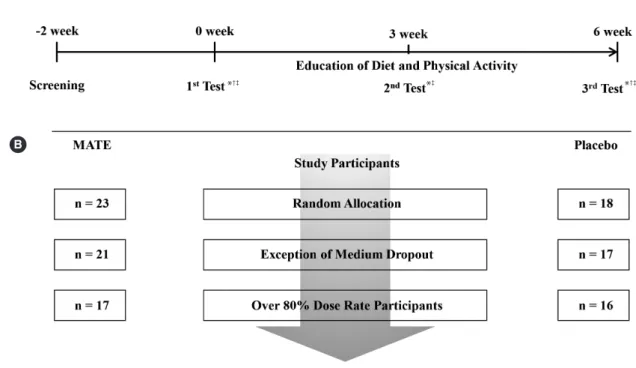
Among the applicants that applied to participate in the study from September 2014 to December 2014 at Seoul Paik Hospital, 60 adults (41 women, 19 men) were selected, after excluding those who met the exclusion criteria. The number of participants to be involved in this study was calculated using a one-sided two sample t-test based on the prospective study results, such that each group contained 24 sub- jects (expected drop-out rate: 20%).15 Subjects were randomly as- signed to either the Maté group (case group) or the placebo group (control group). This study provided results for all the subjects (On- line Appendix 1), but analyzed only the female subjects’ results in detail. The ratio of the numbers of subjects between the two groups was made 1:1, and randomization was performed through a random number assignment to each subject, and then allocating him/her to the group with a random list of numbers, including the number to which the subject corresponds. All doctors, nurses, clinical trial co- ordinators, and subjects remained blind throughout the whole study period. The study subjects paid a total of 4 visits; measurements per- formed at each visit are shown in Fig. 1A.
3. Study product
Maté extract, found in a light brown powder form, has no smell, but has a unique flavor.8 It is acknowledged as a functional ingredi- ent for functional foods within and outside Korea. The product used in this clinical study was in the form of a white, coated tablet, and contained 750.06 mg/tablet. A placebo tablet contained 83.84% corn starch, 11.71% crystalline cellulose, 3.50% hydroxypropyl methylcel- lulose, 0.80% magnesium stearate, 0.40% titanium dioxide, and
0.25% glycerin fatty acid ester. In the Maté tablet, the Maté extract replaced the 83.34% of corn starch in the placebo tablet. All the re- maining components of the Maté tablet were identical to those of the placebo tablet and in the same proportions. The Maté group took the tablets with water twice per day, 2 tablets per time, 30 minutes before breakfast and dinner, for 6 weeks. The control group did the same, but with the placebo tablets. The total amount of Maté extract intake was 3,000 mg/day during the study period.
4. Measurement parameters and method
In order to confirm that the subjects met the qualifications re- quired to participate in the clinical study, body measurements, blood pressure/pulse measurement, blood test, and pregnancy test (for women of childbearing age) were performed 2 weeks before the ini- tial ingestion. On the day of test product distribution, body measure- ments, body composition analysis, and dietary analysis were per- formed. After 3 weeks of ingestion, the study subjects visited the Table 1. Inclusion and exclusion criteria for selection of the study subjects
∙ Inclusion criteria Gender: women Age: 20-65 years
Body mass index (BMI): 25.0 kg/m2 ≤ BMI < 30.0 kg/m2
∙ Exclusion criteria
Blood pressure ≥ 160/100 mmHg
Diabetes defined by fasting blood glucose ≥ 126 mg/dL or random blood glucose ≥ 200 mg/dL or treated with oral hypoglycemic agents or insulin History of neoplastic disease within the past 5 years
Allergic disease including bronchial asthma
Psychiatric disorder including major depression, schizophrenia, alcohol abuse or substance-abuse Cardiac disease, cerebrovascular disease, renal disease, gout
Liver disease, gallbladder disease, gastrointestinal disease Significant musculoskeletal diseases that can interfere with exercise History of surgical procedure during 6 months prior to study start Pregnancy or lactation
Participation in a weight loss program during 3 months prior to study start
Current use of drugs or herbal preparations that can alter body weight (diuretics, anti-obesity agents, anti-depressant drugs, glucocorticoids, oral contraceptive, female hormones, etc.)
Figure 1. Intervention schedule and participation in MATE and placebo groups.
*Anthropometric measurement, vital sign; †Body composition analysis, electrocardiogram (ECG), laboratory tests; ‡Food diary record.
A
B
*†‡ *‡ *†‡
clinic and had their blood pressure/pulse, side effects, and diet re- cords checked. Safety evaluation was performed to check for any un- desirable, unintended symptoms that may have occurred after prod- uct ingestion. Safety evaluation included blood tests, physical exami- nations, electrocardiogram (ECG), and blood pressure/pulse mea- surements.
1) Body measurements
Height was measured only on the first visit, while weight was mea- sured every visit. Heights were rounded up to the nearest 0.1 cm.
Weight was measured while the subject was in a fasting state and dressed in light clothes, and was rounded up to the nearest 0.1 kg.
Body mass index (BMI) was calculated by dividing the body weight in kilograms by the height in meters squared (kg/m2). Waist and hip circumferences were measured starting on the second visit and for every visit afterwards, while having the subject stand on a flat sur- face. They were rounded up to the nearest 0.1 cm. The waist circum- ference (WC) was measured at the midpoint between the lowest rib and the highest point of the iliac crest while having the subject stand in an upright posture, and a consistent amount of pressure was ap- plied by the tape measure. On the other hand, the hip circumference (HC) was measured from the point of the highest protrusion on the hip and then around the hip.
2) Body composition test
Each subject was appointed to a different visit schedule for the test.
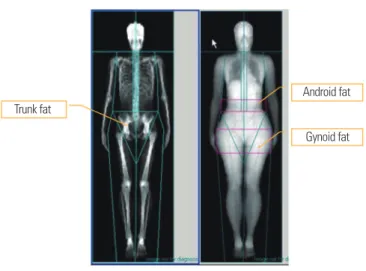
Dual-energy X-ray absorptiometry (ProdigyⓇ DEXA Lunar, GE Healthcare, Madison, WI, USA) was performed in order to measure body fat percentage (BF%), body fat mass (BFM), and lean body mass (LBM) after having the subjects take off any metallic accessories such as glasses, necklaces, and watches, and change into comfortable clothes. Body fat distribution results are indicated for arms (left+
right), legs (left+right), trunk, android, and gynoid. Trunk fat signi- fies all the fat that is distributed in the abdomen, including visceral and subcutaneous fat. Android fat signifies fat in the upper portion of the body, and gynoid fat signifies fat in the hip and the thigh (Fig. 2).16
3) Blood test
Blood samples were collected from the subjects after 8 hours of fasting, and were subjected to hematologic (red blood cell (RBC), he- moglobin (Hb), hematocrit value (Hct), and platelets) and blood
chemical (aspartate aminotransferase (AST), alanine aminotrans- ferase (ALT), protein, albumin, glucose, total bilirubin, and total cholesterol) examinations. Protein, glucose, ketones, and erythro- cytes were measured through urinalysis. A pregnancy test (human chorionic gonadotropin, hCG urine test) was performed on women of childbearing age. We followed the protocol set by the central labo- ratory within the hospital in our blood and urine analyses.
4) Safety evaluation
Safety evaluation involved blood pressure (BP) measurement, pulse monitoring, ECG, and liver functions (protein, albumin, AST, ALT, and total bilirubin), as well as other physical examinations based on clinical symptoms reported by the subject at the visit. Sys- tolic BP, diastolic BP, and pulse rate (PR) were measured every visit by using an electronic manometer after the subject relaxed for more than 10 minutes. ECG was performed on the first and last visit. In addition, we explained to the subjects the possible side effects of Maté extract, and checked if they experienced them. The subjects were asked to report any side effects that occur prior to the visit to the research coordinator.
5) Drug compliance
After the initial screening, the subjects received the test product for 3 weeks. Drug compliance was evaluated by collecting and counting leftover tablets that the subjects did not ingest. Subjects who had a lower compliance than 80% at the start of the final evalua- tion were excluded from the final evaluation.
Figure 2. Total body tissue quantitation.
Trunk fat
Android fat
Gynoid fat
6) Dietary analysis
We recommended that the subjects reduce their daily caloric in- take by 500 kcal per day, and maintain their normal amount of phys- ical activity during the study period. A total of 3 visits (second, third, and fourth visit) were made by the subjects, during which their daily energy and nutrient intake were checked. The mean values of the data from the 3-day diet records (two weekdays and one weekend day) were calculated using Can Pro 3.0, and were used for statistical analysis.
5. Statistical analysis
This study calculated the mean and standard deviation using IBM SPPS statistics program to investigate the weight and fat loss effects of Maté extract ingestion for 6 weeks in women. A paired t-test was performed to analyze body weight, body fat, WC, BP, PR, and blood test results before and after study product ingestion in each group.
An independent samples t-test was used to analyze the differences between the control and the Maté group. IBM SPSS version 21.0 was used, and significance level was set as P<0.05.
Results
1. Clinical test participation
This study analyzed the data corresponding to female subjects only. Relatively few men participated in the study compared to wom- en (41 women, 19 men), and since only 13 of these men showed high- er compliance than 80%, men were completely excluded from this study. It was deemed difficult to analyze men and women’s data to- gether due to the differences in the body fat amount and distribution between them.
The forty-one female subjects who met the selection criteria par- ticipated in the clinical study and were randomly assigned to one of the two groups, Maté group (23 subjects) and the control group (18 subjects). There were 2 drop-outs in the Maté group and one in the control group during the study period. Only the subjects who had higher compliance than 80% during the 6-week period were includ- ed in the final analysis. Finally, 17 subjects from the Maté group and 16 subjects from the control group were selected as the final partici- pants (Fig. 1B). Clinical test failure rates were higher in the Maté group, with the rates being 26.1% in the Maté group, and 11.1% in the control group.
2. Basic characteristics of study subjects
The mean ages of the subjects were 45.59±8.93 years in the Maté group and 41.69±11.38 years in the control group; showing no sig- nificant difference (Table 2). The mean BMI values and body fat per- centages did not differ significantly between the 2 groups: the mean BMI was 27.58±1.72 kg/m2 and 26.97±1.61 kg/m2 in the Maté and the control group, respectively, and the mean body fat percentage was 36.27±3.56% and 35.35±5.28% in the Maté and the control group, respectively. Daily caloric intake of each subject was calculated from 3-day food intake records. The mean daily caloric intake was 1,671.6
±455.9 kcal/day in the Maté group, and 1,791.2±418.9 kcal/day in the control group. No significant difference was observed between the Maté and the control group with respect to their dietary intakes (Maté group: carbohydrate 221.4±52.0 g, protein 73.8±27.4 g, lipid 54.4±19.6 g; Control group: carbohydrate 253.9±65.8 g, protein 72.9
±20.9 g, lipid 56.3±20.3 g) No significant difference in daily energy and nutrition intakes was observed between the 2 groups after 3 and 6 weeks (data not shown). Likewise, no significant difference in BP, PR, and other blood biochemical parameters was observed between the 2 groups after 3 and 6 weeks of the study product ingestion.
3. Body measurement changes
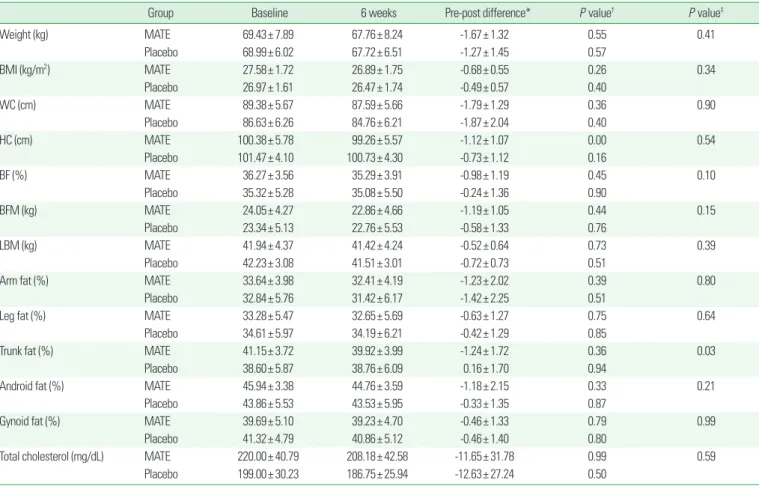
After 6 weeks of ingestion, the mean weight loss was 1.67±1.32 kg in the Maté group and 1.27±1.45 kg in the control group. The mean BMI was reduced by 0.68±0.55 kg/m2 in the Maté group and by 0.49 Table 2. Baseline characteristics of the study subjects
Mate group (n= 17) Placebo group (n= 16) P value
Sex Female Female
Age (year) 45.59± 8.93 41.69± 11.38 0.28
Height (cm) 158.42± 5.97 159.84± 4.81 0.46
Weight (kg) 69.43± 7.89 68.99± 6.02 0.86
BMI (kg/m2) 27.58± 1.72 26.97± 1.61 0.30
WC (cm) 89.38± 5.67 86.63± 6.26 0.19
HC (cm) 100.38± 5.78 101.47± 4.10 0.16
SBP (mmHg) 124.00± 15.57 118.31± 9.21 0.21
DBP (mmHg) 74.94± 12.14 73.44± 8.01 0.68
PR (bpm) 75.59± 9.12 74.88± 7.85 0.81
Energy intake (kcal) 1,671.6± 455.9 1,791.2± 418.9 0.45
Carbohydrate (g) 221.4± 52.0 253.9± 65.8 0.13
Protein (g) 73.8± 27.4 72.9± 20.9 0.92
Lipid (g) 54.4± 19.6 56.3± 20.3 0.79
Values are expressed as mean± standard deviation and P values are obtained from student t-test.
BMI, body mass index; BF%, body fat percentage; WC, waist circumference; HC, hip cir- cumference; SBP, systolic blood pressure; DBP, diastolic blood pressure; PR, pulse rate.
±0.57 kg/m2 in the control group, but no significant difference was observed between the 2 groups before and after the study product ingestion (Table 3). The WC was reduced by 1.79±1.29 cm in the Maté group and by 1.87±2.04 cm in the control group. Again, the results did not show any significant difference between the 2 groups.
Similarly, there was no significant difference in the HC results be- tween the 2 groups.
4. Body fat and total blood cholesterol change
On the 6th week, body fat and total cholesterol were reduced in the arms, legs, android, and gynoid fat in both Maté and control groups to a similar degree (Table 3). However, although trunk fat was re- duced by 1.24±1.72% in the Maté group, it was increased by 0.16±
1.70% in the control group, indicating a significant reduction in the Maté group compared to the control group (P= 0.03) (Fig. 3). Blood cholesterol levels decreased in both groups (Maté group: -11.65±
31.78 mg/dL, control group: -12.63±27.24 mg/dL), but these values
did not differ significantly (Table 3).
5. Safety evaluation results
In order to test product safety, we looked for changes in liver func- Table 3. Changes in anthropometric parameters, fat percentage, and total cholesterol after supplementation of green Mate extract for 6 weeks
Group Baseline 6 weeks Pre-post difference* P value† P value‡
Weight (kg) MATE 69.43± 7.89 67.76± 8.24 -1.67± 1.32 0.55 0.41
Placebo 68.99± 6.02 67.72± 6.51 -1.27± 1.45 0.57
BMI (kg/m2) MATE 27.58± 1.72 26.89± 1.75 -0.68± 0.55 0.26 0.34
Placebo 26.97± 1.61 26.47± 1.74 -0.49± 0.57 0.40
WC (cm) MATE 89.38± 5.67 87.59± 5.66 -1.79± 1.29 0.36 0.90
Placebo 86.63± 6.26 84.76± 6.21 -1.87± 2.04 0.40
HC (cm) MATE 100.38± 5.78 99.26± 5.57 -1.12± 1.07 0.00 0.54
Placebo 101.47± 4.10 100.73± 4.30 -0.73± 1.12 0.16
BF (%) MATE 36.27± 3.56 35.29± 3.91 -0.98± 1.19 0.45 0.10
Placebo 35.32± 5.28 35.08± 5.50 -0.24± 1.36 0.90
BFM (kg) MATE 24.05± 4.27 22.86± 4.66 -1.19± 1.05 0.44 0.15
Placebo 23.34± 5.13 22.76± 5.53 -0.58± 1.33 0.76
LBM (kg) MATE 41.94± 4.37 41.42± 4.24 -0.52± 0.64 0.73 0.39
Placebo 42.23± 3.08 41.51± 3.01 -0.72± 0.73 0.51
Arm fat (%) MATE 33.64± 3.98 32.41± 4.19 -1.23± 2.02 0.39 0.80
Placebo 32.84± 5.76 31.42± 6.17 -1.42± 2.25 0.51
Leg fat (%) MATE 33.28± 5.47 32.65± 5.69 -0.63± 1.27 0.75 0.64
Placebo 34.61± 5.97 34.19± 6.21 -0.42± 1.29 0.85
Trunk fat (%) MATE 41.15± 3.72 39.92± 3.99 -1.24± 1.72 0.36 0.03
Placebo 38.60± 5.87 38.76± 6.09 0.16± 1.70 0.94
Android fat (%) MATE 45.94± 3.38 44.76± 3.59 -1.18± 2.15 0.33 0.21
Placebo 43.86± 5.53 43.53± 5.95 -0.33± 1.35 0.87
Gynoid fat (%) MATE 39.69± 5.10 39.23± 4.70 -0.46± 1.33 0.79 0.99
Placebo 41.32± 4.79 40.86± 5.12 -0.46± 1.40 0.80
Total cholesterol (mg/dL) MATE 220.00± 40.79 208.18± 42.58 -11.65± 31.78 0.99 0.59
Placebo 199.00± 30.23 186.75± 25.94 -12.63± 27.24 0.50
Values are expressed as mean± standard deviation.
*Pre-post difference: 6 weeks-baseline; †P value obtained from paired t-test within group; ‡P value obtained from independent samples t-test.
BMI, body mass index; WC, waist circumference; HC, Hip circumference; BF%, body fat percentage; BFM, body fat mass; LBM, lean body mass.
Figure 3. Changes in trunk fat percentage after supplementation of green mate extraction for 6 weeks.
50 45 40 35 30 25 20 15 10 5 0
Trunk fat (%)
Baseline P = 0.03
-1.24% 0.16%
6 weeks
MATE group Placebo group
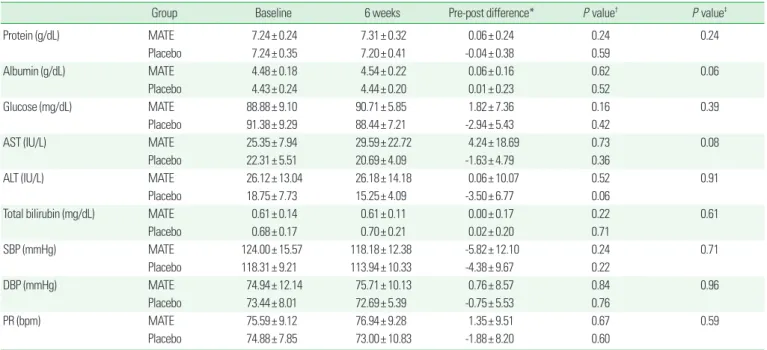
tion indices after product ingestion. In both groups, there were non- significant changes in these indices that were within the normal rang- es. Systolic BP, diastolic BP, and PR also did not differ significantly be- tween the 2 groups, over the course of the 6 weeks (Table 4).
We also evaluated the adverse effects of the extract experienced by the subjects at a 3-week interval. Two cases of adverse effects, one from each group, were reported in total, and they were both reports of nau- sea. However, nausea did not last very long and the subjects recovered immediately, and were able to continue participating in the study.
Discussion
Maté (Ilex paraguariensis St. Hil) is a natural tea that is commonly consumed in South America (Paraguay, Brazil, Argentina, and Uru- guay) and is known as one of the world’s 3 major drinks alongside coffee and green tea.17 In South America, Maté has been traditionally used as a natural substance that boosts the immune system, stabiliz- es the nervous system, stimulates the mind, controls appetite, treats obesity, reduces stress, and delays aging. It is sold in many countries, aside from South America and the United States, as tea products and food supplements, and no side effects have been reported after its in- gestion.18,19 No reports of toxicity or side effects were found while
searching the safety databases for data regarding the safety of ‘Maté’
and other Maté-containing products.20,21 In addition, several studies on the safety of Maté showed no side effects and have scientifically verified its functionality.12,22 In this study, 2 out of the total partici- pants (one from each group, Maté and control) experienced nausea, but it was not regarded as a severe adverse event as it did not last very long and the participants recovered immediately.
Various studies have discovered that chlorogenic acid and triter- penoid saponins, which are components of Maté, promote weight control mechanisms.15,23 Therefore, we designed a clinical study to investigate the effects of Maté, whose weight and body fat loss effects have been verified in previous studies, on human subjects. Adults, who were obese but otherwise healthy, were made to ingest 3,000 mg of Maté extract over a 6-week period, and reductions in their body weight and WC were compared to the control group to assess the ef- fectiveness of Maté. We also assessed the safety of Maté by checking for any abnormal symptoms and by performing clinical and labora- tory evaluations. As mentioned before, our study holds significance in that it involved a wider range of ages than previous studies, and involved Asian subjects.
In this study, the participants lost an average of 1.67±1.32 kg (2.4%) of their body weight after ingesting Maté extract for 6 weeks.
Table 4. Changes in safety outcomes after supplementation of green Mate extract for 6 weeks
Group Baseline 6 weeks Pre-post difference* P value† P value‡
Protein (g/dL) MATE 7.24± 0.24 7.31± 0.32 0.06± 0.24 0.24 0.24
Placebo 7.24± 0.35 7.20± 0.41 -0.04± 0.38 0.59
Albumin (g/dL) MATE 4.48± 0.18 4.54± 0.22 0.06± 0.16 0.62 0.06
Placebo 4.43± 0.24 4.44± 0.20 0.01± 0.23 0.52
Glucose (mg/dL) MATE 88.88± 9.10 90.71± 5.85 1.82± 7.36 0.16 0.39
Placebo 91.38± 9.29 88.44± 7.21 -2.94± 5.43 0.42
AST (IU/L) MATE 25.35± 7.94 29.59± 22.72 4.24± 18.69 0.73 0.08
Placebo 22.31± 5.51 20.69± 4.09 -1.63± 4.79 0.36
ALT (IU/L) MATE 26.12± 13.04 26.18± 14.18 0.06± 10.07 0.52 0.91
Placebo 18.75± 7.73 15.25± 4.09 -3.50± 6.77 0.06
Total bilirubin (mg/dL) MATE 0.61± 0.14 0.61± 0.11 0.00± 0.17 0.22 0.61
Placebo 0.68± 0.17 0.70± 0.21 0.02± 0.20 0.71
SBP (mmHg) MATE 124.00± 15.57 118.18± 12.38 -5.82± 12.10 0.24 0.71
Placebo 118.31± 9.21 113.94± 10.33 -4.38± 9.67 0.22
DBP (mmHg) MATE 74.94± 12.14 75.71± 10.13 0.76± 8.57 0.84 0.96
Placebo 73.44± 8.01 72.69± 5.39 -0.75± 5.53 0.76
PR (bpm) MATE 75.59± 9.12 76.94± 9.28 1.35± 9.51 0.67 0.59
Placebo 74.88± 7.85 73.00± 10.83 -1.88± 8.20 0.60
Values are expressed as mean± standard deviation.
*Pre-post difference: 6 weeks - baseline; †P value obtained from paired t-test within group; ‡P value obtained from independent samples t-test.
AST, aspartate aminotransferase; ALT, alanine aminotransferase; SBP, systolic blood pressure; DBP, diastolic blood pressure; PR, pulse rate.
This was similar to the result of a prospective study in which over- weight women aged between 20 and 35 years were administered Maté extract for 6 weeks, and lost 1.5 kg (2.1%) of their body weight by the end of the study period.15 BMI, WC, and systolic BP tended to decrease in the Maté group after 6 weeks, but to a similar degree to those in the control group. Although our study had different criteria regarding the age and degree of obesity for selecting our subjects and was carried out in different research conditions, our results were similar to those of the previous study, and therefore, we believe that our results are meaningful.
Fat oxidation, thermogenesis, and appetite suppression are consid- ered from the main mechanisms by which Maté extract contributes to weight loss.24 Saponins contained in Maté act on the surface of micelles and destroy them, leading to a reduction in fat reabsorption and lipogenesis.24 Saponins also prevent the binding and absorption of cholesterol in the inner cavity of the intestine, and inhibit fat ab- sorption by inhibiting pancreatic lipase, which can be assessed by measuring respiratory quotient (RQ); a ratio of carbon dioxide ex- haled from the body to oxygen consumed.24 According to the pro- spective study result, among the 12 medicinal herbs, only Maté low- ered the RQ and showed outstanding effects on body fat loss, which can be attributed to fat oxidation caused by thermogenesis.25 Anoth- er study reported that Maté stimulates the adrenergic system to sup- press appetite.9 We believe that even though our results lacked a sig- nificant difference from the control group, the reductions in body weight and BMI observed in our study were due to the aforemen- tioned effects of Maté. We also believe that the lack of statistical sig- nificance in our results is due to the limiting factors such as the small sample size and the short study period.
While WC is closely associated with trunk fat, HC is closely asso- ciated with leg fat and leg lean mass.26 BMI is usually related to total body fat mass.26 The result of this study showed that trunk fat was reduced in the Maté group to a more significant degree (-1.24±
1.72%) than in the control group (0.16±1.70%). On the contrary, the HC and BMI did not decrease significantly, and this can be attribut- ed to the fact that the leg fat decreased to a small degree.
Trunk fat reduces the activity of lipoprotein lipase in the blood.
This leads to disruptions in lipoprotein metabolism, and to several disorders including type 1 hyperlipoproteinemia.27 The significant reduction in trunk fat observed in this study is more clinically mean- ingful than the reductions in other areas of the body, and this is be-
cause trunk fat is directly associated with the blood lipid content.
According to a Japanese study that investigated the relation between trunk fat and health, trunk fat contributes to glucose intolerance and hypertension, and also negatively affects apolipoprotein B.28 Similar- ly, a Norwegian study has reported that the accumulation of trunk fat increases the incidence of insulin resistance and dyslipidemia.29 Therefore, the significant reductions in trunk fat in the Maté group observed in this study suggest that long-term ingestion of Maté may also improve dyslipidemia.
This study had some limitations, for example, it was carried out on a small scale; 33 subjects only, and for a short time (6 weeks long).
However, the study is meaningful as it objectively evaluates the body weight and fat loss effects of Maté extract in Korean women with varying ages and with a BMI ranging between 25.0 kg/m2 and 30.0 kg/m2 through a double-blind randomized placebo-controlled trial.
To summarize our findings, the ingestion of Maté extract over a period of 6 weeks reduced body weight and fat percentage; especially trunk fat was significantly reduced. Therefore, Maté can be consid- ered as a good material for functional foods to be consumed by obese people who are trying to control their weight. However, a long-term clinical study with a more complicated study design and a larger group of subjects would still be needed in the future in order to study the long-term effects of Maté extract on fat loss.
Conflicts of Interest
The authors declare no conflict of interest.
Acknowledgments
This research was supported from Medinutra co. in 2014.
References
1. Kim MK, Lee WY, Kang JH, Kang JH, Kim BT, Kim SM, et al.
2014 clinical practice guidelines for overweight and obesity in Ko- rea. Endocrinol Metab (Seoul) 2014;29:405-9.
2. Jafari-Adli S, Jouyandeh Z, Qorbani M, Soroush A, Larijani B, Hasani-Ranjbar S. Prevalence of obesity and overweight in adults and children in Iran; a systematic review. J Diabetes Metab Disord 2014;13:121.
3. Payab M, Hasani-Ranjbar S, Larijani B. Whether all obese subjects both in metabolic groups and non-metabolic groups should be treated or not. J Diabetes Metab Disord 2014;13:21.
4. Ministry of Health and Welfare, Korea Centers for Disease Con- trol and Prevention. 2012 National Health Statistics. National Sta- tistical Office [accessed 2015 Jan 17]; Available from: URL: http://
www.index.go.kr/potal/enaraIdx/idxField/userPageCh.do?idx_
cd=2705
5. Jung HW. Severely obese, be must aware of ‘dimension of state problem’. Joseilbo [serial online] 2014 May 27 [accessed 2014 Dec 8]; Available from: URL: http://health.joseilbo.com/html/news/?f=r ead&code=CHILD1333960131&seq=8307
6. Kim JN. Obese Payment for Child and Adolescent, National Health Insurance Corporation Finances 10%. Newspim [serial on- line] 2014 Oct 13 [accessed 2014 Dec 9]; Available from: URL:
http://www.newspim.com/view.jsp?newsId=20141013000216 7. Khan MI, Anjum FM, Sohaib M, Sameen A. Tackling metabolic
syndrome by functional foods. Rev Endocr Metab Disord 2013;14:
287-97.
8. Ministry of Food and Drug Safety. Health Functional Food. Avail- able from: URL: http://www.foodnara.go.kr/hfoodi/
9. Andersen T, Fogh J. Weight loss and delayed gastric emptying fol- lowing a South American herbal preparation in overweight pa- tients. J Hum Nutr Diet 2001;14:243-50.
10. Santos JC, Gotardo EM, Brianti MT, Piraee M, Gambero A, Ri- beiro ML. Effects of yerba maté, a plant extract formulation (“YGD”) and resveratrol in 3T3-L1 adipogenesis. Molecules 2014;
19:16909-24.
11. Heck CI, de Mejia EG. Yerba Mate Tea (Ilex paraguariensis): a comprehensive review on chemistry, health implications, and technological considerations. J Food Sci 2007;72:R138-51.
12. Miranda DD, Arçari DP, Pedrazzoli J Jr, Carvalho Pde O, Cerutti SM, Bastos DH, et al. Protective effects of mate tea (Ilex para- guariensis) on H2O2-induced DNA damage and DNA repair in mice. Mutagenesis 2008;23:261-5.
13. Arçari DP, Bartchewsky W, dos Santos TW, Oliveira KA, Funck A, Pedrazzoli J, et al. Antiobesity effects of yerba maté extract (Ilex paraguariensis) in high-fat diet-induced obese mice. Obesity (Sil- ver Spring) 2009;17:2127-33.
14. de Morais EC, Stefanuto A, Klein GA, Boaventura BC, de An- drade F, Wazlawik E, et al. Consumption of yerba mate (Ilex para-
guariensis) improves serum lipid parameters in healthy dyslipid- emic subjects and provides an additional LDL-cholesterol reduc- tion in individuals on statin therapy. J Agric Food Chem 2009;57:
8316-24.
15. Kim HJ, Ko J, Storni C, Song HJ, Cho YG. Effect of green mate in overweight volunteers: A randomized placebo-controlled human study. J Funct Foods 2012;4:287-93.
16. Novotny R, Going S, Teegarden D, Van Loan M, McCabe G, Mc- Cabe L, et al. Hispanic and Asian pubertal girls have higher an- droid/gynoid fat ratio than whites. Obesity (Silver Spring) 2007;
15:1565-70.
17. Bracesco N, Sanchez AG, Contreras V, Menini T, Gugliucci A.
Recent advances on Ilex paraguariensis research: minireview. J Ethnopharmacol 2011;136:378-84.
18. Boaventura BC, Di Pietro PF, Stefanuto A, Klein GA, de Morais EC, de Andrade F, et al. Association of mate tea (Ilex paraguar- iensis) intake and dietary intervention and effects on oxidative stress biomarkers of dyslipidemic subjects. Nutrition 2012;28:657- 64.
19. Gao H, Long Y, Jiang X, Liu Z, Wang D, Zhao Y, et al. Beneficial effects of Yerba Mate tea (Ilex paraguariensis) on hyperlipidemia in high-fat-fed hamsters. Exp Gerontol 2013;48:572-8.
20. MEDLINE; Available from: URL: http://www.ncbi.nlm.nih.gov/
pubmed
21. Ministry of Food and Drug Safety; Available from: URL: http://
mfda.go.kr
22. de Andrade F, de Albuquerque CA, Maraschin M, da Silva EL.
Safety assessment of yerba mate (Ilex paraguariensis) dried ex- tract: results of acute and 90 days subchronic toxicity studies in rats and rabbits. Food Chem Toxicol 2012;50:328-34.
23. Bojić M, Simon Haas V, Sarić D, Maleš Z. Determination of fla- vonoids, phenolic acids, and xanthines in Mate tea (Ilex paraguar- iensis St.-Hil.). J Anal Methods Chem 2013;2013:658596.
24. Resende PE, Verza SG, Kaiser S, Gomes LF, Kucharski LC, Ortega GG. The activity of mate saponins (Ilex paraguariensis) in intra- abdominal and epididymal fat, and glucose oxidation in male Wi- star rats. J Ethnopharmacol 2012;144:735-40.
25. Martinet A, Hostettmann K, Schutz Y. Thermogenic effects of commercially available plant preparations aimed at treating hu- man obesity. Phytomedicine 1999;6:231-8.
26. Snijder MB, Dekker JM, Visser M, Bouter LM, Stehouwer CD,
Yudkin JS, et al. Trunk fat and leg fat have independent and op- posite associations with fasting and postload glucose levels: the Hoorn study. Diabetes Care 2004;27:372-7.
27. Wang H, Eckel RH. Lipoprotein lipase: from gene to obesity. Am J Physiol Endocrinol Metab 2009;297:E271-88.
28. Kawamoto T, Ishikawa K. Intra-abdominal fat, lipid metabolism
and insulin resistance in coronary artery disease. Hypertens Res 1996;19 Suppl 1:S69-74.
29. Aasen G, Fagertun H, Halse J. Insulin resistance and dyslipidaemia in obese premenopausal and postmenopausal women matched for leg/trunk fat mass ratio. Scand J Clin Lab Invest 2009;69:505-11.