• 검색 결과가 없습니다.

Patient Expectations of Visiting Department of Oral Medicine for Burning Mouth Syndrome: Relationship between Expectations and Clinical and Psychological Characteristics JOMP

N/A
N/A
Protected

Academic year: 2021

Share "Patient Expectations of Visiting Department of Oral Medicine for Burning Mouth Syndrome: Relationship between Expectations and Clinical and Psychological Characteristics JOMP"

Copied!
7
0
0

로드 중.... (전체 텍스트 보기)

전체 글

(1)

pISSN 2288-9272 eISSN 2383-8493 J Oral Med Pain 2019;44(4):147-153 https://doi.org/10.14476/jomp.2019.44.4.147

Patient Expectations of Visiting Department of Oral Medicine for Burning Mouth Syndrome: Relationship between Expectations and Clinical and Psychological Characteristics

Hye-Kyoung Kim, Mee-Eun Kim

Department of Oral Medicine, College of Dentistry, Dankook University, Cheonan, Korea

Received November 22, 2019 Revised November 29, 2019 Accepted December 3, 2019

Purpose: The aims of this study were to investigate the expectation of patients with burning mouth syndrome (BMS) and assess the relationship between patient expectations and clini- cal and psychological characteristics.

Methods: Eligibility was retrospectively assessed on 93 patients with BMS. A total of five questionnaires on patients’ expectation for a visit, pain, sleep quality (Pittsburgh Sleep Quality Index), cognition (Pain Catastrophizing Scale) and psychological distress (Symptom Checklist-90 revised) were measured.

Results: Sixty-five patients were included in this study. The top 3 priorities of expectation for a treatment visit to the Department of Oral Medicine were as following; “I want my pain to be free”; “I want to understand why it hurts”; “I want to communicate better with doc- tors about pain”. Patients with priority of pain relief showed poor sleep quality than patients who are more interested in the disease related information.

Conclusions: To improve treatment outcomes of BMS, clinicians should improve their own understanding of patients who are suffering from BMS. Inquiring about the patient expec- tations may be one of them, and it would contribute to the enhancement of patients’ overall well-being.

Key Words: Burning mouth syndrome; Expectation; Surveys and questionnaires

Correspondence to:

Mee-Eun Kim

Department of Oral Medicine, College of Dentistry, Dankook University, 119 Dandae- ro, Dongnam-gu, Cheonan 31116, Korea Tel: +82-41-550-1915

Fax: +82-505-434-7951 E-mail: [email protected] https://orcid.org/0000-0001-9332-532X

JOMP

Journal of Oral Medicine and Pain

Copyright Ⓒ 2019 Korean Academy of Orofacial Pain and Oral Medicine. All rights reserved.

CC This is an open-access article distributed under the terms of the Creative Commons Attribution Non-Commercial License (http://creativecommons.org/licenses/by-nc/4.0/),
INTRODUCTION

Burning mouth syndrome (BMS), also called glossodynia or stomatodynia, is one of the most common, but debilitat- ing oral condition that is characterized by constant burning sensations in the oral mucosa, which does not appear to be abnormal by visual examination or laboratory tests [1,2]. In addition to burning pain, it simultaneously presents a vari- ety of symptoms including xerostomia, dysgeusia, and even psychological distress. However, compared to the great dis- ability of patients, the lack of consensus on the etiology of BMS has made it extremely difficult to establish a correct treatment protocol. Many previous studies have reported

that poorly treated BMS can cause patients to visit several hospitals to seek further medical treatment and therefore, has a significant negative impact on the quality of individ- ual life [3-5]. As mentioned above, patients with BMS may have a long history of oral pain and experience repetitive treatment failure.

Considering the natural course that a patient feels anxiety

about a refractory pain of unknown etiology, it is not sur-

prising that BMS, as a chronic pain, is frequently involved

with stressful life events and psychological conditions in-

cluding depression, anxiety, neuroticism and cancerphobia

[2,6]. These intractable clinical problems that cannot be ful-

ly explained by biological processes are also a challenge for

(2)

clinicians and thus, even little information on the patients might be a great help to clinicians.

In this context, assessing and understanding the expecta- tions and priorities that BMS patients have may help clini- cians to optimize treatment and support patients and finally improve patient-reported outcomes. However, to the au- thors’s knowledge, little is known about the expectations of patients with BMS.

Therefore, the aims of this study were to investigate the expectation of patients with BMS and assess the relation- ship between patient expectations and clinical and psycho- logical characteristics.

MATERIALS AND METHODS

1. Subjects

This study was the second part of a study that investigat- ed characteristics of patients with BMS. Part I of the study also examined the pain intensity and interference, sleep quality and psychological distress with the same patients, and it has been previously published [7]. Details of subjects

and procedures are described in Lee’s study [7].

Between January 2017 to August 2018, a total of 93 pa- tients were diagnosed as BMS at the Department of Oral Medicine of Dankook University Dental Hospital accord- ing to the guidelines from the International Classification of Headache Disorders, 3rd edition (beta version) [8]. Inclusion and exclusion criteria are well described in Lee’s study [7].

To rule out the possible secondary causes of BMS, blood test, candida test and salivary flow rate test were performed.

All patients were asked to complete a number of ques- tionnaires prior to initial examination as part of standard protocol of the Department of Oral Medicine of Dankook University Dental Hospital in the waiting room.

Informed consent for using their clinical data for the re- search purpose prior to the initial examination was ob- tained. Data were collected retrospectively from clinical records and questionnaires of the eligible patients. The cur- rent study was approved by the Institutional Review Board committee of Dankook University Dental Hospital (IRB no.

DKUDH IRB 2018-09-001).

2. Assessment of Patients’ Expectation

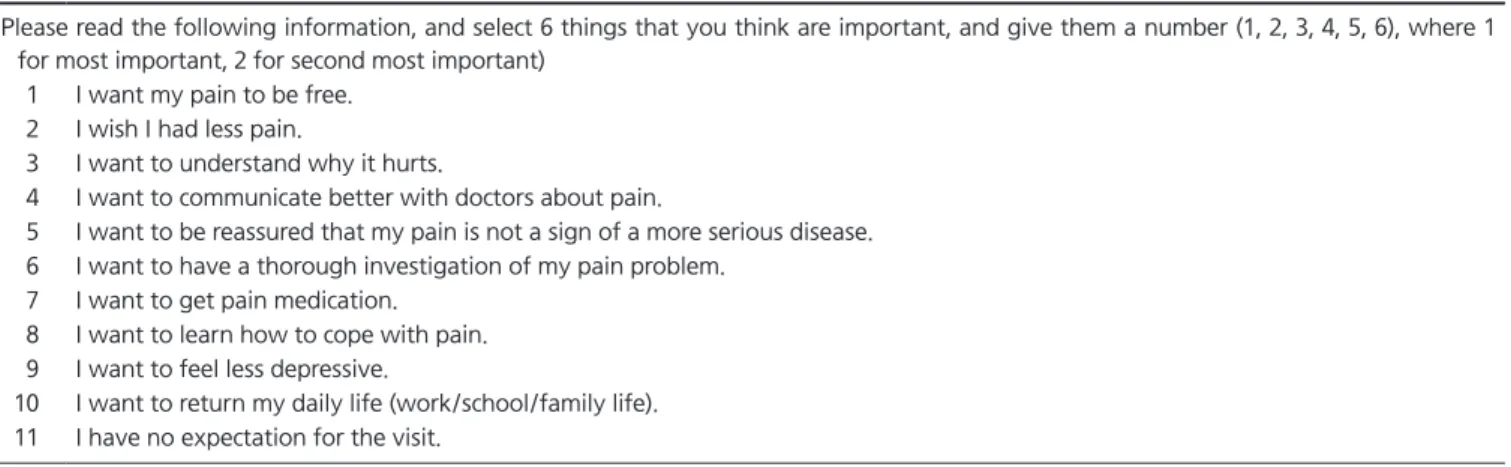
Patients’ expectation of visiting to the Department of Oral Medicine was assessed using the self-reported question- naire (Table 1). This questionnaire includes a total of four- teen questions associated with expectation. Patients can select a total of six questions out of the 14 items in the or- der of their priority. Then, the sum ratio of top three priori- ties for each question was calculated and used for further comparison.

Table 1. Demographics and pain characteristics

Variable Value (n=65)

Age (y) 54.8±14.8

Female 37 (56.9)

Pain duration (mo) 21.8±30.7

BPI

Pain severity 4.2±2.6

Pain interference 4.4±3.1

BPI, Brief Pain Inventory.

Values are presented as mean±standard deviation or number (%).

Table 2. The questionnaire and scale of patient’s expectation of the first visit to the Department of Oral Medicine

Please read the following information, and select 6 things that you think are important, and give them a number (1, 2, 3, 4, 5, 6), where 1 for most important, 2 for second most important)

1 I want my pain to be free.

2 I wish I had less pain.

3 I want to understand why it hurts.

4 I want to communicate better with doctors about pain.

5 I want to be reassured that my pain is not a sign of a more serious disease.

6 I want to have a thorough investigation of my pain problem.

7 I want to get pain medication.

8 I want to learn how to cope with pain.

9 I want to feel less depressive.

10 I want to return my daily life (work/school/family life).

11 I have no expectation for the visit.

(3)

3. Assessment of Pain and Mental Condition

The four questionnaires on pain and mental condi- tion used in this study are the same as those used in part I [7], and are described in detail elsewhere. The Brief Pain Inventory (BPI) is a valid tool for assessment of pain [9]. In this study, Korean version of BPI [10] was used to measure the pain intensity and pain interference of patients. The Pittsburg Sleep Quality Index (PSQI), a valid and reliable questionnaire for evaluation of subjective sleep quality, was used to measure the sleep quality of patients with BMS in this study [11]. Catastrophizing thinking was measured by pain catastrophizing scale (PCS) [12]. It consists of 3 com- ponents including rumination, magnification and helpless- ness and one total score. Psychological conditions including depression and anxiety were evaluated using the Symptom Checklist-90 revised (SCL-90R) [13]. It measures nine sub- types of psychopathology.

4. Data Analysis

Considering that the possible influence of sex, age and pain duration on the pain experience, data from age, sex, pain duration to pain severity and interference, PCS, PSQI, and SCL-90R from questionnaires were used for statisti- cal analyses. Demographics and pain characteristics of the patients were presented as percentage and frequency.

The percentage of expectation rank for each question in the questionnaire were calculated using descriptive sta- tistics. Comparison between groups was performed using the Independent sample t-test. Statistical analyses were

conducted using IBM SPSS Statistics for Windows, Version 21.0 (IBM Co., Armonk, NY, USA) and statistical signifi- cance was set at p=0.05.

RESULTS

1. Patient Characteristics

Demographics of the study population are described in Table 2. Ninety-three eligible patients were enrolled in this study. Among them, 65 patients were finally included ac- cording to the inclusion and exclusion criteria. 56.9% of the patients were female. The mean±SD age and disease duration were 54.8±14.8 years and 21.8±30.7 months, re- spectively. At baseline, the mean±SD pain severity and pain interference measured by BPI were 4.2±2.6 and 4.4±3.1, respectively.

2. Patient Expectation Ratings

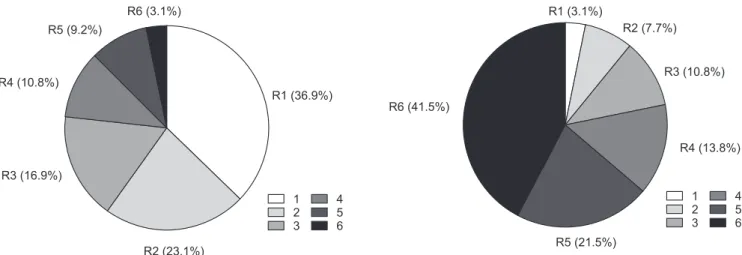
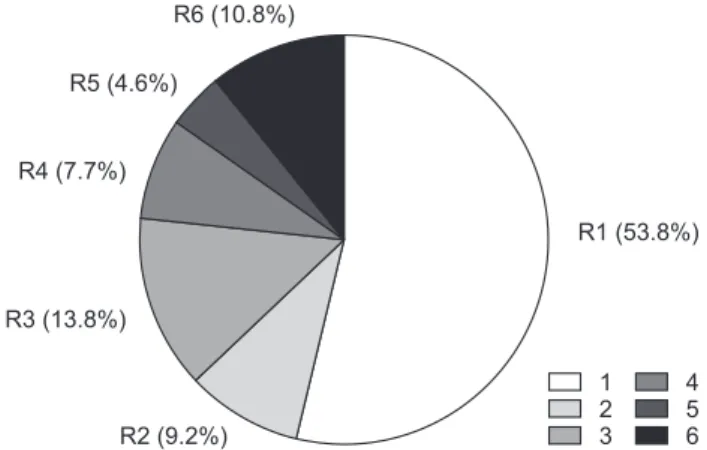
Patients rated priorities on their expectations of visiting Department of Oral Medicine. The Fig. 1-7 show the pro- portion of patients’ expected ranking from the first to sixth and the sum ratio of the first, second and third rank for each question in the expectation questionnaire.

In the question “I want my pain to be free”, the sum per- centage of expectation rank of 1, 2, and 3 was 76.8% (Fig.

1). For the question “I wish I had less pain”, 29.2% was re- corded for the sum percentage of expectation rank of 1, 2, and 3 (Fig. 2). In Fig. 3, the sum percentage of expectation rank of 1, 2, and 3 for the question “I want to understand

Fig. 1. Proportion of expectation rank for the question “I want my pain to be free”. R indicates rank of the patient’s expectations for the question. % of rank 1+2+3=76.8%

R4 (7.7%)

R1 (53.8%)

R3 (13.8%)

R2 (9.2%) R5 (4.6%)

R6 (10.8%)

1 2 3

4 5 6

Fig. 2. Proportion of expectation rank for the question “I wish I had less pain”. R indicates rank of the patient’s expectations for the question. % of rank 1+2+3=29.2%

R4 (12.3%) R1 (4.6%)

R3 (9.2%) R2 (15.4%)

R5 (3.1%) R6 (55.4%)

1 2 3

4

5

6

(4)

why it hurts” was 76.9%, which showed the highest propor- tion of rank 1,2 and 3 with question “I want my pain to be free” (76.8%). The question “I want to communicate better with doctors about pain” showed 66.2% of expectation rank of 1, 2, and 3 (Fig. 4). Proportion of expectation rank for the question “I want to be reassured that my pain is not a sign of a more serious disease”, “I want to have a thorough investigation of my problem” and “I want to get pain medi- cation” were 21.6% (Fig. 5), 18.4% (Fig. 6) and 10.7% (Fig. 7).

3. Comparison of Clinical and Psychological Characteristics between Two BMS Groups with Different Expectation

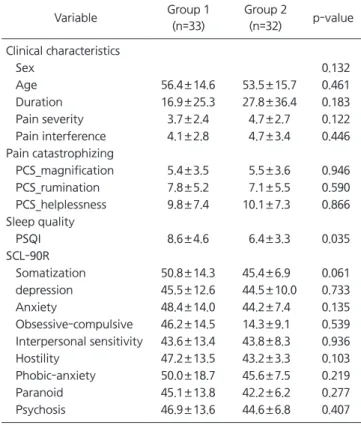
Table 3 shows the clinical and psychological charac- teristics differences between two groups with different pa- tient’s expectation.

Of the four expectations that patients value most, patients with the highest expectations in question 1 (I want my pain to be free) and 2 (I wish I had less pain) were stratified into group 1 (n=33). On the other hand, patients who have the highest expectations in question 3 (I want to understand why it hurts) and 4 (I want to communicate better with doc- tors about pain) were classified into group 2 (n=32). In this

Fig. 3. Proportion of expectation rank for the question “I want to understand why it hurts”. R indicates rank of the patient’s expectations for the question. % of rank 1+2+3=76.9%

R4 (10.8%)

R1 (36.9%)

R3 (16.9%)

R2 (23.1%) R5 (9.2%)

R6 (3.1%)

1 2 3

4 5 6

Fig. 4. Proportion of expectation rank for the question “I want to communicate better with doctors about pain”. R indicates rank of the patient’s expectations for the question. % of rank 1+2+3=66.2%

R4 (15.4%)

R1 (12.3%)

R3 (26.2%)

R2 (27.7%) R5 (12.3%)

R6 (6.2%)

1 2 3

4 5 6

Fig. 5. Proportion of expectation rank for the question “I want to be reassured that my pain is not a sign of a more serious disease”.

R indicates rank of the patient’s expectations for the question. % of rank 1+2+3=21.6%

R4 (13.8%) R1 (3.1%)

R3 (10.8%) R2 (7.7%)

R5 (21.5%) R6 (41.5%)

1 2 3

4 5 6

Fig. 6. Proportion of expectation rank for the question “I want to have a thorough investigation of my pain problem”. R indicates rank of the patient’s expectations for the question. % of rank 1+2+3=18.4%

R4 (13.8%) R1 (4.6%)

R3 (4.6%) R2 (9.2%)

R5 (12.3%) R6 (53.8%)

1 2 3

4

5

6

(5)

stratification, group 1 indicates the patients who focused on being free of pain, understanding the cause of pain, as an expectation, was main characteristics of group 2.

Two groups did not show statistical differences be- tween clinical characteristics including sex (p=0.132), age (p=0.461), duration (p=0.183), pain severity (p=0.122) and pain interference (p=0.446). Pain catastrophizing scores in- cluding three dimensions of magnification (p=0.946), ru- mination (p=0.590) and helplessness (p=0.866) also did not differ between two groups. Multiple dimensions of SCL- 90R were compared between two groups. Although the mean Somatization score of group 1 was higher than that of group 2, it did not reach statistical significance (p=0.061).

Like somatization, other dimensions of SCL-90R did not statistically differ between two groups. On the other hand, the mean score of global PSQI index was significantly high- er in group 1 than group 2 (p=0.035).

DISCUSSION

Previous studies revealed that BMS has a negative impact on the quality of life of patients, but individualized man- agement can improve the patient-reported outcomes in- cluding intraoral pain and quality of life [5,14]. For tailored approach, knowledge on the priorities and expectations of patients is valuable.

In this study, the top 3 priorities of expectation for a treatment visit to the Department of Oral Medicine were as

following; “I want my pain to be free”; “I want to under- stand why it hurts”; “I want to communicate better with doctors about pain”.

Among 65 patients, no one patients first visited the Department of Oral Medicine due to oral pain. Despite pre- vious conservative treatment, patients had high expecta- tions about relieving pain and understanding the cause of pain. Patients prioritized for the complete disappearance of pain (76.8%) rather than less pain (29.2%). Patients also ex- pected it was important to know why I am sick (76.9%) and to listen to the doctor’s detailed explanation (66.2%) rather than knowing that my illness was not serious (21.6%) or get a prescribed medicine (10.7%). Generally, it is reported that BMS patients show a great fear of oral cancer called cancerphobia, and therefore, treatment should be focused on supportive reassurance that it is not a serious condition

Table 3. Comparison of clinical and psychological characteristics between two groups with different patient’s expectation (n=65)

Variable Group 1

(n=33)

Group 2

(n=32) p-value Clinical characteristics

Sex 0.132

Age 56.4±14.6 53.5±15.7 0.461

Duration 16.9±25.3 27.8±36.4 0.183

Pain severity 3.7±2.4 4.7±2.7 0.122

Pain interference 4.1±2.8 4.7±3.4 0.446 Pain catastrophizing

PCS_magnification 5.4±3.5 5.5±3.6 0.946

PCS_rumination 7.8±5.2 7.1±5.5 0.590

PCS_helplessness 9.8±7.4 10.1±7.3 0.866 Sleep quality

PSQI 8.6±4.6 6.4±3.3 0.035

SCL-90R

Somatization 50.8±14.3 45.4±6.9 0.061

depression 45.5±12.6 44.5±10.0 0.733

Anxiety 48.4±14.0 44.2±7.4 0.135

Obsessive-compulsive 46.2±14.5 14.3±9.1 0.539 Interpersonal sensitivity 43.6±13.4 43.8±8.3 0.936

Hostility 47.2±13.5 43.2±3.3 0.103

Phobic-anxiety 50.0±18.7 45.6±7.5 0.219

Paranoid 45.1±13.8 42.2±6.2 0.277

Psychosis 46.9±13.6 44.6±6.8 0.407

PCS, pain catastrophizing scale; PSQI, Pittsburg Sleep Quality Index; SCL-90R, Symptom Checklist-90 revised.

Values are presented as mean±standard deviation.

Group 1 indicates “I want my pain to be free” (CC1), “I wish I had less pain” (CC2). Group 2 indicates “I want to understand why it hurts” (CC3), “I want to communicate better with doctors about pain (CC4).

p-values were obtained from the Independent sample t-test.

Fig. 7. Proportion of expectation rank for the question “I want to get pain medication”. R indicates rank of the patient’s expectations for the question. % of rank 1+2+3=10.7%

R4 (9.2%) R1 (4.6%)

R3 (1.5%) R2 (4.6%)

R5 (23.1%) R6 (55.4%)

1 2 3

4

5

6

(6)

such as oral cancer [15]. Interestingly, this study presents that BMS patients do not give priority to this point.

In this study, two groups with different priority of pain- focused and information-focused expectation were strati- fied and compared of clinical and psychological character- istics at baseline. Two groups did not show any differences in clinical aspects including demographic and pain charac- teristics. Also, there was no differences in pain catastrophiz- ing and psychological distress such as depression and anxi- ety between two groups. Interestingly, the mean score of global PSQI index was significantly higher in pain-focused group than information-focused group (p=0.035). Adamo et al. [16] reported the high prevalence of poor sleep quality in BMS patients. Furthermore, strong positive relationship between poor sleep quality and pain experience in chronic orofacial pain was demonstrated in previous studies [16-19].

Considering this bidirectional association between sleep and pain, sleep problem should be more considered in BMS pa- tients with the expectation focused on pain.

Overall, patients had very high expectations for relieving pain and information. Despite similar pain scores and psy- chological characteristics, patients focused on pain demon- strated poor sleep quality than patients with information- oriented expectations. These results may have implications for prioritizing treatment protocol. For patients with pain- oriented expectations, active pain-relieving approach with evaluation of comorbid sleep problem should be focused first. On the other hand, providing adequate medical infor- mation including disease characteristics and medication ef- fects and related education on pain control and improving functionality in daily activities should be focused for pa- tients who prioritize disease-related information. This edu- cation and reassurance may help the patients follow the treatment plan and medication adherence.

The question of whether treatment based on patient’s ex- pectations improves outcomes deserves further research. In addition, further studies are required to investigate whether treatment prognosis differ between patients with different expectations despite the same pain levels and emotional stress, and whether treatments considering expectation pri- orities are effective.

In conclusion, patients with priority of pain relief showed poor sleep quality than patients who are more interested in

the disease related information. To improve treatment out- comes of BMS, clinicians should improve their own under- standing of patients who are suffering from BMS. Inquiring about the patient expectations may be one of them, and it would contribute to the enhancement of patients’ overall well-being.

CONFLICT OF INTEREST

No potential conflict of interest relevant to this article was reported.

ORCID

Hye-Kyoung Kim

https://orcid.org/0000-0002-0734-5533 Mee-Eun Kim

https://orcid.org/0000-0001-9332-532X

REFERENCES

1. IASP orofacial pain fact sheet. Burning mouth syndrome [Inter- net]. Washington, D.C.: International Association for the study of pain; c2016 [(updated 2016 Sep) cited 2019 Nov 15]. Available from: https://www.iasp-pain.org/Advocacy/GYAP2016Detail.

aspx?ItemNumber=5573.

2. Feller L, Fourie J, Bouckaert M, Khammissa RAG, Ballyram R, Lemmer J. Burning mouth syndrome: aetiopathogenesis and principles of management. Pain Res Manag 2017;2017:1926269.

3. Souza FT, Santos TP, Bernardes VF, et al. The impact of burning mouth syndrome on health-related quality of life. Health Qual Life Outcomes 2011;9:57.

4. López-Jornet P, Camacho-Alonso F, Lucero-Berdugo M. Quality of life in patients with burning mouth syndrome. J Oral Pathol Med 2008;37:389-394.

5. Ni Riordain R, Moloney E, O’Sullivan K, McCreary C. Burning mouth syndrome and oral health-related quality of life: is there a change over time? Oral Dis 2010;16:643-647.

6. Tu TTH, Takenoshita M, Matsuoka H, et al. Current management strategies for the pain of elderly patients with burning mouth syndrome: a critical review. Biopsychosoc Med 2019;13:1.

7. Lee GS, Kim HK, Kim ME. Relevance of sleep, pain cogni- tion, and psychological distress with regard to pain in pa- tients with burning mouth syndrome. Cranio 2019. doi:

10.1080/08869634.2019.1681621. [Epub ahead of print]

8. Headache Classification Committee of the International Headache Society (IHS). The International Classification of Headache Disor- ders, 3rd edition (beta version). Cephalalgia 2013;33:629-808.

9. Cleeland CS, Ryan KM. Pain assessment: global use of the Brief

(7)

Pain Inventory. Ann Acad Med Singapore 1994;23:129-138.

10. Yun YH, Mendoza TR, Heo DS, et al. Development of a cancer pain assessment tool in Korea: a validation study of a Korean version of the brief pain inventory. Oncology 2004;66:439-444.

11. Buysse DJ, Reynolds CF 3rd, Monk TH, Berman SR, Kupfer DJ.

The Pittsburgh Sleep Quality Index: a new instrument for psychi- atric practice and research. Psychiatry Res 1989;28:193-213.

12. Sullivan MJL, Bishop SR, Pivik J. The Pain Catastrophizing Scale:

development and validation. Psychol Assess 1995;74:524-532.

13. Derogatis LR. SCL-90-R, administration, scoring & procedures manual. Baltimore (MD): Clinical Psychology Research; 1977.

14. Adamo D, Pecoraro G, Fortuna G, et al. Assessment of oral health-related quality of life, measured by OHIP-14 and GOHAI, and psychological profiling in burning mouth syndrome: a case- control clinical study. J Oral Rehabil 2020;47:42-52.

15. Drage LA, Rogers RS 3rd. Burning mouth syndrome. Dermatol Clin 2003;21:135-145.

16. Adamo D, Schiavone V, Aria M, et al. Sleep disturbance in pa- tients with burning mouth syndrome: a case-control study. J Orofac Pain 2013;27:304-313.

17. Benoliel R, Zini A, Zakuto A, et al. Subjective sleep quality in temporomandibular disorder patients and association with dis- ease characteristics and oral health-related quality of life. J Oral Facial Pain Headache 2017;31:313-322.

18. Keilani M, Crevenna R, Dorner TE. Sleep quality in subjects suf- fering from chronic pain. Wien Klin Wochenschr 2018;130:31-36.

19. Adamo D, Sardella A, Varoni E, et al. The association between

burning mouth syndrome and sleep disturbance: a case-control

multicentre study. Oral Dis 2018;24:638-649.

수치

Table 2. The questionnaire and scale of patient’s expectation of the first visit to the Department of Oral Medicine
Fig. 2. Proportion of expectation rank for the question “I wish I had  less pain”. R indicates rank of the patient’s expectations for the  question
Fig. 3. Proportion of expectation rank for the question “I want  to understand why it hurts”
Fig. 7. Proportion of expectation rank for the question “I want to  get pain medication”

참조

관련 문서