• 검색 결과가 없습니다.

Duodenal Perforation Caused by an Inferior Vena Cava FilterMi Ju Bae, M.D., Sung Woon Chung, M.D., Chung Won Lee, M.D., Sangpil Kim, M.D., Seunghwan Song, M.D.

N/A
N/A
Protected

Academic year: 2021

Share "Duodenal Perforation Caused by an Inferior Vena Cava FilterMi Ju Bae, M.D., Sung Woon Chung, M.D., Chung Won Lee, M.D., Sangpil Kim, M.D., Seunghwan Song, M.D."

Copied!
3
0
0

로드 중.... (전체 텍스트 보기)

전체 글

(1)

Korean J Thorac Cardiovasc Surg 2012;45:69-71 □ Case Report □ http://dx.doi.org/10.5090/kjtcs.2012.45.1.69 ISSN: 2233-601X (Print) ISSN: 2093-6516 (Online)

− 69 −

Department of Thoracic and Cardiovascular Surgery, Pusan National University School of Medicine

†This study was supported for two years by a Pusan National University Research grant.

Received: July 18, 2011, Revised: September 18, 2011, Accepted: October 15, 2011

Corresponding author: Sung Woon Chung, Department of Thoracic and Cardiovascular Surgery, Pusan National University Hospital, Pusan National University School of Medicine, 305 Gudeok-ro, Seo-gu, Busan 602-739, Korea

(Tel) 82-51-240-7263 (Fax) 82-51-243-9389 (E-mail) [email protected]

C

The Korean Society for Thoracic and Cardiovascular Surgery. 2012. All right reserved.

CC
This is an open access article distributed under the terms of the Creative Commons Attribution Non-Commercial License (http://creative- commons.org/licenses/by-nc/3.0) which permits unrestricted non-commercial use, distribution, and reproduction in any medium, provided the original work is properly cited.

Duodenal Perforation Caused by an Inferior Vena Cava Filter

Mi Ju Bae, M.D., Sung Woon Chung, M.D., Chung Won Lee, M.D., Sangpil Kim, M.D., Seunghwan Song, M.D.

The inferior vena cava (IVC) filter is known as an effective and safe method for preventing fatal pulmonary throm- boembolism in patients with deep vein thrombosis. Usually, the remaining IVC filters are asymptomatic and do not cause clinical problems. We report a case of duodenal perforation caused by a remaining IVC filter.

Key words: 1. Venous disease 2. Complication 3. Foreign bodies 4. Penetrating trauma 5. Vena cava filters

CASE REPORT

A 33-year-old female patient presented at the emergency room with epigastric pain, nausea, and vomiting that had per- sisted for a day. The patient had a history of child birth eight months prior, and had proximal deep vein thrombosis (DVT) on the left common femoral vein during the 36th week of pregnancy. An inferior vena cava (IVC) filter had been in- serted instead of anticoagulation due to the high risk of bleeding during pregnancy. Anticoagulation therapy was ad- ministered immediately after the birth of her child. Removal of the IVC filter was recommended one month after insertion, but the patient refused for personal reasons. On arriving at the emergency room, her vital signs were stable and the labo- ratory examination did not show abnormalities other than mild leukocytosis. The patient’s prothrombin time interna- tional normalized ratio value at the emergency room was 1.31 due to irregular intake of warfarin. A computed tomography

(CT) scan revealed that one of the IVC filter legs had pene- trated the IVC wall and caused a duodenal perforation (Fig.

1). There was no evidence of thrombi in the lower IVC. An endoscopy was performed to evaluate the severity of duode- nal injury. A protruding IVC filter leg was observed in the lumen of the third portion of the duodenum (Fig. 2). In addi- tion, the duodenum mucous membrane on the opposite side showed erythema, erosion, and nodular changes, resembling chronically progressing penetration.

An emergency laparotomy was performed in order to re- move the IVC filter and to repair the duodenum. Because there were concerns regarding the possible IVC rupture dur- ing surgery, a cannula was placed in the superior vena cava to provide extracorporeal circulation when needed. Also, the femoral artery and femoral vein were isolated for cannulation.

The portions of the IVC and the duodenum, including the

penetrations, were isolated behind the colon. When the duo-

denum was lifted up, we found the IVC filter leg between

(2)

Mi Ju Bae, et al

− 70 − Fig. 1. Computed tomography shows one of the inferior vena cava filter legs (arrow) penetrating the inferior vena cava wall and causing penetration into the duodenum.

Fig. 2. Endoscopy shows protruding inferior vena cava filter leg (yellow arrow) in the lumen by penetrating the third portion of duodenum. In addition, the duodenum mucous membrane on the opposite side showed erythema, erosion, and nodular changes, re- sembling a chronically progressing penetration.

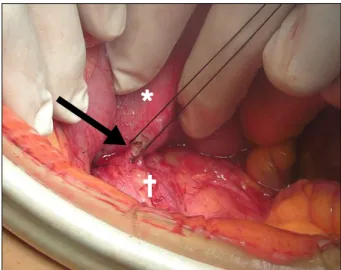
Fig. 3. The duodenum was lifted up, and the inferior vena cava (IVC) filter leg (arrow) between the IVC (†) and duodenum (*) was cut.

the IVC and the duodenum. We then cut the IVC filter leg and removed the IVC filter leg remnant from the duodenum portion. The duodenal perforation was repaired directly. The IVC was found to be densely adhered to the surrounding tis- sue including the aorta, and fixed to the adjacent structures.

We concluded that isolation and removal of the IVC filter leg remnant in the IVC were more dangerous due to the risk of rupture. The remaining leg protruding from the IVC side to the duodenum was cutoff and removed (Fig. 3).

After the surgery, ileus occurred and the patient started to eat by mouth after 14 days. The patient was discharged on the 20th postoperative day without any complications. The patient returned to work and is currently under follow-up observation.

DISCUSSION

The IVC filter is known as an effective and safe method for preventing fatal pulmonary thromboembolism in patients with deep vein thrombosis. The IVC filter is indicated in DVT patients when any of the following symptoms are pres- ent: contraindication of anticoagulation, major bleeding, need for surgery within 2 weeks, severe and prolonged thrombocy- topenia, and recurrent DVT disease despite anticoagulation.

Complications related with the IVC filter can be categorized as insertion-related complications, device failure, and late complications [1]. Insertion-related complications include pneumothorax, hemorrhage, filter misplacement, excessive tilt, and vascular injury. Late complications include recurrent pul- monary embolus, caval occlusion, filter migration, and filter leg perforation. Filter leg perforation occurs very frequently.

In a review of collected case series, the titanium Greenfield

filter showed a 3.5% perforation rate, the stainless steel

Greenfield filter showed a 4.4% rate, the Bird’s Nest filter

(3)

Duodenal Perforation Caused by Inferior Vena Cava Filter

− 71 − showed a 38% rate, and the Simon nitinol filter showed a 37% rate [2]. Most patients with perforations do not show any symptoms and the perforation rarely causes clinical prob- lems [3]. However, there are cases where the filter can dam- age surrounding organs and cause severe complications in the aorta, duodenum, ureter, or retroperitoneal space [4-6].

Pulsation of the aorta and respiratory motion are thought to be the main cause of caval penetration of the filter leg [7]. In our case, the cause of the IVC wall penetration seemed to be chronic progression of the IVC filter leg, nine months after the IVC filter insertion; subsequently, it finally penetrated in- to the duodenum. Based on the preoperative CT venography, the IVC flow was maintained and there was no DVT below the IVC level. Also, based on the observations in the oper- ation room, dense adhesion around the IVC and firmly fixed IVC filter itself was found. Although cardiopulmonary bypass was in standby before surgery, removal of the IVC filter was thought to be more risky. Thus, a partial resection of the IVC filter leg that was penetrating the duodenum was performed, and the IVC was reinforced.

Currently, the IVC filter is widely used and only 50% of them are removed from patients [8]. Most of the remaining IVC filters are asymptomatic and do not cause clinical problems. However, in order to prevent potential sequelae caused by IVC filter leg penetration, like that reported in this

case, the removal of the IVC filter, when possible, is preferred.

REFERENCES

1. Feezor RJ, Huber TS, Welborn MB 3rd, Schell SR. Duode- nal perforation with an inferior vena cava filter: an unusual cause of abdominal pain. J Vasc Surg 2002;35:1010-2.

2. Streiff MB. Vena caval filters: a comprehensive review.

Blood 2000;95:3669-77.

3. Woodward EB, Farber A, Wagner WH, et al. Delayed retro- peritoneal arterial hemorrhage after inferior vena cava (IVC) filter insertion: case report and literature review of caval perforations by IVC filters. Ann Vasc Surg 2002;16:

193-6.

4. Becher RD, Corriere MA, Edwards MS, Godshall CJ. Late erosion of a prophylactic Celect IVC filter into the aorta, right renal artery, and duodenal wall. J Vasc Surg 2010;52:

1041-4.

5. Widmer J, Stavropoulos S, Friedel D. Duodenal perforation by an inferior vena cava filter. Clin Gastroenterol Hepatol 2011;9:A18.

6. Baskara A, Ahmed R, Domingo O, Ahmadinejad A, Raezer D. Surgical management of inferior vena cava strut pene- tration causing hydronephrosis: case report. Vasc Endovas- cular Surg 2010;44:491-3.

7. Kinney TB. Update on inferior vena cava filters. J Vasc Interv Radiol 2003;14:425-40.

8. Rectenwald JE. Vena cava filters: uses and abuses. Semin

Vasc Surg 2005;18:166-75.

수치

Fig. 2. Endoscopy shows protruding inferior vena cava filter leg  (yellow arrow) in the lumen by penetrating the third portion of  duodenum

참조

관련 문서