INTRODUCTION
Idiopathic hypoparathyroidism is an endocrine disorder characterized by hypocalcemia and hyperphosphatemia due to impaired secretion of parathyroid hormone (PTH). Molec- ular genetic studies have elucidated the dynamic pathogen- esis of idiopathic hypoparathyroidism. It may occur as part of a polyglandular autoimmune disorder or as a complex con- genital defect, such as in DiGeorge’s syndrome. In addition, it may occur as a solitary endocrinopathy which is called iso- lated hypoparathyroidism. Isolated hypoparathyroidism may be caused by a mutation in the PTH gene, glial cells miss- ing (GCM)2 gene or calcium-sensing receptor (CaSR) gene (1, 2).
Gain-of-function mutations in the CaSR gene cause famil- ial hypocalcemia (3). Here we report a Korean family with two affected siblings and their phenotypically silent father, who were found to carry mutations in the CaSR gene. This case is the first report in Korea.
CASE REPORT
A 24-yr-old woman was seen in the endocrinology clinic
at Samsung Medical Center because of transient numbness and periodic paralysis. The patient reported that the symp- toms started 10 yr ago. The patient experienced occasional, brief episodes of paralysis during exertion that resolved with rest. Mild numbness and tingling of the hands and feet were also present intermittently.
On examination, the patient appeared well. Her vital signs were normal; her height was 155 cm, and her weight was 44 kg. Neurologic examination was significant for positive Trousseau and Chvostek signs. The remainder of the physi- cal examination was normal. Laboratory tests revealed hypo- calcemia (7.3 mg/dL; reference range 8.4-10.2), hyperphos- phatemia (5.7 mg/dL: reference range 2.5-4.5), decreased 1,25-dihydroxycholecalciferol ([1,25(OH)2D]13.2 pg/mL:
reference range 25.1-66.1), and decreased iPTH (4.9 pg/mL:
reference range 10-65). 25-hydroxycholecalciferol ([25(OH)D] 20.2 ng/mL: reference range 11-70) and 24-hr urinary calci- um excretion was normal as were bone densitometry, thy- roid functions tests, and radiographs of the kidney, ureter, bladder (KUB) and skull. The patient was treated with cal- cium carbonate and alfacalcidol with resolution of symptoms and dosages were adjusted to maintain a serum calcium level within the lower end of the normal reference range.
The older brother of the proband had a history of general-
317
Mi Yeon Kim1, Alice Hyun Kyung Tan1, Chang-Seok Ki2, Ji In Lee1,
Hye Won Jang1, Hyun Won Shin1, Sun Wook Kim1, Yong-Ki Min1, Myung-Shik Lee1, Moon-Kyu Lee1, Kwang-Won Kim1, and Jae Hoon Chung1
Division of Endocrinology and Metabolism, Departments of Medicine1and Laboratory Medicine2, Samsung Medical Center, Sungkyunkwan University School of Medicine, Seoul, Korea
Address for Correspondence Jae Hoon Chung, M.D.
Division of Endocrinology and Metabolism, Department of Medicine, Samsung Medical Center, Sungkyunkwan University School of Medicine, 50 Irwon-dong, Gangnam-gu, Seoul 135-710, Korea Tel : +82.2-3410-3434, Fax : +82.2-3410-6956 E-mail : [email protected]
J Korean Med Sci 2010; 25: 317-20 ISSN 1011-8934
DOI: 10.3346/jkms.2010.25.2.317
Autosomal Dominant Hypocalcemia Caused by an Activating Mutation of the Calcium-Sensing Receptor Gene: The First Case Report in Korea
Hypoparathyroidism is an abnormality of calcium metabolism characterized by low serum levels of parathyroid hormone in spite of hypocalcemia. The causes of hypo- parathyroidism are numerous. Activating mutations in the calcium-sensing recep- tor (CaSR) gene are well-known causes of familial isolated hypoparathyroidism, also known as autosomal dominant hypocalcemia (ADH). Here we describe mem- bers of a Korean family with a heterozygous Pro221Leu mutation causing ADH.
This case is the first report in Korea.
Key Words : Hypoparathyroidism; Hypocalcemia; Receptors, Calcium-Sensing
Received : 9 July 2008 Accepted : 1 October 2008
ⓒ 2010 The Korean Academy of Medical Sciences.
This is an Open Access article distributed under the terms of the Creative Commons Attribution Non-Commercial License (http://creativecommons.org/licenses/by-nc/3.0) which permits unrestricted non-commercial use, distribution, and reproduction in any medium, provided the original work is properly cited.
ized seizures since he was 20-yr-old for which he was seen by a neurologist at an outside hospital. He also presented to Samsung Medical Center with his sister because of intractable seizure. Initial evaluation revealed a serum calcium concen- tration of 7.5 mg/dL (reference range 8.4-10.2), a serum phos- phorus concentration of 6.1 mg/dL (reference range 2.5-4.5), and a serum magnesium concentration of 1.9 mg/dL (refer- ence range 1.9-2.5). The serum concentration of iPTH level was 6.2 pg/mL (reference range 10-65). He was treated with an antiepileptic medication and calcium carbonate, but seizure activity persisted. He was taking calcium carbonate 3 g per day with antiepileptic drug. He was admitted to the neurolo- gy ward where he underwent EEG and brain imaging. The laboratory test on admission showed a serum calcium con- centration of 7.1 mg/dL (reference range 8.4-10.2), a serum phosphorus concentration of 5.6 mg/dL (reference range 2.5- 4.5), and a serum ionized calcium concentration of 0.92 mM/L (reference range 1.05-1.35). Brain magnetic resonance imag- ing showed non-physiologic calcifications in the basal gan-
glia, bilateral frontal lobes, and cerebellum. The EEG was normal. A dosage of calcium supplement was adjusted, and alfacalcidol was added. He reported subsequent absence of seizure activity during follow-up. During follow-up the cal- cium level increased up to 8.3 mg/dL (reference range 8.4- 10.2) and the ionized calcium level increased up to 1.0 mM/L (reference range 1.05-1.35). After seizure activity subsided, he is followed-up by the physician near the home.
Although the parents of patients denied symptoms attribu- table to hypocalcemia, they agreed to evaluation. Laboratory examination of their father revealed hypocalcemia, hyper- phosphatemia, and an inappropriately low PTH level. The results of laboratory test are shown on Table 1. The mother’s laboratory work-up was normal. The remaining members of the family were not included in this study because of inac- cessibility (Fig. 1).
DNA analysis
After we obtained informed consent, the proband and her family members were examined to detect the CaSR muta- tions by direct sequencing analysis. Genomic DNA was ex- tracted from blood using a Wizard genomic DNA purifica- tion kit (Promega, Madison, WI, USA). Each of the 6 exons
318 M.Y. Kim, H.K. Tan, C.-S. Ki, et al.
N/A, not available; Ca, calcium; Mg, magnesium; TSH, thyroid stimulat- ing hormone.
Reference
Proband Sibling Father Mother range
Ca, ionized (mM/L) 1.05-1.35 0.91 0.95 0.80 1.30 Ca, total (mg/dL) 8.4-10.2 7.3 7.5 6.41 9.35 Phosphate (mg/dL) 2.5-4.5 5.7 6.1 4.62 3.8 Mg (mg/dL) 1.9-2.5 2.0 1.9 2.06 N/A iPTH (pg/mL) 10-65 4.9 6.2 13.5 27.2
T3 (ng/dL) 76-190 122 115 95 N/A
T4 (mg/dL) 4.7-12.5 8.4 9.7 N/A N/A Free T4 (ng/dL) 0.79-1.86 N/A N/A 1.43 N/A
TSH (mU/L) 0.30-6.50 2.63 2.34 1.46 N/A
24-hr urine Ca (mg) 100-240 126 204 N/A N/A Table 1. Biochemical features of three affected and a non-affect- ed family members
Gene test: not done
Mutation in CaSR gene: positive Mutation in CaSR gene: negative Proband
Fig. 1. The pedigree of the family. One of the uncles deceased in his third decade without clear cause. Closed black circles indicate the affected persons (proband, sibling, and father). The arrow in- dicates the proband. Closed gray circle indicates proband’s moth- er without mutation in calcium-sensing receptor (CaSR) gene. The remaining members of the family (open circles) were not includ- ed in this study because of inaccessibility.
CaSR-Exon01-F ACTGCAGGGAGTGAACTGCT CaSR-Exon01-R AGGTTGTGGGGGCAATAAG CaSR-Exon02-1-F GCCATGTCATCCCCATTTTA CaSR-Exon02-1-R CGCCTGAGAAGGCTTGAGTA CaSR-Exon02-2-F GTGGGTTTCGCTGGTTACAG CaSR-Exon02-2-R TCAGAAATCCCAAATGGTCA CaSR-Exon03-1-F GATGCTGCTTTTCCTTACCC CaSR-Exon03-1-R CCACTGGAGAAAACCACGAT CaSR-Exon03-2-F GAACCATCCCCAATGATGAG CaSR-Exon03-2-R ACTCCTTGGCAAAACCATTG CaSR-Exon03-3-F TCCAGCATGTGGTAGAGGTG CaSR-Exon03-3-R AGGATATCCGTAAATGCGTGT CaSR-Exon03-4-F ACAATGGTTTTGCCAAGGAG CaSR-Exon03-4-R TGCCCTTTTCAAATGACCAC CaSR-Exon04-F CACGTTCCTCCCACTTTGTT CaSR-Exon04-R CAAAGGCCAGAGAGTTCAGG CaSR-Exon05-F TGCACATGTGTGTGTGTGTG CaSR-Exon05-R AGAAACTGTGCAAAGCACCA CaSR-Exon06-1-F TCAGAATGATTTCAGCAAAATGG CaSR-Exon06-1-R ATGCATGAGATGCAGAGCAC CaSR-Exon06-2-F GCATTTTCCTGACAGCCTTT CaSR-Exon06-2-R TGGCACGTGATGAAGATGAT CaSR-Exon06-3-F CATCTCATGCATCCTGGTGA CaSR-Exon06-3-R AAGATGCACGCCAGCAAG CaSR-Exon06-4-F GCCATCTGCTTCTTCTTTGC CaSR-Exon06-4-R CTGCTGCTCTTGCTGGGTTA CaSR-Exon06-5-F CATCGAGGAGGTGCGTTG CaSR-Exon06-5-R TCCTTGCAGACCTGTTTCCT CaSR-Exon06-6-F CAGATGCAAGCAGAAGGTCA CaSR-Exon06-6-R GACTAAATTCGGGGCATTTG Table 2. Intronic primer sets of calcium-sensing receptor (CaSR) gene
of the CaSR gene were amplified by polymerase chain reac- tion using appropriate intronic primer sets designed by the authors (Table 2). Cycle sequencing was performed with a BigDye Terminator Cycle Sequencing Ready Reaction kit (Applied Biosystems, Foster City, CA, USA) on the ABI- 3100 Genetic Analyzer (Applied Biosystems).
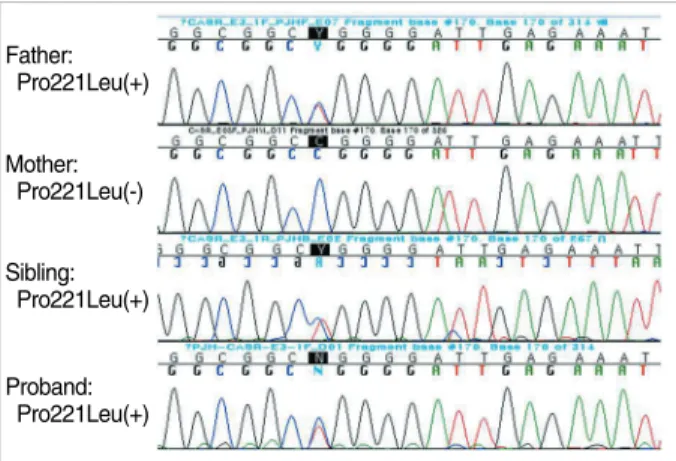
Direct sequencing showed that all affected family mem- bers have a C to T transition at nucleotide 662 resulting in a Pro221Leu missense mutation in exon 3 of the CaSR gene (Fig. 2).
DISCUSSION
In recent years, important advances in endocrinology have resulted from the application of the methods of molecular biology. These advances have helped not only to demonstrate the roles of mutant genes in the etiology of some inherited disorders, but have also helped to identify the chromosomal locations of susceptibility genes that predispose individuals at risk for a particular disorder such as familial hypocalcemia.
The results of the studies on the molecular genetics of the hypoparathyroid disorders have helped to elucidate some of the underlying pathways that are involved in calcium home- ostasis (1).
Theoretically, hypocalcemic disorders can be caused by deficiency of PTH, by a defect in the PTH/PTHrP receptor, or by insensitivity to PTH caused by defects downstream of the PTH/PTHrP receptor. The mutations in several genes such as CaSR (4), PTH (5), GCM2 and GATA3 (6) have been shown to cause hypoparathyroidism. Among them mutations in CaSR and PTH show autosomal dominant inherited forms of isolated hypoparathyroidism. GATA3 mutation is inher- ited autosomal dominantly, but it usually accompanied by multiple anomalies such as deafness and renal impairment (1, 2). Proband and her family member had hypocalcemia in conjunction with low PTH level, and a defect in the PTH/
PTHrP receptor and insensitivity to PTH could be exclud- ed. The absence of associated anomalies could partly exclude the mutations in GCM2 and GATA3 genes.
In 1993, it was discovered that the mutation of the CaSR gene causes familial hypocalciuric hypercalcemia and severe neonatal hyperparathyroidism. Subsequently, it was learned that a loss-of-function mutation causes hypercalcemia and gain-of-function mutation causes hypocalcemia (4), which is called autosomal dominant hypocalcemia (ADH).
The CaSR gene is located on chromosome 3q13.3-q21, and it encodes a cell surface protein of 1078 amino acids that is expressed in the PTH-producing chief cells of the parathy- roid glands and also in cells lining the kidney tubule. The CaSR belongs to the family of G-protein-coupled receptors (3, 7, 8). The CaSR in the parathyroid gland detects small changes of extracellular calcium concentration and regulates transcription of the PTH gene. The CaSR that is expressed in the distal renal tubule regulates renal calcium excretion (1). Thus, the CaSR is vital to maintaining normal serum cal- cium levels (9). Loss-of-function mutations in the CaSR gene are associated with a severe neonatal hyperparathyroidism and familial hypocalciuric hypercalcemia. Gain-of-function mutations in the CaSR gene are associated with a familial hypocalcemia (3). Since Pollack et al. reported an activating mutation in the N-terminal, extracellular domain of the CaSR gene (4), several activating mutations in the CaSR gene have been reported (9). Currently, there is a database of mutations of CaSR available on the internet (http://www.casrdb.mcgill.
ca/) which lists all the known CaSR mutations and their effects (10). Pro221Leu missense mutation was first reported in 2000, and the mutation is located in a lesion of the extracellular domain of the receptor. Replacement of a large, rigid proline with a smaller and more flexible leucine residue, potentially changing the conformation of the calcium-binding region to resemble that of bound calcium or facilitating the bind- ing of calcium ions, resulting in an active mechanism (11).
Four more cases were reported in CaSR database after 2000.
It is important to distinguish hypocalcemia due to an acti- vating mutation of CaSR from isolated hypoparathyroidism because ADH patients can develop nephrocalcinosis and renal impairment during treatment with calcium and vitamin D.
The distinction between isolated hypoparathyroidism and ADH may be difficult to make on based on clinical informa- tion alone. Therefore, mutational analysis of the CaSR gene can be considered to assess the risk of nephrocalcinosis dur- ing treatment of PTH-deficient hypoparathyroidism (12).
In conclusion, although a case of familial benign hypocal- ciuric hypercalcemia due to a loss-of-function mutation in the CaSR gene has been reported in Korea (13), a gain-of-func- tion mutation of the CaSR gene that causes familial hypocal- cemia has not yet to be reported in Korea. Here we have des- cribed the first Korean family with ADH with a review of the literature.
Familial Hypocalcemia Caused by Mutation of the CASR Gene 319
Father:
Pro221Leu(+)
Mother:
Pro221Leu(-)
Sibling:
Pro221Leu(+)
Proband:
Pro221Leu(+)
Fig. 2. Direct sequencing of the calcium-sensing receptor (CaSR) gene.
REFERENCES
1. Thakker RV. The Molecular genetics of Hypoparathyroidism. In:
The Parathyroids: basic and clinical concepts, 2nd ed, San Diego, CA: Academic Press, 2001; 779-90.
2. Thakker RV. Genetics of endocrine and metabolic disorders: para- thyroid. Rev Endocr Metab Disord 2004; 5: 37-51.
3. Pearce SH, Williamson C, Kifor O, Bai M, Coulthard MG, Davies M, Lewis-Barned N, McCredie D, Powell H, Kendall-Taylor P, Bro- wn EM, Thakker RV. A familial syndrome of hypocalcemia with hypercalciuria due to mutations in the calcium-sensing receptor. N Engl J Med 1996; 335: 1115-22.
4. Pollak MR, Brown EM, Estep HL, McLaine PN, Kifor O, Park J, Hebert SC, Seidman CE, Seidman JG. Autosomal dominant hypocal- caemia caused by a Ca(2+)-sensing receptor gene mutation. Nat Ge- net 1994; 8: 303-7.
5. Arnold A, Horst SA, Gardella TJ, Baba H, Levine MA, Kronenberg HM. Mutation of the signal peptide-encoding region of the prepro- parathyroid hormone gene in familial isolated hypoparathyroidism.
J Clin Invest 1990; 86: 1084-7.
6. Chiu WY, Chen HW, Chao HW, Yann LT, Tsai KS. Identification of three novel mutations in the GATA3 gene responsible for familial hypoparathyroidism and deafness in the Chinese population. J Clin Endocrinol Metab 2006; 91: 4587-92.
7. Brown EM, Pollak M, Chou YH, Seidman CE, Seidman JG, Hebert SC. Cloning and functional characterization of extracellular Ca(2+)-
sensing receptors from parathyroid and kidney. Bone 1995; 17 (2 Suppl): 7S-11S.
8. Brown EM, Pollak M, Seidman CE, Seidman JG, Chou YH, Ric- cardi D, Hebert SC. Calcium-ion-sensing cell-surface receptors. N Engl J Med 1995; 333: 234-40.
9. Hendy GN, D’Souza-Li L, Yang B, Canaff L, Cole DE. Mutations of the calcium-sensing receptor (CASR) in familial hypocalciuric hypercalcemia, neonatal severe hyperparathyroidism, and autoso- mal dominant hypocalcemia. Hum Mutat 2000; 16: 281-96.
10. Pidasheva S, D’Souza-Li L, Canaff L, Cole DE, Hendy GN. CAS- Rdb: calcium-sensing receptor locus-specific database for mutations causing familial (benign) hypocalciuric hypercalcemia, neonatal se- vere hyperparathyroidism, and autosomal dominant hypocalcemia.
Hum Mutat 2004; 24: 107-11.
11. Conley YP, Finegold DN, Peters DG, Cook JS, Oppenheim DS, Fer- rell RE. Three novel activating mutations in the calcium-sensing re- ceptor responsible for autosomal dominant hypocalcemia. Mol Genet Metab 2000; 71: 591-8.
12. Lienhardt A, Bai M, Lagarde JP, Rigaud M, Zhang Z, Jiang Y, Kot- tler ML, Brown EM, Garabe@dian M. Activating mutations of the cal- cium-sensing receptor: management of hypocalcemia. J Clin Endo- crinol Metab 2001; 86: 5313-23.
13. Woo SI, Song H, Song KE, Kim DJ, Lee KW, Kim SJ, Chung YS.
A case report of familial benign hypocalciuric hypercalcemia: a mu- tation in the calcium-sensing receptor gene. Yonsei Med J 2006; 47:
255-8.
320 M.Y. Kim, H.K. Tan, C.-S. Ki, et al.