農業科學技術硏究, 第48輯, 2014年 6月 Agricultural Science &
Technology Research, Vol. 48
Effect of endosperm mutation, silk condition and moisture content on Fusarium verticillioides
infection in sweet corn
Tae-Ho Han*
Institution of Agricultural Science and Technology Chonnam National University Gwangju 500-757 South Korea
*Corresponding author: [email protected]
요 약
Fusarium verticillioides J. Sheldon은 전세계적으로 여러 작물에 영양을 끼치는 걸로 알려 져 있다. 근래에는 대부분의 옥수수종류에 감염이 되는 것이 증명되었다. F. verticillioides의 광역적인 서식능력과 생식능력으로 인하여 물리적 화학적 조절이 어렵게 되었다. Sweet corn inbreds들 중 F. verticillioides에 부분 저항성이 있고 발아력이 좋은 inbred들이 존재함이 증명 되었다. 본 실험에서는 sweet corn을 토대로 한 저항성 유전 연구를 위한 기초 자료를 논하였 으며, F, verticillioides에 의한 종자 감염이 1) 배유종류 2) 옥수수 수염상태 3) 옥수수 수염의 수분 함량 등에 영향을 받았다. 종자 감염에 있어서 큰 변이를 보임은 여러 유전자들이 부분적 저항성에 영향을 줌을 알 수 있었다.
Additional key words: Fusarium moniliforme, Germination, Germplasm, Mutation, Plant breeding
Introduction
Fusarium verticillioides J. Sheldon, the imperfect state of Gibberella fujikuroi Sawada, commonly infects a wide range of crops throughout the world and is a major parasite of the Graminea, particularly in tropical and subtropical regions (Styer and Cantliff, 1984). It has been isolated in corn. F.
verticillioides produces a group of compounds called Fumonisin B1, B2, B3 and B4 (Zummo and Scott, 1992) during host tissue colonization that is toxic to plant and mammalian systems and can
contaminate fresh and processed corn products (Bacon et al., 1992; Selby et al., 1992; Sydenham, 1992). Due to the cosmopolitan nature of F.
verticillioides and its ability to survive in seed and debris, crop rotation and chemical control generally have been ineffective. Natural selection of genetic resistance warrants the greatest potential for control of such problems.
Sweet corn inbreds have been identified that exhibit partial resistance to kernel infection by F.
verticillioides and good emergence (Headrick and Pataky, 1989). In a recent study Headrick et al.
(1989) found sh2 genotypic variation for F.
verticillioides susceptibility among sh2, su1 and se1 inbreds. However, a limited set of germplasm were evaluated in his study.
We report information for studies on the genetics of resistance in sweet corn to this seed-borne pathogen. It will also identify promising parents in breeding programs aimed to develop improved sweet corn germplasm.
Material and Methods
1. Plant material
Seed of 25 sweet corn inbreds (8 su1, 8 se1, 9 sh2) were provided from the sweet corn breeding program in the Department of Horticulture at the University of Illinois. Two replicate plantings of 25 sweet corn inbreds were transplanted into the green house ground bed under high pressure sodium vapor lighting. Plots consisted of 15 plants in rows 76 cm apart. Ground bed soil consisted of 10 parts coarse quartz sand and three parts silty clay loam soil by volume and sterilized before planting.
2. Inoculation procedure
A modified peptone-PCNB medium was used for the isolation and growth of Fusarium colonies (Papavizas, 1967). Infected kernels were placed on the modified peptone-PCNB medium plates to isolate and grow F. verticillioides. F. verticillioides colonies were transferred to many petri dishes with PCNB media, and incubated at 20ºC to obtain appropriate amount of F. verticillioides for plant inoculation. Two inoculations (4 - 7 and 18 - 21 DAP) were carried out on individual inbred ears after self-pollinated with F. verticillioides. The silks of one group were inoculated with microconidial suspensions of F. verticillioides while the other served as a non-inoculated control (Headrick and
Pataky, 1989).
Cultures were flooded with water and a drop of Tween 80, gently rubbed with a glass rod to dislodge the conidia. The inoculum concentration was determined with a hemacytometer and adjusted to approximately 103 microconidia/ml for first inoculation and 104 microconidia/ml in the second inoculation. Using a hand sprayer approximately 5 ml of the inoculum suspension was sprayed onto the silks of each developing ear after the tassel bag had been removed from the self-pollinated ear. Each inoculated ear was covered with a plastic bag and recovered with the tassel bag. These plastic bags were used to maintain sufficient humidity in the silks needed for the germination of the spores and for subsequent hypae invasion of the kernel (Warren, 1978). Plastic bags were removed from the ears 48 hours later and recovered with tassel bags until harvested. Three to four weeks after the second inoculation, the ears were harvested, shelled, and dried in an forced air oven at 30ºC. The seed was then cleaned and bulked for each inbred and treatment.
Results and Discussion
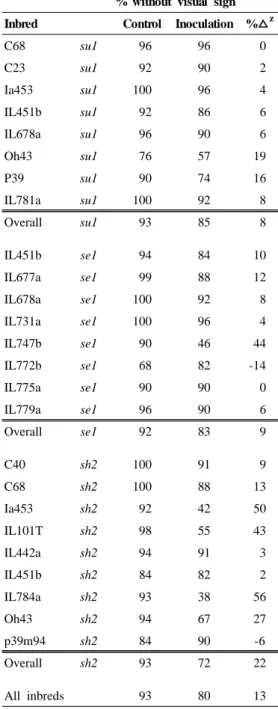
The data presented in table 1 is the percentage of kernels with and without visual sign of F.
verticillioides from the bulked mature-dry seed of each inbred in the control and inoculated treatment.
It provided a preliminary estimate of the comparative susceptibility of the 25 inbred lines to inoculation. Even in the absence of inoculation, substantial numbers of kernels of the control group displayed visual signs of infection from 0 - 32 % (Table 1 and Fig. 1). The level of infection in the control was partially due to the fact both treatments were grown in the same greenhouse, due to limited space, and demonstrated the ubiquitous dispersal of the pathogen. However, the percentage of kernels
Table 1. Percent of kernels of 25 sweet corn inbred displaying visual sign of F.
moniliforme.
% without visual sign Inbred Control Inoculation % z
C68 su1 96 96 0
C23 su1 92 90 2
Ia453 su1 100 96 4
IL451b su1 92 86 6
IL678a su1 96 90 6
Oh43 su1 76 57 19
P39 su1 90 74 16
IL781a su1 100 92 8
Overall su1 93 85 8
IL451b se1 94 84 10
IL677a se1 99 88 12
IL678a se1 100 92 8
IL731a se1 100 96 4
IL747b se1 90 46 44
IL772b se1 68 82 -14
IL775a se1 90 90 0
IL779a se1 96 90 6
Overall se1 92 83 9
C40 sh2 100 91 9
C68 sh2 100 88 13
Ia453 sh2 92 42 50
IL101T sh2 98 55 43
IL442a sh2 94 91 3
IL451b sh2 84 82 2
IL784a sh2 93 38 56
Oh43 sh2 94 67 27
p39m94 sh2 84 90 -6
Overall sh2 93 72 22
All inbreds 93 80 13
z The change in the percent of kernels with sign of the pathogen with inoculation. This value was calculated by subtracting percent kernels with visual sign in the control treatment from percent with visual sign in the inoculated treatment.
su1 se1 sh2
Fig. 1. The percentage with visual sign caused by F. moniliforme infection are shown by endorsperm mutations (su1, se1, sh2).
showing visual signs of infection averaged over all inbreds was nearly three times greater in the inoculated treatment than the control except for only two inbreds, IL772b se1 and p39m94 sh2, showing lower infection levels. The data suggested the inoculation procedure was successful at increasing the percentage of diseased kernels (Fig. 1).
Inbreds were found to vary in the response to the inoculation in terms of the percentage of kernels showing visual signs of the pathogen. The inbreds, C68 su1, Ia453 su1 and IL731a se1 had the lowest proportion of the kernels that displayed visual signs of pathogen in the inoculated treatment. In contrast, IL784a sh2 showed a 63 % increase in diseased kernels with inoculation. The three inbreds with the fewest infected kernels appear to be able to withstand the inoculation without an increase in visual infection. These same inbreds were also found the smallest change in percent kernels with sign between the control and inoculated. Preliminary information, one data suggested these inbreds posses a form of resistance to F. verticillioides that resulting a reduction in the presence of kernels with visual signs of the pathogen.
The proportion of infected kernels when averaged among inbreds for the different endosperm mutations was 22 % for sh2, 8.7 % for se1, and 7.6 % for su1. The sh2 lines possessed 2.5 and 2.9 times more infected kernels than the su1 and se1
genotypes, respectively. The sh2 inbreds were in general more susceptible to the inoculation treatment, suggesting this endosperm mutation may in some way condition susceptibility. Sweet corn with sh2 mutation has been shown to maintain higher sugar and moisture content during the later stages of kernel development (after 20 days following kernel fertilization) than with the su1 and se1 endosperm mutation (Douglass et al., 1993).
The higher sugar and moisture concentration in sh2 sweet corn may influence the ability of the pathogen to colonize kernels, particularly after the silks have begun to senescence and provide the substrate and a path of entry for the hyphae into kernels. The condition of exposed silks at inoculation seemed to be associated with kernel infection by F.
verticillioides as suggested by Headrick et al.
(1989). Inbreds with green, actively growing silks at inoculation had less asymptomatic kernel infection than those with green-brown or brown silks and the presence of brown, senescent silks appeared to be important in initiating infection (Headrick et al., 1989).
Moisture content of the silks and timing of kernel infection also may have been important factors.
Koehler (1942) observed a substantial increase in the percentage of sound kernels infected by F.
verticillioides after kernel moisture had dropped below 34 %. A similar pattern of kernel infection was observed by A. flavus, however they found less kernel infection when brown silks were inoculated (Marsh and Payne, 1984). The placement of plastic bags on the inoculated silks in our experiments may have resulted in an artificial inflation of the incidence of F. verticillioides on brown silks compared to green-brown silks, if in fact moisture was a limiting factor in silk colonization.
Nevertheless, green silks which were high in moisture appeared to be a mechanism of resistance to silk colonization by F. verticillioides.
There are other factors (Headrick et al., 1990)
influencing the response of the genotypes beside the affect associated with the endosperm mutation, as indicated by the fact that among the sh2 inbreds the increase in percent kernels displaying F.
verticillioides with inoculation ranged from 2 to 56%. This suggests genetic variation at other loci are affecting inbred susceptibility to inoculation.
Genetic variation in the precent of kernels showing signs of F. verticillioides with silk inoculation was also observed among the su1 (0 - 19 %) and se1 (0 - 44 %) inbreds. Some of these differences may be related to variation in kernel moisture concentrations during kernel maturation or from differences in silk longevity.
F. verticillioides has been found to inhibit kernel infection by Aspergillus flavus in inoculated maize ears and lead to reduced aflatoxin contamination in kernels (Zummo and Scott, 1992). F. verticillioides may serve as a deterrent to kernel invasion by other seed-infection fungi including Fusarium graminearum and Diplodia maydis (Rheeder et al., 1990).
Even though the inoculation method was not natural infection, it allowed to detect the variation among genetic materials in our study. In conclusion kernel infection by F. verticillioides was influenced by several factors, such as 1) endosperm mutation;
2) silk condition; 3) moisture content of the silks.
Nevertheless, wide variation of symptoms in kernel infection suggested that several genes might be involved for the partial resistance action.
Acknowledgements
This research was supported by Bio-industry Technology Development Program, Ministry for Food, Agriculture, Forestry and Fisheries, and by the LMO environment risk assessment of assign the RDA, Republic of Korea.
Summary
Fusarium verticillioides J. Sheldon infects a wide range of crops throughout the world. It has been isolated in corn of all endosperm types. Due to the cosmopolitan nature of F. verticillioides and its ability to survive in seed and debris, crop rotation and chemical control generally have been ineffective. Sweet corn inbreds have been identified that exhibit partial resistance to kernel infection by F. verticillioides and good emergence. We report preliminary information for future studies on the genetics of resistance in sweet corn to this seed-borne pathogen. Kernel infection by F.
verticillioides was influenced by several factors, such as 1) endosperm mutation; 2) silk condition;
3) moisture content of the silks. Wide variation in kernel infection suggested that several genes might be involved for the partial resistance action.
References
1. Bacon, C.W., Rennett, R.M., Hinton, D.M. and Voss, K.A. 1992. Scanning electron microscopy of Fusarium moniliforme within asymptomatic corn kernels and kernels associated with equine leukoencephalomalcia. Plant Dis. 76: 144-148.
2. Douglass, S.K., Juvik, J.A. and Splittstoesser, W.E. 1993. Sweet corn seedling emergence and variation in kernel carbohydrate reserves. Seed Sci. and Technol., 21, 433-445.
3. Headrick, J.M. and Pataky. J.K. 1989. Maternal Influence and the effect of host traits on the response of sweet corn lines to Fusarium moniliforme. (Abstr.) Phytopathology 79: 1596.
4. Headrick, J.M., Pataky, J.K. and Juvik, J.A.
1990. Relationships among carbohydrate of kernels, condition of silks after pollination, and
the response of sweet corn inbred lines to infection of kernels by Fusarium moniliforme.
Phytopathology 80: 487-494.
5. Koehler, B. 1942. Natural mode of entrance of fungi into corn ears and some symptoms that indicate infection, J. Agric. Res. 64: 421-442.
6. Marsh, S. F. and Payne, G. A. 1984. Preharvest infection of corn silks and kernels by Aspergillus flavus. Phytopathology 74: 1284-1289.
7. Papavizas, G.C. 1967. Evaluation of Various Media and Antimicrobial Agents for Isolation of Fusarium from Soil. Phytopathology 25:
848-852.
8. Rheeder, J.P., Marasas, W.F.O., and Van Wyk, P.S. 1990. Fungal association in corn kernels and effects on germination. Phytopathology 80:
131-134.
9. Selby, R.A., Holt, S.E. and White, D.G. 1992.
Variation in fumonisin levels in maize hybrids.
Phytopathology 82: 1146.
10. Sydenham, E.W, Shephard, G.S. and Thiel, P.G.
1992. Liquid Chromatographic Determination of Fumonisins B1, B2, and B3 in Foods and Feeds. Journal of AOAV International Vol. 75, No. 2, 1992.
11. Styer, R.C. and Cantliffe, D.J. 1984. Infection of two endosperm mutants of sweet corn by Fusarium moniliforme and its effect on seedling vigor. Phytopathology 74: 189-194.
12. Warren, H.L. 1978. Comparison of normal and high-lysine maize inbreds for resistance to kernel rot caused by Fusarium moniliforme.
Phytopathology 68: 1331-1335.
13. Zummo, N. and Scott, G.E. 1992. Interaction of Fusarium moniliforme and Aspergillus flavus on kernel infection and aflatoxin contamination in maize ears. Plant Dis. 76:
771-773.