<연구논문> Fashion & Text. Res. J.
Vol. 16, No. 1, pp.55-65(2014) http://dx.doi.org/10.5805/SFTI.2014.16.1.55
55
Music Visualization Expression in Modern Fashion
- Focus on the application of Mondrian's paintings to Alexander McQueen’s 2014 Spring Ready-to-wear Collection -
Sung-Soo Kim
1)and Young-Sam Kim
2)†Dept. of Fashion, Chung-Ang University; Seoul, Korea
Dept. of Clothing & Textiles, College of Arts, Chung-Ang University; Anseong, Korea
Abstract : This study analyzes music visualization characteristics in modern fashion based on Wassily Kandinsky's music visualization theory. Alexander McQueen’s 2014 Spring Ready-to-wear Collection (as inspired by Mondrian's paintings) was selected as the research subject. First, an analysis of Mondrian's paintings based on Wassily Kandinsky's theory shows that music visualization characteristics can be categorized into spatiality, mobility, and duality. Second, McQueen applied Mondrian's paintings to the overall design, structured the model's shape in the painting, or created patterns using colors and lines that introduced them in clothes; symbolic forms were also introduced as part of or a decorative factor of the clothes. Third, spatiality refers to the creation of a feeling of space through emptiness or fill using lines, colors, and shape. Musical atmosphere such as dissonance were expressed in clothing through the application of color contrast, lines and silhouette dynamics, and symbolic format and patterns by Mondrian. Fourth, mobility generally refers to motion caused by a certain stimulus. Mondrian expressed vibration, internal resonance, sound level in music that emphasized color irregularity, primary color contrast, and rough brush touches as well as free and organic patterns. McQueen expressed this with primary color contrast using different materials, rough touch based on texture, and pattern repetition through transformation. Fifth, duality generally refers to the artistic effect caused by overlap. Mondrian created a resem- blance of dissonance and music through line and color as expressed through the duality of clothing design components based on the artistic sense of the designer.
Key words: music visualization, Piet Mondrian, Alexander McQueen, Wassily Kandinsky, modern fashion
1. Introduction
Food, clothing, and shelter are three primary components of physical protection and comfort for human existence. After achiev- ing stability in the basic elements, they develop into a higher level of mental satisfaction through culture, art, and leisure activities.
The function of clothing(one of the three main necessities) has shifted from protecting the human body to serving as an internal and external expression component that displays class, societal ten- dency, atmosphere, and psychology. Under the term ‘fashion’, modern society considers clothing a mandatory element of culture and art that is universal and encompasses the cultural phenomenon and artistic methods of expression in that era that occur due to the clothes that humans wear.
Modern fashion satisfies the aural, visual senses of humans in the 21st century as well as continuously attempts to create satis- faction through various sensory organ experiences that collaborate with fields such as architecture, sculpture, painting, crafts, and
music. Displaying the inspirations drawn from abstract paintings onto clothing is about borrowing the superficial design of paintings as well as an attempt to share and express the multisensory char- acteristics of the painting. Through modern fashion, this can be considered an expansive effort to provide a satisfactory multisen- sory experience to humans(Kim, 2013).
Music visualization is considered a representative synesthesia phenomenon of modern paintings and fashion. This synesthesia phenomenon appears in the paintings of Wassily Kandinsky(the father of abstract art) as well as in the works of succeeding abstract artists Piet Mondrian, Frantisek Kupka, Robert Delaunay, and Paul Klee. Their works provide design motives and inspiration for the collections of modern day fashion designers(Kim, 2012).
Collections that use abstract paintings as motives and studies on music visualization in clothing have been recently analyzed. Pre- vious studies(Jung, 2002; Lee, 2003; Lee, 2008) related to this research set a music genre and analyzed the characteristics with a fashion design based on music related images. Kang and Kim(2009) conducted a study that planned and produced a piece that used the works of abstract painters like Mondrian and Kan- dinsky as motives; however, Cho(2004) analyzed collections that applied Mondrian's works based on conception methods and fre-
†Corresponding author; Young-Sam Kim Tel. +82-31-670-3278, Fax. +82-31-676-9932 E-mail: [email protected]
quency. Various studies have analyzed fashion design that used music visualization and abstract paintings as motives; however, most were an analyses of artwork production and expression meth- ods. Consequently, we researched the multisensory characteristics analysis and expression methods that appear in clothing as a study that builds on previous studies.
Our research team set the following research problems. First, how is music visualization(a representative synesthesia phenome- non in Mondrian's paintings) expressed in designer collection clothing that uses his paintings as motives. Second, if music visu- alization is expressed, what kind of expression method is used in clothing? Third, are music visualization characteristics from Mon- drian's paintings expressed in the same way in clothing?
Based on the necessity of the study and research problems, the scope of the study was set as modern fashion which applied the music visualization found in paintings by Mondrian. Mondrian was selected because he is a leading abstract artist who expressed music visualization. As shown in Yves Saint Laurent's Mondrian Look in the 1960s, his works have been widely applied by fashion design- ers. We limited it to modern fashion in order to investigate what developments were made in the process of recreating music visu- alization expression in pieces by Mondrian from the 19th to 20th centuries into the design of another field in the 21st century. We limited it to designer collections that applied Mondrian's paintings for the relevance between research subjects to analyze the cloth- ing's music visualization characteristics based on Mondrian's paint- ings. To objectively select a collection as the study subject, we chose a collection that was inspired by or applied Mondrian's work.
Our study examined Alexander McQueen’s 2014 Spring Ready-to- wear Collection praised as ‘Mondrian's New Muse’ by London evening standard's editor Karen Dacre (2013) and ‘Mondrian's Var- ious Visual Forms have Appeared’ by Style.com's editor Tim Blanks(2013).
The following are the goals of this study based on research prob- lems and range. First, we examine the characteristics of music visu- alization that appear in Mondrian's paintings. Second, we analyze Alexander McQueen’s Ready-to-wear 2014 S/S Collection, which applied Mondrian's paintings, and observe the methods to express music visualization. Third, we analyze the music visualization characteristics that appear in Alexander McQueen’s collection.
For the research methods, we conducted a literature review of related previous studies, Internet references on the definition of music visualization and the music visualization expression char- acteristics in Mondrian's paintings. We also conducted a case study based on Alexander McQueen’s collection image material with domestic and overseas fashion and Internet magazines.
2. Theoretical Background
2.1. General Inquiry of Music Visualization
Research and attempts on synesthesia felt by humans have been made in various fields ranging from social sciences to aesthetics.
Synesthesia is a universal human desire to learn about the funda- mental cause of internal phenomenon. Consequently, synesthesia is becoming more conceptualized and defined(Kim, 2013).
Music visualization(the representative phenomenon among syn- esthesia phenomenon) is a composite term. The mutual interaction between aural and visual senses is a synesthesia phenomenon that is a visual expression of a musical experience shown through a resem- blance of social phenomenon or daily experiences(The National Institute of the Korean Language[NIKL], 2013). Visual expression with forms and colors is a representative multisensory phenomenon in which musical experience is visualized(Kim, 2012).
Visual images are composed of an important interaction of col- ors and forms. Consequently, the role that form takes from a visual perspective is very important because it is necessary to visually communicate the original meaning of an object. The meaning can be communicated in the case of fine art(the most representative form of visual art) by only satisfying formative aspects like points, lines, and faces.
A point can express a single vibration and in music, it can make a collective composition by resonating or forming consecutive series. Musicians regard a point as providing a certain level of con- scious force or an attractive force that can be clearly recognized through an internal nature(Kandinsky, 1979/2011). When creating a visual image, a line makes free expression possible based on indi- vidual experience or emotion through which various types of dis- play can be made.
Most instruments can be expressed as a line, with the unique pitch of similar instruments matching the width of a line. The tone and pitch of an instrument may create an extremely thin or thick line. Tension and playful expressions can be displayed with curves made by line transformation or protruded angles. In the case of faces, various effects can be expressed such as pure stability with shapes that have no angles like circles or that provide direction with transformed rectangles. Also, the effects of tension or resistance using confrontation, crossing, parallel arrangements of shapes are visually expressed.
Multi-disciplinary research on the correlation of color and notes
to study music visualization through colors has been done by peo-
ple who are brilliant in colored hearing. Isaac Newton showed the
same correspondence between color and sound by matching
sounds to rainbow colors; in addition, Steve Halpern's color and
sound mutual correlation map and Launyung's Rainbow Scale are representative studies that compare sound to color(Walker, 1990/
1996). Table 1 summarizes the results of previous scholars to con- nect colors to sounds.
2.2. Inquiry of Music Visualization Characteristics Based on Wassily Kandinsky's Theory
Wassily Kandinsky delivered sensitivity to humans through painting(visual art) and music(aural art). He broke the general framework of drawing that depicted objects and expressed colors · lines · forms as art pieces to pursue drawings that devel- oped pure musical language into visual language(Kim, 2012). Bal- ance and harmony are displayed through music chords; consequently, Kandinsky created an overall internal emotion by forming harmony through a balance of colors and lines in paintings. All colors have a certain significance and he showed mobility, balance, contrast, and harmony by assigning form or meaning and expressed them freely and meaningfully.
The representative works of Kandinsky that display music visu- alization can be limited to four pieces, ‘Impression 3’(Fig. 1),
‘Improvisation 19’(Fig. 2), ‘Composition 5’(Fig. 3) and ‘Compo- sition 9’(Fig. 4). He stated in his book 'Concerning the Spiritual in Art'(Uber das Geistige in der Kunst) that these were works that
expressed the unison of art with the rhythmic sense that music gives.
Kandinsky mentions Schoenberg's musical characteristics in his works, saying that “Schoenberg attempts to completely use his freedom. Also, he has already discovered new beauty from the path that reaches internal inevitability. His music guides us with the new perspective that its musical experience is not aural, and rather purely from the heart. Therefore, the music of the future starts here.”(Kandinsky, 1973/2007).
Music visualization characteristics based on the books and pieces of Kandinsky can be categorized into spatiality, mobility, and duality.
2.2.1. Spatiality
Space refers to a wide physical or psychological range or area. It also refers to a place, area, and world where certain matters or objects can exist or certain events may occur. Physically, its def- inition is limited to a location in which matter exists and various phenomenon occur(NIKL, 2013). Space in Kandinsky's paintings is expressed in various methods through colors, lines, and shapes;
in addition, music visualization was displayed through such feel- ings of space.
‘Impression 3’(Fig. 1) of Kandinsky's ‘Impression’ series is a piece that Kandinsky created from inspiration after watching the Schoenberg concert held in Munich on January 2nd 1911. In this piece, the feeling of dissonance in Schoenberg’s music is reinter- preted picturesquely and is implemented with a strong collision between black and yellow which are conflicting colors and the spa- tial feeling of unclear figures created by black smears which imply the audience(Baek, 2011).
‘Improvisation 19’(Fig. 2) is a piece drawn after listening to Wagner's ‘Lohengrin’, it is characterized by a strong primary color contrast that follows a sequential usage of a purple tone. Instead of simply visualizing music, the artist's displays the moment of the performance by depicting the people inside the concert. The per- pendicular solemn form on the right with thick black expressive lines(shaped as if giving a prayer) attracts attention that spreads out to the primary color back. It adds a more profound feeling of space to the purple tone and maintains the composition.
Table 1. Color resemblance of each note Scholar Color
Isaac Newton
Steve
Halpern Launyung
1. Red C C A
2. Red-Violet B
3. Violet B B C
4. Blue-Violet A A C
5. Blue G G D
6. Blue-Green D
7. Green F F E
8. Yellow-Green F
9. Yellow E E F
10. Yellow-Orange G
11. Orange D D G
12. Red-Orange A
Fig. 1. Impression 3.
http://www.wikipaintings.org
Fig. 2. Improvisation19.
http://www.wikipaintings.org
Fig. 3. Composition 5.
http://www.wikipaintings.org
Fig. 4. Composition 9.
http://www.wikipaintings.org
‘Composition 9’(Fig. 4) is a drawing full of musical feeling, atmosphere, or an emotional sense. Kandinsky expresses a varied musical visualization through symbols with a noticeable expression of spatiality. Delicate symbols provide a dynamic feeling of space into the world that transcends morphological formats of organisms and a perspective that is displayed with a space of no gravity. Dis- sonance with respectively different forms are also supplemented with the harmony of colors and dynamic specialty(Jo, 2012).
2.2.2. Mobility
The concept of ‘motion’ generally means movement and those movements occur under a condition such as certain stimuli(NIKL, 2013). Various perspectives interprets the term physically as the change of an object's spatial location when time passes that also philosophically refers to all changes and developments of the object's existence.
Kandinsky's ‘Impression 3’(Fig. 1) shows that the strong contrast between primary colors exerts a feeling of deep vibration between a bass wind instrument and a high tune string instrument as well as internal emotions that resonate together and spread out. The rough touch and the irregularity of the color surface(which displays a sense of pace with a purple tone) further stimulates the eruption of emo- tion and the hue of the thick plane with a contrasting primary color that is overemphasized due to the usage of white.
As an art piece when abstract expressionism started to become more present, ‘Composition 5’(Fig. 3) displays the resurrection of Jesus Christ. It unfolds a drama in which various sorts of free float- ing organic forms that shows a certain mobility. The thick line that penetrates from right to left is the sound coming from a trum- pet(Kim, 2007). The white forms are the movements of angels blowing trumpets when Jesus Christ is resurrected. The black line that is powerfully wriggling in the center of the drawing depicts the sound from the angels' trumpets. With the overall theme being the resurrection of Jesus Christ, the scene in which he ascends to heaven is more lively expressed with musical melody.
‘Composition 9’(Fig. 4) also provides a sense of musical emo- tion across the entire painting. Above the colors divided with diag-
onal lines, geometric shapes that resemble organisms free float with decorative components. The wide diagonal lines in the back are low tone background music that play the background sound in music and the geometrical shapes that float as if flying in the front correspond to the music of instruments that conduct rhythm and harmony(Jo, 2012).
2.2.3. Duality
Duality refers to various objects or content superimposed or laid over each other with multiple phenomenon that simultaneously occur through overlapping. Duality is frequently used to conceal or emphasize a subject and can provide the effect of protection and supplementation. Duality in paintings express the profound inner world of the artist through design components such as lines, colors, or materials, and provides a three dimensional or active feel- ing(NIKL, 2013). Kandinsky tried to create music visualization using duality. His brightly expressed colors below the black line in
‘Composition 5’ represent the twinkling of light and exert the feel- ing of infiniteness from a white flash that ignores perspective and volume(Jo, 2012).
The dissonances in ‘Composition 9’(all which have different forms) are supplemented with harmony of colors and a dynamic feeling of space. The small forms are overlapped as if sprinkled on a background that is widely divided in a diagonal direction shown with like images of life.
Kandinsky expresses mobility and spatiality using the duality of line and color and form change in each of his paintings. This stim- ulates the aural senses of the people who look at the drawing and have them think of music.
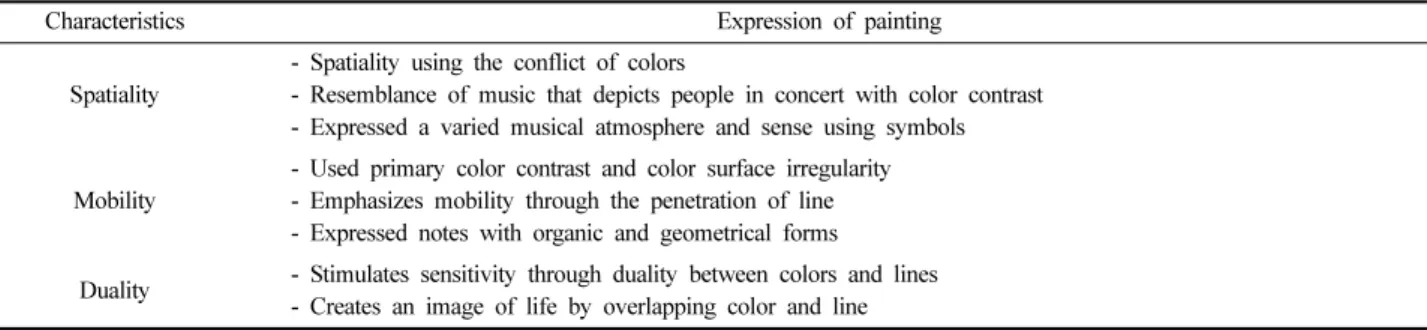
Table 2 summarizes the characteristics of such music visualiza- tion expression in Kandinsky's paintings.
3. Music Visualization in Piet Mondrian's Paintings
Various and in-depth research on music visualization in Kand- insky's paintings have been made by other abstract painters. Mon-
Table 2. Music visualization in Kandinsky's paintings
Characteristics Expression of painting
Spatiality
- Spatiality using the conflict of colors
- Resemblance of music that depicts people in concert with color contrast - Expressed a varied musical atmosphere and sense using symbols
Mobility
- Used primary color contrast and color surface irregularity - Emphasizes mobility through the penetration of line - Expressed notes with organic and geometrical forms Duality - Stimulates sensitivity through duality between colors and lines
- Creates an image of life by overlapping color and line
drian expressed music in paintings with Néo-plasticisme and abstract reality that was depicted through spatial composition, organic expressions and the duality of painting elements. Mondrian defined this as the music of Néo-plasticisme or ‘abstract realistic music’(Mondrian, 1995).
Six pieces(in which musical visualization appears) were selected as the representative art works of Mondrian through reviews of his writings ‘Nature's reality and abstract reality(Natuurlijke en abstracte realiteit)’, ‘Néo-plasticisme: General principles of plastic equivalence (Le Néo-Plasticisme: Principe général de l'équivalence plastique)’, and ‘General principles of Néo-plasticisme(Principes généraux du Néo-plasticisme)’ and previous studies. The selected works are ‘Composition with Grid IX(1919)’(Fig. 5), ‘Composi- tion A(1920)’(Fig. 6), ‘Composition with Yellow, Blue and Red(1937-42)’(Fig. 7), ‘New York City I (1942)’(Fig. 8), ‘Broad- way Boogie-Woogie(1942-1943)’(Fig. 9), ‘Victory Boogie Woo- gie(1943-1944)’(Fig. 10) in the order of their created dates.
‘Composition with Grid IX’ was created when Mondrian was staying in Raren in the Netherlands and working with artists from various areas as part of the ‘De Stijl’ group. Regarding this piece, Mondrian(2008) said that he tried to erase natural rhythms through new forms and make use of various rhythms immanent and con- temporary.
In ‘Composition A’, rectangles changed between red, blue, and yellow and lines changed into achromatic colors; however, dynamic rhythms were absent and an ‘asymmetric balance’ was established(Kim, 1994). ‘Composition with Grid IX’ (released at a similar time) introduced new rhythms through balance.
‘Composition with Yellow, Blue and Red’ is a piece created
when Mondrian's art reached its maximum purity and moderation.
Musical tendency is present in the rhythm that expands out of the canvas edge through two lines of the red square on the upper right side(Hans, 1991).
‘New York City I’ is a later work of Mondrian done after his visit to the United States after World War I. This piece is a lively and splendid feeling of America's culture and art. Europe was devas- tated by war; however, in the United States, Mondrian encountered lively, free senses, music, and dances, and tried to depict the cheer- ful sense rhythm through color bands and not the regular black band(Lee, 2009). When looking at the work, Mondrian expressed energetic, fast rhythm and new harmony through an overlap with red, blue, and yellow lines cross each other and the square canvas.
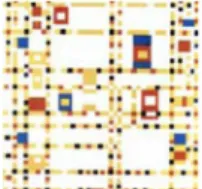
‘Broadway Boogie-Woogie’ is a piece created after being inspired by a lively and enthusiastic jazz performance at a New York concert in 1942. He used cheerful yellow lines in this piece, interwove blue and white between the lines, and expressed various rhythms divided into small units. The audience is able to strongly feel the musicality that uses horizontal and perpendicular lines. It is considered a lively work that shows the world of motion in three dimensions(Lee, 2009).
His last piece, ‘Victory Boogie Woogie’ from his time in New York was not completed; however, it is one of his most highly praised works. Kim(1994) stated that the lines and rectangles come in unison, the increase in colorful faces with the three primary col- ors, and the splendid screen(such as mosaic) adds a musical feeling that resembles a dance of bright colors and is full of cheerful rhythm.
Mondrian's work expressed spatiality through figures composed
Fig. 5. Composition with Grid IX (1919).
http://www.cgfaonlineartmuseum.com/mondrian
Fig. 6. Composition A (1920).
http://www.cgfaonlineartmuseum.com/mondrian
Fig. 7. Composition with Yellow, Blue and Red (1937-42). http://www.cgfaonlineartmuseum.
com/mondrian
Fig. 8. New York City I (1942).
http://www.cgfaonlineartmuseum.com/mondrian
Fig. 9. Broadway Boogie-Woogie (1942-1943).
http://www.cgfaonlineartmuseum.com/
mondrian
Fig. 10. Victory Boogie- Woogie (1943-1944).
http://www.cgfaonlineartmuseum.com/mondrian
of various forms of spatial models outside of existing form and composition after he redefined the concept and expression method of music. Seo(2006) stated that Mondrian strived for a musical world of art by establishing a color face where reality and expres- sion cross a spatial composition. The overall space in Mondrian's paintings(including the spaces of forms and models) emulates mel- ody or musical atmosphere and rhythm with an abstract method.
Mobility is displayed through the structural arrangement of painting components through the implementation of néo-plastic music. Jung(2005) asserted that Mondrian(a jazz music enthusiast) succeeded in reaching a singular atmosphere and rhythm that matches music through his work; consequently, the musical title of the drawing implies the overall liveliness and staccato like rhythm of his piece. Mondrian's work depicts the city atmosphere expe- rienced and the artistic and cultural tendencies of that era imma- nently rather than superficially that resembles the unique liveliness and rhythmic sense of jazz.
Duality appears from the attempt to express various musical rhythms and melodies by crossing lines, colors, and faces. Subse- quently, Jung and Bae(2006) found that Mondrian's painting attempts to give a rhythmic sense by dividing space and form and mingling various horizontal and perpendicular lines. Dancing and music experiences are visually expressed through rhythm, notes, and melodies suggested with such duality. Table 3 provides an overall summary of music visualization characteristics in Mon- drian's paintings.
4. Expression Methods and Characteristics of Music Visualization In Alexander
McQueen's Clothing
4.1. Mondrian's painting expression methods that appear in Alexander McQueen's clothing
After the 19
thto 20
thcenturies during which Mondrian was active, fashion designers in the 21
stcentury emphasized experience from art in order to obtain various forms of inspiration for their designs. Especially, paintings, crafts, and sculptures(which are all visual art forms like design) became important motives for design-
ers to create their inspirations.
Earlier clothing studies that applied Mondrian's paintings or other abstract paintings divided Mondrian's paintings on clothing into three types.
The first method applied Mondrian's paintings on overall clothing design. This method shows the characteristics of Mondrian's work on clothing at a glance and has been used by many designers since the 1965 Yves Saint Laurent collection. Jung and Bae(2006) state that the term ‘Mondrian Look’(Fig. 11) was coined when Mon- drian's form components were applied on the clothing shape itself in the dresses for the 1965 Yves Saint Laurent collection ‘Mondrian’.
This method uses Mondrian's unique form which includes models in the paintings, contrast duality of colors, division and the arrange- ment of lines as motives and gives them a slight change or even uses them in their original form to apply to clothing.
The second method uses forms that appear in Mondrian's paintings or gives slight changes to the colors and lines that transforms them into patterns and finally introduces them into clothing. This method is similar to applying the ‘Mondrian Look’ but the designers add their respective intentions and preferences, developing it into a modern and sophisticated form. Shon and Seo(2006) stated that such a method reaches a maximal beauty by purely using artistic elements such as colors, horizontal and perpendicular lines and raises the liveliness and rhythm established by creating form and spatial composition. Tim Blanks(2011), the editor of Style.com, referred to the Mondrian dresses of Yves Saint Laurent and applied them to the Prada 2011 F/
W collection(Fig. 12) which brings nostalgia.
The third method introduces Mondrian's symbolic expression forms as a part or a decorative component of the clothing. Mon- drian's painting element is expressed as a part(or a clothing dec- oration) that displays uniqueness within simplicity. Such a method is a representative method that expands the innovative area of design for modern designers who develop material and patterns that combine design and art(Jung & Bae, 2006). Giorgio Armani's 2000 F/W clothing(Fig. 13) is a representative case that created modern clothing using Kandinsky's painting as a pattern to trans- form the material into a chain form and add a decorative effect with an overall abstract feeling.
Table 3. Music visualization in Mondrian's paintings
Characteristic Expression of painting
Spatiality 1. Resembles music composition through a composition of spatial models
2. Resembles the rhythm and atmosphere of music through an expression of abstract space and model Mobility 1. Makes use of various rhythm that are immanent and realistic
2. Expressions of unique jazz characteristics like staccato
Duality 1. Separation of space and form through a calculative cross section of lines, colors, and faces 2. Expression of musical elements such as melody, notes, and beat through a three dimensional effect
4.2. Music Visualization Characteristics That Appear In Alexander McQueen's Clothing
4.2.1. Spatiality
In order to display the constitutive expression of space shown in Mondrian's paintings on clothing, geometrical abstraction was applied to fashion and made into patterns in McQueen’s collection.
Music visualization was realized in clothing through néo-plastic models with a musical tendency shown in Mondrian's pieces.
For such expression, Mondrian's shape component was used in McQueen’s collection. In images 1-2, the motive of the overall
clothing's design was brought from Mondrian's paintings(like Yves Saint Laurent in the 1960s) that resembles the ‘Composition’
series(Fig. 5-7). The characteristics of Mondrian's paintings were applied with the overall design printed on fabric; however, unlike Mondrian, red to achromatic colors(such as black and gray) was added. The feeling of space and dynamic movement in Mondrian's flat and perpendicular forms are shown by designing the overall clothing through derivation from Mondrian's paintings. The motive for part of the clothing's design is developed in images 3-5 from Mondrian's paintings and simplicity is avoided by combining dif- ferent artistic motives that transform the designer's motif. The sym- bols in Mondrian's paintings are used in image 6 as a decoration or pattern to recreate the design. An emotional feeling such as dis- sonance of music is expressed by applying the symbolic format and design from Mondrian's paintings in such clothing.
Overall, a feeling of space was added through color contrast that Mondrian uses and the dynamics that appear in lines and silhou- ettes from which musical harmony was expressed. Mondrian's abstract patterns were also used to emotionally share dissonance and the rhythmic elements of jazz. Table 4 summarizes the spati- ality of Alexander McQueen.
Fig. 11. Yves Saint Laurent 1965 F/W
‘Mondrian Look’.
http://www.pinterest.com
Fig. 12. Prada 2011 F/W. www.style.com
Fig. 13. Giorgio Armani 2000 F/W.
www.style.com
Table 4. Spatiality in Alexander McQueen’s clothing
Representative Images
Spatiality
Image 1. Ready-to-wear Alexander McQueen 2014 S/S
www.style.com
Image 2. Ready-to-wear Alexander McQueen 2014 S/S
www.style.com
Image 3. Ready-to-wear Alexander McQueen 2014 S/S
www.style.com
Image 4. Ready-to-wear Alexander McQueen 2014 S/S
www.style.com
Image 5. Ready-to-wear Alexander McQueen 2014 S/S
www.style.com
Image 6. Ready-to-wear Alexander McQueen 2014 S/S
www.style.com
Expression methods and effects
1.Added spatiality using color contrast, dynamic lines and silhouettes used by Mondrian
2. Expressed emptiness and filling within musical harmony by creating a feeling of space through emptying and filling with lines, colors, and shapes
3. Expressed emotional senses such as musical dissonance by applying symbolic formats and designs as patterns and material 4. Created a unique form of patchwork with existing forms in Mondrian's painting using leather
4.2.2. Mobility
Color arrangements and components were mainly used in Alex- ander McQueen’s collection for music visualization that appear in Mondrian's paintings and the structural aspect of geometry was applied. The unique activeness and strong color contrast in Mon- drian's paintings were shown with the re-creation of a musical rhythm.
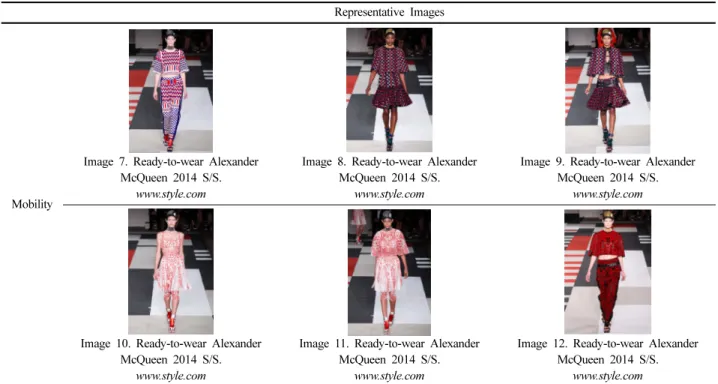
Images 7-9 resemble ‘New York City I’(Fig. 8), ‘Broadway Boogie-Woogie’(Fig. 9), and ‘Victory Boogie-Woogie’(Fig. 10) that Mondrian created during the end of his time in New York. The irregular display of the color composition of the clothing's simple design with a strong contrast provides the effect of an optical illu- sion, emphasis, and rhythm; however, unlike Mondrian, the sophis- tication of modern clothing was added using colors of ethnic series.
The contrast between colors was emphasized further using achro- matic colors like white or black between colors and the mobility of the clothing itself was added. The clothing also exerts the rough touch of the painting using a Boucle series material. Images 10-11 displays mobility through the transformation of clothing material.
The colors of the clothing are a simple red and white; however, it
initially borrows the structural part of colors and lines that appear in Mondrian's ‘Boogie-Woogie’ series(Fig. 9-10). A see-through look effect was added by making holes on the clothing and a three dimensional and floating motion was emphasized. Néo-plastic shapes and designs in the ‘Composition’ series(Fig. 5-7) are made into patterns in image 12 that are printed on the fabric. Also, detailed aspects such as the expression method of the touch and patterns in Mondrian's paintings were displayed using the charac- teristics of the material. The symbolic format of Mondrian that appear in the clothing resemble musical abstraction.
The overall mobility shown in Alexander McQueen’s clothing shows that vibration, internal resonance, and the sound level of music were created through Mondrian's color irregularity and pri- mary color contrast. Color emphasis was made through the bright- ness of color or organic patterns(or contrast in color was made by differentiating materials) to show that the same color is used in var- ious ways. The texture and transformation of materials that change in the patterns of Mondrian's paintings were made and musical curve was expressed to show a more organic movement. Table 5 summarizes the mobility in Alexander McQueen’s clothing.
Table 5. Mobility in Alexander McQueen’s clothing
Representative Images
Mobility
Image 7. Ready-to-wear Alexander McQueen 2014 S/S.
www.style.com
Image 8. Ready-to-wear Alexander McQueen 2014 S/S.
www.style.com
Image 9. Ready-to-wear Alexander McQueen 2014 S/S.
www.style.com
Image 10. Ready-to-wear Alexander McQueen 2014 S/S.
www.style.com
Image 11. Ready-to-wear Alexander McQueen 2014 S/S.
www.style.com
Image 12. Ready-to-wear Alexander McQueen 2014 S/S.
www.style.com
Expression methods and
effects
1. Mondrian expressed vibration, internal resonance, and the sound level of music through color irregularity and primary color contrast in clothing
2. Mobility was added by expressing the emphasis of color through light and shade, or free and organic patterns
3. By giving contrast in color using difference in materials in fashion, the same color was used in various ways and through this, added a fluid rhythm
4. The musical curves of the rough touch patterns were expressed in Mondrian's paintings through the texture and transformation of material
4.2.3. Duality
Duality is a music visualization characteristic of Mondrian's paintings that appears mostly in his latter works; subsequently, it was further developed in Alexander McQueen’s collection by add- ing the components that clothing possess. Rather than simply using the duality of lines, colors, and faces in Mondrian's paintings, bodily beauty was mixed in by using the models' body as a face for the painting. This overcame the two dimensional limitation of the paintings and developed into three dimensions that maximized the synesthesia effect given in the clothing.
In images 13-14, the characteristics of ‘New York City I’(Fig. 8) and ‘Boogie-Woogie’ series(Fig. 9-10) appear in clothing. Trans- forming paintings into patterns and applying them in clothing design; subsequently, yellow in Mondrian's three primary col- ors(red, yellow, and blue) was substituted by white and the three- dimensional effect was enhanced through inflective material. Dual- ity occurred by not obstructing the general frame of Mondrian's paintings despite the partial transformations. The music visualiza- tion that Mondrian expressed from a two dimensional perspective was attempted to be realized from a three-dimensional perspective that utilized the overlap between the clothing and the model.
Images 13-16 show the morphic traits of Mondrian's paintings in
the clothing silhouette. The Néo-plasticisme and structural char- acteristics that Mondrian pursue were emphasized. In images 17- 18, see-through dress, one-piece, laces were made and overlapped with patterns that resemble Mondrian's ‘Boogie-Woogie’
series(Fig. 9-10), adding glamor on top of playfulness and deco- rative effects. Mondrian's color arrangement and composition style(shown in the clothing) try to capture the implications of jazz expressed in Mondrian's later works.
When looking at the duality expressed in the clothing overall, effects were made by making differences in hue, brightness, chrome between colors and harmony and dissonance. The play- fulness, curves, decorative effects along with a three dimensional feeling were displayed by overlapping lines. Table 6 summarizes the duality in Alexander McQueen’s clothing
5. Conclusion
Music visualization was started by Wassily Kandinsky(the father of abstract art) and has been expressed in a flat space by various painters such as Mondrian. In the modern era, fashion designers have used paintings as motives, or further developed them onto a three dimensional space. This study used Kandinsky's theory to
Table 6. Duality in Alexander McQueen’s clothingRepresentative Images
Duality
Image 13. Ready-to-wear Alexander McQueen 2014 S/S
www.style.com
]
Image 14. Ready-to-wear Alexander McQueen 2014 S/S
www.style.com
Image 15. Ready-to-wear Alexander McQueen 2014 S/S
www.style.com
Image 16. Ready-to-wear Alexander McQueen 2014 S/S
www.style.com
Image 17. Ready-to-wear Alexander McQueen 2014 S/S
www.style.com
Image 18. Ready-to-wear Alexander McQueen 2014 S/S
www.style.com Expression
methods and effects
1. Expressed dissonance along with duality effect by putting difference in hue, brightness, and chrome between colors
2. Expressed musical harmony along with three dimension through duality in curve and line, line and line, and curve and curve 3. As a stimulus of emotion through duality, tried to create dissonance and musical resemblance
analyze the characteristics of music visualization that appear in Alexander McQueen’s 2014 Spring Ready-to-wear Collection inspired by Mondrian's paintings. The following are the results of this study.
First, based on the theory proposed by Wassily Kandinsky, the characteristics of music visualization that appear in Mondrian's paintings can be categorized into spatiality, mobility, and duality.
Such music visualization characteristics are best represented in six pieces of Mondrian's paintings, ‘Composition with Grid IX’(Fig.
5), ‘Composition A’(Fig. 6), ‘Composition with Yellow, Blue and Red’(Fig. 7), ‘New York City I’(Fig. 8), ‘Broadway Boogie-Woo- gie’(Fig. 9), and ‘Victory Boogie Woogie’(Fig. 10). Second, when expressing Mondrian's paintings in Alexander McQueen’s collec- tion, the paintings were applied on the overall design of the cloth- ing, the forms themselves were used, or slight changes were given to colors, lines, made into patterns, and then introduced into the clothing. Also, forms of symbolic expressions were introduced as a part or decorative component of the clothing. Third, spatiality refers to creating feeling of space by emptying or filling through lines, colors, and forms. By applying color contrast, line and sil- houette's dynamic, symbolic formats and designs that Mondrian used into patterns and materials, the feelings of emotional senses such as dissonance and musical atmosphere were expressed.
Fourth, mobility generally means movement that occurs due to a certain stimulus and Mondrian expresses vibration, internal reso- nance, and sound level of music with emphasizing irregularity and primary color contrast of color, rough brush touch, and free and organic patterns. This is expressed with a primary color contrast that used different materials, rough touch based on texture, and pat- tern repetition through transformation. Fifth, duality generally refers to the artistic effect due to overlap or stacking. Mondrian attempted to create resemblance of dissonance and music with duality between colors, lines, and line and color. This was expressed by overlapping various clothing design elements such as lines, silhouettes, and colors based on the designer's artistic sense.
This study transcended the simple derivation of design in its analysis of the music visualization characteristics of modern fash- ion that utilizes abstract painting as a motive and found the devel- opmental characteristics of synesthesia that occur when changing from a plane to solid. This research is significant as a fundamental reference for fashion design studies that attempt a music visual- ization when there is an increased trend of designers who find inspiration from various areas and try to realize synesthesia. Design work that includes multisensory factors will be one of the various directions that modern fashion will proceed in and future studies on music visualization of collections that graft works of various abstract painters must be conducted.
Acknowledgement
This research was supported by the Chung-Ang University Excellent Student Scholarship in 2013.
References
Baek, E. K. (2011). Research for Wassily Kandinsky paintings adopting musical expression. Unpublished master’s thesis, Chonbuk National University, Cheongju.
Broadway Boogie-Woogie (1942-1943). (n. d.). www.cgfaonlineartmuseum.
com. Retrieved October 11, 2013, from http://www.cgfaonlineartmuseum.
com/mondrian
Cho, J. S. (2004). A study on fashion design applied with the plastic arts : Focused on Mondrian’s geometrical abstract painting shown in the twenty century’s fashion design. The Research Journal of the Costume Culture, 12(4), 663-675.
Composition A (1920). (n. d.). www.cgfaonlineartmuseum.com. Retrieved October 11, 2013, from http://www.cgfaonlineartmuseum.com/
mondrian
Composition with Grid IX (1919). (n. d.). www.cgfaonlineartmuseum.com.
Retrieved October 11, 2013, from http://www.cgfaonlineartmuseum.
com/mondrian
Composition with Yellow, Blue and Red (1937-42). (n. d.).
www.cgfaonlineartmuseum.com. Retrieved October 11, 2013, from http://www.cgfaonlineartmuseum.com/mondrian
Composition 5. (n. d.). Wikipaintings. Retrieved October 11, 2013, from http://www.wikipaintings.org
Composition 9. (n. d.). Wikipaintings. Retrieved October 11, 2013, from http://www.wikipaintings.org
‘Duality’. (n. d.). The National Institute of The Korean Language.
Retrieved October 13, 2013, from http://www.korean.go.kr Giorgio Armani 2000 F/W. (n. d.). Style.com. Retrieved October 9,
2013, from http://www.style.com
Hans, L. C. J. (1991). Piet Mondrian (G. M. Kim, Trans.). Seoul : The Joongang Newspaper Co. (Original work published 1985) Impression 3. (n. d.). Wikipaintings. Retrieved October 11, 2013, from
http://www.wikipaintings.org
Improvisation 19. (n. d.). Wikipaintings. Retrieved October 11, 2013, from http://www.wikipaintings.org
Jo, H. A. (2012). A study on Kandinsky's thoughts of art : On the basis of Russian icons and the principle of inner necessity. Unpublished master’s thesis, Donga University, Busan.
Jung, A. R. (2002). A study of fashion design based on musical sensitivities : Centered on synesthetic interpretation about jazz.
Unpublished master’s thesis, Ewha Womans University, Seoul.
Jung, K. H. (2005). A study on plastic art of Mondrian. Art Journal, 6, 97-124.
Jung, K. H., & Bae, S. J. (2006). A study on the formative elements of Néo-plasticism applied on contemporary fashion. Korean Journal of Human Ecology, 9(1), 51-61.
Kandinsky, W. (2011). Punkt und linie zu flache (B. H. Cha, Trans.).
Seoul: Youlhwadang. (Original work published 1979) Kandinsky, W. (2007). Uber das Geistige in der Kunst (P. Y. Kwon,
Trans.). Seoul: Youlhwadang. (Original work published 1973) p. 46.
Kang, H. M., & Kim, H. K. (2009). A study of fashion design with the motif on modern abstract painting. The Korean Society of Fashion Design, 9(10), 61-75.
Karen, D. (2013, October 2). Be there and be square: Mondrian is McQueen's new muse. London Evening Standard. Retrieved October 13, 2013, from http://www.standard.co.uk/lifestyle/fashion/be-there- and-be-square-mondrian-is-mcqueens-new-muse-8852988.html Kim, H. J. (1994). Study about Mondrian’s paintings : Emphasizing
musical expressions. Unpublished master’s thesis, Daegu University, Gyeongsan.
Kim, H. S. (2007). A study on the characteristics of art from of Wassily Kandinsky's painting. Unpublished master’s thesis, Hongik University, Seoul.
Kim, J. Y. (2012). A study on the Idea of textile pattern design through the expression of visualizations in music. Unpublished master’s thesis, Chung-Ang University, Seoul.
Kim, S. S. (2013). A study on fashion design by the visualization of music : Focused on the Wassily Kandinsky paintings. Unpublished master’s thesis, Chung-Ang University, Seoul.
Lee, E. J. (2009). Kandinsky, Mondrian, Pollock. Seoul : Jigyoungsa.
Lee, H. A. (2003). A study of fashion design based on visualization of music : Centered on expressing cosmos image by synesthetic interpretation about Punk Rock. Unpublished master’s thesis, Ewha Womans University, Seoul.
Lee, I. S. (2008). A study on dress design through the visualization of Haegum Sanjo’s Melody: Focused on the scratch technique.
Unpublished master’s thesis, Ewha Womans University, Seoul.
‘Mobility’. (n. d.). The National Institute of The Korean Language.
Retrieved October 13, 2013, from http://www.korean.go.kr Mondrian, P. (1995). Neue Gestaltung (Editorial Department Trans.).
Seoul: Kwahakgisul. (Original work published 1986)
Mondrian, P. (2008). Mondrian's room (H. S. Jun, Trans.).
Youlhwadang. (Original work published 1938)
‘Motion’. (n. d.). The National Institute of The Korean Language.
Retrieved October 13, 2013, from http://www.korean.go.kr
‘Music visualization’. (n. d.). The National Institute of The Korean
Language. Retrieved October 13, 2013, from http://www.
korean.go.kr/
New York City I (1942). (n. d.). www.cgfaonlineartmuseum.com. Retrieved October 11, 2013, from http://www.cgfaonlineartmuseum.com/
mondrian
Prada 2011 F/W. (n. d.). Style.com. Retrieved October 9, 2013, from http://www.style.com
Ready-to-wear Alexander McQueen 2014 S/S. (n. d.). Style.com.
Retrieved October 9, 2013, from http://www.style.com Seo, S. G. (2006). An analysis of Mondrian's composition series and
case study of their applications in everyday life. Unpublished master’s thesis, Hongik University, Seoul.
Shon, Y. M., & Seo, Y. J. (2006). A study on fashion designs applying patchwork technique and the characteristics of Mondrian`s works.
The Research Journal of the Costume Culture, 14(4), 670-683.
‘Space’. (n. d.). The National Institute of The Korean Language.
Retrieved October 13, 2013, from http://www.korean.go.kr/
‘Spatiality’. (n. d.). The National Institute of The Korean Language.
Retrieved October 13, 2013, from http://www.korean.go.kr/
Tim, B. (2013, October 1). Spring 2014 ready-to-wear Alexander McQueen. Style.com. Retrieved October 13, 2013, from http://
www.style.com/fashionshows/review/S2014RTW-AMCQUEEN/
Tim, B. (2011, February 23). Fall 2011 ready-to-wear Prada. Style.com.
Retrieved October 13, 2013, from http://www.style.com/
fashionshows/review/F2011RTW-PRADA/
Victory Boogie- Woogie (1943-1944). (n. d.). www.cgfaonlineartmuseum.
com. Retrieved October 11, 2013, from http://www.
cgfaonlineartmuseum.com/mondrian
Walker, M. (1996). The power of color. (E. K. Kim, Trans.). Seoul:
Kyobomongo (Original work published 1990)
Yves Saint Laurent 1965 F/W ‘Mondrian Look’. (n. d.). www.
pinterest.com. Retrieved October 9, 2013, from http://www.
pinterest.com
(Received 13 January 2014; 1st Revised 3 February 2014;
2nd Revised 11 February 2014; Accepted 25 February 2014)
Copyright © 2014 (by) the authors. This article is an open access article distributed under the terms and conditions of the Creative Commons Attribution license (http://creativecommons.org/licenses/by/3.0/), which permits unrestricted use, distribution, and reproduc- tion in any medium, provided the original work is properly cited.