Prediction of Deterioration Rate for Composite Material by Moisture Absorption
Yun-Hae Kim1․Seung-Jun An1․Young-Dae Jo1․Chang-Won Bae2․Kyung-Man Moon†
(Received November 11, 2009 ; Revised January 5, 2010 ; Accepted February 10, 2010)
Abstract: If the fiber reinforced plastic is exposed to the moisture for a long period of time, most of moisture absorption occurs on the resin place, thus dropping cohesiveness between the molecules as the water molecules permeated between high molecular chains grant high molecular mobility and flexibility. Also as the micro crack occurs due to the permeation of moisture on the interface of glass fiber and epoxy resin, it is developed to the overall damage of interface place. Hence, the study on absorption is essential as the mechanical and physical properties of fiber reinforced composites are reduced.
However, the study on absorption has the inconvenience needing to expose composite materials to fresh water or seawater for 1 month or up to 1 year. Therefore, this study has exposed fiber reinforced composites to fresh water and has developed a model with an accuracy of 98% after comparing the analysis value obtained by using ANSYS while basing on the experimental value of property decline by absorption and the basic properties of glass fiber and epoxy resin used in the experiment.
Key words: Glass/Epoxy prepreg, Carbon/Epoxy prepreg, Moisture absorption, Finite elements method, Durability.
†Corresponding author(Department of Materials Engineering, Korea Maritime University, E-mail : [email protected], Tel: 051-410-4352)
1 Department of Marine equipment Engineering, Korea Maritime University,
2 Engineering Education Team, Korea Institute of Maritime and Fisheries Technology,
1. Introduction
Since composites are better in the specific strength, specific rigidity, lightness and corrosion resistance than existing metallic materials, they are widely used in various industries such as aerospace and automobile industries[1-2]. Recently although the shipping industry also uses composite materials instead of metallic materials for energy savings and operation performance improvements, composites have the problems that the mechanical, thermal and physical
properties are deteriorated if they are
exposed to the environmental factors such
as temperature, moisture, salinity and
ultraviolet rays for a long period of time
[3]. Especially, there are the degradation
mechanisms about the environment of
resin in relation to the fiber reinforced
composite materials such as photo-
oxidation, thermal oxidation, thermal
cracking, high energy radiation, stress
cracking, and electro-mechanical corrosion
[4-5]. Generally as for the degradation
reasons of fiber reinforced composites by
the environment, there are several factors such as surrounding temperature and humidity and ultraviolet rays. If the composite materials are exposed to moisture, a serious deformation may occur on the materials by time [6]. Such factors could be explained as a mechanism that the water molecules permeated onto the fiber and resin lowers the glass transition temperature of the resin and reduces the cohesiveness of fiber and resin interface [7]. The deformation by the absorption of composite materials causes a reduction in tensile strength. The influence from a reduction in tensile strength by the glass fiber itself could be regarded as very small in comparison to the reduction of tensile strength by micro cracking.
Although the studies on the behavior of composite materials by absorption up to the present have been conducted actively, the studies on the absorption requiring a long-term and periodic observation are very inconvenient and hold numerous properties due to the manufacture method of composite materials and combination of materials. Hence, it is not easy to estimate reduction in the material property by the absorption of each material. Accordingly, this study has prepared the GE (Glass/Epoxy) prepreg and CE(Carbon/Epoxy) prepreg specimens and has observed the mechanical properties of specimens by dipping them in the distilled water of 80℃ for 10 days that show a sudden absorption of moisture as shown in the papers on absorption. Also by modeling micro crack from the interface by absorption while
using ANSYS an application program of finite elements method, we have compared the test value and analysis value in order to suggest the possibility of developing a model that can predict reduction in the strength of composite materials by absorption in a short period of time.
2. Experiment
2.1 Materials
The epoxy prepreg specimens used in this study are the materials that have impregnated the epoxy resin onto the unidirectional fiber. The prepreg is the pre-impregnated material and the resin was cured as B-stage.[8-9] The content ratios of fiber and epoxy resin are 58%
and 42% respectively. The composite materials hold various mechanical properties according to the molecular structures of resin and curing agent and the content property and component ratio of high molecular resin are designed differently according to the use [10-11].
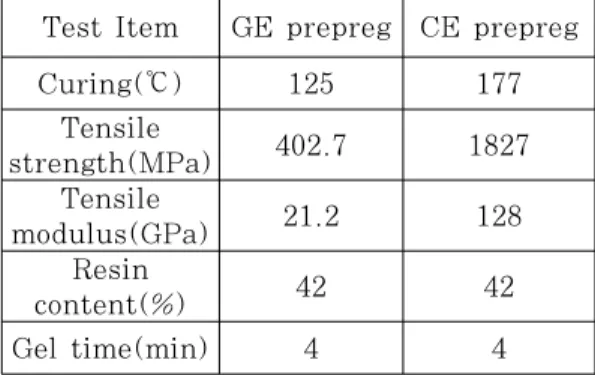
This study has used the GE prepreg of Cytec registered to BMS-79 a certification standard of Boeing and the CE prepreg of Toray registered to 8-276. Their specifications are shown in Table 1.
Table 1: Material property of epoxy prepreg
Test Item GE prepreg CE prepreg
Curing(℃) 125 177
Tensile
strength(MPa) 402.7 1827
Tensile
modulus(GPa) 21.2 128
Resin
content(%) 42 42
Gel time(min) 4 4
S
dM
V = × (3)
As for the criteria in the selection of test materials, we have selected GE prepreg and CE prepreg that are most widely used and show a significant difference in strength.
2.2 Make of Specimen
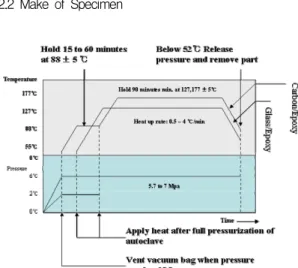
Figure 1: Autoclave cure cycle for GE125, CE177 panels
As shown in Figure 1, this experiment has applied the temperature and pressure conditions differently in order to see the absorption ratio of moisture by the curing condition.
2.3 FEM by ANSYS
In order to predict reduction in the strength of fiber reinforced composite materials by absorption, this study has used ANSYS 11.0 an application program of finite elements method.
The reduction in strength by absorption may occur by two factors such as reduction in the property of resin by the moisture permeated to the inside of resin and the micro crack occurred on the interface between reinforced fiber and
resin. The influence of moisture permeated within the resin can be recovered through drying but the influence by micro crack cannot be recovered by drying. Accordingly in order to compare the resulting value of experiment with the result of finite element method (FEM), this study has only considered reduction in the strength that can not be recovered by drying and has applied only the micro crack in modeling. The specimen used in this experiment was sufficiently dried upon absorption.
× 100
= −
d d m
W W
M W (1)
× 100
×
×
−
× +
= ×
d d
d d w w d d
W
W W
V W
ρ
ρ ρ
ρ (2)
If the expression(2) is approximated, the expression (3) can be obtained.
M
= Moisture absorption ratio (%), Wd =Weight of specimen prior to theabsorption of moisture
Wm=Weight of specimen after the absorption of moisture
Ww=
W
m− W
dV
= Ratio of volume increase (%)S
d =Specific weight of composite materialSince we could see that the ratio in the
modeling of composite laminates has
increased as much as the amount that
has multiplied its own specific weight by
the absorption ratio of moisture according
to the expressions (1) and (3), we have
(a) Glass/epoxy prepreg (b) Carbon/epoxy prepreg
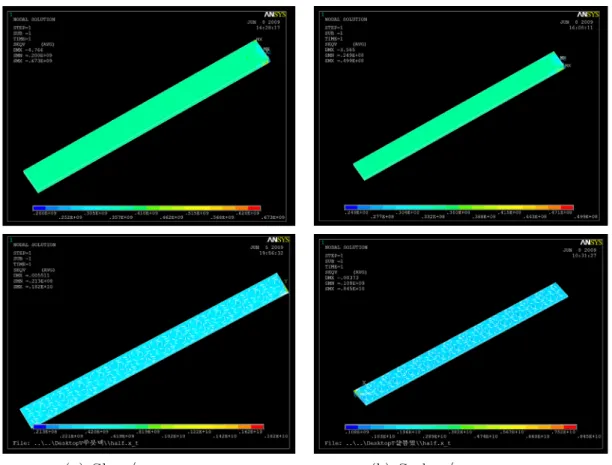
Figure 3: The comparison of ANSYS results between the general model with no crack and the special model with 1%
Figure 2: Surface crack of specimen absorbed moisture
modeled by adding the micro crack as much as the increase of volume for the moisture absorption ratio of 1%.
For the sake of analysis, we have created a crack on the surface of the specimen as shown in the Figure 2 and located the crack in the inside by using axisymmetry.
In order to analyze the composite
materials effectively, we have used the
SOLID191 element. The model of the
specimen with 0% of the moisture
absorption ratio holds 11,000 elements
and 50,873 nodes; on the other hand, the
model of the specimen with 1% of the
moisture absorption ratio has 5,533,770
elements and 774,322 nodes.
3. Result and Discussion
Figure 3 shows the comparison of ANSYS results between general model having no crack and special model having 1% crack. Figure 3(a) indicates the property of GE prepreg. The maximum displacements were 4.77 mm and 5.51 mm when the 402 MPa of tensile strength is applied to general model and special model.
As shown in Figure 3, the difference in displacement in spite of applying same load attributes to the non-uniform stress of special model than that of general model. By this reason, the maximum displacement occurred at inner crack by stress concentration. Figure 3(b) shows the maximum displacement of 3.57 mm and 3.73 mm, respectively, when the 1,827 MPa of tensile strength is applied to general model and special model.
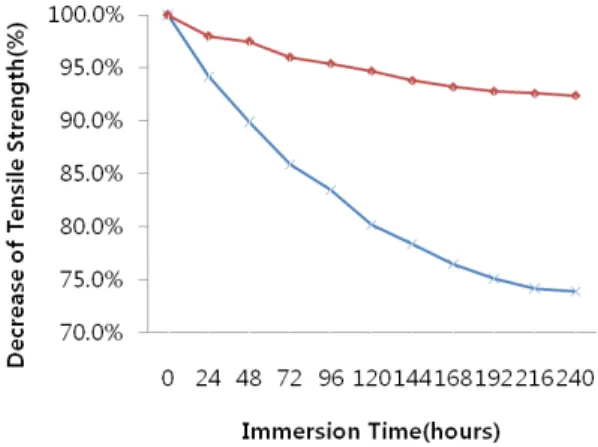
Figure 4 shows changes in the moisture absorption ratio according to the dipping time in the distilled water of 80℃. Two kinds of specimens show the moisture absorption ratio different from each other and this can be explained as a difference in the curing temperature. As for the tensile strength of a specimen by the moisture absorption ratio, it has recovered the mechanical properties from a decline of interface cohesiveness between high molecular resin and fiber reinforced material after drying at the temperature of 80℃ for 24 hours. Figure 5 has shown only the tensile strength micro cracking.
The section that shows 1% of the moisture absorption ratio has shown 1%
of the absorption ratio in the GE prepreg after 60 hours and 1% of the absorption
ratio in the CE prepreg after 90 hours.
The tensile strength of GE prepreg in the 60-hour section has dropped by 12% and the tensile strength of CE prepreg in the 90-hour section has shown a reduction of about 3%.
Figure 4: Water content behaviors of the specimens by immersion time
Figure 5: Tensile strength behaviors of the specimens by immersion time
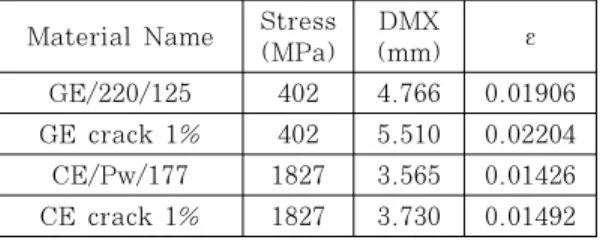
The analysis value of using ANSYS is
shown in the Table 2. The tensile
strength(p) is proportionate to ε the
strain ratio. It is well know the equation P=Eε The Hooke's law.
Table 2: Result by finite elements method
Material Name Stress(MPa)
DMX
(mm) ε
GE/220/125 402 4.766 0.01906 GE crack 1% 402 5.510 0.02204 CE/Pw/177 1827 3.565 0.01426 CE crack 1% 1827 3.730 0.01492
Accordingly for the reduction of tensile strength by the experimental value, we have checked the behavior of strength reduction by using the strain ratio obtained by FEM. The GE crack that the micro crack was made by the absorption of moisture has shown a strength reduction of 13.52% as compared to that of GE before the absorption. From this result, we could predict that the CE crack had a strength reduction of 4.424%
as compared to that of CE. If the analysis value obtained in this way is compared with the experimental value obtained through this test, the GE prepreg and CE prepreg hold the respective error values of 1.52% and 1.424%.
4. Conclusions
This study has checked the durability when the fiber reinforced composites were exposed to moisture and has analyzed the property deterioration of composite materials by absorption using ANSYS a finite element analysis program. This is a study on the possibility of a model that can predict the tensile strength behavior of composite materials by absorption in a
short period of time through the comparisons of experimental value and analysis value.
The comparison values of GE prepreg and CE prepreg have shown the accuracy of 98.48% and 98.58% respectively and this could be regarded as a very accurate model. Although it is very difficult to tell the accuracy only with two comparison values, this study has checked possibility of the study. Hence through this modeling, we expect that the mechanical properties of various composite materials could be predicted.
Acknowledgment
This research was financially supported by the Ministry of Education, Science Technology (MEST) and Korea Industrial Technology Foundation (KOTEF) through the Human Resource Training Project for Regional Innovation.
References
[1] Y.H. Kim, and S.J. An, “A study on the composite blade performance variation by attaching erosion shield for hovercraft”, Journal of the Korean Society of Marine Engineering, vol.33, no.7, pp. 1017-1025, 2009.
[2] Y.H. Kim, an Y.D. Jo, “The evaluation of mechanical properties and physical properties of the Hanji reinforced composites”, ICMDT2009, Jeju Island, Korea June 25-26, pp. 25, 2009.
[3] Y.H. Kim, and K.J. Kim, “A study on
degradation and recovery mechanisms
of composites under the moisture
environment”, The Korean Society for
Composite Materials, pp.1-7, 2008.
[4] W. Schnabel, Polymer Degradation:
Principles and Practical Application, Hansa International, Germany, 1981.
[5] D. M. Pinkerton, The Prevention of the Deterioration of Organic Materials in Operational. Environment, Report TTCP.AUSP3/15 The Technical Corporation Program, 1975.
[6] C. H. Shen and G. S. Springer,
“Effect of moisture and temperature materials”, Journal of Composite Materials, pp2-16, 1997.
[7] K.J. Kim, “A study on the mechanism of moisture absorption with the analysis of physical and mechanical propertiesto the fiber reinforced super-light composite”, doctoral thesis graduate school of Korea Maritime University 2007.
[8] S. Y. Bae, A Study on the Optimum Design of Autonomous Underwater Vehicle by Fiber-reinforced Composites, Master Thesis, Graduate School Korea Maritime University, 2009.
[9] S. H. Song, C. W. Kim, The mixture ratio effect of epoxy resin, curing agentand accelerator on the fatigue behavior of FRMLs, Korean Journal of The Korean society of mechanical engineers, vol.25, no.5, pp.592-601, 2001.
[10] A. Kelly and C. Zweben, “Comprehensive composite materials”, Polymer Matrix Composites, vol. 2, pp. 4-11, 2000.
[11] Y.H. Kim, and S.Y. Bae, “Structural design and analysis of autonomous underwater vehicle by fiber reinforced plastics”, Korean Journal of The Korean society of mechanical engineers, vol.32, no.11, pp.937-942, 2008.
저 자 소 개