The quality of postmenopausal life accounting for 1/3 of women’s life has been emphasized with an increase in life span. As various symptoms associated with menopause and ageing-related diseases including osteoporosis have become critical in women’s health, a large number of studies on hormone therapy have been performed over the past five decades to improve the related symptoms.
Although hormone therapy is effective in preventing osteoporosis and alleviating mental and psychological symptoms associated with typical menopausal symptoms including hot flashes, sweating, and vaginal dryness, the prescription of hormone therapy has decreased markedly1,2 in the years following the Women’s Health Initiative (WHI) publication in 20023,4 after the WHI study
Received: January 2, 2014 Revised: January 3, 2014 Accepted: March 27, 2014
Address for Correspondence: Hyoung Moo Park, Department of Obstetrics and Gynecology, Chung-Ang University Hospital, College of Medicine, 102, Heukseok-ro, Dongjak-gu, Seoul 156-755, Korea
Tel: +82-2-6299-3172, Fax: +82-2-6263-2187, E-mail: [email protected] This abstract was presented at the 11th World Congress on the Menopause.
Original Article
Journal of Menopausal Medicine 2014;20:7-13
Awareness and Experience of Menopausal Symptom and Hormone Therapy in Korean Postmenopausal Women
Hee Dong Chae, M.D.1, Sun Young Choi, M.D.1, Eun Ji Cho, M.D.1, Yoo Mi Cho, M.D.1, Sa Ra Lee, M.D.2, Eun Sil Lee, M.D.3, Hyoung Moo Park, M.D.4
1Department of Obstetrics and Gynecology, University of Ulsan, College of Medicine, Asan Medical Center; 2Department of Obstetrics and Gynecology, Ewha Womans University, School of Medicine; 3Department of Obstetrics and Gynecology, Soonchunhyang University, College of Meidicine; 4Department of Obstetrics and Gynecology, Chung-Ang University Hospital, College of Medicine, Seoul, Korea
Objectives: To investigate awareness and experience of menopausal symptom and hormone therapy in Korean postmenopausal women.
Methods: A total of 570 postmenopausal women were accepted our survey. The women filled out the questionnaires composed of medical and surgical history, menopausal age and symptom, demand of treatment on menopausal symptom, and personal method for overcoming the symptom. Also, we make inquiries about experience of hormone therapy, concern about hormone therapy, improvement of menopausal symptom after therapy, adverse effect, and cause of cease the therapy.
Results: According to the survey, 80% (456/570) of the women experienced menopausal symptom. When they felt the symptom at first, 47% (213/570) of women was 46-50 years old. The most common menopausal symptom was hot flushes (141/570). A number of Korean women regarded that menopause was a natural process of ageing (69%). Eighty two % of women thought to need to have treatment on menopausal symptom. However, only half (43%) visited doctor. The most concerned disease after menopause they had answered was osteoporosis (60%) but only 22% of women were taken regular check-up of bone mineral density. The common causes were unwilling to do treatment were concern about adverse effect (51%) and indefinite fear of cancer (32%). Moreover, many women got diverse information about menopause from the mass media than professional advice.
Conclusion: Only a minority of Korean postmenopausal women with menopausal symptoms had taken a hormone therapy. We should provide appropriate education and counsel to Korean peri-menopause women.(J Menopausal Med 2014;20:7-13) Key Words: Awareness, Experience, Hormone therapy, Korean postmenopausal women, Menopausal symptom
suggested that hormone therapy increased the risk of breast cancer, cardiovascular diseases, cerebrovascular accident, venous thrombosis, and other illnesses. Since then, many women and physicians are reluctant to use hormone therapy. However, a number of problems have been pointed out regarding enrolled women’s age, obesity, a history of cardiovascular diseases, and others in the WHI study. Although hormone therapy has been proven to have fewer risks and more benefits through subgroup analyses,5,6 the degree of prescribing hormone therapy has not been regained to the level before the WHI publication.
In addition, the perception of hormone therapy is thought to be influenced by individual patient’s attitude toward menopause and subjective thinking on hormone therapy. For these reasons, the Korean Society of Menopause (KSM) has conducted surveys for several years to investigate women’s perceptions of menopausal symptoms and hormone therapy.
As part of this project, the study was performed to reflect women’s perceptions in patient care and counsel.
Materials and Methods
A survey was performed in 570 women who attended a health lecture hosted by the KSM in October 2010 in celebration of World Menopause Day in Seoul, Incheon, Daegu, Gwangju, and Busan, Korea. At the end of the health lecture, subjects were administered the questionnaire after obtaining informed consent from all participants.
The questionnaire comprised items on menopausal age, associated diseases, past-surgical history, drug history, the age of experiencing menopausal symptoms, types of menopausal symptoms, awareness of the causes of menopause, the necessity of treatment for menopausal symptoms, and strategies for overcoming menopausal symptoms. To examine perceptions and experiences on hormone therapy, respondents were asked about a history of hormone therapy, reasons for not starting hormone therapy, the age of first hormone therapy, reasons for starting hormone therapy, improved menopausal symptoms after hormone therapy, side effects, concerns about hormone therapy, and reasons for stopping hormone therapy.
Of all 570 subjects who participated in the survey, 409
women were housewives, 529 women attained a high school degree or higher level of education, and the marital status of 500 women was married.
Results
The number of women to reach the menopause at age between 46-50 years was 159 and 51-55 years were 201.
Most women had gone through menopause in their 50’s, showing no difference with the results of previous studies (Fig. 1). The most frequently associated internal disease was arthritis, followed by hypertension and osteoporosis.
Moreover, 16.9% of respondents had received hysterectomy.
Among a total of 570 women, 456 (80.0%) had experienced menopausal symptoms. The most common menopausal age was between 46-50 years in 213 respondents (46.7%),
Fig. 1. Age of menopause.
Fig. 2. Age of menopausal symptom.
followed by 51-55 years in 178 respondents (39.0%) (Fig. 2).
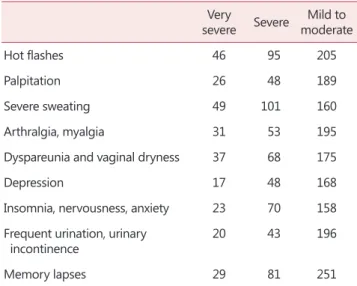
The most common menopausal symptom was hot flashes, and the second most common symptom was sweating (Table 1). However, the majority of Korean women regarded that menopause was a natural process of ageing (348 respondents, 68.9%) (Table 2), and a number of women answered that they feel more comfortable with having no menstrual period (129 respondents, 20.9%) and do not need to concern about being pregnant (25 respondents, 4%). On the other hand, negative awareness including a loss of femininity and ageing were associated in 43.2%
of postmenopausal women (Table 3). The most concerned disease after menopause was osteoporosis in 341 respondents (60%) (Table 4), but only 123 women (22%) underwent regular check-up of bone mineral density (Fig. 3). Although a large number of women were concerned about cancer, only a half of respondents answered that they received regular check-up for breast cancer (Fig. 4). Furthermore, 399 (81.8%) of all respondents said that they need treatment for menopausal symptoms. However, only 212 women underwent hormone therapy after doctor’s consultation, and 162 women considered menopause as a natural process and did not receive any therapy. Of all respondents, 67.9% had no experience of hormone therapy (Table 5, Fig. 5). The
Table 3. Perception on menopause
Loss of femininity 64 (10.4%)
Sadness 56 (9.1%)
Feel like being old 203 (32.8%)
Prefer having no menstrual period 129 (20.9%) No concern about being pregnant 25 (4.0%)
No special feeling 141 (22.8%)
Table 2. Awareness of the causes of menopause
Accept menopause as a natural process of ageing 348 (68.9%)
Hormone deficiency 106 (21.0%)
Don’t know 17 (3.4%)
Other 34 (6.7%)
Table 1. Experienced menopausal symptoms Very
severe Severe Mild to moderate
Hot flashes 46 95 205
Palpitation 26 48 189
Severe sweating 49 101 160
Arthralgia, myalgia 31 53 195
Dyspareunia and vaginal dryness 37 68 175
Depression 17 48 168
Insomnia, nervousness, anxiety 23 70 158 Frequent urination, urinary
incontinence 20 43 196
Memory lapses 29 81 251
Table 4. Concerning diseases after menopause
Cancer 56
Hypertension 58
Cardiovascular disease 89
Diabetes mellitus 19
Cerebrovascular accident 83
Osteoporosis 341
Arthritis 178
Urinary incontinence 102
Depression 176
Insomnia 120
Others 13
Fig. 3. Proportions of bone mineral density check after meno- pause.
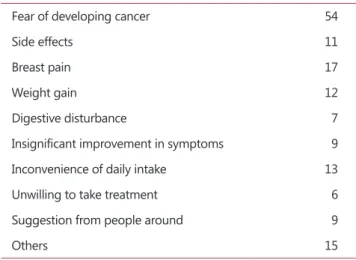
common causes for unwilling to receive hormone therapy in Korean postmenopausal women were concern about adverse effect in 162 respondents, and the fear of developing cancer in 102 respondents (Table 6). Moreover, 318 women obtained information on hormone therapy from the mass media than professional advice (Fig. 6). The leading cause for receiving hormone therapy was to improve postmenopausal symptoms in 163 women, followed by a doctor’s recommendation in 62 women and the prevention of osteoporosis in 42 women (Table 7). The primary reason for stopping hormone therapy was the fear of developing cancer, followed by concern about breast pain or weight gain (Table 8, Fig. 7).
Discussion
The KSM has conducted surveys on women who attended
health lectures held annually in celebration of World Menopause Day. As part of this project, the study aims to contribute to the improvement of patient care and publicity by comparing continuously changing perceptions in patients.
A total of 570 women participated in the 2010 survey, and 456 respondents (80.0%) were found to experience menopausal symptoms. The most common menopausal age was between 46-50 years in 213 respondents (46.7%), followed by 51-55 years in 178 respondents (39.0%). The most common menopausal symptom was hot flashes, and the second most common symptom was sweating. However, the majority of Korean women regarded that menopause was a natural process of ageing (348 respondents, 68.9%).
Table 6. Reasons for not starting hormone therapy
Concern about adverse effects 162
Fear of developing cancer 102
Unwilling to take treatment 43
Digestive disturbance 20
Fear of weight gain 17
Inconvenience of daily intake 14
Breast pain 11
Expensive cost of medication 8
Discomfort in menstrual period 2
Others 46
Table 5. Treatment methods of menopausal symptoms
Hormone therapy after doctor’s consultation 212
Exercise 339
Diet therapy 144
Health or adjuvant foods 146
Placental hormone 17
No treatment by regarding it as a natural ageing process 162
Others 7
Fig. 4. Proportions of mammography check after menopause. Fig. 5. Experiences of hormone therapy.
The finding showed insignificant difference with a study of Chung et al.,4 where 69.3% of respondents accepted menopause as a natural stage of life, performed in 2009 with the same investigation method. In a comparison of results of previous domestic studies published after the WHI study, a slight gradual increase is shown in the percentage of women who recognize that hormone deficiency causes menopausal symptoms. Although menopause is a natural process of ageing, potential health problems or symptoms associated with hormone deficiency need to be publicized and underscored at the level of the Society. A number of women answered that they feel more comfortable with having no menstrual period (129 respondents) and do not need to concern about being pregnant (25 respondents) after menopause. Meanwhile, 341 respondents answered that the
most concerned disease after menopause was osteoporosis, but only 123 women (22%) said that they received check-up for bone mineral density (BMD) on a regular basis. These findings imply that women have become more aware of the increase in risk of osteoporosis generated by drastic bone loss before and after menopause. However, continuous efforts need to be exerted for the prevention and treatment of postmenopausal osteoporosis according to the results of BMD test. Previous studies proposed that women need to be guided by implementing education and counsel that health problems could occur after menopause.7 It cannot be emphasized enough that women have to recognize this.
Among all respondents, 399 (81.8%) women felt that they need to receive treatment for menopausal symptoms.
Table 8. Reasons for stopping hormone therapy
Fear of developing cancer 54
Side effects 11
Breast pain 17
Weight gain 12
Digestive disturbance 7
Insignificant improvement in symptoms 9
Inconvenience of daily intake 13
Unwilling to take treatment 6
Suggestion from people around 9
Others 15
Table 7. Reasons for starting hormone therapy
To improve menopausal symptoms 163
To prevent and manage osteoporosis 42
To manage emotional instability, depression, and etc. 32 To alleviate dyspareunia and vaginal dryness 23
To prevent cardiovascular diseases 9
Doctor’s recommendation 62
Suggestion from people around 8
Mass media 7
Others 14
Fig. 7. Experienced side effects during hormone therapy.
Fig. 6. Motivation of hormone therapy.
This finding was comparable to the study result (81.8%) of Chung et al.4 However, only 212 women underwent hormone therapy after doctor’s consultation. The leading causes for not receiving hormone therapy were concern for adverse effects in 162 women, and the fear of developing cancer in 102 women. In addition, a large number of women taking hormone therapy stopped receiving it due to the fear on the above adverse effects. Even though 8 years have passed since the publication of WHI, many women are still reluctant to take hormone therapy.8 Therefore, changing women’s negative perceptions of hormone therapy is anticipated to be crucial by publicizing the benefits of hormone therapy through continuous education.
Moreover, 318 women obtained information on hormone therapy from the mass media than professional advice. This result was comparable to that of previous study performed a year ago.9 In the past, people tended to obtain more information from doctors. However, increased number of women gained menopause-related information from the mass media after the publication of WHI study that was overstated in public media. Women’s negative perceptions have remained the same. This tendency is proved by the fact that women are still unwilling to take hormone therapy due to the fear of developing cancer. A follow-up WHI study demonstrated that the incidence of breast cancer remained the same in the group with estrogen therapy alone for more than five years, and the incidence rate increased by about 8 cases per 10,000 persons in the group with combined estrogen-progestogen therapy. These findings prove that the impact of exaggerated contents of mass media is considerable. Taking into consideration the fact that patients search a large amount of information before visiting hospitals with the impact of modern mass media and the advances in internet, proactive education for people needs to be implemented through mass media by utilizing the changes in medical conditions. Furthermore, more active intervention needs to be undertaken in the field of medicine since incorrect medical knowledge spreads through mass media.
This study was able to verify that negative perception on menopause has shifted toward positive direction over the last 7-8 years in Korean women. However, women still neither start nor stop hormone therapy through in-depth
consultation with doctors about the benefits and risks of hormone therapy in many cases. Intaking or suspending medication should not be avoided without any reason. To alleviate menopausal symptoms and prevent menopause- related chronic diseases including osteoporosis, public education through health lectures and mass media is thought to be crucial to encourage patients to consult with their physicians to determine the best approach to taking hormone therapy and appropriate dose and duration of medication.9 The KSM surveys on changing perceptions have been beneficial in treating and counseling patients, however it is regrettable that the survey has stopped being implemented since 2011 due to external and internal reasons.
References
1. Choi H, Lee HK, Park HM. The Korean menopausal women`s attitudes and awareness on menopause: results of Korean gallup epidemiologic survey on menopause and HRT. J Korean Soc Menopause 2003; 9: 36-43.
2. Deeks A, Zoungas S, Teede H. Risk perception in women: a focus on menopause. Menopause 2008; 15: 304-9.
3. Rossouw JE, Anderson GL, Prentice RL, LaCroix AZ, Kooperberg C, Stefanick ML, et al. Risks and benefits of estrogen plus progestin in healthy postmenopausal women:
principal results From the Women’s Health Initiative randomized controlled trial. JAMA 2002; 288: 321-33.
4. Chung YJ, Kim MR, Jeong HW, Yoon BK, Lee BS, Kang BM, et al. Changing Korean Menopausal Women’s Awareness on Hormone Therapy: 7-years after Women’s Health Initiative Study. J Korean Soc Menopause 2012; 18:
94-9.
5. North American Menopause Society. Estrogen and progestogen use in postmenopausal women: 2010 position statement of The North American Menopause Society.
Menopause 2010; 17: 242-55.
6. Newton KM, Reed SD, Grothaus LC, La Croix AZ, Nekhlyudov L, Ehrlich K, et al. Hormone therapy discontinuation: physician practices after the Women’s Health Initiative. Menopause 2010; 17: 734-40.
7. Phillips LS, Langer RD. Postmenopausal hormone therapy:
critical reappraisal and a unified hypothesis. Fertil Steril 2005; 83: 558-66.
8. Sturdee DW, Pines A, Archer DF, Baber RJ, Barlow D, Birkhauser MH, et al. Updated IMS recommendations on
postmenopausal hormone therapy and preventive strategies for midlife health. Climacteric 2011; 14: 302-20.
9. Hersh AL, Stefanick ML, Stafford RS. National use of
postmenopausal hormone therapy: annual trends and response to recent evidence. JAMA 2004; 291: 47-53.