Otolaryngology & Dermatology 2011;24(1) : 25-35
MSH에 의해 자극된 B16F10세포에서 사간(射干)의 멜라닌 합성 억제 효과
김대성
1·성병곤
1·이장천
2·이부균
3·우원홍
1,4*·임규상
1,41
원광대학교 한의학전문대학원 한약자원개발학과
2
부산대학교 한의학전문대학원 약물학부
3
세명대학교 본초방제학교실
4
원광대학교 한국전통의학연구소
Inhibitory Effect of Belamcandae Rhizoma on the Melanogenesis in MSH-stimulated B16F10 cells
Dae-Sung Kim
1·Byung-Gon Sung
1·Jang-Cheon Lee
2·Boo-Kyun Lee
3·Won-Hong Woo
1,4*·Kyu-Sang Lim
1,4Objective : The present study was designed to assess the potential inhibitory activity of an ethanol extract of Belamcandae Rhizoma (EBR) on the alpha-melanocyte stimulating hormone (α-MSH)-induced melanogenesis signal pathway in B16F10 melanoma cells.
Methods : Several experiments were performed in B16F10 melanoma cells. We studied tyrosinase activity, melanin content, cell-free tyrosinase activity and DOPA stain, and performed Western blots and RT-PCR for proteins and mRNA involved in melanogenesis.
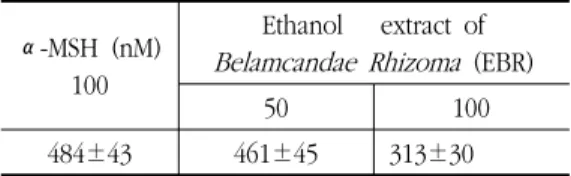
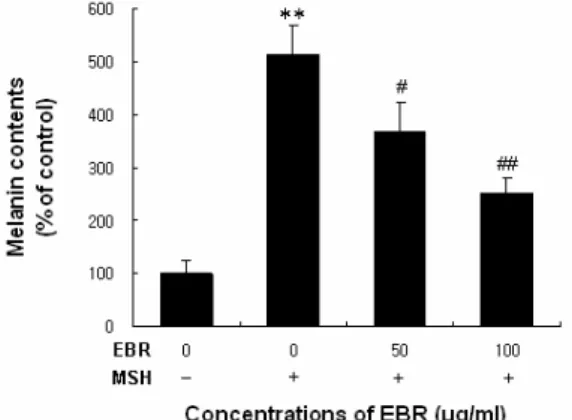
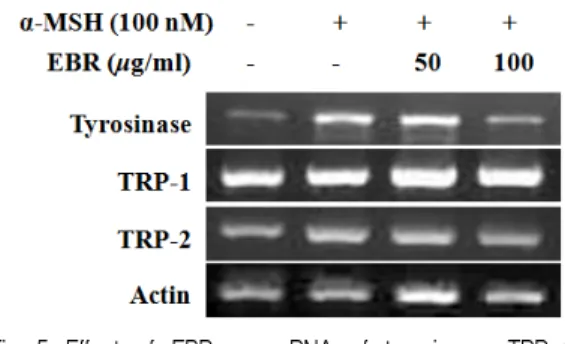
Results : α-MSH-induced tyrosinase activity and melanin content were inhibited significantly by EBR. EBR markedly suppressed the protein expression level of tyrosinase in B16F10 melanoma cells. On the other hand, the expression of tyrosinase-related protein-1 (TRP-1) and -2 (TRP-2; DCT) were not affected by EBR.
To elucidate the mechanism of the depigmenting property of EBR, we examined the involvement EBR in cAMP response element binding (CREB) protein phosphorylation and microphthalmia-associated transcription factor (MITF) signalling induced by α-MSH. EBR did not regulate CREB phosphorylation and MITF expression by α-MSH. Nevertheless, the mRNA expression of tyrosinase was significantly attenuated by EBR treatment without changes in the expression of TRP-1 and -2 mRNA.
Conclusion : Our study suggested that EBR inhibits α-MSH-induced melanogenesis by suppressing tyrosinase mRNA.
Key words : Belamcandae Rhizoma, melanin, tyrosinase, α-MSH
교신저자 : 우원홍, 전라북도 익산시 신용동 344-2번지, 원광대학교 한의학전문대학원 한약자원개학과(Tel : 063-850-5963, Fax : 063-850-5195, e-mail : [email protected])
∙접수 2011/03/04 ∙수정 2011/03/29 ∙채택 2011/04/05