ORIGINAL ARTICLE
야생 산사( Crataegus pinnatifida B UNGE )가 이상지질혈증의 BUN 및 Creatinine 농도 저하에 미치는 영향
김한수․김민아․Duan Yishan․장성호1)*․조한진2)․류재용3)․김상우4)
부산대학교 식품공학과, 1)부산대학교 바이오환경에너지학과, 2)서울디지털대학교,
3)경남대학교 도시환경공학과, 4)국립수산과학원 동해수산연구소
Influences of Wild Haw (Crataegus pinnatifida B
UNGE) on Lowering BUN and Creatinine Concentrations in Dyslipidemia
Han-Soo Kim, Min-A Kim, Yishan Duan, Seong-Ho Jang1)*, Han-Jin Cho2), Jae-Young Ryu3), Sang-Woo Kim4)
Department of Food Science & Technology, Pusan National University, Miryang 627-706, Korea
1)Department of Bioenviromental Energy, Pusan National University, Miryang 627-706, Korea
2)Seoul Digital University, Seoul, 121-040, Korea
3)Department of Urban Enviromental Engineering, Kyungnam University, Changwon 631-701, Korea
4)East Sea Fisheries Research Institute, NFRDI, Gangneung, 210-861, Korea
Abstract
This study was investigate the influences of wild haw (Crataegus pinnatifida BUNGE) on lowering blood urea nitrogen (BUN) and creatinine concentrations in dyslipidemic rats. Four groups of rats were fed different diets for 5 weeks:
basal diet (BD group), nondyslipidemic diet+feral haw extract (NDF group), dyslipidemic diet (DLD group), dyslipidemic diet+feral haw extract (DFH group). BUN, creatinine and uric acid concentrations were significantly higher in the DLD group than in the BD group. However, DFH group significantly lowered BUN, creatinine and uric acid concentrations compared to the DLD group. Amylase activity was significantly lower in the DLD group than in the BD group, while DFH group significantly higher compared to the DLD group. Lipase activity was also also significantly lower in the DLD group than the other group. Accordingly, these results suggest that haw extract could be effective for improving kidney function in dyslipidemic rats.
Key words : Crataegus pinnatifida BUNGE, BUN, Creatinine, Uric acid, Dyslipidemia
1. 서 론1)
생활 수준의 향상 및 서구화된 식생활로 인하여 동 물성 식품의 섭취가 증가하고 있으며 비만, 당뇨, 고혈
압과 같은 생활습관병(lifestyle related disease)이 사 회적으로 문제가 되고 있다(Heo 등, 2012). 심혈관계 질환은 잘못된 식습관 등으로 발병되는데 청소년기에 높은 혈청 콜레스테롤 양상을 보인 경우 성인이 되어
Received 10 February, 2014; Revised 11 March, 2014;
Accepted 27 March, 2014
*Corresponding author : Seong-Ho Jang, Department of Bioenviro- mental Energy, Pusan National University, Miryang 627-706, Korea Phone: +82-55-350-5435
E-mail: [email protected]
ⓒ The Korean Environmental Sciences Society. All rights reserved.
This is an Open-Access article distributed under the terms of the Creative Commons Attribution Non-Commercial License (http://
creativecommons.org/licenses/by-nc/3.0) which permits unrestricted non-commercial use, distribution, and reproduction in any medium, provided the original work is properly cited.
서도 비슷한 경향을 보인다고 하며, 일반적으로 비만 아동의 경우에는 동물성 지방을 많이 섭취하고 야채나 과일류는 적게 섭취한다고 알려져 있다(Han과 Rhee, 1996). 채소와 사과 혼합 주스를 6주간 섭취하였을 때 total cholesterol, triglyceride (TG), low density lipoprotein (LDL)-cholesterol의 농도는 감소하는 경 향을 보였고, superoxide dismutase (SOD), glutathione peroxidase (GPx), catalase의 활성은 증가하는 것으로 보고된 바 있다(Kang 등, 2005). 또한 채식을 할 경우 비채식자에 비하여 혈청 지질 수준이 개선되었고 총 항산화능이 증가하였다고 하며, 흡연자에 비하여 비 흡연자에서 총 항산화능이 높게 나타나 올바른 생활 습관과 식이 조절은 동맥경화의 예방 및 치료에 중요 하다고 보고되어 있다(Kim 등, 2000).
산사(Crataegus pinnatifida BUNGE)는 특유의 향과 맛을 가지고 있는 붉은 색의 열매로 떡, 잼과 같은 식용 및 소화기 질환, 항비만 등의 약용으로 이용되고 있다(Park 등, 2012). 산사의 활성 성분으로는 caffeic acid, pyrogallol, protocatechuic acid, chlorogenic acid, epicatechin, isoquercitrin 등이 알려져 있다(Kim 등, 1993; Liu 등, 2010). 산사의 생리활성으로는 위장보호 (Tadic 등, 2008), 혈관 이완 효능(Chae 등, 2003), 항균 활성(Ryu 등, 2012), 항산화(Liu 등, 2010) 등이 있다. 한 편, 고지혈증 유발 흰쥐에 4주간 산사추출물의 급여는 간 장의 중량 및 LDL-cholesterol, TG 농도를 감소시켰고, high density lipoprotein (HDL)-cholesterol 농도는 증 가시켜 고지혈증의 치료 및 예방에 유효할 것이라고 보고 되어 있다(Kwon과 Kim, 2010). 또한 알콜로 간 손상을 유발시킨 흰쥐에 산사추출물을 급여시킨 결과 간장의 중 량이 정상수준으로 회복되었고, 간 손상 지표인 glutamic oxaloacetic transaminase (GOT), glutamic pyruvic transaminase (GPT) 등의 효소 활성은 유의적으로 감소 하는 것으로 나타나 간 손상 예방 효과가 있다고 보고된 바 있다(Seo, 2005). 따라서 본 연구에서는 산사 추출물이 이상지질혈증 흰쥐에 있어 blood urea nitrogen (BUN) 및 creatinine, uric acid, amylase, lipase에 미치는 영향을 검토한 후, biohealth 기능성 식품 재료로 활용 가능성을 알아보고자 실험을 수행하였다.
2. 재료 및 방법
2.1. 실험재료의 조제
실험에 사용된 시료는 2011년 10월 중하순 강원도 정 선군 남면에서 채취한 산사를 진공동결건조(EYELA, FDU-2000, Rikakikai Co., Tokyo, Japan)시킨 다음 산사 200 g에 1,100 ㎖의 물을 넣고 4시간 동안 증숙(88℃)한 후, 92℃에서 8시간 동안 가열(DWG-50000AR, Dae- Woong, Seoul, Korea)하였다. 그 후 100 ㎖의 물을 넣고 다시 증숙(4h, 88℃) 및 가열(8h, 92℃) 하였다. 추출 과정 이 끝난 후 모아진 추출액(1,000 ㎖)을 본 실험의 시료로 사용하였다.
2.2. 실험동물 및 식이조성
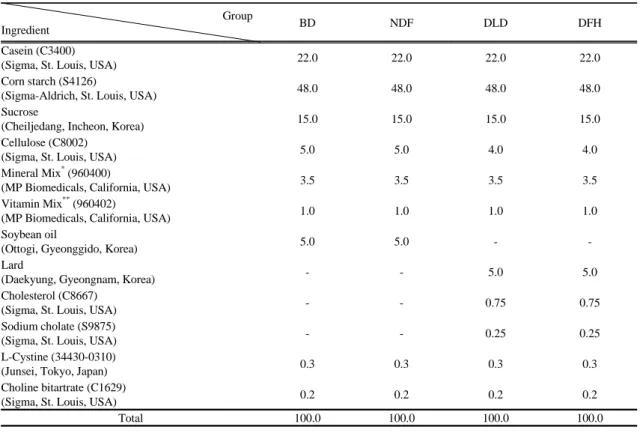
7주령된 Sprague Dawley계 수컷 흰쥐(200±10 g)를 Dae Han Biolink로 부터 구입하여 환경이 조절된 사육실 (온도 20±1℃, 및 습도 50±10%, 조명 07:00~19:00)에서 1주일간 예비 사육하였고, 6마리씩 4군으로 metabolic cage (JD-C-71, Jeongdo, Korea)에 나누어 5주간 실험 사 육하였다. 예비사육 및 실험사육 등 동물실험은 부산대 학교 동물실험윤리위원회의 승인(PNU-2013-0310)과 관리 감독 하에 실시되었다. 식이조성 및 실험군은 Table 1과 같다. 기본 식이를 섭취시킨 대조군(BD군), 대조군 에 산사추출물을 섭취시킨 NDF군, 이상지질혈증 유발 실험군인 DLD군, 이상지질혈증 실험군에 산사 추출물 을 섭취시킨 DFH군으로 나누었다.
2.3. 실험 동물의 처리
실험 동물은 마지막 7시간 동안 절식시킨 후 에테르 마취로 심장채혈법에 의하여 혈액을 채혈하였다. 혈액 은 4℃에서 1시간 방치한 후 3,000 cycle로 20분간 원심분 리하여 혈청만 분리하여 실험에 사용하였다.
2.4. Blood urea nitrogen (BUN) 농도의 정량
Blood urea nitrogen (BUN)은 효소법에 의해 조제된 시약(Eiken, Tokyo, Japan)으로 생화학분석기(Hitachi 7150, Tokyo, Japan)로 측정하였다.
2.5. Creatinine 농도의 정량
Creatinine은 Jaffe reaction법에 의해 조제된 시약
(Eiken, Tokyo, Japan)으로 혈액자동분석기(Hitachi
7150, Tokyo, Japan)에 의하여 정량하였다.
Group
Ingredient BD NDF DLD DFH
Casein (C3400)
(Sigma, St. Louis, USA) 22.0 22.0 22.0 22.0
Corn starch (S4126)
(Sigma-Aldrich, St. Louis, USA) 48.0 48.0 48.0 48.0
Sucrose
(Cheiljedang, Incheon, Korea) 15.0 15.0 15.0 15.0
Cellulose (C8002)
(Sigma, St. Louis, USA) 5.0 5.0 4.0 4.0
Mineral Mix* (960400)
(MP Biomedicals, California, USA) 3.5 3.5 3.5 3.5
Vitamin Mix** (960402)
(MP Biomedicals, California, USA) 1.0 1.0 1.0 1.0
Soybean oil
(Ottogi, Gyeonggido, Korea) 5.0 5.0 - -
Lard
(Daekyung, Gyeongnam, Korea) - - 5.0 5.0
Cholesterol (C8667)
(Sigma, St. Louis, USA) - - 0.75 0.75
Sodium cholate (S9875)
(Sigma, St. Louis, USA) - - 0.25 0.25
L-Cystine (34430-0310)
(Junsei, Tokyo, Japan) 0.3 0.3 0.3 0.3
Choline bitartrate (C1629)
(Sigma, St. Louis, USA) 0.2 0.2 0.2 0.2
Total 100.0 100.0 100.0 100.0
Group BD : Basal Diet. NDF : Nondyslipidemic Diet + Feral haw extract.
DLD : Dyslipidemic Diet DFH : Dyslipidemic Diet + Feral Haw extract.
*AIN-93G-MX Mineral Mix.
**AIN-93-VX Vitamin Mix.
Table 1. Experimental groups and compositions of experimental diet (%)
2.6. Uric acid 농도의 정량
혈청 중의 uric acid의 측정은 효소법에 의해 조제된 시 약(Eiken, Tokyo, Japan)을 이용하여 생화학분석기 (Hitachi 7150, Tokyo, Japan)를 사용하여 조사하였다.
2.7. Amylase activity 측정
Amylase는 pNPG7법으로 조제된 시약(Amylase, Roche, Indianapolis, USA)을 이용하여 측정 장치(Hitachi Modular, Tokyo, Japan)를 사용하여 분석하였다.
2.8. Lipase activity 측정
Lipase는 비색법(Colorimetry)에 의해 조제된 lipase 측정용 시약(LIPC, Roche, Indiana -polis, USA)을 사용하 여 생화학분석기(Integra 800, Roche, Basel, Switzerland) 를 사용하여 측정하였다.
2.9. 통계처리
통계처리는 측정한 분석치를 평균값과 표준편차로 나 타내었다. 군간의 차이는 one-way analysis of variance (ANOVA, IBM SPSS statistics ver. 21)로 분석하였고,
p<0.05 수준에서 Duncan's multiple range test에 의하여각 실험군 간의 유의성을 검증하였다.
3. 결과 및 고찰
3.1. Blood urea nitrogen (BUN)
혈청 중의 BUN 농도는 Fig. 1에서와 같다. 대조군에 산사추출물을 급여시킨 NDF군에서 13.5±1.6 mg/㎗로 대조군인 BD군(16.8±1.4 mg/㎗)보다 유의적으로 낮게 나타났다. 이상지질혈증 유발 실험군인 DLD군은 23.9±
1.4 mg/㎗로 대조군인 BD군과 대조군에 산사 추출물을
급여시킨 NDF군에 비하여 유의적으로 높은 것으로 확 인되었다. 이상지질혈증군에 산사 추출물을 급여시킨 DFH군은 20.4±1.5 mg/㎗로 이상지질혈증군인 DLD군 에 비하여 유의적으로 낮게 나타났다. BUN은 신장 기능 의 지표로 이용되는데 신장 이외의 여러 요인들에 의해 농도가 변하기도 하며, 일반적으로 신장 기능에 이상이 생기면 농도가 증가한다고 알려져 있고, 울혈성 심부전 증 환자의 38%에서 BUN 농도가 증가하였다고 보고된 바 있다(Ha, 1999; Kim, 1977). 따라서 본 실험결과 DLD 군에 비하여 DFH군에서 BUN 농도가 감소된 것은 산사 추출물의 신장 기능 개선 효과에 의한 것이라 판단된다.
Fig. 1. Concentrations of blood urea nitrogen in serum of the experimental rats.
*Group BD : Basal Diet.
NDF : Nondyslipidemic Diet + Feral haw extract.
DLD : Dyslipidemic Diet.
DFH : Dyslipidemic Diet + Feral Haw extract.
**The data are presented as means±SD of 6 independent.
rats. Means with different letters are significantly different at p<0.05 by Duncan's multiple range test.
3.2. Creatinine
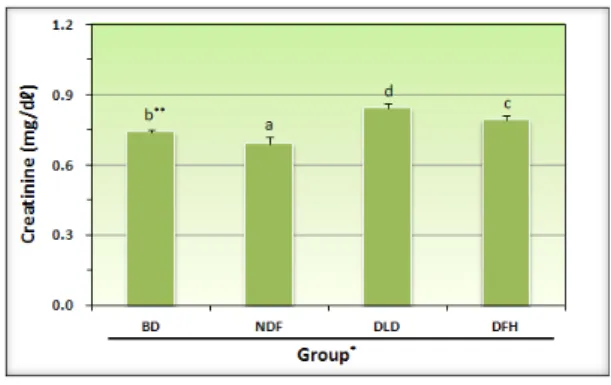
Creatinine의 농도는 Fig. 2와 같으며 BUN과 같은 경 향을 나타내었다. 대조군인 BD군은 0.74±0.01 mg/㎗로 나타났으며 대조군에 산사 추출물을 급여시킨 NDF군은 0.69±0.03 mg/㎗으로 BD군에 비하여 유의적으로 낮게 나타났다. 이상지질혈증군인 DLD군은 0.84± 0.02 mg/
㎗으로 BD군과 NDF군에 비하여 유의적으로 높게 나타 났다. 이상지질혈증에 산사 추출물을 급여시킨 DFH군 은 0.79±0.02 mg/㎗로 BD군 및 NDF군 보다는 높게 나타 났으나 DLD군에 비하여 유의적으로 낮게 나타났다.
Creatinine은 BUN과 마찬가지로 신장 기능의 지표로 이
용되고 있는데 신장 기능이 비정상적일 때 농도가 증가한 다고 하며, 체내에서 비교적 일정하게 생성되므로 BUN 보다 정확하다고 알려져 있다(Kim, 1977). 따라서 본 실 험결과 DLD군에 비하여 DFH군에서 유의적으로 creatinine 농도가 감소한 것으로 보아 산사는 신장 기능 개선에 효과적일 것으로 사료된다.
Fig. 2. Concentrations of creatinine in serum of the experimental rats.
*Group BD : Basal Diet.
NDF : Nondyslipidemic Diet + Feral haw extract.
DLD : Dyslipidemic Diet.
DFH : Dyslipidemic Diet + Feral Haw extract.
**The data are presented as means±SD of 6 independent rats. Means with different letters are significantly different at p<0.05 by Duncan's multiple range test.
3.3. Uric acid 농도의 정량
혈청 중의 uric acid 농도는 Fig. 3과 같으며 대조군인 BD군은 1.79±0.08 mg/㎗로 나타났다. 대조군에 산사 추 출물을 급여시킨 NDF군은 1.62±0.07 mg/㎗로 대조군 인 BD군에 비하여 유의적으로 낮게 나타났다. 이상지질 혈증 유발군인 DLD군은 2.41±0.14 mg/㎗로 대조군인 BD군과 대조군에 산사 추출물을 급여시킨 NDF군에 비 하여 유의적으로 높은 것으로 확인되었다. 이상지질혈 증에 산사 추출물을 급여시킨 DFH군은 2.13±0.10 mg/
㎗으로 나타나 대조군인 BD군, 대조군에 산사 추출물을
급여시킨 NDF군에 비하여 높게 나타났고 이상지질혈증
군인 DLD군에 비하여 유의적으로 낮게 나타났다. 혈중
uric acid는 세포 대사 또는 섭취된 식품의 purine으로부
터 생성되어 신장으로 배설 되는데 요산 결정(urate
crystal)은 통풍의 원인이 되며 혈관 내피의 기능 부전에
의한 만성신장병, 심혈관계 질환 및 신기능 저하와도 연
관성이 있다고 보고되어져 있다(Kang, 2011). 또한, 비 만, 당뇨, 고혈압 등은 혈청 요산 농도와 관련된 인자들이 며 고요산혈증이 있는 환자 중 남성의 28.3%, 여성의 42.2%가 대사증후군의 유병률을 보였다고 보고된 바 있 다(Hong 등, 2012). 따라서 본 실험결과, 산사 추출물의 급 여는 uric acid의 농도를 감소시키는 것으로 확인되었다.
Fig. 3. Concentrations of uric acid in serum of the experimental rats.
*Group BD : Basal Diet.
NDF : Nondyslipidemic Diet + Feral haw extract.
DLD : Dyslipidemic Diet.
DFH : Dyslipidemic Diet + Feral Haw extract.
**The data are presented as means±SD of 6 independent rats. Means with different letters are significantly different at p<0.05 by Duncan's multiple range test.
3.4. Amylase activity
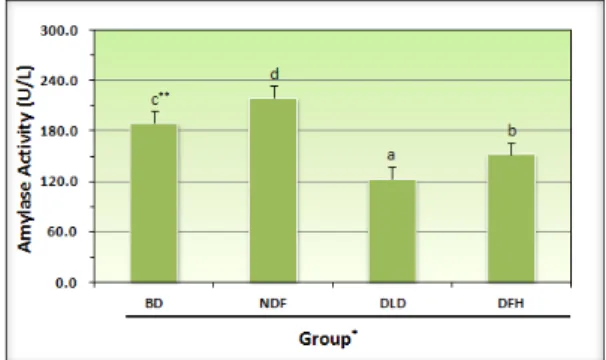
산사 추출물을 5주간 급여시킨 흰쥐의 amylase 활성 은 Fig. 4와 같다. 이상지질혈증 유발군인 DLD군이 123.2±13.8 U/L로 유의적으로 가장 낮은 활성을 보였다.
대조군인 BD군은 189.5±14.5 U/L로 나타났고 대조군 에 산사 추출물을 급여시킨 NDF군은 219.8±14.9 U/L로 대조군인 BD군에 비하여 유의적으로 높은 활성을 보였 다. 이상지질혈증에 산사 추출물을 급여시킨 DFH군은 152.0±14.1 U/L로 BD군 및 NDF군에 비하여 낮은 활성 을 보였지만 이상지질혈증군은 DLD군에 비하여 유의 적으로 높게 나타났다. Amylase는 일반적으로 급성췌장 염일 때 정상보다 높게 나타난다고 알려져 있으나 일부 환자에게서는 정상수준을 나타내었다는 연구 결과도 있 다(Choi, 2007; Park 등, 2012). 한편, streptozotocin으로 당뇨가 유발된 흰쥐의 췌장에서 amylase 활성은 10.60 U/100 mg으로 대조군(30.90 U/100 mg)에 비하여 감소
하였다고 보고된 바 있다(Aughsteen과 Mohammed, 2002). 따라서 본 실험결과 이상지질혈증군인 DLD군은 지질대사 이상에 따른 비정상적인 당질대사가 일어났다 고 사료되며 이상지질혈증군에 산사의 급여는 유의적으 로 amylase 활성을 증가시켰으며 당질대사 개선효과가 있을 것으로 생각된다.
Fig. 4. Amylase in serum of the experimental rats.
*Group BD : Basal Diet.
NDF : Nondyslipidemic Diet + Feral haw extract.
DLD : Dyslipidemic Diet.
DFH : Dyslipidemic Diet + Feral Haw extract.
**The data are presented as means±SD of 6 independent rats. Means with different letters are significantly different at p<0.05 by Duncan's multiple range test.
3.5. Lipase activity
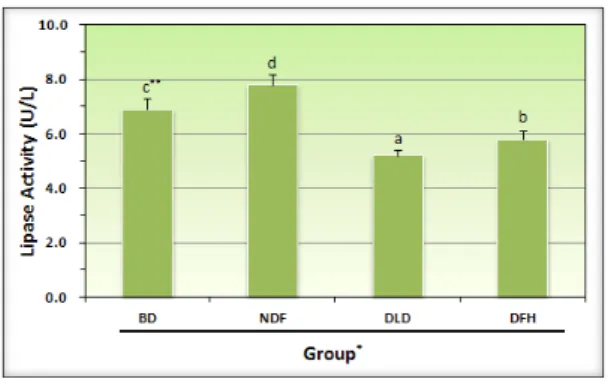
Lipase 활성은 Fig. 5와 같으며, amylase 활성과 같은
경향을 나타내었다. 대조군인 BD군은 6.9±0.4 U/L로 나
타났으며 대조군에 산사 추출물을 급여시킨 NDF군은
7.8±0.4 U/L로 나타나 BD군에 비하여 유의적으로 높은
활성을 보였다. 이상지질혈증 유발군인 DLD군은
5.2±0.2 U/L로 BD군 및 NDF군에 비하여 유의적으로 낮
게 나타났다. 이상지질혈증에 산사 추출물을 급여시킨
DFH군은 5.8±0.3 U/L으로 BD, NDF군에 비하여 낮게
나타났으나 이상지질혈증군인 DLD군에 비하여 유의적
으로 높은 활성을 보였다. Lipase는 amylase와 마찬가지
로 급성 췌장염의 지표로 이용되며 인슐린 비의존형 당뇨
병 환자군에서 활성도가 감소하였으나 대조군과 유의적
인 차이는 없었다고 보고된 바 있다(Mohan 등, 1989). 한
편 당뇨로 유발된 흰쥐에 있어서 췌장의 lipase 활성은
51.92 U/100 mg으로 대조군의 90.98 U/100 mg에 비하
여 유의적으로 감소하였으며 당뇨유발군에 인슐린의 투
여는 lipase의 활성을 98.66 U/100 mg으로 증가시켰다 고 보고된 바 있다(Aughsteen과 Mohammed, 2002). 따 라서 산사의 급여는 지질대사 이상으로 인한 당질대사 이상을 개선시킬 수 있을 것이라 사료된다.
Fig. 5. Lipase in serum of the experimental rats.
*Group BD : Basal Diet.
NDF : Nondyslipidemic Diet + Feral haw extract.
DLD : Dyslipidemic Diet.
DFH : Dyslipidemic Diet + Feral Haw extract.
**The data are presented as means±SD of 6 independent rats. Means with different letters are significantly different at p<0.05 by Duncan's multiple range test.
4. 결 론
산사추출물이 이상지질혈증으로 유발된 Sprague Dawley계 수컷 흰쥐에 있어서 BUN 및 creatinine 농도 저하에 미치는 영향을 관찰하기 위하여 본 실험을 수행하 였다. 기본식이를 섭취시킨 BD군을 대조군으로 하였으 며, 대조군에 산사추출물을 섭취시킨 NDF군, 이상지질 혈증 유발군인 DLD군, 이상지질혈증군에 산사추출물 을 섭취시킨 DFH군으로 5주간 실험 사육하였다. BUN, creatinine, uric acid 농도는 대조군에 비하여 산사추출물 을 급여시킨 NDF군이 유의적으로 낮게 나타났고, 이상 지질혈증군인 DLD군에 비하여 이상지질혈증군에 산사 추출물을 섭취시킨 DFH군이 유의적으로 낮게 나타났 다. Amylase와 lipase 활성은 BD군에 비하여 NDF군에 서 높게 나타났으며, DLD군에 비하여 DFH군에서 유의 적으로 높게 나타났다. 따라서 이상지질혈증 흰쥐에 있 어서 산사추출물의 급여는 신장 기능 개선 효과 및 지질 대사 이상으로 인한 비정상적인 당질대사의 개선 효과가 있는 것으로 추정된다.
참 고 문 헌
Aughsteen, A. A., Mohammed, F. I., 2002, Insulin enhances amylase and lipase activity in the pancreas of streptozotocin-diabetic rats, Saudi Med. J., 23, 838-844.
Chae, J. K., Kim, G. W., Shin, H. M., 2003, Crataegi Fructus-induced vascular relaxation through release of endotherial nitric oxide, Kor. J. Oriental Physiology &
Pathology, 17(1), 146-150.
Choi, K. H., 2007, Normal amylase and lipase serum level in acute pancreatitis: a case report, Yeungnam University.
J. of Med., 24, 627-631.
Han, J. S., Rhee, S. H., 1996, The relationship between serum cholesterol level and dietary intake in obese children, J. Korean Soc. Food. Nutr., 25, 433-440.
Ha, S. K., 1999, Antibiotic therapy in renal failure, Kor. J.
nephrology, 18, 19-30.
Heo, H. J., Nam, S. Y., Lee, S. K., Chung, S. J., Yoon, J. H., 2012, The relationship between high energy/low nutrient food consumption and obesity among Korean children and adolescents, Kor. J. Community Nutr., 17, 226-242.
Hong, S. J., Kim, Y. S., Kim, H. S., 2012, Prevalence and clinical features of hyperuricemia in gwangju and jeonnam territories, J. Rheumatic Diseases, 19, 138-146.
Kang, D. H., 2011, Does hyperuricemia play a causative role in the development and/or aggravation of renal, cardiovascular and metabolic disease? Kor. J. Medicine, 80, 524-528.
Kang, J. Y., Kim, S. Y., Lee, M. S., Ahn, H. S., 2005, Effects of vegetables juice supplementation on serum lipid profile and antioxidant activity in college women, Korean J. Community Nutr., 10, 183-188.
Kim, J. S., 1977, The serum NPN, BUN and creatinine values in chronic congestive heart failure, Kor.
Circulation J., 7, 35-40.
Kim, J. S., Lee, G. D., Kwon, J. H., Yoon, H. S., 1993, Identification of phenolic antioxidative components in Crataegus pinnatifida Bunge, J. Kor. Agric. Chem.
Soc., 36, 154-157.
Kim, S. G., Kim, H. I., Yum, M. S., Jo, H., Oh, Y. Y., Kwan, H. J., Cho, W. H., Park, J. S., 2000, Comparison of serum lipid profiles and total antioxidant status in vegetarian and non-vegetarian groups, Kor. J. Medicine, 58, 197-203.
Kwon, S. H., Kim, J. B., 2010, Effects of Crataegii Fructus on the diet-induced hyperlipidemia in rats, Kor. J.
Oriental Physiology & Pathology, 24, 67-73.
Liu, P., Yang, B., Kallio, H., 2010, Characterization of phenolic compounds in chinese hawthorn (Crataegus pinnatifida Bge. var. major) fruit by high performance liquid chromatography –lectrospray ionization mass spectrometry, Food Chemistry, 121, 1188-1197.
Liu, T., Cao, Y., Zhao, M., 2010, Extraction optimization, purification and antioxidant activity of procyanidins from hawthorn (C. pinnatifida Bge. var. major) fruits, Food Chemistry, 119(4), 1656–1662.
Mohan, V., Snehalatha, C., Ahmed, M. R., Madanagopalan, N., Char, S., jayanthi, V., Malathi, S., Ramachandran, A., Viswanathan, M., 1989, Exocrine pancreatic function in tropical fibrocalculous pancreatic diabetes, Diabetes Care, 12, 145-147.
Park, K. C., Bae, G. S., Choi, S. B., Jo, I. J., Gwak, T. S., Lee, G. S., Park, S. J., Song, H. J., 2012, Protective effect
of Poncirus trifoliata and Citrus aurantium extract on acute pancreatitis in mice model, Kor. J. Herbology, 27, 9-14.
Park, S. J., Shin, E. H., Lee, J. H., 2012, Biological activities of solvent fractions from methanolic extract of Crataegi fructus, Kor. J. Food & Nutr., 25, 897-902.
Ryu, H. Y., Ahn, S. M., Kim, J. S., Jung, I. C., Sohn, H. Y., 2010, Antimicrobial activity of fruit of Crataegus pinnatifida Bunge against multidrug resistant pathogenic Pseudomonas aeruginosa and Candida sp., Kor. J.
Microbiol. Biotechnol, 38(1), 77-83.
Seo, B. I., 2005, Preventive effects of water extracts from Crataegi fructus on hyperlipiderma and liver damage induced by alcohol, Korean J. Herbology, 20, 35-43.
Tadic, V. M., Dobric, S., Markovic, G. M., Dordevic, S. M., Arsic, I. A., Menkovic, N. R., Stevic, T., 2008. Anti- inflammatory, gastroprotective, free radical scavenging and antimicrobial activities of hawthorn berries ethanol extract, J. Agric. Food Chem., 56, 7700-7709.