*Corresponding author: Ho-Sang Shin
Phone: +82-41-850-8811; Fax: +82-41-850-8811;
E-mail: [email protected]
Korean J Environ Agric. 2016;35(1):15-23. Korean Online ISSN: 2233-4173
Published online 2016 March 14. http://dx.doi.org/10.5338/KJEA.2016.35.1.02 Print ISSN: 1225-3537
금강 수계 주요지류인 갑천과 미호천에서 잠정유해물질 오염원 확인 연구
이준배1, 이재정1, 조윤해1, 윤조희1, 홍선화1, 이대희1, 이수형1, 조영환2, 신호상2*
1국립환경과학원 금강물환경연구소 물환경화학연구과, 2공주대학교 환경과학과
Contamination Sources of Several Potentially Hazardous Compounds Found at the Gap Stream and the Miho Stream, Two Major Tributaries of the Geum River
Jun-Bae Lee
1, Jay-Jung Lee
1, Yoon-Hae Cho
1, Jo-Hee Yoon
1, Seoun-Hwa Hong
1, Dae-Hee Lee
1, Soo-Hyung Lee
1, Young-Hwan Cho
2and Ho-Sang Shin
2*(
1Water Environmental Chemistry Graduate, Geum River Environment Research Center, National Institute of Environmental Research Okcheon-gun 29027, Korea,
2Department of Environmental Science, Kongju University, Kongju-si 32588, Korea)
Received: 19 October 2015 / Revised: 2 March 2016 / Accepted: 9 March 2016 Copyright ⓒ 2016 The Korean Society of Environmental Agriculture
This is an Open-Access article distributed under the terms of the Creative Commons Attribution Non-Commercial License (http://creativecommons.org/licenses/by-nc/3.0) which permits unrestricted non-commercial use, distribution, and reproduction in any medium, provided the original work is properly cited.
ORCID Jun-Bae Lee
http://orcid.org/0000-0002-4568-9150
15
Abstract
BACKGROUND: Water quality is of concern to water utility operators, public health officials, and populations using the water. If any contaminant is released from a point of entry, it could be spread rapidly throughout the water stream. So the identification of the location of the points of entry and its release history are critical informations to establish the management strategy.
METHODS AND RESULTS: Aniline, nonylphenol, pentachlorophenol and formaldehyde in 39 surface water samples were analysed using Gas chromatography-mass spectrometry (GC-MS) methods. Formaldehyde, aniline and nonylphenol were mainly detected in the near sites where industrial waste water and domestic sewage were discharged into stream. But pentachlorophenol was detected in the downstream samples where pulp manufacturing plants were operated.
CONCLUSION: Results indicate that pentachlorophenol found in main stream of Guem river was mainly
introduced from pulp manufacture industries. Otherwise, formaldehyde, aniline and nonylphenol were mainly contaminated from the industrial waste water and domestic sewage.
Key words: Aniline, Formaldehyde, Geum River, Nonylphenol, Pentachlorophenol
서 론
잠재적으로 해로운 영향을 줄 수 있는 다양한 오염물질들 은 환경으로 꾸준히 배출되고 있다(Abdel Salam et al ., 2009). 특히 하수처리장은 모든 물질을 완벽하게 제거하지 못 하므로, 역설적으로 불완전하게 처리된 물질이 수계로 유인되 는 주요 유입 원이 될 수 있다(Feng et al ., 2009). 우리나라 는 도심하천이 직접적인 상수원으로 사용되고 있지는 않지만, 최근 하천둔치와 4대강 수변구역이 공원으로 활용되고 있으 므로, 도심하천이 국민 건강에 유해 요소로 작용할 수 있는 가능성이 이전보다 높아졌다. 이에 따라 우리나라도 국민건강 과 수생태계 보호를 위해 환경기준 설정과 더불어 점오염원 및 비점오염원에 대한 수질 관리를 강화하고 있는데, 특히 2013년부터는 수질·수생태계 환경기준에 사람의 건강보호항 목 3개(formaldehyde, 1,4-dioxane, hexachlorobenzene) 이 추가되었다.
Research Article Open Access
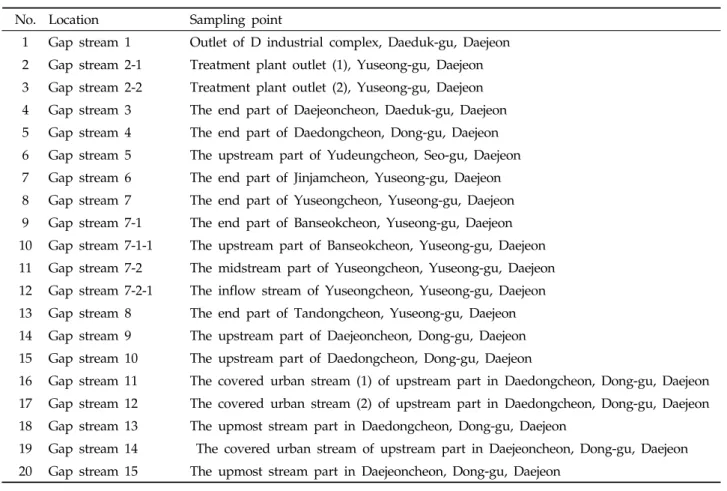
Table 1. Sampling points on the monitoring of potential hazardous compounds contamination routes in Gapcheon No. Location Sampling point
1 Gap stream 1 Outlet of D industrial complex, Daeduk-gu, Daejeon 2 Gap stream 2-1 Treatment plant outlet (1), Yuseong-gu, Daejeon 3 Gap stream 2-2 Treatment plant outlet (2), Yuseong-gu, Daejeon 4 Gap stream 3 The end part of Daejeoncheon, Daeduk-gu, Daejeon 5 Gap stream 4 The end part of Daedongcheon, Dong-gu, Daejeon 6 Gap stream 5 The upstream part of Yudeungcheon, Seo-gu, Daejeon 7 Gap stream 6 The end part of Jinjamcheon, Yuseong-gu, Daejeon 8 Gap stream 7 The end part of Yuseongcheon, Yuseong-gu, Daejeon 9 Gap stream 7-1 The end part of Banseokcheon, Yuseong-gu, Daejeon 10 Gap stream 7-1-1 The upstream part of Banseokcheon, Yuseong-gu, Daejeon 11 Gap stream 7-2 The midstream part of Yuseongcheon, Yuseong-gu, Daejeon 12 Gap stream 7-2-1 The inflow stream of Yuseongcheon, Yuseong-gu, Daejeon 13 Gap stream 8 The end part of Tandongcheon, Yuseong-gu, Daejeon 14 Gap stream 9 The upstream part of Daejeoncheon, Dong-gu, Daejeon 15 Gap stream 10 The upstream part of Daedongcheon, Dong-gu, Daejeon
16 Gap stream 11 The covered urban stream (1) of upstream part in Daedongcheon, Dong-gu, Daejeon 17 Gap stream 12 The covered urban stream (2) of upstream part in Daedongcheon, Dong-gu, Daejeon 18 Gap stream 13 The upmost stream part in Daedongcheon, Dong-gu, Daejeon
19 Gap stream 14 The covered urban stream of upstream part in Daejeoncheon, Dong-gu, Daejeon 20 Gap stream 15 The upmost stream part in Daejeoncheon, Dong-gu, Daejeon
또한 안정적인 수질관리를 위해서는 하천에 존재하는 유 해화학물질의 배출원이 될 수 있는 산업단지, 제조공장에서 사용하고 있는 여러 화학물질에 대한 집중적인 관리·감독과 주기적인 모니터링이 필요하다. 이를 위해서 환경부에서는
‘수질관리과’를 만들어 수질관리를 총괄업무를 강화하였고,
‘수생태계 복원 및 사고 대응 체계 구축을 통한 공공수역 살 리기’, ‘선제적 수질관리를 위한 수질예보제 운영’, ‘수질오염 사고시 신속한 대응을 위한 실시간 예측시스템 개발․운영’,
‘국가 수질 측정망 통합 DB구축․관리, 중장기 수질평가 연구’
등을 수행하며 국민생활과 수생태계와 연관된 수질환경 문제 해결을 위해 지속적인 노력을 해오고 있다.
2000년대 이후부터 전통적인 수질오염물질에 더해 각종 독성물질, 발암성 물질, 내분비계장애물질 등에 대한 우려가 커지고 있으므로 이를 반영한 환경기준 설정이 필요하다. 또 한 각 지역에 따라 수계배출원이 다르므로 효과적인 관리를 위해서는 환경기준을 일괄적으로 적용하기 보다는 지역에 따 는 특성을 반영할 필요가 있다. 이를 위해 규제 대상물질 선 정과 그 물질의 규제치를 정할 때 지역단위 조사 자료를 바탕 으로 하는 것이 바람직하다. 실생활에서 유해물질 노출상황을 고려하여 사람의 건강보호와 더불어 수생생물 보호를 위해서 는 지역별로 특이적으로 검출되거나, 검출농도 및 빈도가 높 은 항목들에 대해서 오염물질 발생 원인을 추적하고 오염 원 인을 규명하는 작업이 필요하다.
이를 위해서 본 연구에서는 금강의 대표적 하천인 갑천(20
지점)과 미호천(19지점)에서 유해화학물질의 발생원을 추적 하고 오염원인을 규명하고자 하였다. 지역에 특화된 대상물질 을 골라내기 위하여 최근에 수행되었던 국가 연구과제의 결 과를 분석하였으며, 그 결과 우선 조사해야 할 물질로 formaldehyde, aniline, nonylphenol, pentachlorophenol 4가지를 선정하였다. 합성원료인 aniline과 페놀류인 nonylphenol, pentachlorophenol은 LLE-GC-MS(liquid-liquid extraction gas chromatography mass spectrometry) 분석 법을 사용하였으며, 알데히드류인 formaldehyde는 HS-GC- MS(headspace gas chromatography mass spectrometry) 분 석법을 사용하였다.
재료 및 방법
시약 및 표준품
내부표준물질(internal standard, IS)을 포함한 각종 표
준물질은 Sigma-Aldrich(Merck, St. Louis, Missouri,
USA)의 고농도 표준용액을 희석하여 사용하였다. 분석용
methanol과 dichloromethane은 Burdick & Jackson
(Honeywell, Morris, New Jersey, USA)의 시약을 사용하
였고, 정제수는 초순수 milli-Q(millipore corp., milford,
MA, USA)를 사용하였다. 모든 초자 기구는 세제, 증류수,
아세톤, 메탄올로 연속하여 세척한 후 350℃에서 4시간 이상
가열한 후 오염이 없는 곳에서 방냉한 것을 사용하였다.
Table 2. Sampling points on the monitoring of potential hazardous compounds contamination routes in Mihocheon No. Location Sampling point
1 Miho stream 1 Jincheon Nong-bridge, Jincheon-gun, Chungcheongbuk-do
2 Miho stream 2 The end part of Musimcheon, Heungdeok-gu, Cheongju-si, Chungcheongbuk-do 3 Miho stream 3 O industrial Complex outlet, Cheongwon-gu, Cheongju-si, Chungcheongbuk-do 4 Miho stream 4 The end part of Seoknamcheon, Cheongwon-gu, Cheongju-si, Chungcheongbuk-do 5 Miho stream 5 The end part of Byeongcheoncheon, Cheongwon-gu, Cheongju-si, Chungcheongbuk-do 6 Miho stream 5-1 A pulp manufacturing plant outlet, Cheongwon-gu, Cheongju-si, Chungcheongbuk-do 7 Miho stream 5-2 B pulp manufacturing plant outlet, Cheongwon-gu, Cheongju-si, Chungcheongbuk-do 8 Miho stream 5-3 C pulp manufacturing plant outlet, Cheongwon-gu, Cheongju-si, Chungcheongbuk-do 9 Miho stream 6 D pulp manufacturing plant outlet, Cheongwon-gu, Cheongju-si, Chungcheongbuk-do 10 Miho stream 7 End part of Jocheon, Jochiwon-eup, Sejong
11 Miho stream 8 E pulp manufacturing plant outlet, Jochiwon-eup, Sejong
12 Miho stream 9 The upstream part of Musimcheon, Sangdang-gu, Cheongju-si, Chungcheongbuk-do 13 Miho stream 10 The end part of Mipyeongcheon, Sangdang-gu, Cheongju-si, Chungcheongbuk-do
14 Miho stream 11 The part near ‘Miho stream 10’ in Mipyeongcheon, Sangdang-gu, Cheongju-si, Chungcheongbuk-do 15 Miho stream 12 The inflow stream (1) of Mipyeongcheon, Sangdang-gu, Cheongju-si, Chungcheongbuk-do 16 Miho stream 13 The inflow stream (2) of Mipyeongcheon, Sangdang-gu, Cheongju-si, Chungcheongbuk-do 17 Miho stream 14 The inflow stream (3) of Mipyeongcheon, Sangdang-gu, Cheongju-si, Chungcheongbuk-do 18 Miho stream 14-1 The upstream inflow-stream (3) of Mipyeongcheon, Sangdang-gu, Cheongju-si, Chungcheongbuk-do 19 Miho stream 15 The upmost stream part of Mipyeongcheon, Sangdang-gu, Cheongju-si, Chungcheongbuk-do
Fig. 1. Sampling points on the monitoring of potential hazardous compounds contamination routes in Gapcheon and Mihocheon.
*A, B, C, D, E : specific names are not provided for each right of privacy.
*1~15 (number) : sampling location, mentioned by table 1, 2.
시료채취
금강수계 지천인 갑천, 미호천을 대상으로 2014년 5월부 터 11월까지 4회에 걸쳐 조사하였다. 채수방법은 갑천과 미 호천으로 들어오는 소하천의 하류부터 시작하여 상류까지 단 계적으로 올라가는 방법으로 오염원 추적을 위해 진행하였다.
조사지점은 총 39개 지점으로써 갑천이 20개 이었으며, 미호 천은 19개 이었다. 각 지점에 대한 명칭 및 자세한 세부내용 은 Table 1, 2와 Fig. 1에 제시하였다.
시료용기는 미리 세척한 후 건조시킨 Environmental
Sampling Supply(San Leandro, CA, USA)사 제품의 테
플론(teflon) 마개가 있는 시료채취용 갈색유리병을 사용하였
다. 이 용기는 유기물이 용출되지 않음을 증명하는 인증서를
포함하고 있다. 유기화합물 분석시료는 각 전처리 방법별로
분리하여 테플론 마개가 있는 1 L 갈색유리병과 40 mL 갈색
바이알에 headspace 없이 채수하였으며, 검출 시 재분석을
위해 각 지점마다 3개씩 6개 시료를 채수하였다. 채수한 시료
는 4℃ 온도를 유지하기 위해 현장에서 얼음을 넣은 아이스
박스에 보관하였으며, 채수한 시료는 실험실로 이송하여 분석
Table 3. Analytical results of formaldehyde in Gapcheon
• Unit : μg/L
Sites 1st (May) 2nd (July) 3rd (September) 4th (November)
Gap stream 1 86.6 54.7 115.6 51.6
Gap stream 2-1 28.0 7.8 6.4 10.8
Gap stream 2-2 30.4 7.1 19.4 6.8
Gap stream 3 10.9 ND - -
Gap stream 4 13.7 3.5 4.5 2.7
Gap stream 5 11.2 - - -
Gap stream 6 11.3 - - -
Gap stream 7 23.6 ND - -
Gap stream 7-1 - - 4.2 4.2
Gap stream 7-1-1 - - - 5.4
Gap stream 7-2 - - 6.0 ND
Gap stream 7-2-1 - - - ND
Gap stream 8 20.7 - - -
Gap stream 9 - ND 12.0 ND
Gap stream 10 - ND ND ND
Gap stream 11 - - ND ND
Gap stream 12 - - ND ND
Gap stream 13 - - ND -
Gap stream 14 - - 4.4 ND
Gap stream 15 - - ND -
Concentration range 10.9-86.6 3.5-54.7 4.2-115.6 2.7-51.6
Mean 26.3 9.8 13.8 7.0
Detection frequency (%) 100 50 62 46
*‘-’: non-sampling point
*‘ND’ : not detected or <LOQ (limit of quantitation)
전까지 냉장 보관하였다.
시료분석
Formaldehyde는 유도체화 시킨 후 HS-GC-MS 분석법 을 사용하였다. 10 mL headspace vial에 시료 3 mL를 취 하고 pH 9.0 buffer(sodium bicarbonate : potassium carbonate = 3:1)로 조절 후 내부표준물질(acetone-d6)을 가한 다음 유도체화 시약(trifluoroethylhydrzine)을 첨가하 여 GC-MS로 분석하였다.
준휘발성 유기화합물인 aniline, nonylphenol, pentachlorophenol은 LLE-GC-MS 분석법을 사용하였다.
1,000 mL 분액깔때기에 시료 1,000 mL를 넣은 후 내부표준 물질로써 phenanthrene-d10를 넣었다. 다음으로 염화나트륨 40 g을 넣고 추출용매인 디클로로메탄 40 mL를 넣은 다음 중 성과 염기성에서 각각 추출한 후 추출액을 진공회전증발기로 100 μL까지 농축하였다. 농축한 시료는 필요하면 정제과정을 거친 후 GC-MS로 분석하였다.
선택이온 또는 정량이온에 대한 크로마토그램을 작성하여 각 물질의 머무름 시간에 해당하는 위치 피이크로부터 면적 을 측정하고, 미리 작성한 검정곡선으로부터 각각의 양을 구
하여 시료 중 농도를 산출하였다.
시험방법의 신뢰성 확인
본 연구의 분석방법에 대한 신뢰성 확인을 위해 검출한계, 정량한계, 검정곡선, 정밀도, 정확도, 회수율에 대한 정도관리 를 아래와 같이 수행하였다.
모든 정도관리는 분석성분이 검출되지 않는 하천수를 이 용하였으며, 예상 검출한계 농도를 첨가한 7개의 시료를 준 비하여 하천시료와 같은 실험절차에 따라 분석하여 얻은 표 준편차에 3.14를 곱한 값을 검출한계로 하였으며, 10을 곱 한 값을 정량한계로 하였다. 분석 대상 물질의 정량한계는 각각 2.7 μg/L (formaldehyde), 0.005 μg/L (aniline), 0.044 μg/L (nonylphenol), 0.005 μg/L (pentachlorophenol) 이었다. 검정곡선 작성 결과 formaldehyde의 직선성(r
2) 은 0.999 이상의 값을 보였고, aniline, nonylphenol, pentachlorophenol의 직선성(r
2)은 0.994 이상의 값을 보였다.
선택한 4가지 유해화학물질들을 적정 농도로 첨가한 5개
시료에 대해 실험절차에 따라 분석하여 정량하였을 때 상대
표준편차를 정밀도, 참값에 대한 백분율을 정확도로 반영하였
다. 정량 결과, 정밀도는 10.9% 이내 이었으며, 정확도는
Table 4. Analytical results of formaldehyde in Mihocheon
• Unit : μg/L
Sites 1st (May) 2nd (July) 3rd (September) 4th (November)
Miho stream 1 15.7 - - -
Miho stream 2 8.7 ND - -
Miho stream 3 24.3 - - -
Miho stream 4 3.3 - - -
Miho stream 5 7.9 19.3 19.2 ND
Miho stream 5-1 - - ND 4.2
Miho stream 5-2 - - 7.3 6.6
Miho stream 5-3 - - - 5.3
Miho stream 6 178.6 61.6 7.5 93.2
Miho stream 7 ND ND - -
Miho stream 8 11.5 ND 5.1 4.5
Miho stream 9 - ND - -
Miho stream 10 - ND 3.6 ND
Miho stream 11 - - 3.6 ND
Miho stream 12 - - ND ND
Miho stream 13 - - ND ND
Miho stream 14 - - ND ND
Miho stream 14-1 - - - ND
Miho stream 15 - - - ND
Concentration range 3.3-178.6 19.3-61.6 3.6-19.2 4.2-93.2
Mean 31.4 12.5 5.2 9.6
Detection frequency (%) 88 29 60 39
*‘-’: non-sampling point
*‘ND’ : not detected or <LOQ(limit of quantitation)
Fig. 2. Analytical results of formaldehyde in Gapcheon.
*1~15 (number) : sampling location, mentioned by table 1 and figure 1.
Fig. 3. Analytical results of formaldehyde in Mihocheon.
*1~15 (number) : sampling location, mentioned by table 2 and figure 1.
83.5-113.6% 범위를 보였다. 또한 aniline, nonylphenol, pentachlorophenol의 회수율은 75.8~109.9% 범위를 보였 다. 이 모든 정도관리 결과를 종합하면, 높은 신뢰성을 확보 한 것으로 볼 수 있다.
결과 및 고찰
측정결과 및 해석
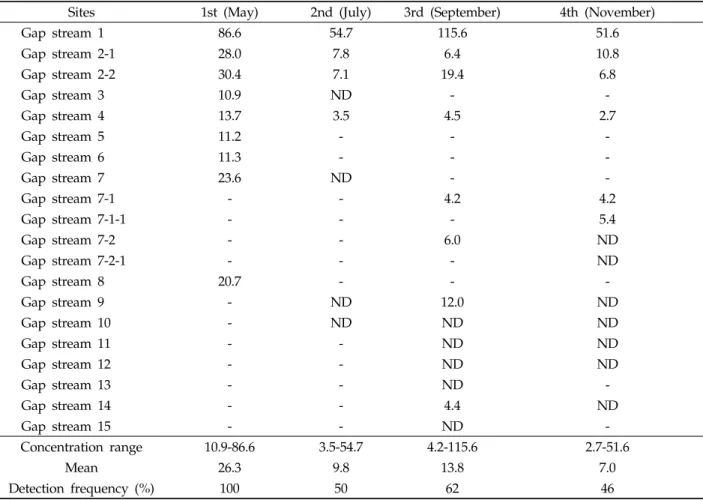
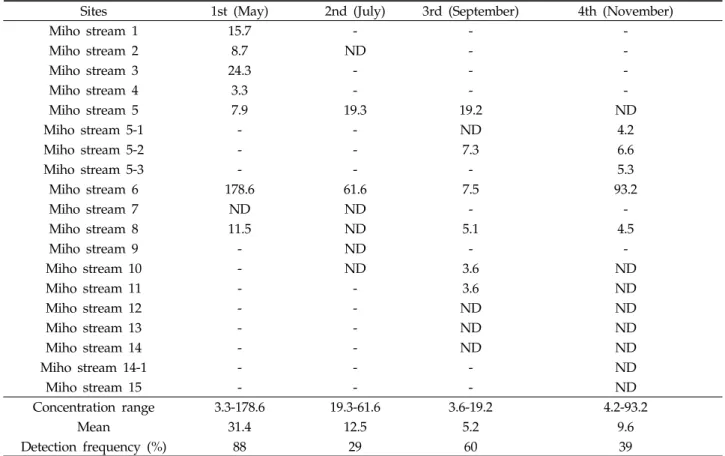
Formaldehyde은 갑천 20개 조사지점의 평균농도가 14.2
μg/L이었으며, 농도분포는 3.5∼115.6 μg/L를 보였다. 미 호천 19개 조사지점의 평균농도는 14.7 μg/L이었고, 농도분 포는 3.3∼178.6 μg/L이었다. Formaldehyde의 분석 결과 를 Table 3, 4와 Fig. 2, 3에 정리하였다.
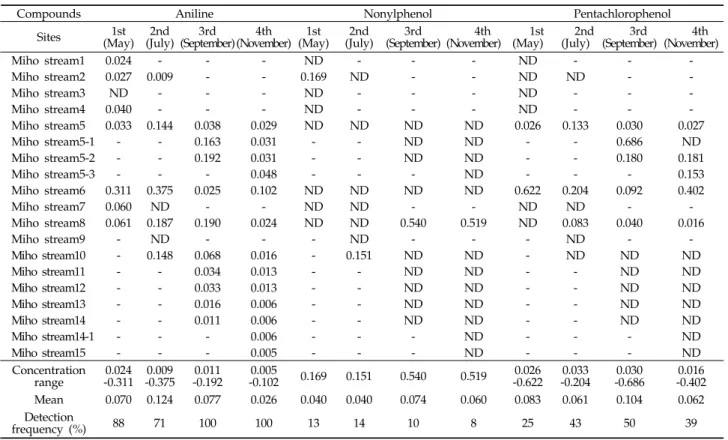
Aniline의 경우 갑천 20개 지점의 평균농도와 농도분포는
각각 0.046 μg/L, 0.007∼0.195 μg/L이었고, 미호천 19개 지
점의 평균농도와 농도분포는 각각 0.074 μg/L, 0.009∼0.375
μg/L 이었다. Nonylphenol의 경우 갑천 20개 지점에서 평
Table 5. Analytical results of semi-volatile organic compounds in Gapcheon
• Unit : μg/L
Compounds Aniline Nonylphenol Pentachlorophenol
Sites 1st
(May) 2nd
(July) 3rd
(September) 4th (November) 1st
(May) 2nd
(July) 3rd
(September) 4th (November) 1st
(May) 2nd
(July) 3rd
(September) 4th (November) Gap stream1 0.065 0.120 0.069 0.060 0.610 ND 0.920 0.340 0.061 0.080 0.044 0.073
Gap stream2-1 0.133 0.007 0.030 0.023 ND ND ND ND ND ND ND ND
Gap stream2-2 0.049 0.026 0.029 0.043 ND ND ND ND ND ND ND ND
Gap stream3 0.164 ND - - 0.111 ND - - ND ND - -
Gap stream4 0.092 0.005 0.007 0.010 ND ND ND ND ND ND ND ND
Gap stream5 0.052 - - - ND - - - ND - - -
Gap stream6 0.035 - - - ND - - - ND - - -
Gap stream7 0.061 0.011 - - 0.056 ND - - ND ND - -
Gap stream7-1 - - 0.010 0.015 - - ND ND - - ND ND
Gap stream7-1-1 - - - 0.022 - - - ND - - - ND
Gap stream7-2 - - 0.008 ND - - ND ND - - ND ND
Gap stream7-2-1 - - - ND - - - ND - - - ND
Gap stream8 0.021 - - - ND - - - ND - - -
Gap stream9 - 0.046 0.008 ND - ND ND ND - ND ND ND
Gap stream10 - 0.153 0.017 0.068 - 0.079 ND ND - ND ND ND
Gap stream11 - - 0.195 0.051 - - ND ND - - ND ND
Gap stream12 - - 0.028 0.062 - - ND ND - - ND ND
Gap stream13 - - ND - - - ND - - - ND -
Gap stream14 - - 0.033 0.038 - - ND ND - - ND ND
Gap stream15 - - ND - - - ND - - - ND -
Concentration range 0.021
-0.164 0.005 -0.153 0.007
-0.195 0.010
-0.068 0.056
-0.610 0.079 0.920 0.340 0.061 0.080 0.044 0.073 Mean 0.075 0.046 0.034 0.031 0.101 0.029 0.091 0.046 0.009 0.012 0.006 0.008 Detection
frequency (%) 100 88 85 77 33 13 8 8 11 13 8 8
*‘-’: non-sampling point, ‘ND’ : not detected or <LOQ(limit of quantitation)
Table 6. Analytical results of semi-volatile organic compounds in Mihocheon
• Unit : μg/L
Compounds Aniline Nonylphenol Pentachlorophenol
Sites 1st (May)
2nd (July)
3rd (September)
4th (November)
1st (May)
2nd (July)
3rd (September)
4th (November)
1st (May)
2nd (July)
3rd (September)
4th (November)
Miho stream1 0.024 - - - ND - - - ND - - -
Miho stream2 0.027 0.009 - - 0.169 ND - - ND ND - -
Miho stream3 ND - - - ND - - - ND - - -
Miho stream4 0.040 - - - ND - - - ND - - -
Miho stream5 0.033 0.144 0.038 0.029 ND ND ND ND 0.026 0.133 0.030 0.027
Miho stream5-1 - - 0.163 0.031 - - ND ND - - 0.686 ND
Miho stream5-2 - - 0.192 0.031 - - ND ND - - 0.180 0.181
Miho stream5-3 - - - 0.048 - - - ND - - - 0.153
Miho stream6 0.311 0.375 0.025 0.102 ND ND ND ND 0.622 0.204 0.092 0.402
Miho stream7 0.060 ND - - ND ND - - ND ND - -
Miho stream8 0.061 0.187 0.190 0.024 ND ND 0.540 0.519 ND 0.083 0.040 0.016
Miho stream9 - ND - - - ND - - - ND - -
Miho stream10 - 0.148 0.068 0.016 - 0.151 ND ND - ND ND ND
Miho stream11 - - 0.034 0.013 - - ND ND - - ND ND
Miho stream12 - - 0.033 0.013 - - ND ND - - ND ND
Miho stream13 - - 0.016 0.006 - - ND ND - - ND ND
Miho stream14 - - 0.011 0.006 - - ND ND - - ND ND
Miho stream14-1 - - - 0.006 - - - ND - - - ND
Miho stream15 - - - 0.005 - - - ND - - - ND
Concentration range 0.024
-0.311 0.009 -0.375 0.011
-0.192 0.005
-0.102 0.169 0.151 0.540 0.519 0.026 -0.622 0.033
-0.204 0.030
-0.686 0.016 -0.402 Mean 0.070 0.124 0.077 0.026 0.040 0.040 0.074 0.060 0.083 0.061 0.104 0.062 Detection
frequency (%) 88 71 100 100 13 14 10 8 25 43 50 39
*‘-’: non-sampling point, ‘ND’ : not detected or <LOQ(limit of quantitation)
Fig. 4. Analytical results of semi-volatile organic compounds in Gapcheon.
*1~15 (number) : sampling location, mentioned by table 1 and figure 1.
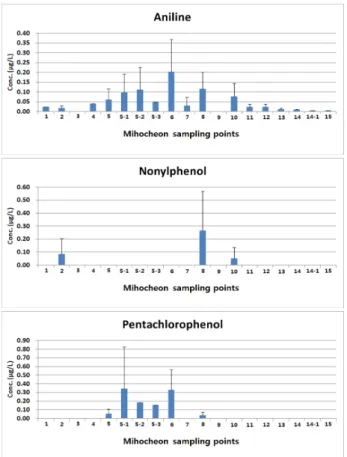
Fig. 5. Analytical results of semi-volatile organic compounds in Mihocheon.
*1~15 (number) : sampling location, mentioned by table 2 and figure 1.
Fig. 6. GC-MS chromatograms of Miho stream 5-1 sample (3th, september) quantified in concentration of 0.163 μg/L (aniline) and 0.686 μg/L (pentachlorophenol).
*Miho stream 5-1 : A pulp manufacturing plant outlet, Cheongwon-gu, Cheongju-si, Chungcheongbuk-do
균농도가 0.067 μg/L이고, 농도분포는 0.056∼0.920 μg/L을 보였으며, 미호천 19개 지점은 평균농도가 0.054 μg/L, 농도 분포는 0.151∼0.540 μg/L을 보였다. Pentachlorophenol 은 갑천 20개 지점에서 평균농도와 농도분포가 각각 0.009 μ g/L, 0.044∼0.080 μg/L인 반면 미호천 19개 지점에서는 평균농도가 0.078 μg/L이고 농도분포는 0.016∼0.686 μ g/L으로 두 하천의 경향이 달랐다. Aniline, nonylphenol,
pentachlorophenol 분석 결과를 Table 5, 6과 Fig. 4, 5에 정리하였고, 오염원 추적 및 오염경로조사 중 미호천 5-1 지 점의 3차 조사결과에 대한 chromatogram은 Fig. 6과 같다.
Formaldehyde의 경우, 공기 중에 포함된 메탄에 햇빛과
산소가 화학반응하거나 탄소 물질이 불완전 연소될 때 자연
적으로 생성되기도 하므로 대기환경 중 배경농도 수준이 검
출 여부(검출 또는 불검출)를 결정할 것으로 판단하였다. 따
라서 그 수준의 값을 일정 수준 넘을 경우 오염원 추적에 활 용하였다. Aniline, nonylphenol, pentachlorophenol의 경우, 해당 오염원의 배출시기와 배출량에 의해 영향을 받을 수 있는데, 채취장소인 지천은 유량도 적고 변동이 심하므로 배출시기와 양이 물질의 검출 여부 및 검출값을 결정한 것으 로 판단된다. 따라서, 오염원 추적 진행시 이 부분들을 고려 하여 진행하였다.
오염경로 추적 고찰
본 연구는 금강의 주요 하천인 갑천과 미호천으로 흐르는 지천 하류부터 조사하여 점차 상류 쪽으로 거슬러 올라가 오 염물질 발생원에 근접해가는 방법으로 7개월간 경로 추적을 실시하였다. 따라서, 추적이 가능한 오염물질은 단계적으로 최종 오염원까지 근접 후 배출수를 바로 채취하여 분석하였 기에 상당 부분 오염경로 추적결과를 구체적이고 명확하게 제시할 수 있다.
Formaldehyde는 화학물질관리법에서 유독물로 지정되 어 있으며, 국제암연구소(IARC)에서 2004년에 발암물질 그 룹1로 재분류한 물질이다. 또한 백혈병과도 관련성이 높다는 연구결과가 있다(Uchiyama et al ., 2013). Formaldehyde 는 주로 산업단지, 자동차 엔진, 소각로 등에서 발생되며, 여 러 광화학반응이나 많은 유기물질의 불완전 연소과정을 통해 환경으로 들어온다(Casella et al ., 2005). 시료를 분석한 결 과 Formaldehyde는 갑천1과 미호천6 지점에서 높게 검출 되었다. 이 지역에 있는 주 오염원을 파악하기 위하여 유입 방류수를 역으로 추적한 결과 갑천의 경우에는 D 산업단지 방류수가 주오염원 이었으며, 미호천은 D사 방류수가 주오염 원으로 판단되었다.
Aniline은 특히 수용성이 높아 토양에 침투하거나 지하수 를 오염시키는 물질이다. 이 물질은 특히 염료, 농약, 의약품 등이 하수 또는 폐수로 직접 배출되거나 분해되었을 때 간접 적으로 환경으로 나오게 된다. 또한 화장품, 고무화학물질 및 석탄 변환 폐처리 과정과 같은 에너지 기술에 의한 부산물로 배출될 수 있기 때문에 오염원을 특정사업장으로 추적하기는 매우 어렵다. 시료분석결과 특히 특히 갑천1, 갑천2-1, 갑천3, 갑천10, 갑천11 지점에서 높게 검출되었는데, 이지역의 특성 살 주요 오염원은 주변의 공장에서 나오는 폐수와 생활하수 가 복합적으로 작용하는 것으로 판단된다.
Nonylphenol은 하천이나 강에서 쉽게 검출되는 물질이 다. 독성과 불쾌한 감각수용적 특성 때문에 미국환경보호청 (United States Environmental Protection Agency, EPA)에서는 우선순위 오염물질의 목록에 포함시켰으며(Han et al ., 2005), 에스트로겐 유사 작용을 하는 내분비계 장애물 질의 하나로 알려져 있다(Luo et al ., 2010). 우리나라에서는 2006년 환경부에서 0.1% 이상 함유한 혼합물질을 ‘취급제한 물질’로 지정하여, 가정용 세척제, 잉크, 페인트의 용도로는 제조, 수입, 판매, 보관·저장, 운반, 사용을 금지하고 있다. 또 한 보건복지부의 ‘공중위생관리법’에서는 세척제로 사용 가능 한 성분을 ‘위생용품의 규격 및 기준’에서 고시하고 있는데,
nonylphenol이 세척제로 사용가능한 성분에서 2002년 삭제 되어 더 이상 세척제의 성분으로는 사용할 수 없게 되었다.
그러나 시료를 분석한 결과 D 산업단지 방류수가 유입하는 갑천 1과 E사가 위치한 미호천8 지점에서 높게 검출되었으 며, 갑천3, 갑천7, 갑천10, 미호천2, 미호천10 지점에서도 검 출되었다. 이 물질이 검출된 지점은 특히 전자부품, 화합물 및 화학제품 제조업 등 산업단지가 주변에 있는 곳으로써 배 출원의 가능성이 높다, 그러나 배출수와 산업단지의 역할에 대해서는 이번 조사결과만으로는 명확하게 보여지지는 않아 관련성에 대해서는 좀 더 조사가 필요하다.
Pentachlorophenol 역시 수생태계에 영향을 줄 수 있는 내분비계장애물질로 분류되고 있다(Kawaguchi et al ., 2004). 이 물질은 다이옥신 발생의 지표 중 하나로 쓰레기 소각에 의해서도 생성될 수 있으며(Kawaguchi et al ., 2005), 과거에는 목재방부제 등 산업용 화학물질로도 폭넓 게 사용되었다(Kawaguchi et al ., 2004). 우리나라에서는 pentachlorophenol과 염류 및 그 혼합물질이 환경부 고시 1999-141호 (1999.9.8)에 따라 제조, 수입, 사용이 금지되어 있다. 따라서 우리나라에서는 공식적으로 생산이나 사용에 따 른 배출원은 존재하지 않는다. 그러나 시료 분석결과 Pentachlorophenol 역시 D산업단지가 위치한 갑천1 지점 에서 검출이 되었으며, 또한 미호천5, 미호천5-1, 미호천5-2, 미호천5-3, 미호천6, 미호천8 지점에서도 검출되고 특히 미호 천5-1 지점과 미호천6 지점에서 높게 검출되었다. 미호천 5, 6, 8 지점은 주로 제지관련 회사들이 있는 곳이다. 따라서 이 사업장들이 주 오염원 역할은 한다고 추정할 수 있다. 그러나 위에서 언급한 바와 같이 우리나라는 이미 20년 전부터 pentachlorophenol의 제조와 사용이 금지되어있기 때문에 해당 사업장에서 직접 사용한다고 할 수 없으며, 다만 제조과 정이나 폐기과정에서 부산물로 나온 물질이 방출되는 것으로 추정된다. 2013년에 수행된 4대강(한강, 금강, 영산강, 낙동 강) 시료 분석결과에서도 pentachlorphenol은 금강수계의 미호천에서만 검출되었다. 해당지점은 이번 연구에서 조사한 지점과 같은 지점이었다. 따라서 미호천에는 이 물질은 지속 적으로 배출하는 오염원이 있는 것으로 판단된다.
결 론
금강 본류에 영향을 크게 미치는 주요 하천인 갑천과 미호
천에서 formaldehyde, aniline, nonylphenol, pentachlrophenol
의 오염원 추적연구를 실시하였다. 하천수 39개 지점의 분석
결과, nonylphenol, aniline, formaldehyde는 공장폐수 및
생활하수에서 나오는 것으로 확인되었다. 갑천에서는 금강에
합류하기 바로 전이면서 D산업단지 방류수가 유입되는 갑천
1지역이 다른 시료보다 훨씬 높은 농도로 4가지 물질이 모두
검출되어 갑철의 가장큰 오염물질 배출원은 갑천 1지역으로
판단되었다. 미호천의 경우 특히 pentachlorophenol이 제지
관련 회사가 있는 미호천5, 6, 8 지점에서 꾸준히 검출되고
있음을 확인하였다. Pentachlorphenol은 우리나라에서는 이
미 제조와 사용이 금지된 물질이므로, 이 지역 사업장의 제조 공정이나 폐기물 처리 등의 과정에서 부산물로 발생하는 pentachlorophenol이 유입되고 있는 것으로 추정된다. 갑천 과 미호천 모두 주변 사업단지의 영향을 받아 꾸준히 오염물 질을 금강으로 보내고 있음을 확인하였으며 앞으로도 인간 건강뿐 아니라 수생태계 보호를 위해 지속적인 위해요소 추 적관리가 이루어져야 할 것이다.
Acknowledgment
This study was supported by the Geum River Environment Research Center, Minister of Environment, Republic of Korea. (2014, research number : 11- 14805023-001777-10)
References