Print ISSN: 2288-4637 / Online ISSN 2288-4645 doi:10.13106/jafeb.2021.vol8.no11.0067
Service-Oriented Organizational Citizenship Behavior in Restaurants: An Empirical Study from Pakistan
Sana Arz BHUTTO 1 , Yasir JAMAL 2 , Asim RAFIQ 3 , Noor Un NISA 4 , Saifullah SAIFULLAH 5 , Munir HUSSAIN 6
Received: July 15, 2021 Revised: September 28, 2021 Accepted: October 05, 2021
Abstract
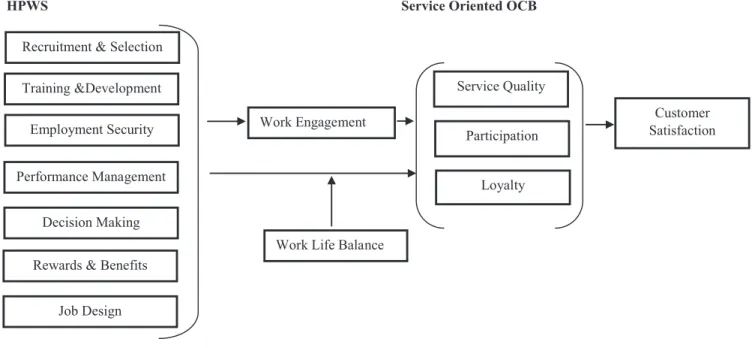
The aim of this study is to investigate the role of employee engagement as a mediator between the High-Performance Work System and the Service-Oriented Organizational Citizenship Behavior (Service-Oriented OCB). Furthermore, work-life balance as a moderator, the impact Service-Oriented OCB on customer satisfaction will be investigated. This study employs a quantitative methodology for which questionnaires were distributed to sixty restaurants in Karachi, and a sample of 418 responses was collected for structural equation modeling analysis. Smart PLS software was used to analyze the structure model. The results show that HPWS has a positive impact on Service-Oriented OCB. It is assumed that the role of work engagement as a mediator between HPWS and Service-Oriented OCB is significant. This study found that Service-Oriented OCB has a positive impact on customer satisfaction. Work-life balance was also found to have a moderating influence. The findings confirmed the black box mechanism and the HPWS procedures in restaurants. This study suggests implementing effective HPWS practices to influence employees’ work engagement, which leads to Service-Oriented OCB and employees being able to optimize their performance to influence customer satisfaction. The study contributes to the existing body of knowledge in human resource management.
Keywords: High-Performance Work Systems, Service-oriented OCB, Work Engagement, Customer Satisfaction, Work-Life Balance JEL Classification Code: J24, F66, D23, C30, D21
1. Introduction
During the last three decades, a significant number of studies in the Human Resource Management (HRM) discipline have focused on human resource (HR) practices and organizational performance, with the goal of identifying the most effective HRM practices that contribute to positive organizational performance. In this realm, High-Performance Work Systems (HPWS) emerges as a central concept that refers to a set of interrelated systems of HR practices considered to enhance employees’ skills, motivation, engagement, dedication, and productivity. It is worth noting that businesses must optimize organizational performance by motivating employees to have a positive attitude toward their jobs and improve their performance. A review of HRM literature suggests that the manufacturing sector has been the subject of the majority of studies examining the influence of HPWS on employee productivity and organizational performance. However, given the significant contribution
1
First Author. Assistant Professor, Business Administration Department, Iqra University, Pakistan.
Email: [email protected]
2
Research Scholar, Business Administration Department, Mohammed Ali Jinnah University, Pakistan.
Email: [email protected]
3
Corresponding Author. Assistant Professor, Faculty of Management Sciences, Hamdard Institute of Management Sciences, Hamdard University, Pakistan [Postal Address: Madinat al-Hikmah, Muhammad Bin Qasim Avenue, Karachi, Sindh, 74600, Pakistan]
Email: [email protected]
4
Assistant Professor, Business Administration Department, Iqra University, Pakistan. Email: [email protected]
5
Research Scholar, Faculty of Management Sciences, Hamdard Institute of Management Sciences, Hamdard University, Pakistan.
Email: [email protected]
6