원예과학기술지 17(3):355-360. 1999
Effects of Irrigation Frequency, Particle Size and Depth of Perlite Medium on Growth and Flowering of Dendran- thema grandiflorum Grown on Recycling System
Kim, Sun Hwa*․Kim, Ki Sun
Dept. of Horticulture, Seoul National University, Suwon 441-744, Korea
*corresponding author
ABSTRACT This study was carried out to investigate the effect of irrigation frequency, particle size and depth of perlite medium on the growth of Dendranthema grandiflorum (Ramat.) Kitamura ‘Shuhouno-chikara' grown on recycling system. In Exp 1, the irrigation frequency (IF) was designed as 3 (IF3), 9 (IF9), and 18 (IF18) times a day. Fine and coarse particle size (PS) of perlite was used as a media, and depth of media (DM) was 15 and 10 cm contained in 34×120×15 cm styrofoam bed. In Exp 2, the IF was 3 (IF3), 6 (IF6), and 9 (IF9) times a day with the same amount of nutrient solution. Fine and coarse PS were used, and DM was 15 and 7.5 cm. In this study, high IF and fine PS was favorable for plant growth. However, as the IF became frequent, difference of plant growth between fine and coarse PS became smaller. Also, shallow media showed little difference with deep media in plant growth. Thus, decreasing the amount of media was recommended to reduce the production cost.
Additional key words: chrysanthemum, depth of media, hydroponic culture, volume of media
※ This report is supported by Korea Re- search Foundation.
Particle size (mm)
Fine Coarse
> 2.0 1 80
1.5 5 11
0.5 40 5
0.25 52 3
<0.25 2 1
Total 100 100
Table 1. Particle-size distribution (%) of fine and coarse perlite.
Nutrient solution
EC (dS/m)
Macroelement (me/L)
NO3-N NH4-N P K Ca Mg S
PTG
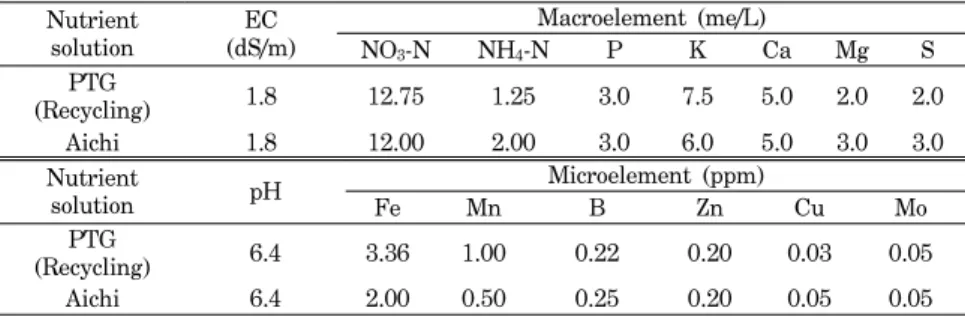
(Recycling) 1.8 12.75 1.25 3.0 7.5 5.0 2.0 2.0
Aichi 1.8 12.00 2.00 3.0 6.0 5.0 3.0 3.0
Nutrient
solution pH Microelement (ppm)
Fe Mn B Zn Cu Mo
PTG
(Recycling) 6.4 3.36 1.00 0.22 0.20 0.03 0.05
Aichi 6.4 2.00 0.50 0.25 0.20 0.05 0.05
Table 2. Composition of nutrient solution used during the experiment.
Introduction
Chrysanthemum is one of the most important cut flowers in history of cultiva- tion, production area, and etc. Recently, hydroponic cultures are used to overcome many problems for growing chrysanthe- mum. But as the buffering capacity of medium is lower than soil, we have to choose the proper media for cultivation and control well the conditions of the nutrient solution. The objectives of this study were to determine the optimum irrigation frequency, particle size of perlite medium, and the optimum depth of perlite during the cultivation of chrysanthemum.
Materials and Methods
Materials
D. grandiflorum (Ramat.) Kitamura
‘Shuhouno-chikara' was used as a plant material. Perlite was used as a medium.
Distribution of particle size was deter- mined by different size of sieves (Table 1).
Experiment 1
It was conducted from January 20 to April 14. PTG solution (prescribed for chrysanthemum by Glasshouse Crops Research Station, Netherlands) was used
as a nutrient solution which is shown at Table 2. At the beginning of the experi- ment, nutrient solution was irrigated 100 mL/day/plant. And from 6 weeks after planting, it was increased to 200 mL/day/
plant. Tap water was irrigated for a week after transplanting. Then nutrient solution was maintained at EC 1.8 dS/m and pH 6.3~6.4. After emergence of visible bud, tab water was irrigated until the end of experiment. Irrigation frequencies (IF) were 3, 9, and 18 times per day. Fine and coarse particle size (PS) of perlite were
used as root media. Depth of media (DM) was 15 and 10 cm contained in 34×120×
15 cm styrofoam bed. At the end of experi- ment, plant growth was measured and mineral nutritions were analyzed. T-N was determined by Kjeldahl method, and P was measured by Vanadate method, using UV-spectrophotometer (UV-1606, Shima- dzu, Japan), whereas K, Ca, Mg, and Fe was analyzed by atomic absorption spec- trophotometer (AA-6401, Shimadzu, Japan).
Experiment 2
It was conducted from June 18 to September 24. Nutrient solution used during this experiment was Aichi solution (prescribed for chrysanthemum by Aichi Prefectural Agricultural Experiment Sta- tion, Japan) shown at Table 2, and the nutrient solution was maintained as same as Exp 1. IF was 3, 6, and 9 times per day. The amount of nutrient solution per irrigation was 33 mL (1~3 weeks after planting, WAP), 67 mL (4~7 WAP), 83 mL (8~10 WAP), and 67 mL (11~14 WAP) per plant. Thus, if IF increased, the total volume of irrigation per day in- creased. Both fine and coarse PS perlite were used as a root media. DM was 15 and 7.5 cm at the 34×120×15 cm styro- foam bed. At the end of the experiment, plant growth was measured. Also, net photosynthesis, stomatal conductance, and leaf temperature were measured with a portable photosynthetic system (LI-6400, LI-COR, Lincolin, Nebraska) in situ from 1000 HR to 1500 HR every 1 hr on a clear day. Mineral nutritions were analyzed with the same method on Exp 1. Flower
Treatmentz Stem length (cm)
Stem diameter
(mm)
No. of leaves (ea)
Root length
(cm)
Fresh weight
(g/plant) Dry weight (g/plant) IF
(times/day) PS DM
(cm) Shoot Root Shoot Root
3 Fine 15 86.00 7.63 44.67 20.83 90.57 22.49 12.83 9.10
10 83.67 7.40 45.33 15.07 94.95 18.19 11.92 8.55
Coarse 15 78.50 6.67 42.33 20.07 67.54 17.77 9.19 7.07
10 76.67 6.67 44.67 15.10 63.93 8.47 7.89 6.41
9 Fine 15 84.33 7.23 46.00 23.00 91.87 24.17 11.91 8.80
10 82.83 7.67 41.33 16.50 80.42 18.60 8.18 6.89
Coarse 15 75.33 6.90 42.67 21.17 76.36 10.80 9.83 6.80
10 74.83 7.07 41.33 18.30 86.37 8.57 6.84 5.83
18 Fine 15 79.00 7.07 42.67 21.57 86.37 18.57 10.77 8.39
10 80.67 6.83 45.67 14.27 82.33 10.61 10.47 8.04
Coarse 15 76.00 7.10 45.00 23.57 83.25 17.20 11.14 9.47
10 72.67 6.87 41.00 16.57 77.43 8.06 8.28 6.49
Statistical significance
IF NS NS NS NS NS NS NS NS
PS ** *** * NS *** *** *** NS
DM NS NS NS NS NS *** *** NS
IF × PS IF × DM
NS ** NS NS *** * * NS
NS NS NS NS NS NS * NS
PS ×DM NS NS NS NS NS NS NS NS
IF×PS×DM NS NS NS NS * NS NS NS
zIF: irrigation frequency; PS: particle size; DM: depth of medium.
NS,*,**,*** Non-significant or significant at P = 0.05, 0.01, or 0.001, respectively.
Table 3. Effects of irrigation frequency, particle size, and depth of medium on the growth of D. grandiflorum ‘Shuhouno-chikara' grown hydroponically on perlite at Exp 1.
Treatmentz Stem
length (cm)
Stem diameter
(mm)
No. of leaves (ea)
Root length
(cm)
Fresh wt.
(g/plant) Dry wt.
(g/plant) Total leaf area
(cm2) IF
(times/day) PS DM
(cm) Shoot Root Shoot Root
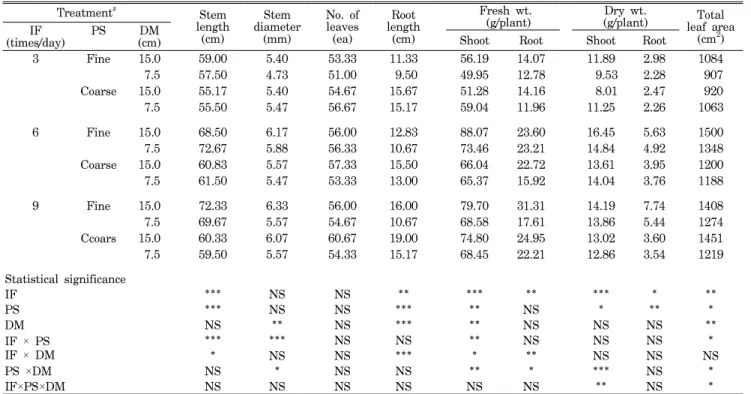
3 Fine 15.0 59.00 5.40 53.33 11.33 56.19 14.07 11.89 2.98 1084
7.5 57.50 4.73 51.00 9.50 49.95 12.78 9.53 2.28 907
Coarse 15.0 55.17 5.40 54.67 15.67 51.28 14.16 8.01 2.47 920
7.5 55.50 5.47 56.67 15.17 59.04 11.96 11.25 2.26 1063
6 Fine 15.0 68.50 6.17 56.00 12.83 88.07 23.60 16.45 5.63 1500
7.5 72.67 5.88 56.33 10.67 73.46 23.21 14.84 4.92 1348
Coarse 15.0 60.83 5.57 57.33 15.50 66.04 22.72 13.61 3.95 1200
7.5 61.50 5.47 53.33 13.00 65.37 15.92 14.04 3.76 1188
9 Fine 15.0 72.33 6.33 56.00 16.00 79.70 31.31 14.19 7.74 1408
7.5 69.67 5.57 54.67 10.67 68.58 17.61 13.86 5.44 1274
Ccoars 15.0 60.33 6.07 60.67 19.00 74.80 24.95 13.02 3.60 1451
7.5 59.50 5.57 54.33 15.17 68.45 22.21 12.86 3.54 1219
Statistical significance
IF *** NS NS ** *** ** *** * **
PS *** NS NS *** ** NS * ** *
DM NS ** NS *** ** NS NS NS **
IF × PS IF × DM
*** *** NS NS ** NS NS NS *
* NS NS *** * ** NS NS NS
PS ×DM NS * NS NS ** * *** NS *
IF×PS×DM NS NS NS NS NS NS ** NS *
zIF: irrigation frequency; PS: particle size; DM: depth of medium.
NS,*,**,*** Non-significant or significant at P = 0.05, 0.01, or 0.001, respectively.
Table 4. Effects of irrigation frequency, particle size, and depth of medium on the growth D. grandiflorum ‘Shuhouno-chikara' grown hydroponically on perlite at Exp 2.
diameter, fresh and dry weight of flower, number of days from planting to visible bud (VB) emergence and to flowering, and number of days from VB emergence to Flowering were measured. EC and pH of the medium were analyzed by EC meter (HI-8423, Hanna, Singapore) and pH meter (HI-8424, Hanna, Singapore). Air-
filled porosity and water content were also measured after experiment.
Results and Discussion
Irrigation frequency
In Exp 1, there was no difference among different IF treatments in plant growth
(Table 3). Since it was conducted in winter when evaporation was not so much active, the plants seemed to have less stress than summer. However, in Exp 2 which was conducted during high temperature period, plant growth differed significantly by IF treatments (Table 4). Stem length was 15% longer, fresh and dry weight were
Treatmentz Flower diameter
(cm)
Fresh wt
(g) Dry wt
(g) VBy
(day) Floweringx (day)
VB to floweringw
(day) IF
(times/day) PS DM
(cm)
3 Fine 15.0 9.50 15.28 1.35 68 94 26
7.5 8.29 15.81 1.64 69 97 28
Coarse 15.0 7.11 12.36 1.47 71 95 24
7.5 7.66 12.18 1.21 73 98 25
6 Fine 15.0 11.47 24.72 2.47 60 88 28
7.5 10.49 20.83 2.37 60 91 31
Coarse 15.0 9.33 17.39 1.66 67 93 26
7.5 9.48 16.92 1.45 67 96 29
9 Fine 15.0 10.11 22.21 2.18 61 89 27
7.5 10.83 18.81 1.80 61 89 27
Coarse 15.0 10.92 17.60 1.56 65 95 30
7.5 10.55 16.73 1.93 67 95 28
Stastistical significance
IF *** * * ** ** *
PS *** * * *** ** NS
DM NS NS NS * ** NS
IF×PS *** NS NS NS NS NS
IF×DM NS NS NS NS * NS
PS×DM NS NS NS NS NS NS
IF×PS×DM NS NS NS NS NS NS
zIF: irrigation frequency; PS: particle size; DM: depth of medium.
yDays when 50% of visible bud was emerged.
xDays from planting to flowering.
wDays from the visible bud to the flowering day.
NS,*,**,*** Non-significant or significant at P = 0.05, 0.01, 0.001, respectively.
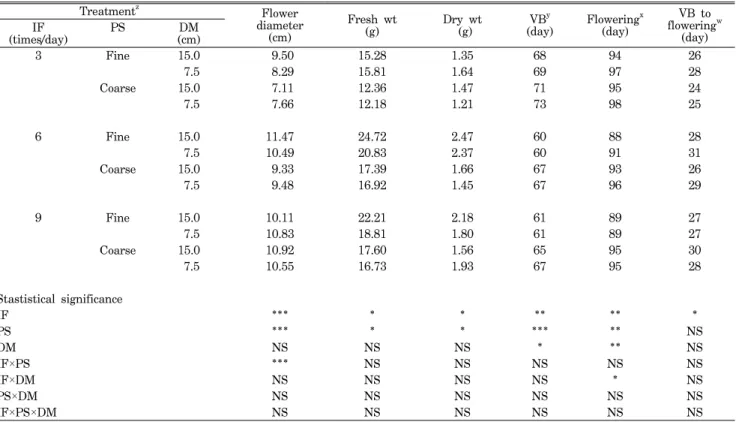
Table 5. Effects of irrigation frequency, particle size, and depth of medium on flowering of D. grandiflorum ‘Shuhouno- chikara' grown hydroponically on perlite at Exp 2.
1000 1100 1200 1300 1400 1500 Time (HR)
Fig. 1. Effects of irrigation frequency (IF) on photosynthesis (A), leaf temperature (B), and stomatal conductance (C) in D. grandiflorum grown hydroponically at perlite medium. Photosynthesis was measured every hour from 1000 to 1500HR.
44% and 41% heavier at IF9 than IF3, respectively. Total leaf area and root length increased as IF increased. These results corresponded to the reports of frequent irrigation resulted in larger where leaf area of rose where significantly higher where fresh and dry weight of chrysanthemum (Lieth and Burger, 1989;
Schuch et al., 1995).
In Exp 1, T-N, P, and K contents increased when IF increased, and in Exp 2, when IF increased, Fe content increased (data not shown). Williams and Nelson (1992) reported that the irrigation of 14 times a day to grow chrysanthemum re- sulted in higher T-N content than 7 times a day. In general, since immobile elements such as Fe, B, and Ca are absorbed along with water, their contents increase in plant when irrigation frequency increase (Karbo et al., 1991).
In Exp 2, flower size, fresh and dry weight of the flowers were 30, 35 and 32%
higher at IF9 than IF3 (Table 5). This result was consistent with the report that frequent irrigation influenced flower num- ber, size, and flowering date of chrysan- themum (Lieth and Burger, 1989). Also, days from planting to VB emergence and flowering were 7 days and 4 days faster at
Treatmentz
EC
(dS/m) pH Water
contenty (%)
Air-filled porosityx IF (%)
(times/day) PS DM
(cm)
3 Fine 15.0 1.14 5.82 188.4 56.7
7.5 0.92 6.13 180.7 61.7
Coarse 15.0 0.98 5.85 114.7 61.7
7.5 0.50 6.00 113.7 49.7
6 Fine 15.0 0.77 5.91 177.3 50.0
7.5 0.21 6.21 181.3 43.3
Coarse 15.0 0.64 5.95 123.0 31.3
7.5 0.38 6.16 124.0 41.3
9 Fine 15.0 0.39 6.18 186.7 42.7
7.5 0.33 6.30 190.0 37.7
Coarse 15.0 0.25 6.08 136.0 48.3
7.5 0.14 6.17 126.3 46.3
Statistical significance
IF *** * NS *
PS * NS *** NS
DM *** * NS *
IF×PS *** *** NS ***
IF×DM *** NS NS NS
PS×DM NS NS NS NS
IF×PS×DM NS NS NS NS
zIF: irrigation frequency; PS: particle size; DM: depth of medium.
yWater content was measured by percentage of weight(g).
xAir porosity was measured by volume(mL).
NS,*,**,*** Non-significant or significant at P = 0.05, 0.01, or 0.001, respectively.
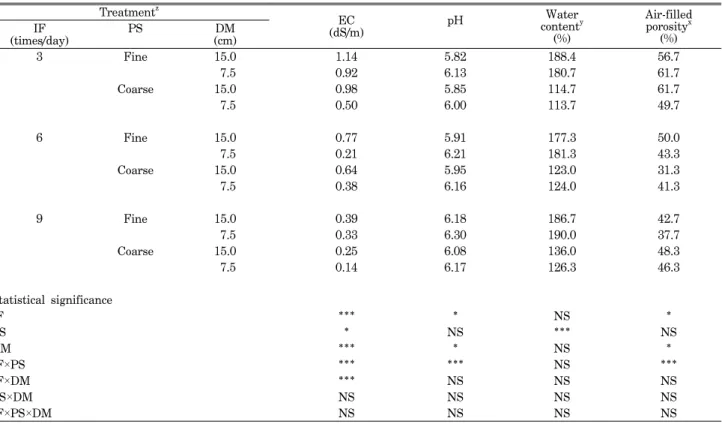
Table 6. Effects of irrigation frequency, particle size, and depth of medium on physical and chemical properties of media at harvest in Exp 2.
IF9 than IF3. However, the number of days from VB emergence to Flowering was 2 days shorter at IF3.
Photosynthesis was lower at IF3 than IF9 (Fig. 1A), which might lead to a lower photosynthate accumulation at IF3 than IF9 (Table 4). It might be attributed to the lower water content in the soil (Hut- macher et al., 1990). Urban et al. (1995) reported that net photosynthesis was positively correlated with the watering frequency. Therefore, we concluded that increasing IF can make higher yields, resulting from increasing photosynthesis.
Difference between the maximum and minimum temperature of leaf during the daytime was higher at IF3 than IF9 (Fig.
1B). Allen et al. (1994) reported that midday leaf temperature levels increased as the water stress progressed. Thus, this result might be due to water stress during the daytime at low IF, which can be explained by the lower stomatal conduc- tance during daytime in IF3 than IF6 and IF9 (Fig. 1C). Hutmacher et al. (1990) found that stomatal conductance decreased under low IF. In another study, stomatal conductance was not related with leaf water status, but with soil water content (Loyd et al., 1991; Schurr et al., 1992).
In Exp 2, EC decreased at IF6 and IF9, and pH was maintained well at IF9 (Table 6). The water content was higher at IF9 than IF3. However, as the IF became frequent, the air-filled porosity became smaller. High IF made the cation ex- change capacity (CEC) higher and leached the nutrition in the media well. Physical and chemical property of the media was suitable at frequent irrigation. This made the difference of plant growth among IF's.
It was reported that moisture content increased with decreasing total porosity, but there was no effect on plant growth (Blom and Piott, 1992).
Particle size
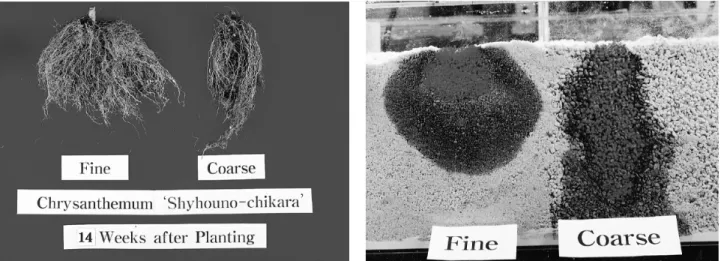
There were great differences in growth between fine and coarse PS treatments in Exp 1 and 2 (Table 3, Table 4). Stem length was 10.3% longer, and fresh and dry weight was 6.3% and 13.3% heavier at fine PS than coarse PS. Root length was longer in coarse PS, while fresh and dry weight of root was higher in fine PS. This is the result of the roots grown in fine PS with much more hairy roots than these of coarse PS (Fig. 2). Shape of root was matched with the spreading pattern of the nutrient solution in perlite (Fig. 2). Water
holding capacity and air-filled porosity were higher at fine PS than coarse PS (Table 6). It was consistent with the reports by Chen and Lieth (1993) who concluded that root branching and extension was influenced by medium texture or physical properties. These results in the different absorbing capacity and thus the difference in plant growth.
However, when the IF increased, the difference between fine and coarse PS became smaller. Contents of P, Mg, and Fe in Exp 1 and, contents of Ca in Exp 2 was higher at coarse PS. It might be influenced by that nutrient solution can be exchanged easily in coarse PS, thus the roots are able to absorb more nutrients.
Flower size, fresh and dry weight in fine PS were 10, 15.5, and 36% bigger than those of coarse PS (Table 5). But, when the IF increased, difference in plant growth between fine and coarse PS became smaller. Days from planting to VB emer- gence and F at fine PS was less than coarse PS.
In Exp 2, EC was much lower at coarse PS (Table 6). Because of the different distribution pattern on fine and coarse PS, nutrient solution could be leached more easily in coarse PS. However, as the IF
Fig. 2. Different distribution patterns of root and nutrient solution in perlite according to different particle size.
increased, the difference of EC between fine and coarse PS was getting smaller.
Even though, there was no difference in air-filled porosity, water content was much higher at fine PS than coarse PS. Because air-filled porosity and water holding capa- city was higher at fine PS even after the experiment, physical properties of the media was maintained well. Maloupa et al. (1992) reported that water availability and air content at root zone also play an important role in plant growth.
Depth of media
Root fresh weight was lower at 10 cm DM than 15 cm DM (Table 3), which might be due to the root growth restriction in shallow DM. No. of leaves and stem diameter were small at 10 cm DM, which might be the reason why shoot fresh weight in 10 cm DM was smaller than those of 15 cm DM. But, there was no difference in plant growth between DM of 15 and 10 cm. Boland et al. (1994) sug- gested that plant growth is not correlated with volume of medium in peach, but with water content. Gislerod (1983) also report- ed that it was possible to grow spray chrysanthemum in the rockwool cube with 5×5×5 cm and peat block with 8×8×8 cm. Therefore, reducing the DM could be possible. Even though the DM became shallow from 15 cm DM to 7.5 cm DM at Exp 2, plant growth was not different among treatments (Table 4). Therefore, it is possible to reduce production cost by using less medium. Days from planting to F were slightly longer at 7.5 cm DM than 15 cm DM, but as the IF increased to IF9, the difference was nullified (Table 5).
At 7.5 cm DM, EC was much lower than
that of 15 cm DM, which might be due to frequent leaching of nutrient solution through the medium (Table 6). Boland et al. (1994) suggested that the small volume of medium should be maintained easily.
The pH was maintained well at IF9 and at 7.5 cm DM. Decreasing the DM is a good way not only to save the cost but to make a stable root environment in EC and pH. Water content was significantly higher at fine PS.
In this study, high IF was favorable for plant growth. But when the IF was higher than 6 times a day, there was no signifi- cant difference in plant growth. Also, other studies reported that IF higher than 10 times a day, did not increase plant growth while energy cost became higher (Lieth and Burger, 1989). Thus, IF for cultivating cut chrysanthemum is recom- mended 6 to 9 times a day. Fine PS was much better than coarse PS, but as the IF became higher, the difference between two PS became smaller. If we use fine PS, 6 times IF a day is enough for plant growth, however, if we use coarse PS, irrigation has to be applied 9 times a day. When DM is shallower than 15cm, it is favorable to use fine PS for cultivation. However, if DM was deeper than 15cm, additional studies should be conducted. Since shal- low depth of media did not influence the plant growth too much, decreasing the amount of media can be recommended to reduce the production cost.
Literature Cited
Allen, L.H., R.R. Valle, and J.W. Jones.
1994. Soybean leaf gas-exchange re- sponses to carbon dioxide and water stress. Agron. J. 86:625-636.
Blom, T.J. and B.D. Piott. 1992. Preplant moisture content and compaction of peatwool using two irrigation techniques on potted chrysanthemums. J. Amer.
Soc. Hort. Sci. 117(2):220-223.
Boland, A.M., P.D. Mitchell, I. Goodwin, and P.H. Jerie. 1994. The effect of soil volume on young peach tree growth and water use. J. Amer. Soc. Hort. Sci.
119(6):1157-1162.
Chen, D.X. and J.H. Lieth. 1993. A two- dimensional, dynamic model for root growth distribution of potted plants. J.
Amer. Soc. Hort. Sci. 18(2):181-187.
Gislerod, H.R. 1983. Capillary watering of chrysanthemum. Acta Hort. 150:415-419.
Hutmacher, R.B., J.J. Steiner, J.E. Ayars, A.B. Mantel, and S.S. Vail. 1990. Re- sponses of seed carrot to various water regimes. Ⅰ. Vegetative growth and plant water relations. J. Amer. Soc. Hort. Sci.
115(5):715-721.
Karbo, D., J. Skopp, and D. Knudsen.
1991. Control of nutrient and uptake by irrigation frequency and relative humid- ity. Agron. J. 83:1023-1028.
Lieth, J.H. and D.W. Burger. 1989.
Growth of chrysanthemum using an irri- gation system controlled by soil mois- ture tension. J. Amer. Soc. Hort. Sci.
114(3):387-392.
Loyd, J., T. Trochoulias, and R. Ensbey.
1991. Stomatal responses and whole-tree hydraulic conductivity of orchard Macc- damia integrifolia under irrigated and non-irrigated conditions. Aust. J. Plant.
Physiol. 18:661-671.
Maloupa E., L. Mitsios, P.F. Martinez, and S. Bladenpoulou. 1992. Study of sub- strates used in gerbera soilless culture grown in plastic greenhouses. Acta Hor-
ticulturae 323:139-144.
Schuch, U., R.A. Redak, and J. Bethke.
1995. Whole-plant response of six poin- settia cultivars to three fertilizer and two irrigation regimes. J. Amer. Soc.
Hort. Sci. 121(1):69-76.
Schurr, U., T. Gollan, and E.D. Schulze.
1992. Stomatal response to drying soil in relation to changes in the xylem sap composition of Helianthus annus. Ⅱ.
Stomatal sensitivity to abscisic acid im- ported from the xylem sap. Plant, Cell and Environment 15:561-567.
Urban, L., M. Huyghes, and M. Monta- rone. 1995. Effects of the irrigation fre- quencies on water status, leaf diffusive conductance. Acta Hort. 387:107-114.
Williams, K.A. and P.V. Nelson. 1992.
Growth of chrysanthemum at low, rela- tively steady nutrient levels in a
commercial-style substrate. HortScience 27(8):877-880.
순환식 양액재배에 있어서 관주 주기, Perlite의 입자 크기 및 깊이가 국화
‘수방력’의 생육과 개화에 미치는 영향
김선화*․김기선 서울대학교 원예학과
초 록
본 연구는 절화용 국화의 생산에 있어서 관주 주기, 펄라이트 배지의 입자 크기 및 배지 깊이 가 생육과 개화에 미치는 영향을 구명하고자 실 시하였다. 실험 1에서 관주 주기는 하루에 3, 9, 18회로 처리하였으며 가는 입자와 굵은 입자 펄라이트를 각각 단용으로 처리하였다. 배지 깊 이는 34×120×15cm의 스티로폴 성형 베드 내에서 15, 10cm로 하였다. 실험 2에서 관주 주기는 하루에 3, 6, 9회로 하여 한 번에 동일
한 양을 관주하였고 배지는 가는 입자와 굵은 입자 펄라이트를 각각 단용으로 처리하였다. 배 지 깊이는 같은 베드 내에서 15, 7.5cm로 하였 다. 관주 횟수에 따른 생육의 차이를 살펴보면 실험 1에서, 관주 주기간 생육의 차는 거의 없 었지만 체내 무기성분의 함량은 18회 관주시 가장 많았다. 실험 2에서는 9회 관주시 가장 생 육이 좋았고 체내무기성분의 함량도 많았다. 배 지 굵기간 차이를 살펴볼 때, 가는 입자 배지에 서 생육이 월등하게 좋았으나 관주가 잦아질수 록 생육의 차는 줄어들었다. 같은 관주 주기 내 에서 배지간 생육 차이는 배지내 수분보유능력 과 공극률의 차이와 뿌리 뻗음의 형태적 차이에 의한 것으로 밝혀졌다. 배지 깊이간 생육의 차 이는 거의 없어서 배지의 양을 줄임으로써 생산 비를 감소시킬 수 있을 것으로 사료되었다.
추가 주요어:국화, 배지 깊이, 양액재배, 배지 부피