Kor. J. Hort. Sci. Technol. 30(6):635-641, 2012 DOI http://dx.doi.org/10.7235/hort.2012.12099
Optimum Application Amount, Timing, and Frequency of Slurry Composted and Biofiltered Liquid Fertilizer for
Zoysia japonica ‘Millock’
Suejin Park
1, Seung Youn Lee
1, Ju Hyun Ryu
1, Hyun Hwan Jung
1,2, and Ki Sun Kim
1,2*1
Department of Plant Science, Seoul National University, Seoul 151-921, Korea
2
Research Institute for Agriculture and Life Science, Seoul National University, Seoul 151-921, Korea
Abstract. In Korea, slurry composted and biofiltered (SCB) liquid fertilizer is produced through the composting and biofiltering of animal waste. An appropriate guidelines involving proper treatment of SCB liquid fertilizer on turfgrass should be considered. An experiment was conducted to determine the optimum application amount, timing, and frequency of SCB liquid fertilizer for Zoysia japonica ‘Millock’. The SCB liquid fertilizer was applied in low, medium, and high amount (N at 15, 25, and 40 g・m
-2per year in 2010, and 10, 20, and 40 g・m
-2per year in 2011, respectively) and treated during the growing season or dormancy period. During the growing season, SCB liquid fertilizer was applied twice or four times. The greatest improvement in turf quality for both years was in SCB plots applied four times with N at 40 g・m
-2per year during the growing season (SH4). This treatment exhibited turf color retention in the fall, and enhanced clipping yield during the growing and fall seasons. SCB plots with four times during the growing season (SL4, SM4, and SH4) exhibited higher shoot density relative to the same amount of other SCB treatments. Plots treated during the dormancy period also showed a high turf color index during the next growing season in 2011. The results indicate that SCB with high amount up to N at 40 g・m
-2per year applied four times during the growing season and dormant application produced high turf quality and growth, and could be recommended as an optimum application guide.
Additional key words: clipping yield, fall color retention, shoot density, turf color index
*Corresponding author: [email protected]
※ Received 24 May 2012; Revised 6 September 2012; Accepted 6 September 2012. This work was carried out with the support of
“Cooperative Research Program for Agriculture Science & Technology Development (Project No. 006635)” Rural Development Administration, Republic of Korea.
Introduction
In many countries, the increasing quantity of animal waste from livestock operations puts pressure on waste disposal services. The potential impact of livestock production on environmental quality has become a matter of nationwide concern (Vukina, 2003). Animal wastes contain excess nitrates, phosphates, salts, undesirable microorganisms, pathogens, and produce greenhouse gases (Eghball and Power, 1999).
Without proper disposal treatment they can pollute the soil, water, and air. However, animal waste contains high levels of organic matter and a considerable amount of essential nutrients for plant growth (Cheng et al., 2007). Nitrogen in animal waste could be applied as a replacement for chemical fertilizer in agriculture production (Smith and Wheeler, 1979). Using untreated animal waste produces
odors and nutrient unevenness for agriculture source, and those disadvantages have been obstacles to use them as a fertilizer (Misselbrook et al., 1997).
Animal wastes can now be treated using biological and physico-chemical method (Kushwaha et al., 2010). In Korea, slurry composted and biofiltered (SCB) liquid fertilizer is produced by a composting and biofiltering process, and this process yields an odorless, homogeneous, pure, low concent- ration, humus-like, and biologically stable organic material (Ham et al., 2009). SCB liquid fertilizer has been applied as a partial replacement for chemical fertilizer on many plants including red pepper, tomato, forage crop, cucumber, yellow poplar, and pine tree (Ham et al., 2009; Jo et al., 2010;
Kim et al., 2011; Lim et al., 2008; Park et al., 2011; Seo
et al., 2010). Although SCB liquid fertilizer could be used
on many crops including rice, fruits, and vegetables, the mass
Fig. 1. Climate conditions at the experimental plot site.
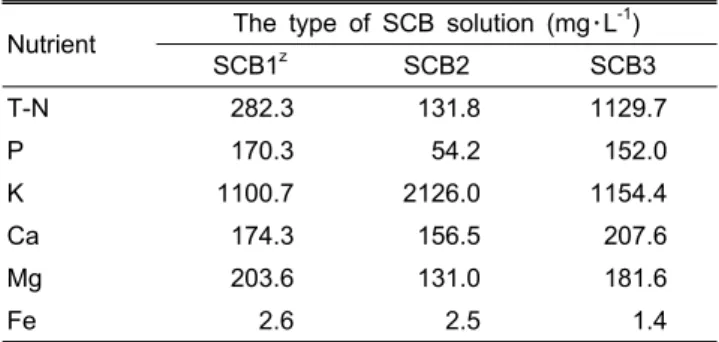
Table 1. Chemical constituents of SCB solution used in the field study.
Nutrient The type of SCB solution (mg・L
-1)
SCB1
zSCB2 SCB3
T-N 282.3 131.8 1129.7
P 170.3 54.2 152.0
K 1100.7 2126.0 1154.4
Ca 174.3 156.5 207.6
Mg 203.6 131.0 181.6
Fe 2.6 2.5 1.4
z
SCB1, SCB2, and SCB3 were provided by National Institute of Animal Science on July 6, August 13, and October 11, 2010, respectively.
production of SCB liquid fertilizer could not be consumed by these industries. Areas with turf, such as golf courses, are enough space to apply a large amount of SCB liquid fertilizer.
Numerous studies have been conducted to determine the effects of composted manure application on turfgrass growth as an alternative to chemical fertilizer (Gaudreau et al., 2002;
Go et al., 2006; McLaughlin et al., 2004). Ham et al. (2009) and Kang et al. (2010) evaluated the effectiveness of SCB liquid fertilizer mixed with chemical fertilizer on bentgrass and zoysiagrass. They found that a mixed application of SCB liquid fertilizer and chemical fertilizer led to high turf growth and quality. In order to increase the consumption of SCB liquid fertilizer in turfgrass managements, new and convenient fertilization programs with utilizing SCB liquid fertilizer should be considered. Because the SCB process yields liquid fertilizer with low nitrogen concentration, proper application would be different from that of granular fertilizer. However, little research has been conducted to assess the appropriate application of SCB liquid fertilizer.
The objectives of this study were to determine the optimum application amount, timing, and frequency of SCB liquid fertilizer for Z. japonica ‘Millock’ and then to recommend a practical guide for the application of SCB liquid fertilizer in turf grass management.
Materials and Methods
Experimental Site and Culture Condition
A field experiment was conducted at the Experimental Farm of the College of Agriculture and Life Sciences, Seoul National University (Suwon, Korea). Experimental plots were established on April 30, 2010 and sodded with Z.
japonica ‘Millock’ purchased from Lgreen (Gwacheon, Korea). Individual sub-plots measured 1.5 by 1.5 m. The ambient air temperature and the amount of precipitation were received from Suwon Meteorological Station located near to the field study plot (Fig. 1). The plots were watered as necessary to prevent moisture stress.
Analysis of SCB Liquid Fertilizer
SCB liquid fertilizer was produced at the National Institute of Animal Science (Suwon, Korea). The chemical characteristics of SCB liquid fertilizer are presented in Table 1. All analyses were performed at the National Instrumentation Center for Environmental Management, Seoul National University (Seoul, Korea). Total and inorganic nitrogen was measured by the Kjeldahl method (Bremmer, 1996; Mulvaney, 1996).
All other nutrients were quantified using inductively coupled
plasma spectrophotometry after acid digestion.
Fertilizer Treatments
SCB liquid fertilizer was applied at either a low (L),
medium (M), and high (H) amount (N at 15, 25, and 40
g・m
-2per year in 2010, and 10, 20, and 40 g・m
-2per year
in 2011, respectively). Application timing treatments consisted
of growing season and dormancy period. During the growing
season, SCB liquid fertilizer was applied twice and four
times. The chemical fertilizer used in this study was a
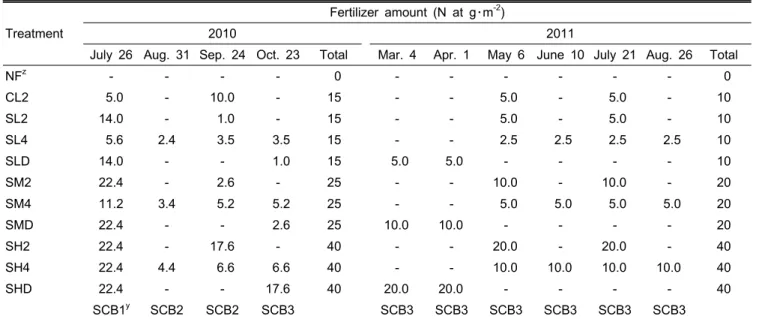
Table 2. SCB solution and chemical fertilizer application schedules for the field study in 2010 and 2011.
Treatment
Fertilizer amount (N at g・m
-2)
2010 2011
July 26 Aug. 31 Sep. 24 Oct. 23 Total Mar. 4 Apr. 1 May 6 June 10 July 21 Aug. 26 Total
NF
z- - - - 0 - - - - - - 0
CL2 5.0 - 10.0 - 15 - - 5.0 - 5.0 - 10
SL2 14.0 - 1.0 - 15 - - 5.0 - 5.0 - 10
SL4 5.6 2.4 3.5 3.5 15 - - 2.5 2.5 2.5 2.5 10
SLD 14.0 - - 1.0 15 5.0 5.0 - - - - 10
SM2 22.4 - 2.6 - 25 - - 10.0 - 10.0 - 20
SM4 11.2 3.4 5.2 5.2 25 - - 5.0 5.0 5.0 5.0 20
SMD 22.4 - - 2.6 25 10.0 10.0 - - - - 20
SH2 22.4 - 17.6 - 40 - - 20.0 - 20.0 - 40
SH4 22.4 4.4 6.6 6.6 40 - - 10.0 10.0 10.0 10.0 40
SHD 22.4 - - 17.6 40 20.0 20.0 - - - - 40
SCB1
ySCB2 SCB2 SCB3 SCB3 SCB3 SCB3 SCB3 SCB3 SCB3
z
NF denotes no fertilizer. C or S indicates chemical or SCB fertilizers. The letters L, M, and H indicate low, medium, and high application amounts, respectively, and D indicates application during the dormancy period. Numbers indicate the number of treatments over the growing season.
y
For the information about SCB solution used in each time of fertilizer application, refer to Table 1.
commercial granular fertilizer (10N-6P-13K, KG Chemical, Bucheon, Korea).
The treatments included no fertilizer (NF), chemical fertilizer with a low amount applied twice during the growing season (CL2), SCB in low, medium, and high amounts applied either twice or four times during the growing season (SL2, SM2, SH2, and SL4, SM4, and SH4, respectively). SCB was also applied in low, medium, and high amounts during the dormancy period (SLD, SMD, and SHD, respectively). Since SCB liquid fertilizer was available late in 2010, SLD, SMD, and SHD plots were treated with SCB liquid fertilizer on July 26. The dates of the treatments are shown in Table 2.
Measurements
Turf quality and fall color retention were obtained as turf color index measured using a turf color meter (TCM 500, Spectrum Technologies, Inc., USA). Experimental plots were mowed at a height of 21 mm. Clippings were harvested on August 27 and September 17 in 2010, and July 21 and August 19 in 2011. Clippings were dried at 80℃ for 72 h in an oven and weighted. At the end of the experiment each year, plant samples were collected by using a 10-cm-diameter hall cutter. Shoot density and fresh weight were measured, and samples were oven-dried at 80℃ for 72 h to measure dry weight.
Experimental Design and Data Analysis
The experiment was conducted as a completely randomized
design with four replicates. SAS version 9.2 (SAS Institute Inc., Cary, NC, USA) was used to perform analysis of variance (ANOVA) and general linear models (GLM).
Differences among the treatment means were assessed by Fisher’s least significant difference test at P < 0.05. Orthogonal contrasts were used to make preplanned comparisons among means for each treatment group.
Results and Discussion
Turf Quality
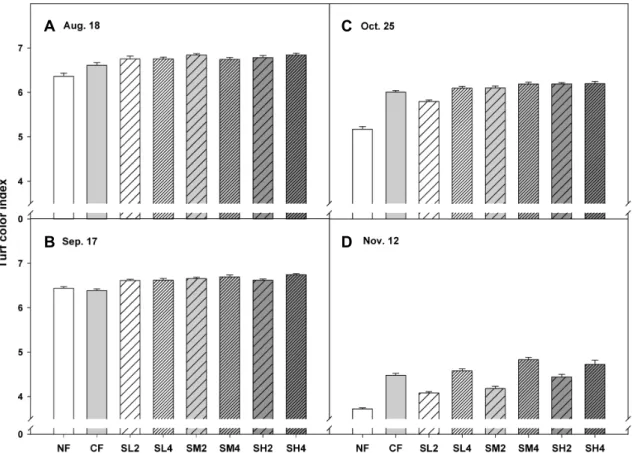
Fertilization with chemical or SCB fertilizers produced a higher turf color index than unfertilized turf throughout the course of the experimental period (Figs. 2 and 3). The turf color of the CL2 plot was lower than those of all SCB plots on August 18, 2010 (Fig. 2A). Turf treated with SM4 and SH4 had turf color index that were 0.31 and 0.36 higher than that of CL2 on September 17, 2010 respectively (Fig.
2B). SCB plots treated with N at 40 g・m
-2per year (SH2, SH4, and SHD) had a significantly higher turf color index on June 10, 2011 (Fig. 3A). Although SLD, SMD, and SHD were applied only during the dormancy period, those plots maintained a high turf color index during the next growing season in 2011 (Figs. 3A and 3B). The results suggested that SCB liquid fertilizer can produce turf quality that is equivalent to that of low amounts of chemical fertilizer.
Previous studies reported that turf quality is associated with
the nitrogen content of fertilizer (Bilgili and Acikgoz, 2005;
A C
B D
Fig. 2. Effect of the amount, timing, and frequency of SCB liquid fertilizer application on the turf color index of Z. japonica in 2010. Vertical bars are standard errors of the means (n = 4). For fertilizer treatment details, refer to Table 2.
A C
B D
Fig. 3. Effect of the amount, timing, and frequency of SCB liquid fertilizer application on the turf color index of Z. japonica in
2011. Vertical bars are standard errors of the means (n = 4). For fertilizer treatment details, refer to Table 2.
A C
B D
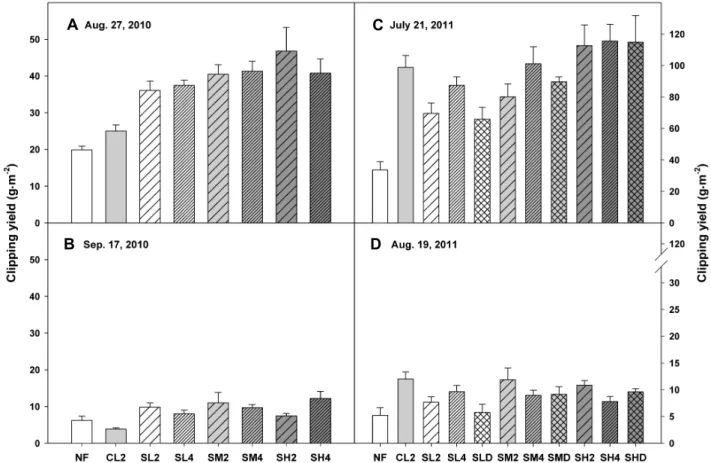
Fig. 4. Effect of the amount, timing, and frequency of SCB liquid fertilizer application on the clipping yield of Z. japonica in 2010 and 2011. Vertical bars are standard errors of the means (n = 4). For fertilizer treatment details, refer to Table 2.
Wehner et al., 1988). The color of Kentucky bluegrass and creeping bentgrass increased with an increase in available nitrogen (Frank et al., 2006; Schlossberg and Schmidt, 2007).
Kang et al. (2010) showed that SCB liquid fertilizer treatment in higher quantities yielded higher turf quality of zoysiagrass.
Contrary to 2010, CL2 plots in the present study exhibited higher turf color index than SCB plots in 2011. These results may be due to the intense precipitation in 2011. The 2011 growing season had a total of 1,976 mm of precipitation (Fig. 1). Specifically, the precipitation in July 2011 was 443.2 mm higher than normal. It is assumed that leaching of nutrients was more pronounced for SCB fertilizer than for the chemical granular fertilizer because liquid fertilizers generally leach more quickly.
Fall Color Retention
SL4, SM4, and SH4 significantly improved turf color retention from October to November in 2010 (Figs. 2C and 2D). They resulted in higher fall color retention by 0.86, 1.11, and 1.00, respectively, than that of NF on November 12, 2010 (Fig. 2D). The fall color retention in plots treated with SH4 was 0.30 higher than that of NF on September 23, 2011 (Fig. 3D). Late nitrogen fertilization often decreases the low temperature tolerance of turf (Wilkinson and Duff,
1972). However, there was no visible sign of injury for any treatment in the experimental period. SH4 enhanced the fall color retention of Z. japonica both in 2010 and 2011. Oral and Acikgoz (2001) reported that split applications yielded the highest overall turf quality and longer duration than heavy applications.
Clipping Yield
SCB plots produced higher clipping yield than CL2 in 2010 (Figs. 4A and 4B). SH4 maintained the highest clipping yield on September 17, 2010 (Fig. 4B). SL4, SM4, and SH4 resulted in high clipping yield, and SCB liquid fertilizer with N at 40 g・m
-2led to high clipping yield on July 21, 2011 (Fig. 4C). These results indicate that the SH4 treatment enhanced clipping yield during the growing and fall seasons.
Increasing nitrogen significantly increased clipping yield in
turf mixtures (Bilgili and Acikgoz, 2005). However, a greater
frequency of application resulted in a more uniform clipping
yield and reduced the total clipping weight (Bilgili and
Acikgoz, 2005). SHD maintained a high clipping yield until
June 21, 2011 (Fig. 4C), but SLD resulted in a lower clipping
yield than SMD and SHD. SCB liquid fertilizer applied
during the dormancy period produced leaf growth, but SLD
application was not sufficient to increase turf growth.
Table 3. Summary of ANOVA and GLM results for shoot density of Z. japonica in 2010 and 2011.
Source of variation 2010 2011
Treatment * NS
NF vs. other treatments ** *
CL2 vs. SCB * NS
SCB NS NS
NS,*,**