韓應昆誌 49(2): 89~91 (2010) Kor. J. Appl. Entomol.
A New Record of Perigrapha extincta (Lepidoptera, Noctuidae) from China
Yong-Quan Zhou and Hui-Lin Han1* Amur Forestry Bureau, Amur, China, 165302
1School of Forestry, Northeast Forestry University, Harbin, China 150040
중국내
Perigrapha extincta
(나비목: 밤나방과)의 최초 보고주영천ㆍ한휘림1*
중국대흥안령아무을림업국, 1중국동북림업대학교림학원
ABSTRACT: A total of four Perigrapha species were found in Northeast China. Among them, Perigrapha extincta Kononenko, 1989 is reported for the first time in China. The species is briefly redescribed with adult and male genitalia pictures, key, and geographic distributions
Key words: Hadeninae, Perigrapha, New record, Northeast China
초 록: 중국 동북지역의 밤나방과 Perigrapha 속에 대한 분류학적 연구를 통해 총4종이 조사되었다. 이 중 Perigrapha extincta Kononenko, 1989는 중국에서 처음 보고되는 종이다. 미기록종에 대한 성충, 수컷생식기의 도해를 포함해서 검색표,
재기재, 및 분포 등을 포함해서 간단하게 정리하였다.
검색어: Hadeninae, Perigrapha, 미기록, 중국 동북지역
*Corresponding author: [email protected] Received April 29 2010; revised May 3 2010;
accepted May 7 2010
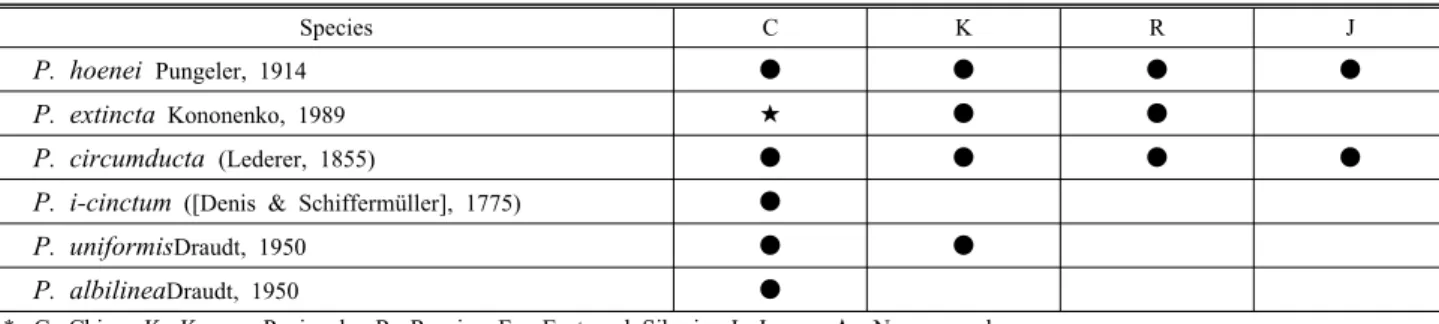
Perigrapha Lederer, 1857 is widely distributed in mountainous areas of the Oriental Region (Table 1), and contain 11 species in the world (Kononenko, 1989; Poole, 1989). Four species of the genus Perigrapha: P. hoenei Pungeler, 1914, P. extincta Kononenko, 1989, P. circum- ducta (Lederer, 1855) and P. uniformis Draudt, 1950 were appeared in Northeastern Asian. 4 species from the Korean Peninsula; 2 species from Japan; 3 species from Russian Far Eastern (Sugi, 1982; Kononenko, 2003, 2005; Kononenko et al., 1999; Kononenko & Han, 2007). Five species (Perigrapha albilinea Draudt, 1950; P. i-cinctum ([Denis
& Schiffermüller], 1775); P. hoenei Pungeler, 1914; P.
circumducta (Lederer, 1855) and P. uniformis Draudt, 1950) had been recorded from China, among them Perigrapha extincta is reported for the first time from China, with
the revision of the genus Perigrapha from Northeastern China in this study. (Chen, 1999; Hua, 2005; Kononenko et al., 1999; Kononenko & Han, 2007; Poole, 1989).
The materials examined in this study are deposited at Northeast Forestry University (NEFU), Harbin, China. This research was supported by the National Natural Science Foundation of China, No. 30700641, and The Project- sponsored by SRF for ROCS, SEM.
Taxonomic accounts
Genus Perigrapha Lederer, 1857
Type species: Noctua i-cinctum [Denis & Schiffermüller], 1775 [Austria].
Anorthoa Berio, 1880, subgenus (Type species: Noctua munda [Denis & Schiffermüller], 1775 [Austria]).
Harutaeographa Yoshimoto, 1993, subgenus (Type species:
Hadena fasciculate Hampson, 1894 [India: Sikkim]).
89
New Record of Perigrapha extincta (Lepidoptera, Noctuidae) from China
90
Table 1. Distribution of the genus Perigrapha in China, the Korean Peninsula, Russia (RFE, Siberia) and Japan
Species C K R J
P. hoenei Pungeler, 1914 ● ● ● ●
P. extincta Kononenko, 1989 ★ ● ●
P. circumducta (Lederer, 1855) ● ● ● ●
P. i-cinctum ([Denis & Schiffermüller], 1775) ●
P. uniformisDraudt, 1950 ● ●
P. albilineaDraudt, 1950 ●
*: C: China; K: Korean Peninsula; R: Russian Far East and Siberia; J: Japan; ★: New record.
1
2 3
Fig. 1-3. Perigrapha extincta Kononenko, 1989: 1, Adult;
2-3, Male genitalia.
Opacographa Hreblay, 1996, subgenus (Type species:
Perigrapha cilissa Püngeler, 1917 [Turkey]).
Rororthosia Beck, 1999, subgenus (Type species: Orthosia rorida Frivaldszky, 1835 [Bulgaria]).
Adult. Wingspan 30-60 mm, medium or large size species; body strong, elongate; male antenna broadly bipectinate, female with biserrate or shortly bipectinate.
Thorax with long and thick scale; abdomen strong, cylindrical or slightly flattened, some species rather short.
Forewing broad and long, median to postmedial areas darker color; ordinary spots appear, slightly fish mark in some species; terminal line with small dots line. Hindwing roundly, outer margin thin color; discal margin smog or very thin.
Male genitalia. Uncus large and broad, point at tip. Valva complicated process of cost extend and strong; harp horn, curved; saccus thick and broad. Juxta elongate. Aedeagus cylindrical, slightly curved or straight, vesica circle, with cornuti band.
Female genitalia. Apophysis long and slender. Ostium broad. Ductus bursae flattened, shorter than corpus bursae.
Corpus bursae large, with signa; appendix bursae at posterioris part, with wrinkle.
Key to the species of genus Perigrapha from NE China 1. Valva with branch ···
··· 2 - Valva without branch
··· P. circumducta (Lederer, 1855) 2. Valva without biparous ···
··· 3
- Valva with biparous ···
··· P. uniformis Draudt, 1950 3. Valva with trifurcate; harpe short, hardly curvered
··· P. extincta Kononenko, 1989 - Valva with quatrefurcate; harpe long, slightly curvered
··· P. hoenei Pungeler, 1914
Perigrapha extincta Kononenko, 1989 (Figs. 1-3) Perigrapha extincta Kononenko, 1989, Ann. Ent. Fennici.
55: 79, figs. 1, 3 (TL: RFE, Primorye terr., Gornotaezhnoe [Preserved in ZIN, St. Petersburg]).
Diagnosis (Fig. 1). This species is superficially similar to P. hoenei Püngeler, 1914, but can be distinguished by ground color of subterminal and terminal areas finely grey;
Yong-Quan Zhou and Hui-Lin Han 91
trangle mark rather small; lacuna narrow between orbicular and reniform spots; ordinary spots usually large, and open at costal direction of forewing.
Redescription. Wingspan 46-48 mm. Head, thorax and abdomen with grey, mixed little brown; patagium with long hair. Forewing with grey ground color; basal dash short, form by two black dots; antemedial line finely waved, black, slender, indistinct; triangle mark at basal part; median and postmedial lines black, blurry, only clearly short at cell part; the circle line of reniform and orbicular spots connect at behind part, black, and mixed brown; the top line of cell with brownish black; postmedial line blurred, dark grey;
subterminal line brownish black, distinct. Hindwing grey;
discal spot darkly and distinctly, rounded distinct; outer margin with sunken at M2, and between Cu2 and 2A.
Male genitalia (Figs. 2-3). Uncus long, gently broad from basal to top, flat. Tegumen broader than basal part of uncus, same length. Juxta bar shaped with thin sunken at top. Valva complex, sacculus broad, process part short and sharp; clasper thick and hook; harpe slender and hook;
costa thick, process part straight, strong, extend out ventral;
digitus short, finger shaped, shorter than costal process;
cucullus narrow, broader and longer than digitus. Aedeagus cylinder with weakly sclerotized carina; caecum slightly swollen. Vesica anomalous curved; basal part with a short and a long subbasal diverticulum, the long diverticulum with a short cornutus; middle part with 1 median diverti- culum; posterior part with a cornutus band.
Material examined. 2 ♂, Prov. Heilongjiang, Maorshan, Laoyeling, 1-6 VIII 2009 (Mu-Jie Qi).
Distribution. China (Heilongjiang), Korea (Central, South), Russia (RFE: Primorye terr.).
Literatures Cited
Chen, Y.X. 1999. Lepidoptera: Noctuidae. Fauna Sinica. Insect, Vol. 16. Science Press, Beijing, 1664 pp.
Hua, L.Z. 2005. List of Chinese Insect, Vol. III, Lepidoptera.
Sun Yat-sen University Press, Guangzhou. 595 pp.
Kononenko, V.S. 1989. A new species of Perigrapha from the Primorye territory, USSR (Lepidoptera, Noctuidae). Ann.
Entomol. Fennici. 55: 79-80.
Kononenko, V.S. 2003. Key to the Insect of Russian Far East.
Vol. V. Trichoptera and Lepidoptera. Part 4. Dal`nauka, Vladivostok. 688 pp.
Kononenko, V.S. 2005. An annotated check list of the Noctuidae (s. l.) (Lepidoptera, Noctuoidea: Nolidae, Erebidae, Micro- noctuidae, Noctuidae) of the Asian part of Russia and the Ural region. Noctuidae Sibiricae, Vol. 1. Entomological Press, Sorǿ. 243 pp.
Kononenko, V.S. and H.L. Han. 2007. Atlas Genitalia of Noctuidae in Korea (Lepidoptera). In: Park, K.T. (ed.). Insects of Korea, Vol. 11. Junghaeng-Sa, Seoul. 464 pp.
Kononenko, V.S., S.B. Ahn and L. Ronkay. 1998. Illustrated Catalogue of Noctuidae in Korea (Lepidoptera). In: Park, K.T.
(ed.). Insects of Korea, Vol. 3. Junghaeng-Sa, Seoul. 507 pp.
Poole, R.W. 1989. Noctuidae. Lepidopterorum Catalogues (New Series). Fascicle 118. E.J. Brill, Leiden. 1314 pp.
Sugi, S. 1982. Noctuidae (except Herminiinae). In: Inoue H., S. Sugi, H. Kuroko, S. Moriuti, and A. Kawabe (eds). Moths of Japan, Vol. 1, pp. 669-913; Vol. 2, pp. 334-405. Kodansha, Tokyo.