- 524 -
Physicochemical and quality characteristics of the Korean and American blueberries
Hey-Kyung Moon1, Su-Won Lee2, Jong-Kuk Kim3*
1
Center for Scientific Instruments, Kyungpook National University, Sangju 742-711, Korea
2Tory Food, Sangju 742-821, Korea
3
Department of Food and Food-Service Industry, Kyungpook National University, Sangju 742-711, Korea
국내산과 미국산 블루베리의 이화학적 품질특성
문혜경1․이수원2․김종국3*
1경북대학교 공동실험실습관, 2(주)토리식품, 3경북대학교 식품외식산업학과
Abstract
We investigated the quality characteristics of the Korean and American blueberry. There was a similarity between the general composition and sugar content of the Korean and American values. The pH values showed a low of 3.46 in American blueberries to a high of 4.49 in Korean blueberries. The L (lightness), a (redness), and b (yellowness) value scores of the American blueberry were higher than the Korean blueberry. The levels of total phenol content and DPPH radical scavenging abilities were 205 mg%, 93.48% in the Korean blueberry and 182 mg%, 84.32%
in the American blueberry, respectively. The free sugar levels showed fructose 2,514 mg%, glucose 2,315 mg%, and sucrose 69 mg% in the Korean blueberry, while the free sugar levels of the American blueberry showed fructose 2,106 mg%, glucose 1,825 mg%. The contents of organic acid were lactic acid and tartaric acid in the Korean blueberry, while the organic acid in the American blueberry contained tartaric acid, succinic acid, oxalic acid, and lactic acid. The Korean blueberry has 12 kinds of free amino acids, while the American blueberry has 9 kinds of free amino acids. Furthermore, the Korean blueberry contains 390 mg% of total amino acids, which was higher than 32% in the American blueberry with 295 mg% of total amino acids. The fatty acid contents of the American blueberry (2,897 mg%) was higher than that of the Korean blueberry (2,783 mg%) as well as in the oleic acid, linoleic acid, and palmitic acid. The mineral contents of all the samples were P>K>Ca>Mg, respectively. Given the above results, the Korean blueberry bioactive chemicals or properties were thought to be somewhat higher than the American blueberry.
Key words:blueberry, quality characteristics, total phenol, DPPH radical scavenging
서 론
1)
블루베리는 진달래과(Ericaceae) 산앵두나무속(Vaccinium) 에 속하는 관목성 식물로서 400여종이 있으며, 주로 동남아 시아에 분포하고 있다. 북미에서는 하이부시 블루베리(V.
corymbosum), 로우부시 블루베리(V. angustifolium) 및 래빗 아이 블루베리(V. ashei) 등 세 종류가 상업적으로 중요한
*Corresponding author. E-mail:[email protected] Phone:82-54-530-1305, Fax:82-54-530-1309
과실로서 재배되고 있다(1). 특히 우리나라에 많이 도입되 어 있는 하이부시베리(V. corymbosum) 블루베리는 과실의 품질이 매우 뛰어나므로 세계적으로 가장 널리 상업적으로 재배가 이루어지고 있는 종류이다(2). 블루베리는 여러 가 지 뛰어난 생체 조절 기능성을 갖는 고품질의 생리활성 소재를 함유하고 있고 각종 성인병을 예방하고 치유하는 훌륭한 기능성도 지니고 있다는 사실들이 최근 밝혀지고 있는 추세이며(3), 2002년 미국 시사 주간지 타임은 블루베 리를 10대 건강식품의 하나로 소개한 바 있다. 블루베리의 주요 성분으로는 가용성 무질소물 81.36%, 수분 10.47%,
조단백 2.66%, 조지방 2.04%, 조회분 1.99%, 조섬유 1.48%
등이 함유되고 있고, 무기질로는 Ca, K, P, Na 등이 있다(4).
블루베리 성숙 과실에는 기능성 물질인 안토시아닌과 카로 티노이드 색소가 다량 함유되어 있어 항산화(5), 항당뇨(6) 및 항암작용(7)이 우수하다는 결과와 로돕신(rhodopsin) 재 합성 작용의 활성화를 촉진하여 눈의 피로를 풀어주고 시야 를 맑아지게 한다는 보고가 있다(8). 특히, 플라보노이드 (flavonoid) 및 페놀산(phenolic acid) 등의 파이토케미컬 (phytochemical)이 풍부하여 활성산소를 억제하는 높은 항 산화 작용으로 노화방지 및 질병예방에 효능이 있는 것으로 알려져 있다(9,10). 블루베리에 관한 선행연구로는 블루베 리 잎의 영양성분 분석 및 항산화 활성(3), 블루베리 추출물 의 항산화 활성(11), 블루베리 첨가 막걸리의 발효특성(12), 블루베리 분말을 첨가한 쿠키의 품질 특성(4), 국내 시판 블루베리와 라즈베리의 영양성분 분석 및 항산화 활성(13), 국내산 블루베리 첨가 머핀의 품질 특성(14) 등 블루베리의 기능성과 블루베리를 이용한 가공식품에 관하여 다양한 연구가 이루어져 왔다. 이에 반해 국내에서 생산되어지는 블루베리와 국외에서 생산되는 블루베리에 관한 연구는 미비한 실정이다. 따라서 본 연구에서는 블루베리를 국내 산과 미국산 블루베리의 품질특성을 비교하고 기능성 소재 식품 및 가공품 개발을 위한 기초자료로서 활용하고자 한 다.
재료 및 방법
실험 재료
국내에서 생산되고 있는 블루베리와 미국에서 수입하여 판매하고 있는 블루베리를 시중에서 구입하여 진공 동결 건조(SFDTS-10K, Samwon Engineering, Pusan, Korea) 후 분말화하여 분석용 시료로 사용하였다.
일반성분 분석
일반성분은 AOAC방법(15)에 준하여 분석하였다. 즉, 수 분함량은 105℃ 상압가열건조법, 조단백질은 Kjeldahl 질소 정량법, 조지방은 Soxhet 추출법, 조회분은 직접회화법, 조 섬유는 Fibertec으로 측정하여 백분율로 나타내었다. 가용 성 무질소물(%)은 100에서 수분, 조단백질, 조지방, 조회분 및 조섬유을 제외한 값으로 나타내었다.
pH 및 당도 측정
pH는 시료 5 g을 칭량하여 증류수를 가하여 50 mL로 만든 다음 균질화한 후 여과지(Whatman No. 2)로 여과한 여액을 pH meter(691 pH Meter, Metrohm, Herisau, Swiss)를 사용하여 측정하였다. 당도는 굴절당도계(N-1E, Atago, Tokyo, Japan)를 이용하여 측정하였다.
색도 측정
색도는 색차계(Spectrocolorimeter, USXE/ SAV/UV-2, Hunterlab Overseas Ltd., Reston, Virginia, USA)를 이용하여 명도(L-value), 적색도(a-value) 및 황색도(b-value, yellowness) 값을 측정하였다. 이때 사용된 표준 백색판의 L, a, b 값은 각각 99.11, 0.23, -0.28이었다.
총페놀성 화합물 함량 및 전자공여능(DPPH) radical 소 거활성 측정
총페놀성 화합물은 Folin-Denis법(16)으로 측정하였다.
즉, 시료 5 g 에 80% 에탄올용액 100 mL를 가하여 환류냉각 기가 부착된 heating mantle에서 80℃, 2시간 반복추출 후 Whatman No. 5로 여과하였다. 여과액은 hexane으로 지질 을 제거한 다음 40℃에서 진공농축 건고 후 80% 에탄올용 액 5 mL로 정용한 용액 1 mL와 Folin-Denis시약 3 mL를 혼합하여 30분간 실온에 방치한 다음 10% Na2CO3 용액 3 mL를 가하여 혼합하고 실온에서 1시간 정치시킨 후 760 nm에서 흡광도를 측정하였다. 이때 표준검량곡선은 garlic acid를 이용하여 작성하였다.
DPPH(α,α-diphenyl-β-picrylhydrazyl) radical 소거활성은 Blios의 방법(17)에 준하여 변형하여 측정하였다. 각 추출물 1 mL에 60 μM DPPH 3 mL를 넣고 vortex한 후 15분 동안 암소에 방치한 다음 517 nm에서 흡광도를 측정하여 다음 식에 의하여 나타내었다.
DPPH radical 전자공여능(%)=(
)×100
유리당 함량 분석
유리당은 Wilson과 Work방법(18) 에 따라 시료를 약 5 g씩 정확히 칭량하여 80% 에탄올용액 100 mL를 가하여 환류냉각 추출장치에 넣어 부착된 heating mantle에서 80℃, 2시간 동안 당성분을 반복추출 후 Whatman No. 5로 여과하 였다. 여과액은 hexane으로 지질을 제거하고 40℃ 진공 농 축 건고 후 증류수 5 mL로 정용한 다음 Sepak C18를 통과시 켜 0.2 μm membrane filter로 여과한 후 HPLC(Waters 2695, Waters Co., Milford, Massachusetts, USA)의 분석용 시료로 사용하였다. 이때 column은 carbohydrate column(ID 3.96×300 mm, Waters Co., Milford, Massachusetts, USA)을 사용하였으며, column oven 온도는 35℃, mobile phase는 75% acetonitrile, flow rate는 1.4 mL/min, 시료주입량은 10 μL의 조건으로 Refractive Index(RI) detector(Waters 2414, Waters Co., Milford, Massachusetts, USA)에서 검출하였다.
표준품은 xylose, fructose, glucose, sucrose, maltose 및 lactose(Sigma, Saint Louis, Missouri, USA)를 일정량씩 혼합 하여 증류수에 녹여 표준용액으로 사용하였다. 표준품과 시료의 당성분은 머무른 시간을 직접 비교하여 확인하였고 각 표준품의 검량곡선을 작성하여 peak의 면적으로 개별
당성분의 함량을 산출하였다.
유기산 함량 분석
유기산은 Wilson과 Work방법(18)에 따라 시료 5 g에 80%
에탄올용액 100 mL를 가하여 환류냉각기가 부착된 heating mantle에서 80℃, 2시간 반복추출 후 Whatman No. 5로 여과 하였다. 여과액은 hexane으로 지질을 제거하고 40℃ 진공 농축 건고 후 증류수 5 mL로 정용한 다음 고분자 물질과 색소를 제거하기 위하여 Sepak C18 cartridge 및 0.2 μm membrane filter로 여과한 후 HPLC(Waters 2695, Waters Co., Milford, Massachusetts, USA)로 분석하였다. 이때 column은 YMC-pack ODS-AQ(YMC Co. 4.6×250 mm)를 사용하였으며, column 온도는 상온에서 분석하였고, mobile phase은 100 mM phosphate buffer, flow rate은 0.7 mL/min, 검출기는 photodiode array(PDA) detector(Waters 2996, Waters Co., Milford, Massachusetts, USA)로 분석하였 다. 표준품은 oxalic acid, citric acid, tartaric acid, malic acid, acetic acid, succinic acid 및 lactic acid(Sigma, Saint Louis, Missouri, USA)를 일정량씩 혼합하여 증류수에 녹여 표준 용액으로 사용하였다. 표준품과 시료의 유기산 성분은 머 무른 시간을 직접 비교하여 확인하였고 각 표준품의 검량곡 선을 작성하여 peak의 면적으로 개별 유기산성분의 함량을 산출하였다.
유리아미노산 함량 분석
유리 아미노산을 분석하기 위해 시료를 약 5 g 씩 정확히 칭량하여 삼각플라스크에 넣고 80% 에탄올 용액을 100 mL 가하여 약 24시간 진탕추출하고, 그 추출물을 감압여과 하여, 45℃의 Water bath에서 감압농축한 후 0.2 M lithium citrate buffer(pH 2.2)용액 10 mL로 정용하고, Sepak C18처리 한 후 0.45 μm membrane filter로 여과하여 Automatic amino acid analyzer(Biochrom-30, Amersham Pharacia Biotech Co., Cambridge, UK)로 분석하였다(19). 이때 column은 Li form column으로 분석하였고 flow rate는 buffer 20 mL/h, ninhydrin 20 mL/hr 이었으며, injection volume은 40 μL 이었 다.
지방산 조성 분석
시료 5 g을 원통여지(Toyo Roshi Kaisha, Ltd., Tokyo, Japan)에 넣고, diethyl ether를 가하여 soxhlet 추출법으로 약 10시간 동안 연속 추출하여 조지방을 얻고 이에 0.5 N NaOH/MeOH를 가하여 80℃에서 환류 시키면서 가수분해 시킨 후, 14%의 BF3methanol 및 n-heptane을 가하여 끓이고 식힌 후 증류수와 Na2SO4을 이용하여 탈수, 여과한 용액 1 μL를 gas chromatography(GC, HP-6890 series, Agilent Technologies, Santa Clara, California, USA)에 주입, 전개시 켰다. GLC에 의해 분리된 각 지방산 metyl ester를 peak
면적의 비율로 계산하여 각 지방산의 조성비를 구하였다 (20). 이 때 컬럼은 SP-2340 (30m×0.25mm I.D.) silica 모세 관 형이었고 FID형 검출기, carrier gas로는 N2gas를 사용하 여 분석하였다. 컬럼, injector 및 검출기 온도는 150~220℃, 220℃ 및 230℃에서 분석하였다.
무기질 함량 분석
무기질 함량 측정은 AOAC법(15)에 따라 정량하였다.
즉 시료 10 g에 질산을 가한 후 실온에서 12시간 이상 방치 후 100℃에서 24시간 이상을 가열하여 노란색의 맑은 용액이 될 때까지 실시하고 반응이 끝나면 다시 질산을 넣고 산이 완전히 증발할 때까지 재반응시켜 유기질을 제거 한다. 유기질 제거 후 0.2 N 질산용액을 20 mL 가하여 24시 간 재용출시킨 시료 용액을 0.45 μm membrane filter로 여과 하여 50 mL volumetric flask로 정용한 후 분석용액으로 하였다. Ca, Co, Cu, Fe, K, Mg, Mn, Mo, Na, Zn 등은 ICP(Inductively Coupled Plasma, IRis Intrepid, Thermo Elemental Co., Cambridge, UK)로 A393.366(85), A228.616(147),
A324.754(103), A259.940(129), A766.491(44), A285.213(117), A257.610(130), A202.030(166), A588.995(57), A213.856(157)에서 각각 분석하였다. 분 석조건은 approximate RF power가 1,150 W이며, analysis pump rate는 100 rpm, nebulizer pressure와 observation height 는 각각 20 psi 및 15 mm로 하였다.
결과 및 고찰
일반성분
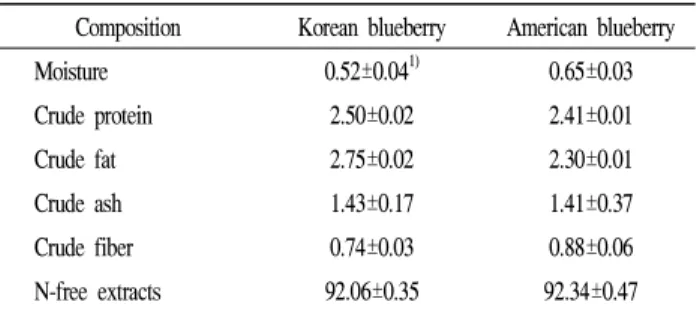
국내 및 미국산 블루베리를 진공 동결 건조하여 분석한 일반성분은 Table 1과 같다. 조단백질의 함량은 국내산 2.5%, 미국산 2.41%로 비슷한 값을 나타내었으며, 조지방 함량은 국내산 2.75%, 미국산 2.30% 국내산이 조금 높은 값을 나타내었다. 조회분과 조섬유의 함량은 각각 국내산 1.43%, 0.74%, 미국산 1.41%, 0.88%로 비슷한 값을 나타내 었다. 국내산과 미국산 블루베리의 일반성분은 비슷한 함
Table 1. Proximate composition of Korean blueberry and American blueberry
(dry basis, unit : %) Composition Korean blueberry American blueberry
Moisture 0.52±0.041) 0.65±0.03
Crude protein 2.50±0.02 2.41±0.01
Crude fat 2.75±0.02 2.30±0.01
Crude ash 1.43±0.17 1.41±0.37
Crude fiber 0.74±0.03 0.88±0.06
N-free extracts 92.06±0.35 92.34±0.47
1)Values are the mean±standard deviation of triples experiments.
유량을 보여 차이가 없는 것으로 나타났다.
Jeong 등(13)은 건조된 블루베리의 일반성분은 수분 10.47%, 조단백질 2.66%, 조지방 2.04%, 회분 1.99%, 조섬 유 1.48%로 보고하였는데 본 실험 결과와는 조금 다른 값을 나타내었다. 이러한 결과는 시료의 건조 방법이 상이함에 따라 나타난 결과로 생각된다.
pH 및 당도
국내산 및 미국산 블루베리를 진공 동결 건조하여 pH 및 당도를 측정한 결과는 Table 2와 같다. pH에 있어서 국내산 블루베리가 4.49로 미국산 3.46보다는 다소 높은 값을 나타내었으며, 당도에 있어서는 국내산 62.67 °Brix, 미국산 62.58 °Brix로 비슷한 값을 보였다.
Table 2. pH and sugar contents of Korean blueberry and American blueberry
(dry basis) Variables Korean blueberry American blueberry
pH 4.49±0.011) 3.46±0.00
°Brix 62.67±0.14 62.58±0.14
1)Values are the mean±standard deviation of triples experiments.
색 도
국내산 및 미국산 블루베리를 진공 동결 건조하여 색도 를 측정한 결과는 Table 3에 나타내었다. L값은 국내산 블루 베리 35.67, 미국산 37.24의 값을 나타내 미국산이 좀 더 밝은 값을 나타내었고, a값에 있어서는 국내산 3.05, 미국산 5.71의 값을 나타내 미국산이 좀 더 붉은 빛을 나타내는 것으로 나타났다. b값에 있어서도 미국산 1.12가 국내산 0.27 보다 높은 값을 나타내었다. 이상의 결과에서 색차 값에 있어서는 L, a, b값 모두 미국산 블루베리가 국내산에 비해 조금 높은 값을 나타내었다. ∆E 값은 전반적인 색차를 나타내는 것으로, 0.0~0.5, 0.5~1.5 및 1.5~3.0이면 각각 흔적(trace), 약간(slight) 및 뚜렷한(noticeable) 정도의 육안 적 차이에 해당한다(21). 본 실험 결과에서 색차는 국내산 63.71, 미국산 62.36으로 국내산이 약간 높은 값을 나타내었 으며, 모두 noticeable 그 이상의 차이를 보이는 것으로 확인 되었다.
Table 3. Hunter's color values of Korean blueberry and American blueberry
(dry basis) Color values Korean blueberry American blueberry
L 35.67±0.011) 37.24±0.02
a 3.05±0.06 5.71±0.05
b 0.27±0.06 1.12±0.04
△E 63.71±0.02 62.36±0.02
1)Values are the mean±standard deviation of triples experiments.
Ji와 Yoo(4)는 블루베리 분말의 색도 측정 결과 L값 22.35, a값 23.13, b값 2.11로 보고하였으며, Rossi 등(22)은 L 29.94, a 6.87, b -0.142로 보고하였다. 이러한 결과의 차이 는 품종, 재배지역, 생산시기, 시료의 형태 및 보관방법 등에 따라 차이가 나는 것으로 생각되며, 시료 선택에 있어서 색도값을 참조하면 특성에 맞는 제품 개발에 이용되어질 수 있을 것으로 생각된다.
총페놀성 화합물 함량 및 전자공여능(DPPH) radical 소거 활성
국내산 및 미국산 블루베리를 진공 동결 건조하여 총 페놀성 화합물 함량과 전자공여능(DPPH) radical 소거활성 을 측정한 결과는 Table 4와 같다. 페놀성 화합물은 다양한 식물성 식품에 존재하는 것으로 알려져 있으며, 구조식에 phenolic hydroxyl(OH)기를 소유하고, 고명 안정화 된 구조 로서 전자를 수용하는 기작으로 항산화 반응에 직접적으로 관여한다(23). 국내산 블루베리의 총페놀성 화합물 함량은 182.87 mg%, 미국산 205.28 mg% 으로 나타나 미국산이 좀 더 높은 총페놀성 화합물 함량을 보였다.
Table 4. Total phenol content and DPPH radical scaverging activity of Korean blueberry and American blueberry
(dry basis) Variables Korean blueberry American blueberry Total phenol content (mg%) 182.87±0.561) 205.29±0.50 DPPH radical scaverging activity (%) 93.48±2.42 84.32±1.56
1)Values are the mean±standard deviation of triples experiments.
DPPH는 천연소재로부터 항산화활성을 분석하는데 많 이 이용되며, 비교적 안정한 free radical로서 항산화제, 방향 족 아민류 등에 환원되어 색이 탈색되는 원리를 이용하여 측정하게 된다(24). 국내산 블루베리 DPPH radical 소거능 은 93.48%의 값을 내었고 미국산을 84.32%의 값을 나타내 었다. 이상의 결과에서 총페놀성 화합물 함량은 미국산 블 루베리가 높은 값을 나타내었고, DPPH radical 소거능에서 는 국내산 블루베리가 좀 더 높은 값을 나타내었다.
Jeong 등(13)은 국내 시판 블루베리와 라즈베리의 DPPH radical 소거능을 각각 92.60%와 91.32%로 보고하였으며, 본 실험결과와 비슷한 값을 나타내었다. Park 등(25)의 국내 산 블루베리 추출물을 이용한 전자공여능 측정결과 77.42%
로 보고하였으며, Su와 Silva(26)의 미국산 블루베리 착즙액 에 대해서 64.3%로 보고하였다. 상기의 보고에서도 국내산 이 미국산보다 높은 DPPH radical 소거능을 나타내어 본 실험과 비슷한 결과를 나타내었다. Rossi 등(22)은 이태리 에서 생산된 하이부시블루베리 6종을 혼합하여 DPPH radical 소거능을 측정한 결과를 69.4%로 보고하였는데, 국 내산 블루베리의 DPPH radical 소거능이 미국산보다 높은
값을 나타내어 항산화력이 높은 것으로 생각된다.
유리당 함량
국내산 및 미국산 블루베리를 진공동결건조하여 유리당 함량을 분석한 결과는 Table 5 와 같다. 국내산 및 미국산 블루베리의 주된 유리당은 fructose, glucose로 나타났으며, 국내산 블루베리는 fructose 2,541.10 mg%, glucose 2,315.81 mg% 함유하고 있었으며, 미국산 블루베리에는 fructose 2,106.06 mg%, glucose 1,825.20 mg%의 값을 나타내었다.
또한 국내산 블루베리는 미국산에 함유하고 있지 않은 sucrose가 69.01 mg% 함유하고 있는 것으로 나타났다.
Xylose, maltose, lactose는 모두 함유하고 있지 않은 것으로 나타났다. 이상의 결과에서 유리당의 함량은 국내산 블루 베리가 미국산에 비해 다소 높은 함량을 보였다.
Cha 등(27)은 fructose와 glucose가 복분자 딸기의 주된 당이며, fructose가 glucose보다 더 많이 함유되어 있는 것으 로 보고하였다. Oh 등(28)은 국내산 나무딸기류 과일의 당 조성 보고에서 당은 fructose와 glucose가 주를 이루고 있었 고, 일부 과일에서는 sucrose도 미량 존재하는 것으로 보고 하였는데, 이는 본 연구 결과와 유사하였다. Rossi 등(22)은 하이부시블루베리 6종을 혼합하여 유리당 함량을 분석한 결과 glucose 5.31 g%, fructose 4.50 g%로 glucose 함량이 fructose 함량보다 높다고 보고하였다. 본 실험결과와는 상 이한 결과를 나타내었는데, 이는 여러 종류의 블루베리 혼 합물과 본 실험에 사용한 단일 품종 시료와의 차이로 보여 진다.
Table 5. Free sugar contents of Korean blueberry and American blueberry
(dry basis, unit:mg%) Free sugar Korean blueberry American blueberry
Xylose ND1) ND
Fructose 2541.10±9.472) 2106.06±0.92 Glucose 2315.81±11.86 1825.20±4.74
Sucrose 69.01±6.85 ND
Maltose ND ND
Lactose ND ND
1)ND=Not Detected
2)Values are the mean±standard deviation of triples experiments.
유기산 함량
국내산 및 미국산 블루베리를 진공동결건조하여 유기산 함량을 분석한 결과는 Table 6과 같다. 국내산 블루베리의 유기산은 tartaric acid 0.3 mg%, lactic acid 3.65 mg%로 2종 류의 유기산을 함유하고 있는 것으로 나타났으며 미국산 블루베리는 oxalic acid 0.24 mg%, tartaric acid 2.51 mg%, malic acid 1.34 mg%, lactic acid 0.16 mg%, succinic acid
2.47 mg%를 함유하고 있는 것으로 나타났다. 미국산이 국 내산보다 유기산 종류에서 더 많이 함유하고 있는 것으로 나타났다.
Oh 등(28)은 나무딸기류 과일에는 citric acid와 malic acid 가 주된 유기산이며, 일부 과일에는 tartaric acid, succinic acid, oxalic acid가 함유되어 있었다고 보고하였다. 이러한 결과는 본 연구와 비교하였을 때 주요 유기산은 다른 것으 로 나타났으나 함유하고 있는 유기산의 종류는 유사한 것으 로 나타났다.
Table 6. Organic acid contents of Korean blueberry and American blueberry
(dry basis, unit: mg%) Organic acid Korean blueberry American blueberry
Oxalic acid ND1) 0.24±0.01
Tartaric acid 0.30±0.032) 2.51±0.30
Malic acid ND 1.34±0.11
Lactic acid 3.65±0.26 0.16±0.01
Acetic acid ND ND
Citric acid ND ND
Succinic acid ND 2.47±0.05
1)ND=Not Detected
2)Values are the mean±standard deviation of triples experiments.
유리아미노산 함량
국내산 및 미국산 블루베리를 진공동결건조하여 유리아 미노산 함량을 분석한 결과 Table 7과 같다. 유리아미노산 Table 7. Free amino acid contents of Korean blueberry and American blueberry
(dry basis, unit: mg%) Amino acid Korean blueberry American blueberry
L-Threonine 5.301) 3.32
L-Serine 16.37 13.30
L-Aspargine 5.78 0.00
L-Glutamic acid 17.08 41.67
L-Alanine 16.89 11.79
L-Valine 8.66 0.00
L-Tyrosine 0.00 16.40
r-Amino-n-butyric acid 38.34 36.50
Ethanolamin 9.31 9.60
Ammonium Chloride 18.48 21.29
L-Lysine 4.37 0.00
L-Histidine 5.30 0.00
L-Arginine 244.86 141.76
Total 390.74 295.61
1)Values are the mean of triples experiments.
40종 중 국내산 블루베리는 총 12종의 유리아미노산을 함 유하고 있었고, 미국산 블루베리는 총 9종의 유리아미노산 을 함유하고 있는 것으로 나타났다. 유리아미산 중 arginine 의 함유량이 국내산 244.86 mg%, 미국산 141.76 mg%으로 가장 높은 함유량을 나타내었다. 국내산 블루베리는 argine
> GABA(38.34 mg%) > glutamic acid(17.08 mg%) 순으로 함유하고 있었고, 미국산 블루베리는 arginine > glutamic acid(41.67 mg%) > GABA(36.50 mg%) 순으로 함유하고 있는 것으로 나타났다. 유리아미노산의 총합계를 살펴보면 국내산은 390.74 mg%로 미국산 295.61 mg%에 비해 32%
더 많이 함유한 것으로 나타났다. 이상의 결과에서 국내산 블루베리가 미국산에 비해 유리아미노산의 총 합계와 함유 하고 있는 종류가 더 많은 것으로 나타났다.
지방산 조성
국내산 및 미국산 블루베리를 진공동결건조하여 지방산 함량을 분석한 결과는 Table 8 과 같다. 블루베리의 주요 지방산은 palmitic acid, stearic acid, oleic acid, linoleic acid, arachidic acid 등의 5종으로 나타났다. 가장 많이 함유하고 있는 지방산은 oleic acid로 국내산 블루베리가 1,111.59 mg%, 미국산 블루베리는 1,161 mg% 함유하고 있는 것으로 나타났으며, 다음으로 linoleic acid로 국내산 695.72 mg%, 미국산 736.29 mg% 함유하고 있는 것으로 나타났다.
Palmitic acid의 경우 국내산 638.99 mg%, 미국산 660 mg%
함유하고 있는 것으로 나타났으며, 총지방산 함량에서 국 내산 2,783 mg%, 미국산 2,897 mg% 함유하고 있는 것으로 나타났다. 이상의 결과에서 블루베리에 대한 지방산 함량 은 국내산 보다 미국산이 많이 함유하고 있는 것으로 나타 났다.
Table 8. Fatty acid contents of Korean blueberry and American blueberry
(dry basis, unit: mg%) Fatty acid Korean blueberry American blueberry
Palmitic acid 638.991) 660.69
Stearic acid 283.35 286.74
Oleic acid 1111.59 1161.05
Linoleic acid 695.72 736.29
Arachidic acid 53.87 52.31
Total 2783.51 2897.08
1)Values are the mean deviation of triples experiments.
무기질 함량
국내산 및 미국산 블루베리를 진공동결건조하여 무기질 함량을 분석한 결과는 Table 9 와 같다. 블루베리에 함유하 고 있는 주요 무기질은 Ca, K, Mg, P 등으로 나타났으며, 그 중에서도 P가 가장 많이 함유하는 것으로 나타났다. 미
국산 P의 함량은 6,948.42 mg%으로 국내산 728.90 mg%
보다 약 10배 가량 높은 함유량을 보였다. K 함량은 국내산 460.28 mg%, 미국산 491.75 mg%, Ca은 국내산 157.53 mg%, 미국산 189.15 mg%의 값을 나타내 미국산이 다소 높은 값을 나타냈다. Co, Cu, Fe 등은 미량 함유하고 있는 것으로 나타났다. 이상의 결과에서 전반적으로 미국산 블 루베리의 무기질 함량이 국내산보다 다소 높은 함유량을 보였다.
Jeong 등(13)은 국내 시판 블루베리의 경우 Ca이 451.34 mg%으로 가장 높게 나타났고, K(355.40 mg%), P(321.10 mg%) 및 Na(137.58 mg%) 순으로 함유되어 있다는 보고는 본 실험의 결과와는 상이하게 나타났다. Cha 등(27)의 미숙 과 및 완숙과의 복분자 딸기 무기질 분석 결과 K 함량이 각각 645.07 mg%, 216.53 mg%로 보고하였다. Ca는 미숙과 214.49 mg%, 완숙과 39.63 mg%로 보고하였다. Mg 미숙과 74.10 mg%, 완숙과 21.73 mg%, Na 미숙과 32.81 mg%, 완숙과 21.75 mg%, Fe은 미숙과 2.31 mg%, 완숙과 1.25 mg%로 보고하였다. Jeong 등(29)은 블랙커런트 무기성분 에서 K 177.36 mg%, P 54.74 mg%, Ca 26.45 mg%, Na 24.63 mg% 및 Mg 21.58 mg% 순으로 함유하고 있다고 보고하였다. 본 실험에 사용된 블루베리와 비교하였을 때 주요 무기성분은 다르지만 일반적으로 베리류에 많이 함유 되어 있는 무기질은 P, Ca, K인 것으로 생각된다.
Table 9. Mineral contents of Korean blueberry and American blueberry
(dry basis, unit: mg%) Mineral Korean blueberry American blueberry
Ca 157.5271) 189.152
Co 0.005 0.001
Cu 0.319 0.240
Fe 0.497 0.921
K 460.281 491.750
Mg 45.314 18.696
Mn 5.027 1.009
Mo ND2) ND
Na 3.396 7.491
P 728.903 6948.421
Zn 1.026 5.677
1)Values are the mean deviation of triples experiments.
2)ND=Not Detected.
요 약
국내산 블루베리와 미국산 블루베리의 이화학적 품질특 성을 조사하였다. 일반성분과 당도를 분석한 결과 미국산
과 국내산 값이 비슷하게 나타났다. pH는 국내산 4.49, 미국 산 3.46으로 낮게 나타내었으며 색도는 L, a, b 값 모두 미국산이 국내산 보다 높게 나타났다. 총페놀성 화합물 함 량은 국내산이 205.29 mg%, 미국산이 182.87 mg%로 나타 났고, DPPH radical 소거 활성능은 국내산이 93.48%, 미국 산이 84.32%를 나타내었다. 유리당 함량은 국내산은 fructose 2,514.10 mg%, glucose 2,315.81 mg%, sucrose 69.01 mg%가 함유되어 있었고, 미국산은 fructose 2,106.06 mg%
와 glucose 1,825.20 mg%만이 함유되어 있었다. 유기산 함 량에서 국내산은 lactic acid 3.65 mg%와 tartaric acid 0.30 mg%가 함유되어 있었고, 미국산은 tartaric acid 2.51 mg%, succinic acid 2.47 mg%, malic acid 1.34 mg%, oxalic acid 0.24 mg%, lactic acid 0.16 mg%가 함유되어 있었다. 유리아 미노산 40종 중 국내산 12종, 미국산 9종의 유리아미노산을 함유하고 있었고, 총함량은 국내산 3,90.74 mg/100g, 미국 산 295.61 mg/100g 으로 미국산에 비해 국내산이 32% 더 많이 함유한 것으로 나타났다. 지방산 함량은 미국산은 2,897.08 mg%로 국내산 2,783.51 mg%보다 조금 높았으며 oleic acid>linoleic aicd>palmitic acid 순을 나타났다. 무기질 P, K, Ca 함량에서 국내산은 각각 728.903 mg%, 460.281 mg%, 157.527 mg%, 미국산은 6,948.421 mg%, 491.750 mg%, 189.152 mg%로 나타났으며, P> K> Ca> Mg순으로 함유되어 있었다. 이상의 결과로 볼 때 국내산 블루베리가 유효 화학성분이나 생리활성적 특성이 미국산보다 다소 높은 것으로 생각된다.
감사의 글
이 논문은 2009학년도 경북대학교 연구교수 연구비에 의하여 연구되었음
References
1. Westwood MN (1993) Temperate-zone pomology.
Timber Press, Portland, OR, USA, p 100-101 2. RDA (2008) Standard Farming Handbook-164 Blueberry.
Rural development administration Suwon, Korea, p 28 3. Jeong HR, Jo YN, Jeong JH, Kim HJ, Heo HJ (2012) Nutritional composition and in vitro antioxidant activities of blueberry (Vaccinium asheii) leaf. Korean J Food Presserv, 19, 604-610
4. Ji JR, Yoo SS (2010) Quality characteristics of cookies with varied concentrations of blueberry powder. J East Asian Soc Dietary Life, 20, 433-438
5. Su, MS, Chien PJ (2007) Antioxidant activity,
anthocyanins and phenolics of rabbityee blueberry (Vaccinium ashei) fluid products as arrected by fermentation. Food Chem, 104, 182-187
6. Martineau LC, Couture A, Spoor D, Benhaddou AA, Harris C, Meddah B, Leduc C, Burt A, Vuong T, Le PM, Prentki M, Bennett SA, Arnason JT, Haddadd PS (2006) Anti-dia-betic properties of the Canadian loubush blueberry Vaccinium angustifoliumAit. Phytomedicine, 13, 612-123
7. Parry J, Su L, Moore J, Cheng Z, Luther M, Rao JN, Wang JY, Yu LL (2006) Chemical compositions antioxidant capacities and antiproliferative activitives of selected fruit seed flours. J Agric Food Chem, 54, 3773-3778
8. Jeollabuk-do Agricultural Research & Extention Services (2009) Functional characteristics of fruit varieties of blueberries, breeding and cultivation technology research.
Rural development administration, Suwon, Korea, p 5-6 9. Naczk M, Shahidi F (2006) Phenolics in cereals, fruits and vegetables: Occurrence, extraction and analysis. J Pharm Biomed Anal, 41, 1523-1542
10. Bagchi D, Sen CK, Bagchi M, Atalay M (2004) Anti-angio-genic, antioxidant, and anti-carcinogenic properties of a novel anthocyanin-rich berry extract formula. Biochem, 69, 75-80
11. O JY, Kang NL, Kang SW, Song HY, Kim HA, Hwang EY, Jeon YJ (2010) Antioxidant activity of extracts from Blueberry. Proceedings of the KAIS fall conference the Korea Academia-Industrial Cooperation Society. 744-747 12. Jeon MH, Lee WJ (2011) Characteristics of blueberry added makgeolli. J Korean Soc Food Sci Nutr, 40, 444-449
13. Jeong CH, Choi SG, Heo HJ (2008) Analysis of nutritional composition and antioxidative activities of Korean commercial blueberry and raspberry. J Korean Soc Food Sci Nutr, 37, 1375-1381
14. Hwang SH, Ko SH (2010) Quality characteristics of muffins contatining domestic blueberry (V. corymbosum).
J East Asian Soc Dietary Life, 20, 727-734
15. AOAC (1990) Official methods of analysis. 15th ed., Association of official analytical chemists. Washington, D.C, USA.
16. Gutfinger T (1958) Polyphenols in olive oils. J Am Oil Chem Soc, 58, 966-968
17. Blios, MS (1958) Antioxidant determinations by the use of a stable free radical. Nature, 181, 1199-1200 18. Wilson AM, Work TM (1981) HPLC determination of
fructose, glucose and sucrose in potatoes. J Food Sci, 46, 300-301
19. Oh SL, Kim SS, Min BY, Chung DH (1990) Composition of free sugars, free amino acids, non-volatile organic acids and tannins in the extracts ofL. chinensisM., A. acutiloba K.,S. chinensisB. andA. sessiliflorumS. Korean J Food Sci Technol, 22, 76-81
20. Metcalf LD, Schmits AA, Pelka JR (1966) Rapid preparation of fatty acid esters form lipids for gas chromatographic analysis. Anal Chem, 38, 514-515 21. Suh CS, Lee MJ, Kim SK (1992) Effect do dry-heat
treatment on properties of corn starch. J Korean Agric Chem Soc, 35, 389-394
22. Roosi M, Giussani E, Morelli R, Scalzo RL, Nani RC, Torreggiani D (2003) Effect of fruit blanching on phenolics and radical scavenging activity of highbush blueberry juice. Food Res Int, 36, 999-1005
23. Giacosa A, Filiberti R (1996) Free radicals, oxidative damage and degenerative degenerative desease. Eur J Prev, 5, 307-312
24. Lee SK, Yu MH, Lee SP, Lee IS (2008) Antioxidant activities and induction of apoptosis by methanol extracts from avocado. J Korean Soc Food Sci Nutr, 37, 269-225 25. Park HM, Yang SJ, Kang EJ, Lee DH, Kim DI, Hong JH (2012) Quality characteristics and granule manufacture of mulberry and blueberry fruit extracts.
Korean J Food Cookery Sci, 28, 375-382
26. Su MS, Silva JL (2006) Antioxidant activity, anthocyanins, and phenolics of rabbiteye blueberry (Vaccinium ashei) by-products as affected by fermentation. Food Chem, 97, 447-451
27. Cha HS, Lee MK, Hwang JB, Park MS, Park KM (2001) Physicochemical characteristics of Rubus coreanus Miquel. J Korean Soc Food Sci Nutr, 30, 1021-1025 28. Oh HH, Hwang KT, Kim M, Lee HW, Kim SZ (2008) Chemical characteristics of raspberry and blackberry fruits produced in Korea. J Korean Soc Food Sci Nutr, 37, 738-743
29. Jeong CH, Jang CW, Lee KY, Kim IH, Shim KH (2012) Chemical components and anti-oxidant activities of black currant. Korean J Food Preserv, 19, 263-270
(접수 2013년 8월 1일 수정 2013년 8월 12일 채택 2013년 8월 12일)