DOI : http://dx.doi.org/10.5394/KINPR.2015.40.2.57
A Study on Estimating Container Throughput in Korean Ports using Time Series Data
††A-Rom Kim․Jing Lu*
†Transportation Management Colleague, Dalian Maritime University, No.1 Linghai Road, Dalian, Liaoning Province, China
* Professor, Transportation Management Colleague, Dalian Maritime University, No.1 Linghai Road, Dalian, Liaoning Province, China
Abstract : The port throughput situation has changed since the 2008 financial crisis in the US. Therefore, we studied the situation, accurately estimating port traffic of Korean port after the 2008 financial crisis. We ensured the proper port facilities in response to changes in port traffic. In the results of regression analysis, Korean GDP and the real effective exchange rate of Korean Won were found to increase the container throughput in Korean and Busan port, as well as trade volume with China. Also, the real effective exchange rate of Korean Won was found to increase the port transshipment cargo volume. Based on the ARIMA models, we forecasted port throughput and port transshipment cargo volume for the next six years (72 months), from 2015 to 2020. As a result, port throughput of Korean and Busan ports was forecasted by increasing annual the average from about 3.5% to 3.9%, and transshipment cargo volume was forecasted by increasing the annual average about 4.5%.
Key words : Container Throughput, Transshipment Cargo Volume, China, Time Series, ARIMA, Estimation
†Corresponding author : [email protected] +82 441)8472-4241
* [email protected] +82 441)8472-4241
1. Introduction
In terms of maritime logistics amount in Northeast Asia, China has sustained a high-speed growth of more than 8%
per year. This is in stark contrast to Japan, which has suffered from sustained recession for more than 10 years.
China’s production has increased quickly compared to what the marine cargo handling volume around the world has shown. In particular, transshipment cargo handling amount has rapidly progressed, compared to the increase in container volume.
The economic development of these Northeast Asian countries has led to the increase of each region’s maritime cargo handling volume. Because of this, the shape of port networks has changed to a polynuclear system hub port, which is the centrality and intermediacy of the large ports.
There are limits to these studies. For example, most studies of time series analysis were analyzed except that of China and Asian related variables. In particular, there are limitations because most of the studies of transshipment volume are estimated and forecasted using Chinese and Japanese economic growth outlook.
There are hardly any studies concerning the changes in the competitive port development projects of the Northeast Asian countries' ports, and port call strategy of shipping
companies to port call in the North China port, especially using China-related variables which have the greatest impact on container cargo volume in Korean port.
Therefore, in this study, by using the time-series data and China-related variables, the container throughput of Korean ports has been estimated.
By using the time series data to respond to changes in the port environment, it estimated the handling volume of the entire container associated with centrality, and the transshipment container volume associated with intermediacy. In addition, the container throughput of Busan port was also estimated together as a Korean representative port.
However, this port throughput situation has changed since the 2008 financial crisis in the US. Port throughput has plummeted. The disparity of large ports and small ports became larger, and liner routes of shipping companies were also changed. It is necessary to correctly estimate port throughput after the 2008 financial crisis in a new light.
This study will discuss the estimated container
throughput in Korean ports, and assurance that the proper
port facilities corresponding to the maritime cargo (which is
handling the amount of increase) and the suggestions to the
port policy of the Korean government after the 2008
financial crisis.
2. Literature Review
Because of the equipment expansion of the port logistics industry is based on port volume prediction, port volume prediction has important implications that have a significant influence on port development in the position of the individual ports. Therefore, it is necessary to perform prediction in consideration of the various domestic and international environmental uncertainties, and it can be displayed with different results based on the prediction model that is always present.
OSC (2003) studied that there is increase in customer demand and raw materials and intermediate goods of industry demand due to the economic growth of the last 10 years. The port environment has drastically changed, due to a variety of factors. For one, radical containerization of general cargo, bulk cargo and intermediate goods occurred.
Second, there was an increase in the size of vessels due to greater trade volume. Third, there was significant port ownership of large shipping companies. Finally, port productivity improved. All of these factors were taken into account while predicting port throughput. Also, they were predicted by mixing two values: the long-term GDP growth rate of positive-negative, and the short-term GDP rate of IMF for container throughput prediction. In particular, the global uncertainty (i.e. double-dip fear of US economy, Europe long-term recession of Japan and Western, diffusion of the Iraq War, and terrorism etc.) acted as a negative scenario in GDP growth rate. On the other hand, in the US economic recovery, stabilization of the East Asian economies and currencies, and diffusion of FTA applied to the positive scenario have been utilized for prediction.
Drewry (2010) was a "Container Market 2010 / 11"
report, and presented a regional medium term prediction about port throughput between 2010 and 2015 in the world.
For their prediction, they referred to the data published in the IMF of 2010. They forecasted port throughput using trading volume of the world's goods and services, and took advantage of the predictive index of consumer prices in major industrialized countries (US, EU, Germany, Japan and England etc.) and BRICs (Brazil, Russia, India and China) which are also the major developing countries. In particular, they emphasized the surprising rise of major economic indicators of China, which caused an increase in the container handling amount over the past few decades.
Zhao et al. (2011) implied that these are dominated by
quantitative methods such as regression forecasting method (particularly ARIMA) because most of the existing methods deduce future trends or pattern based on changing time sequences of the past. Among existing studies, auto regressive integrated moving average (ARIMA) models are being applied most frequently. Then, exponential smoothing class of time-series models is applied less frequently (Coshall and Charlesworth, 2011). However, one class of existing forecasting models does not continuously dominate others and many disputes are currently progressing about choosing the method. For instance, it was demonstrated by some researchers that the autoregressive integrated moving average (ARIMA) model outperforms error collection models (ECM) (Gonzalez and moral, 1995), dynamic harmonic regression (DHR) (Garcia-Ferrer and Queralt, 1997), Winters models (Lee et al., 2008), artificial neural network (ANN) and multivariate adaptive regression splines (MARS) (Lin et al., 2011).
In the previous studies, they estimated port throughput using terminal facilities (total area, berth, number of C/C and length etc.), economic variables (GDP, REER and economic index etc.) and time series data (ARIMA amd GARCH etc.).
Based on these studies, we estimated China's trade scale as an explanatory variable for estimating the transshipment cargo volume, and we also estimated the index representing the economy of the world (including Korean economy) and real effective exchange rate of Korea Won as an explanatory variable for estimating the port throughput.
3. Port Throughput Estimation by Time-Series Data
3.1 Setting the Research Model
As mentioned above, the key points of hub port are centrality and intermediacy. The most important related centrality data is port throughput. It is determined by factors that exchange rate, domestic economy and global economic and other factors. On the other hand, important factors that determine intermediacy can be expressed in transshipment rate and transshipment cargo volume. There was an increase in the amount of ships and liners because there was a greater amount of import and export cargo.
Naturally, with more throughput in nearby ports,
transshipment cargo volume also increased. Therefore, the
factors determine the transshipment cargo volume rate. It is possible to choose import and export cargo volume, flow rate of neighboring countries, port cost and others.
Estimating port throughput of Korean ports, i.e. port throughput and transshipment cargo volume, is believed to give important implications in order to explore the development strategy of Korean port. Therefore, this study tries to estimate port throughput and transshipment cargo volume using time-series data.
Based on studies of Rose (1991) and Coto-Millan et al.
(2005), an equation describing port throughput can be easily explained below.
×
(1)
Here, MT represents port throughput of Korea (excluding transshipment cargo volume), REER is the real effective exchange rate of Korea Won (₩), and WOR indicates the economy of the world. Also, is the exchange rate for Korean won to the currency of country I, is price index of country I, p indicates the price index of Korea and is the weight of country I.
In other words, port throughput has relationship with the real effective exchange rate of Korea Won (₩), Korean economy, and the global economy. Also it has relationship with price variables that affect the import and export (shipping costs, raw material prices, etc.). Rise of the real exchange rate leads to increasing exports and decreasing imports, because more exports causes more imports in Korean import and export structure. The effect of the positive (+) can be expected to become more significant.
Strong Korean economy appears to increase the growth and export revenue, it can be expected to increase port throughput in Korea. Also, strong global economy can be expected to increase port throughput in Korea through an increase in Korean exports. On the other hand, increase in transportation costs can be expected to reduce port throughput in Korea.
The second equation that describes the transshipment cargo volume of Korean ports can be seen below.
(2)
Here, NT is a transshipment cargo volume, CTV is a
trade volume of China, MT shows a container throughput excluding the transshipment cargo volume.
Because the most significant impact on port transshipment scale in Korea is the entry throughput from China, we included China's trade scale as an explanatory variable. Increase of trade volume with China can be expected to increase the transshipment cargo volume of Korean ports. Increase of port throughput is expected to increase the transshipment cargo volume through an increase in number of liner; rise of the real effective exchange rate of the Korean Won. In other words, the decline in the real value of the Korean Won, is not only relatively lower port costs associated with the increases in the transshipment cargo volume, but it can also can be expected to increase the transshipment cargo volume through increasing port throughput.
Port throughput can separate container import and export throughput in Korean port (KMT; excluding transshipment cargo volume) and container import and export throughput in Busan port (BMT; excluding transshipment cargo volume) in equation 1, transshipment cargo volume also can separate container transshipment cargo volume in Korean port (KNT) and transshipment cargo volume in Busan port (BNT) in equation 2.
3.2 Data
The data from SP-IDC of the Ministry of Maritime Affairs and Fisheries was used in finding several points of data. Among the data collected was container throughput (first for Korean, then for Busan ports), as well as transshipment cargo volume (again, for Korean, then for Busan ports).
World import value and China's trade volume variables as determining port traffic were collected in KITA (Korea International Trade Association), Korean GDP variables were collected from the Bank of Korea, and real effective exchange rates of Korean Won were collected from the United Nations. The estimation period is from January 2008 to December 2013.
3.3 Empirical Analysis
Because of data constraints, as an index representing the economy of the world (WOR), we used the world import value (WIV) as a substitute variable. The index stood for the economies of Korea and China, and used the Korean GDP and trade value of China.
Summaries of the variables used in the empirical
analyzes are as follows. 1)
KMT: container throughput in Korean port (TEU) KNT: container transshipment cargo volume in Korean port (TEU)
BMT: container throughput in Busan port (TEU) BNT: container transshipment cargo volume in Busan port (TEU)
WIV: world import value (Dollars, billions) KGDP: Korean GDP (one billion Won) CTV: trade value of China (Dollars, billions) REER: real effective exchange rate of Korean Won 3.3.1 Unit Root Test
Because the eight variables to be analyzed are time series variables, we conducted a unit root test by Phillips-Perron, and an Augmented Dickey-Fuller test.
The results are shown in Table 1.
Level 1st difference
PP-Adj.t-Stat
ADF-Adj.
t-Stat
PP-Adj.
t-Stat
ADF-Adj.
t-Stat
KMT -4.195* -2.112 -14.673* -3.034 KNT -4.342* -4.441* -15.800* -12.109*
BMT -3.680* -2.576 -12.718* -2.360 BNT -4.316* -4.419* -17.369* -12.337*
WIV -1.936 -1.945 -8.551* -8.534*
KGDP -3.681* -2.378 -14.563* -2.225*
CTV -4.324* -2.481* -11.980* -10.040*
REER -3.298** -3.346** -5.742* -5.882*
*,** p>0.05, p>0.1
Table 1 Results of unit root test
In order to modify the correlation between the error terms, we estimated a long term relation including the leads and lags of the explanatory variables in the cointegration equation using dynamic OLS (DOLS) of Stock and Watson (1993) and fully modified OLS (FMOLS) of Phillips and Hansen (1990).
In this study, a port throughput of Korea was estimated through an analysis of time series by the use of explanation variables like Korean GDP, real effective exchange rate, world economic performances and the volume of trade in China etc.
The estimation equation is as follows.
Estimation equation 1:
Estimation equation 2:
Estimation equation 3:
Estimation equation 4:
Estimation equation 5:
Estimation equation 6:
3.3.2 Container Throughput Estimation
The container throughput mainly refers to trade volume of industrial products. As expected, it can be explained on Korean GDP, real effective exchange rate of Korean Won and world imports value variables.
Looking at the estimation equation 1, a 1% increase of Korean GDP were found to increase the container throughput at about 1.1 to 1.3%, and the rise of the real effective exchange rate of Korean Won by 1 % were found to increase the container throughput from 0.5 to 0.8 %.
However, changes in the world import value were found to not affect the container throughput in Korean ports.
On the other hand, these same variables can also be described in the Busan port of container throughput. These coefficients were also similar with the estimation equation of Korea total container throughput (estimation equation 1).
Coefficients of GDP were about 1.3 to 1.5, the coefficients of the real effective exchange rate of Korean Won had appeared in about 0.48 to 0.7, and coefficients of the world import value variables were statistically significant at -0.016 in the OLS and FMOLS.
(1) KMT / KGDP, REER, WIV
(4) BMT / KGDP, REER, WIV
OLS DOLS FMOLS OLS DOLS FMOLS
C
(-4.127) -4.843 (-2.451) -4.453 (-3.871) -5.203 (-4.876) -6.191 (-3.113) -6.832 (-4.274) -7.177
KGDP(12.703) 1.330* (6.300) 1.185* (11.128) 1.365* (12.626) 1.431* (6.056) 1.376* (9.893) 1.516*
REER
0.534*
(4.574) 0.789*
(3.217) 0.513*
(3.598) 0.504*
(3.995) 0.743*
(2.507) 0.485*
(2.724)
WIV(-1.492) -0.010 (0.551) 0.009 (-1.122) -0.009 (-2.166) -0.016* (-0.009) -0.001 -0.016** (-1.665)
Adj. R^0.825 0.867 0.820 0.811 0.849 0.805
*,** p>0.05, p>0.1, ( ) is T-value
Table 2 Results of estimation port throughput of Korean and Busan Port
1) WIV, KGDP, CTV and REER variables were used to find the data of each quarter because of the data collection limit.
3.3.3 Transshipment Cargo Volume Estimation
The container transshipment volume can be explained through the container throughput, trade volume of China and real effective exchange rate of Korean Won variables.
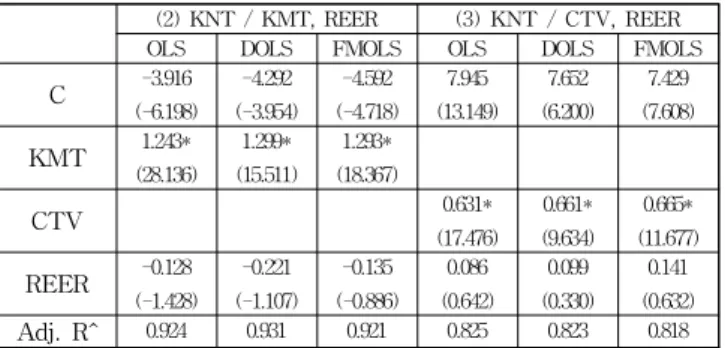
A 1% increase in the trade volume of China was found to increase the container transshipment volume about 0.6%. A result that was estimated by container throughput (TEU) to a variable, increase of port throughput at 1% was found to increase the container transshipment cargo volume by about 1.3%. However, changes in real effective exchange rate of Korean Won were found to not affect transshipment cargo volume.
(2) KNT / KMT, REER (3) KNT / CTV, REER
OLS DOLS FMOLS OLS DOLS FMOLS
C
-3.916
(-6.198) -4.292 (-3.954)
-4.592 (-4.718)
7.945 (13.149)
7.652 (6.200)
7.429 (7.608)
KMT(28.136) 1.243* (15.511) 1.299* (18.367) 1.293*
CTV
0.631*
(17.476) 0.661*
(9.634) 0.665*
(11.677)
REER(-1.428) -0.128 (-1.107) -0.221 (-0.886) -0.135 (0.642) 0.086 (0.330) 0.099 (0.632) 0.141
Adj. R^0.924 0.931 0.921 0.825 0.823 0.818
*,** p>0.05, p>0.1, ( ) is T-value
Table 3 Results of estimation port transshipment cargo volume of Korean port
(5) BNT / BMT, REER (6) BNT / CTV, REER
OLS DOLS FMOLS OLS DOLS FMOLS
C
(-6.980) -3.359 (-4.635) -3.379 (-5.575) -3.671 (13.140) 7.902 (6.400) 7.718 (7.757) 7.423
BMT(36.639) 1.239* (22.993) 1.265* (26.376) 1.261*
CTV
0.649*
(18.054) 0.687*
(10.253) 0.685*
(12.274)
REER(-2.348) -0.168* -0.244** (-1.744) (-1.559) -0.168 (0.395) 0.052 (0.094) 0.027 (0.431) 0.094
Adj. R^0.953 0.964 0.952 0.833 0.835 0.826
*,** p>0.05, p>0.1, ( ) is T-value
Table 4 Results of estimation port transshipment cargo volume of Busan port
On the other hand, the estimated results of the container transshipment cargo volume of Busan port (estimation equation 5 and 6) were found to not have a significant difference from the estimated results in the container transshipment cargo volume of Korean port. This is because the container transshipment cargo volume of Busan
port accounts for more than 80% of container transshipment cargo volume of Korean port.
4. Port Container Throughput Estimation by ARIMA Model
4.1 Data Description and Identification
The regression models of the estimated port throughput and port transshipment cargo volume, including the related-China variables, were estimated to be used after the 2008 financial crisis. In this analysis, simply using the time-series data, it was determined that the situation after the 2008 financial crisis had no effect. It also was too short a period for the ARIMA model to be used. We analyzed the time-series analysis by ARIMA model using monthly data of port throughput and port transshipment cargo volume of Korean port, and the port throughput and port transshipment cargo volume of Busan port.
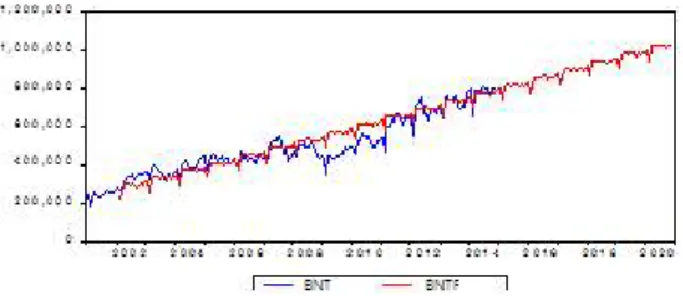
Before setting the model, we visually measured the trend and seasonality using the time series plot and autocorrelation functions. The result of the estimated autocorrelation function (ACF) showed a gradual decrease to "0" which is the result of estimated partial autocorrelation function (PACF). In addition, it had a strong seasonal pattern in a 12 months period. 2)
Moreover, stationarity of time-series needed to be estimated by mixing seasonal or periodic factors. Because monthly port throughput of Korea and Busan port had non-stationary 3) root units, there were autocorrelation and periodicity in the level dependent variable and the dependent variable of port throughput.
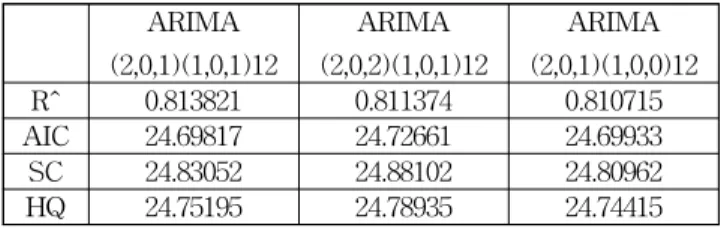
Therefore, to accurately predict by time series data from 2000 to 2014 and estimate the port throughput in consideration with seasonality or periodicity, it is necessary to predict future port throughput after finding the optimal model by estimating some of ARIMA model and application.
2) Box and Jenkins suggested that the maximum number of lag needed to use estimated autocorrelation coefficients is approximately a quarter of the observation period. So in this study, we analyzed autocorrelation function using 42 lags as 25%
of the 168 pieces of monthly data.
3) Looking at the results of the Augmented Dickey-Fuller (ADF) unit root test of monthly port throughput of Korea and Busan port, it was impossible to reject the null hypothesis at the 5% significance level about 4 variables.