Coexpression of Alginate Lyase with Hyperthermophilic Archaea Chaperonin in E. coli
Se Won Kim
1, Gun-Do Kim
2and Soo-Wan Nam
1,3*
1Department of Biomaterial Control, Dong-Eui University, Busan 614-714, Korea
2Department of Microbiology, College of Natural Sciences, Pukyong National University, Busan 608-737, Korea
3Department of Biotechnology and Bioengineering, College of Engineering, Dong-Eui University, Busan 614-714, Korea Received January 20, 2015 /Revised January 27, 2015 /Accepted January 29, 2015
When the alginate lyase gene (aly) from Pseudoalteromonas elyakovii IAM 14594 was expressed in E. coli, most of the gene product expressed was produced as aggregated insoluble particles known as in- clusion bodies. In order to produce with an elevated level of a soluble and active form of alginate lyase in E. coli, the hyperthermophilic chaperonins (ApCpnA and ApCpnB) from archaeon Aeropyrum pernix K1 were employed as the coexpression partners. At 25℃ culture temperature, the level of algi- nate lyase activity was increased from 10.1 unit/g-soluble protein in aly single expression to 83.1 unit/g-soluble protein by coexpressing with ApCpnA and to 100.3 unit/g-soluble protein by coex- pressing with ApCpnB. This results indicate that the coexpression of aly with ApCpnA and ApCpnB revealed a marked enhancement, about 8~10 fold, in the production of alginate lyase as a soluble and active form. Based on the results of various examinations on the expression variables, the optimal con- ditions for the maximal production of alginate lyase were determined as 1.0 mM IPTG for the inducer concentration, 25℃ for the culture temperature after IPTG induction, and ApCpnB for the coex- pression partner. The coexpression set in the present report may be useful in the industrial production of functionally or medically important recombinant proteins in E. coli.
Key words :
Aeropyrum pernix, alginate lyase, chaperonin, coexpression, E. coli
*Corresponding author
*Tel : +82-51-890-2276, Fax : +82-51-890-2632
*E-mail : [email protected]
This is an Open-Access article distributed under the terms of the Creative Commons Attribution Non-Commercial License (http://creativecommons.org/licenses/by-nc/3.0) which permits unrestricted non-commercial use, distribution, and reproduction in any medium, provided the original work is properly cited.
Journal of Life Science 2015 Vol. 25. No. 2. 130~135 DOI : http://dx.doi.org/10.5352/JLS.2015.25.2.130
Introduction
Brown seaweed contains up to 67% (w/w) carbohydrates including materials such as alginate, laminaran, mannitol, etc. The most abundant carbohydrate in the brown seaweed is alginate that constitutes 17-45% of total biomass [25].
Alginates are linear uronic acid polymers in which β- D-mannuronate and its C-5 epimer, α-L-guluronate residues are linked to form blocks of polyguluronate and random sequences. These residues are arranged in block structures which can be homopolymeric [poly (β-D-mannosyluronic acid) and poly (α-L-gulosyluronic acid)] or heteropolymeric, i.e. containing random blocks [6].
The proportion and arrangement of the block structures vary greatly in alginates from different sources and de- termine the physical properties of the polymer, particularly
the ability to form gels in the presence of divalent cations [6]. Marine alga alginate is used widely in the food, pharma- ceutical, textile, and oil industries due to its ability to chelate metal ions and form a highly viscous solution, recently, pol- ymers and oligosaccharides with novel physicochemical and physiological functions are sought by biopolymer-based in- dustries in order to expand the application areas of poly- saccharides [27]. Alginate degrading enzyme, alginate lyas- es, also known as alginases or alginate depolymerases, cata- lyze the degradation of alginate by a β-elimination mecha- nism that has yet to be fully elucidated. Alginate lyases are isolated from various sources, such as marine algae, marine mollusks, fungi, bacteria, and viruses. Many bacteria, such as Pseudoalteromonas elyakovii, Sphingomonas sp., Klebsiella pneumoniae, and Pseudomonas sp. have been found to produce a large amount of alginate lyases [2, 26]. Of these enzymes, unique substrate specificity has been discovered in an algi- nate lyase produced by P. elyakovii, which is capable of de- grading all block structures derived from sodium alginate and produces a series of tri- to octa-oligouronates [19, 20].
When the alginate lyase gene (aly) from P. elyakovii was ex-
pressed in E. coli, it yielded inactive aggregates known as
inclusion bodies [12, 21].
Various plasmid systems have been constructed for the coexpression of molecular chaperones and foldases from E.
coli, and it has been successfully demonstrated that their co- expression increases the formation of active proteins [8, 9, 13, 16-18, 21, 22]. However, there is relatively little in- formation on the comparative effects of coexpressing a series of folding accessory proteins on the productivity of active target proteins, even though such knowledge is important to elucidate the criteria for selecting appropriate folding ac- cessory proteins according to the properties of target proteins.
The role of the subunit heterogeneity or α- and β-subunit cooperativity in group II chaperonins has not been system- atically addressed [5, 7, 23]. One intriguing possibility is that the heterogeneity is directly linked to substrate specificity.
A number of biochemical studies using endogenous model substrates suggest that each subunit contributes to the recog- nition of specific motifs within the substrates [3, 11].
Especially, the substrate specificity of each subunit on the heterologous proteins in E. coli has not been elucidated in details.
To study the substrate specificity and to improve the pro- duction level of active alginate lyase enzyme in E. coli, α- subunit and/or β-subunit of hyperthermophilic group Ⅱ chaperonin from A. pernix K1 were employed to coexpress with alginate lyase (aly) from P. elyakovii. In this work, we have investigated and report on the effects of hyper- thermophilic chaperonin α- and/or β-subunits from A. per- nix K1 on the soluble and active production of alginate lyase in E. coli.
Materials and Methods
Bacterial strain and plasmids
E. coli Rosetta (DE 3) strain was used in all experiments.
Recombinant plasmids, pALP4, pET3d-ApCpnA, pET21a- ApCPnB, and pG-KJE6 were used in this work [11, 21]. The alginate lyase gene (aly, 1.19 kb) from P. elyakovii [19] was subcloned into the pET25-vector, resulting in the plasmid pALP4 (6.7 kb) [21]. The hyperthermophilic chaperonin A and B genes (ApCpnA and ApCpnB) from A. pernix K1 was subcloned into the pRSFDeut-1 vector (Invitrogen, USA), re- sulting in the plasmid ApCpnA (5.4 kb) and ApCpnB (5.4 kb), respectively. The plasmid pG-KJE6 encoding dnaK- dnaJ-grpE and GroES-GroEL of E. coli was also used as a coexpression partner for the active production of alginate lyase [21]. The plasmids, pALP4, ApCpnA, ApCpnB, and
pG-KJE8 were transformed into E. coli Rosetta (DE 3) by CaCl
2method, respectively or simultaneously [14]. The transformed E. coli cells were selected on LB agar plates con- taining 50 μg/ml ampicillin (selection for pALP4), 50 μg/ml kanamycin (selection for ApCpnA and ApCpnB), and 50 μ g/ml chloramphenicol (selection for pG-KJE6).
Culture media and culture condition
The transformed E. coli cells were grown and selected on LB agar plates containing 50 μg/ml ampicillin, 50 μg/ml ka- namycin, and 50 μg/ml chloramphenicol. Isopropyl-1-thio-β- D-galactopyranoside (IPTG) was used for the expression of aly, ApCpnA, and ApCpnB. To induce the expression of groEL/ES and dnaK/dnaK/grpE, tetracycline and L-arabinose were used, respectively. After all cells were preincubated in LB media supplemented with appropriate antibiotics at 37℃, when the cell density (OD
600) reached at 0.6~0.8, IPTG was added to LB medium at a concentration of 0~2 mM, followed by continuous incubation for 6 hr.
Measurement of cell growth and protein concentration Cell growth was estimated by optical density at 600 nm (OD
600) with a spectrophotometer (Shimadzu, Japan). Cells were disrupted by sonication (1 min, 70 Watt, and 7 sec cycle on ice) with a sonicator (Sonoplus HD2070, Bandelin, Germany), and then centrifuged at 9,800× g for 10 min for the separation into the soluble and insoluble fractions. The protein concentrations of total cell lysates and soluble and insoluble fractions were determined by the modified micro method of Lowry by using bovine serum albumin as a standard.
SDS-PAGE analysis
The soluble and insoluble fractions obtained from 10 μg cell lysate protein was analyzed by SDS-PAGE (14% gel).
The ApCpnA and ApCpnB proteins were detected by stain- ing gels with Coomassie brilliant blue RT250.
Assay of alginate lyase activity
The assay for alginate lyase activity was conducted as
follows. In each assay, reaction products were confirmed to
increase proportionally with time and enzyme concentration
in the reaction mixture. Alginate lyase assayed in a mixture
containing 0.2% sodium alginate (Sigma, USA) in 1 M Tris-
HCl (pH 7.5) and 0.3 M NaCl. The reaction was monitored
at 37℃ for 5 min, depending on the increase in absorbance
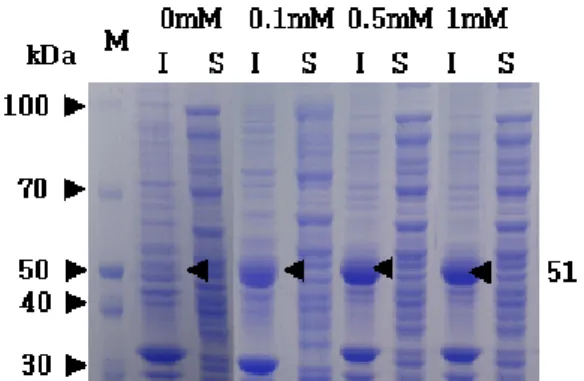
Fig. 1. Effect of IPTG concentration on the expression of alginate lyase (aly) in the recombinant E. coli Rosetta (DE 3) har- boring pALP4 plasmid. S, soluble fraction; I, insoluble fraction.
IPTG Concentration (mM)
0.0 0.5 1.0 1.5 2.0
Alginat lyase activity (unit/g-soluble protein)
0 1 2 3 4
pALP4 0mM pALP4 0.1mM pALP4 0.5mM pALP4 1.0mM pALP4 1.5mM pALP4 2.0mM
1.0
Fig. 2. Activity of alginate lyase in the cell lysate of E. coli Rosetta (DE 3) harboring pALP4 plasmid with the dif- ferent concentration of IPTG (0~2 mM) at 37℃.
at 235 nm in comparison with that without enzyme. One unit of alginate lyase was defined as the amount of enzyme required to increase the absorbance by 0.1 at 235 nm per min [21].
Results and Discussion
Expression of alginate lyase (aly) in E. coli To optimize the expression of alginate lyase (aly), the E.
coli transformant harboring pALP4 plasmid was cultivated on LB medium with various IPTG concentrations. As shown in Fig. 1, the 51 kDa protein band corresponding to the mo- lecular weight of alginate lyase was clearly detected in the insoluble fraction of cell lysate and had no differences in the protein intensity between IPTG concentrations. However, the activity of alginate lyase of the cell lysate was peaked
at 1 mM IPTG (Fig. 2). Since the most of alginate lyase was expressed as an insoluble body in the insoluble fraction [21], the enzyme activity in the cell lysate was very low at the level of 3.6 unit/g-soluble protein. The majority of alginate lyase activity was detected in the soluble fraction and is probably due to a high expression rate leading the protein to accumulate with an abnormal conformation [21].
Expression of hyperthermophilic archaea chaperonin in E. coli
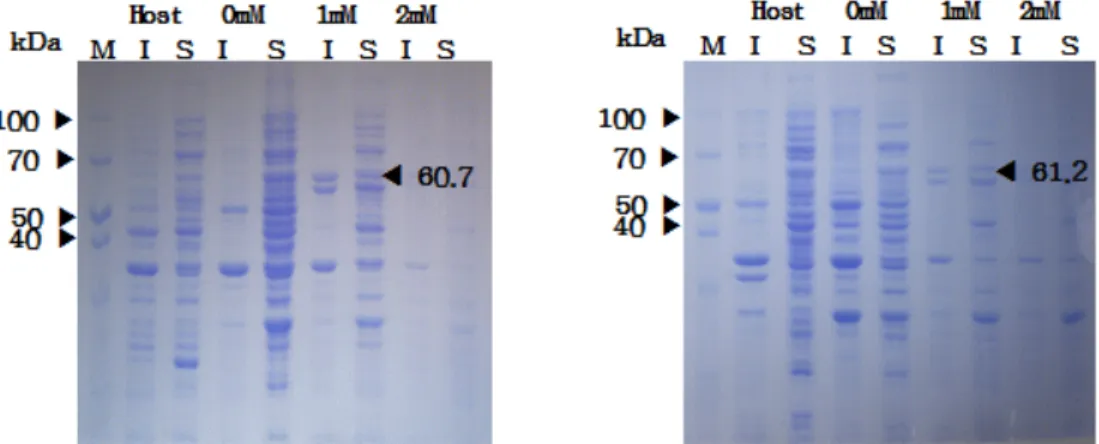
For the maximal expression of ApCpnA and ApCpnB, IPTG with different concentrations was added in the culture of E. coli cell harboring ApCpnA or ApCpnB plasmid. After IPTG induction for 6 hr, the proteins in the soluble and in- soluble fractions were analysed by SDS-PAGE. As shown in Fig. 3, the protein bands corresponding to ApCpnA (60.7 kDa) and ApCpnB (61.2 kDa) were found in the both soluble and insoluble fractions at 1 mM IPTG. After heat treated at 85℃ for 20 min of the soluble fractions, most of intra- cellular proteins of E. coli itself were removed as the precip- itates by centrifugation and the supernatant revealed the ho- mogeneous protein bands of thermophilic ApCpnA and ApCpnB (Fig. 4).
Effect of culture temperature and coexpression of APCpnA and ApCpnB on the soluble production of alginate lyase
In order to investigate the effects of culture temperature and coexpression system of archaea chaperonin on the syn- thesis and solubilization of alginate lyase, two transformants harboring plasmids of pALP4 and ApCpnA, and pALP4 and ApCpnnB were cultivated on LB media for 37℃, respectively.
When the cell concentration of OD
600reached at 0.8, 1 mM IPTG was added into the culture media and then the cells were incubated for more 6 hr at different temperatures (15~37℃). The highest activity of alginate lyase in both cases of aly single expression and coexpression with archaea chap- eronins was detected at 25℃ (Fig. 5). At 25℃, the level of alginate lyase activity was increased from 10.1 unit/g-solu- ble protein in aly single expression to 83.1 unit/g-soluble protein by coexpressing with ApCpnA and to 100.3 unit/
g-soluble protein by coexpressing with ApCpnB.
Therefore, it can suggested that the optimal culture tem-
perature for the soluble and active production of alginate
lyase with or without chaperonin is 25℃ and ApCpnB is
the preferable coexpression partner than ApCpnA. Due to
Fig. 3. Effect of IPTG concentration on the expression of ApCpnA (left) and ApCpnB (right) in the recombinant E. coli Rosetta (DE 3) harboring ApCpnA or ApCpnB plasmids.
Fig. 4. Homogeneity of ApCpnA and ApCpnB after 85℃ for 20 min heat-shock treatment.
Fig. 5. Effect of coexpression of ApCpnA and ApCpnB on the alginate lyase production in the recombinant E. coli Rosetta/ pALP4+ApCpnA and E. coli Rosetta/pALP4+
ApCpnB at different culture temperatures.
the decreased or retarded rate of protein synthesis, low cul- ture temperature below 37℃ has been reported as one of prerequisite parameters for the overexpression of various heterologous genes in E. coli [24, 28]. The reason of ApCpnB as the optimal coexpression partner than ApCpnA for the overproduction of alginate lyase is not clear at present, but the specificity or affinity toward unfold misfolded substrate, i.e., alginate lyase, of ApCpnB seems to be greater than that of ApCpnA [1, 7].
Comparison with archaea chaperonin and E. coli molecular chaperones
To compare the coexpression effect on the production of active alginate lyase, molecular chaperones such as GroEL/
GroES and DnaK/DnaJ/GrpE of E. coli itself, and archaea chaperonins (ApCpnA and ApCpnB) were employed as co- expression partners of aly, in which IPTG concentration were 20 μM and I mM. As shown in Fig. 6, 1 mM IPTG for all expression systems resulted in higher expression of aly over 20 μM. In our previous report [20], the activity of alginate
lyase in E. coli by coexpressing GroEL/GroES and DnaK/
DnaJ/GrpE was about 20.0 unit/g-soluble protein at 20 μM IPTG. In addition, the coexpression system of archaea chap- eronin gave greater benefit on the expression of aly than E.
coli molecular chaperones.
Recently, it was reported that the promotion of proteol- ysis of target proteins was observed in DnaK and GroEL sets as folding assistant partner, resulting in the reduced yield or decreased expression level of foreign polypeptides [4, 15]. In our archaea chaperonin system, this proteolysis on alginate lyase produced is likely less profound than GroEL/GroES and DnaK/DnaJ/GrpE sets.
In conclusion, the coexpression system employing archaea
chaperonins rather than E. coli itself molecular chaperones
(GroEL/GroES and DnaK/DnaJ/GrpE sets) could effectively
Fig. 6. Comparison of coexpression effect of E. coli molecular chaperones and archaea chaperonins on the expression level of alginate lyase in E. coli at 37℃.
improve the production of active and soluble alginate lyase.
The optimal combination for the maximal production of algi- nate lyase was determined as 1.0 mM IPTG, 25℃ for the culture temperature after IPTG induction, and ApCpnB co- expression partner. The coexpression system in the present report may be useful in the industrial production of func- tionally or medically important recombinant proteins in E.
coli.
Acknowledgement
This work was supported by Dong-Eui University Grant (2013).
References
1. Bigotti, M. G. and Clarke, A. R. 2005. Cooperativity in the thermosome. J. Mol. Biol. 348, 13-26.
2. Chavagnat, F., Duez, C., Guinand, M., Potin, P., Barbeyron, T., Henrissat, B., Wallach, J. and Ghuysen, J. M. 1996.
Cloning, sequencing and overexpression in Escherichia coli of the alginate lyase-encoding aly gene of Pseudomonas algi- novora : identification of three classes of alginate lyases.
Biochem. J. 319, 575-583
3. Frydman, J. 2001. Folding of newly translated proteins in vivo: the role of molecular chaperones. Annu. Rev. Biochem.
70, 603-647.
4. García-Fruitós, E., Martínez-Alonso, M., Gonzalez-Montalban, N., Valli, M., Mattanovich, D. and Villaverde, A. 2007.
Divergent genetic control of protein solubility and con- formational quality in Escherichia coli. J. Mol. Biol. 374, 195-205.
5. Gutsche, I., Essen, L. O. and Baumeister, W. 1999. Group
II chaperonins: new TRiC (k)s and turns of a protein folding machine. J. Mol. Biol. 293, 295-312.
6. Haug, A., Larsen, B. and Baardseth, E. 1969. Comparison of the constitution of alginates from different sources. Proc.
Int. Seaweed Symp. 6, 443-451.
7. Kim, J. H., Lee, J. W., Shin, E. J. and Nam, S. W. 2011.
Cooperativity of α- and β-subunits of group ІІ chaperonin from the hyperthermophilic archaeum Aeropyrum pernix K1.
J. Microbiol. Biotechnol. 21, 212-217.
8. Kohda, J., Endo, Y., Okumura, N., Kurokawa, Y., Nishihara, K., Yanagi, H., Yura, T., Fukuda, H. and Kondo, A. 2002.
Improvement of productivity of active form of glutamate racemase in Escherichia coli by coexpression of folding ac- cessory proteins. J. Biochem. Eng. 10, 39-45.
9. Kurokawa, Y., Yanagi, H. and Yura, T. 2000. Overexpression of protein disulfide isomerase DsbC stabilizes multi- ple-disulfide-bonded recombinant protein produced and transported to the periplasm in Escherichia coli. Appl.
Environ. Microbiol. 66, 3960-3965.
11. Lee, J. W., Kim, S. W., Kim, J. H., Jeon, S. J., Kwon, H. J., Kim, B. W. and Nam, S. W. 2013. Functional characterization of the α- and β-subunits of a group II chaperonin from Aeropyrum pernix K1. J. Microbiol. Biotechnol. 23, 818-825.
12. Ma, L. Y., Chi, Z. M., Li, J. and Wu, L. F. 2008. Overexpress- ion of alginate lyase of Pseudoalteromonas elyakovii in Escherichia coli, purification, and characterization of the re- combinant alginate lyase. World J. Microbiol. Biotechnol. 24, 89-96.
13. Makino, T., Skretas, G. and Georgiou, G. 2011. Strain en- gineering for improved expression of recombinant proteins in bacteria. Microb. Cell Fact. 10, 32-41.
14. Mandel, M. and Higa, A. 1970. Calcium-dependent bacter- iophage DNA infection. J. Mol. Biol. 53, 159-162.
15. Martínez-Alonso, M., García-Fruitós, E., Ferrer-Miralles, N., Rinas, U. and Villaverde, A. 2010. Side effects of chaperone gene co-expression in recombinant protein production.
Microb. Cell Fact. 9, 64-69.
16. Nishihara, K., Kanemori, M., Yanagi, H. and Yura, T. 2000.
Overexpression of trigger factor prevents aggregation of re- combinant proteins in Escherichia coli. Appl. Environ.
Microbiol. 66, 884-889.
17. Priya, S., Sharma, S. K. and Goloubinoff, P. 2013. Molecular chaperones as enzymes that catalytically unfold misfolded polypeptides. FEBS Lett. 587, 1981-1987.
18. Qiu, J., Swartz, J. R. and Georgiou, G. 1998. Expression of active human tissue-type plasminogen activator in Escherichia coli. Appl. Environ. Microbiol. 64, 4891-4896.
19. Sawabe, T., Takahashi, H., Ezura, Y. and Gacesa, P. 2001.
Cloning, sequence analysis and expression of Pseudoalter- omonas elyakovii IAM 14594 gene (alyPEEC) encoding the ex- tracellular alginate lyase. Carbohydr. Res. 335, 11-21.
20. Sawabe, T., Takahasi, H., Saeki, H., Niwa, K. and Aono, H. 2007. Enhanced expression of active recombinant alginate lyase AlyPEEC cloned from a marine bacterium Pseudoalter- omonas elyakovii in Escherichia coli by calcium compounds.
Enzyme Microb. Technol. 40, 285-291.
초록:대장균에서 초고온성 샤페로닌과 alginate lyase의 공발현
김세원
1․김군도
2․남수완
1,3*
(1동의대학교 물질제어학과, 2부경대학교 미생물학과, 3동의대학교 생명공학과)
Pseudoalteromonas elyakovii 유래 alginate lyase 유전자(aly)를 대장균에서 발현시켰을 때, 발현된 대부분의 유전 자 산물은 내포체라는 불용성 응집체 형태로 생산되었다. Alginate lyase를 가용성 및 활성형으로 생산하기 위해 Aeropyrum pernix K1 유래의 초고온성 샤페로닌 ApCpnA와 ApCpnB를 공발현 파트너로 도입하였다. aly와 ApCpnA와 ApCpnB 각각과의 공발현 결과, aly 단독발현 때의 alginate lyase 활성 10.1 unit/g-soluble protein에 서 ApCpnA와의 공발현 때는 83.1 unit/g-soluble protein, ApCpnB와의 공발현 때는 100.3 unit/g-soluble protein 으로 가용성 및 활성형으로의 alginate lyase 생산이 8~10배 크게 향상되었다. 다양한 배양 조건들의 조사를 통해 alginate lyase 최대 생산을 위한 조건은 다음과 같았다: 1.0 mM IPTG, 25℃ 배양 온도(IPTG 유도 후), ApCpnB 공발현 파트너. 이러한 공발현 시스템은 대장균에서 기능적으로 또한 의학적으로 중요한 재조합 단백질의 산업적 생산에 크게 유용하게 사용될 것이다.
21. Shin, E. J., Park, S. L., Jeon, S. J., Lee, J. W., Kim, Y. T., Kim, Y. H. and Nam, S. W. 2006. Effect of molecular chaper- ones on the soluble expression of alginate lyase in E. coli.
Biotechnol. Bioprocess Eng. 11, 414-419.
22. Shuo-shuo, C., Xue-zheng, L. and Ji-hong, S. 2011. Effects of co-expression of molecular chaperones on heterologous soluble expression of the cold-active lipase Lip-948. Protein Expr. Purif. 77, 166-172.
23. Son, H. J., Shin, E. J., Nam, S. W., Kim, D. E. and Jeon, S. J. 2007. Properties of the alpha subunit of a chaperonin from the hyperthermophilic Crenarchaeon Aeropyrum pernix K1. FEMS Microbiol. Lett. 266, 103-109.
24. Vuillemin, M., Malbert, Y., Laguerre, S., Remaud-Siméon, M. and Moulis, C. 2014. Optimizing the production of an α-(1→2) branching sucrase in Escherichia coli using statistical design. Appl. Microbiol. Biotechnol. 98, 5173-6184.
25. Wang, J., Jin, W., Hou Y., Niu, X., Zhang, H. and Zhang,
Q. 2013. Chemical composition and moisture-absorption/re- tention ability of polysaccharides extracted from five algae.
Int. J. Biol. Macromol. 57, 26-29.
26. Wong, T. Y., Preston. L. A. and Schiller, N. L. 2000. Alginate lyase: Review of major sources and enzyme characteristics, structure-function analysis, biological roles, and applica- tions. Ann. Rev. Microbiol. 54, 289-340.
27. Yoon, H. J., Hashimoto, W., Miyake, O., Okamoto, M., Mikami, B. and Murata, K., 2000. Overexpression in Escher- ichia coli, purification, and characterization of Sphingomonas sp. A1 alginate lyases. Protein Expr. Purif. 19, 84-90.
28. Zhao, H. L., Yang, J., Chen, X. L., Su, H. N., Zhang, X. Y., Huang, F., Zhou, B. C. and Xie, B. B. 2014. Optimization of fermentation conditions for the production of the M23 protease Pseudoalterin by deep-sea Pseudoalteromonas sp.
CF6-2 with artery powder as an inducer. Molecules 19, 4779-4790.