ARTICLE
Clinical Study
Phase III study of cisplatin with or without S-1 in patients with stage IVB, recurrent, or persistent cervical cancer
Yoichi Aoki
1, Kazunori Ochiai
2, Soyi Lim
3, Daisuke Aoki
4, Shoji Kamiura
5, Hao Lin
6, Noriyuki Katsumata
7,21, Soon-Do Cha
8, Jae-Hoon Kim
9, Byoung-Gie Kim
10, Yasuyuki Hirashima
11, Keiichi Fujiwara
12, Young-Tak Kim
13, Seok Mo Kim
14, Hyun Hoon Chung
15, Ting-Chang Chang
16, Toshiharu Kamura
17, Ken Takizawa
18, Masahiro Takeuchi
19and Soon-Beom Kang
20BACKGROUND: This open-label phase III trial evaluated efficacy and safety of S-1 plus cisplatin vs. cisplatin alone as first-line chemotherapy in patients with stage IVB, recurrent, or persistent cervical cancer.
METHODS: Patients were randomised (1:1) to S-1 plus cisplatin (study group) or cisplatin alone (control group). In each cycle, cisplatin 50 mg/m
2was administered on Day 1 in both groups. S-1 was administered orally at 80 –120 mg daily on Days 1–14 of a 21-day cycle in the study group. The primary endpoint was overall survival (OS).
RESULTS: A total of 375 patients were enrolled, of whom 364 (188, study group; 176, control group) received treatment. Median OS was 21.9 and 19.5 months in the study and control groups, respectively (log-rank P = 0.125; hazard ratio [HR] 0.84, 95% confidence interval [CI] 0.67–1.05). Median progression-free survival (PFS) was 7.3 and 4.9 months in the study and control groups, respectively (HR 0.62, 95% CI 0.48 –0.80, P < 0.001). The adverse event (AE) rate increased in the study group despite the absence of any unexpected AEs.
CONCLUSIONS: S-1 plus cisplatin did not show superiority over cisplatin alone in OS but signi ficantly increased PFS in patients with stage IVB, recurrent, or persistent cervical cancer. Since the standard therapy has changed in the course of this study, further studies are warranted to con firm the clinical positioning of S-1 combined with cisplatin for this population.
British Journal of Cancer (2018) 119:530–537; https://doi.org/10.1038/s41416-018-0206-7
INTRODUCTION
Cancer of the uterine cervix is one of the most common cancers among women worldwide and is particularly prevalent in developing nations.
1Platinum-based combination chemotherapy has been the standard first-line chemotherapy for recurrent or advanced cervical cancer.
2Currently, paclitaxel and cisplatin combined with bevacizumab is considered the preferred first-
line regimen in metastatic or recurrent cervical cancer.
3However, first-line chemotherapy options for stage IVB, recurrent, or persistent cervical cancers are limited; there are still unmet medical needs for new agents with favourable bene fit-risk profiles that maintain quality of life.
In a previous study, Katsumata et al.
4reported promising results for S-1, an oral fluoropyrimidine-based anticancer agent, as a
Received: 26 December 2017 Revised: 18 June 2018 Accepted: 10 July 2018 Published online: 3 August 2018
1Department of Obstetrics and Gynecology, Graduate School of Medical Science, University of the Ryukyus, 207 Uehara Nishihara-cho, Nakagami-gun, Okinawa 903-0215, Japan;
2Department of Obstetrics and Gynecology, The Jikei University School of Medicine, 3-19-18, Nishishimbashi, Minato-ku, Tokyo 105-8471, Japan;3Department of Obstetrics and Gynecology, Gachon University Gil Medical Center, 1198 Guwol-dong, Namdong-gu, Incheon 405-760, Korea;4Department of Obstetrics and Gynecology, Keio University School of Medicine, 35 Shinanomachi, Shinjyuku-ku, Tokyo 160-8582, Japan;5Department of Gynecology, Osaka International Cancer Institute, 3-1-69, Otemae, Chuo-ku, Osaka, Osaka 541-8567, Japan;6Department of Obstetrics and Gynecology, Kaohsiung Chang Gung Memorial Hospital and Chang Gung University College of Medicine, No. 123, Ta-Pei Road, Niao-Sung District, Kaohsiung 83301, Taiwan;7Department of Breast and Medical Oncology, National Cancer Center Hospital, 5-1-1, Tsukiji, Chuo-ku, Tokyo 104-0045, Japan;
8Department of Obstetrics and Gynecology, Keimyung University School of Medicine, 194 Dong San Dong, Daegu 700-712, Korea;9Department of Obstetrics and Gynecology, Yonsei University College of Medicine, 50-1 Yonsei-ro, Seodaemun-gu, Seoul 03722, Korea;10Department of Obstetrics and Gynecology, Samsung Medical Center, Sungkyunkwan University School of Medicine, 50 Ilwon-Dong, Gangnam-gu, Seoul 135-710, Korea;11Department of Gynecology, Shizuoka Cancer Center, 1007 Shimonagakubo, Nagaizumi-cho, Sunto-gun, Shizuoka 411-8777, Japan;12Department of Gynecologic Oncology, Saitama Medical University International Medical Center, 1397-1, Yamane, Hidaka, Saitama 350- 1298, Japan;13Department of Obstetrics and Gynecology, Asan Medical Center, 388-1 Pungnap-2dong, Songpa-gu, Seoul 138-736, Korea;14Department of Obstetrics and Gynecology, Chonnam National University Hwasun Hospital, 160 Ilsimri Hwasun-eup, Hwasun, Jeonnam 519-809, Korea;15Department of Obstetrics and Gynecology, Seoul National University College of Medicine, 50 Ilwon-Dong, Gangnam-gu, Seoul 135-710, Korea;16Department of Obstetrics and Gynecology, Linkou Chang Gung Memorial Hospital and Chang Gung University Medical College, No.5, Fu-Shin Street, Kueishan County, Taoyuan 33305, Taiwan;17Department of Obstetrics and Gynecology, Kurume University School of Medicine, Asahi-machi 67, Kurume, Fukuoka 830-0011, Japan;18Department of Gynecology, Cancer Institute Hospital of the Japanese Foundation for Cancer Research, 3-10-6, Ariake, Koto-ku, Tokyo 135-8550, Japan;19Department of Clinical Medicine (Biostatistics), Kitasato University School of Pharmacy, Shirokane 5-9-1, Minato-ku, Tokyo 108- 8641, Japan and20Department of Obstetrics and Gynecology, Konkuk University School of Medicine, 120-1 Neungdong-ro, Gwangjin-gu, Seoul 05080, Korea
Correspondence: Kazunori Ochiai ([email protected])
21Present address: Department of Medical Oncology, Nippon Medical School Musashikosugi Hospital, 1-396, Kosugi-cho, Nakahara-ku, Kawasaki-shi, Kanagawa 211-8533, Japan Past presentation: An abstract titled‘A randomised phase III trial of cisplatin with or without S-1 in patients with FIGO IVB, recurrent, or persistent cervical cancer: an Asian study’
including some data from this manuscript was presented at ASCO 2017, Abstract No: 5527; Poster Session, Gynecologic Cancer, 03 June 2017.
© The Author(s) 2018 Published by Springer Nature on behalf of Cancer Research UK
single agent, with an overall response rate (ORR) of 30.6% and median time to progression of 5.2 months in patients with advanced or recurrent cervical cancer. Furthermore, S-1 plus cisplatin has shown ef ficacy with acceptable toxicity for the treatment of gastric and lung cancer.
5,6Given that platinum-based combinations have been widely used for patients with advanced cervical cancer, adding S-1 to cisplatin was expected to be an effective treatment option.
We therefore compared the ef ficacy and safety of S-1 plus cisplatin with cisplatin alone as first-line chemotherapy in patients with stage IVB, recurrent, or persistent cervical cancer.
MATERIALS AND METHODS Study design
This open-label, multicentre, parallel-group, randomised, phase III study, conducted at 69 institutions in Japan, Korea, and Taiwan, was designed to compare the ef ficacy and safety of S-1 plus cisplatin (study group) with cisplatin alone (control group) in patients with stage IVB, recurrent, or persistent cervical cancer (Supplementary Table S1). At the time this study was planned, cisplatin alone was one of the effective treatments available for this patient population.
7In the past, a number of cisplatin-based chemotherapies have been evaluated over cisplatin alone with respect to overall survival (OS). Although only topotecan plus cisplatin showed a survival advantage over cisplatin alone in the GOG179 trial,
8the use of this regimen has not become widespread because of its greater toxicity as compared to other available regimens. So far, only one study suggests a survival benefit for topotecan. The GOG204 trial, which compared different cisplatin doublets (paclitaxel, vinorelbine, gemcitabine, or topotecan), was terminated early after an interim analysis showed no improvement in OS with any regimen, compared to paclitaxel plus cisplatin.
9Because paclitaxel plus cisplatin was considered the most preferable treatment in terms of OS, progression-free survival (PFS), and ORR in the GOG204 trial, this combination became widely used. Paclitaxel plus carboplatin has also demonstrated noninferiority to paclitaxel plus cisplatin (JCOG0505 trial).
10Based on these results, paclitaxel plus platinum-based drug became frequently used; however, paclitaxel plus cisplatin failed to show super- iority in OS compared with cisplatin alone in the GOG169 trial.
11Therefore, we considered cisplatin 50 mg/m
2to be the most reasonable candidate for the control arm of this study.
Patients were randomly assigned (1:1) to the study group or the control group using an interactive web response system.
Randomisation was strati fied using a minimisation assignment based on the presence/absence of disease in a previously irradiated field, previous use of platinum-based therapy, and institution. After the investigators enrolled patients, the randomisation sequence was generated by The Kitasato Institute Clinical Trial Coordinating Center (Tokyo, Japan), independent of the study sponsor. The protocol summary is available in Supplementary Material S1. The trial was registered at ClinicalTrials.gov (NCT00770874).
Patients
Brie fly, patients had to be ≥20 years of age with histologically proven International Federation of Gynecology and Obstetrics (FIGO) stage IVB, recurrent, or persistent cervical carcinoma, with no chemotherapy or chemoradiotherapy after diagnosis of their disease. Patients were required to have adequate organ function and Eastern Cooperative Oncology Group (ECOG) performance status (PS) score of 0 –1. Main exclusion criteria were known hypersensitivity to 5- fluorouracil or cisplatin, previous treatment with S-1, or disease progression during platinum-based che- motherapy or chemoradiotherapy.
Treatment
Each treatment cycle lasted for 3 weeks, and cycles were repeated until the patient met one of the discontinuation criteria: either disease progression or unacceptable toxicity. In the study group, S-1 was administered orally twice daily from Day 1 to Day 14, followed by a 1-week rest. The initial dose of S-1 was determined according to the patient ’s body surface area at the time of registration: <1.25 m
2, 80 mg/day; ≥1.25 to <1.5 m
2, 100 mg/day;
and ≥1.5 m
2, 120 mg/day. Cisplatin 50 mg/m
2was administered intravenously on Day 1 with adequate hydration. Patients in the control group received the same regimen without S-1. Detailed criteria for suspension, resumption, initiation of subsequent cycle, and dose modification of the study treatment are defined in the study protocol (Supplementary Material S2). Prophylactic use of granulocyte colony-stimulating factor was not permitted, and crossover treatment with S-1 was prohibited in the control group.
If a patient developed drug-related adverse events (AEs) with either study drug, the treatment was discontinued but the patient was allowed to continue treatment with another drug.
Study endpoints
The primary endpoint was OS, and the secondary endpoints were PFS, ORR, and safety. OS was de fined as the period from the date of randomisation to death. PFS was de fined as the period from the date of randomisation to disease progression or death. Survival information was obtained every 3 months after the end of treatment. Tumour imaging was performed at baseline and after every two cycles. Tumours were assessed by the investigator according to the Response Evaluation Criteria in Solid Tumors, version 1.0.
12AEs and laboratory values were graded according to the Common Terminology Criteria for Adverse Events, version 3.0.
Statistical analyses
Sample size was calculated based on the survival endpoint reported in previous trials, with an expected median survival time (MST) in the control group of 9 months.
7An improvement in MST of at least 39% from 9 months in the control group to 12.5 months in the study group, yielding a decreased hazard ratio (HR) of 0.72 (below the point estimate for topotecan plus cisplatin, GOG179 trial), was considered clinically relevant in this population. A total of 296 events (deaths) were required for a power of 80% at a two- sided alpha 5% to detect a difference in OS using an unstrati fied log-rank test. Based on a planned accrual of 24 months, a minimum follow-up of 18 months and an approximate rate of 5%
loss to follow-up, a total of 360 patients (180 per group) were estimated to achieve the speci fied number of events in the scheduled follow-up.
The efficacy endpoints of OS and PFS were assessed in the full analysis set (FAS), which comprised all patients who received the study drugs in each assigned treatment group at randomisation, even if they received a treatment different from the assigned treatment. Safety was assessed in the as-treated population (ATP), which comprised all patients who initiated treatment in both treatment groups according to the actual treatment received by the patients. ORR was evaluated in the ORR-evaluable population, which included patients in the ATP with measurable disease (at least one target lesion) at baseline.
The superiority of the study group over the control group for the primary OS analysis was tested using an unstrati fied log-rank test. OS in each group was summarised using Kaplan –Meier curves, and was further characterised for MST and survival probability at 12 months, with the corresponding 95% con fidence intervals (CIs). In addition, HRs were estimated using the Cox proportional hazards model with only treatment as a factor. PFS was analysed in the same way as OS. ORR was compared between the two groups using Fisher’s exact test. Estimates for each group and differences were presented with associated 95% CIs.
531
1234567890();,:
The final statistical analysis was originally planned for 18 months after the last patient randomisation or when 296 events had occurred, whichever came later. Statistical analyses were per- formed with SAS software, version 9.2. All reported P values were two sided, and P values < 0.05 were considered statistically signi ficant.
RESULTS
Patient characteristics
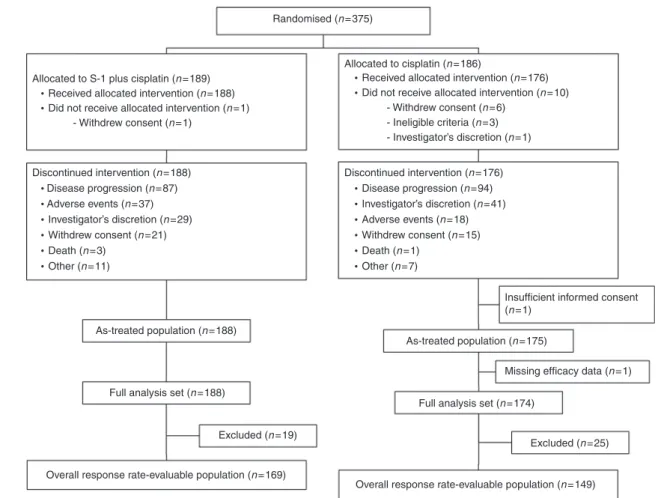
A total of 375 patients were enrolled between September 2008 and April 2011 and randomised to the study group (189) or the control group (186); of these, 364 (188 in the study group; 176 in the control group) received study treatment (Fig. 1).
The baseline characteristics of the patients were well balanced between the two groups (Table 1). The majority of patients had recurrent disease (74.5% in the study group; 74.1% in the control group [hereinafter in this order]), a history of platinum-based therapy (64.4%; 63.8%), presence of disease in previously irradiated field (51.6%; 52.3%), and PS 0 (75.0%; 78.2%).
Treatment
All patients discontinued the study treatment. The main reason for discontinuation was disease progression (Fig. 1).
In the ATP, the median number of cycles was 6 (range, 1 –57) in the study group and 5 (range, 1 –16) in the control group. The total dose of cisplatin was 255.0 mg/m
2in the study group and 250.0 mg/m
2in the control group.
Post-treatment therapy
In the study group, 69.1% of patients received post-treatment therapy, compared with 78.7% in the control group
(Supplementary Table S2). The most common first post- treatment therapy was chemotherapy (52.1% and 61.5% in the study and control groups, respectively), of which platinum-based therapy was administered to 34.0% and 44.8% of patients, respectively.
Ef ficacy
Although the timing for the statistical analysis had been previously established, the number of events was unlikely to reach 296 in the FAS, even after 4 years of follow-up. Therefore, we conducted the final statistical analysis at the cutoff date of 30 November 2015. A total of 294 death events (148, study group;
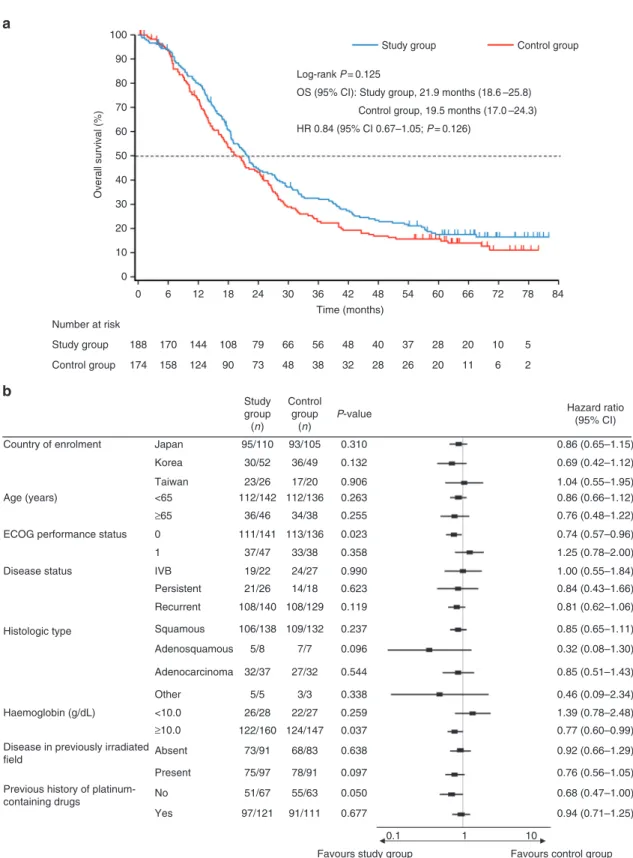
146, control group) occurred in the FAS by the cutoff date. MST (95% CI) was 21.9 months (18.6–25.8) in the study group and 19.5 months (17.0–24.3) in the control group. There was no statistically signi ficant difference in the OS between the two groups (log-rank P = 0.125, HR 0.84, 95% CI 0.67–1.05) (Fig. 2a); the 1-, 3-, and 5-year survival rates (study group vs control group) were 79.7% vs 73.6%, 32.0% vs 22.9%, and 17.5% vs 15.7%, respectively. A prespeci fied forest plot of HR for OS showed the favourable impact of PS 0 (HR 0.74, 95% CI 0.57 –0.96, P = 0.023) and of haemoglobin ≥10.0 g/dL (HR 0.77, 95% CI 0.60–0.99, P = 0.037) on OS in the study group compared with the control group (Fig. 2b).
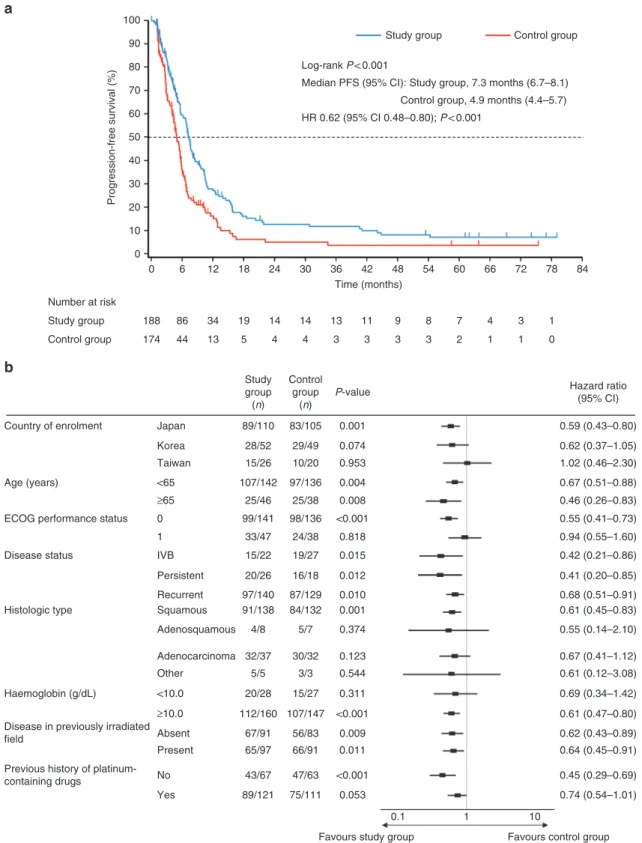
Median PFS was longer in the study group (7.3 months, 95% CI 6.7 –8.1) compared with the control group, with a statistically signi ficant difference (4.9 months, 95% CI 4.4–5.7) (log-rank P <
0.001, HR 0.62, 95% CI 0.48 –0.80) (Fig. 3a). The forest plot of HR for PFS is shown in Fig. 3b.
ORR and disease control rate are shown in Table 2. ORR was significantly higher (P < 0.001) in the study group (43.8%, 95% CI 36.2–51.6) than in the control group (20.1%, 95% CI 14.0–27.5).
Allocated to S-1 plus cisplatin (n =189)
Discontinued intervention (n =188) Disease progression (n =87) Adverse events (n =37)
Investigator’s discretion (n =29) Withdrew consent (n =21) Death (n =3)
Other (n =11)
Discontinued intervention (n =176) Disease progression (n =94)
Adverse events (n =18) Investigator’s discretion (n =41)
Withdrew consent (n =15)
Insufficient informed consent (n =1)
Missing efficacy data (n =1)
Excluded (n =25) Excluded (n =19)
Full analysis set (n =174) Full analysis set (n =188)
As-treated population (n =188)
Overall response rate-evaluable population (n =149) Overall response rate-evaluable population (n =169)
As-treated population (n =175) Death (n =1)
Other (n =7) Received allocated intervention (n =188)
Did not receive allocated intervention (n =1) - Withdrew consent (n =1)
Allocated to cisplatin (n =186) Randomised (n =375)
Received allocated intervention (n =176) Did not receive allocated intervention (n =10)
- Withdrew consent (n =6) - Ineligible criteria (n =3) - Investigator’s discretion (n =1)
Fig. 1 CONSORT diagram
532
Safety
AEs were observed in 188/188 (100%) patients in the study group and 172/175 (98.3%) patients in the control group. The AE rate in the study group was higher than in the control group. The most frequent grade 3 or higher AEs (occurring in ≥10% of patients in either group) for the study group vs the control group were neutropaenia (52.7% vs 6.3%), anaemia (34.6% vs 17.1%), leucopaenia (32.4% vs 4.0%), anorexia (12.8% vs 2.9%), diarrhoea (11.2% vs 4.0%), hypokalaemia (11.2% vs 1.1%), and fatigue (10.6%
vs 1.7%) (Table 3). The incidence of febrile neutropaenia was 2.7 and 0% of patients in the study and control groups; 1.6 and 2.8%
of patients in the study and control groups had genitourinary or anal fistulas; and 8.0 and 1.1% of patients in the study and control groups had alopecia, respectively. Discontinuation of the study treatment due to AEs occurred in 13.3% and 7.4% of patients in the study and control groups, respectively. The most common
toxic effect leading to study discontinuation was gastrointestinal toxicity in the study group and hypersensitivity in the control group.
Overall, 72 of 188 patients (38.3%) in the study group and 34 of 175 (19.4%) patients in the control group had serious AEs (SAEs).
Fatal SAEs occurred in seven patients in the study group, of which myocardial ischaemia in one patient and disseminated intravas- cular coagulation and intra-abdominal haemorrhage in another patient were related to the study drugs. Three fatal SAEs were reported in the control group, but none of them were related to the study drug. No unexpected AEs were identi fied in either group.
DISCUSSION
In this study in patients with stage IVB, recurrent, or persistent cervical cancer, S-1 plus cisplatin did not improve OS over cisplatin alone. However, adding S-1 to cisplatin signi ficantly prolonged OS in patients with better physical condition (PS 0 or haemoglobin ≥ 10.0 g/dL). Moreover, S-1 in combination with cisplatin signi fi- cantly improved PFS and ORR over cisplatin alone.
There are several reasons for the lack of a signi ficant OS bene fit despite improvements in PFS and ORR. First, although the PS criteria were different (ECOG PS in our study and JCOG0505 study vs Gynecologic Oncology Group [GOG] PS in the GOG204 and GOG240), the proportion of patients with PS 0 in the cisplatin-alone group in our study was higher than that in the GOG169 and GOG179 studies with the same treatment.
8,11On the other hand, the proportion of patients with PS 0 in the S- 1 plus cisplatin group was higher than that in the GOG204 and GOG240 studies, but similar to the JCOG0505 study.
9,10,13Since PS is one of the prognostic factors for cervical cancer,
14this might be one of the reasons for the prolonged OS observed in our study. Second, post-treatment therapy including subsequent salvage chemotherapy was used in this study. Over half of the patients in both groups received post-treatment therapy. The effect of greater use of post-treatment therapy on prolonged OS was also speculated in the JCOG0505 trial;
10in fact, chemother- apy was used most frequently as post-treatment therapy. As a result, median survival may have been prolonged. Third, survival post-progression (SPP) in the S-1 plus cisplatin group was 14.6 months in this study. Broglio et al.
15have reported that even if PFS is prolonged, OS may not show a bene fit, especially for diseases with long median SPP. We thus re-calculated the statistical power of this study based on the observed OS and found the power to be 18.4%.
Notably, S-1 plus cisplatin signi ficantly prolonged PFS to 7.3 months. Furthermore, other phase III studies have reported median PFS of 3.98 to 6.9 months with cisplatin-based doublet combinations and 8.2 months with paclitaxel and cisplatin combined with bevacizumab.
9,10,13Although the patients’ quality of life data are lacking in this study, S-1 plus cisplatin demonstrated a similar response in terms of PFS to these combination therapies. ORR was also signi ficantly improved with S-1 in combination with cisplatin. Response rates of 27 –48% have been obtained with cisplatin-based doublet combinations or paclitaxel and cisplatin combined with bevacizumab.
8,11,13Remarkably, a complete response rate of 12.4% has been obtained with S-1 plus cisplatin and was comparable to cisplatin plus paclitaxel plus bevacizumab.
Advanced cervical cancer is known to predispose patients to fistulas. Fistulas occurred in 1.6 and 6% of patients with S-1 plus cisplatin and bevacizumab combination therapy, respectively.
Overall, the toxicity increased with S-1 plus cisplatin compared with cisplatin alone, but the incidence of toxicity was similar to or lower than that with cisplatin-containing doublet and triplet including bevacizumab combination therapies.
9,13Myelosuppres- sion were the major AEs in patients receiving S-1 plus cisplatin;
Table 1.
Baseline patient characteristics Study group(n= 188) Control group (n= 174) Country of enrolment, n (%)
Japan 110 (58.5) 105 (60.3)
Korea 52 (27.7) 49 (28.2)
Taiwan 26 (13.8) 20 (11.5)
Age (years)
Median 55 52.5
Range 27–84 28–81
Body surface area (m2), n (%)
<1.25 2 (1.1) 3 (1.7)
1.25 to <1.5 81 (43.1) 80 (46.0)
≥1.5 105 (55.9) 91 (52.3)
ECOG performance status, n (%)
0 141 (75.0) 136 (78.2)
1 47 (25.0) 38 (21.8)
Disease status, n (%)
IVB 22 (11.7) 27 (15.5)
Recurrent 140 (74.5) 129 (74.1)
Persistent 26 (13.8) 18 (10.3)
Histological type, n (%)
Squamous 138 (73.4) 132 (75.9)
Adenosquamous 8 (4.3) 7 (4.0)
Adeno 37 (19.7) 32 (18.4)
Other 5 (2.7) 3 (1.7)
Haemoglobin (g/dL), n (%)
<10.0 28 (14.9) 27 (15.5)
≥10.0 160 (85.1) 147 (84.5)
Prior radiotherapy, n (%) 51 (27.1) 44 (25.3) Prior chemoradiotherapy, n (%) 113 (60.1) 100 (57.5) Disease in previously irradiatedfield, n (%)
Present 97 (51.6) 91 (52.3)
Absent 91 (48.4) 83 (47.7)
Previous history of platinum-based therapy, n (%)
Yes 121 (64.4) 111 (63.8)
No 67 (35.6) 63 (36.2)
The full analysis set was used for the analysis. Study group, S-1 plus cisplatin; Control group, cisplatin ECOG Eastern Cooperative Oncology Group
533
however, the incidence of grade 3 or worse adverse events of anaemia, neutropaenia, thrombocytopaenia in the S-1 plus cisplatin group, except for topotecan plus cisplatin regimen in GOG204, was similar in the GOG204 and JCOG0505 studies. The incidence of grade 3 or worse leucopoaenia and febrile neutropaenia in the cisplatin group was lower than that in the GOG204 and JCOG0505 studies.
9,10The S-1 plus cisplatin regimen
demonstrated a tolerable safety pro file in patients with stage IVB, recurrent, or persistent cervical cancer.
Patients with stage IVB, recurrent, or persistent cervical cancer are rarely curable. Therefore, selection of combination chemotherapy considering the toxicity profile and patient preference is important. For example, alopecia may worsen a patient’s quality of life and lead to interference with
100 90 80 70 60 50 40 30 20 10 0
0 6 12 18 24 30 36 42 48
Time (months)
Overall survival (%)
54 60 66 72 78 84
188 Study group Control group Number at risk
170 144 108 79 66 56 48 40 37 28 20 10 5
174 158 124 90 73 48 38 32 28 26 20 11 6 2
Control group Study group
Log-rank P = 0.125
OS (95% CI): Study group, 21.9 months (18.6 –25.8)
HR 0.84 (95% CI 0.67–1.05; P = 0.126)
Control group, 19.5 months (17.0 –24.3)
Country of enrolment Japan 0.310 0.86 (0.65–1.15)
0.69 (0.42–1.12) 1.04 (0.55–1.95) 0.86 (0.66–1.12) 0.76 (0.48–1.22) 0.74 (0.57–0.96) 1.25 (0.78–2.00) 1.00 (0.55–1.84) 0.84 (0.43–1.66) 0.81 (0.62–1.06) 0.85 (0.65–1.11) 0.32 (0.08–1.30) 0.85 (0.51–1.43) 0.46 (0.09–2.34) 1.39 (0.78–2.48) 0.77 (0.60–0.99) 0.92 (0.66–1.29) 0.76 (0.56–1.05) 0.68 (0.47–1.00) 0.94 (0.71–1.25)
0.1 1 10
Favours control group Favours study group
93/105 Control group
(n)
Hazard ratio (95% CI) Study
group (n)
P-value
36/49 17/20 112/136
34/38 113/136
33/38 24/27 14/18 108/129 109/132 7/7 27/32
3/3 22/27 124/147
68/83 78/91 55/63 91/111 95/110
30/52 23/26 112/142
36/46 111/141
37/47 19/22 21/26 108/140 106/138 5/8 32/37
5/5 26/28 122/160
73/91 75/97 51/67 97/121
0.132 0.906 0.263 0.255 0.023 0.358 0.990 0.623 0.119 0.237 0.096 0.544 0.338 0.259 0.037 0.638 0.097 0.050 0.677 Korea
Taiwan
<65
≥65
<10.0
Absent Present No Yes
≥10.0 0 1 IVB Persistent Recurrent Squamous Adenosquamous Adenocarcinoma Other
Age (years)
ECOG performance status
Disease status
Histologic type
Haemoglobin (g/dL)
Disease in previously irradiated field
Previous history of platinum- containing drugs
a
b
Fig. 2 a Kaplan–Meier plot and b forest plot of hazard ratio for overall survival. Study group, S-1 plus cisplatin; Control group, cisplatin. CI con fidence interval, ECOG Eastern Cooperative Oncology Group, HR hazard ratio, OS overall survival
534
treatment. Alopecia occurred in 64.3% of patients treated with paclitaxel plus cisplatin.
11In contrast, 8% of patients experi- enced grade 1, but not grade 2, alopecia with S-1 plus cisplatin in this study.
We chose cisplatin 50 mg/m
2as the control arm of this study and considered the validity of the study results by comparing the efficacy and safety of cisplatin monotherapy in
this study with those of other phase III studies. The OS of 19.5 months in the cisplatin-alone group was much longer than that reported in other studies (6.5 –9.3 months) with the same therapy.
8,11On the other hand, PFS in the control group was similar to the PFS reported in other studies (2.8–4.5 months).
8,11,16–18Further, the SPP in this study was 14.6 months. According to the study by Broglio et al.
15, if the SPP
100 90 80 70 60 50 40 30 20 10 0
0 6 12 18 24 30 36 42 48
Time (months)
Progression-free survival (%)
54 60 66 72 78
188 86 34 19 14 14 13 11 9 8 7 4 3 1
174 44 13 5 4 4 3 3 3 3 2 1 1 0
84
Study group Control group Number at risk
Control group Study group
Log-rank P < 0.001
Median PFS (95% CI): Study group, 7.3 months (6.7–8.1)
HR 0.62 (95% CI 0.48–0.80); P < 0.001
Control group, 4.9 months (4.4–5.7)
Country of enrolment
Control group
(n)
Hazard ratio (95% CI) Study
group (n)
P-value
Age (years)
ECOG performance status
Disease status
Histologic type
Haemoglobin (g/dL)
Disease in previously irradiated field
Previous history of platinum- containing drugs
0.1 1 10
Favours control group Favours study group
Japan 89/110
28/52 15/26 107/142
25/46 99/141
33/47 15/22 20/26 97/140 91/138 4/8 32/37
5/5 20/28 112/160
67/91 65/97 43/67 89/121
83/105 29/49 10/20 97/136
25/38 98/136
24/38 19/27 16/18 87/129 84/132 5/7 30/32
3/3 15/27 107/147
56/83 66/91 47/63 75/111
0.001 0.59 (0.43–0.80)
0.62 (0.37–1.05) 1.02 (0.46–2.30) 0.67 (0.51–0.88) 0.46 (0.26–0.83) 0.55 (0.41–0.73) 0.94 (0.55–1.60) 0.42 (0.21–0.86) 0.41 (0.20–0.85) 0.68 (0.51–0.91) 0.61 (0.45–0.83) 0.55 (0.14–2.10) 0.67 (0.41–1.12) 0.61 (0.12–3.08) 0.69 (0.34–1.42) 0.61 (0.47–0.80) 0.62 (0.43–0.89) 0.64 (0.45–0.91) 0.45 (0.29–0.69) 0.74 (0.54–1.01) 0.074
0.953 0.004 0.008
<0.001 0.818 0.015 0.012 0.010 0.001 0.374 0.123 0.544 0.311
<0.001 0.009 0.011
<0.001 0.053 Korea
Taiwan
<65
≥65
<10.0
Absent Present No Yes
≥10.0 0 1 IVB Persistent Recurrent Squamous Adenosquamous Adenocarcinoma Other
a
b
Fig. 3 a Kaplan–Meier plot and b forest plot of hazard ratio for progression-free survival. Study group, S-1 plus cisplatin; Control group, cisplatin. CI con fidence interval; ECOG Eastern Cooperative Oncology Group, HR hazard ratio, PFS progression-free survival
535
exceeds 12 months, OS may be affected, which may explain the lack of an OS advantage in the current study. As for myelosuppression, the safety results were similar to the other phase III studies.
These results suggest that S-1 plus cisplatin offers a better response than S-1 or cisplatin monotherapy and may be one of the first-line chemotherapy options in patients with FIGO stage IVB, recurrent, or persistent cervical cancer, especially for those in better physical condition (PS 0 or haemoglobin ≥ 10.0 g/dL), as seen in the forest plot analysis of OS. However, a limitation of this study is that the optimal clinical positioning of S-1 plus cisplatin among other combination chemotherapies for this population is unclear, because this study did not include combination chemotherapy as a comparator.
To further improve effectiveness, we are considering S-1 plus cisplatin with bevacizumab because overlapping toxicity is minimal. Although treatment schedule and dose are different, S- 1 plus bevacizumab demonstrated acceptable toxicity in patients with metastatic colorectal cancer.
19,20S-1 might be a good candidate for combination therapy with bevacizumab for advanced cervical cancer.
In conclusion, S-1 plus cisplatin did not show superiority over cisplatin alone in OS. S-1 plus cisplatin may provide some bene fit as first-line chemotherapy for patients with FIGO stage IVB, recurrent, or persistent cervical cancer in terms of PFS and ORR compared with cisplatin alone, although contribution to survival is unclear. Given that the standard therapy for this population has changed in the course of this study, further studies to compare with combination therapy as a comparator are warranted to confirm the clinical positioning of S-1 combined with cisplatin for this population.
Table 2.
Overall responses in patients receiving S-1 plus cisplatin or cisplatin aloneStudy group
(n= 169) Control group
(n= 149) Pvaluea Best overall response, n
(%)
NA Complete response 21 (12.4) 6 (4.0)
Partial response 53 (31.4) 24 (16.1) Stable disease 54 (32.0) 54 (36.2) Progressive disease 24 (14.2) 43 (28.9)
Unknownb 17 (10.1) 22 (14.8)
Overall response rate, n(%)
74 (43.8) 30 (20.1) <0.001
95% CI 36.2–51.6% 14.0–27.5%
Disease control rate
(CR+ PR + SD), n (%) 128 (75.7) 84 (56.4) <0.001
95% CI 68.6–82.0% 48.0–64.5%
The overall response rate-evaluable population was used. Study group, S-1 plus cisplatin; Control group, cisplatin. CI confidence interval, CR complete response, NA not applicable, PR partial response, SD stable disease.aPvalue was calculated using Fisher’s exact test. bUnknown contains ‘not assessable’ or ‘insufficient data’
Table 3.
All-grade adverse events≥20% patients and grade 3 and higher adverse events ≥10% patients in either groupAdverse event, n (%) Study group (n= 188) Control group (n= 174)
All grade Grade≥ 3 All grade Grade≥ 3
Haematological
Neutropaenia 148 (78.7) 99 (52.7) 65 (37.1) 11 (6.3)
Anaemia 147 (78.2) 65 (34.6) 87 (49.7) 30 (17.1)
Leucopaenia 92 (48.9) 61 (32.4) 52 (29.7) 7 (4.0)
Thrombocytopaenia 90 (47.9) 17 (9.0) 26 (14.9) 5 (2.9)
Non-haematological
Albumin decreased 46 (24.5) 6 (3.2) 23 (13.1) 2 (1.1)
Hypokalaemia 39 (20.7) 21 (11.2) 9 (5.1) 2 (1.1)
ALT (GPT) increased 38 (20.2) 3 (1.6) 23 (13.1) 2 (1.1)
Creatinine increased 38 (20.2) 4 (2.1) 39 (22.3) 2 (1.1)
Weight decreased 38 (20.2) 5 (2.7) 10 (5.7) 1 (0.6)
Clinical symptoms
Nausea 153 (81.4) 6 (3.2) 134 (76.6) 7 (4.0)
Anorexia 141 (75.0) 24 (12.8) 105 (60.0) 5 (2.9)
Fatigue 109 (58.0) 20 (10.6) 79 (45.1) 3 (1.7)
Vomiting 103 (54.8) 12 (6.4) 71 (40.6) 4 (2.3)
Diarrhoea 94 (50.0) 21 (11.2) 51 (29.1) 7 (4.0)
Constipation 61 (32.4) 3 (1.6) 48 (27.4) 1 (0.6)
Stomatitis 59 (31.4) 7 (3.7) 16 (9.1) 0
Skin hyperpigmentation 48 (25.5) 0 2 (1.1) 0
Oedema peripheral 41 (21.8) 2 (1.1) 16 (9.1) 1 (0.6)
Peripheral sensory neuropathy 39 (20.7) 3 (1.6) 22 (12.6) 0
Pyrexia 38 (20.2) 0 20 (11.4) 1 (0.6)
The as-treated population was used for the analysis. Study group, S-1 plus cisplatin; Control group, cisplatin. ALT alanine aminotransferase, GPT glutamic- pyruvic transaminase
536
ACKNOWLEDGEMENTS
We thank all the patients, their families, and the investigators who participated in this study. We thank all the members of the independent data monitoring committee:
Yutaka Ariyoshi (Aichi Cancer Center Aichi Hospital), Hiroyuki Yoshikawa (Ibaraki Prefectural Central Hospital), and Junzo Kigawa (Matsue City Hospital) for their contribution, and Kentaro Tsuji (Taiho Pharmaceutical Co., Ltd.) for his support in compiling and writing this report. This study was collaborated with the Japanese Gynecologic Oncology Group. Medical writing assistance was provided by Chiaki Fukuhara, Ph.D., and ASCA Corp, and funded by Taiho Pharmaceutical Co., Ltd. There is no applicable grant number.
AUTHOR CONTRIBUTIONS
Y.A., K.O., N.K., T.C.C., T.K., K.T., M.T., and S.B.K. designed the study in collaboration with the sponsor (Taiho Pharmaceutical). Y.A., K.O., S.L., D.A., S.K., H.L., N.K., S.D.C., J.H.
K., B.G.K., Y.H., K.F., Y.T.K., S.M.K., H.H.C., T.C.C., T.K., K.T., S.B.K. were involved in data acquisition. K.O., M.T. contributed to analysis and interpretation of the data. M.T. was responsible for statistical analysis. All authors contributed to drafting the manuscript and critical revision of the manuscript with regards to important intellectual content.
All authors approved thefinal version of the manuscript prior to submission.
ADDITIONAL INFORMATION
Supplementary Information is available for this paper athttps://doi.org/10.1038/
s41416-018-0206-7.
Ethics approval and consent to participate: This study was conducted in compliance with Good Clinical Practice, the Declaration of Helsinki, and each country’s regulations governing the conduct of clinical trials. The study protocol was approved by the institutional review board at each site prior to the initiation of the study. All patients provided written informed consent before enrolment.
Funding: This work was supported by Taiho Pharmaceutical Co., Ltd.
Competing interests: Y.A. has received research funding from Taiho. K.O. has served as a consultant for Taiho and Zeria. S.L. has received travel expense from Taiho. D.A. has received honoraria and research funding from Taiho. N.K. has received honoraria from Taiho, Sawai, Pfizer, Kyowa Hakko Kirin, Ono, Eisai, Takeda, Chugai, Nippon Kayaku, GlaxoSmithKline, Shionogi, Daiichi Sankyo, Yakult, Astellas, and Mochida. Y.H. has received honoraria from Taiho. K.F. has received honoraria from Kyowa Hakko Kirin, Zeria, Nippon Kayaku, Chugai, Eisai, Taiho, Yakult Honsha, Janssen Oncology, Daiichi Sankyo, Novartis, Eli Lilly Japan, Asahi Kasei, and Ono; has served as a consultant for Chugai, AstraZeneca, MSD, Pfizer, Taiho, and Eisai; and has received research funding from Eisai, GlaxoSmithKline, Taiho, Pfizer, Kaken, Chugai, Shionogi, Immunogen, Oncotherapeutics, AstraZeneca, Eli Lilly, Zeria, Ono, and MSD. M.T. has served as a consultant for AstraZeneca, Hisamitsu, AbbVie, Kyorin, Sanofi, Kowa, Taiho, Takeda, and Mitsubishi Tanabe. The remaining authors declare no competing interests.
Data availability This study was conducted in compliance with Good Clinical Practice, the Declaration of Helsinki, and each country’s regulations governing the conduct of clinical trials. The study protocol was approved by the institutional review board at each site prior to the initiation of the study. All patients provided written informed consent before enrolment.
REFERENCES
1. Global Burden of Disease Cancer Collaboration. The global burden of cancer 2013. JAMA Oncol. 1, 505–527 (2015).
2. National Comprehensive Cancer Network. NCCN clinical practice guidelines in oncology: cervical cancer, version 1. 2017https://www.nccn.org/professionals/
physician_gls/pdf/cervical.pdf. Accessed 16 May 2017.
3. Marth, C. et al. Cervical cancer: ESMO Clinical Practice Guidelines for diagnosis, treatment and follow-up. Ann. Oncol. 28, iv72–iv83 (2017).
4. Katsumata, N. et al. Phase II study of S-1, an oralfluoropyrimidine, in patients with advanced or recurrent cervical cancer. Ann. Oncol. 22, 1353–1357 (2011).
5. Koizumi, W. et al. S-1 plus cisplatin versus S-1 alone forfirst-line treatment of advanced gastric cancer (SPIRITS trial): a phase III trial. Lancet Oncol. 9, 215–221 (2008).
6. Kubota, K. et al. A multi-institution phase I/II trial of triweekly regimen with S-1 plus cisplatin in patients with advanced non-small cell lung cancer. J. Thorac.
Oncol. 5, 702–706 (2010).
7. Pfaendler, K. S. & Tewari, K. S. Changing paradigms in the systemic treatment of advanced cervical cancer. Am. J. Obstet. Gynecol. 214, 22–30 (2016).
8. Long, H. J. 3rd et al. Randomized phase III trial of cisplatin with or without topotecan in carcinoma of the uterine cervix: a Gynecologic Oncology Group study. J. Clin. Oncol. 23, 4626–4633 (2005).
9. Monk, B. J. et al. Phase III trial of four cisplatin-containing doublet combinations in stage IVB, recurrent, or persistent cervical carcinoma: a Gynecologic Oncology Group study. J. Clin. Oncol. 27, 4649–4655 (2009).
10. Kitagawa, R. et al. Paclitaxel plus carboplatin versus paclitaxel plus cisplatin in metastatic or recurrent cervical cancer: the open-label randomized phase III trial JCOG0505. J. Clin. Oncol. 33, 2129–2135 (2015).
11. Moore, D. H. et al. Phase III study of cisplatin with or without paclitaxel in stage IVB, recurrent, or persistent squamous cell carcinoma of the cervix: a Gynecologic Oncology Group study. J. Clin. Oncol. 22, 3113–3119 (2004).
12. Therasse, P. et al. New guidelines to evaluate the response to treatment in solid tumors. European Organization for Research and Treatment of Cancer, National Cancer Institute of the United States, National Cancer Institute of Canada. J. Natl.
Cancer Inst. 92, 205–216 (2000).
13. Tewari, K. S. et al. Improved survival with bevacizumab in advanced cervical cancer. N. Engl. J. Med 370, 734–743 (2014).
14. Moore, D. H. et al. Prognostic factors for response to cisplatin-based che- motherapy in advanced cervical carcinoma: a Gynecologic Oncology Group study. Gynecol. Oncol.116, 44–49 (2010).
15. Broglio, K. R. & Berry, D. A. Detecting an overall survival benefit that is derived from progression-free survival. J. Natl. Cancer Inst. 101, 1642–1649 (2009).
16. Bonomi, P. et al. Randomized trial of three cisplatin dose schedules in squamous- cell carcinoma of the cervix: a Gynecologic Oncology Group study. J. Clin. Oncol.
3, 1079–1085 (1985).
17. Omura, G. A. et al. Randomized trial of cisplatin versus cisplatin plus mitolactol versus cisplatin plus ifosfamide in advanced squamous carcinoma of the cervix: a Gynecologic Oncology Group study. J. Clin. Oncol. 15, 165–171 (1997).
18. Vermorken, J. B. et al. Randomized phase III trial of bleomycin, vindesine, mito- mycin-C, and cisplatin (BEMP) versus cisplatin (P) in disseminated squamous-cell carcinoma of the uterine cervix: an EORTC Gynecological Cancer Cooperative Group study. Ann. Oncol. 12, 967–974 (2001).
19. Yoshida, M. et al. Combination chemotherapy with bevacizumab and S-1 for elderly patients with metastatic colorectal cancer (BASIC trial). Eur. J. Cancer 51, 935–941 (2015).
20. Yoshida, M. et al. A phase II study of third-line combination chemotherapy with bevacizumab plus S-1 for metastatic colorectal cancer with mutated KRAS (SAVIOR study). Oncology 91, 24–30 (2015).
Open Access This article is licensed under a Creative Commons Attribution 4.0 International License, which permits use, sharing, adaptation, distribution and reproduction in any medium or format, as long as you give appropriate credit to the original author(s) and the source, provide a link to the Creative Commons license, and indicate if changes were made. The images or other third party material in this article are included in the article’s Creative Commons license, unless indicated otherwise in a credit line to the material. If material is not included in the article’s Creative Commons license and your intended use is not permitted by statutory regulation or exceeds the permitted use, you will need to obtain permission directly from the copyright holder. To view a copy of this license, visithttp://creativecommons.
org/licenses/by/4.0/.
© The Author(s) 2018