• 검색 결과가 없습니다.

연료전지용 고분자 전해질 복합막의 최근 발전 동향

N/A
N/A
Protected

Academic year: 2021

Share "연료전지용 고분자 전해질 복합막의 최근 발전 동향"

Copied!
10
0
0

로드 중.... (전체 텍스트 보기)

전체 글

(1)

Review https://doi.org/10.14478/ace.2018.1105

1)

1. Introduction

In the emergent advancement of polymer electrolyte membrane fuel cells (PEMFCs), the development of membrane electrode assemblies capable to operate at high temperatures and low relative humidity is essential. Those fuel cells do not require an external humidification system and hence expected to reduce the cost. Furthermore, higher op- erating temperature improves the fuel cell performance and overall effi- ciency of the system[1,2]. Current state of the art perfluorosulfonic acid ionomer based membranes (DuPont’s Nafion) have limited their long-term application due to the high degree of dimensional change during the operation and reduction in conductivity due to dehydration at elevated temperatures and thus a drastic increase in IR over- potential[3]. Although various techniques have been developed in the last few decades, the durability and cost are still two major obstacles hindering its widespread application. Therefore, the research door is still open to design an innovative conductive and durable membrane for PEMFCs.

Development of organic-inorganic nanocomposites by incorporating nanofillers is a widely accepted facile approach to form continuous

† Corresponding Author: Gyeongsang National University,

Department of Materials Engineering and Convergence Technology, Engineering Research Institute, Jinju 52828, Republic of Korea

Tel: +82-55-772-1657 e-mail: [email protected]

pISSN: 1225-0112 eISSN: 2288-4505 @ 2019 The Korean Society of Industrial and Engineering Chemistry. All rights reserved.

proton conductive pathways and improve proton transportation through polymer electrolyte membrane (PEM). However, its tendency to form aggregate limits their ability to construct continuous conducting chan- nels[4,5]. During the past five years, a number of publications relating to composite membranes have risen steeply. In recent times, the devel- opment of composite nanostructured systems comprising ion con- ductive polymer gel supported by a porous matrix or electrospun non- woven mats has emerged as a promising strategy to stabilize polymer electrolyte membranes and improve their properties for fuel cell appli- cation[6]. The main roles of the support in the composite polymer electrolyte are: (i) to reinforcing the membrane, which leads to better mechanical, dimensional and thermal stabilities and (ii) reduce the thickness of the membranes and improve ion conductivity. The purpose of this review is, to sum up the recent progress on PEMs based on pore filling and nanofibrous support composites.

2. Polymer Electrolyte Membranes

Polymer electrolyte membrane fuel cells using proton exchange membranes (PEMs) and alkaline anion exchange membranes (AEMs), due to their high energy conversion efficiency, environmental friend- liness, and their flexibility for use in various kinds of electric vehicles as solid electrolytes are being considered as renewable and portable en- ergy devices[7-9]. Perfluorosulfonic acid based membranes owing to their extraordinary chemical, electrochemical as well as mechanical sta- bilities with good proton conductivity have been widely employed in

연료전지용 고분자 전해질 복합막의 최근 발전 동향

비자야레크쉬미 비자야쿠마르⋅손태양⋅남상용

경상대학교 나노신소재융합공학과, 공학연구원

(2018년 11월 1일 접수, 2018년 11월 14일 심사, 2018년 11월 20일 채택)

Recent Advances in Composite Polymer Electrolyte Membranes for Fuel Cell

Vijayalekshmi Vijayakumar, Tae Yang Son, and Sang Yong Nam

Department of Materials Engineering and Convergence Technology, Engineering Research Institute, Gyeongsang National University, Jinju 52828, Republic of Korea

(Received November 1, 2018; Revised November 14, 2018; Accepted November 20, 2018)

Abstract

Composite polymer electrolyte membranes based on porous supports have been recognized as an alternative for fuel cell appli- cations since it can provide both mechanical as well as electrochemical stabilities. This mini-review highlights recent advances in supported composite polymer electrolyte membranes using porous matrix and nanofibrous supports. In addition, a compre- hensive table listing a wide range of anion and proton exchange pore filling membranes was provided at the end of the review.

Keywords: Composites, Electrospinning, Fuel cell, Polymer electrolyte membranes, Pore filling

(2)

fuel cell systems. Unfortunately, the drawbacks such as high cost, high fuel permeability, and an adverse effect of dehydration which affects proton conductivity and hence performance drop at elevated temper- ature (above 80 ℃) leads to considerable efforts to improve or finding an alternative membrane for fuel cell applications[10,11].

Hydrocarbon-based polymers such as poly(aryl ether ketone)s, poly- sulfones, polybenzimidazoles, poly(phenylene) and polyimides have been investigated as alternative electrolytes for fuel cells[12-16].

However, such hydrocarbon based proton exchange membranes have several drawbacks such as low electrochemical, mechanical and dimen- sional stability. In particular, the low thickness of the membranes pre- pared by casting process leads to poor mechanical strength properties.

A variety of reinforced composite membranes has been developed by various researchers to solve these difficulties.

The concept of using a pore-filled membrane to control swelling and solvent permeation has been attracted much attention in the field of fuel cells to overcome the limitations of polymer blended membranes.

The pore-filled membrane consists of two parts, namely a porous sub- strate to provide mechanical strength and a polymer electrolyte em- bedded in the pores of the substrate to allow proton conduction[17,18].

According to the synthesis strategies and structures, polymer electrolyte membranes are divided into two different categories in this review, in- cluding pore filling and nanofibrous composite membranes based on perfluorinated sulfonic acid and non-fluorinated hydrocarbon polymers.

2.1. Pore filling membranes

Recently, reinforced composite membranes consisting of mechan- ically stable porous substrates and proton conductive electrolytes have drawn considerable interest owing to their advantages in membrane thickness, mechanical strength, and dimensional stability than conven- tional reinforced composite membranes. Generally, the incorporation of ionically inert porous substrates causes unwanted loss of proton conductivity. Therefore, the composite membranes based on porous support filled with ion-conducting polymer appeared to be a promising approach to develop novel polymer electrolyte membranes[19].

Perfluorosulfonic acid (PFSA) polymers with high ion exchange ca- pacity (IEC) can impart high proton conductivity to the PEM at high temperatures and low relative humidity. Oshiba et al. proposed a pore-filling membrane, composed of a low equivalent weight (EW) perfluorosulfonic acid (PFSA) polymer and a mechanically strong thin (6 µm) ultra-high molecular weight polyethylene porous substrate. The high density structure of sulfonic acid groups inside the pores induced rapid proton conductivity and low hydrogen cross-over via packed acid mechanism. The prepared membrane electrode assembly (MEA) also exhibited higher fuel cell performance than that with Nafion 211 at high temperature and low RH. Low IR loss has been reported due to the effective transport of water from the cathode to anode and hence suppressing dehydration of the membranes at its lower thickness[2].

Over the years, a number of strategies have been adopted to mitigate the drawbacks associated with prototypical perfluorosulfonic acid membranes. Most of the alternative membranes are ranked below per- fluorosulfonated (Nafion) membranes over an entire set of important

properties. Sulfonated hydrocarbon-based membranes developed still suffer from insufficient durability, which is largely determined by the rate of chemical degradation by hydroxyl and hydroperoxyl radicals formed during fuel cell operation and excessive swelling or shrinking in response to the change in relative humidity[20].

Poly(tetrafluoroethylene) (PTFE), polyimide, polypropylene, poly- acrylonitrile, and polycarbonate are widely using as pore filling substrates. However, the membranes prepared using these substrates showed much lower conductivity than the pore-filled membranes be- cause of the non-conductive nature of these substrates. In order to de- velop a dimensionally stable pore-filling membrane system with in- creased proton conductivity, porous substrates consisting of cross-linked benzoxazine-benzimidazole copolymers are developed for practical application of reinforced pore-filling membranes in polymer electrolyte membrane fuel cells operating at a temperature above 100 ℃ and a relative humidity of < 50%[21]. The porous proton conductive substrates were prepared by reacting PBI with sulfonated benzoxazine, using dibutyl phthalate (DBP) as a porogen followed by subsequent stepwise heating to 220 ℃ and extraction of DBP from the P(pS-co-BI) films. The resulting porous substrates exhibited mechanically robust cross-linked structures, tunable hydrophilicity, and proton conductivity.

The pore-filling membrane prepared by impregnating the porous sub- strate with sulfonated poly(arylene ether sulfone) having the degree of sulfonation of 70 mol% displayed much improved dimensional stability and mechanical strength.

Even through alcohols are considered to be high energy density fuels, the main challenge that currently limits the performance of direct alcohol fuel cells (DAFCs) is the high permeability of alcohols through electrolyte membranes. Composite membranes consisted of a micro- porous polytetrafluoroethylene (PTFE) substrate filled with silane crosslinked sulfonated poly(styrene-ethylene/butylene-styrene) (sSEBS) developed exhibited long-term performance in direct alcohol fuel cells (DAFCs) and direct formic acid fuel cells (DFAFCs). The methanol permeability of the PTFE/sSEBS composite membrane was 30% lower than the Nafion 117 membrane. The selectively of the PTFE/sSEBS membrane was 0.66 × 10

4

cm

-3

Ss at 60 ℃ which is higher than Nafion 117 and pristine sSEBS[22].

Highly sulfonated polymer membranes with higher ion exchange ca-

pacity exhibit severely lower dimensional and mechanical stability due

to its excessive water uptake. In order to overcome issues associated

with excessive swelling as well as degradation of polymer chains,

cross-linked and pore-filled membranes have been actively

investigated. PVDF membranes filled with cross-linked sulfonated pol-

ystyrene (CSPS) were directly prepared by Kang et al. using an organ-

ic-soluble sulfonate monomer without any highly acidic sulfonation

step[12]. In their work, sodium 4-vinylbenzene sulfonate was treated

with tetrabutylammonium hydroxide to synthesize organic-soluble tetra-

butylammonium 4-vinylbenzene sulfonate (TVS). PVDF membranes

were filled with TVS, N,N’-methylenebisacrylamide (cross-linking

agent), and 2,2’-azobisisobutyronitrile (AIBN, initiator) in dimethyl

sulfoxide (DMSO), followed by radical polymerization and subsequent

washing with dilute hydrochloric acid solution to replace the tetrabuty-

(3)

lammonium ions with protons and to remove any unreacted cross-link- ing agent together with the monomer. The pore filling showed im- provement in mechanical strength and conductivity greater than Nafion-212. However, those membranes are suitable only where high oxidation stability is not required. Poly(p-phenylene sulfonic acid-ran-2,5-benzophenone) (PPPS-BP) along with vinyl sulfonic acid (VSA) and triallyl isocyanurate (cross-linker) impregnated into poly-

ethylene microporous membrane followed by electron beam irradiation cross-linking produced membranes with high ion exchange capacity (4.0-5.1 meq g

-1

) and stability in water. Moreover, the membranes showed low gas permeability and high dry-wet durability[23].

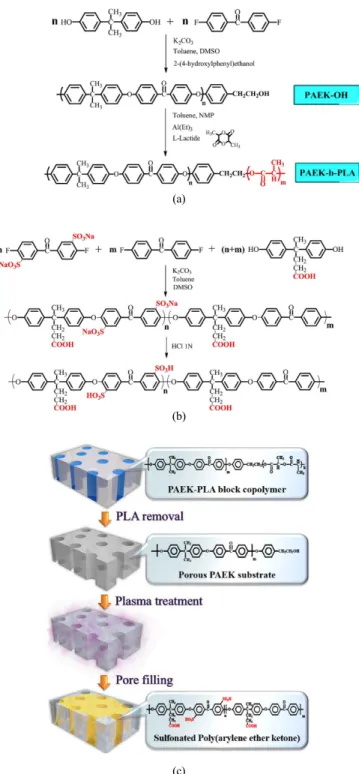
The pore-filled membranes composed of a similar structured porous substrate and polymeric filler using poly(arylene ether ketone) based material was proposed to enhance interfacial compatibility and hence diminish the leakage of polymeric filler. The porous poly(arylene ether ketone) (PAEK) membrane was chosen as a pore-filling substrate and sulfonated PAEK with 80% degree of sulfonation as polymer filler for proton conduction. Plasma treatment on porous surface were also given to improve adhesion between the hydrophobic porous substrate and hy- drophilic polymer filler. Figure 1 illustrates the synthesis routes for the polymer filler, substrate and composite membrane. The pore-filled composite membranes exhibited thermal resistance up to 230 ℃, as well as excellent dimensional stability from room temperature to 90 ℃.

However, the proton conductivity was still lower than Nafion-117, but the methanol permeability was much lower so that the selectivity was better than Nafion-117[24].

Kim et al. reported a series of pore filling membranes containing a po- rous cross-linked benzoxazine-benzimidazole copolymer P(pBUa-co-BI) substrates with sulfonated poly(arylene ether sulfone)s (SPAES)s hav- ing different degree of sulfonation for fuel cells operating at high-tem- peratures (> 100 ℃) and low humidity (< 50% RH) conditions, it shows much improved dimensional stability and mechanical properties than SPAES membranes. The ultra-thin pore filling membranes (15-20 µm) also exhibited high chemically bound water and hence displayed improved fuel cell performance at 120 ℃ and 40% RH[25].

The use of ionic liquids as conductive fillers allows tuning of the individual properties of both conductive and polymer materials. Van de Ven et al. proposed the concept of ionic liquid H-3-methylimidazolium bis(tri-fluoromethanesulfonyl) imide ([h-mim] Ntf2) embedded into po- rous non-conductive PBI polymer matrix with tailored morphology as the membrane for high temperature (> 100 ℃) fuel cell applications.

The resulting membrane showed a proton conductivity of 1.86 mS cm

-1

at 190 ℃. A peak power density of 0.039 W cm

-2

was observed at 150 ℃, which proved that the developed PBI/IL membrane can be considered as a candidate for high-temperature fuel cell applica- tions[26].

There are substantial attempt to fabricate polymer electrolyte mem- branes having electrically aligned nanostructure along with the direc- tion of electric field. Lee and his co-workers demonstrated the effect of alignment technique by DC electric field in continuous and scale up modes[27]. Four series of aligned sulfonated poly(2,6-di- methyl-1,4-phenylene oxide) (SPPO) polymer filled porous poly- ethylene membranes were prepared in accordance with different IEC values and varying intensity of applied electric field. The optimized aligned composite membrane showed the highest maximum power den- sity than other fabricated composite membranes and Nafion-115. The morphology of the membranes was also studied under the influence of the electric field.

(a)

(b)

(c)

Figure 1. Synthetic schemes of (a) PAEK-OH and PAEK-b-PLA; (b)

polymeric filler SPAEK (DS = 80%); and (c) preparation of pore filling

composite membrane (Reproduced with permission from Elsevier).

(4)

2.2. Nano fibrous composite membrane

Recently, the method of building the proton transfer channel based on nanofibers has drawn considerable interest from researchers.

Electrospun nanofiber mat provides high porosity and a three-dimen- sional network structure. Unlike conventional fiber production method such as extrusion, electrospinning form long strands of nanofibers and subsequently mat with better interconnectivity and uniformity[28].

Nanostructured composites can be prepared either by embedding elec- trospun fibers of proton conducting polymer in an inert polymer matrix or by filling matrix ionomer in a nanofiber mat. Proper selection of matrices can improve swelling as well as mechanical and conductivity behaviour of the composite membrane. For example, Nafion filled elec- trospun nanofibrous sulfonated poly(aryl ether sulfone) (CSPES) com- posite membranes reported by Wang et al. showed improved proton conductivity, mechanical and methanol barrier properties as well as the reduction in swelling ratio[29].

Gao and his co-workers reported a novel approach to enhance the performance of PEMs by filling sulfonated poly(ether ether ketone) (SPEEK) into the pores in the sulfonated pre-oxidized polyacrylonitrile (SONF) fiber web by solution impregnation method. The introduction of nanofiber improved the thermal stability, water absorption, dimen- sional stability as well as proton conductivity and decreased methanol permeability due to the long and tortuous diffusive pathway in the

presence of nanofibers[10].

Phase morphology of the composite membranes has much influence on its proton conductivity and dimensional stability. Sulfonated poly(arylene ether sulfone) (SPAES) nanofiber nonwoven fabric/silicate composite membrane with dual phase co-continuous morphology (SN/S membrane) and conventional SPAES/silicate composite membrane (S/S membrane) was compared by Won and his co-workers. The unique phase morphology and the relative humidity variation driven dimen- sional change of the membrane has been schematically shown in Figure 2. Dual-phase co-continuous morphology in SN/S membrane exhibited noticeable improvement in dimensional stability (Figure 3).

The three-dimensionally interconnected silicate phase acted as an in- dependent inorganic framework which is highly stable against humidity variation, thereby effectively mitigating the dimensional change of the SPAES phase in the SN/S membrane. SN/S membrane exhibited lower activation energy (7.07 KJ mol

-1

) than that of S/S membrane (8.1 KJ mol

-1

) illustrated the effect on conductivity[19].

Nanofibrous composite membranes consist of three main parts:

nanofiber phase, polymer matrix and interfacial regions among these

two phases for proton transfer. It is easy to tune the proton transfer

pathway at interfacial region between nanofiber and polymer matrix of

composite and there have been lots of attempts to construct efficient

pathways at these regions. The functional groups from nanofiber and/or

Figure 2. Schematic illustration of phase morphology and the relative humidity variation driven dimensional change of SN/S and S/S membranes

(Reproduced with permission from Elsevier)[19].

(5)

incorporated polymer matrix could transport protons along the inter lapped fibers, creating continuous conduction pathways at interfacial regions. Introducing acidic and basic groups can form acid-base pairs, which would work as facile hopping sites for ultrafast proton con- duction along the interfacial pathways. Zhang et al. investigated a nov- el and facile strategy to construct dual interfacial proton conducting pathways in the platform of nanofibrous composite membranes (NFCMs) by incorporating sulfonated halloysite nanotubes (SHNTs) in- to chitosan (CS) matrix followed by incorporating them into the pores of sulfonated poly(ether ether ketone) (SPEEK) nanofiber mat. Two distinct interfacial pathways are created at SPEEK/CS and CS/SHNTs interfaces, on which ordered acid-base pairs (-SO

3

…-H

3

N-) formed re- duces the energy barrier for proton conduction. The large surface area and high aspect ratio of nanofillers allowed to form long-range path- ways for proton transport. Moreover, the plenty of acid-base pairs formed onto the surface of nanofibers and nanofillers inhibited the movement of polymer chains and improved the thermal and structural stabilities of the membranes[30].

Coupling of different conductive groups could construct different en- vironments, which would significantly modify the proton transferability of the resultant composite proton carriers. In order to study the influ- ence of coupling different functional groups on proton migration, a ser- ies of nanofiber mats bearing different functional groups (neutral, acid- ic, or basic groups) were fabricated. Subsequently, acidic or basic poly- mer matrix was incorporated into nanofiber mat to obtain nanofiber composite membranes bearing three types of composite proton carriers (I-type: acid-neutral or base-neutral, II-type: acid-acid or base-base, III-type: acid-base or base-acid) at the interfacial domains of nano- fiber/matrix. Electrospun nanofiber bearing lots of -OH (neutral groups) (NF-OH) was prepared using PVA/TEOS. Then, NF-OH was facilely modified with two kinds of silane coupling agents to introduce -SO

3

H groups (NF-SO

3

H) and -NH

2

groups (NF-NH

2

). SPEEK and chitosan (CS) respectively, were chosen as the acidic and basic poly-

mer matrixes for pore filling. The proton conductivity was found to be increased in the order of I < II < III. The highest hydrated conductivity of 93.8 mS cm

-1

at 65 ℃ was exhibited by acid-base paired SP/NF-NH

2

. The electrostatic interactions within type III proton car- riers facilitated protonation and deprotonation process and providing low energy barrier proton hopping sites as well as admirable thermal, mechanical and oxidative stability by inhibiting polymer chain mobility. SP/NF-NH

2

displayed a 49% increase in maximum current density (475.8 mA cm

-2

) coupled with a 63% increase in maximum power density (143.4 mW cm

-2

) compared to SPEEK cast mem- brane[4].

Liao et al. prepared a highly conductive quasi-coaxial quaternized polyvinyl alcohol (Q-PVA) nanofibers via the electrospinning process.

Potassium hydroxide doped nanofiber mat demonstrated a 36.4% in- crease in peak power density compared with a cell employing a pris- tine Q-PVA membrane. They ascribed both high conductivity and sup- pressed methanol permeability obtained are attributed to the quasi-co- axial structure of the electrospun nanofibers. The more amorphous core region forms highly conductive paths, while the outer shell of the nanofibers contains more polymer crystals serve as a hard sheath sur- rounding the softcore. The mass transfer resistance and tortuous fuel pathway formed by the outer shell suppressed the methanol per- meation[31]. Nanocomposite membranes made from nanofiber mats of sulfonated PEEK-polyvinyl butyral (SPEEK-30%PVB) filled with a blend of SPEEK and polyvinyl alcohol (SPEEK-35%PVA) provided mechanical stability, methanol barrier properties and certain proton conductivity up to a crosslinking temperature of 120 ℃. DMFC per- formance experiments concluded promising results for this new low-cost type of membranes[18]. The electrospun fiber mats made up of non-charged polymeric materials such as PVDF and PSF fused to one another form a welded porous mat, which is filled with per- fluorosulfonic acid (PFSA) polymer generate a proton conducting com- posite polymeric electrolyte. The membrane exhibited lower water up- take and higher mechanical stability[32].

As the electrolyte with high molecular weight polymer tends not to be completely embedded in the substrate, the pore-filling method con- ventionally used to fabricate reinforced composite membranes exhibits limited reliability. This can be solved by the use of electrospun sub- strates with desired pore size and porosity. In view of that, Jang and his co-workers introduced a reinforced micro-composite polymer elec- trolyte membrane by simultaneous electrospinning/spraying process. A diluted polysulfone (PSf) solution was sprayed on to a thin layer of sPAES electrospun fiber and vice versa to form PSf (SP) + sPAES (ES) and PSf (ES) + sPAES (SP) membranes. The PSf (ES) + sPAES (SP) membrane exhibited the highest durability with slightly lower cell performance. The CV curves of PSf (ES) + sPAES (SP) showed little fuel cross-over induced changes up to 300 cycles, with significant changes observed between 300 and 600 cycles due to progressing mem- brane degradation[20].

Figure 3. Comparison of dimensional change between SPAES, S/S and

SN/S membranes with humidity cycling (repeated hydration-room

temperature/100% RH/24 h and dehydration 80 ℃/50% RH/3 h)

(Reproduced with permission from Elsevier)[19].

(6)

3. Proton Exchange Membrane Fuel Cells

Maximizing the proton conduction, while keeping sufficient mechan- ical strength and reduced dimensional swelling is a key challenge for the development of PEMFC membranes. Much research approaches in this domain have been devoted to the use of perfluorosulfonic acid (PFSA) ionomers. sPEEK/Aquivion

®

composite membranes prepared by casting the PFSA ionomer dispersion (Aquivion

®

) onto cross-linked sPEEK electrospun mats showed improvement in mechanical strength and dimensional stability than pristine

®

membrane ascribed to the high stiffness of the porous substrate. However, the proton conductivity val- ues are comparatively lower due to the relatively lower conductivity of sPEEK[1]. Nafion-impregnated SiO

2

/sPEEK composite nanofiber mem- branes were prepared by electrospinning of mixed solutions of silica precursor (tetraethylorthosilicate) and SPEEK followed by impregnat- ing Nafion inside the pores. Nafion impregnated SiO

2

/SPEEK nano- fiber composite showed a maximum power density of 170 mW cm

-2

at 120 ℃ and 40% RH, which was more than doubled the power den- sity for the recast Nafion (71 mW cm

-2

) membrane[33]. Acid doping can provide polymer electrolyte a better proton conductivity. N, N-di- methylhexadecylamine partially quaternized poly(vinyl benzyl chloride) (qPVBzCl

-

) ionomer filled porous polytetrafluoroethylene (PTFE) film treated with phosphoric acid gives a composite membrane with im- proved conductivity and a peak power density of 360 mW cm

-2

at 175

℃ under low humidity conditions (< 1%)[34]. Incorporating chitosan (CS) matrix into electrospun sulfonated poly(ether ether ketone) (SPEEK) nanofiber mats exhibited electrostatic interaction within acid-base pairs and more proton hopping sites in the perpendicular di- rection of the nanofiber composite membranes[35].

The durability of membranes are normally affected by two different sources: hydroxide radicals generated as byproducts of the electro- chemical reactions during PEFC operation attack the main or side chains of ionomers which lead to its decomposition, swelling-induced mechanical stresses lead to pinhole formation, delamination, and creep.

In an effort to address the durability demands, PFSA membranes with reinforcement have become of great interest as they have demonstrated superior durability in PEMFCs compared to their unreinforced analogues. Shi et al. explored how reinforcement could impact the overall structure-property relationship and anisotropy of ionomers which could potentially benefit the development of alternative hybrid

ion-conductive polymers. Nafion XL composed of 10% PTFE, 75-90%

PFSA/TFE copolymer and up to 5% proprietary additive was subjected to different pretreatment and conditioning to elucidate the impact of re- inforcement on its anisotropic properties and structure/property relationship. Heating of the membranes in water at different temper- atures showed significant impacts on its structure/property relationship, in particular, the mechanical stability, conductivity, and their aniso- tropy, which were related to the morphological changes observed from microscopy studies[6].

Solution blowing has been reported as a new process for nanofiber preparation because of its significant advantages such as high pro- ductivity due to its high solution feed rate, easy accessibility and low energy consumption due to the absence of high voltage equipment over electrospinning. The fibers are also commonly curled in three dimensions. Solution blown sulfonated poly(ether ether ketone) (SPEEK) nanofibers after impregnation into Nafion form pore filled nanofiber composite membranes with suppressed in-plane swelling and improved conductivity. The absence of any significant cracks indicated good compatibility among nanofiber and Nafion. Generally, high water uptake also leads to high swelling of the membrane. However, the pre- pared membranes possessed both high water uptake and low swelling ratio. The tortuous and anfractuous channels developed by nanofibers prevented methanol cross-over and achieved good selectivity to the membranes[36].

Most non-fluorinated membranes possess aromatic polymer chains with sulfonic acid functional groups connecting to the backbones, which lead to narrow, tortuous and dead-end proton conductive chan- nels and low proton conductivity. Hence interconnecting proton chan- nels are essential to get high conductivity and mechanical stability in non-fluorinated membranes. Gong and his co-workers proposed a novel approach of using thickness aligned nano-size proton conductive chan- nels by means of electrospinning process for high-performance fuel cells. Sulfonated poly(phthalazinone ether sulfone ketone) (SPPESK) was electrospun into aligned nanofibers and then arranged through the plane in the membranes to induce straight nano-scale proton con- ductive channels. The negatively charged sulfonic acid groups were ag- gregate towards the surface of the fibers and then on inter-fiber voids.

The long-range ionic clusters formed along the aligned electrospun

nanofibers in the thickness direction resulted in much higher

through-plane conductivity, nearly twice the conductivity of SPPESK

Figure 4. Schematic structure of electro spun nano fiber enhanced SPPESK composite PEM (Reproduced with permission from Elsevier)[38].

(7)

membrane. The membranes exhibited higher single cell power density (1.2 fold), lower hydrogen crossover (33%) and higher tensile strength (1.5 fold) as compared with that of Nafion 115[37]. The interfacial compatibility between electrospun fiber and inter fiber voids filler af- fects the proton conductivity and mechanical stability. The strategy of higher ion exchange capacity (IEC) electrospun fiber mats with lower IEC inter-fiber voids filler matrix improved the contribution of electro- spun fiber mats embedded in the SPPESK matrix (Figure 4). Larger and ordered ionic clusters aggregated along the interfaces between SPPESK nanofibers and matrix exhibited a high proton conductivity of 186.4 mS cm

-1

and controlled swelling of 30% at 80 ℃[38].

Integrating proton conductive sulfonated poly(ether ketone) (SPEK) nanofibers as reinforcement into a Nafion membrane by direct electro- spinning and membrane deposition was reported. The proton con- ductivity of the fiber reinforcement led to a reduced membrane resist- ance and higher power density compared to a similarly fabricated com- posite membrane with inert reinforcement, poly(vinylidene fluo- ride-co-hexafluoropropylene) (PVDF-HFP) material. The chemical ac- celerated stress test (100 h OCV hold at 90 ℃, 30% RH, H

2

/air, 50/50 kPa) revealed a degradation rate of about 0.8 mV/h for the fuel cell with SPEK reinforced membrane, compared to 1.0 mV/h for the PVDF-HFP reinforced membrane[39].

Significant efforts have been made to reduce the methanol perme- ability through Nafion membranes by adopting different strategies of modifying surface and composition. Unfortunately, negative impacts on the remaining properties were observed. In the work of Li et al., they have developed an in-situ nanoscale swelling-filling (SF) strategy to improve the performance of Nafion membranes. Nafion membrane was filled in-situ with proton conductive macromolecules (PCMs) of the structure, shown in Figure 5 which are capable of physically blocking the fuel molecules during fuel cell operation. The DMFC equipped with the membrane yielded 33% higher power density than the original

Nafion DMFC and these notable advantages demonstrated the sig- nificance of SF strategy in the performance of DMFCs[40]. Xu et al.

were also boosted methanol permeation resistivity and proton con- ductivity of Nafion by structural architecture modification of PCM fill- er using -COOH as end capping groups[41].

Some progress has been made recently on nanofiber based bilayer membranes to improve the methanol barrier properties. Nanofiber-based bilayer membranes by direct electrospinning of sulfonated poly- ethersulfone (SPES) nanofibers on Nafion112 membrane’s surface fol- lowed by impregnation of Nafion solution into the pores of electrospun SPES (SPES-N-N112) were compared with Nafion impregnated porous SPES nanofibrous membranes with a uniform top layer of Nafion (SPES-N-N). The proton to methanol selectivity of the SPES nano- fiber-based bilayer membranes is about 53,680 and 45,500 Sscm

-3

for SPES-N-N and SPES-N-N112 in comparison with 28,300 and 40,500 Sscm

-3

for Nafion112 and Nafion117, respectively[42].

Membranes with sufficient durability for long-term operation of high-temperature PEMFC is one of the challenges. Two types of porous polybenzimidazole (PBI) membranes with symmetric and asymmetric morphologies were fabricated by template leaching method using differ- ent soft templates, DBP and 1-ethyl-3-methylimidazoliumbis(tri- fluoro-methylsulfonyl)imide ([EMIM] [TFSI]), respectively.

Asymmetrically porous PBI exhibited a higher porosity compared to the symmetrical one, which had better tensile properties and oxidative stability. On the other hand, an ultra-high proton conductivity of 2.02

× 10

-1

S cm

-1

was obtained at 160 ℃ for the symmetrical one.

Moreover, significant improvements in the durability of fuel cell oper- ation, fuel crossover and phosphoric acid leakage were observed in symmetrically porous structure[43]. Improvements in electrochemical durability were achieved also by introducing cross-linker with two or more cross-linkable sites. Monomer impregnated porous PE film sand- wiched between polyethyleneterephthalate (PET) films after simulta- neous polymerization and cross-linking using UV radiation forming a three-dimensional polymer network with long-term durability[44].

Phosphoric acid doped track-etched polybenzimidazole (PBI) mem- branes, formed by energetic heavy ion irradiation followed by a se- lective chemical etching of these tracks into pores exhibited a con- ductivity of more than 15 mS cm

-1

even after 250 h of operation at 150 ℃[45]. Silica nanofiber biofunctionalized with four kinds of ami- no acids (including cysteine, serine, lysine, and glycine) impregnated into Nafion matrix obtained composites (Figure 6 (a)) with dimensional and thermal stability as well as continuous pathways for proton conduction. The molecular structure of modifiers are given in Figure 6 (b). Bio-SiO

2

nanofiber-grafted cysteine, serine, lysine, and glycine were designated as SiO

2

-Cys, SiO

2

-Ser, SiO

2

-Lys, and SiO

2

-Gly, respectively. Nafion-Cys presented the best proton conductivity and Nafion-Gly demonstrated the best dimensional stability and methanol permeability[46].

Figure 5. Schematic diagram of in-situ nano scale SF strategy

(Reproduced with permission from Elsevier)[40].

(8)

4. Summary and Conclusions

An extensive research on the preparation and characterization of poly- mer electrolyte membranes are performed aiming at improving the me- chanical, chemical and electrochemical stability. Ionically conductive poly- mer gel with porous matrix or electrospun mat support may efficiently overcome the limitations associated with the state of the art per- fluorosulfonic acid based membranes and enhance mechanical strength,

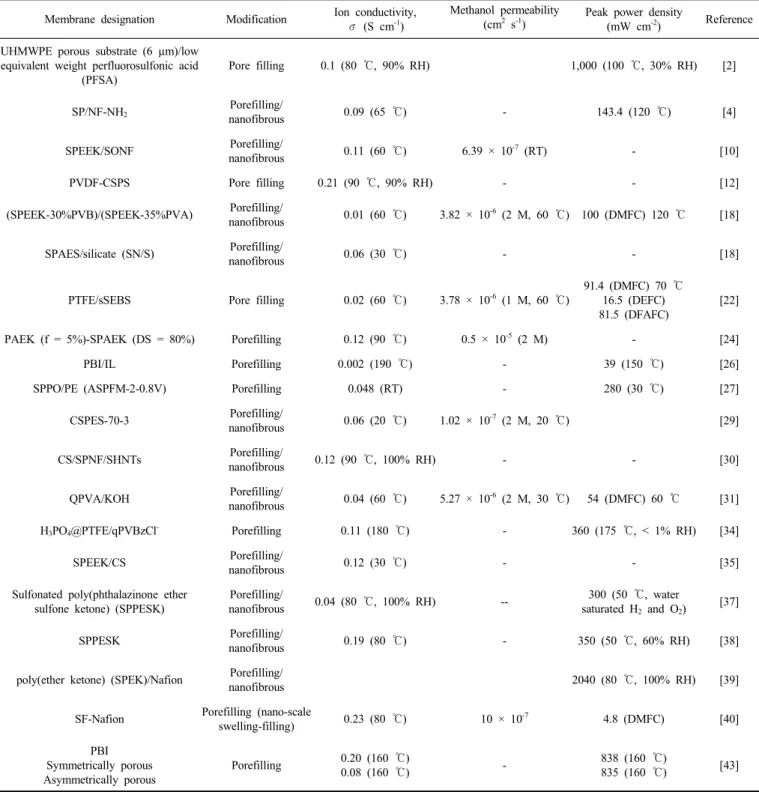
conductivity, stability, selectivity and durability. This review gives an overview of various efforts that have been made during the last five years on porous supported polymer electrolyte membranes. Table 1 shows a summarized report on the work performed on various membranes.

Isotropic porous matrices have been most common for preparing pore-filling composites. Membranes composed of supporting PTFE ma- trix filled with Nafion were extensively studied and demonstrated sig- nificant benefits. Reinforced composite membranes based on Membrane designation Modification Ion conductivity,

σ (S cm

-1

)

Methanol permeability

(cm

2

s

-1

) Peak power density

(mW cm

-2

) Reference UHMWPE porous substrate (6 µm)/low

equivalent weight perfluorosulfonic acid (PFSA)

Pore filling 0.1 (80 ℃, 90% RH) 1,000 (100 ℃, 30% RH) [2]

SP/NF-NH

2

Porefilling/

nanofibrous 0.09 (65 ℃) - 143.4 (120 ℃) [4]

SPEEK/SONF Porefilling/

nanofibrous 0.11 (60 ℃) 6.39 × 10

-7

(RT) - [10]

PVDF-CSPS Pore filling 0.21 (90 ℃, 90% RH) - - [12]

(SPEEK-30%PVB)/(SPEEK-35%PVA) Porefilling/

nanofibrous 0.01 (60 ℃) 3.82 × 10

-6

(2 M, 60 ℃) 100 (DMFC) 120 ℃ [18]

SPAES/silicate (SN/S) Porefilling/

nanofibrous 0.06 (30 ℃) - - [18]

PTFE/sSEBS Pore filling 0.02 (60 ℃) 3.78 × 10

-6

(1 M, 60 ℃)

91.4 (DMFC) 70 ℃ 16.5 (DEFC) 81.5 (DFAFC)

[22]

PAEK (f = 5%)-SPAEK (DS = 80%) Porefilling 0.12 (90 ℃) 0.5 × 10

-5

(2 M) - [24]

PBI/IL Porefilling 0.002 (190 ℃) - 39 (150 ℃) [26]

SPPO/PE (ASPFM-2-0.8V) Porefilling 0.048 (RT) - 280 (30 ℃) [27]

CSPES-70-3 Porefilling/

nanofibrous 0.06 (20 ℃) 1.02 × 10

-7

(2 M, 20 ℃) [29]

CS/SPNF/SHNTs Porefilling/

nanofibrous 0.12 (90 ℃, 100% RH) - - [30]

QPVA/KOH Porefilling/

nanofibrous 0.04 (60 ℃) 5.27 × 10

-6

(2 M, 30 ℃) 54 (DMFC) 60 ℃ [31]

H

3

PO

4

@PTFE/qPVBzCl

-

Porefilling 0.11 (180 ℃) - 360 (175 ℃, < 1% RH) [34]

SPEEK/CS Porefilling/

nanofibrous 0.12 (30 ℃) - - [35]

Sulfonated poly(phthalazinone ether sulfone ketone) (SPPESK)

Porefilling/

nanofibrous 0.04 (80 ℃, 100% RH) -- 300 (50 ℃, water

saturated H

2

and O

2

) [37]

SPPESK Porefilling/

nanofibrous 0.19 (80 ℃) - 350 (50 ℃, 60% RH) [38]

poly(ether ketone) (SPEK)/Nafion Porefilling/

nanofibrous 2040 (80 ℃, 100% RH) [39]

SF-Nafion Porefilling (nano-scale

swelling-filling) 0.23 (80 ℃) 10 × 10

-7

4.8 (DMFC) [40]

PBI Symmetrically porous Asymmetrically porous

Porefilling 0.20 (160 ℃)

0.08 (160 ℃) - 838 (160 ℃)

835 (160 ℃) [43]

Table 1. Summary of Composite Membranes

(9)

cross-linked polymers embedded porous substrate demonstrated dimen- sional stability, high-temperature applicability and durability. The use of similarly structured substrate and filling material leads to enhanced interfacial compatibility and hence proton conductivity. Dual interfacial proton conducting pathways by implementing acid-base interaction re- duces the energy barrier for conduction. Enhanced mechanical proper- ties and selectivity were achieved by the use of bilayer membranes.

Further improvements in performance, especially conductivity, may be achieved in anisotropic matrices through the alignment of ionic channels. In-situ nanoscale swelling-filling strategy significantly af- fected the DMFC performance by blocking the fuel molecules.

The past investigations have laid a solid foundation for the basic un- derstanding of how the performances of polymer electrolyte mem- branes been affected the structure of the membranes.

Acknowledgment

This work was supported by the National Research Foundation of Korea (NRF) grant funded by the ministry of science and ICI (NRF-2015 M1A2A2058028).

References

1. C. Boaretti, L. Pasquini, R. Sood, S. Giancola, A. Donnadio, M.

Roso, M. Modesti, and S. Cavaliere, Mechanically stable nano- fibrous sPEEK/Aquivion

®

composite membranes for fuel cell appli- cations, J. Membr. Sci., 545, 66-74 (2018).

2. Y. Oshiba, J. Tomatsu, and T. Yamaguchi, Thin pore-filling mem- brane with highly packed-acid structure for high temperature and low humidity operating polymer electrolyte fuel cells, J. Power Sources, 394, 67-73 (2018).

3. G. C. Abuin, E. A. Franceschini, P. Nonjola, M. K. Mathe, M.

Modibedi, and H. R. Corti, A high selectivity quaternized poly-

sulfone membrane for alkaline direct methanol fuel cells, J. Power Sources, 279, 450-459 (2015).

4. Y. He, H. Zhang, Y. Li, J. Wang, L. Ma, W. Zhang, and J. Liu, Synergistic proton transfer through nanofibrous composite mem- branes by suitably combining proton carriers from the nanofiber mat and pore-filling matrix, J. Mater. Chem. A, 3, 21832-21841 (2015).

5. D. J. Kim and S. Y. Nam, Research trend of organic/inorganic composite membrane for polymer electrolyte membrane fuel cell, Membr. J., 22, 155-170 (2012).

6. S. Shi, A. Z. Weber, and A. Kusoglu, Structure/property relation- ship of Nafion XL composite membranes, J. Membr. Sci., 516, 123-134 (2016).

7. H. W. Zhang, D. Z. Chen, Y. Xianze, and S. B. Yin, Anion ex- change membranes for fuel cells: Synthesis strategies, properties and perspectives, Fuel Cells, 15, 761-780 (2015).

8. Z. Zakaria, S. K. Kamarudin, and S. N. Timmiati, Membranes for direct ethanol fuel cells: An overview, Appl. Energy, 163, 334-342 (2016).

9. C. H. Park, S. Y. Nam, and Y. T. Hong, Molecular dynamics (MD) study of proton exchange membranes for fuel cells, Membr.

J., 26, 329-336 (2016).

10. Z. Gao, G. Jiang, and P. Ma, Preparation and performance as PEM of sulfonated pre-oxidized nanofiber/SPEEK composite membrane, Fibers Polym., 18, 1025-1030 (2017).

11. S. Y. Lee, H. Kim, S. Y. Nam, and C. H. Park, Synthetic strat- egies for high performance hydrocarbon polymer electrolyte mem- branes (PEMs) for fuel cells, Membr. J., 26, 1-13 (2016).

12. N. Kang, J. Shin, T. S. Hwang, and Y. S. Lee, A facile method for the preparation of poly(vinylidene fluoride) membranes filled with cross-linked sulfonated polystyrene, React. Funct. Polym., 99, 42-48 (2016).

13. D. J. Kim, H. Y. Hwang, H. J. Kim, and S. Y. Nam, Preparation and characterization of polysulfone substrate for reinforced compo- site membrane fuel cell membrane, Membr. J., 19, 63-71 (2009).

14. D. J. Kim, H. Y. Hwang, and S. Y. Nam, Characterization of com- posite membranes made from sulfonated poly(arylene ether sul- fone) and vermiculite with high cation exchange capacity for DMFC applications, Membr. J., 21, 389-397 (2011).

15. T. Y. Son, T. H. Ko, J. H. Kim, J. U. Hong, and S. Y. Nam, Preparation and characterization of chitosan membranes cross-linked using poly(2,6-dimethyl-1,4-phenylene oxide) polymer and chitosan, Membr. J., 28, 205-213 (2018).

16. T. Y. Son, J. W. Jo, J. H. Kim, T. H. Kim, E. Tocci., and S. Y.

Nam, Preparation and gas characterization of poly(phenylene ox- ide) containing imidazolium, Membr. J., 27, 528-535 (2017).

17. M. S. Lee, H. G. Kang, J. D. Jeon, Y. W. Choi, and Y. G. Yoon, A novel amphoteric ion-exchange membrane prepared by the pore-filling technique for vanadium redox flow batteries, RSC Adv., 6, 63023-63029 (2016).

18. S. Molla and V. Compan, Nanocomposite SPEEK-based mem- branes for Direct Methanol Fuel Cells at intermediate temperatures, J. Membr. Sci., 492, 123-136 (2015).

19. J. H. Won, H. J. Lee, J. M. Lim, J. H. Kim, Y. T. Hong, and S.

Y. Lee, Anomalous behavior of proton transport and dimensional stability of sulfonated poly(arylene ether sulfone) nonwoven/silicate composite proton exchange membrane with dual phase co-con- tinuous morphology, J. Membr. Sci., 450, 235-241 (2014).

20. S. Jang, Y. G. Yoon, Y. S. Lee, and Y. W. Choi, One-step fab- (a)

(b)

Figure 6. (a) Schematic diagram of Nafion membrane with

biofunctional SiO

2

nanofiber (cysteine) and (b) molecular structures of

cysteine, serine, lysine and glycine (Reproduced with permission from

Elsevier)[46].

(10)

rication and characterization of reinforced microcomposite mem- branes for polymer electrolyte membrane fuel cells, J. Membr. Sci., 563, 896-902 (2018).

21. K. Kim, S. W. Choi, J. O. Park, S. K. Kim, M. W. Lim, K. H Kim, T. Ko, and J. C. Lee, Proton conductive cross-linked benzox- azine-benzimidazole copolymers as novel porous substrates for re- inforced pore-filling membranes in fuel cells operating at high temperatures, J. Membr. Sci., 536, 76-85 (2017).

22. B. Y. Wang, C. K. Tseng, C. M. Shih, Y. L. Pai, H. P. Kuo, and S. J. Lue, Polytetrafluoroethylene (PTFE)/silane cross-linked sulfo- nated poly(styrene-ethylene/butylene-styrene) (sSEBS) composite membrane for direct alcohol and formic acid fuel cells, J. Membr.

Sci., 464, 43-54 (2014).

23. S. Ichimura, Y. Sota, J. Ishikawa, Y. Imanishi, K. Kitamura, S. Tsujii, and T. Yamaguchi, Poly(p-phenylene sulfonic acid-ran-2,5-benzophe- none) pore-filling membranes with highly packed acid structure and their polymer electrolyte fuel cell performances, Int. J.

Hydrogen Energy, 41, 21461-21469 (2016).

24. A. Le Mong, S. Yang, and D. Kim, Pore-filling polymer electro- lyte membrane based on poly(arylene ether ketone) for enhanced dimensional stability and reduced methanol permeability, J.

Membr. Sci., 543, 133-142 (2017).

25. K. Kim, S. K. Kim, J. O. Park, S. W. Choi, K. H. Kim, T. Ko, C. Pak, and J. C. Lee, Highly reinforced pore-filling membranes based on sulfonated poly(arylene ether sulfone)s for high-temper- ature/low-humidity polymer electrolyte membrane fuel cells, J.

Membr. Sci., 537, 11-21 (2017).

26. E. van de Ven, A. Chairuna, G. Merle, S. P. Benito, Z. Borneman, and K. Nijmeijer, Ionic liquid doped polybenzimidazole mem- branes for high temperature proton exchange membrane fuel cell applications, J. Power Sources, 222, 202-209 (2013).

27. J. H. Lee, J. Y. Lee, J. H. Kim, J. Joo, S. Maurya, M. Choun, J.

Lee, and S. H. Moon, SPPO pore-filled composite membranes with electrically aligned ion channels via a lab-scale continuous caster for fuel cells: An optimal DC electric field strength-IEC relation- ship, J. Membr. Sci., 501, 15-23 (2016).

28. S. Subianto, M. Pica, M. Casciola, P. Cojocaru, L. Merlo, G.

Hards, and D. J. Jones, Physical and chemical modification routes leading to improved mechanical properties of perfluorosulfonic acid membranes for PEM fuel cells, J. Power Sources, 233, 216-230 (2013).

29. L. Wang, J. Zhu, J. Zheng, S. Zhang, and L. Dou, Nanofiber mats electrospun from composite proton exchange membranes prepared from poly(aryl ether sulfone)s with pendant sulfonated aliphatic side chains, RSC Adv., 4, 25195-25200 (2014).

30. H. Zhang, Y. He, J. Zhang, L. Ma, Y. Li, and J. Wang, Constructing dual-interfacial proton-conducting pathways in nano- fibrous composite membrane for efficient proton transfer, J.

Membr. Sci., 505, 108-118 (2016).

31. G. M. Liao, P. C. Li, J. S. Lin, W. T. Ma, B. C. Yu, H. Y. Li, Y. L. Liu, C. C. Yang, C. M. Shih, and S. J. Lue, Highly con- ductive quasi-coaxial electrospun quaternized polyvinyl alcohol nanofibers and composite as high-performance solid electrolytes, J.

Power Sources, 304, 136-145 (2016).

32. M. Gummalla, Z. Yang, P. Pintauro, K. M. Lee, and R. Wycisk, Porous nanofiber mats to reinforce proton conducting membranes for PEM applications, U.S. Patent, 9716285B2 (2017).

33. C. Lee, S. M. Jo, J. Choi, K. Y. Baek, Y. B. Truong, I. L.

Kyratzis, and Y. G. Shul, SiO

2

/sulfonated poly ether ether ketone (SPEEK) composite nanofiber mat supported proton exchange membranes for fuel cells, J. Mater. Sci., 48, 3665-3671 (2013).

34. Y. C. Cao, C. Xu,, L. Zou, K. Scott, and J. Liu, A polytetrafluoro- ethylene porous membrane and dimethylhexadecylamine quater- nized poly(vinyl benzyl chloride) composite membrane for inter- mediate temperature fuel cells, J. Power Sources, 294, 691-695 (2015).

35. J. Wang, Y. He, L. Zhao, Y. Li, S. Cao, B. Zhang, and H. Zhang, Enhanced proton conductivities of nanofibrous composite mem- branes enabled by acid-base pairs under hydrated and anhydrous conditions, J. Membr. Sci., 482, 1-12 (2015).

36. X. Xu, L. Li, H. Wang, X. Li, and X. Zhuang, Solution blown sul- fonated poly(ether ether ketone) nanofiber-Nafion composite mem- branes for proton exchange membrane fuel cells, RSC Adv., 5, 4934-4940 (2015).

37. X. Gong, G. He, Y. Wu, S. Zhang, B. Chen, Y. Dai, and X. Wu, Aligned electrospun nanofibers as proton conductive channels through thickness of sulfonated poly(phthalazinone ether sulfone ketone) proton exchange membranes, J. Power Sources, 358, 134-141 (2017).

38. S. Zhang, G. He, X. Gong, X. Zhu, X. Wu, X. Sun, X. Zhao, and H. Li, Electrospun nanofiber enhanced sulfonated poly(phthalazi- none ether sulfone ketone) composite proton exchange membranes, J. Membr. Sci., 493, 58-65 (2015).

39. C. Klose, M. Breitwieser, S. Vierrath, M. Klingele, H. Cho, A.

Büchler, J. Kerres, and S. Thiele, Electrospun sulfonated poly(ether ketone) nanofibers as proton conductive reinforcement for durable Nafion composite membranes, J. Power Sources, 361, 237-242 (2017).

40. J. Li, K. Fan, W. Cai, L. Ma, G. Xu, S. Xu, L. Ma, and H. Cheng, An in-situ nano-scale swelling-filling strategy to improve overall performance of Nafion membrane for direct methanol fuel cell ap- plication, J. Power Sources, 332, 37-41 (2016).

41. E. L. Cussler, S. E. Hughes, W. J. Ward, and R. Aris, Performance dependence of swelling-filling treated Nafion membrane on nano-structure of macromolecular filler, J. Membr. Sci., 534, 68-72 (2017).

42. I. Shabani, M. M. Hasani-Sadrabadi, V. Haddadi-Asl, and M.

Soleimani, Nanofiber-based polyelectrolytes as novel membranes for fuel cell applications, J. Membr. Sci., 368, 233-240 (2011).

43. L. C. Jheng, W. J. Y. Chang, S. L. C. Hsu, and P. Y. Cheng, Durability of symmetrically and asymmetrically porous poly- benzimidazole membranes for high temperature proton exchange membrane fuel cells, J. Power Sources, 323, 57-66 (2016).

44. H. Kang, M. Lee, W. Sim, T. Yang, and K. Shin, Effect of num- ber of cross-linkable sites on proton conducting, pore-filling mem- branes, J. Membr. Sci., 460, 178-184 (2014).

45. A. Eguizábal, M. Sgroi, D. Pullini, E. Ferain, and M. P. Pina, Nanoporous PBI membranes by track etching for high temperature PEMs, J. Membr. Sci., 454, 243-252 (2014).

46. H. Wang, X. Li, X. Zhuang, B. Cheng, W. Wang, W. Kang, L.

Shi, and H. Li, Modification of Nafion membrane with biofunc- tional SiO

2

nanofiber for proton exchange membrane fuel cells, J.

Power Sources, 340, 201-209 (2017).

수치

Figure 1. Synthetic schemes of (a) PAEK-OH and PAEK-b-PLA; (b)  polymeric filler SPAEK (DS = 80%); and (c) preparation of pore filling  composite membrane (Reproduced with permission from Elsevier).
Figure 3. Comparison of dimensional change between SPAES, S/S and  SN/S membranes with humidity cycling (repeated hydration-room  temperature/100% RH/24 h and dehydration 80 ℃/50% RH/3 h)  (Reproduced with permission from Elsevier)[19].
Figure 5. Schematic diagram of in-situ nano scale SF strategy  (Reproduced with permission from Elsevier)[40].
Table 1. Summary of Composite Membranes

참조

관련 문서