aaps
Archives of Aesthetic Plastic SurgeryORIGINAL
ARTICLE
https://doi.org/10.14730/aaps.2016.22.3.135 Arch Aesthetic Plast Surg 2016;22(3):135-143 pISSN: 2234-0831 eISSN: 2288-9337Vertical Mammaplasty for Varying Degrees of Reduction
INTRODUCTION
Vertical scar reduction mammaplasty, as described by Lassus [1]
and popularized by Lejour [2], has not achieved widespread accep- tance, and is considered to have certain limitations by many. Among the various modifications to vertical reduction mammaplasty that have been reported, the most clinically significant was described by Hall-Findlay [3], who showed that the use of a superomedial der-
moglandular pedicle led to better outcomes and fewer complica- tions.
Despite—or perhaps because of—this change in the pedicle, the Hall-Findlay vertical mammaplasty [3] was limited to breasts re- quiring resections of less than 1,100 g per breast and/or with mild to moderate mastoptosis (less than 30 cm from sternal notch to nipple). A relatively high frequency of sensory loss in the nipple- areola complex (NAC) has also been reported [4].
The goal of reduction mammaplasty is achieved when the re- sulting shape and size of the breasts is satisfactory to the patient and when sensation in the NAC is preserved. Moreover, it is pref- erable if the operation can be performed using a single method re- gardless of the size of the breast.
In this study, we present our single-institution experience with the use of a vertical mammaplasty with refinements involving the superomedial dermoglandular pedicle. This article describes a sur- gical technique performed by a single surgeon, including an evalu- ation of the postoperative results.
Daejin Kim1, Seo-young Kim2, Daegu Son2
1Dr. Kim Plastic Surgery, Pohang;
2Department of Plastic and Reconstructive Surgery, Institute for Medical Science, Keimyung University School of Medicine, Daegu, Korea
Background Vertical reduction mammaplasty has been criticized for its inability to ad-
dress larger cases of mammary hypertrophy, with a relatively high frequency of senso- ry loss reported. This article describes our single-institution experience with modified vertical reduction mammaplasty for varying degrees of breast reduction.
Methods Thirty-three patients underwent breast reduction using the modified vertical
reduction mammaplasty technique with a superomedial dermoglandular pedicle and modifications involving breast parenchyma excision. The degree of sensory preserva- tion in the nipple-areola complex (NAC) was compared with preoperative sensation us- ing an ordinal scale (0, insensate; 10, unchanged). Postoperative outcomes were evalu- ated through a photogrammetric analysis. Satisfaction with postoperative outcomes was assessed using a telephone questionnaire survey (1, very poor; 5, very good).
Results The modified vertical mammaplasty technique allowed for reductions of up to
1,800 g per side. The mean resection weight was 459.24 g per breast (range, 76-1,800 g). Of the 59 operations, 9 involved complications without significant morbidity. The sensibility of the NAC recovered in most patients by 5 months after the operation. The mean satisfaction score was 3.4, which was between ‘no change’ and ‘satisfied.’
Conclusions Modified vertical reduction mammaplasty allows a single surgeon to ad-
dress varying degrees of breast hypertrophy.
Keywords Gigantomastia, Mammaplasty, Nipples
This article was presented at the 69th Con- gress of the Korean Society of Plastic and Reconstructive Surgeons on November 11-13, 2011, in Seoul, Korea.
Acknowledgements: The author wishes to thank Dr. Aram Harijan for his insightful comments and Dr. Xiao Yang for her excep- tional drawings.
No potential conflict of interest relevant to this article was reported.
Received: Aug 6, 2016 Revised: Oct 1, 2016 Accepted: Oct 4, 2016 Correspondence: Daegu Son Department of Plastic and Reconstructive Surgery, Institute for Medical Science, Keimyung University School of Medicine, 56, Dalseong-ro, Jung-gu, Daegu 41931, Korea.
E-mail: [email protected]
Copyright © 2016 The Korean Society for Aesthetic Plastic Surgery.
This is an Open Access article distributed under the terms of the Creative Commons At- tribution Non-Commercial License (http://creativecommons.org/licenses/by-nc/4.0/) which permits unrestricted non-commercial use, distribution, and reproduction in any medium, provided the original work is properly cited. www.e-aaps.org
aaps
Archives ofAesthetic Plastic Surgery VOLUME 22. NUMBER 3. OCTOBER 2016
METHODS
Patients
This retrospective study was approved by the Institutional Review Board. A single-institution retrospective review was performed for all patients who underwent vertical reduction mammaplasty be- tween April 2004 and June 2013. Each patient underwent a typical preoperative evaluation for reduction mammaplasty, including photogrammetric analysis. After the operations, patients received follow-up at our outpatient clinic, where postoperative photographs were obtained and sensory recovery evaluated. Additionally, fol- low-up telephone surveys were used to evaluate patient satisfaction.
The modified mammaplasty design
The mammaplasty design was made with the patient in standing position, as described by Hall-Findlay [3], with modifications by others [4-6]. Previously, the NAC was marked with a cookie cutter 45 mm in diameter, but we designed the planned circumference of the NAC utilizing a new mosque pattern. A malleable wire of ap- propriate size (16, 17, or 19 cm) was used to draw a parabolic curve that would eventually become the circumferential areola margin.
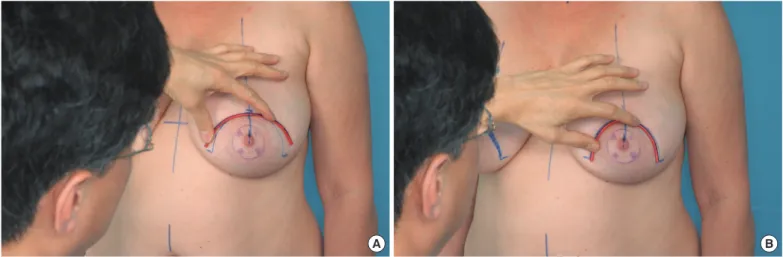
For instance, a 16-cm long wire was used to design an areola with a diameter of 45 mm (π×diameter). Variations in the parabolic curve allowed control of projection. The malleable wire could be bent to produce a narrower or wider areola margin for increased or de- creased projection, respectively (Fig. 1). The amount of breast pa- renchyma to be resected was determined by the vertical limb. When designing the lateral and medial vertical limit, the extent of the re- section could be controlled by pushing harder when more reduc- tion was requested and pushing less when less reduction was nec- essary. Care should be taken when designing the medial vertical
limit because problems such as scar widening may develop due to the tension on the medial portion (sternum). The two vertical inci- sion lines are joined in a U shape, with the bottommost portion approximately 4 to 5 cm above the inframammary fold. To prevent the vertical scar from extending below the inframammary fold line, the design length was limited to less than 5 cm.
In most cases, superomedial pedicles were employed. Superior pedicles were used for smaller breasts, and medial pedicles were reserved for larger breasts (Fig. 2). For larger breasts, the supero- medial dermoglandular pedicle base (approximately 6-8 cm) ex- tended deep to the vertical limb, with only 1 to 2 cm of the pedicle base running beneath the areolar opening (Fig. 2).
Operative technique
The method of vertical reduction mammaplasty was partially based on the technique described by Hall-Findlay [3], with modifications by others [4-6].
To protect the lateral branch of the fourth intercostal nerve, much of the soft tissue above the pectoralis fascia was left in place. The tissue was left at full thickness without any undermining deep to the pedicle. At the fourth intercostal level, the resection was carried out laterally for relatively small (200-400 g) reductions. Additional beveled sections were removed laterally as needed for larger reduc- tions (>600 g). Resections were carried as far out laterally as possi- ble without compromising the lateral portion of the skin flap (Fig.
3A). Below the fourth intercostal space and the level of the lateral branch, the main bulk of resection took place in the central portion of the breast, with additional beveled sections taken both medially and laterally (Fig. 3B).
The inferior portion of the skin flap was undermined down to the inframammary fold with medial and lateral extensions to the
A B
Fig. 1. Preoperative mosque dome design. The preoperative modified mosque dome (areolar opening) skin markings are shown. Instead of the more traditional rendering of a key-hole shape opening to determine the future position and shape of the areola, a variable opening for the areola was drawn using malleable wire. (A) If more projection was needed, the wire was widened. (B) If less projection was needed, the mal- leable wire was narrowed to achieve better coning and increased projection.
aaps
Archives ofAesthetic Plastic Surgery Kim D et al. Vertical Reduction Mammaplasty
Fig. 2. (A) Design of the superomedial pedicles. According to breast size, the pedicle is superior, superomedial, (B) or medial. (B) In large breasts, the base of the pedicle was 1 to 2 cm into the areolar opening, and the other end of the pedicle onto the vertical limb.
A B
Fig. 3. Design of the dermoglandular resection patterns. Resection patterns varied with the volume of the reduction (a, b, c). (A) Resection pat- terns at the pedicle level. (B) Resection patterns at the sub-pedicle level.
Pectoralis major Sternum
Superior epigastric artery
a a
b b b
c c c
Pectoralis minor
A B
vertical limbs to prevent contour irregularities and dog-ear forma- tion on the most inferior portion. A buffer of fatty tissue measur- ing approximately 1 cm is adequate to minimize skin necrosis in this area.
After insetting the areola, the medial pillar and lateral pillar were brought together for shaping. For gigantomastia, the incision was
extended laterally and medially to prevent the extension of the ver- tical scar to the inframammary fold.
Degree of sensory preservation in the NAC
The NAC was assessed in 18 patients during postoperative clinic
visits. Patients were instructed to self-evaluate NAC sensation by
aaps
Archives ofAesthetic Plastic Surgery VOLUME 22. NUMBER 3. OCTOBER 2016
manual touch. The degree of sensory preservation in the NAC was compared with the preoperative sensibility using an ordinal scale from 0 (insensate) to 10 (no change in sensation) [7].
Photogrammetry analysis
Postoperative outcomes were assessed in 19 patients using photo- graphs. All photographs were obtained in a standard clinical pho- tographic view in the same anatomical position. Anthropometry
Table 1. Telephone questionnaire survey (n = 10)Postoperative satisfaction survey
1. Appearance ⑤ Very satisfied ④ Satisfied ③ No change ② Dissatisfied ① Very dissatisfied
1.1 While clothed, are you satisfied with… ☐ ☐ ☐ ☐ ☐
1.1.1 Your overall appearance in the mirror? ☐ ☐ ☐ ☐ ☐
1.1.2 Your appearance when wearing a bra? ☐ ☐ ☐ ☐ ☐
1.1.3 The feel of clothes over the breasts? ☐ ☐ ☐ ☐ ☐
1.1.4 The level of comfort when wearing a bra? ☐ ☐ ☐ ☐ ☐
1.1.5 The fit of the clothes? ☐ ☐ ☐ ☐ ☐
1.2 While undressed, are you satisfied with… ☐ ☐ ☐ ☐ ☐
1.2.1 The decrease in the size of the breasts? ☐ ☐ ☐ ☐ ☐
1.2.2 The symmetry of the shape of the breasts? ☐ ☐ ☐ ☐ ☐
1.2.3 The symmetry of the size of the breasts? ☐ ☐ ☐ ☐ ☐
1.2.4 The shape of the nipple-areola complex? ☐ ☐ ☐ ☐ ☐
1.2.5 The location of the nipple-areola complex? ☐ ☐ ☐ ☐ ☐
1.2.6 The naturalness of the appearance of the breasts? ☐ ☐ ☐ ☐ ☐
1.2.7 The overall appearance of the bare breasts? ☐ ☐ ☐ ☐ ☐
2. Postoperative incision scar ⑤ Very satisfied ④ Satisfied ③ No change ② Dissatisfied ① Very dissatisfied
2.1 Length of the scar ☐ ☐ ☐ ☐ ☐
2.2 Width of the scar ☐ ☐ ☐ ☐ ☐
3. Symptoms ⑤ Very satisfied ④ Satisfied ③ No change ② Dissatisfied ① Very dissatisfied
3.1 Changes in pain ☐ ☐ ☐ ☐ ☐
3.1.1 Neck ☐ ☐ ☐ ☐ ☐
3.1.2 Shoulder ☐ ☐ ☐ ☐ ☐
3.1.3 Back ☐ ☐ ☐ ☐ ☐
3.1.4 Breast ☐ ☐ ☐ ☐ ☐
3.2 Changes in skin ☐ ☐ ☐ ☐ ☐
3.2.1 Improvements in intertrigo ☐ ☐ ☐ ☐ ☐
3.2.2 Improvements in maceration ☐ ☐ ☐ ☐ ☐
3.3 Changes in posture ☐ ☐ ☐ ☐ ☐
3.3.1 Improvements in kyphosis ☐ ☐ ☐ ☐ ☐
3.3.2 Improvements in general posture ☐ ☐ ☐ ☐ ☐
3.4 Shoulder indentations from bra straps ☐ ☐ ☐ ☐ ☐
4. Improvements during exercise/activity ⑤ Very satisfied ④ Satisfied ③ No change ② Dissatisfied ① Very dissatisfied
4.1 Aerobic exercises, such as running ☐ ☐ ☐ ☐ ☐
4.2 Static activities, such as bending and picking up objects ☐ ☐ ☐ ☐ ☐
5. Overall satisfaction ⑤ Very satisfied ④ Satisfied ③ No change ② Dissatisfied ① Very dissatisfied
5.1 Satisfied with the decision to undergo surgery ☐ ☐ ☐ ☐ ☐
5.2 Would recommend the operation to others ☐ ☐ ☐ ☐ ☐
5.3 Would undergo the same operation again ☐ ☐ ☐ ☐ ☐
aaps
Archives ofAesthetic Plastic Surgery Kim D et al. Vertical Reduction Mammaplasty
Table 2. Baseline characteristics of the study participants
Patients, n 33
Breasts, n 59
Mean age (SD), year 41.67 (11.75)
Patient background
Korean, n (%) 25 (75.76)
American, n (%) 8 (24.24)
Black, n (%) 5 (15.15)
White, n (%) 3 (9.09)
Comorbidities
Hypertension, n (%) 6 (18.18)
Diabetes mellitus, n (%) 0 (0)
Obesity
Korea (BMI >25), n (%) 21 (63.64)
WHO (BMI >30), n (%) 4 (12.12)
Breast cancer (unilateral)
Total, n (%) 7 (21.21)
Right, n (%) 3 (9.09)
Left, n (%) 4 (12.12)
IDC, n (%) 4 (12.12)
DCIS, n (%) 3 (9.09)
Smokers, n (%) 0 (0)
Mean weight (SD), kg 66.35 (10.87)
Mean height (SD), m 1.58 (0.052)
Mean BMI (SD) 26.48 (3.99)
Mean follow-up duration (SD), month 8.92 (8.87) Reduction amounts
Mean total, g 459.24 (76–1,800)
Mean right, g 452.17 (76–1,450)
Mean left, g 466.55 (90–1,800)
SD, standard deviation; BMI, body mass index; WHO, World Health Organiza- tion; IDC, invasive ductal carcinoma; DCIS, ductal carcinoma in situ.
Table 3. Reduction amounts
Reduction amounts Total (n = 33, 59 breasts) Korean (n = 25, 43 breasts) American (n = 8, 16 breasts) Patients, n (%) Breasts, n (%) Patients, n (%) Breasts, n (%) Patients, n (%) Breasts, n (%)
<200 g 6 (18.18) 8 (13.56) 5 (20) 6 (13.95) 1 (12.5) 2 (12.5)
200–400 g 8 (24.24) 18 (30.51) 4 (16) 10 (23.26) 4 (50) 8 (50)
400–600 g 12 (36.36) 22 (37.29) 12 (48) 22 (51.16) 0 (0) 0 (0)
>600 g 7 (21.21) 11 (18.64) 4 (16) 5 (11.63) 3 (37.5) 6 (37.5)
was assessed using Photoshop CS5 (Adobe. San Jose, CA, USA).
Breast symmetry was compared between the preoperative and post- operative photographs.
Telephone questionnaire survey
The survey evaluated 5 categories of patient-centric perceptions of the surgical intervention, consisting of satisfaction levels regarding overall appearance, scar appearance, symptoms, activity, and the op- eration itself. Each of the categorical items was evaluated using an ordinal scale of 1 (very dissatisfied) to 5 (very satisfied) (Table 1) [7].
Statistical analysis
All statistical analyses were performed using SPSS version 16.0 (SPSS Inc., Chicago, IL, USA). P-values less than 0.05 in the paired t-test were considered to indicate statistical significance.
RESULTS
This review identified 33 patients as having undergone the modi- fied vertical reduction mammaplasty technique described above.
Twenty-five patients (43 breasts) were ethnic Koreans. The remain- ing 8 patients (16 breasts) were American military service person- nel, among whom 3 were African-American and 5 were Caucasian.
The patients’ mean age was 41.7±11.8 years, with a mean follow-up period of 8.9 months. The patients’ mean body mass index (BMI) was 26.5 kg/m
2. None of the patients had comorbidities such as di- abetes mellitus or coronary artery disease. However, 6 patients had hypertension, and 7 had unilateral breast cancer (Table 2). The amount of resected tissue was <200 g in 8 breasts (6 patients), 200- 400 g in 18 breasts (8 patients), 400 to 600 g in 22 breasts (12 pa- tients), and >600 g in 11 breasts (7 patients). The proportion of patients requiring resections of more than 600 g was higher for the American patients than for the Korean patients (37.5% vs. 11.6%, respectively) (Table 3).
No instances of postoperative hematoma, seroma, skin necrosis, or infection were observed (Table 4). The most common complica- tion was dog-ear formations (n=5, 8.47%) at the inferior aspect of the incision, for which scar revision was performed 6 months post- operatively. Wound dehiscence occurred in a single patient with a BMI of 38.94. Daily dressing changes were sufficient for closing the wound by secondary intention.
Degree of sensory preservation in the NAC
Of the 33 patients, 18 patients were followed up. The amount of
tissue removed was 200 to 400 g per breast in 6 patients, 400 to 600
g in 7 patients, and >600 g in 5 patients. Among these 18 patients,
9 responded to the telephone survey and reported satisfactory sen-
sory recovery at a mean follow-up period of 5 months. The maxi-
aaps
Archives ofAesthetic Plastic Surgery VOLUME 22. NUMBER 3. OCTOBER 2016
Table 4. Postoperative complications in 59 breasts
Postoperative evaluation Breasts, n (%)
Complication
Seroma 0 (0)
Hematoma 0 (0)
Infection 0 (0)
Skin necrosis 0 (0)
Delayed wound healing 2 (3.39)
Hypertrophic scar 2 (3.39)
Dog ear 5 (8.47)
Loss of sensation in the NAC 0 (0)
NAC, nipple-areola complex.
Table 5. Photogrammetric analysis (n = 19) Preoperative
Rt./Lt. ratio (SD) Postoperative
Rt./Lt. ratio (SD) P-value SSN-N 0.991 ± 0.00854 0.999 ± 0.00289 0.002a) N-midline 0.988 ± 0.01063 0.999 ± 0.00939 0.006a)
N-In 1.069 ± 0.06531 0.969 ± 0.02427 0.002a)
BW 1.0047 ± 0.00615 1.0042 ± 0.00216 0.001a)
BH 1.011 ± 0.01513 0.994 ± 0.00731 0.001a)
Br-inclination 1.023 ± 0.00918 0.983 ± 0.00557 0.001a) Rt., right; Lt., left; SD, standard deviation; SSN, suprasternal notch; N, nipple;
N-midline, N to midline of anterior chest; N-In, lowest point on inframmary crease; BW, breast width (lateral endpoint of the breast to medial endpoint of the breast); BH, breast height (superior endpoint of the breast to lowest point on inframmary crease); Br-inclination, breast-inclination (angle between the anterior endpoint of the axilla to nipple and the vertical line of the anterior endpoint of the axilla).
a)Paired t-test.
mum recovery period was 12 months. Four of the 18 patients re- ported sensory improvement at both 1- and 6-month follow-up appointments (Fig. 4).
Photogrammetric analysis
Photogrammetric analysis was possible for 19 patients, among whom the amount of reduction was 200 to 400 g per breast in 5 patients, 400 to 600 g in 9 patients, and >600 g in 5 patients. An- thropometric assessments revealed statistically significant improve- ments in breast symmetry (Table 5, Fig. 5 and 6).
Fig. 4. Survey assessing the degree of sensory preservation in the nipple-areola complex (right/left score). Although 64.2% of the sur- vey respondents indicated scores of 0 to 9 on a scale ranging from 0 to 10, where 10 referred to unchanged sensibility, all respondents reported restored sensibility by 12 months, with recovery of sensibil- ity taking place at a mean of 5 months.
Telephone survey
Ten patients agreed to participate in the telephone survey. In this group, the amount of reduction was 200 to 400 g per breast in 3 patients, 400 to 600 g in 4 patients, and >600 g in 3 patients. The patients assessed their overall postoperative appearance with an average score of 3.4, between ‘no change’ and ‘satisfied.’ Similarly, satisfaction levels with clothed and undressed postoperative appear- ance were rated 3.58 and 3.22, respectively. Patients assessed their
Fig. 5. A case of a reduction mammaplasty. A 25-year-old female patient underwent a total resection of 1,190 g (right, 680 g; left, 510 g). (A, B, C) Preoperative views. (D, E, F) Twelve-month postoperative views.
A B C
D E F
aaps
Archives ofAesthetic Plastic Surgery Kim D et al. Vertical Reduction Mammaplasty
Fig. 6. A case of a reduction mammaplasty. An extremely adipose 35-year-old female patient with gigantomastia. (A, B, C) Preopera- tive views. (D, E, F) Three-month postoperative views. On the right side, 1,450 g of breast tissue was removed, while 1,800 g was removed on the left.
A B C
D E F
Table 6. Results of the telephone questionnaire survey (n = 10) Score
1. Appearance 3.4a)
1.1 While clothed 3.58b)
1.1.1 3.5
1.1.2 3.5
1.1.3 3.6
1.1.4 3.5
1.1.5 3.8
1.2 While undressed 3.22b)
1.2.1 3.3
1.2.2 3.2
1.2.3 3.3
1.2.4 3
1.2.5 3.4
1.2.6 3.56
1.2.7 3
2. Scar 3a)
2.1 Length 3
2.2 Width 2.89
3. Symptoms 3.69a)
3.1 Changes in pain 4b)
3.1.1 4.1
3.1.2 4
3.1.3 4.1
3.1.4 3.8
3.2 Changes in skin 3.72b)
3.2.1 3.67
3.2.2 3.78
3.3 Change in posture 3.33b)
3.3.1 3.33
3.3.2 3.33
3.4 Shoulder indentation 3.63b)
4. Exercise/activity 4a)
4.1 Aerobic exercise 3.8
4.2 Static activities 4.11
5. Overall satisfaction 3.43a)
5.1 Surgery 3.5
5.2 Recommend to others 3.3
5.3 Same operation again 3.5
a)Average of the overall category.
b)Average of the subcategory.
symmetrical and shapely breasts despite the large variations in sec- ondary and tertiary objectives.
While vertical-incision mastopexy had been described earlier, the modern version of vertical reduction mammaplasty began with Lassus [1], who was in the first generation of surgeons to consider incisional scars with a score of 3.0, which did not represent any sig-
nificant like or dislike for the appearance of the scar. With regard to symptoms, patients reported an overall score of 3.69 points on a 5-point scale. More specifically, patients rated improvements with 4 points (‘satisfied’) for pain, 3.7 points for skin, 3.3 for posture, and 3.6 for shoulder indentation from bra straps. Improvements in exercise/activity were rated as 4 points (‘satisfied’). Patients’ overall satisfaction with the operation was 3.43, between ‘no strong opin- ion’ and ‘satisfied’ (Table 6).
DISCUSSION
All forms of reduction mammaplasty share the primary goal of re-
ducing the mechanical burden of large breasts. However, the sec-
ondary objectives vary depending on patient-specific factors, such
as preoperative breast asymmetry, projection, and ptosis [8]. The
tertiary objectives of avoiding complications further subdivide a
single indication (macromastia) into many (macromastia with pto-
sis, unilateral macromastia, macromastia versus gigantomastia,
etc.). As a result of pursuing these secondary and tertiary objec-
tives, a single operation, reduction mammaplasty, has become a
numerous set of procedures due to the possible combinations of
breast incisions and pedicle designs. Bearing this in mind, the ideal
reduction mammaplasty reduces breast volume while resulting in
aaps
Archives ofAesthetic Plastic Surgery VOLUME 22. NUMBER 3. OCTOBER 2016
the issue of resecting the breast parenchyma and skin en bloc infe- riorly, without any undermining of the skin. In addition to liposuc- tion for volume reduction, Lejour [2] modified the Lassus proce- dure by undermining the skin, which allowed independent manip- ulation of the underlying parenchyma. The transition from a supe- rior pedicle to a superomedial and medial pedicle, as reported by Hall-Findlay [3], allowed more extensive breast resections through the vertical technique.
With resection masses greater than 1,100 g per breast, complica- tions such as wound dehiscence, NAC necrosis, seroma formation, and excessive scarring have been reported to occur at rates from 7% to 20% [9,10]. In these patients, NAC repositioning is a signifi- cant challenge. The use of NAC free graft techniques only increases the incidence of serious complications, such as partial or complete nipple loss (up to 18%). In addition, the complete loss of nipple sen- sation and poor nipple projection are recognized problems [11,12].
While the vertical reduction mammaplasty technique has been validated for mild-to-moderate breast hypertrophy, the inverted-T incision and inferior pedicle have been recommended for resections greater than a kilogram. A tendency to cause long vertical scars ex- tending below the inframammary crease and dog-ears at the lower end of the scar has led to the addition of short horizontal scars [13, 14]. Using the established method of vertical reduction mamma- plasty with few modifications and a superomedial pedicle, such complications can be diminished, while still achieving cosmetically satisfactorily breasts. The advantages of a superomedial pedicle in- clude reliable circulation with the capacity of a long nipple-areola distance transposition and the ability to better shape the breast.
One of the goals of breast reduction is to reduce the lateral fullness caused by dense breast tissue in the upper outer quadrant, which can be achieved with a superomedial pedicle [15]. Problems can arise for NAC viability when the length of the pedicle is excessive, especially for large breasts requiring more than 600 g of reduction.
At our institution, we design the pedicle closer to the superior side when the amount of the reduction is small, and closer to medial side for larger reductions. Previous studies have reported that the superomedial dermoglandular pedicle base located between the areolar opening and vertical limb should be at a ratio of 1:1 [16], but the authors only included 1 to 2 cm of the pedicle base. This was done because shaping the NAC is more difficult when the ped- icle base is included in the areolar opening, as the de-epithelialized base crumbles when closing the mosque dome. Moreover, the rea- son why the pedicle base should be included in the areola opening is that if the whole pedicle is included in the vertical limb, the for- mation of the inferior fullness causes pseudoptosis due to uncom- fortable pedicle insetting, especially in rotation. The breast tissue and skin were removed en bloc, but the pattern of the parenchymal resection was determined by the amount of the parenchymal re- section. When the resection was small, the parenchyma was ex- cised only in the vertical direction from the incision line. In con-
trast, in larger resections, the parenchyma was resected in a beveled fashion, from the outer caudal direction (Fig. 3). Inferiorly, exces- sive subcutaneous tissue can lead to dog-ear formation.
Although this study reviewed a relatively small study group, the survey responders (n=10) reported overall satisfaction (satisfac- tion score, 3.43) with having undergone reduction mammaplasty.
While conventional vertical reduction mammoplasty has been re- served for reductions <600 g [17], the modified method has al- lowed reductions >600 g, with a maximum of 1,800 g and 1,450 g in one patient. It is interesting to note that NAC sensibility was re- tained in the reductions performed with a superomedial pedicle (n=18). Previously, Spear et al. [18] reported that no significant differences in breast sensation were found across various methods of mammaplasty, among which vertical reduction mammaplasty was reserved for reductions of approximately 460 g (range, 340-590 g). In contrast, we were able to perform reductions greater than 600 g using this method, with most patients recovering NAC sensi- bility by 1 year postoperatively. However, the patient with the great- est amount of reduction reported subjectively unsatisfactory out- comes (3 out of 10 on an ordinal scale) regarding NAC sensation 60 months after the operation. This patient represented the index case of vertical reduction mammaplasty for reductions greater than 600 g, and patients subsequent to this case reported full recovery of sensation, including a patient who underwent reductions of 840 and 994 g in the left and right breast, respectively.
Sensory loss in the NAC is a well-known complication of reduc-
tion mammaplasty. In 2002, when describing the medial dermo-
glandular pedicle technique, Hall-Findlay [3] concluded that the
sensation of the NAC remained unchanged when a medial pedicle
was used, unlike the inferior pedicle technique. A detailed descrip-
tion of the innervation of the nipple and areola was published by
Schlenz et al. [19] in 2000. The most constant innervation pattern
was innervation by the fourth lateral cutaneous branch (79%) and
by the third and fourth anterior cutaneous branches (57%) of the
intercostal nerve. The lateral cutaneous branches took a deep course
within the pectoral fascia and reached the nipple from its posterior
surface in 93% of the dissected breasts. In 7% of the dissected breasts,
the lateral cutaneous branches took a superficial course within the
subcutaneous fat and reached the nipple from the lateral side. In a
study regarding nipple sensitivity following reduction mamma-
plasty, medial pedicle reduction mammaplasty was associated with
complete sensory recovery in 68 of 79 breasts (86%) [20]. In 2010,
Michelle le Roux et al. [21] reported the course of the nerve supply
of the NAC in an anatomical study of 11 female cadaveric breast
specimens. It is of great significance that the nerves supplying the
NAC run in a deep plane laterally, but are completely superficial
within a distance of 3 cm from the nipple. This suggests that it is
necessary to preserve superficial tissue in the design of a neurovas-
cular pedicle of the preservation of sensibility in the nipple. To pre-
vent the complete loss of sensation, the skin should be de-epitheli-
aaps
Archives ofAesthetic Plastic Surgery Kim D et al. Vertical Reduction Mammaplasty
alized, but a 1-cm cuff of tissue should be preserved around the edge of the new areola. The diameter of the pedicle base surround- ing the NAC was 6.5 cm, which was well within the 3-cm radius described by Michelle le Roux et al. The full-thickness, superome- dially based pedicle was then carried directly down to the chest wall. The dissection was carried straight down, but the pectoralis fascia was not exposed. At this time, some breast parenchymal tis- sue was left in continuity to the pectoralis fascia to preserve the blood and nerve supply.
In our experience, refinements in the vertical mammaplasty tech- nique with the superomedial dermoglandular pedicle allowed for mammaplasty with reductions ranging from 76 to 1,800 g, while maintaining patient satisfaction and sensory preservation in the NAC.
The limitations of our study are that the study sample size was small, the response rate was not high, sensory assessment was sub- jective, and that the incision needed to be extended laterally in pa- tients with gigantomastia requiring reduction of more than 1,100 g.
Subsequent studies will require quantitative methods of sensory assessment, such as pressure-specified sensory devices [16].
PATIENT CONSENT
Patients provided written consent for the use of their images.
REFERENCES
1. Lassus C. A technique for breast reduction. Int Surg 1970;53:69-72.
2. Lejour M. Vertical mammaplasty and liposuction of the breast. Plast Reconstr Surg 1994;94:100-14.
3. Hall-Findlay EJ. Vertical breast reduction with a medially-based pedi- cle. Aesthet Surg J 2002;22:185-94.
4. Spear SL, Howard MA. Evolution of the vertical reduction mamma- plasty. Plast Reconstr Surg 2003;112:855-68.
5. Dancey A, Khan M, Dawson J, et al. Gigantomastia--a classification and review of the literature. J Plast Reconstr Aesthet Surg 2008;61:493- 502.
6. Amini P, Stasch T, Theodorou P, et al. Vertical reduction mammaplas- ty combined with a superomedial pedicle in gigantomastia. Ann Plast
Surg 2010;64:279-85.
7. Nymann P, Hedelund L, Haedersdal M. Long-pulsed dye laser vs. in- tense pulsed light for the treatment of facial telangiectasias: a random- ized controlled trial. J Eur Acad Dermatol Venereol 2010;24:143-6.
8. Lapid O, de Groof EJ, Corion LU, et al. The effect of breast hypertro- phy on patient posture. Arch Plast Surg 2013;40:559-63.
9. Heine N, Eisenmann-Klein M, Prantl L. Gigantomasty: treatment with a short vertical scar. Aesthetic Plast Surg 2008;32:41-7.
10. Landau AG, Hudson DA. Choosing the superomedial pedicle for re- duction mammaplasty in gigantomastia. Plast Reconstr Surg 2008;121:
735-9.
11. Townsend PL. Nipple sensation following breast reduction and free nipple transplantation. Br J Plast Surg 1974;27:308-10.
12. McGregor JC, Hafeez A. Is there still a place for free nipple areolar graft- ing in breast reduction surgery? A review of cases over a three year pe- riod. J Plast Reconstr Aesthet Surg 2006;59:213-8.
13. Marchac D, de Olarte G. Reduction mammaplasty and correction of ptosis with a short inframammary scar. Plast Reconstr Surg 1982;69:
45-55.
14. Pallua N, Ermisch C. “I” becomes “L”: modification of vertical mam- maplasty. Plast Reconstr Surg 2003;111:1860-70.
15. Hall-Findlay EJ. Pedicles in vertical breast reduction and mastopexy.
Clin Plast Surg 2002;29:379-91.
16. Hall-Findlay EJ. Vertical breast reduction. Semin Plast Surg 2004;18:
211-24.
17. Hall-Findlay EJ. Vertical reduction mammaplasty. In: Thorne CH, Bea- sley RW, Aston SJ, et al., editors. Grabb and Smith’s plastic surgery. 6th ed. Philadelphia, PA: Lippincott Williams and Wilkins; 2007. p.604-13.
18. Spear ME, Nanney LB, Phillips S, et al. The impact of reduction mam- maplasty on breast sensation: an analysis of multiple surgical techniques.
Ann Plast Surg 2012;68:142-9.
19. Schlenz I, Kuzbari R, Gruber H, et al. The sensitivity of the nipple-are- ola complex: an anatomic study. Plast Reconstr Surg 2000;105:905-9.
20. Nahabedian MY, Mofid MM. Viability and sensation of the nipple-are- olar complex after reduction mammaplasty. Ann Plast Surg 2002;49:
24-31.
21. Michelle le Roux C, Kiil BJ, Pan WR, et al. Preserving the neurovascu- lar supply in the Hall-Findlay superomedial pedicle breast reduction:
an anatomical study. J Plast Reconstr Aesthet Surg 2010;63:655-62.