• 검색 결과가 없습니다.

A Study on Concept Generation and Development for Street Furniture Design through Extracting Design Factors from the Space Design

N/A
N/A
Protected

Academic year: 2021

Share "A Study on Concept Generation and Development for Street Furniture Design through Extracting Design Factors from the Space Design"

Copied!
7
0
0

로드 중.... (전체 텍스트 보기)

전체 글

(1)

School of Art & Design, Korea University, Seoul 136-701, Korea

Abstract: This is a study on methods for designers of furniture and products to generate and develop design concept in consideration of design and existing conditions of the space when they design street furniture. In particular, in case when they participate in a process of design- ing new space, this study aims to reveal methods generating strategic elements and basic ideas for designing street furniture through cases study of projects by understanding and analyzing concept of overall space design and by extracting artistic elements for deployment of specific designs. First, Design DNA, which decides overall flow of design concept of street furniture, is extracted through analyses of basic concepts of space design. Next, by applying 3V Design Process, alternatives of the concept generation are suggested through methods of storytelling and design language under the two approach methods of verbalization stage and visualization stage.

Also its methods were explored through suggestion of designs by developing each idea of the respective concepts into specific design vocabulary.

Keywords: street furniture, space design, concept generation & development

1. Introduction

1)

1.1. Background and Purpose

Scope of the field of designing street furniture is very wide and diverse ranging from designing products and furniture, architecture, landscape and up to urban design. Street furniture in a mac- roscopic dimension of designing urban regions such as commercial space or residential space can be considered as a very small element. On the contrary, in a microscopic viewpoint as a product design of one individual entity of furniture, it can be considered as one independent element. In the former case, it can be designed in consideration of the harmony with the surrounding space but

Received for publication: June 24, 2011; Reviewed: June 24, 2011; Accepted: July 10, 2011

Corresponding author: Chi Ho In ([email protected])

usability or design detail of street furniture itself can be lacking. In the latter case, level of perfec- tion as one product can be high but there can be problems in the issue of harmony between the de- sign and the surrounding space.

Among these two viewpoints, this study in-

tends to suggest discord problems of the harmony

with regard to generation and development meth-

ods of design concepts without considering sur-

rounding buildings or other external spatial ele-

ments by simply considering it as one entity of el-

ement as furniture. It is the reality of these days

that a group initiating majority of buildings or

complex planning and a group designing street

furniture are different mutually. The main ob-

jective of this study is to explore methods to gen-

erate and develop its design concept of the dis-

cord generated due to this by deeply considering

(2)

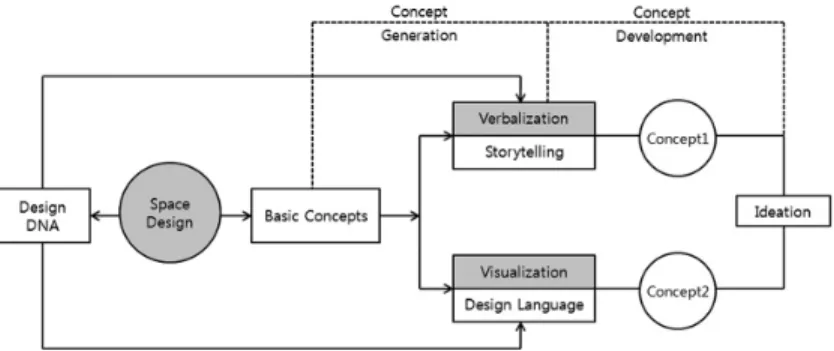
Fig. 1. Schematic Plan for The Study.

the existing design composition elements of space from the viewpoints of industrial design.

1.2. Range and Methods

As a case study through design project, this study was carried out centering on the research of street furniture design of I' Park Apartment in Suwon, which was designed in 2008 by UN Studio of Ben Van Berkel, a Holland architect.

Target street furniture of the design is six prod- ucts of Main Signage, Bench, Lighting, Bike Rack, Litter Bin and Bollard. Processes ranging from establishing and generating the basic design concept up to developing through visualization were set as the design scope and the study was implemented on the assumption that apartment complex is now under construction and street fur- niture will be vitalized later.

Space design, which is mentioned in the proc- ess of the study, includes the Apartment Site Plan (Complex Plan), architecture and landscape plans. Study method and process were started by fully understanding and analyzing already sug- gested draft for the existing space design. As the first stage, so-called Design DNA for establishing overall design strategy was extracted through se- lection of keyword of the basic plan. Second, by extracting basic concept of from space design, ba-

sic structure for the concept generation was made. Third, the two concept generation meth- ods of storytelling and design language were es- tablished by linking phase of verbalization and visualization, which are among the 3V Design Process of Verbalization, Visualization and Vita- lization, with the basic concept. And then the de- sign concept was also developed visually.

2. Concept Generation

Basic overview of the space design plan has unique site conditions as an intermediate height apartment complex. Total area is approximately one million m2 and the site accommodates ap- proximately 6,500 family-units by utilizing a golf course in Kwonsun-gu owned by ROK-AF (Republic of Korean Air Force) as its surround- ing landscape. Basic design element and concept were extracted by analyzing the data of the Apartment Concept Design Manual and Landscape Schematic Design Booklet provided from UN STUDIO and through discussion with actual working team.

2.1. Design DNA

Design DNA is necessary for extracting key el-

ements to establish design concept and to deploy

the design more smoothly. To reiterate, it means

(3)

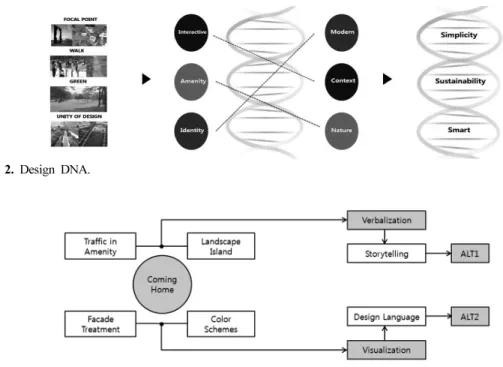
Fig. 2. Design DNA.

Fig. 3. Structure of Concept Generation.

to extract new design variables in the initial con- ceptualization stage for inducing conceptual ele- ments and its visual identity of the design and al- so for improving value of the design identity.

Through analyses of the report of Space Design Plan and the presentation data, Focal Point, Walk, Green and Unity of Design, which are the standards of establishment of the basic design, were extracted as key elements. Based on these, Identity, Interactive, Context, Amenity, Nature and Modern, which are new keyword, were established.

Besides the data presented from UN Studio, three factors, which can be operated as variables during designing process, were extracted by com- bining again those keywords extracted through analyzing additionally researched Visual Inno- vative Style and landscape design guideline of I’

Park Company. A factor of Simplicity was se- cured in a sense of creating modern feeling and simple identity centering on modern artistic char-

acteristics and a factor of Smart was also secured in a sense of pursuing Human-Centered Design by fusing and compounding context and digital technology through behaviors of users. And fi- nally, so-called 3S-DNA was established by set- ting Sustainability as the third factor in a sense of pursuing mutual affinity and sustainability with nature centering on Green Design which is a big issue in modern society.

2.2. Schematic Concepts from the Space Design

Schematic Concepts of the Space Design of I'

Park City, which have integrated the site plan

and the architectural design, start from an overall

theme of “Coming Home” basically. Comfort-

able landscape, communicating traffics and dif-

ferentiated unique form of architectural design

were suggested for solving problems of the apart-

ment with the existing boxy type, uniform and

(4)

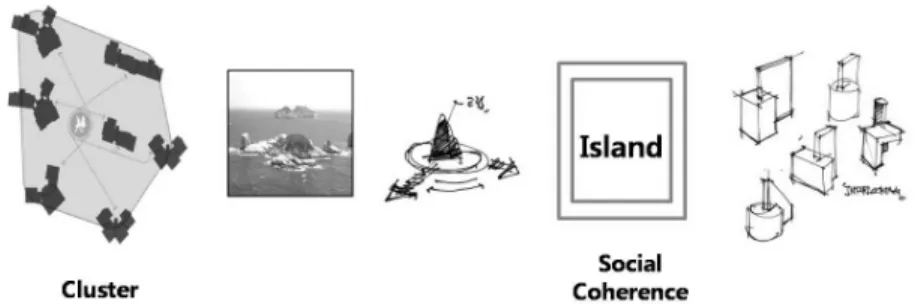
Fig. 4. Concept Development for ALT.Ⅰ.

dense complex plan. Direction of Concept Gene- ration was established by extracting the four con- cepts of comfort and convenience of traffics with- in the site under a sense of Traffic in Amenity, ar- tistic originality through Facade Treatment with unique patterns, Landscape Island, which has conceptualized cluster in the unit of approx- imately several buildings of residential buildings, and Color Schemes with differentiated coloring plan per area of each island.

2.3. 3V Design Process

Method and scope of Concept Generation has applied Verbalization Phase, Visualization Phase and Vitalization Phase with the application of 3V Design Process. To explain these processes brief- ly, the verbalization is a process synchronizing a concept by speaking in the meaning of a dic- tionary. In other words, it means an initial stage to conceptualize a basic idea by establishing a concept. In this phase, while unfolding a story centering on a basic concept, that is, through a method of storytelling, a method to generate a concept was explored. The visualization phase is a method that an idea was modeled in 2D or 3D form to develop and decide a design in visual. In this phase, by establishing the visual elements of design possessed by architectural structures with- in already designed site as a basic motif, a con- cept was generated. Finally, the vitalization phase is a method to produce mass production by

vitalizing selected design. In this study, Concept Generation & Development Process were re- searched centering on the two types of the verbal- ization and visualization, and the vitalization was excluded from the scope of this study.

Concept was generated & developed in two methods by grouping into each of verbalization and visualization respectively after reviewing and analyzing the four basic concepts extracted from the existing Space Design. The concept was de- veloped further by establishing the two methods of verbalization through storytelling in con- nection of Traffic in Amenity concept and Landscape island concept as well as visualization method, which is developed through design lan- guage, in connection of the two concepts of Facade Treatment and unique Color Schemes per area.

3. Concept Development

3.1. Alternative Ⅰ: Storytelling

The most representative concept of Space

Design in this study was to form a cluster per the

unit of block with a fixed scale instead of the de-

ployment of monotonous pattern provided by ex-

isting general apartment space. One community

was formed by collecting the unit of each several

buildings and one island was formed through

traffic for communication and cohesive type de-

ployment structure. Basic conception was im-

(5)

Fig. 6. Concept Design ALT I : Lighting, Bollard, Litter Bin, Bike Rack.

plemented from an idea of creating more ame- nable living space as social glue was generated from this. Because the most important theme of Space Design is “Coming Home,” the meaning of an island was attempted to be found while un- folding stories such as communicating with neighbors and enjoying the living space after re- turning home with happy hearts upon finishing a day’s works.

In considering the meaning of 3S-DNA ex- tracted in the above, that is, Simplicity, Smart and Sustainability, it was designed by establish- ing the basic motif in a design identity of rec- tangular frame through association with geo- metric square forms from an actual island. In case of Main Signage Board, it was design in a form to be surrounded with a frame using rec- tangular steel pipes and each different accent col- or symbolizing each complex was painted on in- side surface of the frame. In concept of the same frame, Bench, Street Light, Litter Bin, Bike Rack and Bollard were designed.

3.2. Alternative Ⅱ: Design Language Artistic originality of the buildings within the site can be unique Facade Pattern of external ap- pearance of the buildings and bold application plan of coloring per area. The pattern has sug- gested three types of Design Identity under the names of Village, Water and Park. In particular, as the result of analyzing patters of Facade Treatment, there was a flow that each individual originality was fused with the uniformity of forms.

Especially, it was judged to have the similarity with the patterns of origami which is a traditional Japanese paper crafts. By interlocking artistic ele- ments of these two kinds of designs, a design was deployed by using folding, cutting off and band- ing forms as the basic visual motif of design.

Folding, cutting off and banding works of steel

sheets with various thickness with laser process-

ing are applied to all designs and it was intended

to provide the feeling of the same identity in

forms and textures. In particular, in case of

bench, artistic elements of buildings were linked

(6)

Fig. 7. Concept Development for ALT.II.

Fig. 8. Concept Design ALT II : Main Sign Board, Directory Sign, Benches.

Fig. 9. Concept Design ALT II : Lighting, Bollard, Litter Bin, Bike Rack.

by applying Facade Pattern as the pattern of ac- tual furniture.

4. Conclusion

To conclude, the concept of street furniture de- sign of this study was generated and developed from the design of the space where the street fur- niture will be installed. Through analyses of the contents of given Space Design Concept, design criteria were established in design DNA of Simplicity, Smart and Sustainability for establish- ing basic direction of design by extracting core

keyword. Next, by finding out in detail forms of buildings and the design concept of surrounding site, four concepts of Traffic in Amenity, Facade Treatment, Landscape Island, and Color Sche- mes were extracted. Design concept through storytelling of verbalization phase was developed by using 3V Design Process. And with the two al- ternatives of application of visual elements of the buildings, Design Concept could be generated and developed by using the Visualization phase.

In case when furniture designers or product de-

signers design street furniture, characters of the

given space are mostly very diverse. Given space

(7)

from this study can suggest methods which can create design rapport with the space, where street furniture will be installed, by solving these prob- lems in designing process of street furniture while street furniture is installed in harmony with the surrounding landscape.

References

Baljon, L. 2008. Landscape Schematic Design, pp. 1-112.

Baljon, L. 2008. Apartments Concept design,

Wester, L. M. 1990. Design Communication for Landscape Architects, pp. 4-112.

Urban Affairs and Veronique Patteeuw, 2002. City Branding Image Building & Building Images, pp.

10-163.

Kroemer, K. H. E. and A. D. Kroemer, 2001. Office Ergonomics, pp. 62-130.

Bacon, E. N. 1976. Design of Cities, pp. 29-84.

Smitshuijzen, E. 2009. Signage Design Manual, pp.

32-91.

수치

Fig. 1. Schematic Plan for The Study.
Fig. 2. Design DNA.
Fig. 4. Concept Development for ALT.Ⅰ.
Fig. 6. Concept Design ALT I : Lighting, Bollard, Litter Bin, Bike Rack.
+2

참조

관련 문서