pISSN 1598-2033 eISSN 2233-5706 J. Korea Inst. Build. Const., Vol. 14, No. 4
http://dx.doi.org/10.5345/JKIBC.2014.14.4.314 www.jkibc.org
원자력발전소 건설현장의 철근콘크리트 공종 생산성 및 영향요인 분석
Reinforced-Concrete Works Productivity and Influence Factor Analysis on Nuclear-Power-Plant Project
허 영 기11) 임 진 호 김 경 욱 안 영 철 오 재 훈*
Huh, Y oung-K i Lim , Jin-Ho Kim , K young-U k Ahn, Y oung-Chul O h, Jae-Hun* Department of Architectural Engineering, Pusan National University, Geumjeong-gu, Busan, 609-735, Korea
Abstract
Nuclear power plant projects are being increased all over the world. The construction of nuclear power plants needs huge money and time, which makes conducting a detailed analysis of productivity through the whole process.
Reinforced-concrete works productivity field data was collected for more than one year and analyzed from a nuclear-power-plant project in Korea. The productivities of formwork, rebar-work, and concrete pouring were 0.54 ㎡ /man․day, 0.06 ton/man․day, 1.98 ㎥/man․day, respectively. Moreover, it is revealed that ‘Day of the Week’ is a driver of the formwork activity and ‘Overtime’ is for all of the three. The results will be a great interest of industry personnel estimating time and cost of a new nuclear power plant.
Keywords : productivity analysis, productivity factor, nuclear power plant, reinforced concrete work
1. 서 론
1.1 연구의 목적
원자력의 위험성에도 불구하고 천연자원고갈과 건설경 기의 침체 등의 문제로 인해 국내·외 원자력발전소 건설이 지속적으로 추진되고 있다. 원자력 발전소를 포함한 세계 플랜트시장 규모는 약 1조 6,000억 달러로 이중 석유·가 스 및 발전 등 에너지분야 플랜트시장이 전체의 65%를 차지 하며, 국제입찰시장은 7,300억 달러에 이르는 것으로 보고 되고 있다.
2011년 한국의 원자력 산업은 아랍에미리트(UAE) 원자
Received : February 25, 2014 Revision received : April 23, 2014 Accepted : May 8, 2014
* Corresponding author : Oh, Jae Hun
[Tel: 82-51-510-7353, E-mail: [email protected]]
ⓒ2014 The Korea Institute of Building Construction, All rights reserved.
력 발전사업 프로젝트를 400억달려(약47조원)규모로 수주 하였으며, 향후 해외 원자력 건설시장에서의 국가 경쟁력강 화에 큰 교두부가 될 것으로 예상된다. 국내기술력은 선진국 에 비해 약 81%정도로 낮은 수준임에도 불구하고 원자력 발전소 건설뿐만 아니라 다양한 플랜트분야에서 수주를 활 발하게 진행하고 있다. 하지만 최근 수요기반의 축소와 경쟁 의 격화, 건설산업의 각 부문별 진입장벽 해소에 따른 신규 기업의 진입증가, 투명성 및 사회인식 변화에 따른 발주자들 의 교섭력증대 등은 기존 건설산업의 구조와 핵심 경쟁력요 소를 변화시키고 있다.
이러한 이유로 국가에서는 국내 플랜트건설 경쟁력강화 를 위해 기술력강화, 인력양성, 사업관리능력 향상 등에 많은 연구개발을 지원하고 있다. 그러나, 플랜트 현장은 경험과 정보력 부족으로 인해 실제 현장에 적용하는데 어려 운 점이 많다. 특히 원자력 발전소와 같은 특수플랜트 건설 은 천문학적인 금액이 투입됨으로 보다 철저한 공정 및 원가 관리가 필수라고 할 수 있다.
특히, 플랜트건설에서 건축이 차지하는 비중은 기계, 전 기설비에 비해 상대적으로 낮아 건축부분에 관한 원가관리 연구는 미흡한 실정이다. 따라서, 본 연구에서는 국내 원자 력발전소 건설현장의 철근콘크리트 공종을 대상으로 생산 성을 측정하고, 현장에 영향을 줄 수 있는 요인들을 대상으 로 생산성에 어떠한 영향을 미치는가에 대한 분석을 실시하 여 향후 특수플랜트 사업의 원가 및 공정관리의 기초자료로 제시하고자 한다.
1.2 연구의 방법 및 범위
본 연구에서는 국내에서 건설 중인 S원자력 발전소 건설 현장의 보조건물을 대상으로 하여 약 9개월(2011년8월∼
2012년6월)간의 현장방문 및 자료수집 등을 통하여 생산성 을 측정 하였다. 또한, 전문가와의 면담을 통하여 특수플랜 트 건설현장에서 생산성에 영향을 줄 수 있는 요인들을 선정 하고 희귀분석과 ANOVA를 이용하여 영향요인에 대한 통 계적 분석을 실시하였으며, 그 연구의 방법은 아래 Figure 1과 같다.
Research Background and Purpose
Site visit and collection of work daily report, expert interview.
Data Collection
Productivity Measurement
Analysis of Influence elements
Result
productivity measurement of each work type based on the unit of Man·Time.
statistical analysis of influence degree according to different influence elements, including weather, week, night duty, number of workers, etc.
Figure 1. Research procedure
2. 플랜트관련 주요 연구 현황
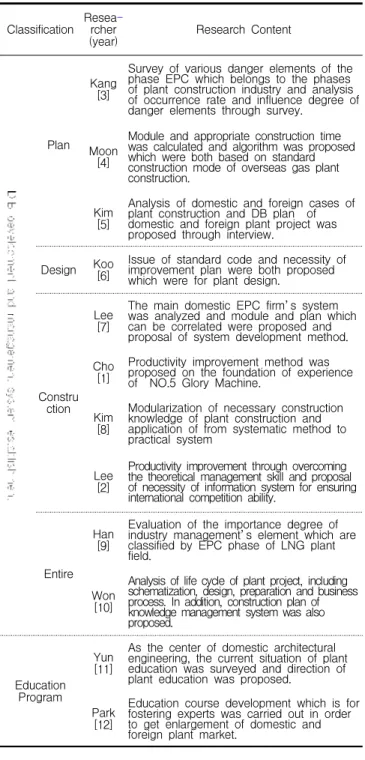
국내의 플랜트 건설 관련연구를 살펴보면, 주로 시스템설 계를 중심으로 한 기술적 문제해결 및 국내·외 시장규모와 진출방안에 대한 내용이 주를 이루고 있으며 생산성과 관련 된 연구는 매우 미미한 실정이다(Table 1).
Cho[1]은 2002년 영광 5호기의 경험을 토대로 원자력
발전소의 시공관리 방법을 통해 생산성 향상을 위한 방법을 연구하고, 그 적용 결과 현저한 공기단축 및 비용절감 효과 가 있었던 것으로 발표하였다.
Lee[2]는 원전 건설사업 관리의 효율성을 높이기 위한 이전의 이론적 관리기법이 실용적 한계를 벗어나지 못하는 점을 지적하고, 극복방안으로 생산성 향상과 국제 경쟁력 확보를 위한 정보시스템 구축의 필요성을 제기하였다.
Classification Resea- rcher
(year) Research Content
Plan Kang[3]
Survey of various danger elements of the phase EPC which belongs to the phases of plant construction industry and analysis of occurrence rate and influence degree of danger elements through survey.
Moon[4]
Module and appropriate construction time was calculated and algorithm was proposed which were both based on standard construction mode of overseas gas plant construction.
Kim[5]
Analysis of domestic and foreign cases of plant construction and DB plan of domestic and foreign plant project was proposed through interview.
Design Koo [6]
Issue of standard code and necessity of improvement plan were both proposed which were for plant design.
Constru ction
Lee[7]
The main domestic EPC firm’s system was analyzed and module and plan which can be correlated were proposed and proposal of system development method.
Cho[1] Productivity improvement method was proposed on the foundation of experience of NO.5 Glory Machine.
Kim[8]
Modularization of necessary construction knowledge of plant construction and application of from systematic method to practical system
Lee[2]
Productivity improvement through overcoming the theoretical management skill and proposal of necessity of information system for ensuring international competition ability.
Entire Han[9]
Evaluation of the importance degree of industry management’s element which are classified by EPC phase of LNG plant field.
Won[10]
Analysis of life cycle of plant project, including schematization, design, preparation and business process. In addition, construction plan of knowledge management system was also proposed.
Education Program
Yun[11]
As the center of domestic architectural engineering, the current situation of plant education was surveyed and direction of plant education was proposed.
Park[12]
Education course development which is for fostering experts was carried out in order to get enlargement of domestic and foreign plant market.
Table 1. Plant relevant research trends
Reinforced-Concrete Works Productivity and Influence Factor Analysis on Nuclear-Power-Plant Project
특수 플랜트건설현장은 일반적인 플랜트현장과 달리 보 다 체계적인 원가관리가 요구되지만 이에 필요한 생산성 관련 연구가 없어, 공종별로 생산성을 측정하고 영향요인을 분석하는 구체적인 연구가 시급하다.
3. 대상 분석 및 생산성의 정의
3.1 S현장의 개요
현재 건설중인 S원자력 발전소 건설현장은 2007년 9월 에 착공을 하였으며, 2014년 9월에 준공 예정에 있으며, 개요 는 Table 2와 같다.
Classification Contents
Date of Primary
Plan Established 2001.2.24
Type Pressurized Light Water Reactor(1400MW×2) Total Construction
Cost USD 5,760,000,000
Floor Area 1,737,788 ㎡
Table 2. Outline & Layout of site S
3.2 생산성 측정 및 영향요인 선정
3.2.1 생산성의 정의
S현장 시공생산성을 분석하고자 ‘작업 인·시간 생산성’
을 측정단위로 정의하고, 생산량(Ouput)은 작업물량(㎡, Ton,㎥)을 기준으로 하였으며 투입량(Iutput)은 하루 동안 현장에 투입된 인원을 기준으로 하였다. 하루는 오전, 오후 동안 작업시간을 기준으로 9시간 정의하며, 야간작업일 경 우 2시간을 추가로 포함하고 각 공종별 작업반장은 투입인 원 수에서 제외 하였다.
작업 인·시간 생산성 총 투입공수 ·일인·일
총 생산량
-- (1)
3.2.2 영향요인 선정
전문가들과의 면담을 통하여 현장에서 생산성에 영향을 줄 수 있는 요인들을 선정 하였으며, 수집할 수 있는 자료 내에서 분석할 수 있는 영향요인으로는 날씨, 요일, 야간 작업 유무, 작업인원, 작업조, 작업물량으로 파악되었다 (Table 3).
Candidate Drivers Definition
Weather
Data from Meteorological Administration
Cloud amount is above 6 and below 6
Weather data from the
site work report
Clean day, cloudy day and rainy day
Day of the Week Divided by week, from Monday to Sunday
Overtime Divided by whether there is a night duty or not according to the work report
No. of Worker Number of total workers per unit day
No. of Crew Number of total crews per unit day Work Amount Total work amount (m2, Ton, ㎥)
per unit day
Table 3. Key elements of productivity influence selection
4. 생산성 측정 및 품셈과의 비교분석
4.1 생산성 측정결과
현장 실사를 통해 수집된 자료를 근거로 S현장의 ‘작업 인·시간 생산성’을 산출하였다. 형틀, 철근, 콘크리트 타 설 등 세 개 공종을 대상으로 하였으며, 이상치를 제거하고 분석에 사용된 생산성 자료는 각각 169, 179, 53개 이다.
그 결과 형틀공, 철근공, 콘크리트공의 인·시간 생산성의 평균은 각각 0.54(㎡/man·time), 0.06(t/man·time), 1.98(㎥/man·time)로 나타났다(Figure 2, Table 4).
a) Formwork productivity b) Rebar productivity
c) Concrete productivity
Figure 2. Box diagram of labour․time productivity
Classification N Average StandardDeviations Standard
Error Min Max Formwork
Worker
(㎡/man·time) 169 0.5418 0.16745 0.1288 0.11 0.98 Rebar-Worker
(t/man·time) 179 0.0621 0.01318 0.00099 0.04 0.10 Concrete
Pouring
(㎥/man·time) 53 1.9817 1.34600 0.18489 0.08 5.42
4.2 생산성 품셈과의 비교
산출된 ‘작업 인·시간 생산성’과 작업조 생산성의 수준 을 분석하기 위하여 표준품셈에서 제시하고 있는 생산성과 비교를 실시하였다. 표준품셈에서 도출한 생산성 수치는 전문가의견 및 실사내용을 참고하여 Table 5와 같은 기준을 근거로 하였다.
Worktype Estimating Sandards(2013)
-workForm Under the standard of formwork and euro form are applied by a scale of 1 to 9, extra 10% is attached
Rebar Under the standard of the number of rebar workers of complicated process and assembly Concr
ete Under the standard of concrete pump truck’s pipe cast and tunnel cast are applied by a scale of 7 to 3 Table 5. Calculation basis of quota productivity for
productivity comparison
품셈과 비교를 위하여 분석한 단위(Work Amount/Man·
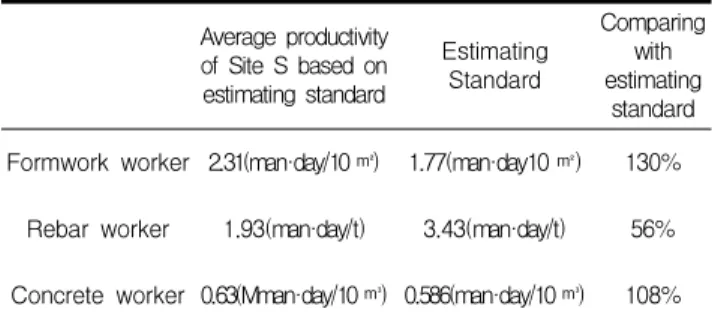
Time)를 품셈기준(Man·Day/Work Amount)으로 산출한 결과 형틀공은 2.31, 철근공 1.93, 콘크리트공 0.63으로 나타 났으며, 이는 품셈 기준대비 각각 130%, 56%, 108% 수준으로 분석되었다(Table 6).
형틀 및 콘크리트 공종의 생산성은 품질관리가 철저하게 이루어지는 현장의 특성 때문에 품셈 기준보다 높은 결과가 나온 것으로 판단된다. 철근 공종의 경우는 품셈대비 약 50% 정도의 인력만이 투입되는 것으로 분석되었다. 이는, 플랜트 공종의 경우 투입되는 철근의 단위당 무게가 일반 건축물에 비해 매우 큼에 인한 것으로 판단된다.
Average productivity of Site S based on estimating standard
Estimating Standard
Comparing estimatingwith standard Formwork worker 2.31(man·day/10㎡) 1.77(man·day10 ㎡) 130%
Rebar worker 1.93(man·day/t) 3.43(man·day/t) 56%
Concrete worker 0.63(Mman·day/10㎥) 0.586(man·day/10㎥) 108%
5. 영향요인 분석
생산성에 영향을 미치는 요인들의 분석은 형틀, 철근, 콘크리트 공종별로 앞서 선정된 7가지 요인들에 대하여 상 관분석을 실시한 후 의미있는 요인들에 대하여 회귀분석과 ANOVA분석을 실시하였다. 본 논문에서는 모든 영향요인 중 통계적으로 유의하여 영향을 미치는 것으로 판단되는 요인들만에 대하여 기술 하였다.
5.1 형틀공종의 영향요인 분석
5.1.1 요일
요일별에 따른 형틀공종의 ‘작업 인·시간 생산성’에 대 한 ANOVA분석 결과 유의확률이 0.007로 유의수준(0.05) 보다 낮아 통계적으로 유의하여 영향을 미치는 것으로 분석 되었다(Figure 3, Table 7).
Monday∼Thursday Friday Sunday Saturday
Week(workday , weekend) form-worke Productivity(m 2/man·time)
Figure 3. Box diagram of work labour·time productivity according to week
Reinforced-Concrete Works Productivity and Influence Factor Analysis on Nuclear-Power-Plant Project
multiply Freedom
degree Average
multiply F Benefit rate Between
group 0.333 3 0.111 4.189 0.007
Within
group 4.377 165 0.027
Total 4.711 168
Table 7. Work productivity ANOVA according to week
5.1.2 야간작업 유무
야간작업 유무에 따른 ‘작업 인·시간 생산성’의 ANOVA 분석 결과 유의확률이 0.000으로 유의수준(0.05)보다 낮아 통계적으로 유의하여 영향을 미치는 것으로 분석되었다 (Figure 4, Table 8).
rm-work Productivity(m/man·time) Fo2
night duty off night duty on Form-work night duty on or off
Figure 4. Work productivity ANOVA according to existence or in-existence of night duty
multiply Freedom
degree Average
multiply F Benefit rate Between
group 0.637 1 0.637 26.114 0.000
Within
group 4.074 167 0.024
Total 4.711 168
Table 8. Work productivity ANOVA according to night duty
5.2 철근공종의 영향요인 분석
5.2.1 야간작업 유무
야간작업 유무에 따른 철근공종의 ‘작업 인·시간 생산 성’에 대한 ANOVA분석 결과 유의확률이 0.001로 유의수 준(0.05)보다 낮아 통계적으로 유의하여 영향을 미치는 것 으로 분석되었다(Figure 5, Table 9).
night duty off night duty on
RebarProductivity(t/man·time)
Rebar night duty on or off
Figure 5. Box diagram of work labour·time productivity according to existence or in-existence of night duty
multiply Freedom
degree Average
multiply F Benefit rate Between
group 0.002 1 0.002 12.213 0.001
Within
group 0.029 177 0.000
Total 0.031 178
Table 9. Work productivity ANOVA according to night duty
5.3 콘크리트공종의 영향요인 분석
5.3.1 야간작업 유무
야간작업 유무에 따른 콘크리트공종의 ‘작업 인·시간 생산성’에 대한 ANOVA분석 결과 유의확률이 0.026으로 유의수준(0.05)보다 낮아 통계적으로 유의하여 영향을 미 치는 것으로 분석되었다(Figure 6, Table 10).
Concrete night duty on or off night duty off night duty on
Concrete Productivity(m 3/man·time)
Figure 6. Box diagram of work labour·time productivity according to existence or in-existence of night duty
multiply Freedom
degree Average
multiply F Benefit rate Between
group 8.823 1 8.823 5.270 0.026
Within
group 85.386 51 1.674
Total 94.209 52
5.3.2 콘크리트 물량
콘크리트 물량에 대한 회귀분석 결과 결정계수(R2)는 0.466이며 유의확률이 0.000으로서 ‘작업 인·시간 생산 성’에 어느 정도 영향을 미치는 것으로 분석되었다(Figure 7, Table 11).
Regression Analysis
Concrete Amount
Y = 0.831 + 0.006X
R2 = 0.466, Std. Error of Est. = 0.993, p-Vaue(of X) = 0.000 Figure 7. Work labour․time productivity regression analysis
according to concrete amount
Multiply Freedom
degree Average
multiply F Benefit rate Regression
model 43.887 1 43.887 44.479 0.000
Residual
return 50.322 51 0.987
Total 94.209 52
Table 11. Work labour·time productivity ANOVA according to concrete amount
5.4 영향요인 분석 결과
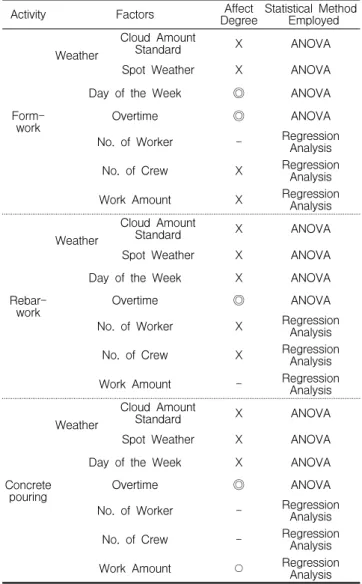
각 공종별로 상관성 분석을 통해 의미 있는 영향요인들에 대하여 통계 분석을 실시한 결과 형틀공종에서는 요일과 야간작업 유무, 철근공종에서는 야간작업 유무, 콘크리트공
의하게 영향을 미치는 것으로 나타났다(Table 12).
Activity Factors Affect
Degree Statistical Method Employed
Form- work
Weather
Cloud Amount
Standard X ANOVA
Spot Weather X ANOVA
Day of the Week ◎ ANOVA
Overtime ◎ ANOVA
No. of Worker - Regression
Analysis
No. of Crew X Regression
Analysis
Work Amount X Regression
Analysis
Rebar- work
Weather
Cloud Amount
Standard X ANOVA
Spot Weather X ANOVA
Day of the Week X ANOVA
Overtime ◎ ANOVA
No. of Worker X Regression
Analysis
No. of Crew X Regression
Analysis
Work Amount - Regression
Analysis
Concrete pouring
Weather
Cloud Amount
Standard X ANOVA
Spot Weather X ANOVA
Day of the Week X ANOVA
Overtime ◎ ANOVA
No. of Worker - Regression
Analysis
No. of Crew - Regression
Analysis
Work Amount ○ Regression
Analysis
◎ : Statistically is significant
○ : Affect to a certain extent X : Not affect
Table 12. Analysis result of key influence elements classified by engineering
6. 결 론
특수플랜트 현장의 생산성 측정과 영향요인 분석을 위하 여 최근 건설 중에 있는 S현장의 실측자료를 토대로 분석한 결과 다음과 같은 결과를 얻었다.
1) 평균생산성은 형틀공종 0.54(㎡/man·time), 철근 공종 0.06 (t/man·time), 콘크리트공종 1.98(㎥
/man·time)로 나타났다.
Reinforced-Concrete Works Productivity and Influence Factor Analysis on Nuclear-Power-Plant Project
2) 품셈과의 비교를 위해 품셈기준 단위로 환산 후 비교 분석을 한 결과, 형틀공종 130%, 철근공종 56%, 콘크 리트공종 108%로 나타났으며; 형틀과 콘크리트의 경우 철저한 품질관리 때문에 보다 많은 인원이 필요 하며, 철근공종의 경우 플랜트현장의 특성상 무거운 철근무게로 인해 적은 작업인원이 투입되는 결과가 나온 것으로 판단된다.
3) 전문가 면담을 통하여 생산성에 영향을 줄 것으로 예 상되는 요인들을 선정한 후 통계분석을 실시한 결과, 형틀공종에서는 요일과 야간작업 유무, 철근공종에 서는 야간작업 유무, 콘크리트공종에서는 야간작업 유무와 콘크리트 물량이 통계적으로 유의하여 영향을 미치는 것으로 나타났다.
본 연구에서는 특수 플랜트 건설현장 자료를 수집하여 생산성을 측정하고 생산성에 영향을 미치는 직접적인 요인 들을 도출하였다. 향후 직접적인 영향요인들 외에 작업의 난이도, 설계변경, 작업조건 등과 같은 보다 구체적인 요인 들이 생산성에 어떠한 영향을 미치는지에 대한 분석이 필요 하다.
요 약
특수 플랜트 건설은 타 건설사업보다 체계적인 원가 및 공정관리가 요구되지만 이를 위하 반드시 필요한 현장 생산 성을 구체적으로 분석한 연구는 이루어지지 않고 있다. 본 연구에서는 국내에서 건설중인 특수 플랜트 현장의 철근콘 크리트공종을 형틀, 철근, 콘크리트로 나누어 생산성을 측 정하고 생산성에 영향을 미치는 요인을 분석하였다.
생산성 측정결과 형틀공종 0.54(㎡/man·time), 철근공종 0.06(t/man·time), 콘크리트공종 1.98(㎥/man·time)로 나타났다. 영향요인으로는 형틀공종은 요일과 야간적업 유무, 철근공종은 야간잡업 유무, 콘크리트공종은 야간작업 유무와 콘크리트 물량이 통계적으로 유의게 영향을 미치는 것으로 분석 되었다.
키워드 : 생산성, 영향요인, 원자력발전소, 철근콘크리트 공종
Acknowledgement
This work was supported by the National Research Foundation of Korea Grant funded by the Korean Government (NRF-2011-0028987).
References
1. Cho YS. Improving Productivity by Effective Construction Management of Atomic Power Station. Journal of the Korea Institute of Construction Management. 2002 Jun;10(2):9-13.
2. Lee UB, Moon BS. Establishment of Information System for Improving Construction Productivity of Nuclear Power Stations.
Journal of the Korea Atomic Industrial Forum. 2000 Dec;214(12):32-8.
3. Kang HU, Min BJ, Kim YS. A Study on the Influence Analysis of Management list for Overseas Plant Construction Projects Risk Factors. Journal of the Korea Institute of Construction Management. 2010 Nov;261(7): 333-4.
4. Moon SU, Park SC, Kwon KN. Approximate Estimating of Plant Construction Duration Using a Standard Schedule Model.
Journal of the Korea Institute of Construction Management.
2009 Mar;48(2):26-33.
5. Kim SS, You YH, Cho CY, Son JH. A Study on Measures for Structuring Overseas Plant Database Through the Analysis of Awarded Overseas Plant Orders. Proceeding of the Korea Institute of Construction Management; 2007 Nov 8-9; Busan, Korea. Seoul (Korea): Korea Institute of Construction Management; 2007. p. 234-8.
6. Koo BH, Kim TH. Application System Improvement of the Codes and Standards for Plant Design. Journal of the Korea Institute of Construction Management. 2007 Aug;38(4):81-9.
7. Lee SH, Kim SK, Lee JB, Han CH. Proposal for Developed Procurement and Material management System On Using Previous System Analysis in Plant Engineering. Proceeding of the Korea Institute of Construction Management; 2006 Nov 11; Suwon, Korea. Seoul (Korea): Korea Institute of Construction Management; 2006. p. 204-9.
8. Kim UJ. A Knowledge-based Approach to Plant Construction Process Planning. Journal of the Korea Intelligent Information System Society. 2001 Jun;7(1): 81-95.
9. Han JG, Chin KH, Park HP. Elicitation Project Management Factors and Evaluation of its Weight to Ensure LNG Plant Success. Proceeding of the Korea Institute of Building
10. Won SY, Lee JB, Han CH. Analysis of the Pre-construction Process for Overseas LNG Plant Projects. Journal of the Korea Institute of Construction Management. 2009 Dec;38(6):151-9.
11. Yun SH, Lee SJ, Ock JH. The Analysis of Domestic Plant Engineering Curriculums Based on Architecture Engineering.
Proceeding of the Korea Institute of Construction Management;
2011 Nov 11; Seoul, Korea. Seoul (Korea); Korea Institute of Construction Management; 2011. p. 31-4.
12. Park ES, Jang KS, Koh SW, Lee TS. A Study on Development of Plant Educational Contents For Training the Plant Experts in the Abroad Construction Market. Proceeding of the Korea Institute of Construction Management; 2007 Nov 8-9; Busan, Korea. Seoul (Korea): Korea Institute of Construction Management; 2007. p. 695-8.
13. Song CB, Hong SH, Lee DU. The Operating Rate of Build Labor of Construction Business Fluctuation and Analysis on Productivity. Journal of the Korea Institute of Architecture.
2010 May;259(5):141-9.
14. Son JU, Yoon JS, Baek JH. A Study on Construction Productivity Measurement Method. Journal of the Korea Institute of Architecture. 2003 Oct;180(10):101-8.