친환경자재를 이용한 인삼 점무늬병과 탄저병의 발병억제효과
1)
임진수*․모황성*․이응호*․박기춘**․정찬문***
Suppressive Effects of Homemade Environment-friendly Materials on Alternaria Blight and Anthracnose of Ginseng
Lim, Jin-Soo․Mo, Hwang-Sung․Lee, Eung-Ho․
Park, Kee-Choon․Chung, Chan-Moon
This study was performed to evaluate the suppressive effects of organic fungicides made using environment-friendly materials on leaf spot disease and anthracnose that infect ginseng. Anthracnose (Colletotrichum gloeosporioides) and leaf spot disease (Alternaria panax) are principal diseases that decrease the yield of ginseng by defoliation before root enlargement. Fermented eggs and oyster shells, water extract of green tea and ethanol extract of red ginseng dregs were significantly effective in suppressing leaf spot disease. Fermented crab and shrimp shells and fermented motherwort were also effective in suppressing the recurrence of ginseng anthracnose. The preventive effects of these environment-friendly materials were definitely superior to the therapeutic effects. Therefore, these materials could be used as alternatives to chemical pesticides, which can not be applied in organic ginseng cultivation field. These organic fungicides need to be applied before the incidence of ginseng anthracnose in order to maximize their suppressive effects.
Key words : ginseng anthracnose, leaf spot disease, organic fungicide
* 농촌진흥청 원예특작과학원 인삼특작부 인삼과
** Corresponding author, 농촌진흥청 원예특작과학원 인삼특작부 인삼과([email protected])
*** 충북대학교 농업생명환경대학 특용식물학과
Ⅰ. 서 론
인삼 점무늬병은 Alternaria panax에 의해 유발되고(Leahy, 1986; Putnam and Du-Toit, 2003) 줄기 또는 잎에 흑갈색의 부정형 병반을 형성한다(Bae et al., 2005). Rosenbaum(1915)의 보 고에 의하면 Alternaria 균은 흑색뿌리썩음병(Black root rot)에도 관여한다고 한다. 점무늬병 은 4월 하순부터 8월까지 발생하는데, 특히 고온 다습한 5~6월에 크게 발병하여 인삼에 큰 피해를 준다(Kang et al., 2007; Kim et al., 2008).
인삼 탄저병은 Colletotrichum gloeosporioides 균에 의해 유발되고(Nakada and Takimoto, 1922) 인삼의 잎, 줄기, 열매 등에서 병반이 발생한다. 발병 시기는 6월 하순경부터이며 탄저 병 발생밀도는 강우량, 상대습도, 온도와 같은 기상환경과 아주 밀접한 관련이 있다(Jeffriese et al., 1990; Wharton and Dieguez-Uribeondo, 2004). 그래서 인삼 탄저병의 발병은 고온다습 조건인 8월 하순에 최성기를 보인다(Kim et al., 1990). 인삼 탄저균의 포자는 빗물에 의해서 전파되는 대표적인 병원균이다(Madden, 1992). 탄저균은 토양 표면에 존재하다가 빗방울 등에 의해 튀어 줄기 또는 잎으로 전염된다(Madden et al., 1993; Bae et al., 2005). 부적합한 환경에서 탄저균은 작물의 조직 내에 잠복하여 있다가 적합한 환경이 되면 다시 발병하기 시작한다(Wharton and Dieguez-Uribeondo, 2004; Than et al., 2008). 탄저균은 감염된 토양과 감염된 식물체 조직에서 월동한 후에 식물체에 다시 감염된다고 한다(Eastburn and Gubler, 1990; Khan and Sinclair, 1991; Wilson et al., 1992; Yoshida and Shirata, 1999).
인삼은 재배 특성상 다년생 반음지성 작물로 해가림을 해주어야하기 때문에 식물체가 연약하여 병해나 충해의 피해가 커서 매년 크게 수확량이 감소하기 때문에(Whetzel, 1906;
Nakada and Takimoto, 1922; Mok, 2000; Kim et al., 2008) 재배농가에서는 일반적으로 농약 을 년 7~10회 정도 사용하고 있는 실정이다(Bae et al., 2005). 그러나 인삼을 소비하는 소비 자들의 인삼 선택 기준에 있어서 품질 다음으로 안전성을 중요시하고 있다(Jang et al., 2011). 최근 유기농 인삼에 대한 수요가 증가하면서 유기농 인삼의 생산농가도 늘어나고 있 는 추세이고 고품질 안전농산물을 생산하여 소득을 증가시키려는 시도가 계속해서 이루어 지고 있다. 따라서 최근 연구진들은 화학농약을 대체하기 위하여 생물학적 방제방법(Jung et al., 2006; Lee et al., 2012)과 친환경자재(Lee et al., 2010; Kim and Park, 2013)의 이용에 관한 연구를 끊임없이 수행하고 있다.
생물학적 방법으로는 천연물에서 추출한 항균활성물질을 이용하여 병원균을 억제시키는 방법(Robert et al., 2003)과 독성을 가진 항균성 물질을 가지고 있는 Bacillus spp.(Baker et al., 1983; Mehnaz et al., 2001)와 같은 길항미생물을 이용한 병 방제를 하는 방법들이 활발 하게 사용되고 있다(Kim et al., 2010a; Lee et al., 2012). 많이 사용되고 있는 친환경 유기농 자재 중 대표적인 친환경 자재인 석회보르드액은 구리황산염과 과산화칼슘의 반응으로 만 들어진 친환경 보호 살균제이면서 현재까지 여러 작물에 광범위하게 사용되고 있다(Agrios,
2005; Li et al., 2005; Kang et al., 2008). 석회유황합제나 황토유황합제와 같은 유황자재는 작물의 흰가루병(Lee et al., 2010), 잿빛곰팡이병(Kwak et al., 2012a), 탄저병 등의 포자 발아 및 균사의 생장 억제 능력이 우수하고(Kwak et al., 2012b) 가격이 저렴하여 최근 농가에서 많이 사용하고 있다. 그러나 7월 이후 고온 기에 이와 같은 유황자재를 사용하면 약해 발생 이 생기는 문제점이 있다(Ahn et al., 2013a). 그러나 아직까지 친환경자재의 병 방제 효과 및 효능에 대한 명확한 보고는 없다. 따라서 인삼 재배에서 가장 문제가 되는 병인 점무늬 병과 탄저병은 유기농 인삼재배 시 더욱 문제가 되는 병해로써 화학농약을 대체하여 이들 병을 막을 수 있는 대체제가 필요하다. 본 연구에서는 유기농 농가에서 사용되고 있는 친 환경자재들을 경엽에 살포했을 때 인삼 탄저병과 점무늬병에 대한 발병 억제효과를 조사 하였다.
Ⅱ. 재료 및 방법
1. 공시 재료본 시험에 사용한 공시재료는 인삼탄화액, 인삼 부산물 발효액, 인산칼슘, 천연칼슘, 녹 차 추출물, 쑥 술, 민들레 술, 홍삼박 술, 게 껍질 발효액, 인삼효소술, 익모초 자연즙액 등 이며 그 제조 방법은 다음과 같다. 인삼탄화액은 인삼의 잎과 줄기 300 kg을 화로에서 12시 간 태울 때 생긴 증기를 자연냉각으로 응축하였다. 인삼 부산물 발효액은 200 L 통에 홍삼 박 20 kg, 건조한 인삼의 잎 ․ 줄기 5 kg과 잔뿌리 5 kg을 넣고 토착 미생물 배양액을 통에 가득 채워 1년 동안 실온, 암실에서 발효하였다. 인산칼슘은 20L용기에 건조된 돼지뼈 8 kg, 소뼈 4 kg을 넣고 토착미생물배양 원액을 가득 채워 검은 비닐로 덮은 후에 실온, 암실 에서 100일 동안 발효하였다. 천연칼슘은 20 L 용기에 계란껍질 8 kg, 굴 껍질 4 kg을 넣고 토착미생물 배양 원액을 가득 채워 검은 비닐로 덮은 후 실온, 암실에서 100일 동안 발효하 였다. 녹차 추출물은 미지근한 물 1 L에 마른 녹차 잎 10 g을 넣고 1시간동안 중탕하여 추 출했다. 쑥 술은 10 L 항아리에 쑥 3 kg과 흑설탕 3 kg을 넣고 100일 후 액을 제거한 다음 남은 잔여물에 95% 알코올을 항아리에 가득 채우고 밀봉하여 실온, 암실에서 100일 동안 발효하였다. 민들레 술은 10 L 항아리에 민들레 3 kg과 흑설탕 3 kg을 넣고 100일 후 액을 제거한 다음 남은 잔여물에 95% 알코올을 항아리에 가득 채우고 밀봉하여 실온, 암실에서 100일 동안 발효하였다. 홍삼박 술은 20 L 항아리에 건조된 홍삼박 2 kg과 막걸리 3 L를 넣 고 2일 후 항아리에 95% 알코올을 가득 채운 후 밀봉하여 실온, 암실에서 100일 동안 발효 하였다. 게 껍질 발효액은 20 L 용기에 마른 게 껍질 5 kg과 마른 새우껍질 5 kg 채우고 토 착미생물 배양 원액을 가득 채워 검은 비닐로 덮고 실온, 암실에서 100일 동안 발효하였다.
인삼효소 술은 10 L 항아리에 인삼 식물체 전체(잎, 줄기, 뿌리) 3 kg과 흑설탕 3 kg을 넣고 100일 후 액을 제거한 후 남은 잔여물에 95% 알코올을 항아리에 가득 채우고 밀봉하여 실 온, 암실에서 100일 동안 발효하였다. 익모초 자연즙액은 20 L 비닐봉투에 익모초 식물체 전체를 15 kg을 채우고 입구를 밀봉한 후 실온, 암실에서 발효하였다.
2. 친환경자재의 발병 억제효과
생육상태가 일정한 자경종 1년근 묘삼을 2012년 4월 7일 지름 13 cm, 높이 12 cm의 플라 스틱 포트에 식재한 후 탄저와 점무늬병과 같은 인삼 병해로부터 보호하기 위하여 비가림 하우스에서 3개월 동안 재배하였다. 병원균을 접종하기 위해 비가림 하우스에 있는 식물체 를 7월 7일 해가림 시설로 옮겼다. 이 연구에 사용한 병원균은 농촌진흥청 유전자원센터 (RDA genebank)에서 2012년도에 분양받은 점무늬병(A. panax)과 탄저병(C. gloeosporioides) 균주들을 이용하였다. 점무늬병원균은 V8A 배지에 접종한 후 23℃ UV 배양기에 넣어 하루 에 12시간 동안 UV 등을, 탄저병원균은 PDA(potato dextrose agar) 배지에 접종한 후 23℃로 유지되는 배양기에 넣은 후 형광등을 하루에 각각 12시간 동안 점등하여 포자가 완전히 형 성될 때까지 10일 동안 배양하였다. 3겹의 거즈를 깔때기에 올린 후 50 mL Conical-tube에 넣어 잘 형성된 분생포자와 균사를 긁어모아 거른 후 Hemocytometer를 이용하여 점무늬병 과 탄저병의 분생포자 현탁액 밀도를 각각 1×10⁴와 5×10⁴ spore/mL으로 맞추었다. 시험은 예방효과와 치료효과로 나누어서 실시하였으며 예방효과를 검정하기 위해 먼저 친환경자 재 처리(500배 희석) 후 다음날 병원균을 접종하였고, 치료효과를 검증하기 위해 먼저 병원 균 접종 후 다음날 친환경자재를 처리(500배 희석)하였다. 시험구 배치는 완전임의배치 5반 복으로 친환경자재와 분생포자 현탁액을 각각 포트 당 50 mL씩 경엽에 처리하였으며 병원 균 접종 후 습도를 유지하기 위해 3일 동안 접종한 식물체를 플라스틱 용기로 덮고 그 이 후에는 가습을 중단하기 위해 플라스틱 용기를 제거하였다. 처리 자재는 13종의 친환경 자 재, 탄저병 및 점무늬병 방제로 등록된 화학농약(오티바, 신젠타 코리아) 및 증류수를 사용 하였다. 병의 예방 및 치료효과 조사는 접종 7일 후에 잎과 줄기에 해부현미경과 광학현미 경을 이용하여 포자 및 균사를 확인하여 감염 여부를 확인한 후 이병률과 방제가를 계산하 였다. 이병률과 방제가 계산은 다음과 같은 식을 이용하여 산출 하였다. 평균간 유의차 검 정은 Duncan의 다중검정 방법을 이용하였다.
Disease incidence (%) = No. infected leaf / No. total leaf × 100
Control value (%) = ((Disease leaf of untreated - Disease leaf of treatment) / Disease leaf of untreated) × 100
Ⅲ. 결과 및 고찰
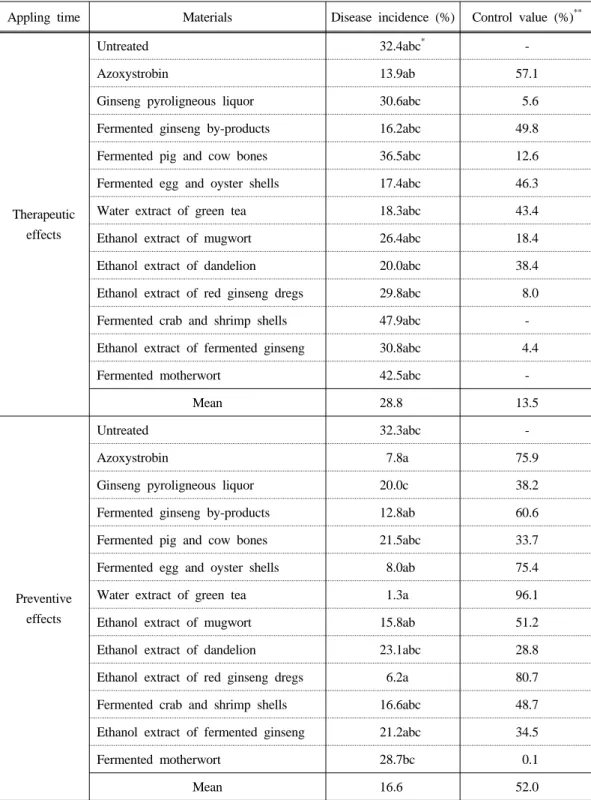
1. 친환경자재의 인삼 점무늬병 방제효과친환경자재별 처리 전 ․ 후의 잎 점무늬병 발생률을 조사 대조하였다(Table 1). 살균제는 치료보다 예방 차원에서 이용할 경우 더 효율적인 발병 억제효과를 나타낸다고 한 Hyun 등(2000)과 Shin 등(2010)의 보고처럼 A. panax에 의하여 발병하는 인삼 점무늬병 실험에서 친환경자재는 치료효과보다 예방차원에서 처리할 때 대체로 발병 억제효과가 컸다. 치료효 과를 검증하기 위해 접종 후 친환경자재를 처리 했을 경우 병 방제 효과는 거의 나타나지 않았으며 화학농약 처리 구에 훨씬 못 미치는 결과를 나타내었다. 반면에 예방차원으로 친 환경자재를 처리했을 때 더 큰 효과를 보였다. 이 결과들을 볼 때 처리 시기는 발병 억제효 과와 아주 밀접한 관계가 있을 뿐 아니라 큰 영향을 미치는 것을 알 수 있었다(Shin et al., 2010).
방제효과를 보인 친환경 자재는 녹차추출물, 홍삼박 막걸리 주정액, 천연칼슘 등이었으 며 이들은 예방차원에서 처리했을 때 화학농약 처리구와 대등한 억제효과를 보였다(Fig. 1).
반면에 치료차원에서 처리를 하면 오히려 억제효과가 떨어지는 경향을 보였다. Chang 등 (2000)은 오이 노균병(Peronospora spp.) 방제는 발병 후보다 발병 전에 살포하는 것이 더 효 과적이라고 보고하였다. 친환경자재 중 녹차 추출물을 예방차원에서 처리 할 경우 화학농 약(75.94%)보다 더 우수한 방제효과(96.1%)를 나타내었다. 녹차는 다양한 생리활성 성분을 함유하고 있어 높은 항산화 효과가 있는 것으로 알려졌다(Wickremasinghe, 1978; Lee and Shin, 1993). 녹차 추출물은 또한 세균의 원형질막 용해를 촉진시켜 식중독세균(Salmonella typhimurium), 변패미생물과 같은 세포를 사멸시킨다(Park et al., 2001; Shin et al., 2009). 식 물의 줄기나 잎에서 추출한 천연추출물은 다양한 생리활성물질을 함유하고 있어 친환경적 으로 발병을 억제시킨다(Choi et al., 2002; Ahn et al., 2013b). 특히 인진쑥이나 녹차 추출물 은 육류에 천연 항생제로 사용할 만큼 항균효과가 높다(Kim et al., 2010b).
칼슘화합물은 사과나무 점무늬병(A. mali)의 병원균 생육을 억제한다(Yoon and Lee, 1987)고 하였는데, 천연칼슘을 예방적으로 처리했을 때 화학농약과 대등한 방제효과를 보였다. 그러나 인산칼슘은 방제효과가 다소 저조했다. Yoon 등(1989)은 CaO와 Ca(OH)2는 농도가 높을수록 발병 억제효과가 좋았지만 CaCO3는 농도에 상관없이 방제효과가 저조하다고 보고했다.
발효하여 만든 친환경자재 중 홍삼박 막걸리 주정액의 점무늬병 방제효과는 대조구로 사용한 농약처리보다 더 높은 것으로 나타났다. 반면에 인삼부산물미생물분해액은 대조구 에 못 미치는 결과를 나타내었다. Choi 등(2005)은 야생차 추출물의 항균활성은 단순히 추 출액보다 발효 추출액이 더 크지만 발효를 많이 시키면 오히려 항균활성이 떨어진다고 보 고 하였다.
Table 1. Effects of environment-friendly materials on Alternaria panax in Korea ginseng
Appling time Materials Disease incidence (%) Control value (%)**
Therapeutic effects
Untreated 32.4abc* -
Azoxystrobin 13.9ab 57.1
Ginseng pyroligneous liquor 30.6abc 5.6
Fermented ginseng by-products 16.2abc 49.8
Fermented pig and cow bones 36.5abc 12.6
Fermented egg and oyster shells 17.4abc 46.3
Water extract of green tea 18.3abc 43.4
Ethanol extract of mugwort 26.4abc 18.4
Ethanol extract of dandelion 20.0abc 38.4
Ethanol extract of red ginseng dregs 29.8abc 8.0
Fermented crab and shrimp shells 47.9abc -
Ethanol extract of fermented ginseng 30.8abc 4.4
Fermented motherwort 42.5abc -
Mean 28.8 13.5
Preventive effects
Untreated 32.3abc -
Azoxystrobin 7.8a 75.9
Ginseng pyroligneous liquor 20.0c 38.2
Fermented ginseng by-products 12.8ab 60.6
Fermented pig and cow bones 21.5abc 33.7
Fermented egg and oyster shells 8.0ab 75.4
Water extract of green tea 1.3a 96.1
Ethanol extract of mugwort 15.8ab 51.2
Ethanol extract of dandelion 23.1abc 28.8
Ethanol extract of red ginseng dregs 6.2a 80.7
Fermented crab and shrimp shells 16.6abc 48.7
Ethanol extract of fermented ginseng 21.2abc 34.5
Fermented motherwort 28.7bc 0.1
Mean 16.6 52.0
* Mean segregation within columns by Duncanz’s multiple range test at P=0.05
** Control value = ((Disease leaf of untreated-Disease leaf of treatment)/Disease leaf of untreated)
B
C D
A
Fig. 1. Effects of organic fungicides made using environment-friendly materials on leaf spot disease caused by Alternaria panax that infect ginseng
A: Untreated, B: Azoxystrobin (Ohtiba, Sygenta Co.), C: Water extract of green tea, D: Ethanol extract of red ginseng dregs.
2. 친환경자재의 인삼탄저병 방제효과
이 연구에 사용한 친환경자재를 예방적으로 처리할 때보다 치료차원에서 처리 할 경우 대조구로 사용한 화학농약(Azoxystrobin)에 비해 현저히 낮은 방제효과를 보이면서 오히려 탄저병을 조장하는 경향을 나타내었다(Table 2). 친환경 자재를 예방적으로 처리했을 때 발 병율이 낮았지만, 오히려 홍삼박 막걸리 주정액, 녹차추출물, 익모초자연즙액 등은 병 접종 후 처리 했을 때 오히려 발병을 조장하였다. 대조구로 사용한 Azoxystrobin 계열의 농약은 곰팡이의 전자전달계를 교란시켜서 호흡을 억제하게 만들어 발병을 억제시킨다고 보고하 였는데(Sauter et al., 1999; Bartlett et al., 2002) 대조구로 사용한 농약은 치료차원이나 예방 차원에 상관없이 높은 방제효과를 보였다. 녹차추출물과 홍삼박 막걸리 주정액의 경우 점 무늬병에 있어서는 방제효과가 있었지만 탄저병 방제효과는 저조했고 녹차추출물은 병 접
Table 2. Effect of environmental friendly materials on Colletrichum gloeosporioides in Korea ginseng
Appling time Materials Disease incidence (%) Control value (%)**
Therapeutic effects
Untreated 16.6abc* -
Azoxystrobin 3.8a 77.1
Ginseng pyroligneous liquor 19.5abc -
Fermented ginseng by-products 26.6bc -
Fermented pig and cow bones 12.4ab 22.4
Fermented egg and oyster shells 32.6cd -
Water extract of green tea 72.3d -
Ethanol extract of mugwort 21.4bc -
Ethanol extract of dandelion 41.6cd -
Ethanol extract of red ginseng dregs 18.2abc -
Fermented crab and shrimp shells 24.9bc -
Ethanol extract of fermented ginseng 41.0cd -
Fermented motherwort 26.6bc -
Mean 27.4 -71.3
Preventive effects
Untreated 16.61abc -
Azoxystrobin 3.33a 78.7
Ginseng pyroligneous liquor 10.11ab 39.2
Fermented ginseng by-products 12.49ab 24.8
Fermented pig and cow bones 15.27abc 8.0
Fermented egg and oyster shells 12.51ab 24.7
Water extract of green tea 25.22bc -
Ethanol extract of mugwort 8.58ab 48.3
Ethanol extract of dandelion 13.86ab 16.6
Ethanol extract of red ginseng dregs 28.29bc -
Fermented crab and shrimp shells 6.99a 57.9
Ethanol extract of fermented ginseng 18.00abc -
Fermented motherwort 4.55a 72.6
Mean 13.52 20.0
* Mean segregation within columns by Duncan’s multiple range test at P=0.05
** Control value = ((Disease leaf of untreated-Disease leaf of treatment)/Disease leaf of untreated)
종 후 처리했을 때 탄저병 발병을 오히려 조장하는 경향을 보였다. Kang 등(2007)과 Kim 등(2008)의 보고에 따르면 점무늬병 발생적기는 4월 하순부터 6월까지라고 보고하였는데 이 연구에서는 점무늬병과 탄저병을 7월초에 접종한 후 중순쯤 발병 조사를 실시했기 때문 에 오히려 점무늬병 방제효과가 더 높게 나온 것으로 생각되어진다. 반면에 탄저병의 발생 적기는 장마철 이후 7~8월이다. 그래서 탄저병 발병이 높게 나온 것으로 생각되어진다.
게 껍질 발효액, 익모초 자연즙액을 예방적으로 처리 했을 때 발병률은 각각 7.0%, 4.6%로 서 대조구의 3.3%보다 높았지만 유의성은 없었다(Fig. 2). 키토산은 탄저병(C. gloeosporioides), 흰가루병(Golovinomyces cichoracearum)뿐만 아니라 저온저장 중에 가장 큰 문제가 되는 부 패균 또한 억제시킨다고 보고되었다(El Ghaouth et al., 1992; Li and Yu, 2000; Jung et al., 2011).
A B
C D
Fig. 2. Effects of organic fungicides made using environment-friendly materials on anth- racnose caused Colletotrichum gloeosporioides that infect ginseng
A: Untreated, B: Azoxystrobin (Ohtiba, Sygenta Co.), C: Fermented crab and shrimp shells, D:
Fermented motherwort.
실험에 사용된 친환경자재들은 대부분 병이 발병한 후에는 효과가 없고 발병 전에 살포 해야 효과가 있으므로 점무늬병과 탄저병이 발병하기 이전에 살포하는 것이 중요하다. 또 한 친환경자재의 종류에 따라 발병 억제효과나 대상 병이 다르므로 각 시기별로 적당한 자 재를 선택해야 한다.
Ⅳ. 적 요
본 연구는 인삼점무늬병과 탄저병에 대한 친환경자재로 만들어진 친환경 살균제의 억제 효과를 알아보기 위해서 수행을 했다. 인삼 점무늬병과 인삼 탄저병들은 인삼뿌리가 비대 하기 시작하기 전에 낙엽을 시켜서 수확량을 크게 감소하는 주요한 병들이다. 천연칼슘, 녹 차추출물, 홍삼박 술등은 A. panax에 의해서 유발된 인삼 점무늬병에 대해서 상당한 억제효 과를 보였고 게 껍질 발효액과 익모초자연즙액은 C. gloeosporioides에 의해서 유발된 인삼 탄저병에 대해서 큰 억제효과를 나타내었다. 이들 친환경 살균제는 치료효능보다 대체적으 로 예방효능이 더 우수 하였다. 그러므로 이들 친환경 자재들은 인삼 유기재배포장에서 사 용할 수 없는 화학농약을 대체하는 살균제로써 이용할 수 있고 그들의 억제효과를 극대화 하기 위해 발병 전에 처리를 해야 한다.
[논문접수일 : 2014. 10. 2. 논문수정일 : 2014. 11. 6. 최종논문접수일 : 2014. 11. 11.]
Reference
1. Agrios, G. N. 2005. Plant pathology. 5th ed. Academic Press. p. 922.
2. Ahn, D. J., T. R. Kwon, W. K. Jung, J. K. Choi, and M. H. Jang. 2013a. Effect of growth and disease control as affected by lime-sulfur mixture in ginseng cultivation. Korean J. Plant Resources Soc. p. 87.
3. Ahn, I., W. Y. Maeng, I. E. Lee, S. H. Kim, J. W. You, K. W. Chang, and B. Y. Kim.
2013b. Study on eco-firendly control effect of natural plant extract mixtures on mulberry popcorn disease and mulberry sucker. Korean J. Environ. Agric. 32: 338-342.
4. Bae Y. S., B. Y. Park, S. W. Kang, S. W. Cha, K. S. Hyun, B. Y. Yeun, T. J. Ahn, S.
W. Lee, D. Y. Hyun, Y. C. Kim, K. C. Chung, S. K. Kim, and M. J. Han. 2005. Handbook of Ginseng Diseases and Pests. National Institute of Crop Science Press. Suwon, Korea. p.
1-79.
5. Baker, C. J., J. R. Stavely, C. A. Tomas, S. Myron, S. Janet, and S. Macfall. 1983.
Inhibitory effect of Bacillus subtilis on Uromyces phaseoli and on leaves development of rust pustules on bean leaves. J. Phytopathology. 73:1148-1152.
6. Bartlett, D. W., J. M. Clough, J. R. Godwin, A. A. Hall, M. Hamer, and B. Parrdobranski.
2002. The strobilurin fungicides. Pest Manag. Sci. 58: 649-662.
7. Chang, T. H., T. H. Lim, I. Y. Kim, G. J. Choi, J. C. Kim, H. T. Kim, Y. S. Lee, and K.
Y. Cho. 2000. Effect of phosphorous acid on control of phytopthora blight of red-pepper and tomato and downy mildew of cucumber in the greenhouse. Korean J. Pesticide Sci. 1: 64-70.
8. Choi, G. J., J. G. Kim, K. S. Jang, S. W. Lee, J. S. Kim, and K. Y. Cho. 2002. Antifungal activities of several plant extracts against wheat leaf rust. Korean J. Pesticide Sci. 2: 87-95.
9. Choi, O. J., H. J. Rhee, and K. H. Choi. 2005. Antimicrobial activity of Korean wild tea extract according to the degree of fermentation. J. Korean Soc. Food Sci. Nutr. 34: 148-157.
10. Doh, E. S. and G. J. Kil. 2001. Screening and utilization of antifungal plant against ginseng anthracnose (Colletotrichum gloeosporioides). Korean J. Plant Res. 14: 206-212.
11. Eastburn, D. M. and W. D. Gubler. 1990. Strawberry anthracnose: Detection and survival of Colletotrichum acutatum in soil. Plant Dis. 74: 161-163.
12. El Ghaouth, A., J. Arul, J. Grenier, and A. Asselin. 1992. Antifungal activity of chitosan on two postharvest pathogens of strawberry fruit. Phytopathology 82:398-402.
13. Jang, I. B., K. C. Park, S. W. Cha, and B. S. Yoon. 2011. Cousumer preferences for organic Korean ginseng and development strategies for organic Korean ginseng industry. J.
Agr. Sci. Chungbuk Nat'l Univ. 27: 245-251.
14. Jeffries, P., J. C. Dodd, M. J. Jeger, and R. A. Plumbey. 1990. The biology and control of collectotrichum species on tropical fruit crops. Plant Pathology 39: 343-366.
15. Jung, J. H., S. W. Kim, K. Lamsal, Y. S. Kim, H. J. Park, and Y. S. Lee. 2011. Effect of chitosan coated fungicide against Colletotrichum gloeosporioides and powdery mildew. J.
Agri. Life and Environ. Sci. 23:14-22.
16. Jung, G. C., C. B. Kim, D. G. Kim, and B. J. Kim. 2006. Isolation of antagonistic bacteria against major diseases in Panax ginseng C. A. Meyer. Korean J. Medicinal Crop Sci. 14:
202-205.
17. Kang, B. R., S. G. Kim, D. I. Kim, Y. H. Lee, Choi, and Y. S. Choi. 2008. Effect of bordeaux Mixture on control of rice leaf blast. Res. Plant Dis. 14: 182-186.
18. Kang, H. S., D. S. Park, Y. K. Hwang, and S. M. Kim. 2007. Survey on pesticide use by ginseng growers at Gangwon farmland in Korea. Korean Journal of Pesticide Science 11:
131-218.
19. Khan, M. and J. B. Sinclair. 1991. Effect of soil temperature on infection of soybean roots by sclerotia-forming isolates of C. truncatum. Plant Dis. 75: 282-285.
20. Kim, D. W., J. H. Kim, G. H. Kang, H. K. Kang, S. B. Park, J. H Park, H. T. Bang, M.
J. Kim, J. C. Na, H. S. Chae, H. C. Choi, O. S. Suh, S. H. Kim, and C. W. Kang. 2010a.
Studies for antibiotic free chicken production using water extracts from Artemisia capillaris and Camellia sinensis. Korean J. Food Sci. Anl. Resour. 30: 975-988.
21. Kim, Y. C., J. H. Lee, Y. S. Bae, B. K. Sohn, and S. K. Park. 2010b. Development of effiective environmentally-friendly approaches to control Alternaria blight and anthracnose diseases of Korean ginseng. Eur. J. Plant Pathol. 127: 443-450.
22. Kim, W. S. and J. S. Park. 2013. Selection and control effect of environmental friendly organic materials for controlling the ginseng alternaria blight. Korean J. Medicinal Crop Sci.
21: 388-393.
23. Kim Y. H., Y. H. Yu, and J. H. Lee. 1990. Effect of shading on the quality of raw, red and white ginseng and the contents of some minerals in ginseng roots. J. Ginseng Res. 14:
36-43.
24. Kim, H. J., S. S. Jung, D. W. Kim, J. S. Park, J. Rhy, Y. K. Bae, and S. J. Yoo. 2008.
Investigation into disease and pest incidence of Panax ginseng in Jeonbuk province. Korean J. Medicinal Crop Sci. 16: 33-38.
25. Kwak, Y. K., I. S. Kim, M. C. Cho, S. C. Lee, and S. Kim. 2012a. Growth Inhibition Effect of Environment-friendly Agricultural Materials in Botrytis cinerea In Vitro. Journal of Bio-Environment Control 21(2): 134-139.
26. Kwak, Y. K, I. S. Kim, M. C. Cho, S. C. Lee, and S. Kim. 2012b. Growth Inhibition Effect of Environment-friendly Farm Materials in Colletotrichum acutatum In Vitro. Journal of Bio- Environment Control 21(2): 127-133.
27. Leahy, R. M. 1986. Alternaria leaf blight of brassica and related hosts. Plant Pathology Circular. pp. 283-284.
28. Lee, J. W. and H. S. Shin. 1993. Antioxidant effect of aqueous extract obtained from green tea. Korean J. Food Sci. Technol. 6: 759-763.
29. Lee, H. J., G. C. Park, S. H. Lee, K. H. Bang, H. W. Park, D. Y. Hyen, S. W. Kang, S.
W. Cha, and I. M. Chung. 2012. Screening of antifungal Bacillus spp. against alternaria blight pathogen (Alternaria panax) and anthracnose pathogen (Colletotrichum gloesporioides) of ginseng. Korean J. Medicinal Crop Sci. 20: 339-344.
30. Lee, S. W., G. S. Kim, D. Y. Hyen, Y. B. Kim, S. W. Kang, and S. W. Cha. 2010. Effects
of spraying lime-bordeaux mixture on yield, ginsenoside, and 70% ehtanol extract contents of 3-year-old ginseng in Panax ginseng C. A. Meyer. Korean J. Medicinal Crop Sci. 18:
244-247.
31. Li, H. and T. Yu. 2000. Effect of chitosan on incidence of brown rot, quality and physiological attributes of postharvest peach fruit. J. Sci. Food Agric. 81: 269-274.
32. Li, W., M. Zhang, and H. Shu. 2005. Distribution and fractionation of copper in soils of apple orchards. Environ. Sci. and Pollut. Res. Int 12: 168-172.
33. Madden, L. V. 1992. Rainfall and the dispersal of fungal spores. Adv. Plant Pathol. 8: 39-79.
34. Madden, L. V., L. L. Wilson, and M. A. Ellis. 1993. Field spread of anthracnose fruit rot of strawberry in relation to ground cover and ambient weather conditions. Plant Dis. 77:
861-866.
35. Mehnaz, S., M. S. Mirza, J. Hanrat, R. Bally, P. Normand, A. Bano, and K. A. Malik.
2001. Isolation and 16S rRNA sequence analysis of the beneficial bacteria from the rhizosphere of rice. Canadian J. Microbiology. 47: 110-117.
36. Mok, S. K. 2000. Standard cultivation method for ginseng. Rural Development Administra- tion Press. Suwon, Korea. pp. 166-169.
37. Nakada, K. R. and S. H. Takimoto. 1922. Studies on disease of ginseng. Korea Agricultural Experiment Station Bull. 5: 41-51.
38. Park, C. S., M. S. Cha, and M. L. Kim. 2001. Changes in the antibacterial activity of green tea extracts in various pH of culture both against Staphyloccus aureus and Salmonella typhimurium. Korean J. Postharvest Sci. Technol. 2: 206-212.
39. Putnam, M. L. and L. J. Du Toit. 2003. First report of alternaria blight caused by alternaria panax on ginseng (Panax quinquefolius) in Oregon and Washington, USA. Plant Pathology 52: 406.
40. Robert, W. N., Y. Lina, A. T. James, and A. B. Mark. 2003. Ginsenosides stimulate the growth of soilborne pathogens of American ginseng. Phytochemistry 64: 257-264.
41. Rosenbaum, J. 1915. Alternaria panax, the cause of a root-rot of ginseng. J. Agricultural Res. 5: 181-182.
42. Sauter, H., W. Steglich, and T. Anke. 1999. Strobilurins: evolution of a new class of active substances. Angew Chem Int Ed. 38: 1328-1349.
43. Shin, J. H., J. H. Kim, H. J. Kim, Y. K. Choi, A. H. Kim, K. H. Lee, C. W. Rho, and H.
T. Kim. 2010. Control efficacy of carboxylic acid amide fungicides against pepper Phytop- thora blight causing Phytophtora capsici. Korean J. Pesticide Sci. 4:463-472.
44. Shin, Y. H., B. T. Oh, S. G. Choi, H. J. Heo, S. C. Lee, and S. H. Cho. 2009. Antimi-
crobial activity of an aqueous extract of green tea against food putrefactive microorganisms.
J. Korean Soc. Food Sci. Nutr. 37: 1382-1388.
45. Than, P. P., H. Prihastuti, S. Phoulivong, P. W. J. Taylor, and K. D. Hyde. 2008. Chilli anthracnose disease caused by Colletotrichum species. J. Zhejiang University Science B. 9:
764-778.
46. Wharton, P. S. and J. Dieguez-Uribeondo. 2004. The biology of Collectotrichum acutatum.
Anales del Jardin Botanico de Madrid 61: 3-22.
47. Whetzel, H. H. 1906. The alternaria blight of ginseng. Cornell Countryman 4: 33-41.
48. Wickremasinghe, R. L. 1978. Tea. In Advances in Food Res. Academic Press, New York.
p. 268. acutatum in infected strawberry fruit in Ohio. Plant Dis. 76: 948-950.
49. Wilson, L. L., Madden, L. V. and Ellis, M. A. 1992. Overwinter survival of Colletotrichum.
50. Yoon, J. T. and J. T. Lee. 1987. Effect of calcium on the apple varieties resistance to alternaria leaf spot an mycelium growth of Alternaria mali roberts. Korean J. Plant Prot. 26:
239-244.
51. Yoon, J. T., J. T. Lee, D. U. Choi, and S. G. Shon. 1989. Inhibitory effects of calcium compounds on the outbreak of Alternaria leaf spot caused by Alternaria alternata f. sp.
mali. Korean J. Plant Pathol. 5: 306-311.
52. Yoshida, S. and A. Shirata. 1999. Survival of Colletotrichum dematium in soil and infected mulberry leaves. Plant Dis. 83: 465-468.