Introduction
Human beings get nutrient and energy essential for their livings from foods. Foods supply us nutrient and energy as well as various pleasures such as aroma, aesthetic,and chewing taste. Food wastes generated in Korea averaged daily 11,464 Ton (MOE, 2005). It is desirable to dispose food wastes as soon as possible due to the easy rot and odor. However landfill or incineration may cause unknown secondary pollution. The government induce to reduce thewastes as much as possible and try to recycle the food wastes (MOE, 2003).
Food wastes are mainly recycled as feedstuff (52%) and compost (44%). Water and salt contents in food wastes
are high, and act as limiting factor for composting. Salts, over-applied to the soil, are in danger of causing salt injury to the crops. For this reason their contents in compost are limited below 0.3% by the Korean official standard of liquid fertilizer (RDA, 2004). Excess water content retards composting rate. Initial water content suitable for composting range from 50% to 65%, and above this range the activities of aerobic microorganisms are restricted resulting in retardation of composting and filthy odor by anaerobic condition of a stack of compost (MAF, 2003; RDA, 2002). In the process of composting of food wastes, therefore, saw dust are generally mixed as bulking agent with the compost, but we found our no account in there because of high expenses for saw dust.
Recently food wastes are composted after press- dewatering, however it has also problem with disposing
Received : 14 February 2007 Accepted : 18 May 2007*Corresponding author: Phone : +82312900230, E-mail : [email protected]
Physicochemical Changes of Food Waste Slurry Co-fermented with Pig Manure Slurry
Kyu-Ho So,
*Ki-Seog Seong, and Seung-Gil Hong
National Institute of Agricultural Science and Technology, Suwon 441-707, Korea
To find a feasibility of utilization of food waste slurry (FWS) generated during composting, FWS was combined with pig manure slurry (PMS) in various ratios and the change of nutrient contents and offensive odor of the combined slurries before and after fermentation were studied. The initial pH was 7.67 for PMS and 8.45 for FWS. However, during the fermentation, pH increased in the combined slurries with the higher FWS rate among the treatments while decreased in thosewith higher PMS rate. EC of each slurry sample showed that the difference among combined slurry samples has been reduced during fermentation and became stabilized in 21~23 dS m
-1after 180 days.After 180 days fermentation, total nitrogen (T-N) decreased. T-N of mixture with a half and more FWS decreased up to 0.1%, less than the critical level (0.3%). The contents of O.M., T-N, phosphorus, calcium and magnesium decreased with fermentation while those of potash and salinity increased. From initial fermentation until 30 days, a lot of NH
3, as an offensive odor, was produced. However, it decreased steadily, except in higher PMS rate. In terms of producing 50 μ μg ml
-1of NH
3, the top layer took 30 days after fertilization with FWS only, 45 days for utilized treatment with F75 (25 % of PMS), 75 days for utilized with F50 (50%) and F25 (75%) and 90 days for PMS only, respectively. RNH
2also had similar trend with NH
3but it was produced continuously as long fermentation proceeded. In terms of RNH
2, the decrease in concentration up to 50 μ μg ml
-1were; 45 days for FWS only(F100), 105 days for F75 utilization, 120 daysfor F50, 165 days for F25, respectively. ethyl mercaptan was produced in PMS until 180 days after fertilization but it was not produced in FWS. Sensory tests as an integrated test of offensive odor were also done. FWS showed lower than 1 after 30 days from initial fermentation, while PMS had still offensive odor even up to 180 days from initial fermentation. It is probably affected by the continuous production of ethyl mercaptan and amines. However, considering in decrease T-N content caused by volatilization while offensive odor intensity according to official standard of fertilizer is lower than 2. Further study on controlling offensive odor needs to be done.
Key words: Food waste slurry, Pig manure slurry, Co-fermentation, Offensive odor
slurry resulted from dewatering. The amount of slurry production is about 60% of food wastes, of which are mainly cleaned-up at the facilities or disposed to the ocean. Developing reasonable disposing method is in great haste where there is no cleanup facility or where is far from the ocean.
To dispose pig manure effectively and economically, new method applying liquefiedpig manure to the soil was developed and spread by Rural Development Administration (RDA). Liquefied fertilizer is defined as fertilizers that are hygienically agronomically stabilized by reducing pathogenic organisms and weed seeds and by decomposing easily degraded materials from collecting, storing and fermenting mixture of feces, urine and wash from pig raising within a given period(RDA, 2002).
Offensive odor generated from the facilities during the composting. There are a great number of odorous compounds identified in air and manure from animal production facilities . Hwang and Jeon (2007) reported that ammonia, tri-methyl amine and methyl mercaptan generated from the food waste composting and ammonia, amine, hydrogen sulfide and methyl mercaptan from livestock manure composting.
Controlling the offensive odor while using liquid manure, especially pig manure is also as important as maintaining the component of fertilizer. Highly offensive odor in liquid manure makes others disgust which restrict the use of it. For this reason proper offensive odor densityby sensory test was restricted up to 2 according to the official standard of liquid fertilizer (RDA, 2004) in accordance with the Standard Methods of Air Sampling and Analysis (MOE, 2004). Co-
fermentation of food waste slurry (FWS) with pig manure slurry (PMS) in storage tank makes it possible to dispose FWS consistently without extra facilities and to reduce environmental pollution. In this study we found a feasibility of co-disposing PMS and FWS by examining quality and content change of PMS co- fermented with FWSin pig manure slurry tank.
Materials and Methods
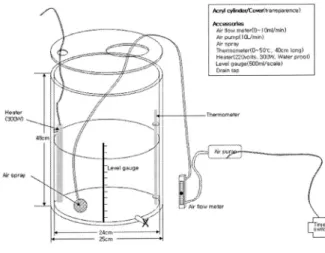
Fermenter Two types of fermenters were manufactured with acryl cylinder (ID 24 cm, OD 25 cm, Height 48 cm) attached 300 W-heater and thermometer for maintaining temperature control (Fig. 1, 2). In agitation type fermenter (Fig. 1), stirrer attached 300 rpm DC 12 V-motor at the other side and connected to the time switch controlling the agitation time and speed was inserted in the fermenter. On the other hand, air sprayer connected to the air pump via air flowmeter and to the time switch controlling the amount and time of aeration was settled in the fermenter in the aeration type fermenter (Fig. 2). The level gauge was applied on the wall of each fermenter.
Slurry sampling and tests FWSused in this experiment was the press-dewatered slurry for making compost in order to recycle the food wastes from Sihwa Landfill Site and PMS was from Gwangmyeong farm in Hwasung. Chemical properties of FWS, PMS and their mixture were conducted by Fertilizer Analysis of liquid manure (NIAST, 1999) and Soil Tests and Plant Analysis(NIAST, 2000). The chemical properties of slurry used in this study are shown in Table 1.
Fig. 1. Agitation type fermenter. Fig. 2. Aeration type fermenter.
Slurry samples combined FWS and PMS in various ratios (Table 2) were placed in the fermenter and run at 20±2℃ and 30±2℃. Aeration type fermenter was aerated by 2.5 m
3ton
-1hr
-1for 30 minutes every 4 hours and agitation type fermenter was stirred by 300 rpm for 30 minutes every 4 hours. Fermented slurry was sampled at the interval of 15 days, and components and offensive odor were measured.
Offensive odor was tested by sensory test according to the Standard Methods of Air Sampling and Analysis (MOE, 2004), and by portable gas detector (GASTEC).
25 ml of each mixed slurry was placed into a 250 ml bottle with a cap and settled at 20℃ in the incubator for 1 hour then drawn an accurate sample volume through the
tube to give a reading of the gas present at that time.
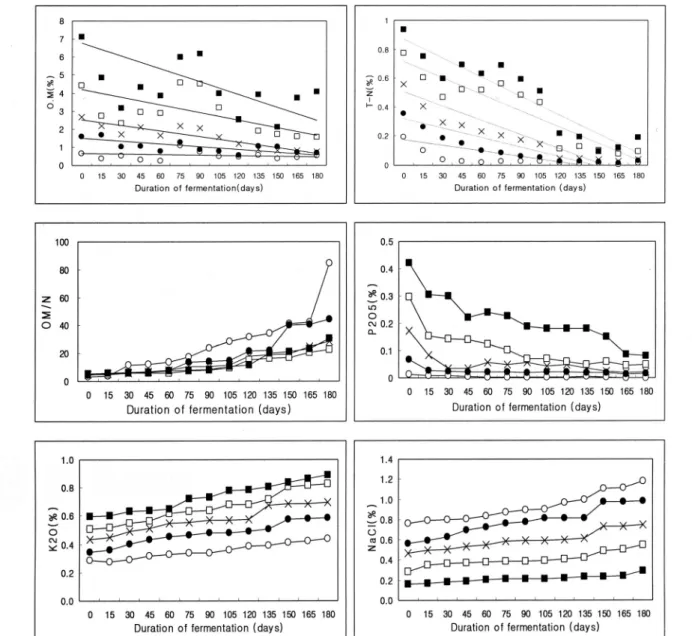
Results and Discussion Liquid manure is principally object to apply to the soil as a fertilizer. Its nutrient content, therefore,should not be reduced belowcritical level defined by official standard of fertilizer after fermentation. Figure 3 was shown the nutrient changes of mixed slurries in various manners during fermentation at 30℃ under aeration and Table 3 was shown the amount of contents of slurry mixed in different ratios after 180 days fermentation.
The initial pH was 7.67 for PMS and 8.45 for FWS (Table 1). During the fermentation, pH of combined slurries with higher FWS rate increased while those with higher PMS rate decreased. Electroconductivity (EC) of each slurry sample showed that the difference among combined slurry samples has been reduced during fermentation and became stabilized in 21~23 dS m
-1after 180 days. By long fermentation of slurry and mixing more FWS, the amounts of organic matter (O.M.), total nitrogen (T-N) and phosphatereduced much more. The amount of O.M. was reduced due to the decompositionby microorganisms and the lower PMS ratio, because its amount in FWS was relatively much less than that in PMS (Table 1). The amount of T-N for F50, F75 and
Type" EC Water OM T-N P2O5 K2O CaO MgO
dS m-1 --- % --- pH
Cu
--- mg L-1---
"
FWS represents food waste slurry and PMS represents pig manure slurry.
Zn Cr Cd Pb NaCl
%
8.45 23.4 98.2 0.67 0.19 0.01 0.29 0.02 0.27
7.67 34.4 90.6 7.14 0.94 0.42 0.60 0.29 0.22
FWS PWS
0.90 tr. tr. tr. 0.3 0.76
1.84 0.35 tr. tr. tr. 0.16
FWS PWS
Table 1. Chemical properties of slurry used.
"
FWS represents food waste slurry and PMS represents pig manure slurry.
F100 F75 F50 F25 F0
100 75 50 25 0
0 25 50 75 100 PWS FWS
Table 2. Combination ratio of materials in weight (%)
Type of Slurry"
"
F100: FWS:PMS=100:0, F75: FWS:PMS=75:25, F50: FWS:PMS=50:50, F25: FWS:PMS=25:75, F0: FWS:PMS=0:100 F100
F75 F50 F25 F0
9.16 9.00 8.89 7.49 6.86
21.3 22.2 22.0 22.6 21.4
98.0 97.8 97.6 96.7 93.7
0.54 0.69 0.74 1.56 4.07
0.02 0.03 0.04 0.10 0.19
0 0.02 0.02 0.05 0.23
0.33 0.45 0.57 0.64 0.78
0 0.01 0.02 0.06 0.19
0.01 0.01 0.01 0.02 0.09
0.83 0.73 0.59 0.37 0.22 NaCl MgO
CaO K2O
P2O5 T-N
OM Water
EC pH
dS m-1 --- % --- Table 3. Chemical properties of slurries combined FWS and PMS in different ratios after 180 days fermentation.
F100 in this test decreased up to 0.1%, less than the critical level (0.3%) defined by official standard of liquid fertilizer. The probable reason is that the amount of T-N in FWS was also less than that of PMS like O.M. and NH
4-N generated from O.M. decomposition was volatilized due to the high pH kept around 8 during fermentation. It is highly probable that insoluble precipitation resulted from combination of inorganic phosphorus by decomposing of organic phosphorus and calcium and magnesium under high pH reduced the amount of available phosphorus. As the slurries were fermented, the amount of potash and sodium chloride relatively high soluble increased gradually resulted in water evaporation during fermentation. In this study,
however, these two components showed opposite tendency by mixing ratio, come from the difference of original contents.
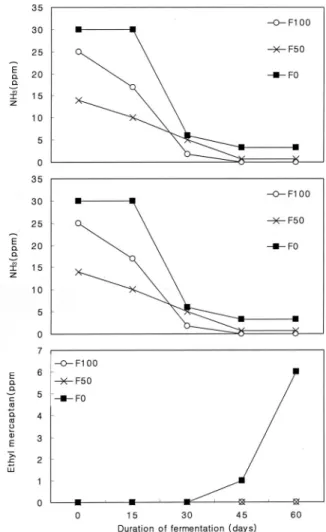
Figure 4 was shown the concentration of odor components determined by portable gas detector (GASTEC). It is well-known that odor components from pig manure are composed of hydrogen sulfide (H
2S), Skatole (C
9H
9N), methyl mercaptan (CH
3SH), amines (R-NH
2), fatty acids, etc. (MAF, 2000). We tested offensive odor from the combined slurries during fermentation using portable gas detectors for acetone, acetaldehyde, hydrogen sulfide, acetic acid, methyl mercaptan, methyl ethyl ketone, ammonia, methyl iso- butyl ketone (MIBK), styrene, ethyl mercaptan, iso-
Fig. 3. Changes of chemical properties of slurries combined FWS and PMS in different ratios during fermentation at 30℃℃ under aeration. F100(○○), F75(●●), F50(X), F25(□□), and F0(■■)."
F100: FWS:PMS=100:0, F75: FWS:PMS=75:25, F50: FWS:PMS=50:50, F25: FWS:PMS=25:75, F0: FWS:PMS=0:100
butyl alcohol and amines, but only ammonia, amines, ethyl mercaptan among them were detected as shown in Fig. 4. Hwang and Jeon (2007) also suggested that nitrogen compounds such as ammonia and amines are mainly generated from the fermentation processing.
From initial fermentation until 30 days, a lot of NH3, as an offensive odor was produced. However, it decreased steadily except in higher rate of PMS. In terms of producing NH3 with 50 μ g ml
-1, the top layer took 30 days of fermentation with F100, F75 for 45 days, F50 and F25 took 75 days and F0 took 90 days, respectively.
RNH
2also had similar trend with NH
3but it was produced continually as long fermentation had been prolonged. In terms of RNH
2, the decrease in concentration up to 50 μ g ml
-1were; 45days for F100, 105 days for F75, 120 days for F50, 165 days for F25, respectively. Ethyl mercaptan (C
2H
5SH) was produced in F0 up to 180 days of fertilization but it was not produced in F100.
Offensive odor by gas detector are not exactly agreed with human being, therefore sensory tests as an integrated test of offensive odor were also done.Figure 5 and Table 4 show the averaged offensive odor density by sensory test. As the ratio of FWS increased, offensive odor was tend to be reduced. Long-term fermentation, high temperature, and aeration condition rather than agitation affected also on the offensive odor reduction. It results from the decomposition of odor components. FWS showed lower than 1 after 30 days from initial fermentation, while PMS had still offensive odor (can not reach up to 1) even up to 180 days from initial
fermentation. It is probably affected by the continuous production of C
2H
5SH and RNH
2.
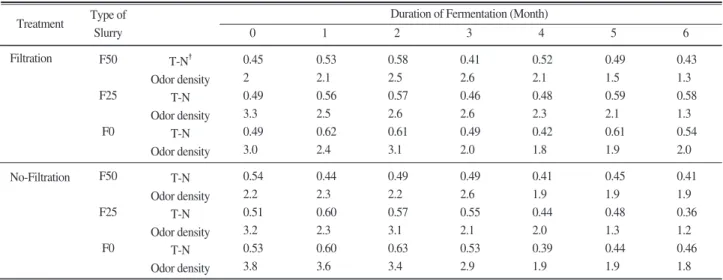
To decompose the offensive odor components quickly and promote the fertilization, PMS was apparently filtered with gauze, combined with FWS and then fermented. The change of the amount of T-N and the offensive odor density, the primary limiting factor of liquid manure, were examined. As shown in Table 5, it did not affect the amount of T-N and offensive odor density. Only F50, F25, F0 among the mixture were above 0.3% of the amount of T-N, defined by official standard of liquid fertilizer. However, in case of offensive odor density (less than 2.0 by sensory test), it did not meet the critical level less than 6 months fermented with PMS only. It is highly probable that F25 and F50 with 5~6 months fermentation reduce the offensive odor density. From the results of odor strength and offensiveness in the pig manure slurry co-fermented with
Fig. 4. Malodor ingredients slurries combined FWS and PMSin different ratios during fermentation under aeration.
"
F100: FWS:PMS=100:0, F50: FWS:PMS=50:50, F0:
FWS:PMS=0:100
‡Odor density (0: None, 1: Threshold, 2: Moderate, 3: Strong, 4:Very Strong)
Fig. 5. Changes in offensive odor density of slurries combined FWS and PMS in different ratios with the digestion Time.
"
F100: FWS:PMS=100:0, F50: FWS:PMS=50:50, F0: FWS:PMS=0:100
food waste slurry, it is difficult to correlate the concentrations of single odorous compounds in the manure and the odor strength and offensiveness of the odorous air emitting from the manure. Therefore, it is necessary to analyze odorous compounds in the air.
Summary
Tremendous quantities of food wastes have been generated and at the same time the efforts to dispose them have been on. FWS generated during food waste
At 30℃
Aeration
Agitation
F100 F75 F50 F25 F0 F100
F75 F50 F25 F0
3.2 3.8 3.6 4.2 3.4 3.2 3.8 3.6 4.2 3.4
2.0 3.4 3.2 3.4 3.0 2.0 3.6 3.4 3.4 2.8
1.0 2.4 3.0 3.4 3.0 1.0 2.2 2.8 3.4 3.2
0.4 2.8 3.0 3.6 3.0 0.4 3.2 2.8 3.8 3.0
0 2.2 2.4 3.4 4.2 0 2.0 3.2 3.4 3.6
0.2 2.0 3.0 3.8 4.0 0.2 1.4 3.0 4.0 4.0 At 20℃
Aeration
Agitation
Odor density (0: None, 1: Threshold, 2: Moderate, 3: Strong, 4: Very Strong)
"
F100: FWS:PMS=100:0, F75: FWS:PMS=75:25, F50: FWS:PMS=50:50, F25: FWS:PMS=25:75, F0: FWS:PMS=0:100 F100
F75 F50 F25 F0 F100
F75 F50 F25 F0
3.2 3.8 3.6 4.2 3.4 3.2 3.8 3.6 4.2 3.4
2.0 2.6 3.2 3.4 3.2 2.0 3.4 3.2 3.4 3.0
1.0 2.2 2.6 3.4 3.2 1.0 2.6 3.2 3.2 3.2
0.4 2.8 2.8 3.0 3.4 0.4 3.4 3.8 3.8 3.6
0 2.8 3.2 3.2 3.6 0 2.4 3.4 4.0 4.0
0.2 2.2 3.6 4.0 4.6 0.2 2.6 3.8 4.4 4.8 75 60
45 30
15 0
Duration of fermentation (days) Type of Slurry"
Table 4. Changes in offensive odor density of slurries combined FWS and PMS in different ratios with the different digestion Temperature.
Treatment
6 5
4 3
2 1
0
Duration of Fermentation (Month)
T-N"
Odor density T-N Odor density
T-N Odor density
T-N Odor density
T-N Odor density
T-N Odor density
0.45 2 0.49 3.3 0.49 3.0 0.54 2.2 0.51 3.2 0.53 3.8
0.53 2.1 0.56 2.5 0.62 2.4 0.44 2.3 0.60 2.3 0.60 3.6
0.58 2.5 0.57 2.6 0.61 3.1 0.49 2.2 0.57 3.1 0.63 3.4
0.41 2.6 0.46 2.6 0.49 2.0 0.49 2.6 0.55 2.1 0.53 2.9
0.52 2.1 0.48 2.3 0.42 1.8 0.41 1.9 0.44 2.0 0.39 1.9
0.49 1.5 0.59 2.1 0.61 1.9 0.45 1.9 0.48 1.3 0.44 1.9
0.43 1.3 0.58 1.3 0.54 2.0 0.41 1.9 0.36 1.2 0.46 1.8 F50
F25
F0
F50
F25
F0 Filtration
No-Filtration
"
Total nitrogen (%) of food waste slurries (FWS) combined with filtered pig manure slurries (PMS) under 95% water content
‡F50 means FWS:PMS=50:50, F25 means FWS:PMS=25:75, and F0 means FWS:PMS=0:100 Type of
Slurry
Table 5. Changes in Offensive Odor Density (Sensory evaluation) and Total Nitrogen of FWS slurries combined with the Filtered PMS.
composting was dumped into the ocean or discharged to the stream and soil resulting in ground water pollution.
The movement of recycling the waste resource in agriculture is gathering strength. To apply the waste resource to the farm land, stability and safety of the wastes should be guaranteed and they should contain sufficient nutrients suit for the official standard of liquid fertilizer. From this point of view, FWS combined with PMS in various ratios was studied by examining the change of nutrient contents and offensive odor before and after fermentation. As combined slurries were fermented, the contents of T-N were reduced below the criteria by Korean official standard of liquid fertilizer. The contents of sodium chloride exceeded the criteria. Further study on controlling offensive odor and guaranteeing T-N content preventing its loss by volatilization needs to be done.
References
Hwang, J.W. and K. S. Jeon. 2007. The properties and reducing methods of odor generated from organic waste recycling facilities.
In Symposium and oral presentation of Korean organic resources recycling association 2007.
MAF. 2000. Final report: Recycling and utilization of livestock manure. Ministry of Agriculture and Forestry.
MAF. 2003. Statistic on livestock. Ministry of Agriculture and Forestry.
MOE. 2003. Policy toward disposing food wastes. In Symposium on recycling of wastes and promoting safety. Ministry of Environment.
MOE. 2004. Standard methods of air sampling and analysis.
Ministry of Environment.
MOE. 2005. The Status of production and treatment of wastes in Korea in 2004. Ministry of Environment.
NIAST. 1999. Manufacture and utilization of compost and liquid manure for environmental friendly agriculture. National Institute of Agricultural Science and Technology.
NIAST. 2000. Soil tests and plant analysis. National Institute of Agricultural Science and Technology.
O'Neill, D. H., and V. R. A. Phillips. 1992. Review of the control of odour nuisance from livestock buildings: Part 3: Properties of the odorous substances which have been identified in livestock wastes or in the air around them. J. Agric. Eng. Res. 53:23 50
RDA. 2002. Standard farming manual: Manufacture and utilization of compost for environmental friendly agriculture. Rural Development Administration.
RDA. 2004. Act and regulations on fertilizer management (Revised), Standard methods for quality analysis and sampling of fertilizer. Rural Development Administration.
Schiffman, S. S., J. L. Bennett, and J. H. Raymer. 2001.
Quantification of odors and odorants from swine operations in North Carolina. Agric. Forest. Meterol. 108:213 240.
돈분뇨 슬러리와 음식물쓰레기 자원화 과정에서 발생하는 액상물의 혼합 액비화를 통한 액비의 비료적 특성 및 액비의 악취 저감 특성을 검토하였다. 발효가 진행됨에 따라 음식물쓰레기 액상물 혼합비율이 높은 처리구 에서 pH가 높아졌고 돈분뇨 슬러리 혼합비율이 높은 처리구에서는 낮아졌고, EC는 180일째에 모든 처리구에서 21~23 dS m-1로 안정되었다. 180일간 발효시키고 난 후에 질소성분은 최초 성분량의 20%까지 저하되었는데, 음식물쓰레기 액상물 50% 이상 혼합한 구에서는 비료공정규격에 미달되었다. 발효가 진행되면서 유기물, 인산, 석회, 고토성분은 감소되었고 칼리, 염분의 함량은 증가하였는데, 염분의 증가는 액비 발효과정 중 수분 증발에 따른 농축효과에 기인하였다. 악취 성분으로서 NH3는 발효 초기 30일째까지 많이 발생하다 점차 감소하였고 돈분뇨 슬러리 혼합비율이 높을수록 오래까지 지속적으로 발생되었고, R-NH2의 경우는 NH3에 비해 발효기간 이 길어져도 지속적으로 발생하였다. C2H5SH는 돈분뇨슬러리와 혼합처리구에서만 발생하였는데, 발효기간 180 일이 지나도 지속적으로 발생되었다. 관능검사 결과 역시 돈분뇨슬러리 혼합처리구에서는 발효기간 180 일이 지나도 악취도가 1 이하로 저하되지 않았다. 현행 비료 공정규격상 악취강도 기준이 2 이하인 점과 질소성분의 휘산으로 인한 액비 중 T-N 성분 저하 등을 고려했을 때 이의 제어연구가 수행될 필요가 있었다.
음식물쓰레기와 돈분 액상물의 혼합부숙시 이화학적 특성 변화
소규호*·성기석·홍승길 농업과학기술원 환경생태과