Introduction
Soil biological parameters, which reflect 95% of the energy flow through soil(Persson et al., 1980), are sensitive to soil management practices and seasonal weather patterns. Soil biological properties should be investigated at consistent sampling intervals to account for seasonal variation to aid in selecting the most beneficial practices for managing organic input.
Soil enzyme activities can be used as early indicators for changes associated with soil management practices (Aseri and Tarafdar, 2006; Bandick and Dick, 1999).
Dehydrogenase (DH) activity may reflect changes in the microbial population as well as the soil redox potential (Frankenberger and Dick, 1983). Fluorescein diacetate (FDA) hydrolytic activity reflects soil microbial biomass and soil organic matter content, and also seems to provide an indication of the quantity and quality of biologically available organic substances in soil required for
sustainable biological control (Bruns et al., 1996;
Schnürer et al., 1985). Soil enzyme assays are generally insensitive to changes in the composition of microbial populations due to the redundancy of function within soil microbial communities, and may primarily reflect the soil fungal biomass because fungi occupy most of the soil microbial biomass (Gaspar et al., 2001; Zvyagintsev, 1994).
The community-level physiological profiling (CLPP) of the soil microbial community determined with the Biolog system is a widely adapted means to measure changing functional diversity of soil microorganisms, especially the bacterial community (Haack et al., 1995; Pérez-Piqueres et al., 2006). CLPP has been used as an early indicator of the effects of environmental stress (Rogers and Tate, 2001), different carbon substrate inputs (Pérez-Piqueres et al., 2006), altered plant species (Zak et al., 1994), various management strategies (Bossio and Scow, 1995; Buyer and Drinkwater, 1997), or vegetation changes (Grayston et al., 1998) on the soil microbial community.
Organic sources added to soil directly or indirectly affect the structure and activities of soil microbial
Received : May 15. 2009 Accepted : Julr 16. 2009*Corresponding author: Phone : +15738826408, E-mail : [email protected]
Seasonal Dynamics of Enzymetic Activities and Functional Diversity in Soils under Different Organic Managements
Kee-Choon Park, and Robert J. Kremer
1,*Ginseng Research Division, Rural Development Administration, Eumseong 369-873, Korea
1
Agricultural Research Service, United States Department of Agriculture (USDA-ARS), Columbia, MO 65211, USA
Soil microbial activity and diversity are affected by organic sources applied to improve soil quality and fluctuate seasonally. We investigated the effects of municipal compost (MC), poultry litter (PL), and cover crops of spring oats and red clover (RC) on soil enzyme activities, and soil bacterial community-level physiological profiling (CLPP) in a Mexico silt loam in North Central Missouri, USA. Temporal patterns of these parameters were observed by periodic five soil sampling from spring to fall over a two year period.
MC increased soil dehydrogenase (DH) activity consistently beginning about three months after MC application; fluorescein diacetate (FDA) hydrolytic activity significantly began to increase by the September of the first year but fluctuated during the following period. DH activity responded more directly to the amount or properties of organic residues in soils while FDA hydrolysis and CLPP were generally influenced by composition of organic sources, and enzyme activities and CLPP showed seasonal variation, which depended on organic sources and soil moisture. MC and cover crops may be useful organic sources for enhancing general soil microbial activity and altering soil microbial diversity, respectively. Because microbial activities and diversity are dynamic and subject to seasonal changes, the effects of organic amendments on these parameters should be investigated frequently during a growing season.
Key words : Organic amendment, FDA hydrolysis, Dehydrogenase activity, Community-level physiological
profiling (CLPP)
communities (García-Gil, 2000; Pérez-Piqueres et al., 2006). Plant species and composition also affect soil microbial activity and diversity due to differences in the quantity and quality of plant litter and rhizodeposition (Baudoin et al., 2003; Grayston et al., 2004). These effects are often closely related to various plant ecophysiological traits (Groffman et al., 1996; Wardle et al., 1998).
The effects of plant species and organic amendments on soil microbial activity and diversity vary during the growing season (Bardgett et al., 1999). The seasonal effect on biological activity and diversity is partly due to changes in organic and inorganic chemical composition of organic residues during decomposition (Berg and McClaugherty, 2003). Also, seasonal changes related to temperature and moisture fluctuations affect microbial activity and community composition (Kayang, 2001).
The objective of this research was to determine seasonal effects of various organic amendments and cover crops on soil enzyme activities and microbial functional diversity.
Materials and Methods
Study site and experimental design This study was conducted at the University of Missouri Bradford Research Center (38˚ 53' N, 92˚ 12' W) in North Central Missouri during 2001 to 2002. The soil was a Mexico silt loam (fine, smectitic, mesic Aeric Vertic Epiaqualfs). A randomized complete block design was used with three replicate blocks, and individual plots were approximately 36 m
2. Each block consisted of five treatments comprising a non-amended control, municipal compost (MC), poultry litter (PL), spring oats (Avena sativa), and red clover (RC) (Trifolium pratense). Soils not treated with cover crops were planted to soybeans. MC was obtained from the City of Columbia Sanitary Landfill and Composting Facility located in Columbia, Missouri. The components and proportions of the materials used in preparing one unit of compostable substrate for MC were: municipal yard waste, 4,540 Kg; cellulose casings, 1,810 Kg; milled dry wall, 900 Kg; and charcoal sawdust, 450 Kg (personal communication, Mark Russell, Manager, Columbia Composting Facility, May 2001). These materials were combined and mechanically turned for optimum composting using a windrow composting system. PL was obtained from the University of Missouri Rocheford Turkey Farm.
MC and PL with average moisture contents of 82.6%
and 40.5% and C:N ratio of 30.4 and 10.3, respectively, were manually applied at 15 and 20 tons ha
-1, respectively, in early May and incorporated into soil by mid-June each year before soybean planting. A control plot without any organic amendment was also plowed as in MC and PL plots. Soybeans were sowed at a row width of 76 cm and plant density of 44,800 plants ha
-1after application of MC and PL in early summer. In oats- and RC-treated plots, oats and RC were planted as cover crops with seeding rates of 134 and 13.4 kg ha
-1, respectively, in early spring each year, maintained until the end of the experiment without additional fertilizers and sowing of soybeans, and mowed in late spring to provide ground cover.
Soil sampling procedures Soils were sampled five times each year including once before application of organic amendments. Sample times were: 30 March (prior to applying organic amendments), 6 July, 2 August, 4 September, and 30 October, 2001 and 13 April (prior to applying organic amendments), 6 July, 15 August, 5 September, and 18 October, 2002. Soil was sampled to a depth of 10 cm with a soil probe (diameter: 5 cm) at three points in each plot, pooled, and transported in 1-L plastic bags to the laboratory. The sampled soils were passed through a 2-mm mesh sieve and stored within closed plastic bags at 4 ℃ in the dark until analysis.
Approximately 10 g of fresh soil was dried in an oven at 105 ℃ , and the moisture content was calculated based on dry soil weight.
Analysis of soil chemical properties Soil chemical properties (pH, SOM, P, K, Ca, and Mg) were determined for samples obtained in spring and fall each year by the Soil and Plant Testing Laboratory at the University of Missouri, based on standard procedures (Brown, 1998). Soil pH was determined using 1:1 soil/water ratio. Extractable soil P was measured using the Bray P-1 test. Exchangeable Ca, Mg, and K were extracted by 1 M NH
4OAc (pH = 7.0), and Ca and Mg were determined by atomic adsorption and K by emission. Soil organic matter was determined by loss of weight on ignition.
Soil enzyme activities and functional diversity
assays DH activity and FDA hydrolysis were evaluated
following the procedures of Pepper et al (1995) and
Bandick and Dick (1999). CLPP of microbial communities in whole soil were determined using GN2 Microplate
TM‚ (Biolog Inc., Hayward, CA). Soil (5 g) was homogenized with 95 ml of 0.85% NaCl for 15 min with 200 rpm on a rotary shaker. An aliquot of 125 μ l of the 10
-3dilution was dispensed into each well of the GN2 MicroPlates. The inoculated MicroPlates were placed in plastic bags containing a water-soaked paper towel in order to minimize evaporation from the wells. The plates were incubated at 22 ℃ in the dark and color densities were monitored by a MicroPlate reader equipped with a 570-nm filter (Dynatech MR5000) after 72 h. All values were calibrated by subtracting the absorbance (density) of the control well, and negative values after substracting the control well were transformed to zero. The absorbance of each well was divided by the average well color development (AWCD), which was calculated as the mean of absorbance values for all 95 wells to minimize the influence of inoculum density differences between plates (Garland, 1996a).
Statistical analysis The data for soil chemical properties and soil enzymes were analyzed with the linear mixed model of repeated measures and slice option with the SAS
®statistical software package (SAS Institute, 2001). Principal component analysis (PCA) was performed on Biolog data to characterize microbial communities from different sampling dates and organic amendments. Multivariate approaches, statistically proved by Läuter (1996) and Glimm et al. (1997), and contrast tests were applied after principal component analysis to test significant differences between OM sources and seasonal patterns in CLPP. Orthogonal contrasts with MANOVA were performed for the principal components which explained over 80% for the CLPP analysis. Pearson's linear correlation coefficients were calculated to observe the relation between soil parameters. All significance tests were performed with P
< 0.05, except as otherwise noted.
Results and Discussion
Seasonal and annual changes of weather and soil moisture content and soil chemical properties Precipitation was evenly distributed despite a lower total amount of rainfall in 2001 compared to 2002 (Fig. 1A).
Drought periods persisted from mid-June to early July, from late July to early August, and late August to mid-
September despite more rainfall during soil sampling period in 2002 (Fig. 1A).
Soil water content varied seasonally with the lowest water content in August and September in both years (Fig. 2A). Soils from oats plots had significantly higher soil water content compared with MC and control soils in August 2001; and significantly lower soil water content compared to all other soils in July 2002. MC-treated soils had significantly higher soil water content compared with all other soils in July 2002 and in comparison with the control in September 2002,respectively (Fig. 2A).
MC consistently increased pH and SOM, gradually decreased Mg, and initially increased Ca; PL consistently increased SOM, P, and K and initially increased Mg; oats consistently increased pH (Fig. 3).
Enzyme activities Organic sources significantly affected soil DH activity (P = 0.0073). MC significantly increased DH activity from September 2001. DH activity was significantly higher in MC-treated soils than in the soils planted with oats by September 2001. In 2002, DH activity in MC soils remained at a consistently high level throughout the season compared to all other organic sources except September. By August 2002, the DH activity of other treated soils began increasing and
Fig.1. Daily (bars) and cumulative (line) precipitation during growing seasons at the University of Missouri Bradford Research Center, Columbia Missouri in 2001(A) and 2002(B).
MC: municipal compost; PL: poultry litter: arrows under X axes indicate sampling dates.
reached the level of MC-treated soils by September. By October 2002, DH activity in the PL soil remained significantly higher than in the control soil. In July 2001, soils under oats had significantly higher DH activity than MC- and PL-treated soils. And PL and red clover did not influenced the DH activities (Fig. 2B).
The low DH activity until August 2001 after MC application means that newly added MC to soil may not be immediately available to soil microorganisms due to high carbon to nitrogen (C:N) ratio and carbon compounds, lignin and cellulose, resistant to decomposition in MC composted with trees. DH activity in MC-treated soils remained high under dry conditions in 2002, which suggested that microorganisms able to decompose MC can tolerate conditions under low precipitation. The high DH activities in MC-treated soils are in agreement with the reports that soils receiving municipal solid waste in Spain (García-Gil et al., 2000;
Pascual et al., 2000) due to increases in microbial metabolism that resulted from mineralization of biodegradable C fractions contained in the amendments.
Increased OM by PL was not rapidly associated with
high DH activity. But after microbial adaptation to PL, incremental increases in SOM resulted in significant increasein DH activity by October 2002. The effects of PL on DH activity have been identified by other studies where high DH activity occurred in soils amended with poultry manure (Martens et al., 1992) and with other organic sources including cow manure, cattle slurry, liquid hog manure, and straw. (García-Gil et al., 2000;
Lalande et al., 2000; Parham et al., 2002).
Rapid decomposition by soil microorganisms and possible variable amounts of the biomass produced by oats under variable seasonal weather conditions may have caused low DH activity under oats in all sampling dates except July 2001. Low DH activity in RC-planted soils over both growing seasons suggest that RC also is decomposed easily by soil microorganisms and that vegetative biomass partly controls the degree of microbial activity. Contrary to the reports that cover crops enhanced soil DH activity (Martens et al., 1992 Simard et al., 1994), the low and limited effects of cover crops on DH activity may be because cover crops remained intact in this study whereas residues of cover crops were incorporated into soil before planting summer crops in previous research. In addition, our 2-year trial may be too short for the cover crops to affect soil microbial activity because soil microbial activity may become more critical in a long-term cropping system than that in the short-term (Groffman et al., 1996).
Organic sources significantly affected soil FDA hydrolysis (P = 0.0136). FDA hydrolysis in soils amended with all organic sources was generally higher at all dates in 2002. In July 2001, although activity declined from April, FDA hydrolysis for PL soils remained significantly higher compared to oats soils. RC and MC soils had significantly high FDA hydrolysis activities during the season compared to control and oats, and control, respectively. In 2002, RC significantly increased the FDA hydrolysis compared to oats in August and MC increased FDA hydrolysis compared to control in October. All organic amended soils were associated with increased FDA hydrolysis compared to control by October 2002 (Fig. 2C).
FDA hydrolytic activity varied over time, similar to DH activity except no interactions between organic sources and year was observed (data not shown). FDA hydrolytic activity varied seasonally more in 2001 than in 2002;
activity levels under all treatments were significantly higher in 2002 than in 2001 (Fig. 2C). The seasonal
Fig. 2. Seasonal trends in soil water content (A),dehydrogenase activity (B) and fluorescein diacetate hydrolysis(C) in soils receiving organic amendments (municipal compost and poultry litter) and planted to cover crops (red clover and oats). Vertical bars indicate standard deviation for samples in each sampling date.
pattern of FDA hydrolysis did not show any consistent seasonal variation but was similar with the seasonal pattern of soil water content in 2002. Based on pairwise comparisons, there were significant changes in FDA hydrolysis in all plots from April to July and September to October only in 2001. FDA hydrolysis for all plots was more consistent from October 2001 through the end of the study than before October 2001.
MC did not rapidly increase FDA hydrolysis at the outset of the study. The effects on FDA hydrolysis in MC-treated soils that developed from September 2001 onward suggested that the organic matter associated with
MC served as an energy source for soil microorganisms over time that resulted in a gradual and persistent increase in FDA hydrolysis. In contrast, PL and oats enhanced FDA hydrolysis initially but the effects did not persist.
Cover crops or organic residues increased FDA hydrolysis compared to treatments without organic amendments (Bandick and Dick, 1999). FDA hydrolysis served as a good indicator of effects on soil biological activity by organic amendments because it reflects biologically available organic substances for soil microorganisms (Hoitink and Boehm, 1999).
Seasonal and annual variation of FDA hydrolysis in our
Fig. 3. Seasonal changes of chemical properties in soils applied with organic amendments of municipal compost and poultry litter and planted with cover crops of oats and red clover over two years.
study agree with the reports from Rastin et al. (1988) who noted seasonal fluctuations in FDA hydrolysis in a beech forest soil. Bandick and Dick (1999) reported that the degree of seasonal variation depended on the OM sources. MC was more resistant to seasonal change than other OM sources. FDA hydrolysis differed between cereal or legume winter cover crops depending on the year or sampling time (Mendes et al., 1999).
The DH activity varied seasonally but the order of DH activity levels among treatments did not change, showing highest DH activities in MC-treated soils which had high OM. On the other hand, the order of FDA hydrolysis among treatments varied over time compared with DH activity regardless of the organic matter content. These results show that dehydrogenase activity responded more to overall soil microbial activity dependent on total SOM while FDA hydrolytic activity is more constant regardless of newly-added organic matter because dehydrogenase is endo-enzyme and FDA hydrolytic enzymes make complexes with organic matter, especially humus C (Chakrabarti and2006). These results suggest that DH activity shows early soil microbial activity or soil organic matter content after addition of organic matter in soil and respond more to the quantity of organic amendments, and FDA hydrolytic activity represent late soil microbial activity or SOM content recalcitrant to decomposition and respond more to the composition of organic amendments. These contrasting results between two enzymes are similar to those reported by Shi et al.
(2006) and Graham and Haynes (2005) who observed that FDA hydrolysis was affected but DH activity remained unaffected by grazing and camping in grass
land, and the several kinds of enzyme activities are differently influenced by soil microbial community composition likely changed by the chemical composition of SOM.
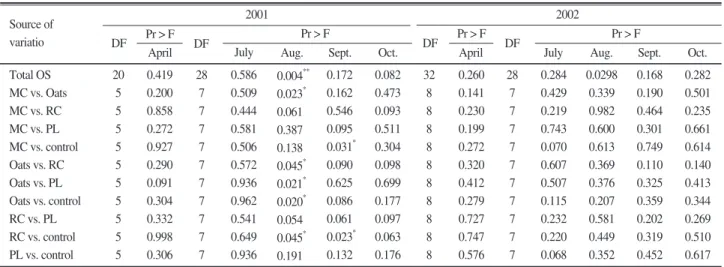
Analysis of CLPP The MANOVA test for principal components that explained more than 80% of the total variation in PCA was performed for each sampling date.
The results showed significant differences between organic sources only in August and September of 2001, in which soils under oats were separated from all other soils and RC was separated from control in August and September 2001. MC- treated soils were separated from the control in September 2001. These results indicated that oats, MC, and RC changed microbial functional diversity, with oats being most effective, but the effects on functional diversity were very limited and variable within seasons, and changes were not maintained across years. PL did not affect soil microbial functional diversity based on CLPP (Table 1).
The PCA for samples collected five times each year during the two-year study showed seasonal and annual changes in functional diversityin which the annual change was significantly greater than the monthly changes (Fig. 4). Significant interactions between all factors of organic source, sampling date, and year existed in CLPP (data not shown). PCA using all Biolog data from all sampling dates and treatments showed that 25%
and 7% of total variation was explained by PC1 and PC2, respectively. CLPP for all soils from all sampling dates and treatments differentiated 2001 from 2002 in PC1 alone. Monthly variation in CLPP appeared within each
Source of variatio
Total OS MC vs. Oats MC vs. RC MC vs. PL MC vs. control Oats vs. RC Oats vs. PL Oats vs. control RC vs. PL RC vs. control PL vs. control
20 5 5 5 5 5 5 5 5 5 5
0.419 0.200 0.858 0.272 0.927 0.290 0.091 0.304 0.332 0.998 0.306
0.586 0.509 0.444 0.581 0.506 0.572 0.936 0.962 0.541 0.649 0.936
0.004**
0.023* 0.061 0.387 0.138 0.045* 0.021* 0.020* 0.054 0.045* 0.191
0.172 0.162 0.546 0.095 0.031* 0.090 0.625 0.086 0.061 0.023* 0.132
0.082 0.473 0.093 0.511 0.304 0.098 0.699 0.177 0.097 0.063 0.176
0.260 0.141 0.230 0.199 0.272 0.320 0.412 0.279 0.727 0.747 0.576
0.284 0.429 0.219 0.743 0.070 0.607 0.507 0.115 0.232 0.220 0.068
0.0298 0.339 0.982 0.600 0.613 0.369 0.376 0.207 0.581 0.449 0.352
0.168 0.190 0.464 0.301 0.749 0.110 0.325 0.359 0.202 0.319 0.452
0.282 0.501 0.235 0.661 0.614 0.140 0.413 0.344 0.269 0.510 0.617 28
7 7 7 7 7 7 7 7 7 7 32
8 8 8 8 8 8 8 8 8 8 28
7 7 7 7 7 7 7 7 7 7
Oct.
Sept.
Aug.
DF July April Oct. DF
Sept.
July Aug.
April DF Pr > F
DF Pr > F Pr > F Pr > F
2002 2001
Table 1. Contrast tests for substrate utilization patterns for soils sampled over time. Organics sources comprised of non-amended control, municipal compost (MC), poultry litter (PL), and cover crops (oats and red clover (RC)). Samples were collected five times each year for two years.
year, in which the variation occurred in 2001 for PC2, and in 2002 for PC1, respectively.
The distinct separation in CLPP in oats-planted soils from all other treatments in August 2001 means that oats provided diverse substrates for decomposition by a diverse community of soil bacteria. Similarly, wheat straw can alter soil bacterial constitution (Acea and Carballas, 1996). The distinct separation in CLPP in RC- planted soils from the control from August to September 2001 means that the effects of RC on CLPP was more sustained than oats, but the effects were not as great as that for oats. Similarly, unfertilized grasslands also tend to have larger and more active soil microbial communities than fertilized sites (Bardgett and Cook, 1998). The effects of plant species or rhizodeposition on soil microbial community have been observed in numerous studies. Two synthetic solutions containing carbon sources of contrasting C/N from maize significantly increased bacterial densities and modified the CLPP determined by Biolog plates regardless of C/N ratio when they were applied to bulk soil in an in vitro experiment (Baudoin et al., 2003). Plant species have been also shown to have a major selective influence on microbial communities in their rhizospheres (Berg et al., 2002; Grayston et al., 2001; Smalla et al., 2001). The distinct separation in CLPP in MC-applied soils only from the control in September 2001 suggests that the effects of MC on bacterial functional composition were neither high nor persistent. PL has the potential to alter CLPP because high N concentrations in soil increased
rhizosphere depositon and resulted in increased bacterial numbersin wheat (Liljeroth et al., 1990), and poultry manure drastically changed the numbers of the various taxonomic and physiological groups in bacteria (Acea and Carballas, 1996). The lack of effects of PL on CLPP suggests that PL has variable effects on CLPP depending on its composting process or source. The impact of organic amendments on soil characteristics differed with the nature of the composts (Pérez-Piqueres et al., 2006)
The effects of added organic sources can affect the soil CLPP only when the environmental conditions are suitable for soil microorganisms to actively use the added organic sources.
Relationship between enzymes and CLPP CLPP appeared related to FDA hydrolysis more than to DH activity because CLPP may respond to the composition of organic matter sources but the significant separation between treatments on FDA hydroslysis and CLPP were not always occurred simultaneously, which means that the FDA hydrolysis and CLPP reflect different microbial compositions. Contradictory reports describing relationships between soil microbial biomass and soil microbial diversity exist. For example, application of pig manure or agricultural intensification changed the soil microbial community without affecting total microbial biomass (Donnison et al., 2000). On the other hand, microbial biomass rather than composition was affected with application of diverse organic sources (Fauci and Dick, 1994). Soil enzyme activities were very well correlated with fatty acid profiles but not with Biolog profiles in five tropical soils (Waldrop et al., 2000).
The results that seasonal variation affected CLPP more than enzyme activities are similar to the reports thatgreater seasonal variations occurred in microbial community composition by PLFA than in soil microbial biomass by SMB-C assays in maize-growing soils with different tillage or residue management regimes (Spedding et al., 2004). The high DH activity in MC- treated soils and the low separation ability of MC by CLPP suggest that MC application favored soil fungi and didnot affect soil bacterial community structure (Grayston et al., 2001; Grayston et al., 2004).
Conclusions
In agreement with Spedding et al. (2004), we conclude that soil microbial activity and microbial functional
Fig. 4. Annual and seasonal variation of carbon substrateutilization pattern in soils amended with organic amendments of municipal compost and poultry litter or planted with cover crops (oats and red clover) over two years. Error bars indicate standard deviation.
diversity in soils are responsive to not only introduced cover crops and added organic amendments but also temporal variation. The annual and seasonal effects could be of greater consequence than organic matter effects, especially in extremely dry weather. The changes caused by organic management could be broadly related to changes in soil organic matter content, decomposition stage, and nutritional composition of cover crops and organic amendments. Our results also suggest that elements of caution and a multifaceted approach are required when interpreting data on changes in microbial activity and diversity in agricultural soil, because measures of microbial activity with enzymes are variable with the enzyme properties and soil conditions and soil microbial diversity measured by the Biolog
TM‚ method is likely to provide only a limited picture of the response of soil microbial communities to environmental or land-use change.
Acknowledgements
We thank Lynn Stanley and Jenan Nichols for their technical assistance.
References
Adam, G., and H. Duncan.2001. Development of a sensitive and rapid method for the measurement of total microbial activity using fluorescein diacetate (FDA) in a range of soils. Soil Biol.
Biochem. 33:943-951.
Aseri G.K., and J.C. Tarafdar. Fluorescein diacetate: A potential biological indicator for arid soils. Arid Land Res. Manag. 20:87- 99.
Bandick, A.K., and R.P. Dick. 1999. Field management effects on soil enzyme activities. Soil Biol. Biochem. 31:1471-1479.
Bardgett, R.D., and R. Cook.1998. Functional aspects of soil animal diversity in agricultural grasslands. Appl. Soil Ecol. 10:263-276.
Bardgett, R.D., J.L. Mawdsley, S. Edwards, P.J. Hobbs, J.S.
Rodwell, and W.J. Davies.1999. Plant species and nitrogen effects on soil biological properties of temperate upland grasslands. Funct.
Ecol. 13:650-660.
Baudoin, E., E. Benizri, and A. Guckert. 2003. Impact of artificial root exudates on the bacterial community structure in bulk soil and maize rhizosphere. Soil Biol. Biochem. 35:1183-1192.
Berg, B., and C. McClaugherty. 2003. Plant Litter Decomposition, Humus Formation, Carbon Sequestration. p. 31-48. Springer- Verlag, Berlin, Germany.
Berg, G., N. Roskot, A. Steidle, L. Eberl, A. Zock, and K.
Smalla.2002. Plant-dependent genotypic and phenotypic diversity of antagonistic rhizobacteria isolated from different Verticillium host plants, Appl. Environ. Microbiol. 68:3328-3338.
Bossio, D.A., and K.M. Scow. 1995. Impact of carbon and flooding on the metabolic diversity of microbial communities in soils. Appl.
Environ. Microbiol. 61:4043-4050.
Brown, J.R. 1998. Recommended chemical soil test procedures for the north central region, North central regional research publication No.221 (Revised). Missouri Agricultural Experiment Station, Columbia, MO, USA.
Bruns, C., S. Ahlers, A. Gattinger, C. Schüler, H. Vogtmann, and G.
Wolf. 1996. The suppressive effects of composted separately collected organic waste and yard waste compost on two important soilborne plant pathogens, In: Bertoldi, M.D., P. Sequi, B.
Lemmes, and T. Papi (eds) The science of composting, pp 1094- 1095. Chapman & Hall, London, UK.
Buyer, J.S., and L.E. Drinkwater. 1997. Comparison of substrate utilization assay and fatty acid analysis of soil microbial communities. J. Microbiol. Methods 30:3-11.
Chakrabarti, K. and P.Bhattacharyya. 2006. Influence of soil properties on fluorescein diacetate hydrolyzing activity under different agro-ecosystems. Arch. Agron. Soil Sci. 52:461-467.
Donnison, L.M., G.S. Griffith, J. Hedger, P.J. Hobbs, and R.D.
Bardgett. 2000. Management influences on soil microbial communities and their function in botanically diverse haymeadows of northern England and Wales. Soil Biol. Biochem.
32:253-263.
Fauci, M.F., and R.P. Dick. 1994. Soil microbial dynamics: Short- and long-term effects of inorganic and organic nitrogen. Soil Sci.
Soc. Am. J. 58:801-806.
Frankenberger, W.T., Jr., and W.A. Dick. 1983. Relationships between enzyme activities and microbial growth and activity indices in soil. Soil Sci. Soc. Am. J. 47, 945-951.
García-Gil, J.C., C. Plaza, P. Soler-Rovira, and A. Polo.2000. Long- term effects of municipal solid waste compost application on soil enzyme activities and microbial biomass. Soil Biol. Biochem.
32:1907-1913.
Gaspar, M.L., M.N. Cabello, R. Pollero, and M.A. Aon. 2001.
Fluorescein diacetate hydrolysis as a measure of fungal biomass in soil. Curr. Microbiol. 42:339-344.
Glimm, E., H. Heuer, B. Engelen, K. Smalla, and H. Backhaus.
1997. Statistical comparisons of community catabolic profiles. J.
Microbiol. Methods 30:71-80.
Graham M.H., and R.J. Haynes. 2005. Organic matter accumulation and fertilizer-induced acidification interact to affect soil microbial and enzyme activity on a long-term sugarcane management experiment. Biol. Fert. Soils 41: 249-256.
Grayston, S.J., C.D. Campbell, R.D. Bardgett, J.L. Mawdsley, C.D.
Clegg, K. Ritz, B.S. Griffiths, J.S. Rodwell, S.J. Edwards, W.J.
Davies, D.J. Elston, and P. Millard. 2004. Assessing shifts in microbial community structure across a range of grasslands of differing management intensity using CLPP, PLFA and community DNA techniques. Appl. Soil Ecol. 25:63-84.
Grayston, S.J., G.S. Griffith, J.L. Mawdsley, C.D. Campbell, and R.D. Bardgett. 2001. Accounting for variability in soil microbial communities of temperate upland grassland ecosystems. Soil Biol.
Biochem. 33:533-551.
Grayston, S.J., S. Wang, C.D. Campbell, and A.C. Edwards. 1998.
Selective influence of plant species on microbial diversity in the rhizosphere. Soil Biol. Biochem. 30:369-378.
Groffman, P.M., P. Eagan, W.M. Sullivan, and J.L.
Lemunyon.1996. Grass species and soil type effects on microbial biomass and activity. Plant Soil 183:61-67.
Haack, S.K., H. Garchow, M.J. Klug, and L.J. Forney. 1995.
Analysis of factors affecting the accuracy, reproducibility, and interpretation of microbial community carbon source utilization patterns. Appl. Environ. Microbiol. 61:1458-1468.
Hoitink, H.A.J., and M.J. Boehm. 1999. Biocontrol within the context of soil microbial communities: a substrate-dependent phenomenon. Annu. Rev. Phytopathol. 37:427-446.
Kayang, H., 2001. Fungal and bacterial enzyme activities in Alnus nepalensis D. Don. Eur. J. Soil Biol. 37:175-180.
Ladd J.N. 1978. Origin and range of enzymes in soil. p. 51-96. In R.G. Burns (ed). Soil enzymes. Academic Press, New York, USA.
Lalande, R., B. Gagnon, R.R. Simard, and D. Côté. 2000. Soil microbial biomass and enzyme activity following liquid hog manure application in a long-term field trial. Can. J. Soil Sci.
80:263-269.
Läuter, J., 1996. Exact t and F tests for analyzing studies with multiple endpoints. Biometrics 52:964-970.
Liljeroth, E., E. Bååth, I. Mathiasson, and T. Lundborg. 1990. Root exudation and rhizoplane bacterial abundance of barley (Hordeum vulgare L.) in relation to nitrogen fixation and root growth. Plant Soil 127:81-89.
Martens, D.A., J.B. Johanson, and W.T. Frankenberger, Jr. 1992.
Production and persistence of soil enzymes with repeated additions of organic residues. Soil Sci. 153:53-61.
Mendes, I.C., A.K. Bandick, and R.P. Dick. Bottomley, P.J., 1999.
Microbial biomass and activities in soil aggregates affected by winter cover crops. Soil Sci. Soc. Am. J. 63:873-881.
Parham, J.A., S.P.Deng, W.R. Raun, and G.V. Johnson.2002. Long- term cattle manure application in soil: I. Effect on soil phosphorus levels, microbial biomass C, and dehydrogenase and phosphatase activities. Biol. Fert. Soils 35:328-337.
Pascual, J.A., C. Garcia, T. Hernandez, J.L. Moreno, and M.
Ros.2000. Soil microbial activity as a biomarker of degradation and remediation processes. Soil Biol. Biochem. 32:1877-1883.
Pérez-Piqueres, A, V. Edel-Hermann, C. Alabouvette, and C.
Steinberg. 2006. Response of soil microbialcommunities to compost amendments. Soil Biol. Biochem. 38:460-470.
Persson, T., E. Baath, M. Clarholm, H. Lundkvist, B.E. Soderstrom,
and B. Sohlenius. 1980. Trophic structure, biomass dynamics and carbon metabolism of soil organisms in a Scots pine forest. Ecol.
Bull. 32:419-459.
Rastin, N., K. Rosenplänter, and A Hüttermann.1988. Seasonal variation of enzyme activity and their dependence on certain soil factors in a beech forest soil. Soil Biol. Biochem. 20:637-642.
Rogers, B.F., and R.L. Tate.2001. Temporal analysis of the soil microbial community along a toposequence in Pineland soils. Soil Biol. Biochem. 33:1389-1401.
SAS Institute. 2001. SAS/STAT User Guide. Version 8.2 SAS Inst., Cary, NC.
Schnürer, J., M. Clarholm, and T. Rosswall. 1985. Microbial biomass and activity in an agricultural soil with different organic matter contents. Soil Biol. Biochem. 17:611-618.
Shi W, E. Dell, D. Bowman, and K. Iyyemperumal. 2006. Soil enzyme activities and organic matter composition in a turfgrass chronosequence. Plant Soil 288:285-296.
Simard, R.R., D.A. Angers, C. Lapierre. 1994. Soil organic matter quality as influenced by tillage, lime, and phosphorous. Biol. Fert.
Soils 18:13-18.
Smalla, K.,G. Wieland, A. Buchner,A. Zock,J. Parzy,S. Kaiser, N.
Roskot, H. Heuer, and G. Berg. 2001. Bulk and rhizosphere soil bacterial communities studied by denaturing gradient gel electrophoresis: Plant-dependent enrichment and seasonal shifts revealed. Appl. Environ. Microbiol. 67:4742-4751.
Spedding, T.A., C. Hamel, G.R. Mehuys, and C.A.
Madramootoo.2004. Soil microbial dynamics in maize-growing soil under different tillage and residue management systems. Soil Biol. Biochem. 36:499-512.
Waldrop, M.P., T.C. Balser, and M.K. Firestone.2000. Linking microbial community composition to function in a tropical soil.
Soil Biol. Biochem. 32:1837-1846.
Wardle, D.A., G.M. Barker, K.I. Bonner, and K.S. Nicholson. 1998.
Can comparative approaches based on plant ecophysiological traits predict the nature of biotic interactions and individual plant species effects in ecosystems?. J. Ecol. 86:405-420.
Zak, D.R., D. Tilman, R.R. Parmenter, C.W. Rice, F.M. Fisher, J.
Vose, D. Milchunas, and C.W. Martin. 1994. Plant production and soil microorganisms in late-successional exosystems: a continental scale study. Ecology 75:2333-2347.
Zvyagintsev, D. G. 1994. Vertical distribution of microbial communities in soils. P. 29-37. K. Ritz, et al. (ed.) Beyond the Biomass:Compositional and Functional Analysis of Soil Microbial Communities.John Wiley & Sons, Inc. NY, USA.
토양 개량을 위해 시용하는 유기물은 종류에 따라서 토양미생물 활성과 다양성에 미치는 영향을 다르며 그 효 과는 계절적인 영향을 크게 받는다. 도시 가로수 폐기물 퇴비, 가금류 분뇨, 귀리와 레드 클로버의 피복작물이 토양 효소활성과 토양 미생물의 생리적 군락(CLPP) 특성에 미치는 영향을 미국 미주리 주의 사양토에서 조사 하였다. 이들 토양 조사 항목들의 계절적 변화 패턴을 조사하기 위해서 2년간 봄부터 가을까지 토양을 매년 5회 채취하였다. 나무 폐기물 퇴비는 시용 3달 후부터 탈수소효소의 활성을 증가시키기 시작하였다. fluorescein diacetate (FDA) 수화도는 첫 해의 9월부터 증가하기 시작했으나 그 이후 변화가 심하였다. 탈수수효소의 활성 은 FDA 소화도에 비하여 토양 유기물의 량이나 특성에 더 직접적으로 반응하였다. 반면에 FDA 수화도나 CLPP는 일반적으로 유기물의 구성 성분에 반응하였고, 효소활성과 CLPP 모두 계절에 따른 변화가 심하였다.
계절에 따른 변화는 유기물과 토양 수분함량의 차이에 기인한 것으로 보였다. 도시 가로수 폐기물 퇴비는 일반 적인 토양 미생물 활성을 증가시키는데 효과적이었고 녹비는 토양 미생물 군락의 다양성을 변화시키는데 효과 적이었다. 그리고 토양 미생물 활성과 다양성은 계절적 변화가 심하고 그 정도는 시용하는 유기물의 종류에 따 라서 차이가 있으므로 토양의 미생물 특성을 조사할 때에는 작물의 재배기간 동안 여러 번 실시할 필요가 있다.
시용 유기물을 달리한 토양에서 미생물 군락의 효소활성과 기능적 다양성의 계절적 변화
박기춘·Robert J. Kremer1,*